TOPIC: STUDY DESIGN
OF EPIDEMIOLOGY
PRESENTED BY,
Nusrat Jahan Mim, Tasnim Tamanna, Fatema Azadi Tasfia, Umme Kulsum
Mukta, Fatema Sharmin, Farhana Aznin Joya
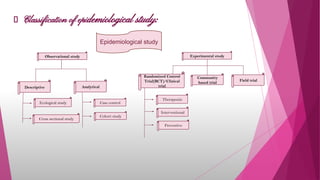
An epidemiological study is a research investigation that examines health and disease
within a populations. Epidemiological study is mainly divided into observational study
and experimental study.
What is epidemiological study ??
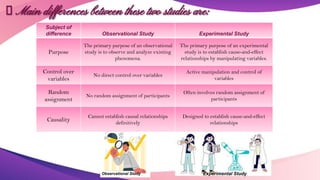
Main differences between these two studies are:
Subject of
difference Observational Study Experimental Study
Purpose
The primary purpose of an observational
study is to observe and analyze existing
phenomena.
The primary purpose of an experimental
study is to establish cause-and-effect
relationships by manipulating variables.
Control over
variables
No direct control over variables
Active manipulation and control of
variables
Random
assignment
No random assignment of participants
Often involves random assignment of
participants
Causality
Cannot establish causal relationships
definitively
Designed to establish cause-and-effect
relationships
Experimental Study
Observational Study
Epidemiological study
Analytical
Field trial
Randomized Control
Trial(RCT)/Clinical
trial
Community
based trial
Ecological study
Cross sectional study
Case control
Cohort study
Descriptive
Therapeutic
Interventional
Preventive
Observational study Experimental study
Classification of epidemiological study:
Descriptive study:
A descriptive study can be defined as one in which only one group of subjects is studied,
without any comparison group, according to selected variables related to person, place and
time.
Cross-sectional study:
Ecological study:
An epidemiological study that examines health outcomes and exposures at the population level.
A type of research that collects data at a single point in time to determine the prevalence or association
of variables within a population.
Reference population
Design of cross-sectional study
Sample
Exposer & disease
Exposer & no disease
No exposer & disease
No exposer & no disease
Advantages of the cross-sectional study:
i. Enables researchers to gather large amounts of information on a particular topic quickly.
ii. Cross-sectional research is a cost-efficient and effective technique to collect data on a
sizeable group of individuals at a specific time.
Disadvantages of the cross-sectional study:
i. It can be tough to understand the cause-and-effect or chronological sequence of events.
ii. There's a chance of selection bias since participants might not reflect the entire
population.
Advantages of descriptive study design:
i. Conducting such a study can help generate ideas for future research questions.
ii. Conducting descriptive studies is a quick and low-cost option, which is appealing for
researchers with limited resources or time.
Disadvantages of descriptive study design
i. Drawing firm conclusions from descriptive studies can prove challenging as they may
lack the same degree of control and depth as other types of research.
ii. Descriptive study designs also lack causal inference, generalizability, and explanatory
power, and are prone to bias.
What is Analytical study?
A case control study is a type of observational study that compares individuals with a
specific health outcome (cases) to those without the outcome (controls). This design is
commonly used in epidemiological research when studying rare diseases or outcomes. The
goal of a case control study is to identify factors that may have contributed to the
development of the disease or outcome.
Analytical studies are research studies that aim to explore and establish the
cause-and-effect relationship between a particular exposure and an outcome. In contrast to
descriptive studies, which only describe the characteristics of a population or phenomenon,
analytical studies attempt to explain why something happens. There are two types of
Analytical study. Such as-
• Case control study
• Cohort study
About case-control study
Basic steps of case control study
Uses:
i. Case-control studies are used to investigate rare diseases or outcomes efficiently.
ii. They help explore potential risk factors by comparing cases with the outcome to
controls without the outcome.
iii. Case-control studies are cost-effective and enable the study of associations between
exposures and outcomes.
i. Selection of cases and controls
ii. Matching
iii. Measurement of exposure
iv. Analysis and interpretation
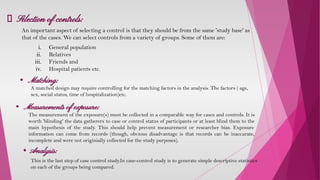
Selection of controls:
An important aspect of selecting a control is that they should be from the same 'study base' as
that of the cases. We can select controls from a variety of groups. Some of them are:
i. General population
ii. Relatives
iii. Friends and
iv. Hospital patients etc.
A matched design may require controlling for the matching factors in the analysis. The factors ( age,
sex, social status, time of hospitalization)etc.
• Matching:
• Measurements of exposure:
The measurement of the exposure(s) must be collected in a comparable way for cases and controls. It is
worth 'blinding' the data gatherers to case or control status of participants or at least blind them to the
main hypothesis of the study. This should help prevent measurement or researcher bias. Exposure
information can come from records (though, obvious disadvantage is that records can be inaccurate,
incomplete and were not originially collected for the study purposes).
• Analysis:
This is the last step of case control study.In case-control study is to generate simple descriptive statistics
on each of the groups being compared.
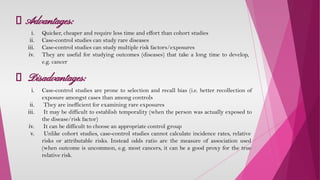
Advantages:
i. Quicker, cheaper and require less time and effort than cohort studies
ii. Case-control studies can study rare diseases
iii. Case-control studies can study multiple risk factors/exposures
iv. They are useful for studying outcomes (diseases) that take a long time to develop,
e.g. cancer
Disadvantages:
i. Case-control studies are prone to selection and recall bias (i.e. better recollection of
exposure amongst cases than among controls
ii. They are inefficient for examining rare exposures
iii. It may be difficult to establish temporality (when the person was actually exposed to
the disease/risk factor)
iv. It can be difficult to choose an appropriate control group
v. Unlike cohort studies, case-control studies cannot calculate incidence rates, relative
risks or attributable risks. Instead odds ratio are the measure of association used
(when outcome is uncommon, e.g. most cancers, it can be a good proxy for the true
relative risk.
Cohort Study
Cohort studies are a type of longitudinal study—an approach that follows research participants over
a period of time (often many years). Specifically, cohort studies recruit and follow participants who
share a common characteristic, such as a particular occupation or demographic similarity.
Advantages
i. Gather data regarding sequence of events; can assess causality
ii. Examine multiple outcomes for a given exposure
iii. Good for investigating rare exposures
iv. Can calculate rates of disease in exposed and unexposed
individuals over time (eg. incidence, relative risk )
Disadvantages
i. Large numbers of subjects are required to study rare exposures
ii. Susceptible to selection bias
iii. Susceptible to lose to follow up or withdrawals.
iv. Prospective cohort study may be expensive, may require long
duration for follow-up which can make it difficult to maintain
follow-up
v. Whereas, a Retrospective cohort study is susceptible to recall bias
or information bias and less control over variables.
Advantages of experimental study:
i. Establishing sequence between exposer and outcome
ii. It is useful in rare disease research
iii. It directly calculates the specific incidence rate of exposure
iv. It is relatively more unbiased than other research methods.
Disadvantages of experimental study
i. It is an expensive research method
ii. If the latent state of the disease is long, then a long follow-up is
required, which results in sample loss due to various reasons.
iii. Rare diseases require more samples.
iv. RCT results may not be unbiased if diagnostic methods change
over time
Community Trial
The treatment group in this study is a particular community, not a particular individual.
This research is suitable for diseases rooted in social environment. In this case, the
intervention method should be sensitive to group behavior.
Pros of community Trail
i. Diseases rooted in social environment are studied in this way.
ii. Working in teams is easier.
Cons of community Trail
i. Only a small number of people or communities can be included. As a result
randomization is not possible
ii. Other methods are needed to confirm that the difference in data at the end of
the study is due to the intervention, not to the individual characteristics of
the population or community.
Field Trial
This research method usually collects field data from non-institutionalized
individuals in the population.
Pros:
Cons :
i. This approach is useful for comparing interventions used to
reduce the outcome of an exposure
ii. This research method can be introduced at low cost, on a
small scale
i. The main disadvantage of this research method is that it does
not take into account the side effects that may occur from the
applied intervention, such as skin problems caused by vaccines
used to prevent a particular infection.
Difference between Case-Control Study and Cohort Study:
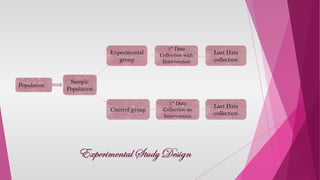
Population
1st
Data
Collection no
Intervention
Sample
Population
1st
Data
Collection with
Intervention
Experimental
group
Control group
Last Data
collection
Last Data
collection
i. Randomized Controlled trial/ Clinical trial
ii. Community trial
iii. Field trial
Generally, there are 3 ways to conduct experimental studies:
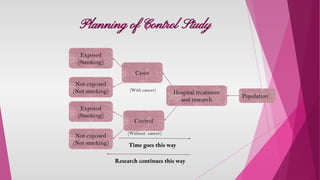
Not exposed
(Not smoking)
Exposed
(Smoking)
Cases
Exposed
(Smoking)
Control
Not exposed
(Not smoking)
Population
Hospital treatment
and research
(With cancer)
(Without cancer)
Time goes this way
Research continues this way
Planning of Control Study
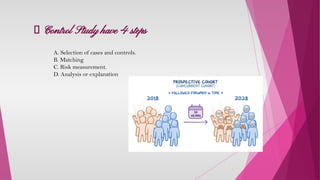
A. Selection of cases and controls.
B. Matching
C. Risk measurement.
D. Analysis or explanation
Control Study have 4 steps
Thank you

Study design of Epidemiology.pdf

  • 1.
    TOPIC: STUDY DESIGN OFEPIDEMIOLOGY PRESENTED BY, Nusrat Jahan Mim, Tasnim Tamanna, Fatema Azadi Tasfia, Umme Kulsum Mukta, Fatema Sharmin, Farhana Aznin Joya
  • 2.
    An epidemiological studyis a research investigation that examines health and disease within a populations. Epidemiological study is mainly divided into observational study and experimental study. What is epidemiological study ??
  • 3.
    Main differences betweenthese two studies are: Subject of difference Observational Study Experimental Study Purpose The primary purpose of an observational study is to observe and analyze existing phenomena. The primary purpose of an experimental study is to establish cause-and-effect relationships by manipulating variables. Control over variables No direct control over variables Active manipulation and control of variables Random assignment No random assignment of participants Often involves random assignment of participants Causality Cannot establish causal relationships definitively Designed to establish cause-and-effect relationships Experimental Study Observational Study
  • 4.
    Epidemiological study Analytical Field trial RandomizedControl Trial(RCT)/Clinical trial Community based trial Ecological study Cross sectional study Case control Cohort study Descriptive Therapeutic Interventional Preventive Observational study Experimental study Classification of epidemiological study:
  • 5.
    Descriptive study: A descriptivestudy can be defined as one in which only one group of subjects is studied, without any comparison group, according to selected variables related to person, place and time. Cross-sectional study: Ecological study: An epidemiological study that examines health outcomes and exposures at the population level. A type of research that collects data at a single point in time to determine the prevalence or association of variables within a population. Reference population Design of cross-sectional study Sample Exposer & disease Exposer & no disease No exposer & disease No exposer & no disease
  • 6.
    Advantages of thecross-sectional study: i. Enables researchers to gather large amounts of information on a particular topic quickly. ii. Cross-sectional research is a cost-efficient and effective technique to collect data on a sizeable group of individuals at a specific time. Disadvantages of the cross-sectional study: i. It can be tough to understand the cause-and-effect or chronological sequence of events. ii. There's a chance of selection bias since participants might not reflect the entire population. Advantages of descriptive study design: i. Conducting such a study can help generate ideas for future research questions. ii. Conducting descriptive studies is a quick and low-cost option, which is appealing for researchers with limited resources or time. Disadvantages of descriptive study design i. Drawing firm conclusions from descriptive studies can prove challenging as they may lack the same degree of control and depth as other types of research. ii. Descriptive study designs also lack causal inference, generalizability, and explanatory power, and are prone to bias.
  • 7.
    What is Analyticalstudy? A case control study is a type of observational study that compares individuals with a specific health outcome (cases) to those without the outcome (controls). This design is commonly used in epidemiological research when studying rare diseases or outcomes. The goal of a case control study is to identify factors that may have contributed to the development of the disease or outcome. Analytical studies are research studies that aim to explore and establish the cause-and-effect relationship between a particular exposure and an outcome. In contrast to descriptive studies, which only describe the characteristics of a population or phenomenon, analytical studies attempt to explain why something happens. There are two types of Analytical study. Such as- • Case control study • Cohort study About case-control study
  • 8.
    Basic steps ofcase control study Uses: i. Case-control studies are used to investigate rare diseases or outcomes efficiently. ii. They help explore potential risk factors by comparing cases with the outcome to controls without the outcome. iii. Case-control studies are cost-effective and enable the study of associations between exposures and outcomes. i. Selection of cases and controls ii. Matching iii. Measurement of exposure iv. Analysis and interpretation
  • 9.
    Selection of controls: Animportant aspect of selecting a control is that they should be from the same 'study base' as that of the cases. We can select controls from a variety of groups. Some of them are: i. General population ii. Relatives iii. Friends and iv. Hospital patients etc. A matched design may require controlling for the matching factors in the analysis. The factors ( age, sex, social status, time of hospitalization)etc. • Matching: • Measurements of exposure: The measurement of the exposure(s) must be collected in a comparable way for cases and controls. It is worth 'blinding' the data gatherers to case or control status of participants or at least blind them to the main hypothesis of the study. This should help prevent measurement or researcher bias. Exposure information can come from records (though, obvious disadvantage is that records can be inaccurate, incomplete and were not originially collected for the study purposes). • Analysis: This is the last step of case control study.In case-control study is to generate simple descriptive statistics on each of the groups being compared.
  • 10.
    Advantages: i. Quicker, cheaperand require less time and effort than cohort studies ii. Case-control studies can study rare diseases iii. Case-control studies can study multiple risk factors/exposures iv. They are useful for studying outcomes (diseases) that take a long time to develop, e.g. cancer Disadvantages: i. Case-control studies are prone to selection and recall bias (i.e. better recollection of exposure amongst cases than among controls ii. They are inefficient for examining rare exposures iii. It may be difficult to establish temporality (when the person was actually exposed to the disease/risk factor) iv. It can be difficult to choose an appropriate control group v. Unlike cohort studies, case-control studies cannot calculate incidence rates, relative risks or attributable risks. Instead odds ratio are the measure of association used (when outcome is uncommon, e.g. most cancers, it can be a good proxy for the true relative risk.
  • 11.
    Cohort Study Cohort studiesare a type of longitudinal study—an approach that follows research participants over a period of time (often many years). Specifically, cohort studies recruit and follow participants who share a common characteristic, such as a particular occupation or demographic similarity. Advantages i. Gather data regarding sequence of events; can assess causality ii. Examine multiple outcomes for a given exposure iii. Good for investigating rare exposures iv. Can calculate rates of disease in exposed and unexposed individuals over time (eg. incidence, relative risk ) Disadvantages i. Large numbers of subjects are required to study rare exposures ii. Susceptible to selection bias iii. Susceptible to lose to follow up or withdrawals. iv. Prospective cohort study may be expensive, may require long duration for follow-up which can make it difficult to maintain follow-up v. Whereas, a Retrospective cohort study is susceptible to recall bias or information bias and less control over variables.
  • 12.
    Advantages of experimentalstudy: i. Establishing sequence between exposer and outcome ii. It is useful in rare disease research iii. It directly calculates the specific incidence rate of exposure iv. It is relatively more unbiased than other research methods. Disadvantages of experimental study i. It is an expensive research method ii. If the latent state of the disease is long, then a long follow-up is required, which results in sample loss due to various reasons. iii. Rare diseases require more samples. iv. RCT results may not be unbiased if diagnostic methods change over time
  • 13.
    Community Trial The treatmentgroup in this study is a particular community, not a particular individual. This research is suitable for diseases rooted in social environment. In this case, the intervention method should be sensitive to group behavior. Pros of community Trail i. Diseases rooted in social environment are studied in this way. ii. Working in teams is easier. Cons of community Trail i. Only a small number of people or communities can be included. As a result randomization is not possible ii. Other methods are needed to confirm that the difference in data at the end of the study is due to the intervention, not to the individual characteristics of the population or community.
  • 14.
    Field Trial This researchmethod usually collects field data from non-institutionalized individuals in the population. Pros: Cons : i. This approach is useful for comparing interventions used to reduce the outcome of an exposure ii. This research method can be introduced at low cost, on a small scale i. The main disadvantage of this research method is that it does not take into account the side effects that may occur from the applied intervention, such as skin problems caused by vaccines used to prevent a particular infection.
  • 15.
    Difference between Case-ControlStudy and Cohort Study:
  • 16.
  • 17.
    i. Randomized Controlledtrial/ Clinical trial ii. Community trial iii. Field trial Generally, there are 3 ways to conduct experimental studies:
  • 18.
    Not exposed (Not smoking) Exposed (Smoking) Cases Exposed (Smoking) Control Notexposed (Not smoking) Population Hospital treatment and research (With cancer) (Without cancer) Time goes this way Research continues this way Planning of Control Study
  • 19.
    A. Selection ofcases and controls. B. Matching C. Risk measurement. D. Analysis or explanation Control Study have 4 steps
  • 21.