OPERATION RESEARCH
DECISION
MAKING
ENVIRONMENT
SUBMITTED TO :- PARESH ANDHARIYA
SUBMITTED BY :-
Vaghela Shubham
Department of business administration
M k Bhavnagar university
Bhavnagar
1.Introduction
2.type of decision making environment
i. decision making under certainty
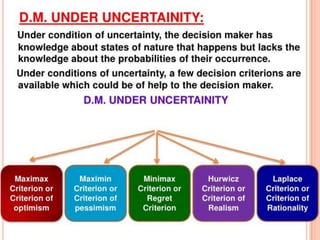
ii. decision making under uncertainty
iii. decision making under risk
3. decision tree
4.Bayesian analysis
DECISION MAKING ENVIRONMENT
 Introduction
 History
 Meaning
 Definition
 Explanation
 Example
 Concept
 Objective
INTRODUCTION
DECISION MAKING PROCESS :-
1. Recognizing & defining the situation
2. Identifying the alternatives
3. Evaluating the alternatives
4. Apply the model
5. Selecting the best alternatives
6. Conduct a sensitivity of the solution
7. Implementing the chosen alternatives
8. Following up & evaluating the result
TYPE OF DECISION MAKING ENVIRONMENT
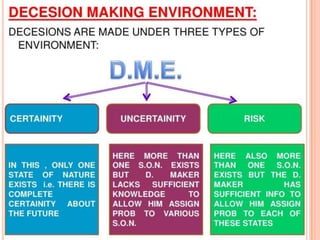
 Decision making under certainty
 Decision making under uncertainty
 Decision making under risk
DECISION MAKING UNDER CERTANITY
Assume that complete knowledge is available
( deterministic environment )
Example U.S. treasury bill investment
Typical for structured problem with short time horizons
Some time DSS approach is needed for certainty situation
 there is only one type of event that can take place.
 It is very difficult to find complete certainty in most of
the business decisions.
 in many routine type of decisions, almost complete
certainty can be noticed.
 In uncertainty the decision are of very little significance
to the success of business.
 The decision maker is not in a position, even to assign
the probabilities of happening of the events.
 In the environment of uncertainty, more than one type
of event can take place and the decision maker is
completely in dark regarding the event that is likely to
take place.
 Such situations generally arise in cases where happening
of the event is determined by external factors.
 For example, demand for the product, moves of
competitors, etc. are the factors that involve
uncertainty.
MAXIMAX CRITERION OR CRITERION OF
OPTIMISM :
 This criterion provides the decision maker with
optimistic criterion. The working method is summarizing
as follow.
 Locate the maximum payoff value corresponding to each
alternative, then select an alternative with maximum
payoff value.
MAXIMIN CRITERION OR CRITERION
OF PESSIMISM :
 This criterion provides the decision maker with
pessimistic criterion. The working method is
summarizing as follow.
 Locate the minimum payoff value corresponding to each
alternative, then select an alternative with maximum
payoff value
MINIMAX CRITERION OR MINIMUM
REGRET CRITERION :
 This criterion is also known as opportunity loss decision
criterion or minimum regret criterion. The working
method is summarizing as follow.
 Determine the amount of regret corresponding to each
state of nature. Regret for jth event corresponding to ith
alternative is given by
Ith regret = (maximum payoff- Ith payoff) for
the Jth event
 Determine the maximum regret amount for each
alternative.
 Choose the alternative which corresponding to the
minimum of the maximum regrets.
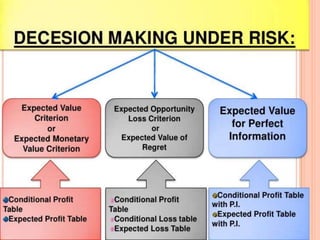
DECISION MAKING UNDER RISK
 Here more then one state of nature exists and the
decision maker has sufficient information to assign
probabilities to each of this states.
 These probabilities could be obtained from the past
records and simply the subjective judgment of the
decision maker.
 Under condition of risk, knowing the probability
distribution of the state of nature, the best decision is to
select the course of action which has the largest
expected pay off value.
 Under the condition of risk, there are more than one
possible events that can take place.
 The decision maker has adequate information to assign
probability to the happening or non- happening of each
possible event.
 Such information is generally based on the past
experience.
 Every decision in a modern business enterprise is based
on interplay of a number of factors.
 New tools of analysis of such decision making situations
are being developed. These tools include risk analysis,
decision trees and preference theory.
EXPECTED OPPORTUNITY LOSS CRITERION :
 EOL represent the amount by which maximum possible
profit will be reduced under various possible stock
actions. The course of action that minimizes these losses
of reductions is the optimal decision alternative. The
procedure the calculate expected opportunity losses is
as follow.
 Prepare the conditional profit table for each decision
event combination and write associated probabilities.
 Foe each event determine the conditional opportunity
loss (COL) by subtracting the payoff from the maximum
payoff for that event.
 Calculate the expected opportunity loss for each
decision alternative by multiplying the COL’s by the
associated probabilities and then adding the value.
 Select the alternative that yields the lowest EOL.
DECISION TREE :
 Instances describable by attribute-value pairs
 e.g Humidity: High, Normal
 Target function is discrete valued
 e.g Play tennis; Yes, No
 Disjunctive hypothesis may be required
 e.g Outlook=Sunny  Wind=Weak
 Possibly noisy training data
 Missing attribute values
 Application Examples:
 Medical diagnosis
 Credit risk analysis
 Object classification for robot manipulator (Tan
1993)
TOP-DOWN INDUCTION OF DECISION TREES
ID3
1. A  the “best” decision attribute for next node
2. Assign A as decision attribute for node
3. For each value of A create new descendant
4. Sort training examples to leaf node according to
the attribute value of the branch
5. If all training examples are perfectly classified
(same value of target attribute) stop, else iterate
over new leaf nodes.
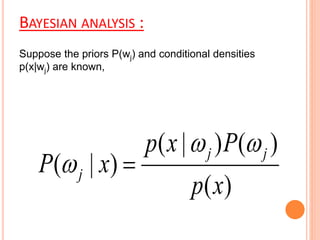
BAYESIAN ANALYSIS :
( | ) ( )
( | )
( )
j j
j
p x P
P x
p x
 
 
Suppose the priors P(wj) and conditional densities
p(x|wj) are known,
UTILITY THEORY :
Step for determine the utility for money :
1. Develop a payoff table using monetary values
2. Identify the best and worst payoff value
3. For every other monetary value in the original
payoff table
4. Convert the payoff table from monetary value to
calculate utility value.
5. Apply the expected utility criterion to the utility
table and select the decision alternative with the
best expected utility.
Decision making environment

Decision making environment

  • 1.
  • 2.
    SUBMITTED BY :- VaghelaShubham Department of business administration M k Bhavnagar university Bhavnagar
  • 3.
    1.Introduction 2.type of decisionmaking environment i. decision making under certainty ii. decision making under uncertainty iii. decision making under risk 3. decision tree 4.Bayesian analysis
  • 4.
    DECISION MAKING ENVIRONMENT Introduction  History  Meaning  Definition  Explanation  Example  Concept  Objective
  • 5.
    INTRODUCTION DECISION MAKING PROCESS:- 1. Recognizing & defining the situation 2. Identifying the alternatives 3. Evaluating the alternatives 4. Apply the model 5. Selecting the best alternatives 6. Conduct a sensitivity of the solution 7. Implementing the chosen alternatives 8. Following up & evaluating the result
  • 6.
    TYPE OF DECISIONMAKING ENVIRONMENT  Decision making under certainty  Decision making under uncertainty  Decision making under risk
  • 8.
    DECISION MAKING UNDERCERTANITY Assume that complete knowledge is available ( deterministic environment ) Example U.S. treasury bill investment Typical for structured problem with short time horizons Some time DSS approach is needed for certainty situation
  • 9.
     there isonly one type of event that can take place.  It is very difficult to find complete certainty in most of the business decisions.  in many routine type of decisions, almost complete certainty can be noticed.  In uncertainty the decision are of very little significance to the success of business.
  • 11.
     The decisionmaker is not in a position, even to assign the probabilities of happening of the events.  In the environment of uncertainty, more than one type of event can take place and the decision maker is completely in dark regarding the event that is likely to take place.  Such situations generally arise in cases where happening of the event is determined by external factors.  For example, demand for the product, moves of competitors, etc. are the factors that involve uncertainty.
  • 12.
    MAXIMAX CRITERION ORCRITERION OF OPTIMISM :  This criterion provides the decision maker with optimistic criterion. The working method is summarizing as follow.  Locate the maximum payoff value corresponding to each alternative, then select an alternative with maximum payoff value.
  • 13.
    MAXIMIN CRITERION ORCRITERION OF PESSIMISM :  This criterion provides the decision maker with pessimistic criterion. The working method is summarizing as follow.  Locate the minimum payoff value corresponding to each alternative, then select an alternative with maximum payoff value
  • 14.
    MINIMAX CRITERION ORMINIMUM REGRET CRITERION :  This criterion is also known as opportunity loss decision criterion or minimum regret criterion. The working method is summarizing as follow.  Determine the amount of regret corresponding to each state of nature. Regret for jth event corresponding to ith alternative is given by Ith regret = (maximum payoff- Ith payoff) for the Jth event  Determine the maximum regret amount for each alternative.  Choose the alternative which corresponding to the minimum of the maximum regrets.
  • 17.
    DECISION MAKING UNDERRISK  Here more then one state of nature exists and the decision maker has sufficient information to assign probabilities to each of this states.  These probabilities could be obtained from the past records and simply the subjective judgment of the decision maker.  Under condition of risk, knowing the probability distribution of the state of nature, the best decision is to select the course of action which has the largest expected pay off value.
  • 18.
     Under thecondition of risk, there are more than one possible events that can take place.  The decision maker has adequate information to assign probability to the happening or non- happening of each possible event.  Such information is generally based on the past experience.  Every decision in a modern business enterprise is based on interplay of a number of factors.  New tools of analysis of such decision making situations are being developed. These tools include risk analysis, decision trees and preference theory.
  • 21.
    EXPECTED OPPORTUNITY LOSSCRITERION :  EOL represent the amount by which maximum possible profit will be reduced under various possible stock actions. The course of action that minimizes these losses of reductions is the optimal decision alternative. The procedure the calculate expected opportunity losses is as follow.  Prepare the conditional profit table for each decision event combination and write associated probabilities.  Foe each event determine the conditional opportunity loss (COL) by subtracting the payoff from the maximum payoff for that event.  Calculate the expected opportunity loss for each decision alternative by multiplying the COL’s by the associated probabilities and then adding the value.  Select the alternative that yields the lowest EOL.
  • 23.
    DECISION TREE : Instances describable by attribute-value pairs  e.g Humidity: High, Normal  Target function is discrete valued  e.g Play tennis; Yes, No  Disjunctive hypothesis may be required  e.g Outlook=Sunny  Wind=Weak  Possibly noisy training data  Missing attribute values  Application Examples:  Medical diagnosis  Credit risk analysis  Object classification for robot manipulator (Tan 1993)
  • 24.
    TOP-DOWN INDUCTION OFDECISION TREES ID3 1. A  the “best” decision attribute for next node 2. Assign A as decision attribute for node 3. For each value of A create new descendant 4. Sort training examples to leaf node according to the attribute value of the branch 5. If all training examples are perfectly classified (same value of target attribute) stop, else iterate over new leaf nodes.
  • 25.
    BAYESIAN ANALYSIS : (| ) ( ) ( | ) ( ) j j j p x P P x p x     Suppose the priors P(wj) and conditional densities p(x|wj) are known,
  • 26.
    UTILITY THEORY : Stepfor determine the utility for money : 1. Develop a payoff table using monetary values 2. Identify the best and worst payoff value 3. For every other monetary value in the original payoff table 4. Convert the payoff table from monetary value to calculate utility value. 5. Apply the expected utility criterion to the utility table and select the decision alternative with the best expected utility.

Editor's Notes