

Dr. Urfeya Mirza
Assistant Prof.
Veterinary Surgery and Radiology, KCVAS
Anaesthetic Techniques
INTRODUCTION:-
• Anaesthesia is used to denote loss of sensetion
to any part or whole of the body, produced by
agents which depress the activity of nervous
tissue either locally or centrally.
• It is revesible process.
Types of anaesthetic techniques:-
A. General anaesthesia:-
1.Injectable anaesthesia
2.Inhalation anaesthesia
B. Local anaesthesia:-
1.Topical anaesthesia
2.Field block
3.Regional nerve block
C. Other:-
1.Electronarcosis
2.Acupuncture
3.Hypothermia
General Anaesthesia:-
• It is a state of unconsciousness produced by a
process of controlled, reversible, intoxication of
the central nervous system in which there is a
lowered sensibility to stimuli from the
environment and a diminished motor response to
such stimuli.
• Intravenous anaesthesia in veterinary practice is
primarily used for the induction of anaesthesia
which is subsequently maintained by ihalation
anaesthesia in small animals.
Intravenous Anaesthesia:-
e.g. 1.Barbiturates:-
phenobarbital (20-30 mg/kg b.wt.),
pentobarbitone(6-8mg/kg b.wt.),
thopental,
methohexitone etc.
2.Non barbiturates:-
chloral hydrate,
propofol(4-6mg/kg b.wt.)
3.Dissociative anaesthetics:-
ketamine(10mg/kg b.wt.),
tiletamine(6.6-13.2mg/ke b.wt.)
Inhalation anaesthesia:-
• Method of administration:-
1. Open insufflation
2. Semi open systems without nonbreathing valves
3. Semi open system with nonbreathing valves
4. Semi closed and closed systems
Inhalant anaesthetics
*Volatile or gaseous
e.g. Ether
Methoxiflurane
Halothane
Isoflurane
Sevoflurane
Desflurane
Nitrous oxide
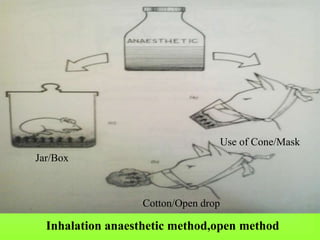
Inhalation anaesthetic method,open method
Jar/Box
Use of Cone/Mask
Cotton/Open drop
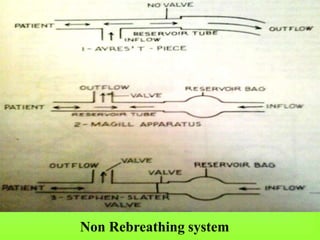
Non Rebreathing system
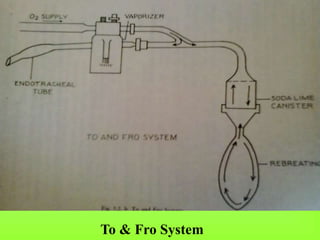
To & Fro System
Local anaesthesia:-
• Anaesthetic sloution is applied topically in the
form of gel, solution or aerosol on the eye and
mucous membrane of penis, vagina, rectum,
urethra etc.(Topical) or injected locally in surgical
site(Field Block).
• Besides, anaesthetics are injected around a large
nerve trunk(Regional nerve block) or in the
epidural or subarachnoid space(Epidural) Or in
distal to the site of a tourniquet
intravenously(Regional intravenous).
Common methods of producing
local anesthesia
• Surface (topical) anesthesia
• Intrasynovial anesthesia
• Infiltration anesthesia
• Spinal anesthesia
• Intravenous regional local anesthesia
• Regional anesthesia
Surface (topical) anesthesia:-
• This refers to the use of local anesthetics in
solution sprays as well as in various creams
and ointments, on mucous membranes; drops
into the eye; sprays or brush in laryngeal area,
infuse into the nostrils, urethra, or rectum.
Intrasynovial anesthesia:-
• In joints, bursa, and tendon sheaths.
• Useful for both diagnosis of lameness, and for
general pain relief.
• The local anesthetic chosen must cause
minimal irritation, and great care in sterility is
necessary as infection in these sites occurs
easily
Infiltration anesthesia:-
• By this method the nerve endings are affected at
the actual site of operation.
• Most minor surgery can be done this way,
excluding surgery on teats in cattle or small
animal digits.
• Never inject local analgesic through infected
tissues
• where this is used is on the teats of cattle (do not
use epinephrine here, as vasoconstriction could
lead to ischemic necrosis and sloughing of tissue)
or around the limb of cattle.
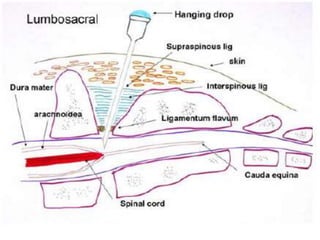
Spinal anesthesia:-
• Spinal anesthesia is the injection of local
anesthetic around the spinal cord.
• Spinal anesthesia is divided into two types;
‘epidural’ and ‘true spinal’.
– Epidural (or extradural) anesthesia refers to
depositing of local anesthetics into the extradural
space. The needle enters the spinal canal, but does
not penetrate the meninges.
– True spinal anesthesia refers to the subarachnoid
access (usually known as ‘spinal’ anesthesia) in which
the needle penetrates the dura mater.
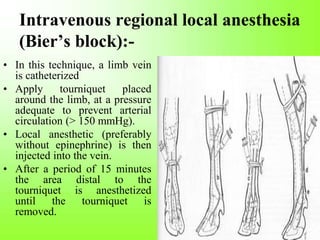
Intravenous regional local anesthesia
(Bier’s block):-
• In this technique, a limb vein
is catheterized
• Apply tourniquet placed
around the limb, at a pressure
adequate to prevent arterial
circulation (> 150 mmHg).
• Local anesthetic (preferably
without epinephrine) is then
injected into the vein.
• After a period of 15 minutes
the area distal to the
tourniquet is anesthetized
until the tourniquet is
removed.
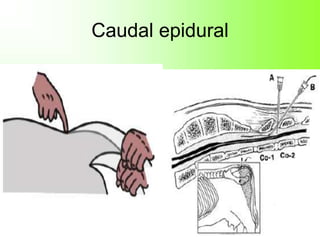
Caudal epidural
NERVE BLOCKS
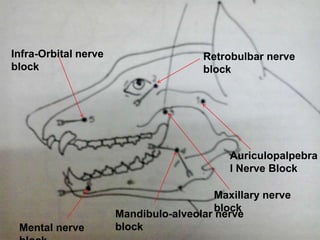
Auriculopalpebra
l Nerve Block
Retrobulbar nerve
block
Maxillary nerve
block
Mandibulo-alveolar nerve
block
Infra-Orbital nerve
block
Mental nerve
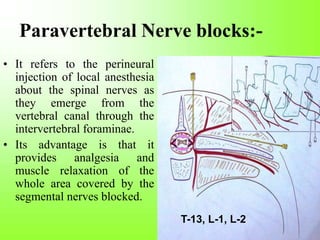
Paravertebral Nerve blocks:-
• It refers to the perineural
injection of local anesthesia
about the spinal nerves as
they emerge from the
vertebral canal through the
intervertebral foraminae.
• Its advantage is that it
provides analgesia and
muscle relaxation of the
whole area covered by the
segmental nerves blocked.
T-13, L-1, L-2
Auriculopalpebral Nerve Block:-
• This block can be used to prevent the eyelids
moving during clinical examination or surgery.
• It blocks the orbicularis oculi muscle.
• The nerve course runs from the base of the ear
past the eye ventrally along the facial crest.
• Purpose:
– Prevent eyelid closure during examination of the
eyeball.
• Injection site:
– The needle is inserted in front of the base of the
ear at the base of the ear at the end of the
zygomatic arch and is introduced until its point lies
at the dorsal border of the arch.
• Caution:
– This block does not produce analgesia of the eye
or the lids.
– In conjunction with topic analgesia (2% lidocaine)
it is useful for the removal of foreign bodies form
the cornea and conjunctival sac.
Cornual Nerve Block:-
• This block is used for dehorning.
• The nerve can be found at the orbit running
behind the lateral ridge of the frontal bone.
• The nerve supplies the horn coruim and the
skin around the base of the horn.
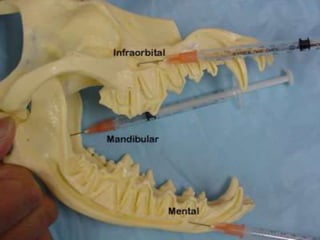
Mandibulo-Alveolar Nerve Block:-
• It is used to desensitize the lower jaw
alongwith its teeth and lower lip.
Indication:
• Management of surgical condition of molar
teeth and incisors and the body of the
mandible,suturing of wound of the teeth.
Mental Nerve Block:-
• To desensitize the dental nerves of the lower
jaw in the mandibular canal and at the mental
foramen.
Indication:-
• Suturing of wound of lower lip, wiring
operations around the lower teeth and the body
of the mandible.
Infra-Orbital Nerve Block:-
• To desensitize the whole anterior half of the
face including the cheek teeth as far as the
second molar, nostril,upper lip, gum and
incisors.
Indication:-
• Surgical management of conditions of upper
lip and nostril.
Maxillary Nerve Block:-
• For surgical management of the conditions of
the upper lip, nose and upper jaw
• The maxillary nerve is blocked in the
pterygopalatine fossa before it enter the infra
orbital canal.
Retrobulbar Nerve Block:-
• For the surgical management of conditions of
eyeball and membrana nictitans
• The needle is inserted through the lateral
canthus of the eye
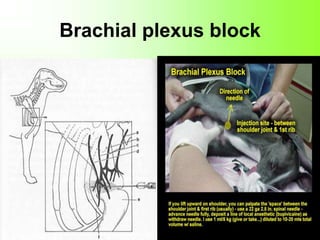
Brachial plexus block
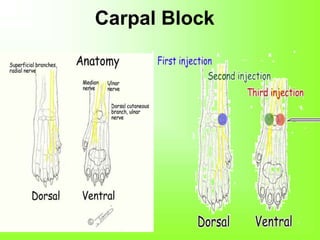
Carpal Block
Other Routes:-
• Electronarcosis:-anaesthesia is achieved by
passing an electric current through theccerebrum
to induce deep nacosis although the method is
rarely used in veterinary practice.
• Acupuncture:-an ancient Chinese system that
involves insertion of specially designed needles at
specific points and their stimulation by various
means to produce analgesia.
• Hypothermia:-the procedure involves decreasing
the body temperature either locally or generally to
minimize the anaesthetic doses.
Thank

Anaesthetic Techniques

  • 1.
    Dr. Urfeya Mirza AssistantProf. Veterinary Surgery and Radiology, KCVAS Anaesthetic Techniques
  • 2.
    INTRODUCTION:- • Anaesthesia isused to denote loss of sensetion to any part or whole of the body, produced by agents which depress the activity of nervous tissue either locally or centrally. • It is revesible process.
  • 3.
    Types of anaesthetictechniques:- A. General anaesthesia:- 1.Injectable anaesthesia 2.Inhalation anaesthesia B. Local anaesthesia:- 1.Topical anaesthesia 2.Field block 3.Regional nerve block C. Other:- 1.Electronarcosis 2.Acupuncture 3.Hypothermia
  • 4.
    General Anaesthesia:- • Itis a state of unconsciousness produced by a process of controlled, reversible, intoxication of the central nervous system in which there is a lowered sensibility to stimuli from the environment and a diminished motor response to such stimuli. • Intravenous anaesthesia in veterinary practice is primarily used for the induction of anaesthesia which is subsequently maintained by ihalation anaesthesia in small animals.
  • 5.
    Intravenous Anaesthesia:- e.g. 1.Barbiturates:- phenobarbital(20-30 mg/kg b.wt.), pentobarbitone(6-8mg/kg b.wt.), thopental, methohexitone etc. 2.Non barbiturates:- chloral hydrate, propofol(4-6mg/kg b.wt.) 3.Dissociative anaesthetics:- ketamine(10mg/kg b.wt.), tiletamine(6.6-13.2mg/ke b.wt.)
  • 6.
    Inhalation anaesthesia:- • Methodof administration:- 1. Open insufflation 2. Semi open systems without nonbreathing valves 3. Semi open system with nonbreathing valves 4. Semi closed and closed systems
  • 7.
    Inhalant anaesthetics *Volatile orgaseous e.g. Ether Methoxiflurane Halothane Isoflurane Sevoflurane Desflurane Nitrous oxide
  • 8.
    Inhalation anaesthetic method,openmethod Jar/Box Use of Cone/Mask Cotton/Open drop
  • 9.
  • 10.
    To & FroSystem
  • 11.
    Local anaesthesia:- • Anaestheticsloution is applied topically in the form of gel, solution or aerosol on the eye and mucous membrane of penis, vagina, rectum, urethra etc.(Topical) or injected locally in surgical site(Field Block). • Besides, anaesthetics are injected around a large nerve trunk(Regional nerve block) or in the epidural or subarachnoid space(Epidural) Or in distal to the site of a tourniquet intravenously(Regional intravenous).
  • 12.
    Common methods ofproducing local anesthesia • Surface (topical) anesthesia • Intrasynovial anesthesia • Infiltration anesthesia • Spinal anesthesia • Intravenous regional local anesthesia • Regional anesthesia
  • 13.
    Surface (topical) anesthesia:- •This refers to the use of local anesthetics in solution sprays as well as in various creams and ointments, on mucous membranes; drops into the eye; sprays or brush in laryngeal area, infuse into the nostrils, urethra, or rectum.
  • 14.
    Intrasynovial anesthesia:- • Injoints, bursa, and tendon sheaths. • Useful for both diagnosis of lameness, and for general pain relief. • The local anesthetic chosen must cause minimal irritation, and great care in sterility is necessary as infection in these sites occurs easily
  • 15.
    Infiltration anesthesia:- • Bythis method the nerve endings are affected at the actual site of operation. • Most minor surgery can be done this way, excluding surgery on teats in cattle or small animal digits. • Never inject local analgesic through infected tissues • where this is used is on the teats of cattle (do not use epinephrine here, as vasoconstriction could lead to ischemic necrosis and sloughing of tissue) or around the limb of cattle.
  • 16.
    Spinal anesthesia:- • Spinalanesthesia is the injection of local anesthetic around the spinal cord. • Spinal anesthesia is divided into two types; ‘epidural’ and ‘true spinal’. – Epidural (or extradural) anesthesia refers to depositing of local anesthetics into the extradural space. The needle enters the spinal canal, but does not penetrate the meninges. – True spinal anesthesia refers to the subarachnoid access (usually known as ‘spinal’ anesthesia) in which the needle penetrates the dura mater.
  • 17.
    Intravenous regional localanesthesia (Bier’s block):- • In this technique, a limb vein is catheterized • Apply tourniquet placed around the limb, at a pressure adequate to prevent arterial circulation (> 150 mmHg). • Local anesthetic (preferably without epinephrine) is then injected into the vein. • After a period of 15 minutes the area distal to the tourniquet is anesthetized until the tourniquet is removed.
  • 19.
  • 20.
  • 22.
    Auriculopalpebra l Nerve Block Retrobulbarnerve block Maxillary nerve block Mandibulo-alveolar nerve block Infra-Orbital nerve block Mental nerve
  • 23.
    Paravertebral Nerve blocks:- •It refers to the perineural injection of local anesthesia about the spinal nerves as they emerge from the vertebral canal through the intervertebral foraminae. • Its advantage is that it provides analgesia and muscle relaxation of the whole area covered by the segmental nerves blocked. T-13, L-1, L-2
  • 24.
    Auriculopalpebral Nerve Block:- •This block can be used to prevent the eyelids moving during clinical examination or surgery. • It blocks the orbicularis oculi muscle. • The nerve course runs from the base of the ear past the eye ventrally along the facial crest.
  • 25.
    • Purpose: – Preventeyelid closure during examination of the eyeball. • Injection site: – The needle is inserted in front of the base of the ear at the base of the ear at the end of the zygomatic arch and is introduced until its point lies at the dorsal border of the arch. • Caution: – This block does not produce analgesia of the eye or the lids. – In conjunction with topic analgesia (2% lidocaine) it is useful for the removal of foreign bodies form the cornea and conjunctival sac.
  • 26.
    Cornual Nerve Block:- •This block is used for dehorning. • The nerve can be found at the orbit running behind the lateral ridge of the frontal bone. • The nerve supplies the horn coruim and the skin around the base of the horn.
  • 27.
    Mandibulo-Alveolar Nerve Block:- •It is used to desensitize the lower jaw alongwith its teeth and lower lip. Indication: • Management of surgical condition of molar teeth and incisors and the body of the mandible,suturing of wound of the teeth.
  • 28.
    Mental Nerve Block:- •To desensitize the dental nerves of the lower jaw in the mandibular canal and at the mental foramen. Indication:- • Suturing of wound of lower lip, wiring operations around the lower teeth and the body of the mandible.
  • 29.
    Infra-Orbital Nerve Block:- •To desensitize the whole anterior half of the face including the cheek teeth as far as the second molar, nostril,upper lip, gum and incisors. Indication:- • Surgical management of conditions of upper lip and nostril.
  • 30.
    Maxillary Nerve Block:- •For surgical management of the conditions of the upper lip, nose and upper jaw • The maxillary nerve is blocked in the pterygopalatine fossa before it enter the infra orbital canal.
  • 31.
    Retrobulbar Nerve Block:- •For the surgical management of conditions of eyeball and membrana nictitans • The needle is inserted through the lateral canthus of the eye
  • 32.
  • 33.
  • 34.
    Other Routes:- • Electronarcosis:-anaesthesiais achieved by passing an electric current through theccerebrum to induce deep nacosis although the method is rarely used in veterinary practice. • Acupuncture:-an ancient Chinese system that involves insertion of specially designed needles at specific points and their stimulation by various means to produce analgesia. • Hypothermia:-the procedure involves decreasing the body temperature either locally or generally to minimize the anaesthetic doses.
  • 35.