Presented by : Mudasser
Ashraf
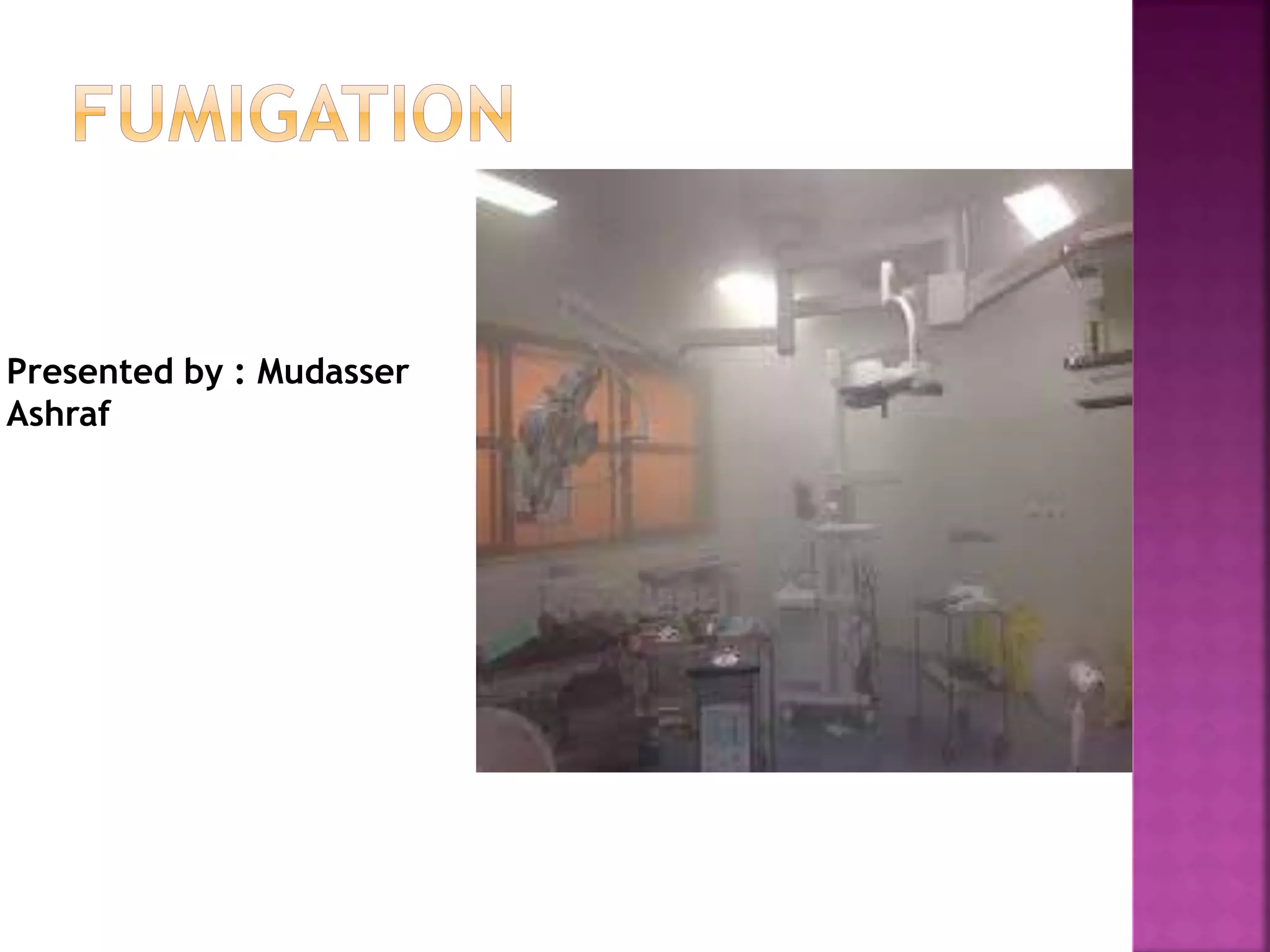
 Fumigation is process of gaseous sterilization
(mostly by formaldehyde) which is used for
killing of microbial organisms and prevention
of microbial growth in air ,surface of wall or
floor.
 Within a hospital OT ROOMS ,WARDS ,ICU and
can fumigated.
 Hydrogen cyanide: Inorganic compound that
actually boils at room temperature. Smells a
bit like almonds, but deadly to rats and
people.
 Iodoform: A hospital like smell, and similar
to chloroform and disinfectants. Less
powerful, since it is actually used in some
healing treatments.
 Formaldehyde: Powerful enough to be a
disinfectant and a preserver of bodies.
Highly toxic to all living things.
Magnesium Phosphide: This solid can be converted into
powder or granules. The phosphine gas it produces
when introduced to acid or moisture is very toxic.
Methyl Bromide: Methyl bromide, commonly used in
farming, can be a fumigant as well as a solid. It is so
powerful than it has been banned in some areas.
Sulfuryl Fluoride: This pressurized liquid gas is strong
enough to be used in lumber and auto
manufacturing/cleaning. So powerful it can causes
burns.
Chloropicrin:s liquid evaporates when released into air
and was so powerful it was used in World War I as a
Phosphine: This odorless gas works longer than other
fumigants, though it can complete the job. It may very
well be the weakest mentioned here though, as some
bugs have developed resistance to it.
Methyl isocyanate: Made from rubber production, it is so
powerful it must be carefully stored. Very toxic to all
life forms.
1,3-Dichloropropene: Mainly used in farming, highly
toxic and no longer used as frequently in Europe.
 Formaldehyde vapor is an extremely effective
biocidal agent. It acts as an alkylating agent,
inactivating micro-organisms by reacting with
carboxyl, amino, hydroxyl and sulphydral groups of
proteins.
 Fumigation is effective at above the temperature of
20ºC and relative humidity of 65%.
 Formalin is commercially available as 40% solution of
formaldehyde in water.
 When formalin is heated formaldehyde vapor is
generated.
Step 2
• Thoroughly clean windows, doors, floor, walls, surgery
table and all washable equipements with soap and water.
• Close windows and ventilators tightly. If any openings found
seal it with cellophane tape or other material to avoid the
leak of fume.
• Switch off all lights, A/C and other electrical & electronical
items.
• Calculate the room size (surgical theater only) in cubic feet
(L×B×H) and calculate the required amount of
formaldehyde.
Step 2
 Adequate care must be taken by wearing cap,
mask, foot cover, spectacle etc.,
 Formaldehyde is irritant to eye & nose; and it
has also been recognized as a potential
carcinogen.
 So the fumigating person must be provided with
the personal protective equipments (PPE).
 Paste a warning notice on the front door
indicating fumigation is in progress.
 For Each 1000 cubic feet, 500 ml of
formaldehyde (40% solution) added in 1000
ml of distilled water in an electric boiler.
 Switch on the boiler, leave the room and
seal the door. After 45 minutes (variable
depending to volume present in the boils
apparatus/its heating proficiency)
 switch off the boiler without entering in to
the room (Switch off the main from outside).
 Here the heat generation is induced by an oxidizer
- Potassium permanganate (KMnO4), which results
in auto boiling and generates fume from
formaldehyde.
 Take 500 ml of formaldehyde (40% solution) in 1000
ml of distilled water (if not available use tap water)
in a heat resistant bowel, preferably in a steel
bucket and then add 450gm of KMnO4 for 1000
cubic feet of theater volume.
 Repeat the same in separate bucket for every
another 1000 cubic feet until it reaches the
complete theater volume. It is important to add
KMnO4 to all buckets simultaneously to reduce the
exposure to fume
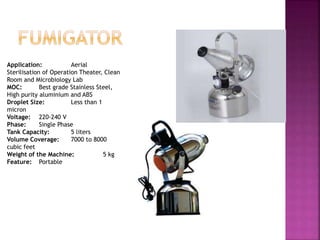
Application: Aerial
Sterilisation of Operation Theater, Clean
Room and Microbiology Lab
MOC: Best grade Stainless Steel,
High purity aluminium and ABS
Droplet Size: Less than 1
micron
Voltage: 220-240 V
Phase: Single Phase
Tank Capacity: 5 liters
Volume Coverage: 7000 to 8000
cubic feet
Weight of the Machine: 5 kg
Feature: Portable
 Under certain conditions formaldehyde can
react with hydrochloric acid and chlorine
containing disinfectants such as
hypochlorites to form chlormethyl ether, a
potent lung carcinogen. So hydrochloric acid
and chlorine-containing disinfectants must
be removed from the room before
fumigation.
 After the initiation of formaldehyde vapor,
immediately leave the room and seal it for at
least 12 to 24 hours
 Before neutralization, formaldehyde fumigation system
should be taken out from the surgical theater. Then the
toxicity of formaldehyde vapor should be neutralized
with ammonia solution.
 Place a cotton ball and pour 300 ml of 10% ammonia
(for each 500 ml of formaldehyde used) on the floor of
surgical theater, at least 4 hours before (07 a.m.) the
“Sterility Test”.
 Formaldehyde gas reacts with ammonia gas and produce
hexamine (synonym hexamethylenetetramine) which is
considered a harmless substance.
 Switch on the A/C, at least 2 hours before the “Sterility
Test”.
 Surgical Theater Volume = L×B×H = 20 × 15
× 10 = 3000 cubic feet
 Note: Make it into nearest 1000, if the
volume is in fractions
 Formaldehyde required for fumigation = 500
ml for 1000 cubic feet
 = So, 1500 ml of formaldehyde required (to
be diluted in 3000 ml of distilled water)
 Ammonia required for neutralization = 300
ml of 10% ammonia for 500 ml of
formaldehyde
 = So 900 ml of 10% ammonia
required
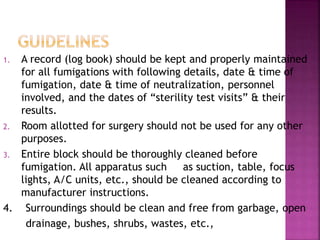
1. A record (log book) should be kept and properly maintained
for all fumigations with following details, date & time of
fumigation, date & time of neutralization, personnel
involved, and the dates of “sterility test visits” & their
results.
2. Room allotted for surgery should not be used for any other
purposes.
3. Entire block should be thoroughly cleaned before
fumigation. All apparatus such as suction, table, focus
lights, A/C units, etc., should be cleaned according to
manufacturer instructions.
4. Surroundings should be clean and free from garbage, open
drainage, bushes, shrubs, wastes, etc.,
5. Warning notice should be pasted on the front door
indicating fumigation is in progress.
6. Entry should be restricted to authorized persons.
7. Separate footwear should be kept at the entrance
(inside) of surgical theater.
8. Theater dress (includes head cap, mask, apron,
footwear, etc.,) should be made available for all
persons who are entering into the surgical theater
(surgeons, anesthetist, microbiologist team, nurses,
theater assistants & helper).
9. Surgical theater should be cleaned and fumigated
periodically depending upon the case load.
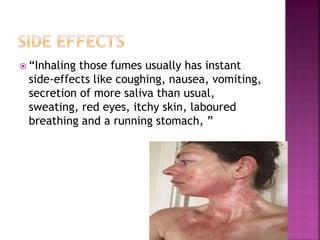
 “Inhaling those fumes usually has instant
side-effects like coughing, nausea, vomiting,
secretion of more saliva than usual,
sweating, red eyes, itchy skin, laboured
breathing and a running stomach, ”
 “At the hospital the stomach will emptied
using oral or IV (intravenous) medication, a
process called regurgitation such that the
concentration of the chemicals in the body is
reduced.
 A corticosteroid (usually a drug called
hydrocortisone) will also be given to dilute
the poison further and reduce on the possible
damage the chemicals might have on the
liver and the kidney as we carry out tests to
look for the exact compounds in the poison
that the person has been exposed to.”

OT Fumigation presentation.pptx

  • 1.
    Presented by :Mudasser Ashraf
  • 2.
     Fumigation isprocess of gaseous sterilization (mostly by formaldehyde) which is used for killing of microbial organisms and prevention of microbial growth in air ,surface of wall or floor.  Within a hospital OT ROOMS ,WARDS ,ICU and can fumigated.
  • 4.
     Hydrogen cyanide:Inorganic compound that actually boils at room temperature. Smells a bit like almonds, but deadly to rats and people.  Iodoform: A hospital like smell, and similar to chloroform and disinfectants. Less powerful, since it is actually used in some healing treatments.  Formaldehyde: Powerful enough to be a disinfectant and a preserver of bodies. Highly toxic to all living things.
  • 5.
    Magnesium Phosphide: Thissolid can be converted into powder or granules. The phosphine gas it produces when introduced to acid or moisture is very toxic. Methyl Bromide: Methyl bromide, commonly used in farming, can be a fumigant as well as a solid. It is so powerful than it has been banned in some areas. Sulfuryl Fluoride: This pressurized liquid gas is strong enough to be used in lumber and auto manufacturing/cleaning. So powerful it can causes burns. Chloropicrin:s liquid evaporates when released into air and was so powerful it was used in World War I as a
  • 6.
    Phosphine: This odorlessgas works longer than other fumigants, though it can complete the job. It may very well be the weakest mentioned here though, as some bugs have developed resistance to it. Methyl isocyanate: Made from rubber production, it is so powerful it must be carefully stored. Very toxic to all life forms. 1,3-Dichloropropene: Mainly used in farming, highly toxic and no longer used as frequently in Europe.
  • 7.
     Formaldehyde vaporis an extremely effective biocidal agent. It acts as an alkylating agent, inactivating micro-organisms by reacting with carboxyl, amino, hydroxyl and sulphydral groups of proteins.  Fumigation is effective at above the temperature of 20ºC and relative humidity of 65%.  Formalin is commercially available as 40% solution of formaldehyde in water.  When formalin is heated formaldehyde vapor is generated.
  • 8.
    Step 2 • Thoroughlyclean windows, doors, floor, walls, surgery table and all washable equipements with soap and water. • Close windows and ventilators tightly. If any openings found seal it with cellophane tape or other material to avoid the leak of fume. • Switch off all lights, A/C and other electrical & electronical items. • Calculate the room size (surgical theater only) in cubic feet (L×B×H) and calculate the required amount of formaldehyde.
  • 9.
    Step 2  Adequatecare must be taken by wearing cap, mask, foot cover, spectacle etc.,  Formaldehyde is irritant to eye & nose; and it has also been recognized as a potential carcinogen.  So the fumigating person must be provided with the personal protective equipments (PPE).  Paste a warning notice on the front door indicating fumigation is in progress.
  • 10.
     For Each1000 cubic feet, 500 ml of formaldehyde (40% solution) added in 1000 ml of distilled water in an electric boiler.  Switch on the boiler, leave the room and seal the door. After 45 minutes (variable depending to volume present in the boils apparatus/its heating proficiency)  switch off the boiler without entering in to the room (Switch off the main from outside).
  • 11.
     Here theheat generation is induced by an oxidizer - Potassium permanganate (KMnO4), which results in auto boiling and generates fume from formaldehyde.  Take 500 ml of formaldehyde (40% solution) in 1000 ml of distilled water (if not available use tap water) in a heat resistant bowel, preferably in a steel bucket and then add 450gm of KMnO4 for 1000 cubic feet of theater volume.  Repeat the same in separate bucket for every another 1000 cubic feet until it reaches the complete theater volume. It is important to add KMnO4 to all buckets simultaneously to reduce the exposure to fume
  • 12.
    Application: Aerial Sterilisation ofOperation Theater, Clean Room and Microbiology Lab MOC: Best grade Stainless Steel, High purity aluminium and ABS Droplet Size: Less than 1 micron Voltage: 220-240 V Phase: Single Phase Tank Capacity: 5 liters Volume Coverage: 7000 to 8000 cubic feet Weight of the Machine: 5 kg Feature: Portable
  • 13.
     Under certainconditions formaldehyde can react with hydrochloric acid and chlorine containing disinfectants such as hypochlorites to form chlormethyl ether, a potent lung carcinogen. So hydrochloric acid and chlorine-containing disinfectants must be removed from the room before fumigation.  After the initiation of formaldehyde vapor, immediately leave the room and seal it for at least 12 to 24 hours
  • 14.
     Before neutralization,formaldehyde fumigation system should be taken out from the surgical theater. Then the toxicity of formaldehyde vapor should be neutralized with ammonia solution.  Place a cotton ball and pour 300 ml of 10% ammonia (for each 500 ml of formaldehyde used) on the floor of surgical theater, at least 4 hours before (07 a.m.) the “Sterility Test”.  Formaldehyde gas reacts with ammonia gas and produce hexamine (synonym hexamethylenetetramine) which is considered a harmless substance.  Switch on the A/C, at least 2 hours before the “Sterility Test”.
  • 15.
     Surgical TheaterVolume = L×B×H = 20 × 15 × 10 = 3000 cubic feet  Note: Make it into nearest 1000, if the volume is in fractions  Formaldehyde required for fumigation = 500 ml for 1000 cubic feet  = So, 1500 ml of formaldehyde required (to be diluted in 3000 ml of distilled water)  Ammonia required for neutralization = 300 ml of 10% ammonia for 500 ml of formaldehyde  = So 900 ml of 10% ammonia required
  • 16.
    1. A record(log book) should be kept and properly maintained for all fumigations with following details, date & time of fumigation, date & time of neutralization, personnel involved, and the dates of “sterility test visits” & their results. 2. Room allotted for surgery should not be used for any other purposes. 3. Entire block should be thoroughly cleaned before fumigation. All apparatus such as suction, table, focus lights, A/C units, etc., should be cleaned according to manufacturer instructions. 4. Surroundings should be clean and free from garbage, open drainage, bushes, shrubs, wastes, etc.,
  • 17.
    5. Warning noticeshould be pasted on the front door indicating fumigation is in progress. 6. Entry should be restricted to authorized persons. 7. Separate footwear should be kept at the entrance (inside) of surgical theater. 8. Theater dress (includes head cap, mask, apron, footwear, etc.,) should be made available for all persons who are entering into the surgical theater (surgeons, anesthetist, microbiologist team, nurses, theater assistants & helper). 9. Surgical theater should be cleaned and fumigated periodically depending upon the case load.
  • 20.
     “Inhaling thosefumes usually has instant side-effects like coughing, nausea, vomiting, secretion of more saliva than usual, sweating, red eyes, itchy skin, laboured breathing and a running stomach, ”
  • 21.
     “At thehospital the stomach will emptied using oral or IV (intravenous) medication, a process called regurgitation such that the concentration of the chemicals in the body is reduced.  A corticosteroid (usually a drug called hydrocortisone) will also be given to dilute the poison further and reduce on the possible damage the chemicals might have on the liver and the kidney as we carry out tests to look for the exact compounds in the poison that the person has been exposed to.”