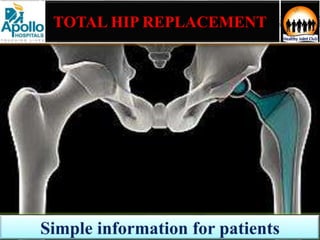
TOTAL HIP REPLACEMENT
Dr. A.MOHAN KRISHNA
M.S.ORTHO, MCh ORTH(U.K)
Consultant Orthopaedic surgeon ,
Trauma, Arthroscopy, Arthroplasty
Surgeon
Apollo hospitals, Hyderabad
Consultant Orthopaedic Surgeon at
www.drmohankrishna.com
www.healthyjointclub.com
www.bonesandjointsclinic.com
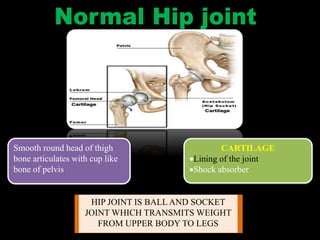
Smooth round head of thigh
bone articulates with cup like
bone of pelvis
CARTILAGE
Lining of the joint
Shock absorber
HIP JOINT IS BALL AND SOCKET
JOINT WHICH TRANSMITS WEIGHT
FROM UPPER BODY TO LEGS
What causes it?
Osteoarthritis
Rheumatoid
arthritis
Worn-out cartilage
Injury to the
joint
Avascular Necrosis
Infections
How common is it?
Commonly affected joint in the
body after knee joint
Nearly 15% of general
population
Risk factors
 Age - Uncommon under 40
years
1 in 5 over 60 years
 Overweight / obesity
Runs in families
Joint injury
Restriction of activities
like squatting, sitting
cross legged
Swelling of
the joint
Joint pain &
Stiffness
Difficulty in
walking/Limp
• Diagnosis is made on
X-ray of the Hip joint
• Decrease in the joint space,
•Irregular and rough surface
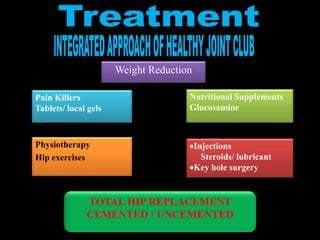
Weight Reduction
Pain Killers
Tablets/ local gels
Nutritional Supplements
Glucosamine
Physiotherapy
Hip exercises
Injections
Steroids/ lubricant
Key hole surgery
TOTAL HIP REPLACEMENT
CEMENTED / UNCEMENTED
Replacing the damaged cartilage
in the Hip joint with metal stem,
metal or ceramic ball and liner
with Plastic or Metal or Ceramic
combinations.
METAL
Cobalt-chrome or
Stainless steel
PLASTIC
Specialised
polyethylene
CERAMIC
Cemented Total Hip Cementless Total Hip
CEMENTED TOTAL HIP
REPLACEMENT
Cement is used to fix the
thigh and cup component
to the bone.
CEMENTLESS TOTAL HIP
REPLACEMENT
The cup component is fixed as
press fit with or without
augmentation with screws.
The thigh component is fixed
press fit with the bone.
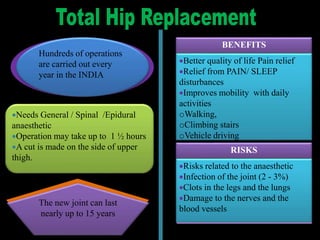
Hundreds of operations
are carried out every
year in the INDIA
Needs General / Spinal /Epidural
anaesthetic
Operation may take up to 1 ½ hours
A cut is made on the side of upper
thigh.
The new joint can last
nearly up to 15 years
BENEFITS
Better quality of life Pain relief
Relief from PAIN/ SLEEP
disturbances
Improves mobility with daily
activities
oWalking,
oClimbing stairs
oVehicle driving
RISKS
Risks related to the anaesthetic
Infection of the joint (2 - 3%)
Clots in the legs and the lungs
Damage to the nerves and the
blood vessels
Weight Height (BMI)
Blood & Urine tests, ECG, Chest X-
ray,
2D Echo
Check up by a General physician,
Cardiologist, anaesthetist
Details of medical
conditions/Allergies
Previous operations
List of medicines you are taking
To stop blood thinning drugs
(ASPIRIN , CLOPIDOGREL)
General examination : Dental
check
Discussion regarding operation
Sometimes a further check-up by an
Anaesthetist may be required
Continue regular medications if any for
Diabetes / BP /any long term drugs
Early Light dinner (Fat free) on the
night before surgery.
Plenty of fluids on the day before
surgery.
Informed consent & site marking of the
limb.
Good bath
At least six hours of fasting before
surgery.
Take BP/Thyroid medications after consulting
the doctor. Normally you are advised not to
take medication for diabetes
IV lines and monitors will be placed in the
operation theatre.
Commonly General anaesthesia will be given
and other measures for post surgery pain relief.
Urinary catheter will be placed
Cleaning and draping of the leg will be done
prior to surgery & surgeon will proceed for
surgery
If you have any heart or other problem you
will be kept in ICU for a day.
At least six hours after surgery you will be
allowed to have liquids first & followed by
normal diet.
SURGICAL STEPS
WOUND CLOSURE AFTER
SURGERY
UNCEMENTED
TOTAL HIP
REPLACEMENT
CEMENTED TOTAL HIP REPLACEMENT
RIGHT
Day 1
Exercises for ankles and toes to prevent blood clots
You can sit on a chair or take a few steps with a
frame
Day 2
Removal of bandage and drain from the Hip joint
Knee exercises – straightening / bending
Cemented Hip: Full weight bearing walking with
frame.
Day 3
Walking up and down the stairs
Continue the exercises
You may be able to go home
within 3 to 5 days after the
operation
Stitches / clips removed
at 12 - 14 days
You can shower/ bathe after
removal of stitches / clips
Return to household work & other
day to day activities in 6-8 weeks
Frequent deep
breathing1
Pull your toes towards
you and point away.
2
Circle your feet in
both directions
3
Push knee down
Tighten thigh muscles
Count to 10 and relax
Do it 10 times / hour
4
Place a rolled towel
under your knee. Lift
your heel to straighten
knee. Count to 10 and
do 10 times / hour
5
Place a rolled towel
under your knee.
Push your knee and
heel down. Count to
10 and do 10 times /
hour
6
Sit at the edge of bed / chair. Bend
the operated leg and straighten
slowly. Repeat 10 times/hour.
7
Note: it is important to do frequent repetitions of all exercises for a short
time than spending more time on exercises once or twice a day. Do not
force any movements
Raise and support your
operated leg on a stool
Do walk short distances initially
As you get stronger increase
the distance of walking
• Neurological
risks In previous
neurological
problems
• Cardiac risks
(elderly with
uncontrolled
blood pressures
• Anaesthetic
risks
Infection
of joints 2-
3%
hip
stiffness
Clots in
legs &
lungs
Damage
to nerves
& blood
vessels
Risks of TOTAL HIP REPLACEMENT
SPECIAL CONSIDERATIONS
Inform other doctors about
artificial joint. As these
joints are risk of bacterial
infection from the above
mentioned procedures.
Dental
procedures
Urological
procedures
Endoscopic
procedures
CONTACT
Dr.A.MOHAN KRISHNA
M.S.Ortho., MCh Ortho(U.K).,
Consultant Orthopaedic Surgeon,
Apollo Hospitals,
Hyderabad.
Appointments: Secretary : 09247258989 / 09441184590
08332936085
www.drmohankrishna.com
www.healthyjointclub.com
www.bonesandjointsclinic.com
Email: bonesandjointsclinic@gmail.com

Total hip replacement

  • 1.
  • 2.
    Dr. A.MOHAN KRISHNA M.S.ORTHO,MCh ORTH(U.K) Consultant Orthopaedic surgeon , Trauma, Arthroscopy, Arthroplasty Surgeon Apollo hospitals, Hyderabad Consultant Orthopaedic Surgeon at www.drmohankrishna.com www.healthyjointclub.com www.bonesandjointsclinic.com
  • 3.
    Smooth round headof thigh bone articulates with cup like bone of pelvis CARTILAGE Lining of the joint Shock absorber HIP JOINT IS BALL AND SOCKET JOINT WHICH TRANSMITS WEIGHT FROM UPPER BODY TO LEGS
  • 4.
    What causes it? Osteoarthritis Rheumatoid arthritis Worn-outcartilage Injury to the joint Avascular Necrosis Infections
  • 5.
    How common isit? Commonly affected joint in the body after knee joint Nearly 15% of general population Risk factors  Age - Uncommon under 40 years 1 in 5 over 60 years  Overweight / obesity Runs in families Joint injury Restriction of activities like squatting, sitting cross legged Swelling of the joint Joint pain & Stiffness Difficulty in walking/Limp
  • 6.
    • Diagnosis ismade on X-ray of the Hip joint • Decrease in the joint space, •Irregular and rough surface
  • 7.
    Weight Reduction Pain Killers Tablets/local gels Nutritional Supplements Glucosamine Physiotherapy Hip exercises Injections Steroids/ lubricant Key hole surgery TOTAL HIP REPLACEMENT CEMENTED / UNCEMENTED
  • 8.
    Replacing the damagedcartilage in the Hip joint with metal stem, metal or ceramic ball and liner with Plastic or Metal or Ceramic combinations. METAL Cobalt-chrome or Stainless steel PLASTIC Specialised polyethylene CERAMIC Cemented Total Hip Cementless Total Hip
  • 9.
    CEMENTED TOTAL HIP REPLACEMENT Cementis used to fix the thigh and cup component to the bone. CEMENTLESS TOTAL HIP REPLACEMENT The cup component is fixed as press fit with or without augmentation with screws. The thigh component is fixed press fit with the bone.
  • 10.
    Hundreds of operations arecarried out every year in the INDIA Needs General / Spinal /Epidural anaesthetic Operation may take up to 1 ½ hours A cut is made on the side of upper thigh. The new joint can last nearly up to 15 years BENEFITS Better quality of life Pain relief Relief from PAIN/ SLEEP disturbances Improves mobility with daily activities oWalking, oClimbing stairs oVehicle driving RISKS Risks related to the anaesthetic Infection of the joint (2 - 3%) Clots in the legs and the lungs Damage to the nerves and the blood vessels
  • 11.
    Weight Height (BMI) Blood& Urine tests, ECG, Chest X- ray, 2D Echo Check up by a General physician, Cardiologist, anaesthetist Details of medical conditions/Allergies Previous operations List of medicines you are taking To stop blood thinning drugs (ASPIRIN , CLOPIDOGREL) General examination : Dental check Discussion regarding operation Sometimes a further check-up by an Anaesthetist may be required
  • 12.
    Continue regular medicationsif any for Diabetes / BP /any long term drugs Early Light dinner (Fat free) on the night before surgery. Plenty of fluids on the day before surgery. Informed consent & site marking of the limb. Good bath At least six hours of fasting before surgery.
  • 13.
    Take BP/Thyroid medicationsafter consulting the doctor. Normally you are advised not to take medication for diabetes IV lines and monitors will be placed in the operation theatre. Commonly General anaesthesia will be given and other measures for post surgery pain relief. Urinary catheter will be placed Cleaning and draping of the leg will be done prior to surgery & surgeon will proceed for surgery If you have any heart or other problem you will be kept in ICU for a day. At least six hours after surgery you will be allowed to have liquids first & followed by normal diet.
  • 14.
  • 15.
  • 16.
    CEMENTED TOTAL HIPREPLACEMENT RIGHT
  • 17.
    Day 1 Exercises forankles and toes to prevent blood clots You can sit on a chair or take a few steps with a frame Day 2 Removal of bandage and drain from the Hip joint Knee exercises – straightening / bending Cemented Hip: Full weight bearing walking with frame. Day 3 Walking up and down the stairs Continue the exercises You may be able to go home within 3 to 5 days after the operation
  • 18.
    Stitches / clipsremoved at 12 - 14 days You can shower/ bathe after removal of stitches / clips Return to household work & other day to day activities in 6-8 weeks
  • 19.
    Frequent deep breathing1 Pull yourtoes towards you and point away. 2 Circle your feet in both directions 3 Push knee down Tighten thigh muscles Count to 10 and relax Do it 10 times / hour 4 Place a rolled towel under your knee. Lift your heel to straighten knee. Count to 10 and do 10 times / hour 5 Place a rolled towel under your knee. Push your knee and heel down. Count to 10 and do 10 times / hour 6
  • 20.
    Sit at theedge of bed / chair. Bend the operated leg and straighten slowly. Repeat 10 times/hour. 7 Note: it is important to do frequent repetitions of all exercises for a short time than spending more time on exercises once or twice a day. Do not force any movements
  • 21.
    Raise and supportyour operated leg on a stool Do walk short distances initially As you get stronger increase the distance of walking
  • 22.
    • Neurological risks Inprevious neurological problems • Cardiac risks (elderly with uncontrolled blood pressures • Anaesthetic risks Infection of joints 2- 3% hip stiffness Clots in legs & lungs Damage to nerves & blood vessels Risks of TOTAL HIP REPLACEMENT
  • 23.
    SPECIAL CONSIDERATIONS Inform otherdoctors about artificial joint. As these joints are risk of bacterial infection from the above mentioned procedures. Dental procedures Urological procedures Endoscopic procedures
  • 24.
    CONTACT Dr.A.MOHAN KRISHNA M.S.Ortho., MChOrtho(U.K)., Consultant Orthopaedic Surgeon, Apollo Hospitals, Hyderabad. Appointments: Secretary : 09247258989 / 09441184590 08332936085 www.drmohankrishna.com www.healthyjointclub.com www.bonesandjointsclinic.com Email: bonesandjointsclinic@gmail.com