ANESTHESIA FOR TKR
Aftab Hussain
• What are the conditions requiring knee
replacement ?
• Most of the patients have degenerative joint
disease, commonly osteoarthritis (OA).
• injury to knee joint,
• knee deformity,
• rheumatoid arthritis
• Gout
• Hemophilia
Joint replacement is performed to relieve -
• pain and
• morbidity.
• What are the challenges associated with TKR
patients ?
The challenges….
• Decreased organ function and reserve due to
aging.
• Co-morbid conditions
• Pain
• Obesity
• Consequences of poly-pharmacy
What are major concerns in preoperative period
?
• Cardiopulmonary ?
• Musculoskeletal ?
Cardiopulmonary
• Cardiopulmonary reserve difficult to assess as
exercise tolerence is limited by knee disease.
• Resting ECG may show silent ischemia or
previous MI.
• Dynamic function such as cardiopulmonary
exercise or pharmacological stress test difficult
to perform.
Evaluation of the functional cardiovascular
reserves ?
Cardiac Risk Index?
• Simple steps (e.g., auscultation, ECG, and
chest x-ray) can detect acute decompensation.
• Echocardiography if feasible at the bedside.
• Evaluation of electrolytes and blood count is
required.
• Metabolic equivalent (MET) ?
• Metabolic equivalent (MET)
• Metabolic equivalent gold standard to
evaluate patients physical capacity.
• MET >4 associated with decreased risk of
perioperative cardiovascular events.
Revised cardiac risk predictors
• History of Ischemic heart ds
• History of CHF
• History of Cerebrovascular ds
• History of diabetes
• Chronic kidney ds
• Type of surgery.
• Risk of MI or Cardiac arrest 0= 0.4%, 1 = 0.9%, 2= 6.6%, >3= >11%
• What are the implication of Musculoskeletal
examination in these patients ?
Musculoskeletal system
• Other joint involvement is common which
have implications for positioning for regional
anaesthesia & surgery.
• Obesity may be present.
• Rheumatoid Arthritis –
cervical spine involvement
TMJ involvement ?
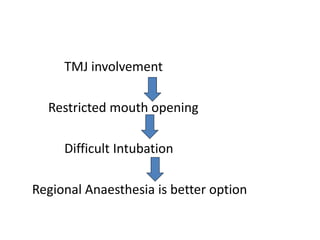
TMJ involvement
Restricted mouth opening
Difficult Intubation
Regional Anaesthesia is better option
H/o Drugs –
. If patient is taking warfarin,
aspirin, clopidogrel
More chances of hematoma formation in
regional anaesthesia
. Beta blockers – can be continued
Anti hypertensive drugs?
• What is American society of regional
anesthesia(ASRA) recommendation??
NEURAXIAL BLOCKADE ,ANTICOAGULANTS
AND ANTIPLATELET AGENTS
• Pts taking NSAIDS or receiving Aspirin in low
dose(75mg/day) are not viewed as being at
increased risk of spinal hematoma
• DISCONTINUE---ticlopidine 2 weeks,
clopidogrel for 1 week ,abciximab 24 to 48 hrs,
eptifibate and tirofiban 4 to 8 hrs before
performing central neuraxial block.
• What are the investigations required ?
Investigations - Blood Counts
Renal function test
ECG
Blood Grouping
Coagulation Profile
Chest X-ray
The choice of anaesthesia is determined by:
i) surgical factors
ii) Patients factors
iii) Estimates of risk associated with
anaesthesia techniques
Choice Of Anaesthesia
• Name anaesthetic techniques for TKR ?
 TKR –
1. Combined Spinal Epidural
2. Epidural
3. Spinal
4. GA with femoral & sciatic nerve block
5. Femoral & sciatic n. block alone
6. General Anaesthesia
Anaesthesia
SPINAL
 If no contraindication
 Preload with IV fluid before performing
spinal.
 In TKR Avoid excessive preload before
performing spinal
• For a single shot spinal use 2.5 – 3.0 mls of 0.5%
bupivacaine depending on patient size.
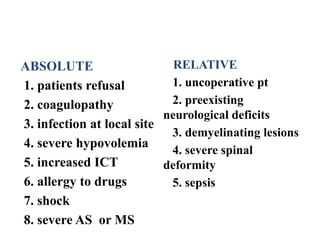
• CONTRAINDICATIONS OF
NEURAXIAL BLOCKADE??
ABSOLUTE
1. patients refusal
2. coagulopathy
3. infection at local site
4. severe hypovolemia
5. increased ICT
6. allergy to drugs
7. shock
8. severe AS or MS
RELATIVE
1. uncoperative pt
2. preexisting
neurological deficits
3. demyelinating lesions
4. severe spinal
deformity
5. sepsis
• Adjuvants added to prolong effect of spinal
anaesthesia ?
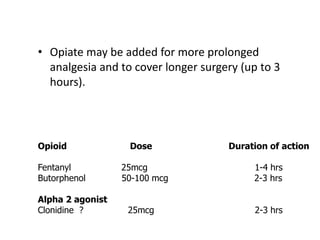
• Opiate may be added for more prolonged
analgesia and to cover longer surgery (up to 3
hours).
Opioid Dose Duration of action
Fentanyl 25mcg 1-4 hrs
Butorphenol 50-100 mcg 2-3 hrs
Alpha 2 agonist
Clonidine ? 25mcg 2-3 hrs
• Light sedation using increments of midazolam
0.5mg or low dose target controlled infusion
of propofol may be used.
• For long cases – Epidural &
combined spinal epidural
PERIPHERAL NERVE BLOCKS
• Peripheral nerve blocks employing long-acting
anesthetics or catheters may provide excellent
intraoperative anesthesia and superior
postoperative analgesia.
• Peripheral nerve block for TKR ?
Peripheral nerve blocks for TKR
• (3 in 1) blocks have become popular and
provide good analgesia in the first 12-24 hrs.
• They avoid the need for a urinary catheter in
most patients and allow mobility in bed.
• They need 30 minutes to become effective
and do not provide surgical anaesthesia.
• Femoral 3 in 1 block … ?
• Historically femoral nerve block was
thought to block femoral, lateral femoral
cutaneous nerve and obturator nerve.
• Most of the time obturator nerve is not
blocked.
• What are the advantages of regional
anaesthesia ?
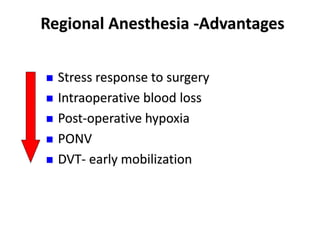
Regional Anesthesia -Advantages
 Stress response to surgery
 Intraoperative blood loss
 Post-operative hypoxia
 PONV
 DVT- early mobilization
GENERAL ANAESTHESIA
• Spontaneous ventilation via LMA
• Ventilation via endotracheal tube
• What are the advantages of general
anaesthesia ?
General Anaesthesia -
Advantages
• Better for patients who are unable to lie flat.
• Safer for patients with fixed cardiac output
states such as aortic stenosis.
• Patient preference.
• Less likely to require urinary catheterisation.
• Monitoring requirement ?
Perioperative…
Monitoring – NIBP
ECG
PULSE OXIMETER
CAPNOGRAPH
URINE OUTPUT
• What is the use of tourniquet in TKR and
morbidity associated with it ?
Tourniquet -
 Used in TKR so perioperative blood loss is
not a problem until its release.
 Tourniquet pain occur after about 1 hr
causing increased
HR & BP (GA) and it can occur even with
regional anaesthesia.
Tt – deepen anaesthesia
opioids
• Risks associated with tourniquet deflation ?
Tourniquet deflation
• After deflation of the tourniquet a short-
lived reperfusion event commonly occurs.
• Acidic products of metabolism are washed
out of the limb causing peripheral
vasodilatation and reduced cardiac
contractility, both of which result in a drop
in blood pressure.
• End-tidal CO2 rises and a fall in oxygen
saturation is often seen.
• Prevention involves fluid loading before and
during tourniquet release. Additional oxygen
and vasopressors may be required.
• Antibiotic prophylaxis .. When ?
Antibiotic Prophylaxis
Infection is one of the most common
complication after TKR. So all patients
should receive antibiotic prophylaxis.
Administered within 1 hr prior to skin
incision.
If tourniquet is to be used, should be
given prior to tourniquet inflation.
• Post op care ?
Immediate postoperative care to support
 oxygenation,
 controlling pain, and
 early mobilisation
Post-operative care
• Oxygen therapy for 24 hours is
advisable in most patients, continued
up to 72 hours in those at high risk of
myocardial ischaemia.
• Post operative Pain management ?
• Patient education
• Preemptive analgesia ?
• Neuraxial analgesia
• Peripheral nerve block
• Periarticular injection
• PCA
• Oral analgesics
• Multimodal analgesia ?
• Effective post op analgesia is essential for
early physical rehabilitation to maximize
postoperative range of motion and
prevent joint adhesions.
• Patients usually undertake passive
exercises in the operated leg within 24
hours and are mobilized at 48 hours.
• What are the complications associated with
TKR ?
COMPLICATIONS
• Blood loss –
• In TKR Blood loss may be brisk after deflation
of the tourniquet, and if it exceeds 500 mls
the surgeon may clamp the drain for a period.
Venous Thromboembolism
• More common in TKR.
• Clinical DVT occurs in 10% of patients
without prophylaxis and fatal pulmonary
embolism in 0.4% of patients.
• Strategies to prevent Venous thromboembolism ?
• Strategies to minimise risk include -
.avoiding dehydration,
.early mobilisation,
.regional anaesthesia,
.intermittent leg-compression devices,
.graduated compression stockings.
• Prophylaxis for DVT ?
Prophylaxis against DVT
• Low dose heparin, low molecular weight heparin
(LMWH), warfarin, or the selective factor Xa inhibitor,
fondaparinux are effective in reducing DVT.
• concern about possible bleeding complications
• Recommendations allow a 12 hour interval between
low molecular weight heparin and epidural/spinal
injection. This also applies to removal of an epidural
catheter.
• SBTKR ?
• Advantages and disadvantages?
• SBTKR -- Simulataneous B/l, TKR
• Advantages and disadvantages?
• Advantages:
One anaesthetic exposure
Postop pain course
Reduced rehabilitation
Earlier return of baseline function
• Disadvantages
Increased perioperative complications
More blood transfusions
Risk of ICU admissions.
• Persistent post operative pain ?
Persistent postoperative pain
• Pain lasting >3 months
• Can affect 10-50% of certain surgical patients
(44% of TKR)*
• Risks?
• Female sex, depression and presence of pain
in more than one body location.
• Presence of pre-surgical pain >1year also
found to be significant risk factors to become
chronic pain.
Conclusion
• Geriatric patients for joint replacement
surgeries offer a great challenge to the
anaesthesiologists.
• A careful preoperative examination,
preoperative optimization, safe
intraoperative anaesthetic techniques,
good postoperative pain relief, good
postoperative followup with rehabilitation
would aid in decreasing the morbidity in
these patients.
THANK YOU

Anesthesia for Total Knee replacement 4-3-2017

  • 1.
  • 2.
    • What arethe conditions requiring knee replacement ?
  • 3.
    • Most ofthe patients have degenerative joint disease, commonly osteoarthritis (OA). • injury to knee joint, • knee deformity, • rheumatoid arthritis • Gout • Hemophilia
  • 4.
    Joint replacement isperformed to relieve - • pain and • morbidity.
  • 5.
    • What arethe challenges associated with TKR patients ?
  • 6.
    The challenges…. • Decreasedorgan function and reserve due to aging. • Co-morbid conditions • Pain • Obesity • Consequences of poly-pharmacy
  • 7.
    What are majorconcerns in preoperative period ? • Cardiopulmonary ? • Musculoskeletal ?
  • 8.
    Cardiopulmonary • Cardiopulmonary reservedifficult to assess as exercise tolerence is limited by knee disease. • Resting ECG may show silent ischemia or previous MI. • Dynamic function such as cardiopulmonary exercise or pharmacological stress test difficult to perform.
  • 9.
    Evaluation of thefunctional cardiovascular reserves ? Cardiac Risk Index?
  • 10.
    • Simple steps(e.g., auscultation, ECG, and chest x-ray) can detect acute decompensation. • Echocardiography if feasible at the bedside. • Evaluation of electrolytes and blood count is required. • Metabolic equivalent (MET) ?
  • 11.
    • Metabolic equivalent(MET) • Metabolic equivalent gold standard to evaluate patients physical capacity. • MET >4 associated with decreased risk of perioperative cardiovascular events.
  • 12.
    Revised cardiac riskpredictors • History of Ischemic heart ds • History of CHF • History of Cerebrovascular ds • History of diabetes • Chronic kidney ds • Type of surgery. • Risk of MI or Cardiac arrest 0= 0.4%, 1 = 0.9%, 2= 6.6%, >3= >11%
  • 13.
    • What arethe implication of Musculoskeletal examination in these patients ?
  • 14.
    Musculoskeletal system • Otherjoint involvement is common which have implications for positioning for regional anaesthesia & surgery. • Obesity may be present. • Rheumatoid Arthritis – cervical spine involvement TMJ involvement ?
  • 15.
    TMJ involvement Restricted mouthopening Difficult Intubation Regional Anaesthesia is better option
  • 16.
    H/o Drugs – .If patient is taking warfarin, aspirin, clopidogrel More chances of hematoma formation in regional anaesthesia . Beta blockers – can be continued Anti hypertensive drugs?
  • 17.
    • What isAmerican society of regional anesthesia(ASRA) recommendation??
  • 18.
    NEURAXIAL BLOCKADE ,ANTICOAGULANTS ANDANTIPLATELET AGENTS • Pts taking NSAIDS or receiving Aspirin in low dose(75mg/day) are not viewed as being at increased risk of spinal hematoma • DISCONTINUE---ticlopidine 2 weeks, clopidogrel for 1 week ,abciximab 24 to 48 hrs, eptifibate and tirofiban 4 to 8 hrs before performing central neuraxial block.
  • 19.
    • What arethe investigations required ?
  • 20.
    Investigations - BloodCounts Renal function test ECG Blood Grouping Coagulation Profile Chest X-ray
  • 21.
    The choice ofanaesthesia is determined by: i) surgical factors ii) Patients factors iii) Estimates of risk associated with anaesthesia techniques Choice Of Anaesthesia
  • 22.
    • Name anaesthetictechniques for TKR ?
  • 23.
     TKR – 1.Combined Spinal Epidural 2. Epidural 3. Spinal 4. GA with femoral & sciatic nerve block 5. Femoral & sciatic n. block alone 6. General Anaesthesia
  • 24.
    Anaesthesia SPINAL  If nocontraindication  Preload with IV fluid before performing spinal.  In TKR Avoid excessive preload before performing spinal
  • 25.
    • For asingle shot spinal use 2.5 – 3.0 mls of 0.5% bupivacaine depending on patient size.
  • 26.
  • 27.
    ABSOLUTE 1. patients refusal 2.coagulopathy 3. infection at local site 4. severe hypovolemia 5. increased ICT 6. allergy to drugs 7. shock 8. severe AS or MS RELATIVE 1. uncoperative pt 2. preexisting neurological deficits 3. demyelinating lesions 4. severe spinal deformity 5. sepsis
  • 28.
    • Adjuvants addedto prolong effect of spinal anaesthesia ?
  • 29.
    • Opiate maybe added for more prolonged analgesia and to cover longer surgery (up to 3 hours). Opioid Dose Duration of action Fentanyl 25mcg 1-4 hrs Butorphenol 50-100 mcg 2-3 hrs Alpha 2 agonist Clonidine ? 25mcg 2-3 hrs
  • 30.
    • Light sedationusing increments of midazolam 0.5mg or low dose target controlled infusion of propofol may be used. • For long cases – Epidural & combined spinal epidural
  • 31.
    PERIPHERAL NERVE BLOCKS •Peripheral nerve blocks employing long-acting anesthetics or catheters may provide excellent intraoperative anesthesia and superior postoperative analgesia.
  • 32.
    • Peripheral nerveblock for TKR ?
  • 33.
    Peripheral nerve blocksfor TKR • (3 in 1) blocks have become popular and provide good analgesia in the first 12-24 hrs. • They avoid the need for a urinary catheter in most patients and allow mobility in bed. • They need 30 minutes to become effective and do not provide surgical anaesthesia.
  • 34.
    • Femoral 3in 1 block … ?
  • 35.
    • Historically femoralnerve block was thought to block femoral, lateral femoral cutaneous nerve and obturator nerve. • Most of the time obturator nerve is not blocked.
  • 36.
    • What arethe advantages of regional anaesthesia ?
  • 37.
    Regional Anesthesia -Advantages Stress response to surgery  Intraoperative blood loss  Post-operative hypoxia  PONV  DVT- early mobilization
  • 38.
    GENERAL ANAESTHESIA • Spontaneousventilation via LMA • Ventilation via endotracheal tube
  • 39.
    • What arethe advantages of general anaesthesia ?
  • 40.
    General Anaesthesia - Advantages •Better for patients who are unable to lie flat. • Safer for patients with fixed cardiac output states such as aortic stenosis. • Patient preference. • Less likely to require urinary catheterisation.
  • 41.
  • 42.
    Perioperative… Monitoring – NIBP ECG PULSEOXIMETER CAPNOGRAPH URINE OUTPUT
  • 43.
    • What isthe use of tourniquet in TKR and morbidity associated with it ?
  • 44.
    Tourniquet -  Usedin TKR so perioperative blood loss is not a problem until its release.  Tourniquet pain occur after about 1 hr causing increased HR & BP (GA) and it can occur even with regional anaesthesia. Tt – deepen anaesthesia opioids
  • 45.
    • Risks associatedwith tourniquet deflation ?
  • 46.
    Tourniquet deflation • Afterdeflation of the tourniquet a short- lived reperfusion event commonly occurs. • Acidic products of metabolism are washed out of the limb causing peripheral vasodilatation and reduced cardiac contractility, both of which result in a drop in blood pressure.
  • 47.
    • End-tidal CO2rises and a fall in oxygen saturation is often seen. • Prevention involves fluid loading before and during tourniquet release. Additional oxygen and vasopressors may be required.
  • 48.
  • 49.
    Antibiotic Prophylaxis Infection isone of the most common complication after TKR. So all patients should receive antibiotic prophylaxis. Administered within 1 hr prior to skin incision. If tourniquet is to be used, should be given prior to tourniquet inflation.
  • 50.
  • 51.
    Immediate postoperative careto support  oxygenation,  controlling pain, and  early mobilisation Post-operative care
  • 52.
    • Oxygen therapyfor 24 hours is advisable in most patients, continued up to 72 hours in those at high risk of myocardial ischaemia.
  • 53.
    • Post operativePain management ?
  • 54.
    • Patient education •Preemptive analgesia ? • Neuraxial analgesia • Peripheral nerve block • Periarticular injection • PCA • Oral analgesics • Multimodal analgesia ?
  • 55.
    • Effective postop analgesia is essential for early physical rehabilitation to maximize postoperative range of motion and prevent joint adhesions. • Patients usually undertake passive exercises in the operated leg within 24 hours and are mobilized at 48 hours.
  • 56.
    • What arethe complications associated with TKR ?
  • 57.
    COMPLICATIONS • Blood loss– • In TKR Blood loss may be brisk after deflation of the tourniquet, and if it exceeds 500 mls the surgeon may clamp the drain for a period.
  • 58.
    Venous Thromboembolism • Morecommon in TKR. • Clinical DVT occurs in 10% of patients without prophylaxis and fatal pulmonary embolism in 0.4% of patients.
  • 59.
    • Strategies toprevent Venous thromboembolism ?
  • 60.
    • Strategies tominimise risk include - .avoiding dehydration, .early mobilisation, .regional anaesthesia, .intermittent leg-compression devices, .graduated compression stockings.
  • 61.
  • 62.
    Prophylaxis against DVT •Low dose heparin, low molecular weight heparin (LMWH), warfarin, or the selective factor Xa inhibitor, fondaparinux are effective in reducing DVT. • concern about possible bleeding complications • Recommendations allow a 12 hour interval between low molecular weight heparin and epidural/spinal injection. This also applies to removal of an epidural catheter.
  • 63.
    • SBTKR ? •Advantages and disadvantages?
  • 64.
    • SBTKR --Simulataneous B/l, TKR • Advantages and disadvantages?
  • 65.
    • Advantages: One anaestheticexposure Postop pain course Reduced rehabilitation Earlier return of baseline function • Disadvantages Increased perioperative complications More blood transfusions Risk of ICU admissions.
  • 66.
    • Persistent postoperative pain ?
  • 67.
    Persistent postoperative pain •Pain lasting >3 months • Can affect 10-50% of certain surgical patients (44% of TKR)* • Risks?
  • 68.
    • Female sex,depression and presence of pain in more than one body location. • Presence of pre-surgical pain >1year also found to be significant risk factors to become chronic pain.
  • 69.
    Conclusion • Geriatric patientsfor joint replacement surgeries offer a great challenge to the anaesthesiologists. • A careful preoperative examination, preoperative optimization, safe intraoperative anaesthetic techniques, good postoperative pain relief, good postoperative followup with rehabilitation would aid in decreasing the morbidity in these patients.
  • 70.

Editor's Notes

  • #55 Effective reduction in cemntral and peripheral sensitization and postoperative pain level and result in decreased consumption of analgesics. Multimiodal pain management combined use of drugs or procedures that have different mech of action can be more effective in improveing pain and reducing the consumption of each agent. In particular opioids.