An Algorithm to Find the Visible Region
of a Polygon
Kasun Ranga Wijeweera
(krw19870829@gmail.com)
1
Introduction
2
What is a Polygon?
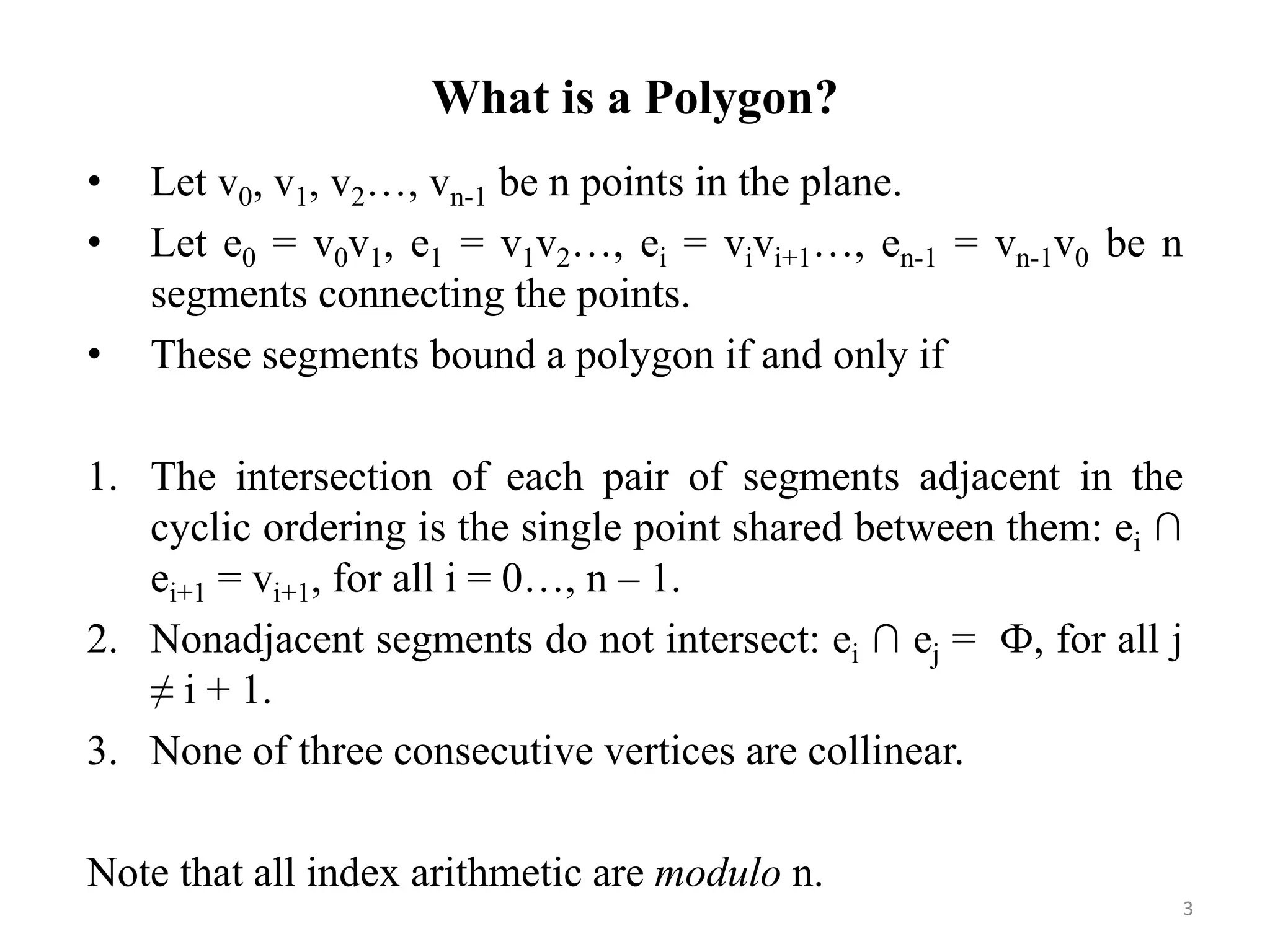
• Let v0, v1, v2…, vn-1 be n points in the plane.
• Let e0 = v0v1, e1 = v1v2…, ei = vivi+1…, en-1 = vn-1v0 be n
segments connecting the points.
• These segments bound a polygon if and only if
1. The intersection of each pair of segments adjacent in the
cyclic ordering is the single point shared between them: ei ∩
ei+1 = vi+1, for all i = 0…, n – 1.
2. Nonadjacent segments do not intersect: ei ∩ ej = Ф, for all j
≠ i + 1.
3. None of three consecutive vertices are collinear.
Note that all index arithmetic are modulo n.
3
Examples of Polygons
4
Examples of Polygons…
5
Visible Region of a Polygon
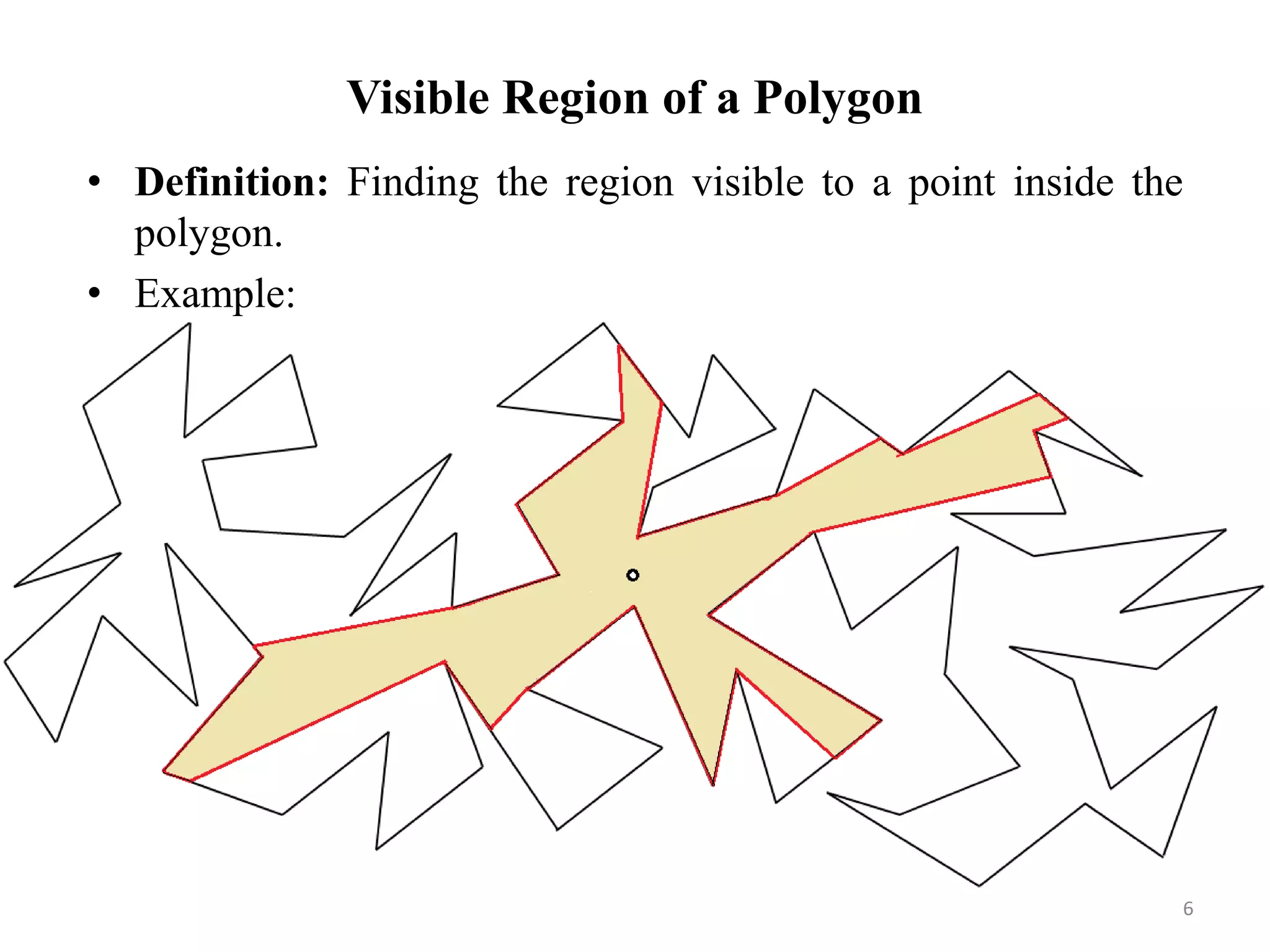
• Definition: Finding the region visible to a point inside the
polygon.
• Example:
6
Research Problem
• The naïve algorithm to find the visible region inside a
polygon takes O (k * n) time and O (n) space where k is the
number of rays shot around the point.
• The output of this algorithm may contain lots of unnecessary
collinear points.
• The other existing algorithms are extremely complicated and
far from reality to provide correct implementations to them.
• An algorithm is proposed to find the visible region of a
polygon in O (n2) time and O (n) space.
• The proposed algorithm can find the exact visible region and
it does not produce unnecessary collinear points.
7
Literature Survey
8
Visible Region Algorithms
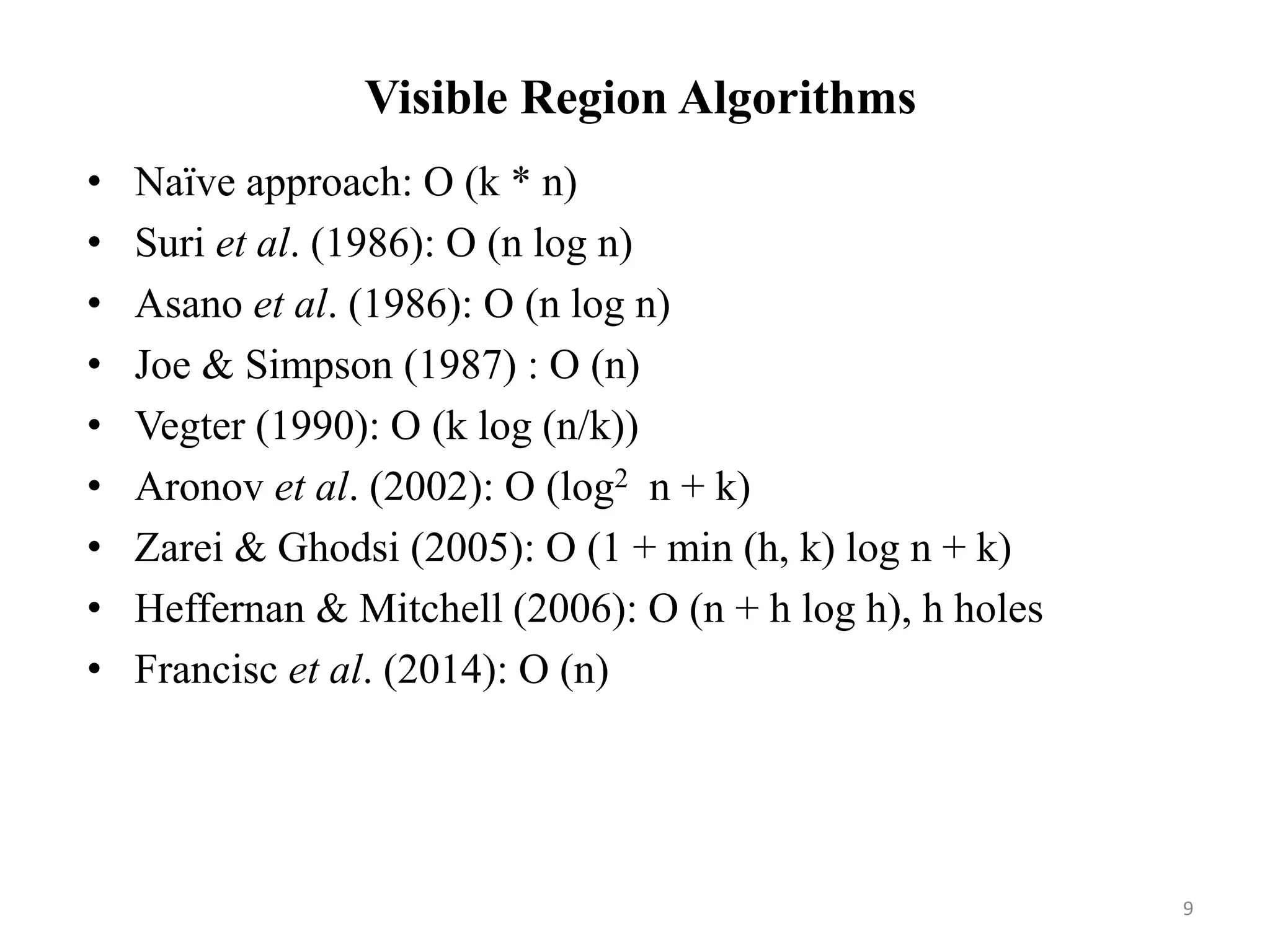
• Naïve approach: O (k * n)
• Suri et al. (1986): O (n log n)
• Asano et al. (1986): O (n log n)
• Joe & Simpson (1987) : O (n)
• Vegter (1990): O (k log (n/k))
• Aronov et al. (2002): O (log2 n + k)
• Zarei & Ghodsi (2005): O (1 + min (h, k) log n + k)
• Heffernan & Mitchell (2006): O (n + h log h), h holes
• Francisc et al. (2014): O (n)
9
Methodology
10
Research Paper
K. R. Wijeweera, S. R. Kodituwakku (2015), An Algorithm to
Find the Visible Region of a Polygon, Ceylon Journal of
Science (Physical Sciences), Volume 19, pp. 33 - 44.
11
Visible Region of a Polygon Example
12
Representation of the Polygon
• The variable points stores the number of vertices of the
polygon.
• The coordinates of the vertices of the polygon are stored
using two arrays x and y.
• Then (x[i], y[i]) denotes the ith vertex of the polygon where i
= 0, 1…, (points - 1).
13
Intersection of Two Line Segments
• Suppose L1 and L2 are two line segments.
• End points of L1 are P1 (x1, y1) and P2 (x2, y2).
• End points of L2 are P3 (x3, y3) and P4 (x4, y4).
• The function isIntersect returns 1 if these line segments x-
intersect else returns 0.
14
✔ ✘ ✘
Intersection of Two Line Segments…
• The visible region is computed with respect to the given point
(xp, yp).
• The function isIntersect has two parameters v and i.
• Here j = (i + 1) MODULO points.
15
Intersection of Two Line Segments…
• If following two conditions are satisfied only then L1 and L2
x-intersect.
1. P3 and P4 should be in two sides of L1.
2. P1 and P2 should be in two sides of L2.
16
✔ ✘ ✘
Intersection of Two Line Segments…
• The function isTwoSides {P1, P2, P3, P4} returns 1 if points P3
and P4 are situated in opposite sides of the line P1P2 else the
function returns 0.
• Therefore, isTwoSides {P1, P2, P3, P4} && isTwoSides {P3,
P4, P1, P2} = 1  the two line segments x-intersect.
17
Test for X-Intersection
• The vertices of the triangle: P1 (x1, y1), P2 (x2, y2), P3 (x3, y3).
• Let t = x1 * (y2 – y3) + x2 * (y3 – y1) + x3 * (y1 – y2).
• t = 0 ↔ (P1, P2, P3) are collinear.
• t > 0 ↔ (P1, P2, P3) are in anticlockwise order.
• t < 0 ↔ (P1, P2, P3) are in clockwise order.
• The function tv returns the sign of value t.
18
t > 0 t < 0
Test for X-Intersection…
• If tv{P1, P2, P3} * tv{P1, P2, P4} < 0  P3, P4 are on same
side of L.
• If tv{P1, P2, P3} * tv{P1, P2, P4} > 0  P3, P4 are on opposite
sides of L.
19
Finding the Visible Vertices
• The visibility is decided with respect to point P which is
inside the polygon.
• A vertex is said to be visible to the point P, if the line segment
joining the point P and the vertex does not have any x-
intersections with the edges of the polygon.
• The function checkVisible is used.
• The array vs stores the indices of visible vertices.
• The variable pvs stores the number of visible vertices.
• If there is at least one x-intersection then vertex is not visible.
(Use of keyword BREAK)
20
Finding the Visible Vertices…
• Following figure shows the ‘visible vertices region’.
• This region is a sub region of visible region.
21
Visible Vertices Region to Visible Region
• The function createRegion extends the visible vertices region
to visible region.
• The visible region is stored using arrays xv and yv where
(xv[i], yv[i]) denotes the ith vertex of the visible region.
• The variable pt stores the number of vertices of the visible
region.
• The variable gap stores the number of edges between two
consecutive visible vertices.
• Each visible vertex is accessed: FOR (i = 0 TO (pvs - 1))
{…}.
• Then gap = vs[j] – vs[i] where j = (i + 1) MODULO pvs.
• If gap < 0 then gap = gap + points.
• Initially pt = 0 then xv[pt] = x[vs[i]]; yv[pt] = y[vs[i]]; pt = pt
+ 1;.
22
Visible Vertices Region to Visible Region…
• Following figure shows the expanded region.
• If gap = 1 then no new points will be included.
• If gap > 0 then zero or more new points will be included
depending on the situation.
23
Two Important Results
• Two lines can be drawn by joining point P and each end point
of the gap.
• These two extreme lines form a region which is visible to the
point P.
• Number of new points required may vary depending on the
situation.
24
Two Important Results…
• Lemma 1: The number of new points for given gap cannot
exceed two.
• Lemma 2: If there are two new points for a given gap then
both of the new points should lie on the same edge of the
polygon.
25
The Function findIntersection
• Any two straight lines intersect unless they are parallel.
• Let’s consider two lines L1 and L2 formed by end points {P1
(x1, y1), P2 (x2, y2)} and {P3 (x3, y3), P4 (x4, y4)} respectively.
• If L1 and L2 are not parallel then these eight coordinates are
sent to function findIntersection to compute the intersection
point (xn, yn).
26
The Function findIntersection…
• Let’s take (m1, c1) and (m2, c2) as the (gradient, y-intercept)
of each line respectively if they exist.
• There are four different cases of these two lines.
27
The Function findIntersection …
• Case 1; (x1 = x2; x3 = x4): This case is ignored and not
handled using the function. Only coordinates of non-parallel
lines are sent to the function.
28
The Function findIntersection…
• Case 2; (x1 = x2; x3 ≠ x4): L1 is parallel to y-axis and L2 is
not parallel to y-axis.
• m2 = (y3 – y4)/(x3 – x4);
• c2 = y3 – m2 * x3;
• xn = x1;
• yn = m2 * xn + c2;
29
The Function findIntersection…
• Case 3; (x1 ≠ x2; x3 = x4): L1 is not parallel to y-axis and L2
is parallel to y-axis.
• m1 = (y1 – y2)/(x1 – x2);
• c1 = y1 – m1 * x1;
• xn = x3;
• yn = m1 * xn + c1;
30
The Function findIntersection…
• Case 4; (x1 ≠ x2; x3 ≠ x4): Both L1 and L2 are not parallel to
y-axis.
• m1 * xn + c1 = m2 * xn + c2  xn = (c2 – c1)/(m1 – m2);
• yn = m1 * xn + c1;
31
An Illustrative Example
• ABV1V2 is the visible vertices region with respect to the
point P.
• There is a gap between vertices V1 and V2.
• Let E1 and E2 be the two extreme lines drawn through
vertices V1 and V2 respectively.
32
An Illustrative Example…
• Again let’s look at function createRegion.
• If gap > 1 then found = 0.
• Each edge within the gap is accessed.
• The variables f and g store the indices of each vertex of an
edge.
• V1 ≡ (x[vs[i]], y[vs[i]]) and V2 ≡ (x[vs[j]], y[vs[j]]).
• First, the extreme line E1 is considered where E1 = VP1.
• The function isTwoSides is used to find edges which x-
intersect E1.
• The function findIntersection is used to compute the
intersection points.
• The function setClosest is used to select the actual insertion
point out of those intersection points.
33
An Illustrative Example…
• Being found = 1 means that the line E1 generates a new point.
• If found = 1 then xv[pt] = xg; yv[pt] = yg; pt = pt + 1.
• If line E2 generates a new point then it should generate it with
the same edge for E1. (The Trick)
• The functions isTwoSides and findIntersection are used for
line E2 as well.
• Then xv[pt] = xn; yv[pt] = yn; pt = pt + 1;.
34
An Illustrative Example…
• Being still found = 0 means that the line E1 does not generate
any new points.
• However, the line E2 may generate a new point.
• Then the functions isTwoSides, findIntersection and
setClosest are used for line E2.
• If found = 1 then xv[pt] = xg; yv[pt] = yg; pt = pt + 1;.
35
A Trick to Save Computational Cost
• This result is derived from Lemma 2.
• Result: If one extreme line causes to have a new intersection
point intersecting with a particular edge. Then the other
extreme line either does not cause any new insertion points or
makes a new insertion point with the same edge.
36
The Function setClosest
• The purpose of this function is to find the actual insertion
point among a set of candidate insertion points.
• The variables dx and dy are used to store the projections on x
and y axes respectively.
• The function ab returns the absolute value of its argument.
• The projection with maximum magnitude is selected in order
to avoid precision error.
37
The Function setClosest
• Here, dx = x[i] - xp.
• Then, dx * (xn - xp) > 0 if and only if lines x = xn and x =
x[i] are on the same side of the line x = xp.
• Therefore, intersection points I4 and I5 can be rejected.
• Now, the closest point to the point P among of I1, I2, and I3 is
selected.
• Similar approach is used if the projection is on y-axis.
38
Back to Previous Example
• The visible vertices region can be extended to visible region
for the following example as explained.
• Note that visible region of this particular example is a
polygon.
39
Visible Region is not Necessarily be a Polygon
• The term “visible region” is used instead “visible polygon”.
• Suppose points P, B, C, and D are collinear.
• Then the visible region with respect to the point P is {A, B,
C, D, E}.
• Edges BC and CD touch more than from a single point.
• Therefore, visible region is not a polygon.
40
Results and Discussion
41
Time Complexity
• Let n be the number of vertices in the given polygon.
• It takes O (n) time to test whether a given vertex is visible by
checking intersection with each edge.
• Therefore, it takes n * O (n) = O (n2) time to find the visible
vertices region.
42
Time Complexity…
• In the worst case, the visible vertices region has a single gap
with (n - 2) edges.
• One of the extreme lines should be tested against each edge
within the gap in order to find intersection edge and it takes
O (n) time.
• Processing the other extreme line takes only O (1) time.
• Therefore, it takes O (n) + O (1) = O (n) time to extend
visible vertices region to visible region.
• Thus, the time complexity of the proposed algorithm is O (n2)
+ O (n) = O (n2).
43
Space Complexity
• It takes n memory cells to hold x-coordinates and n memory
cells to hold y-coordinates.
• Altogether, it takes 2n memory cells to hold the input.
• Therefore, it needs O (n) space to hold the input.
• The memory needed for workspace is O (1).
• Therefore, the space complexity of the proposed algorithm is
O (n) + O (n) + O (1) = O (n).
44
Comparison
• The naïve algorithm takes O (k * n) time and O (n) space
where k is the number of rays shot around the point.
• The efficiency of the naïve algorithm is sufficiently enough
for many applications such as video games.
• In order to get a sufficiently accurate output, k should be
larger than n.
• The output of the naïve algorithm contains lots of
unnecessary collinear points.
• There are number of theoretical algorithms available in
literature.
• However, they are extremely complicated and far from reality
to provide a computer implementation.
• The proposed algorithm is faster than the naïve approach and
it does not produce unnecessary collinear points. 45
Conclusions
46
Conclusion
• The proposed visible region algorithm is faster than the naïve
algorithm and does not produce unnecessary collinear points.
47
Thank you!
48

An Algorithm to Find the Visible Region of a Polygon

  • 1.
    An Algorithm toFind the Visible Region of a Polygon Kasun Ranga Wijeweera (krw19870829@gmail.com) 1
  • 2.
  • 3.
    What is aPolygon? • Let v0, v1, v2…, vn-1 be n points in the plane. • Let e0 = v0v1, e1 = v1v2…, ei = vivi+1…, en-1 = vn-1v0 be n segments connecting the points. • These segments bound a polygon if and only if 1. The intersection of each pair of segments adjacent in the cyclic ordering is the single point shared between them: ei ∩ ei+1 = vi+1, for all i = 0…, n – 1. 2. Nonadjacent segments do not intersect: ei ∩ ej = Ф, for all j ≠ i + 1. 3. None of three consecutive vertices are collinear. Note that all index arithmetic are modulo n. 3
  • 4.
  • 5.
  • 6.
    Visible Region ofa Polygon • Definition: Finding the region visible to a point inside the polygon. • Example: 6
  • 7.
    Research Problem • Thenaïve algorithm to find the visible region inside a polygon takes O (k * n) time and O (n) space where k is the number of rays shot around the point. • The output of this algorithm may contain lots of unnecessary collinear points. • The other existing algorithms are extremely complicated and far from reality to provide correct implementations to them. • An algorithm is proposed to find the visible region of a polygon in O (n2) time and O (n) space. • The proposed algorithm can find the exact visible region and it does not produce unnecessary collinear points. 7
  • 8.
  • 9.
    Visible Region Algorithms •Naïve approach: O (k * n) • Suri et al. (1986): O (n log n) • Asano et al. (1986): O (n log n) • Joe & Simpson (1987) : O (n) • Vegter (1990): O (k log (n/k)) • Aronov et al. (2002): O (log2 n + k) • Zarei & Ghodsi (2005): O (1 + min (h, k) log n + k) • Heffernan & Mitchell (2006): O (n + h log h), h holes • Francisc et al. (2014): O (n) 9
  • 10.
  • 11.
    Research Paper K. R.Wijeweera, S. R. Kodituwakku (2015), An Algorithm to Find the Visible Region of a Polygon, Ceylon Journal of Science (Physical Sciences), Volume 19, pp. 33 - 44. 11
  • 12.
    Visible Region ofa Polygon Example 12
  • 13.
    Representation of thePolygon • The variable points stores the number of vertices of the polygon. • The coordinates of the vertices of the polygon are stored using two arrays x and y. • Then (x[i], y[i]) denotes the ith vertex of the polygon where i = 0, 1…, (points - 1). 13
  • 14.
    Intersection of TwoLine Segments • Suppose L1 and L2 are two line segments. • End points of L1 are P1 (x1, y1) and P2 (x2, y2). • End points of L2 are P3 (x3, y3) and P4 (x4, y4). • The function isIntersect returns 1 if these line segments x- intersect else returns 0. 14 ✔ ✘ ✘
  • 15.
    Intersection of TwoLine Segments… • The visible region is computed with respect to the given point (xp, yp). • The function isIntersect has two parameters v and i. • Here j = (i + 1) MODULO points. 15
  • 16.
    Intersection of TwoLine Segments… • If following two conditions are satisfied only then L1 and L2 x-intersect. 1. P3 and P4 should be in two sides of L1. 2. P1 and P2 should be in two sides of L2. 16 ✔ ✘ ✘
  • 17.
    Intersection of TwoLine Segments… • The function isTwoSides {P1, P2, P3, P4} returns 1 if points P3 and P4 are situated in opposite sides of the line P1P2 else the function returns 0. • Therefore, isTwoSides {P1, P2, P3, P4} && isTwoSides {P3, P4, P1, P2} = 1  the two line segments x-intersect. 17
  • 18.
    Test for X-Intersection •The vertices of the triangle: P1 (x1, y1), P2 (x2, y2), P3 (x3, y3). • Let t = x1 * (y2 – y3) + x2 * (y3 – y1) + x3 * (y1 – y2). • t = 0 ↔ (P1, P2, P3) are collinear. • t > 0 ↔ (P1, P2, P3) are in anticlockwise order. • t < 0 ↔ (P1, P2, P3) are in clockwise order. • The function tv returns the sign of value t. 18 t > 0 t < 0
  • 19.
    Test for X-Intersection… •If tv{P1, P2, P3} * tv{P1, P2, P4} < 0  P3, P4 are on same side of L. • If tv{P1, P2, P3} * tv{P1, P2, P4} > 0  P3, P4 are on opposite sides of L. 19
  • 20.
    Finding the VisibleVertices • The visibility is decided with respect to point P which is inside the polygon. • A vertex is said to be visible to the point P, if the line segment joining the point P and the vertex does not have any x- intersections with the edges of the polygon. • The function checkVisible is used. • The array vs stores the indices of visible vertices. • The variable pvs stores the number of visible vertices. • If there is at least one x-intersection then vertex is not visible. (Use of keyword BREAK) 20
  • 21.
    Finding the VisibleVertices… • Following figure shows the ‘visible vertices region’. • This region is a sub region of visible region. 21
  • 22.
    Visible Vertices Regionto Visible Region • The function createRegion extends the visible vertices region to visible region. • The visible region is stored using arrays xv and yv where (xv[i], yv[i]) denotes the ith vertex of the visible region. • The variable pt stores the number of vertices of the visible region. • The variable gap stores the number of edges between two consecutive visible vertices. • Each visible vertex is accessed: FOR (i = 0 TO (pvs - 1)) {…}. • Then gap = vs[j] – vs[i] where j = (i + 1) MODULO pvs. • If gap < 0 then gap = gap + points. • Initially pt = 0 then xv[pt] = x[vs[i]]; yv[pt] = y[vs[i]]; pt = pt + 1;. 22
  • 23.
    Visible Vertices Regionto Visible Region… • Following figure shows the expanded region. • If gap = 1 then no new points will be included. • If gap > 0 then zero or more new points will be included depending on the situation. 23
  • 24.
    Two Important Results •Two lines can be drawn by joining point P and each end point of the gap. • These two extreme lines form a region which is visible to the point P. • Number of new points required may vary depending on the situation. 24
  • 25.
    Two Important Results… •Lemma 1: The number of new points for given gap cannot exceed two. • Lemma 2: If there are two new points for a given gap then both of the new points should lie on the same edge of the polygon. 25
  • 26.
    The Function findIntersection •Any two straight lines intersect unless they are parallel. • Let’s consider two lines L1 and L2 formed by end points {P1 (x1, y1), P2 (x2, y2)} and {P3 (x3, y3), P4 (x4, y4)} respectively. • If L1 and L2 are not parallel then these eight coordinates are sent to function findIntersection to compute the intersection point (xn, yn). 26
  • 27.
    The Function findIntersection… •Let’s take (m1, c1) and (m2, c2) as the (gradient, y-intercept) of each line respectively if they exist. • There are four different cases of these two lines. 27
  • 28.
    The Function findIntersection… • Case 1; (x1 = x2; x3 = x4): This case is ignored and not handled using the function. Only coordinates of non-parallel lines are sent to the function. 28
  • 29.
    The Function findIntersection… •Case 2; (x1 = x2; x3 ≠ x4): L1 is parallel to y-axis and L2 is not parallel to y-axis. • m2 = (y3 – y4)/(x3 – x4); • c2 = y3 – m2 * x3; • xn = x1; • yn = m2 * xn + c2; 29
  • 30.
    The Function findIntersection… •Case 3; (x1 ≠ x2; x3 = x4): L1 is not parallel to y-axis and L2 is parallel to y-axis. • m1 = (y1 – y2)/(x1 – x2); • c1 = y1 – m1 * x1; • xn = x3; • yn = m1 * xn + c1; 30
  • 31.
    The Function findIntersection… •Case 4; (x1 ≠ x2; x3 ≠ x4): Both L1 and L2 are not parallel to y-axis. • m1 * xn + c1 = m2 * xn + c2  xn = (c2 – c1)/(m1 – m2); • yn = m1 * xn + c1; 31
  • 32.
    An Illustrative Example •ABV1V2 is the visible vertices region with respect to the point P. • There is a gap between vertices V1 and V2. • Let E1 and E2 be the two extreme lines drawn through vertices V1 and V2 respectively. 32
  • 33.
    An Illustrative Example… •Again let’s look at function createRegion. • If gap > 1 then found = 0. • Each edge within the gap is accessed. • The variables f and g store the indices of each vertex of an edge. • V1 ≡ (x[vs[i]], y[vs[i]]) and V2 ≡ (x[vs[j]], y[vs[j]]). • First, the extreme line E1 is considered where E1 = VP1. • The function isTwoSides is used to find edges which x- intersect E1. • The function findIntersection is used to compute the intersection points. • The function setClosest is used to select the actual insertion point out of those intersection points. 33
  • 34.
    An Illustrative Example… •Being found = 1 means that the line E1 generates a new point. • If found = 1 then xv[pt] = xg; yv[pt] = yg; pt = pt + 1. • If line E2 generates a new point then it should generate it with the same edge for E1. (The Trick) • The functions isTwoSides and findIntersection are used for line E2 as well. • Then xv[pt] = xn; yv[pt] = yn; pt = pt + 1;. 34
  • 35.
    An Illustrative Example… •Being still found = 0 means that the line E1 does not generate any new points. • However, the line E2 may generate a new point. • Then the functions isTwoSides, findIntersection and setClosest are used for line E2. • If found = 1 then xv[pt] = xg; yv[pt] = yg; pt = pt + 1;. 35
  • 36.
    A Trick toSave Computational Cost • This result is derived from Lemma 2. • Result: If one extreme line causes to have a new intersection point intersecting with a particular edge. Then the other extreme line either does not cause any new insertion points or makes a new insertion point with the same edge. 36
  • 37.
    The Function setClosest •The purpose of this function is to find the actual insertion point among a set of candidate insertion points. • The variables dx and dy are used to store the projections on x and y axes respectively. • The function ab returns the absolute value of its argument. • The projection with maximum magnitude is selected in order to avoid precision error. 37
  • 38.
    The Function setClosest •Here, dx = x[i] - xp. • Then, dx * (xn - xp) > 0 if and only if lines x = xn and x = x[i] are on the same side of the line x = xp. • Therefore, intersection points I4 and I5 can be rejected. • Now, the closest point to the point P among of I1, I2, and I3 is selected. • Similar approach is used if the projection is on y-axis. 38
  • 39.
    Back to PreviousExample • The visible vertices region can be extended to visible region for the following example as explained. • Note that visible region of this particular example is a polygon. 39
  • 40.
    Visible Region isnot Necessarily be a Polygon • The term “visible region” is used instead “visible polygon”. • Suppose points P, B, C, and D are collinear. • Then the visible region with respect to the point P is {A, B, C, D, E}. • Edges BC and CD touch more than from a single point. • Therefore, visible region is not a polygon. 40
  • 41.
  • 42.
    Time Complexity • Letn be the number of vertices in the given polygon. • It takes O (n) time to test whether a given vertex is visible by checking intersection with each edge. • Therefore, it takes n * O (n) = O (n2) time to find the visible vertices region. 42
  • 43.
    Time Complexity… • Inthe worst case, the visible vertices region has a single gap with (n - 2) edges. • One of the extreme lines should be tested against each edge within the gap in order to find intersection edge and it takes O (n) time. • Processing the other extreme line takes only O (1) time. • Therefore, it takes O (n) + O (1) = O (n) time to extend visible vertices region to visible region. • Thus, the time complexity of the proposed algorithm is O (n2) + O (n) = O (n2). 43
  • 44.
    Space Complexity • Ittakes n memory cells to hold x-coordinates and n memory cells to hold y-coordinates. • Altogether, it takes 2n memory cells to hold the input. • Therefore, it needs O (n) space to hold the input. • The memory needed for workspace is O (1). • Therefore, the space complexity of the proposed algorithm is O (n) + O (n) + O (1) = O (n). 44
  • 45.
    Comparison • The naïvealgorithm takes O (k * n) time and O (n) space where k is the number of rays shot around the point. • The efficiency of the naïve algorithm is sufficiently enough for many applications such as video games. • In order to get a sufficiently accurate output, k should be larger than n. • The output of the naïve algorithm contains lots of unnecessary collinear points. • There are number of theoretical algorithms available in literature. • However, they are extremely complicated and far from reality to provide a computer implementation. • The proposed algorithm is faster than the naïve approach and it does not produce unnecessary collinear points. 45
  • 46.
  • 47.
    Conclusion • The proposedvisible region algorithm is faster than the naïve algorithm and does not produce unnecessary collinear points. 47
  • 48.