Regret Ratio Minimization in
Multi-objective Submodular
Function Maximization
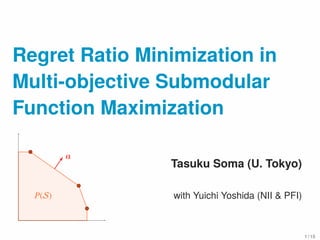
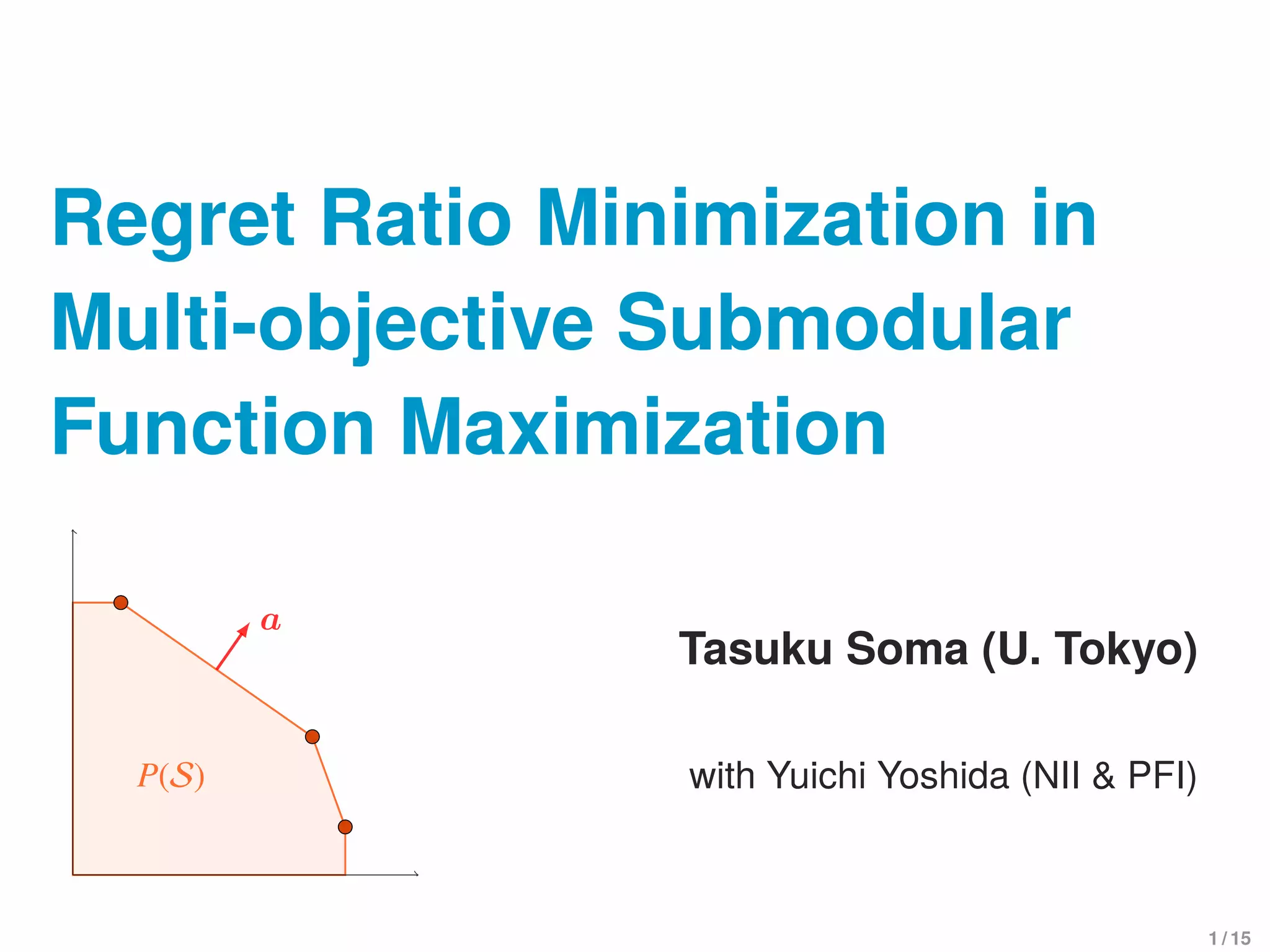
P(S)
a
Tasuku Soma (U. Tokyo)
with Yuichi Yoshida (NII & PFI)
1 / 15
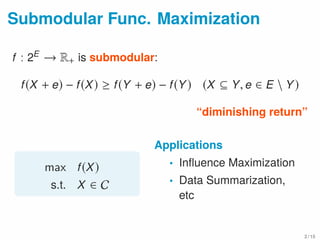
Submodular Func. Maximization
f : 2E
→ R+ is submodular:
f(X + e) − f(X) ≥ f(Y + e) − f(Y) (X ⊆ Y, e ∈ E  Y)
“diminishing return”
max f(X)
s.t. X ∈ C
Applications
• Influence Maximization
• Data Summarization,
etc
2 / 15
Multiple Criteria
3 / 15
Multiple Criteria
3 / 15
Multiple Criteria
1. coverage
3 / 15
Multiple Criteria
1. coverage
2. diversity
3 / 15
Multi-objective Optimization?
× Exponentially Many Pareto Solutions!
4 / 15
Multi-objective Optimization?
× Exponentially Many Pareto Solutions!
“Good” Subsets of Pareto Solutions
• k-representative skyline queries [Lin et al. 07,
Tao et al. 09]
• top-k dominating queries [Yiu and Mamoulis 09]
• regret minimizing database [Nanongkai et al. 10]
4 / 15
Multi-objective Optimization?
× Exponentially Many Pareto Solutions!
“Good” Subsets of Pareto Solutions
• k-representative skyline queries [Lin et al. 07,
Tao et al. 09]
• top-k dominating queries [Yiu and Mamoulis 09]
• regret minimizing database [Nanongkai et al. 10]
Issue These assume data points are explicitly given...
4 / 15
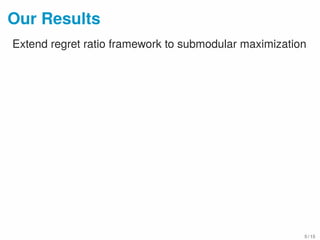
Our Results
Extend regret ratio framework to submodular maximization
5 / 15
Our Results
Extend regret ratio framework to submodular maximization
Upper Bound
Given an α-approx algorithm for (weighted) single
objective problem,
• regret ratio 1 − α/d for any d
• regret ratio 1 − α + O(1/k) for any k and d = 2.
d = # objectives, k = # of feasible solutions
5 / 15
Our Results
Extend regret ratio framework to submodular maximization
Upper Bound
Given an α-approx algorithm for (weighted) single
objective problem,
• regret ratio 1 − α/d for any d
• regret ratio 1 − α + O(1/k) for any k and d = 2.
d = # objectives, k = # of feasible solutions
Lower Bound
• Even if α = 1 and d = 2, it is impossible to achieve
regret ratio o(1/k2
).
5 / 15
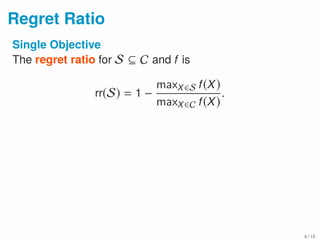
Regret Ratio
Single Objective
The regret ratio for S ⊆ C and f is
rr(S) = 1 −
maxX∈S f(X)
maxX∈C f(X)
.
6 / 15
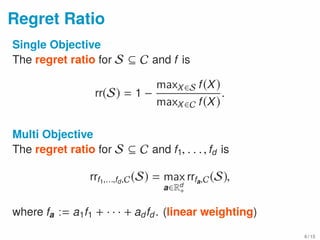
Regret Ratio
Single Objective
The regret ratio for S ⊆ C and f is
rr(S) = 1 −
maxX∈S f(X)
maxX∈C f(X)
.
Multi Objective
The regret ratio for S ⊆ C and f1, . . ., fd is
rrf1,...,fd,C(S) = max
a∈Rd
+
rrfa,C(S),
where fa := a1f1 + · · · + adfd. (linear weighting)
6 / 15
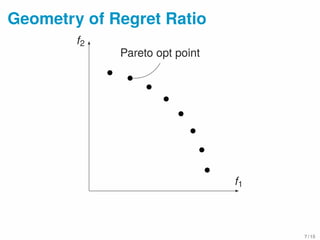
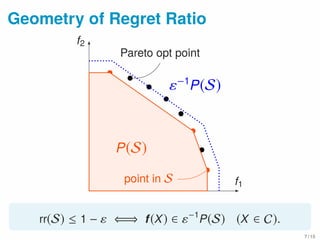
Geometry of Regret Ratio
f1
f2
Pareto opt point
7 / 15
Geometry of Regret Ratio
f1
f2
Pareto opt point
P(S)
point in S
7 / 15
Geometry of Regret Ratio
f1
f2
Pareto opt point
P(S)
point in S
ε−1
P(S)
rr(S) ≤ 1 − ε ⇐⇒ f(X) ∈ ε−1
P(S) (X ∈ C).
7 / 15
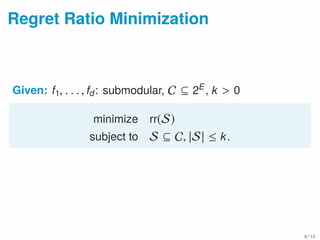
Regret Ratio Minimization
Given: f1, . . ., fd: submodular, C ⊆ 2E
, k > 0
minimize rr(S)
subject to S ⊆ C, |S| ≤ k.
8 / 15
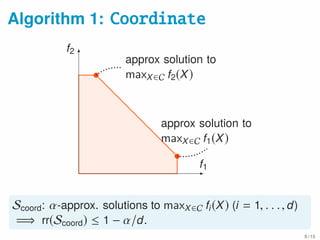
Algorithm 1: Coordinate
f1
f2
approx solution to
maxX∈C f1(X)
approx solution to
maxX∈C f2(X)
Scoord: α-approx. solutions to maxX∈C fi(X) (i = 1, . . ., d)
=⇒ rr(Scoord) ≤ 1 − α/d.
9 / 15
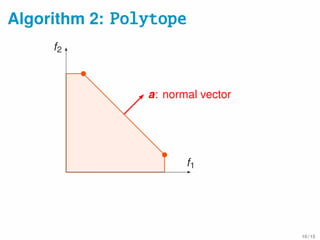
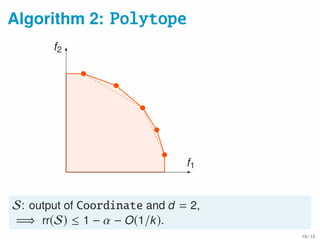
Algorithm 2: Polytope
f1
f2
a: normal vector
10 / 15
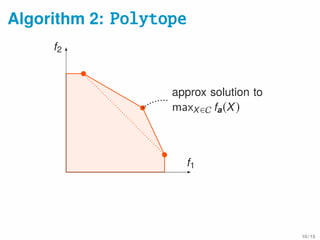
Algorithm 2: Polytope
f1
f2
approx solution to
maxX∈C fa(X)
10 / 15
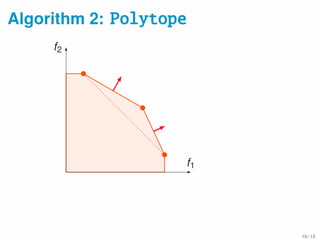
Algorithm 2: Polytope
f1
f2
10 / 15
Algorithm 2: Polytope
f1
f2
10 / 15
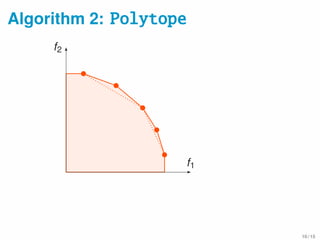
Algorithm 2: Polytope
f1
f2
S: output of Coordinate and d = 2,
=⇒ rr(S) ≤ 1 − α − O(1/k).
10 / 15
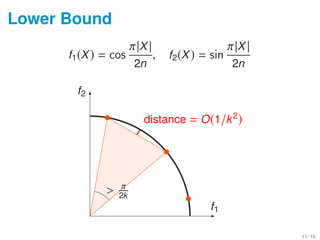
Lower Bound
f1(X) = cos
π|X|
2n
, f2(X) = sin
π|X|
2n
> π
2k
f1
f2
distance = O(1/k2
)
11 / 15
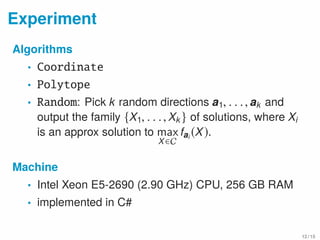
Experiment
Algorithms
• Coordinate
• Polytope
• Random: Pick k random directions a1, . . ., ak and
output the family {X1, . . ., Xk } of solutions, where Xi
is an approx solution to max
X∈C
fai
(X).
Machine
• Intel Xeon E5-2690 (2.90 GHz) CPU, 256 GB RAM
• implemented in C#
12 / 15
Data Summarization
Dataset: MovieLens
E: set of movies, si,j: similarities of movies i and j
f1(X) =
i∈E j∈X
si,j, coverage
f2(X) = λ
i∈E j∈E
si,j − λ
i∈X j∈X
si,j diversity
C = 2E
(unconstrained), 1 ≤ k ≤ 20, λ > 0,
single-objective algorithm: double greedy (1/2-approx)
[Buchbinder et al. 12]
13 / 15
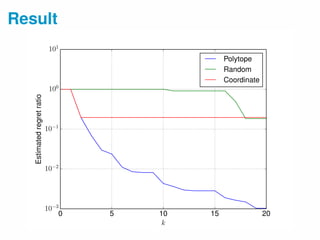
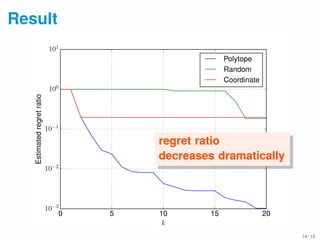
Result
0 5 10 15 20
k
10−3
10−2
10−1
100
101
Estimatedregretratio
Polytope
Random
Coordinate
Result
0 5 10 15 20
k
10−3
10−2
10−1
100
101
Estimatedregretratio
Polytope
Random
Coordinate
regret ratio
decreases dramatically
14 / 15
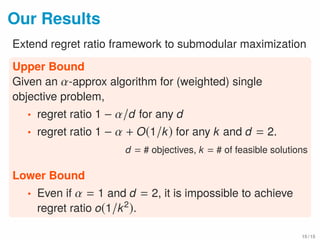
Our Results
Extend regret ratio framework to submodular maximization
Upper Bound
Given an α-approx algorithm for (weighted) single
objective problem,
• regret ratio 1 − α/d for any d
• regret ratio 1 − α + O(1/k) for any k and d = 2.
d = # objectives, k = # of feasible solutions
Lower Bound
• Even if α = 1 and d = 2, it is impossible to achieve
regret ratio o(1/k2
).
15 / 15

Regret Minimization in Multi-objective Submodular Function Maximization

  • 1.
    Regret Ratio Minimizationin Multi-objective Submodular Function Maximization P(S) a Tasuku Soma (U. Tokyo) with Yuichi Yoshida (NII & PFI) 1 / 15
  • 2.
    Submodular Func. Maximization f: 2E → R+ is submodular: f(X + e) − f(X) ≥ f(Y + e) − f(Y) (X ⊆ Y, e ∈ E Y) “diminishing return” max f(X) s.t. X ∈ C Applications • Influence Maximization • Data Summarization, etc 2 / 15
  • 3.
  • 4.
  • 5.
  • 6.
  • 7.
  • 8.
    Multi-objective Optimization? × ExponentiallyMany Pareto Solutions! “Good” Subsets of Pareto Solutions • k-representative skyline queries [Lin et al. 07, Tao et al. 09] • top-k dominating queries [Yiu and Mamoulis 09] • regret minimizing database [Nanongkai et al. 10] 4 / 15
  • 9.
    Multi-objective Optimization? × ExponentiallyMany Pareto Solutions! “Good” Subsets of Pareto Solutions • k-representative skyline queries [Lin et al. 07, Tao et al. 09] • top-k dominating queries [Yiu and Mamoulis 09] • regret minimizing database [Nanongkai et al. 10] Issue These assume data points are explicitly given... 4 / 15
  • 10.
    Our Results Extend regretratio framework to submodular maximization 5 / 15
  • 11.
    Our Results Extend regretratio framework to submodular maximization Upper Bound Given an α-approx algorithm for (weighted) single objective problem, • regret ratio 1 − α/d for any d • regret ratio 1 − α + O(1/k) for any k and d = 2. d = # objectives, k = # of feasible solutions 5 / 15
  • 12.
    Our Results Extend regretratio framework to submodular maximization Upper Bound Given an α-approx algorithm for (weighted) single objective problem, • regret ratio 1 − α/d for any d • regret ratio 1 − α + O(1/k) for any k and d = 2. d = # objectives, k = # of feasible solutions Lower Bound • Even if α = 1 and d = 2, it is impossible to achieve regret ratio o(1/k2 ). 5 / 15
  • 13.
    Regret Ratio Single Objective Theregret ratio for S ⊆ C and f is rr(S) = 1 − maxX∈S f(X) maxX∈C f(X) . 6 / 15
  • 14.
    Regret Ratio Single Objective Theregret ratio for S ⊆ C and f is rr(S) = 1 − maxX∈S f(X) maxX∈C f(X) . Multi Objective The regret ratio for S ⊆ C and f1, . . ., fd is rrf1,...,fd,C(S) = max a∈Rd + rrfa,C(S), where fa := a1f1 + · · · + adfd. (linear weighting) 6 / 15
  • 15.
    Geometry of RegretRatio f1 f2 Pareto opt point 7 / 15
  • 16.
    Geometry of RegretRatio f1 f2 Pareto opt point P(S) point in S 7 / 15
  • 17.
    Geometry of RegretRatio f1 f2 Pareto opt point P(S) point in S ε−1 P(S) rr(S) ≤ 1 − ε ⇐⇒ f(X) ∈ ε−1 P(S) (X ∈ C). 7 / 15
  • 18.
    Regret Ratio Minimization Given:f1, . . ., fd: submodular, C ⊆ 2E , k > 0 minimize rr(S) subject to S ⊆ C, |S| ≤ k. 8 / 15
  • 19.
    Algorithm 1: Coordinate f1 f2 approxsolution to maxX∈C f1(X) approx solution to maxX∈C f2(X) Scoord: α-approx. solutions to maxX∈C fi(X) (i = 1, . . ., d) =⇒ rr(Scoord) ≤ 1 − α/d. 9 / 15
  • 20.
    Algorithm 2: Polytope f1 f2 a:normal vector 10 / 15
  • 21.
    Algorithm 2: Polytope f1 f2 approxsolution to maxX∈C fa(X) 10 / 15
  • 22.
  • 23.
  • 24.
    Algorithm 2: Polytope f1 f2 S:output of Coordinate and d = 2, =⇒ rr(S) ≤ 1 − α − O(1/k). 10 / 15
  • 25.
    Lower Bound f1(X) =cos π|X| 2n , f2(X) = sin π|X| 2n > π 2k f1 f2 distance = O(1/k2 ) 11 / 15
  • 26.
    Experiment Algorithms • Coordinate • Polytope •Random: Pick k random directions a1, . . ., ak and output the family {X1, . . ., Xk } of solutions, where Xi is an approx solution to max X∈C fai (X). Machine • Intel Xeon E5-2690 (2.90 GHz) CPU, 256 GB RAM • implemented in C# 12 / 15
  • 27.
    Data Summarization Dataset: MovieLens E:set of movies, si,j: similarities of movies i and j f1(X) = i∈E j∈X si,j, coverage f2(X) = λ i∈E j∈E si,j − λ i∈X j∈X si,j diversity C = 2E (unconstrained), 1 ≤ k ≤ 20, λ > 0, single-objective algorithm: double greedy (1/2-approx) [Buchbinder et al. 12] 13 / 15
  • 28.
    Result 0 5 1015 20 k 10−3 10−2 10−1 100 101 Estimatedregretratio Polytope Random Coordinate
  • 29.
    Result 0 5 1015 20 k 10−3 10−2 10−1 100 101 Estimatedregretratio Polytope Random Coordinate regret ratio decreases dramatically 14 / 15
  • 30.
    Our Results Extend regretratio framework to submodular maximization Upper Bound Given an α-approx algorithm for (weighted) single objective problem, • regret ratio 1 − α/d for any d • regret ratio 1 − α + O(1/k) for any k and d = 2. d = # objectives, k = # of feasible solutions Lower Bound • Even if α = 1 and d = 2, it is impossible to achieve regret ratio o(1/k2 ). 15 / 15