1
Artificial Neural
Network
2
Lecture 4
Regression
Supervised Learning:
• Supervised Learning: Given the “right answer” for each
example in the data.
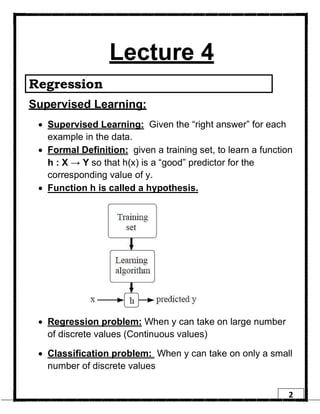
• Formal Definition: given a training set, to learn a function
h : X → Y so that h(x) is a “good” predictor for the
corresponding value of y.
• Function h is called a hypothesis.
• Regression problem: When y can take on large number
of discrete values (Continuous values)
• Classification problem: When y can take on only a small
number of discrete values
3
Regression Problem
• Regression Problem: Predict real-valued output
• Regression Types
o Linear Regression
§ One variable
§ Multiple variables
o Gradient Descent
o Logistic Regression
Linear regression with one variable - Univariate
linear regression
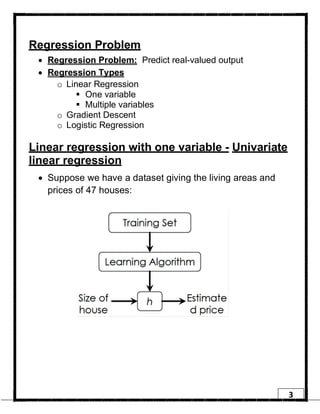
• Suppose we have a dataset giving the living areas and
prices of 47 houses:
4
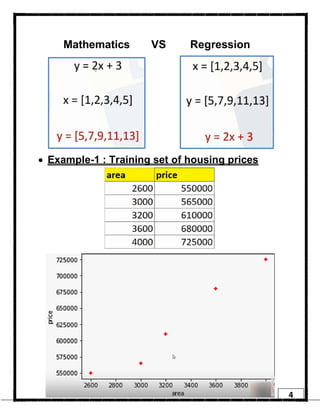
Mathematics VS Regression
• Example-1 : Training set of housing prices
5
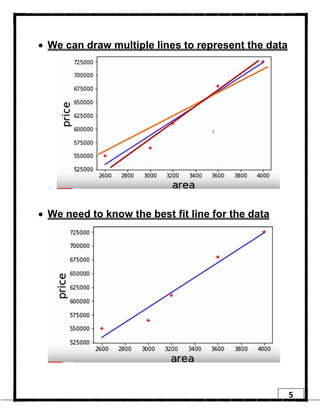
• We can draw multiple lines to represent the data
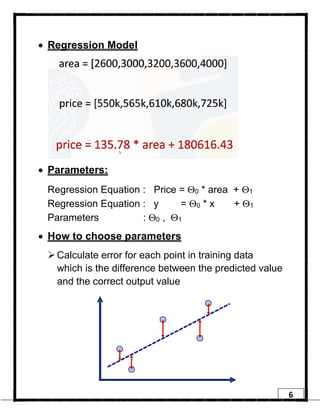
• We need to know the best fit line for the data
6
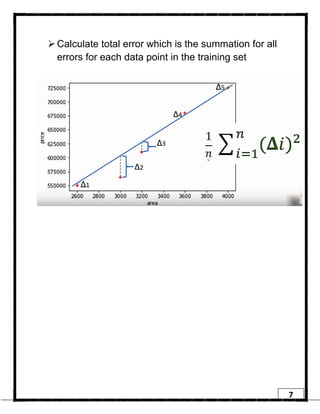
• Regression Model
• Parameters:
Regression Equation : Price = Q0 * area + Q1
Regression Equation : y = Q0 * x + Q1
Parameters : Q0 , Q1
• How to choose parameters
Ø Calculate error for each point in training data
which is the difference between the predicted value
and the correct output value
7
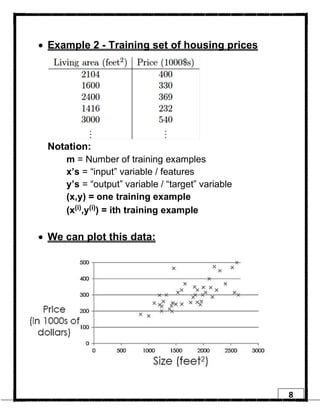
Ø Calculate total error which is the summation for all
errors for each data point in the training set
8
• Example 2 - Training set of housing prices
Notation:
m = Number of training examples
x’s = “input” variable / features
y’s = “output” variable / “target” variable
(x,y) = one training example
(x(i),y(i)) = ith training example
• We can plot this data:
9
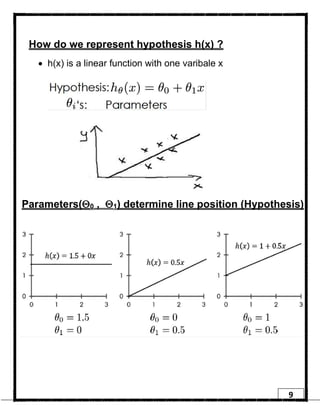
How do we represent hypothesis h(x) ?
• h(x) is a linear function with one varibale x
Parameters(Q0 , Q1) determine line position (Hypothesis)
10
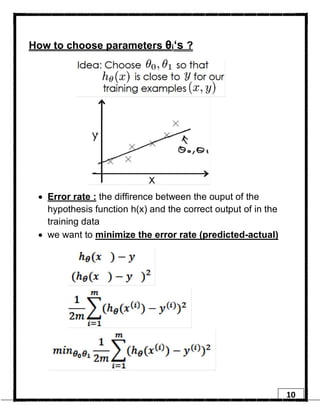
How to choose parameters θi‘s ?
• Error rate : the diffirence between the ouput of the
hypothesis function h(x) and the correct output of in the
training data
• we want to minimize the error rate (predicted-actual)
11
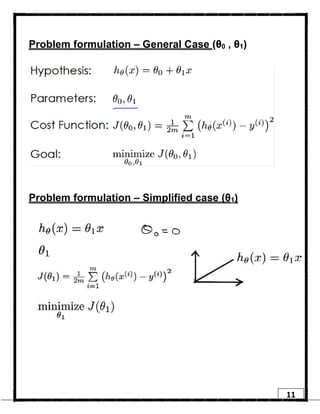
Problem formulation – General Case (θ0 , θ1)
Problem formulation – Simplified case (θ1)
12
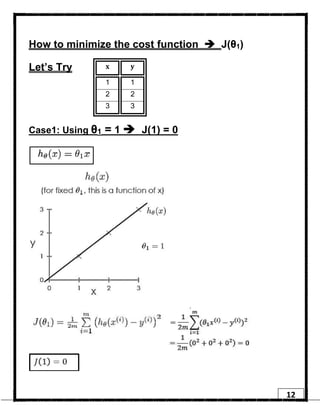
How to minimize the cost function è J(θ1)
Let’s Try
Case1: Using θ1 = 1 è J(1) = 0
x y
1 1
2 2
3 3
13
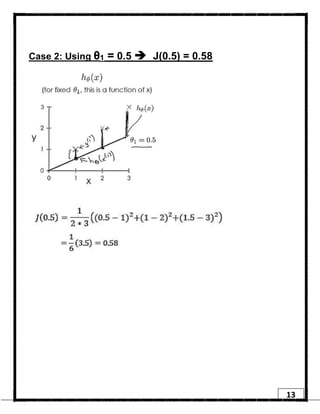
Case 2: Using θ1 = 0.5 è J(0.5) = 0.58
14
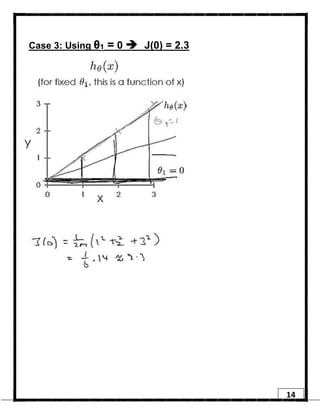
Case 3: Using θ1 = 0 è J(0) = 2.3
15
Gradient descent method
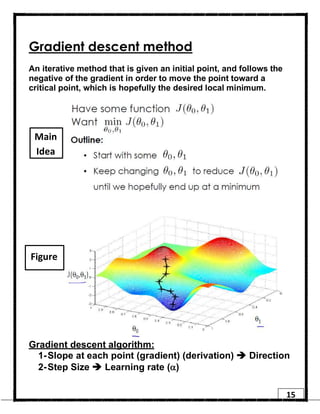
An iterative method that is given an initial point, and follows the
negative of the gradient in order to move the point toward a
critical point, which is hopefully the desired local minimum.
Gradient descent algorithm:
1-Slope at each point (gradient) (derivation) è Direction
2-Step Size è Learning rate (a)
Main
Idea
Figure
16
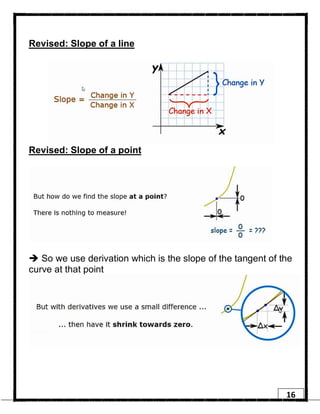
Revised: Slope of a line
Revised: Slope of a point
è So we use derivation which is the slope of the tangent of the
curve at that point
17
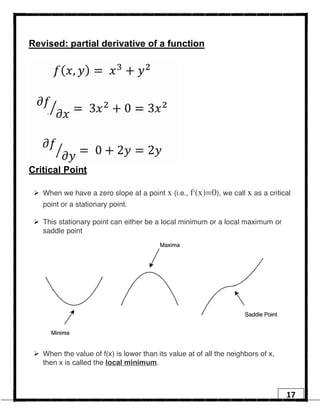
Revised: partial derivative of a function
Critical Point
Ø When we have a zero slope at a point x (i.e., f′(x)=0), we call x as a critical
point or a stationary point.
Ø This stationary point can either be a local minimum or a local maximum or
saddle point
Ø When the value of f(x) is lower than its value at of all the neighbors of x,
then x is called the local minimum.
18
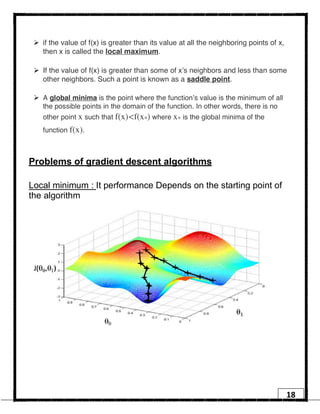
Ø if the value of f(x) is greater than its value at all the neighboring points of x,
then x is called the local maximum.
Ø If the value of f(x) is greater than some of x’s neighbors and less than some
other neighbors. Such a point is known as a saddle point.
Ø A global minima is the point where the function’s value is the minimum of all
the possible points in the domain of the function. In other words, there is no
other point x such that f(x)<f(x∗) where x∗ is the global minima of the
function f(x).
Problems of gradient descent algorithms
Local minimum : It performance Depends on the starting point of
the algorithm
19
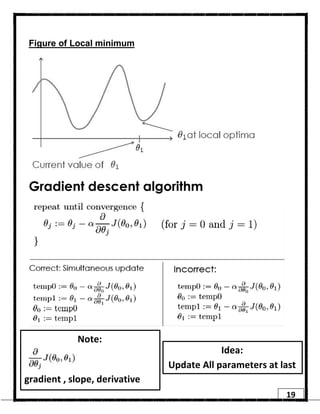
Figure of Local minimum
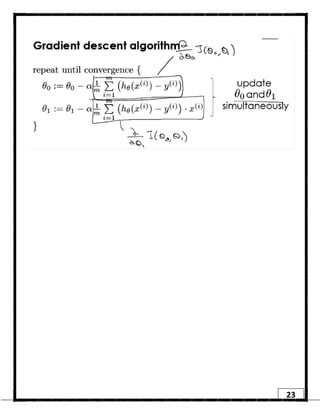
Gradient descent algorithm
Idea:
Update All parameters at last
Note:
gradient , slope, derivative
20
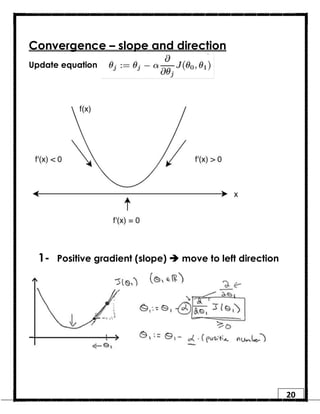
Convergence – slope and direction
Update equation
1- Positive gradient (slope) è move to left direction
21
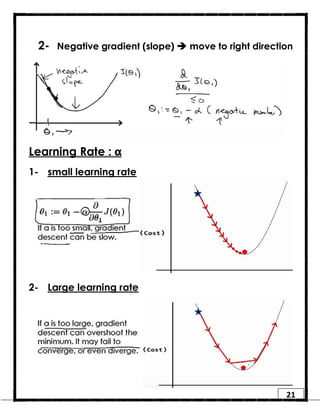
2- Negative gradient (slope) è move to right direction
Learning Rate : α
1- small learning rate
2- Large learning rate
22
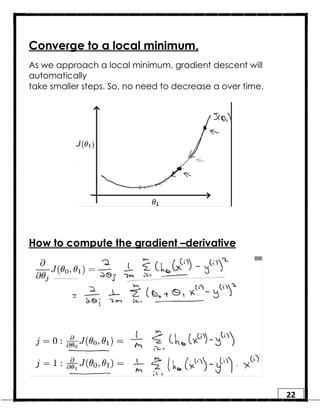
Converge to a local minimum,
As we approach a local minimum, gradient descent will
automatically
take smaller steps. So, no need to decrease α over time.
How to compute the gradient –derivative
23

Regression_1.pdf

  • 1.
  • 2.
    2 Lecture 4 Regression Supervised Learning: •Supervised Learning: Given the “right answer” for each example in the data. • Formal Definition: given a training set, to learn a function h : X → Y so that h(x) is a “good” predictor for the corresponding value of y. • Function h is called a hypothesis. • Regression problem: When y can take on large number of discrete values (Continuous values) • Classification problem: When y can take on only a small number of discrete values
  • 3.
    3 Regression Problem • RegressionProblem: Predict real-valued output • Regression Types o Linear Regression § One variable § Multiple variables o Gradient Descent o Logistic Regression Linear regression with one variable - Univariate linear regression • Suppose we have a dataset giving the living areas and prices of 47 houses:
  • 4.
    4 Mathematics VS Regression •Example-1 : Training set of housing prices
  • 5.
    5 • We candraw multiple lines to represent the data • We need to know the best fit line for the data
  • 6.
    6 • Regression Model •Parameters: Regression Equation : Price = Q0 * area + Q1 Regression Equation : y = Q0 * x + Q1 Parameters : Q0 , Q1 • How to choose parameters Ø Calculate error for each point in training data which is the difference between the predicted value and the correct output value
  • 7.
    7 Ø Calculate totalerror which is the summation for all errors for each data point in the training set
  • 8.
    8 • Example 2- Training set of housing prices Notation: m = Number of training examples x’s = “input” variable / features y’s = “output” variable / “target” variable (x,y) = one training example (x(i),y(i)) = ith training example • We can plot this data:
  • 9.
    9 How do werepresent hypothesis h(x) ? • h(x) is a linear function with one varibale x Parameters(Q0 , Q1) determine line position (Hypothesis)
  • 10.
    10 How to chooseparameters θi‘s ? • Error rate : the diffirence between the ouput of the hypothesis function h(x) and the correct output of in the training data • we want to minimize the error rate (predicted-actual)
  • 11.
    11 Problem formulation –General Case (θ0 , θ1) Problem formulation – Simplified case (θ1)
  • 12.
    12 How to minimizethe cost function è J(θ1) Let’s Try Case1: Using θ1 = 1 è J(1) = 0 x y 1 1 2 2 3 3
  • 13.
    13 Case 2: Usingθ1 = 0.5 è J(0.5) = 0.58
  • 14.
    14 Case 3: Usingθ1 = 0 è J(0) = 2.3
  • 15.
    15 Gradient descent method Aniterative method that is given an initial point, and follows the negative of the gradient in order to move the point toward a critical point, which is hopefully the desired local minimum. Gradient descent algorithm: 1-Slope at each point (gradient) (derivation) è Direction 2-Step Size è Learning rate (a) Main Idea Figure
  • 16.
    16 Revised: Slope ofa line Revised: Slope of a point è So we use derivation which is the slope of the tangent of the curve at that point
  • 17.
    17 Revised: partial derivativeof a function Critical Point Ø When we have a zero slope at a point x (i.e., f′(x)=0), we call x as a critical point or a stationary point. Ø This stationary point can either be a local minimum or a local maximum or saddle point Ø When the value of f(x) is lower than its value at of all the neighbors of x, then x is called the local minimum.
  • 18.
    18 Ø if thevalue of f(x) is greater than its value at all the neighboring points of x, then x is called the local maximum. Ø If the value of f(x) is greater than some of x’s neighbors and less than some other neighbors. Such a point is known as a saddle point. Ø A global minima is the point where the function’s value is the minimum of all the possible points in the domain of the function. In other words, there is no other point x such that f(x)<f(x∗) where x∗ is the global minima of the function f(x). Problems of gradient descent algorithms Local minimum : It performance Depends on the starting point of the algorithm
  • 19.
    19 Figure of Localminimum Gradient descent algorithm Idea: Update All parameters at last Note: gradient , slope, derivative
  • 20.
    20 Convergence – slopeand direction Update equation 1- Positive gradient (slope) è move to left direction
  • 21.
    21 2- Negative gradient(slope) è move to right direction Learning Rate : α 1- small learning rate 2- Large learning rate
  • 22.
    22 Converge to alocal minimum, As we approach a local minimum, gradient descent will automatically take smaller steps. So, no need to decrease α over time. How to compute the gradient –derivative
  • 23.