AROMATIC AMINES
Miss. Vaishnavi R. Mangrule
Sarojini College of Pharmacy, Kolhapur
Aromatic Amines
• Amines constitute an important class of organic compounds derived by
replacing one or more hydrogen atoms of ammonia molecule by alkyl
group(s) (alkylamines) and /or aryl group(s) (aromatic amines).
• In nature, they occur among proteins, vitamins, alkaloids (e.g. like opium
alkaloids morphine, codeine, nicotine alkaloid of tobacco, etc.) and
hormones.
Introduction
• Synthetic examples include polymers, dyestuffs and drugs.
• Two biologically active compounds, namely adrenaline and ephedrine, both
containing secondary amino group, are used to increase blood pressure.
• Novocain, a synthetic amino compound, is used as an anaesthetic in dentistry.
• Benadryl, a well known antihistaminic drug also contains tertiary amino group.
• Quaternary ammonium salts are used as surfactants.
• Diazonium salts are intermediates in the preparation of a variety of aromatic
compounds including dyes and starting material in the preparation of many
substituted benzene compounds (both in laboratory and in industry).
Introduction
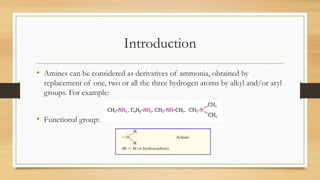
• Amines can be considered as derivatives of ammonia, obtained by
replacement of one, two or all the three hydrogen atoms by alkyl and/or aryl
groups. For example:
• Functional group:
Classification of Amines:
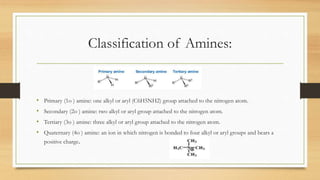
• Primary (1o ) amine: one alkyl or aryl (C6H5NH2) group attached to the nitrogen atom.
• Secondary (2o ) amine: two alkyl or aryl group attached to the nitrogen atom.
• Tertiary (3o ) amine: three alkyl or aryl group attached to the nitrogen atom.
• Quaternary (4o ) amine: an ion in which nitrogen is bonded to four alkyl or aryl groups and bears a
positive charge.
Classification of Amines:
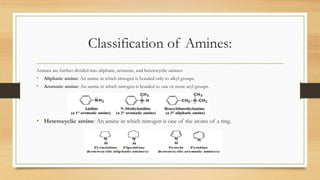
Amines are further divided into aliphatic, aromatic, and heterocyclic amines:
• Aliphatic amine: An amine in which nitrogen is bonded only to alkyl groups.
• Aromatic amine: An amine in which nitrogen is bonded to one or more aryl groups.
• Heterocyclic amine: An amine in which nitrogen is one of the atoms of a ring.
Nomenclature:
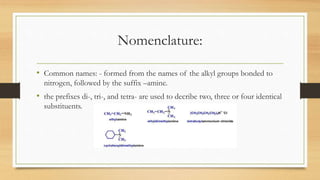
• Common names: - formed from the names of the alkyl groups bonded to
nitrogen, followed by the suffix –amine.
• the prefixes di-, tri-, and tetra- are used to decribe two, three or four identical
substituents.
Nomenclature:
IUPAC names
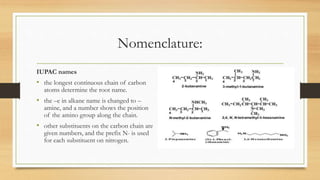
• the longest continuous chain of carbon
atoms determine the root name.
• the –e in alkane name is changed to –
amine, and a number shows the position
of the amino group along the chain.
• other substituents on the carbon chain are
given numbers, and the prefix N- is used
for each substituent on nitrogen.
Nomenclature:
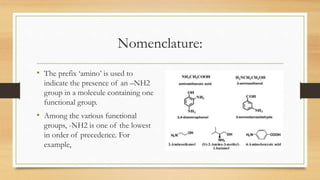
• The prefix ‘amino’ is used to
indicate the presence of an –NH2
group in a molecule containing one
functional group.
• Among the various functional
groups, -NH2 is one of the lowest
in order of precedence. For
example,
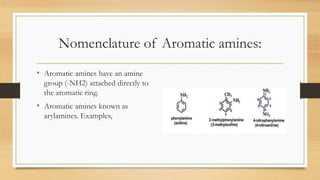
Nomenclature of Aromatic amines:
• Aromatic amines have an amine
group (-NH2) attached directly to
the aromatic ring.
• Aromatic amines known as
arylamines. Examples,
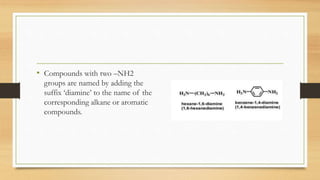
• Compounds with two –NH2
groups are named by adding the
suffix ‘diamine’ to the name of the
corresponding alkane or aromatic
compounds.
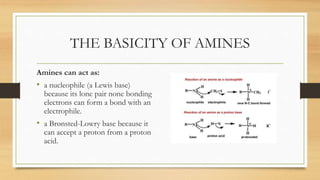
THE BASICITY OF AMINES
Amines can act as:
• a nucleophile (a Lewis base)
because its lone pair none bonding
electrons can form a bond with an
electrophile.
• a Brønsted-Lowry base because it
can accept a proton from a proton
acid.
General Reaction:
:B + H+ → + BH (conjugate acid)
• The basicity of the amines depends on the ability
of the lone pair none bonding electrons at
nitrogen atom to form bond with an acid.
• The more easier the lone pair electrons formed
bond with the acid, will make the amines a
stronger base.
• The equilibrium constant for this reaction is called
base-dissociation constant, symbolized by Kb.
• Kb = [BH+ ] /[:B] [H+ ] (Strong base have
higher values of Kb)
• pKb = - log Kb (Stronger base have smaller values
of pKb)
Factors That Affect the Basicity of the Amines
• Amines are basic because they possess a pair of
unshared electrons, which they can share with
other atoms.
• These unshared electrons create an electron
density around the nitrogen atom
• The greater the electron density, the more
basic the molecule.
• Groups that donate or supply electrons (by
means of positive inductive effect) will
increase the basicity of amines like alkyl
groups (-CH3, etc.).
• Groups that decrease the electron density
like -NO2 etc., (by means of negative
inductive effect) around the nitrogen
decrease the basicity of the molecule.
Factors That Affect the Basicity of the Amines
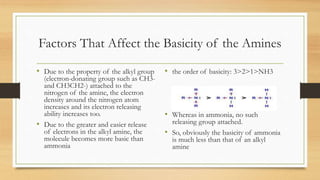
• Due to the property of the alkyl group
(electron-donating group such as CH3-
and CH3CH2-) attached to the
nitrogen of the amine, the electron
density around the nitrogen atom
increases and its electron releasing
ability increases too.
• Due to the greater and easier release
of electrons in the alkyl amine, the
molecule becomes more basic than
ammonia
• the order of basicity: 3>2>1>NH3
• Whereas in ammonia, no such
releasing group attached.
• So, obviously the basicity of ammonia
is much less than that of an alkyl
amine
Factors That Affect the Basicity of the Amines
• In comparison, the basicity of the aliphatic amines i.e. tertiary amines to be the greatest,
followed by secondary amine and then primary amine. BUT THIS IS NOT SO. The order
of basicity is NH3 < primary amine ~ tertiary amine < secondary amine respectively
because of due to
• Steric hindrance
• Hydrogen bonding or Solvation effects
Steric Hindrance
• The size of an alkyl group is more than that of a hydrogen atom.
• So, an alkyl group would hinder the attack of a hydrogen atom, thus
decreasing the basicity of the molecule.
• The more the number of alkyl groups attached, lesser will be its basicity.
• So, the decreasing order of basicity will be:
Primary amine > secondary amine > tertiary amine
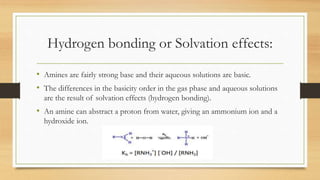
Hydrogen bonding or Solvation effects:
• Amines are fairly strong base and their aqueous solutions are basic.
• The differences in the basicity order in the gas phase and aqueous solutions
are the result of solvation effects (hydrogen bonding).
• An amine can abstract a proton from water, giving an ammonium ion and a
hydroxide ion.
• In water, the ammonium salts of primary and secondary amines undergo
solvation effects (due to hydrogen bonding) to a much greater degree than
ammonium salts of tertiary amines.
• These solvation effects increase the electron density on the amine nitrogen to
a greater degree than the inductive effect of alkyl groups.
• When amines are dissolved in water, they form protonated amines.
• Also, the number of possibilities of hydrogen bonding formation increases.
• More the number of hydrogen bonding, more is the hydration that is
released in the process of the formation of hydrogen bonds.
• The more the hydration energy of
the molecule, more is the stability
of the amine.
• Experiments have indicated, in
terms of hydration energy, that the
tertiary amines are the least stable
followed by the secondary amines
followed by the primary amines.
This can be explained on the basis of
the following reactions.
• In primary amine:
RNH2 + H2O → RNH3 + + OH
• In secondary amine:
R2NH + H2O → R2NH2 + + OH
• In tertiary amine:
R3N + H2O → R2NH+ + OH-
• So, the number of hydrogen bonds
possible when primary amines are
dissolved in water is the greatest, implying
that they are most stable species of amine,
the least being the tertiary amines.
• Conclusion: The combined effect of the pushing
effect of the alkyl group (+I effect), steric
hindrance and the salvation of amines causes the
basicity order to be: (basicity of tertiary is almost
the same as that of primary).
NH3< primary amine ~ tertiary amine < secondary
amine
Basicity of Aromatic Amines:
Aromatic amines are less basic than aliphatic amines and ammonia.
Reason:-
• pKb value of aniline (pKb: 9.4) is quite higher than ammonia (pKb: 4.7).
• It is because in aniline or other arylamines, the -NH2 group is attached directly to
the benzene ring.
• It results in the unshared electron pair on nitrogen atom to be in conjugation (The
lone pair of electrons on the nitrogen atom is delocalised into the benzene ring on
to the ortho and para posibitions) with the benzene ring and thus making it less
available for protonation.
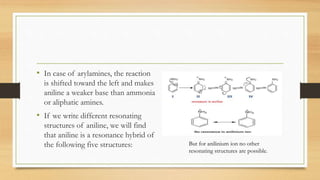
• In case of arylamines, the reaction
is shifted toward the left and makes
aniline a weaker base than ammonia
or aliphatic amines.
• If we write different resonating
structures of aniline, we will find
that aniline is a resonance hybrid of
the following five structures: But for anilinium ion no other
resonating structures are possible.
• We know that greater the number of
resonating structures, greater is the
stability.
• Thus you can infer that aniline is more
stable than anilinium ion.
• Hence, the proton acceptability or the
basic nature of aniline or other
aromatic amines would be less than
that of ammonia.
• Other factor(s) to consider in
comparison is that the greater electron
withdrawing inductive effect of the
sp2 -hybridized carbon of an aromatic
amine compared with that of the sp3 -
hybridized carbon of an aliphatic
amine.
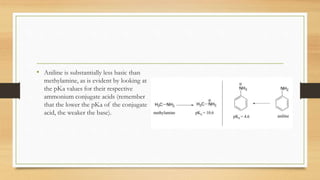
• Aniline is substantially less basic than
methylamine, as is evident by looking at
the pKa values for their respective
ammonium conjugate acids (remember
that the lower the pKa of the conjugate
acid, the weaker the base).
Compare the basicity of aniline with cyclohexylamine
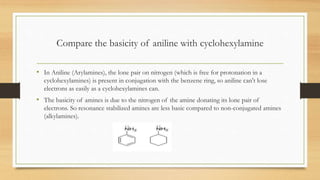
• In Aniline (Arylamines), the lone pair on nitrogen (which is free for protonation in a
cyclohexylamines) is present in conjugation with the benzene ring, so aniline can't lose
electrons as easily as a cyclohexylamines can.
• The basicity of amines is due to the nitrogen of the amine donating its lone pair of
electrons. So resonance stabilized amines are less basic compared to non-conjugated amines
(alkylamines).
• In case of substituted aniline, it is observed that electron releasing groups like –
OCH3, –CH3 increase basic strength whereas electron withdrawing groups like –
NO2, –SO3H, –COOH, -CHO, & –X (X:halogen) decrease it by a combination of
resonance and inductive effects.
• Anything ortho to the amine, no matter whether it is electron donating or
withdrawing, will decrease the basicity of the aromatic amine.
• This is because of the ortho effect, which is basically sterics.
• The protonated amine will have a greater steric interaction with the ortho group, so
it will be less stable.
Reactions of Amines:
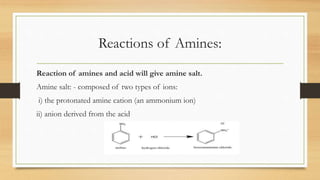
Reaction of amines and acid will give amine salt.
Amine salt: - composed of two types of ions:
i) the protonated amine cation (an ammonium ion)
ii) anion derived from the acid
Reaction with nitrous acid:
• Nitrous acid (HNO2) is unstable and is prepared in situ by
the reaction of dilute HCl or dilute H2SO4 with sodium
nitrite in the absence of heat.
NaNO2 (s) + HCl (aq) → NaCl (aq) + O=N-OH (aq)
nitrous acid
• Nitrous acid can be used to differentiate primary, secondary
and tertiary aliphatic amines.
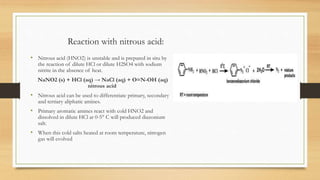
• Primary aromatic amines react with cold HNO2 and
dissolved in dilute HCl at 0-5° C will produced diazonium
salt.
• When this cold salts heated at room temperature, nitrogen
gas will evolved
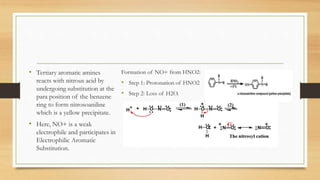
• Tertiary aromatic amines
reacts with nitrous acid by
undergoing substitution at the
para position of the benzene
ring to form nitrosoaniline
which is a yellow precipitate.
• Here, NO+ is a weak
electrophile and participates in
Electrophilic Aromatic
Substitution.
Formation of NO+ from HNO2:
• Step 1: Protonation of HNO2
• Step 2: Loss of H2O.
Acylation
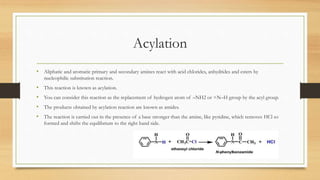
• Aliphatic and aromatic primary and secondary amines react with acid chlorides, anhydrides and esters by
nucleophilic substitution reaction.
• This reaction is known as acylation.
• You can consider this reaction as the replacement of hydrogen atom of –NH2 or >N–H group by the acyl group.
• The products obtained by acylation reaction are known as amides.
• The reaction is carried out in the presence of a base stronger than the amine, like pyridine, which removes HCl so
formed and shifts the equilibrium to the right hand side.
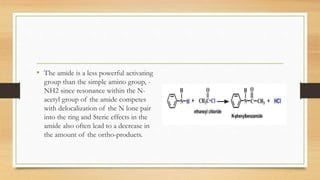
• The amide is a less powerful activating
group than the simple amino group, -
NH2 since resonance within the N-
acetyl group of the amide competes
with delocalization of the N lone pair
into the ring and Steric effects in the
amide also often lead to a decrease in
the amount of the ortho-products.
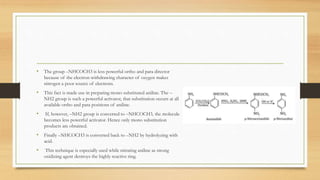
• The group –NHCOCH3 is less powerful ortho and para director
because of the electron-withdrawing character of oxygen makes
nitrogen a poor source of electrons.
• This fact is made use in preparing mono substituted aniline. The –
NH2 group is such a powerful activator, that substitution occurs at all
available ortho and para positions of aniline.
• If, however, –NH2 group is converted to –NHCOCH3, the molecule
becomes less powerful activator. Hence only mono substitution
products are obtained.
• Finally –NHCOCH3 is converted back to –NH2 by hydrolyzing with
acid.
• This technique is especially used while nitrating aniline as strong
oxidizing agent destroys the highly reactive ring.
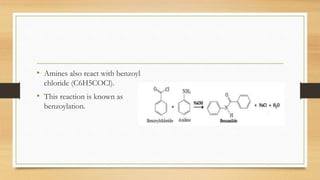
• Amines also react with benzoyl
chloride (C6H5COCl).
• This reaction is known as
benzoylation.
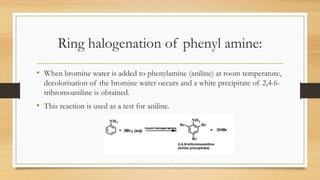
Ring halogenation of phenyl amine:
• When bromine water is added to phenylamine (aniline) at room temperature,
decolorisation of the bromine water occurs and a white precipitate of 2,4-6-
tribromoaniline is obtained.
• This reaction is used as a test for aniline.
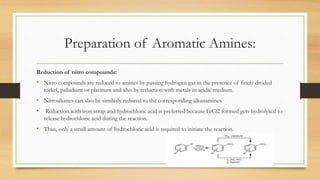
Preparation of Aromatic Amines:
Reduction of nitro compounds:
• Nitro compounds are reduced to amines by passing hydrogen gas in the presence of finely divided
nickel, palladium or platinum and also by reduction with metals in acidic medium.
• Nitroalkanes can also be similarly reduced to the corresponding alkanamines.
• Reduction with iron scrap and hydrochloric acid is preferred because FeCl2 formed gets hydrolysed to
release hydrochloric acid during the reaction.
• Thus, only a small amount of hydrochloric acid is required to initiate the reaction.
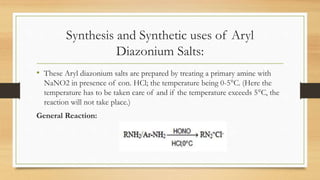
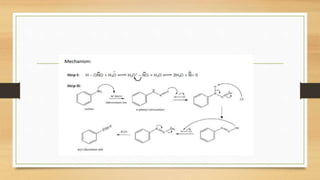
Synthesis and Synthetic uses of Aryl
Diazonium Salts:
• These Aryl diazonium salts are prepared by treating a primary amine with
NaNO2 in presence of con. HCl; the temperature being 0-5°C. (Here the
temperature has to be taken care of and if the temperature exceeds 5°C, the
reaction will not take place.)
General Reaction:
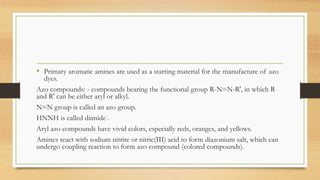
• Primary aromatic amines are used as a starting material for the manufacture of azo
dyes.
Azo compounds: - compounds bearing the functional group R-N=N-R', in which R
and R' can be either aryl or alkyl.
N=N group is called an azo group.
HNNH is called diimide .
Aryl azo compounds have vivid colors, especially reds, oranges, and yellows.
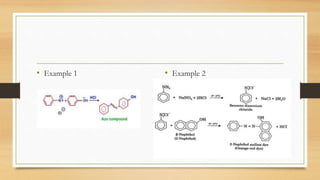
Amines react with sodium nitrite or nitric(III) acid to form diazonium salt, which can
undergo coupling reaction to form azo compound (colored compounds).
• Example 1 • Example 2
Uses
• Azo-compounds are highly coloured, they are widely used in dyeing industries, such as:
• i) Methyl orange ii) Direct brown 138 iii) Sunset yellow FCF.
• Methyl orange - used as acid-base indicators due to the different colors of their acid and salt
forms.
• Artist’s paints – clays, yellow to red range.
• Dye in food and textiles Uses and important of azo dye.
• EXAMPLES OF AZO DYES USED IN FOOD:
E102: Tartrazine, E107 : Yellow 2G, E110 : Sunset Yellow, E122 : Azorubine, E123: Amaranth,
E124 : Ponceau 4R, E129 : Allura Red & E151 : Brilliant Black.
AROMATIC AMINES .pptx

AROMATIC AMINES .pptx

  • 1.
    AROMATIC AMINES Miss. VaishnaviR. Mangrule Sarojini College of Pharmacy, Kolhapur
  • 2.
    Aromatic Amines • Aminesconstitute an important class of organic compounds derived by replacing one or more hydrogen atoms of ammonia molecule by alkyl group(s) (alkylamines) and /or aryl group(s) (aromatic amines). • In nature, they occur among proteins, vitamins, alkaloids (e.g. like opium alkaloids morphine, codeine, nicotine alkaloid of tobacco, etc.) and hormones.
  • 3.
    Introduction • Synthetic examplesinclude polymers, dyestuffs and drugs. • Two biologically active compounds, namely adrenaline and ephedrine, both containing secondary amino group, are used to increase blood pressure. • Novocain, a synthetic amino compound, is used as an anaesthetic in dentistry. • Benadryl, a well known antihistaminic drug also contains tertiary amino group. • Quaternary ammonium salts are used as surfactants. • Diazonium salts are intermediates in the preparation of a variety of aromatic compounds including dyes and starting material in the preparation of many substituted benzene compounds (both in laboratory and in industry).
  • 4.
    Introduction • Amines canbe considered as derivatives of ammonia, obtained by replacement of one, two or all the three hydrogen atoms by alkyl and/or aryl groups. For example: • Functional group:
  • 5.
    Classification of Amines: •Primary (1o ) amine: one alkyl or aryl (C6H5NH2) group attached to the nitrogen atom. • Secondary (2o ) amine: two alkyl or aryl group attached to the nitrogen atom. • Tertiary (3o ) amine: three alkyl or aryl group attached to the nitrogen atom. • Quaternary (4o ) amine: an ion in which nitrogen is bonded to four alkyl or aryl groups and bears a positive charge.
  • 6.
    Classification of Amines: Aminesare further divided into aliphatic, aromatic, and heterocyclic amines: • Aliphatic amine: An amine in which nitrogen is bonded only to alkyl groups. • Aromatic amine: An amine in which nitrogen is bonded to one or more aryl groups. • Heterocyclic amine: An amine in which nitrogen is one of the atoms of a ring.
  • 7.
    Nomenclature: • Common names:- formed from the names of the alkyl groups bonded to nitrogen, followed by the suffix –amine. • the prefixes di-, tri-, and tetra- are used to decribe two, three or four identical substituents.
  • 8.
    Nomenclature: IUPAC names • thelongest continuous chain of carbon atoms determine the root name. • the –e in alkane name is changed to – amine, and a number shows the position of the amino group along the chain. • other substituents on the carbon chain are given numbers, and the prefix N- is used for each substituent on nitrogen.
  • 9.
    Nomenclature: • The prefix‘amino’ is used to indicate the presence of an –NH2 group in a molecule containing one functional group. • Among the various functional groups, -NH2 is one of the lowest in order of precedence. For example,
  • 10.
    Nomenclature of Aromaticamines: • Aromatic amines have an amine group (-NH2) attached directly to the aromatic ring. • Aromatic amines known as arylamines. Examples,
  • 11.
    • Compounds withtwo –NH2 groups are named by adding the suffix ‘diamine’ to the name of the corresponding alkane or aromatic compounds.
  • 12.
    THE BASICITY OFAMINES Amines can act as: • a nucleophile (a Lewis base) because its lone pair none bonding electrons can form a bond with an electrophile. • a Brønsted-Lowry base because it can accept a proton from a proton acid.
  • 13.
    General Reaction: :B +H+ → + BH (conjugate acid) • The basicity of the amines depends on the ability of the lone pair none bonding electrons at nitrogen atom to form bond with an acid. • The more easier the lone pair electrons formed bond with the acid, will make the amines a stronger base. • The equilibrium constant for this reaction is called base-dissociation constant, symbolized by Kb. • Kb = [BH+ ] /[:B] [H+ ] (Strong base have higher values of Kb) • pKb = - log Kb (Stronger base have smaller values of pKb)
  • 14.
    Factors That Affectthe Basicity of the Amines • Amines are basic because they possess a pair of unshared electrons, which they can share with other atoms. • These unshared electrons create an electron density around the nitrogen atom • The greater the electron density, the more basic the molecule. • Groups that donate or supply electrons (by means of positive inductive effect) will increase the basicity of amines like alkyl groups (-CH3, etc.). • Groups that decrease the electron density like -NO2 etc., (by means of negative inductive effect) around the nitrogen decrease the basicity of the molecule.
  • 15.
    Factors That Affectthe Basicity of the Amines • Due to the property of the alkyl group (electron-donating group such as CH3- and CH3CH2-) attached to the nitrogen of the amine, the electron density around the nitrogen atom increases and its electron releasing ability increases too. • Due to the greater and easier release of electrons in the alkyl amine, the molecule becomes more basic than ammonia • the order of basicity: 3>2>1>NH3 • Whereas in ammonia, no such releasing group attached. • So, obviously the basicity of ammonia is much less than that of an alkyl amine
  • 16.
    Factors That Affectthe Basicity of the Amines • In comparison, the basicity of the aliphatic amines i.e. tertiary amines to be the greatest, followed by secondary amine and then primary amine. BUT THIS IS NOT SO. The order of basicity is NH3 < primary amine ~ tertiary amine < secondary amine respectively because of due to • Steric hindrance • Hydrogen bonding or Solvation effects
  • 17.
    Steric Hindrance • Thesize of an alkyl group is more than that of a hydrogen atom. • So, an alkyl group would hinder the attack of a hydrogen atom, thus decreasing the basicity of the molecule. • The more the number of alkyl groups attached, lesser will be its basicity. • So, the decreasing order of basicity will be: Primary amine > secondary amine > tertiary amine
  • 18.
    Hydrogen bonding orSolvation effects: • Amines are fairly strong base and their aqueous solutions are basic. • The differences in the basicity order in the gas phase and aqueous solutions are the result of solvation effects (hydrogen bonding). • An amine can abstract a proton from water, giving an ammonium ion and a hydroxide ion.
  • 19.
    • In water,the ammonium salts of primary and secondary amines undergo solvation effects (due to hydrogen bonding) to a much greater degree than ammonium salts of tertiary amines. • These solvation effects increase the electron density on the amine nitrogen to a greater degree than the inductive effect of alkyl groups.
  • 20.
    • When aminesare dissolved in water, they form protonated amines. • Also, the number of possibilities of hydrogen bonding formation increases. • More the number of hydrogen bonding, more is the hydration that is released in the process of the formation of hydrogen bonds.
  • 21.
    • The morethe hydration energy of the molecule, more is the stability of the amine. • Experiments have indicated, in terms of hydration energy, that the tertiary amines are the least stable followed by the secondary amines followed by the primary amines. This can be explained on the basis of the following reactions. • In primary amine: RNH2 + H2O → RNH3 + + OH • In secondary amine: R2NH + H2O → R2NH2 + + OH • In tertiary amine: R3N + H2O → R2NH+ + OH-
  • 22.
    • So, thenumber of hydrogen bonds possible when primary amines are dissolved in water is the greatest, implying that they are most stable species of amine, the least being the tertiary amines. • Conclusion: The combined effect of the pushing effect of the alkyl group (+I effect), steric hindrance and the salvation of amines causes the basicity order to be: (basicity of tertiary is almost the same as that of primary). NH3< primary amine ~ tertiary amine < secondary amine
  • 23.
    Basicity of AromaticAmines: Aromatic amines are less basic than aliphatic amines and ammonia. Reason:- • pKb value of aniline (pKb: 9.4) is quite higher than ammonia (pKb: 4.7). • It is because in aniline or other arylamines, the -NH2 group is attached directly to the benzene ring. • It results in the unshared electron pair on nitrogen atom to be in conjugation (The lone pair of electrons on the nitrogen atom is delocalised into the benzene ring on to the ortho and para posibitions) with the benzene ring and thus making it less available for protonation.
  • 24.
    • In caseof arylamines, the reaction is shifted toward the left and makes aniline a weaker base than ammonia or aliphatic amines. • If we write different resonating structures of aniline, we will find that aniline is a resonance hybrid of the following five structures: But for anilinium ion no other resonating structures are possible.
  • 25.
    • We knowthat greater the number of resonating structures, greater is the stability. • Thus you can infer that aniline is more stable than anilinium ion. • Hence, the proton acceptability or the basic nature of aniline or other aromatic amines would be less than that of ammonia. • Other factor(s) to consider in comparison is that the greater electron withdrawing inductive effect of the sp2 -hybridized carbon of an aromatic amine compared with that of the sp3 - hybridized carbon of an aliphatic amine.
  • 26.
    • Aniline issubstantially less basic than methylamine, as is evident by looking at the pKa values for their respective ammonium conjugate acids (remember that the lower the pKa of the conjugate acid, the weaker the base).
  • 27.
    Compare the basicityof aniline with cyclohexylamine • In Aniline (Arylamines), the lone pair on nitrogen (which is free for protonation in a cyclohexylamines) is present in conjugation with the benzene ring, so aniline can't lose electrons as easily as a cyclohexylamines can. • The basicity of amines is due to the nitrogen of the amine donating its lone pair of electrons. So resonance stabilized amines are less basic compared to non-conjugated amines (alkylamines).
  • 28.
    • In caseof substituted aniline, it is observed that electron releasing groups like – OCH3, –CH3 increase basic strength whereas electron withdrawing groups like – NO2, –SO3H, –COOH, -CHO, & –X (X:halogen) decrease it by a combination of resonance and inductive effects. • Anything ortho to the amine, no matter whether it is electron donating or withdrawing, will decrease the basicity of the aromatic amine. • This is because of the ortho effect, which is basically sterics. • The protonated amine will have a greater steric interaction with the ortho group, so it will be less stable.
  • 29.
    Reactions of Amines: Reactionof amines and acid will give amine salt. Amine salt: - composed of two types of ions: i) the protonated amine cation (an ammonium ion) ii) anion derived from the acid
  • 30.
    Reaction with nitrousacid: • Nitrous acid (HNO2) is unstable and is prepared in situ by the reaction of dilute HCl or dilute H2SO4 with sodium nitrite in the absence of heat. NaNO2 (s) + HCl (aq) → NaCl (aq) + O=N-OH (aq) nitrous acid • Nitrous acid can be used to differentiate primary, secondary and tertiary aliphatic amines. • Primary aromatic amines react with cold HNO2 and dissolved in dilute HCl at 0-5° C will produced diazonium salt. • When this cold salts heated at room temperature, nitrogen gas will evolved
  • 31.
    • Tertiary aromaticamines reacts with nitrous acid by undergoing substitution at the para position of the benzene ring to form nitrosoaniline which is a yellow precipitate. • Here, NO+ is a weak electrophile and participates in Electrophilic Aromatic Substitution. Formation of NO+ from HNO2: • Step 1: Protonation of HNO2 • Step 2: Loss of H2O.
  • 32.
    Acylation • Aliphatic andaromatic primary and secondary amines react with acid chlorides, anhydrides and esters by nucleophilic substitution reaction. • This reaction is known as acylation. • You can consider this reaction as the replacement of hydrogen atom of –NH2 or >N–H group by the acyl group. • The products obtained by acylation reaction are known as amides. • The reaction is carried out in the presence of a base stronger than the amine, like pyridine, which removes HCl so formed and shifts the equilibrium to the right hand side.
  • 33.
    • The amideis a less powerful activating group than the simple amino group, - NH2 since resonance within the N- acetyl group of the amide competes with delocalization of the N lone pair into the ring and Steric effects in the amide also often lead to a decrease in the amount of the ortho-products.
  • 34.
    • The group–NHCOCH3 is less powerful ortho and para director because of the electron-withdrawing character of oxygen makes nitrogen a poor source of electrons. • This fact is made use in preparing mono substituted aniline. The – NH2 group is such a powerful activator, that substitution occurs at all available ortho and para positions of aniline. • If, however, –NH2 group is converted to –NHCOCH3, the molecule becomes less powerful activator. Hence only mono substitution products are obtained. • Finally –NHCOCH3 is converted back to –NH2 by hydrolyzing with acid. • This technique is especially used while nitrating aniline as strong oxidizing agent destroys the highly reactive ring.
  • 35.
    • Amines alsoreact with benzoyl chloride (C6H5COCl). • This reaction is known as benzoylation.
  • 36.
    Ring halogenation ofphenyl amine: • When bromine water is added to phenylamine (aniline) at room temperature, decolorisation of the bromine water occurs and a white precipitate of 2,4-6- tribromoaniline is obtained. • This reaction is used as a test for aniline.
  • 37.
    Preparation of AromaticAmines: Reduction of nitro compounds: • Nitro compounds are reduced to amines by passing hydrogen gas in the presence of finely divided nickel, palladium or platinum and also by reduction with metals in acidic medium. • Nitroalkanes can also be similarly reduced to the corresponding alkanamines. • Reduction with iron scrap and hydrochloric acid is preferred because FeCl2 formed gets hydrolysed to release hydrochloric acid during the reaction. • Thus, only a small amount of hydrochloric acid is required to initiate the reaction.
  • 38.
    Synthesis and Syntheticuses of Aryl Diazonium Salts: • These Aryl diazonium salts are prepared by treating a primary amine with NaNO2 in presence of con. HCl; the temperature being 0-5°C. (Here the temperature has to be taken care of and if the temperature exceeds 5°C, the reaction will not take place.) General Reaction:
  • 40.
    • Primary aromaticamines are used as a starting material for the manufacture of azo dyes. Azo compounds: - compounds bearing the functional group R-N=N-R', in which R and R' can be either aryl or alkyl. N=N group is called an azo group. HNNH is called diimide . Aryl azo compounds have vivid colors, especially reds, oranges, and yellows. Amines react with sodium nitrite or nitric(III) acid to form diazonium salt, which can undergo coupling reaction to form azo compound (colored compounds).
  • 41.
    • Example 1• Example 2
  • 42.
    Uses • Azo-compounds arehighly coloured, they are widely used in dyeing industries, such as: • i) Methyl orange ii) Direct brown 138 iii) Sunset yellow FCF. • Methyl orange - used as acid-base indicators due to the different colors of their acid and salt forms. • Artist’s paints – clays, yellow to red range. • Dye in food and textiles Uses and important of azo dye. • EXAMPLES OF AZO DYES USED IN FOOD: E102: Tartrazine, E107 : Yellow 2G, E110 : Sunset Yellow, E122 : Azorubine, E123: Amaranth, E124 : Ponceau 4R, E129 : Allura Red & E151 : Brilliant Black.