Criteria Air Pollutants
and Ambient Air Monitoring

Topics for Discussion
• Air pollutants regulated by the EPA
• Ozone – sources, chemistry, standard,
sampling, air monitor works
• Instrumentation
• Meteorology
• How data is collected/stored
• Locating a monitor
• Documentation/Analysis of data

1
Criteria Pollutants
•
•
•
•
•
•
•
•
•

Ozone
Carbon Monoxide
http://www.epa.gov/airquality/carbonmonoxide/pdfs/COFactShe
etAugust12v4.pdf
Lead
Nitrogen Oxides (NO, NO2)
Particulate Matter (PM10)/Particulate Matter (PM2.5)
Sulfur Oxides
Reference: http://www.epa.gov/air/criteria.html
Note: covered under 40CFR part 50

National Ambient Air Quality
Standards (NAAQS)

2
Brief comment: Ozone
• Stratospheric ozone
protects us from the
UV rays of the sun.
• Ground level ozone
at high
concentrations can
irritate the
respiratory tract and
damage plant life in
high concentrations.

How is O3 created?

3
Chemistry of Ozone

VOCs + NOx + Sunlight + Heat = Ozone

Night Time O3 Chemistry

4
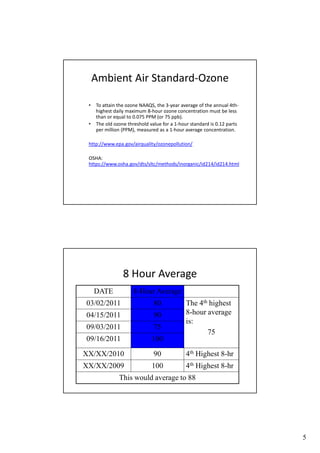
Ambient Air Standard-Ozone
•

•

To attain the ozone NAAQS, the 3-year average of the annual 4thhighest daily maximum 8-hour ozone concentration must be less
than or equal to 0.075 PPM (or 75 ppb).
The old ozone threshold value for a 1-hour standard is 0.12 parts
per million (PPM), measured as a 1-hour average concentration.

http://www.epa.gov/airquality/ozonepollution/
OSHA:
https://www.osha.gov/dts/sltc/methods/inorganic/id214/id214.html

8 Hour Average
DATE

8-Hour Average

03/02/2011

80

04/15/2011

90

09/03/2011

75

09/16/2011

100

XX/XX/2010

90

4th Highest 8-hr

XX/XX/2009

100

4th Highest 8-hr

The 4th highest
8-hour average
is:
75

This would average to 88

5
Schematic Diagram Ozone Monitor
Air Pump

Thermistor

Hg Lamp
254nm

Absorption Cell

Photodiode

Pressure Sensor
Solenoid Valve

Ozone
Scrubber

Air Inlet

Ozone Monitors
Rack mount with ozone
transfer standard instrument
and ozone monitor.

6
Instruments for other Pollutants
• Criteria pollutants: Ozone, SO2, NOx, CO
• Other pollutants: NH3, H2S, CO2, NOy, Total
Hydrocarbon
• VOC (volatile organic compounds)
• Laser/IR systems also used.

Air Monitor – Basic Principles
• Chemiluminescence
• UV flourescence
• Beer’s law

7
Chemiluminescence
The chemiluminescence reaction of NO to NO2:
NO + O3 ==> NO2+ O2 + hv

http://www.k2bw.com/chemiluminescence.htm

Variations of chemiluminescence have been used to
perfom measurements of Ammonia (NH3):
NH3 + O2 ==> NO + H2O
or:
4NH3 + 5O2 = 4NO + 6H2O
then:
4NO + 4O3 -------->4NO2+4O2 + 4hv
Schematic of a reaction chamber under vacuum and a
Photomultiplier tube (PMT) for detection.

Principle - UV fluorescence

Principle - UV fluorescence
The UV fluorescence method operates on the principle that when the SO2 molecules contained in the sample gas
are excited by ultraviolet radiation they emit a characteristic fluorescence in the range of 220- 240 nm. This
fluorescence is measured and the SO2 concentration is obtained from changes in the intensity of the
fluorescence.
The reactive mechanism is:
(1)SO2 + hv1 ¤ SO2*
(2)SO2* ¤SO + (O)
(3)SO2* ¤ SO2 + hv2
(4)SO2*+ M ¤ SO2 + M
Here, (1) shows the excited state of the SO2 molecules that have absorbed the amount of energy hv1 by
ultraviolet radiation.
(2) shows the amount of energy, hv2 emitted by the excited molecules as they return to the ground state. (3)
shows the decomposition by the light emitted from the excited molecules. (4) shows the quenching, i.e., the
energy lost by the excited molecules colliding with other molecules.

http://www.horiba.co.uk/apsa360.htm

8
Beer’s Law
Many compounds absorb ultraviolet (UV) or visible (Vis.) light. The diagram below shows a beam of monochromatic
radiation of radiant power P0, directed at a sample solution. Absorption takes place and the beam of radiation
leaving the sample has radiant power P.

The amount of radiation absorbed may be measured in a number of ways: Transmittance, T = P /
P0
% Transmittance, %T = 100 T Absorbance, A = log10 P0 / P
A = log10 1 / T
A = log10 100 / %T
A = 2 - log10 %T
http://teaching.shu.ac.uk/hwb/chemistry/tutorials/molspec/beers1.htm

Calibration-Ozone

9
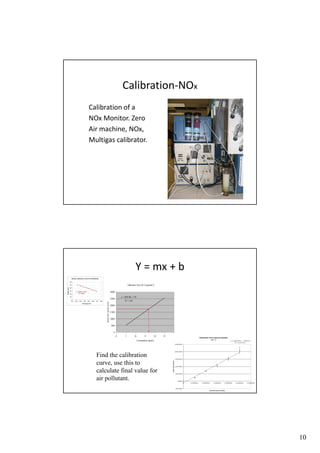
Calibration-NOx
Calibration of a
NOx Monitor. Zero
Air machine, NOx,
Multigas calibrator.

Y = mx + b

Find the calibration
curve, use this to
calculate final value for
air pollutant.

10
TEOM 1400 Ambient PM Sampler

11
Meteorological Parameters
•
•
•
•

Wind Speed/Wind Direction
Air Temperature/Relative Humidity
Solar Radiation
Ultra-Violet

Ultra-Violet
• UV-A radiation refers to atmospheric radiation from 320
nm-400 nm (that's 0.320-0.400 m m). UV-A is very
important to photosynthesis and plant studies.
• UV-B is the shortest wavelength atmospheric radiation
that actually reaches the ground, and covers from 280-320
nm (that's 0.280-0.320 nm). However, it is UV-B that
causes skin cancer over prolonged exposure.
• UV-C is "extraterrestrial" solar radiation, and includes light
with wavelengths between 100-280 nm.
• Reference: http://www.yesinc.com/products/data/FAQuvrad/faq4.html

12
Zeno Datalogger

Documentation
• Quality Assurance Project Plan (QAPP)
– Calibration of instrumentation, how data is processed
and stored

• Site Operations Procedures (SOP)
– Calibration of instruments
– How to troubleshoot equipment
– Setting up a site

• Logbook for each site
• Logbook for each instrument
• Atmospheric Research & Analysis Inc.:
http://www.atmospheric-research.com/newindex.html

13
Air Monitoring Sites-Texas

Typical Site

14
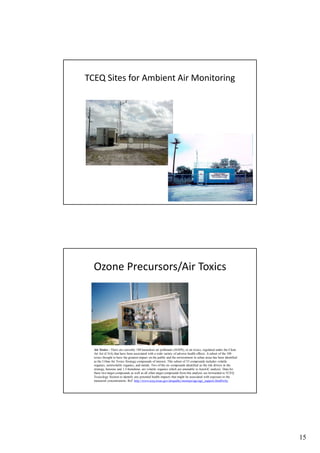
TCEQ Sites for Ambient Air Monitoring

Ozone Precursors/Air Toxics

Air Toxics - There are currently 188 hazardous air pollutants (HAPS), or air toxics, regulated under the Clean
Air Act (CAA) that have been associated with a wide variety of adverse health effects. A subset of the 188
toxics thought to have the greatest impact on the public and the environment in urban areas has been identified
as the Urban Air Toxics Strategy compounds of interest. This subset of 33 compounds includes volatile
organics, semivolatile organics, and metals. Two of the six compounds identified as the risk drivers in the
strategy, benzene and 1,3-butadiene, are volatile organics which are amenable to AutoGC analysis. Data for
these two target compounds as well as all other target compounds from this analysis are forwarded to TCEQ
Toxicology Section to identify any potential health impacts that might be associated with exposure to the
measured concentrations. Ref: http://www.tceq.texas.gov/airquality/monops/agc/agc_support.html#why

15
GC-MS Analytical System
Sample Canister

Mass Spectrometer
Gas Chromatograph

Pre-concentrator

ANALYSIS AND
COLLECTION OF DATA

16
Automated Data Collection

Databases
•
•
•
•
•

The first source is the state.
http://www.tceq.texas.gov/agency/air_main.html
EPA keeps an extensive database of monitoring sites.
http://www.epa.gov/ttn/airs/airsaqs/
Free data available for meteorology, terrain. NOAA,
NASA, many others.
• http://www.webmet.com/

17
Ozone Concentrations vs Wind

Time Series Graph
September 29, 2004
120
80
60
40
20
23

21

19

17

15

13

11

9

7

5

3

0
1

Ozone-ppb

100

Time
AP

HR

VI

CAMS04

CAMS21

Kingsville

18
Statistics
• Average, median, frequency analysis.
• Box-whisker plots.
• Trend analysis.

Wind Rose

•

Reference: http://www.questconsult.com/papers/weather-variations-qra/

19
Pollution Rose
• Can be used for
evaluating the
common direction of
pollutants
• Useful for ozone, PM,
SO2, VOCs.

Direction of Sources
•
•
•
•

Non parametric regression
Positive Matrix Factorization
Conditional Probability Function
Can be used for:
– Particulate Matter
– VOC’s

• Not appropriate for ozone

20
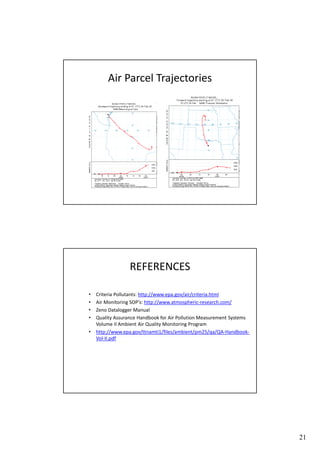
Air Parcel Trajectories

REFERENCES
•
•
•
•
•

Criteria Pollutants: http://www.epa.gov/air/criteria.html
Air Monitoring SOP’s: http://www.atmospheric-research.com/
Zeno Datalogger Manual
Quality Assurance Handbook for Air Pollution Measurement Systems
Volume II Ambient Air Quality Monitoring Program
http://www.epa.gov/ttnamti1/files/ambient/pm25/qa/QA-HandbookVol-II.pdf

21

Criteria Air Pollutants and Ambient Air Monitoring

  • 1.
    Criteria Air Pollutants andAmbient Air Monitoring Topics for Discussion • Air pollutants regulated by the EPA • Ozone – sources, chemistry, standard, sampling, air monitor works • Instrumentation • Meteorology • How data is collected/stored • Locating a monitor • Documentation/Analysis of data 1
  • 2.
    Criteria Pollutants • • • • • • • • • Ozone Carbon Monoxide http://www.epa.gov/airquality/carbonmonoxide/pdfs/COFactShe etAugust12v4.pdf Lead NitrogenOxides (NO, NO2) Particulate Matter (PM10)/Particulate Matter (PM2.5) Sulfur Oxides Reference: http://www.epa.gov/air/criteria.html Note: covered under 40CFR part 50 National Ambient Air Quality Standards (NAAQS) 2
  • 3.
    Brief comment: Ozone •Stratospheric ozone protects us from the UV rays of the sun. • Ground level ozone at high concentrations can irritate the respiratory tract and damage plant life in high concentrations. How is O3 created? 3
  • 4.
    Chemistry of Ozone VOCs+ NOx + Sunlight + Heat = Ozone Night Time O3 Chemistry 4
  • 5.
    Ambient Air Standard-Ozone • • Toattain the ozone NAAQS, the 3-year average of the annual 4thhighest daily maximum 8-hour ozone concentration must be less than or equal to 0.075 PPM (or 75 ppb). The old ozone threshold value for a 1-hour standard is 0.12 parts per million (PPM), measured as a 1-hour average concentration. http://www.epa.gov/airquality/ozonepollution/ OSHA: https://www.osha.gov/dts/sltc/methods/inorganic/id214/id214.html 8 Hour Average DATE 8-Hour Average 03/02/2011 80 04/15/2011 90 09/03/2011 75 09/16/2011 100 XX/XX/2010 90 4th Highest 8-hr XX/XX/2009 100 4th Highest 8-hr The 4th highest 8-hour average is: 75 This would average to 88 5
  • 6.
    Schematic Diagram OzoneMonitor Air Pump Thermistor Hg Lamp 254nm Absorption Cell Photodiode Pressure Sensor Solenoid Valve Ozone Scrubber Air Inlet Ozone Monitors Rack mount with ozone transfer standard instrument and ozone monitor. 6
  • 7.
    Instruments for otherPollutants • Criteria pollutants: Ozone, SO2, NOx, CO • Other pollutants: NH3, H2S, CO2, NOy, Total Hydrocarbon • VOC (volatile organic compounds) • Laser/IR systems also used. Air Monitor – Basic Principles • Chemiluminescence • UV flourescence • Beer’s law 7
  • 8.
    Chemiluminescence The chemiluminescence reactionof NO to NO2: NO + O3 ==> NO2+ O2 + hv http://www.k2bw.com/chemiluminescence.htm Variations of chemiluminescence have been used to perfom measurements of Ammonia (NH3): NH3 + O2 ==> NO + H2O or: 4NH3 + 5O2 = 4NO + 6H2O then: 4NO + 4O3 -------->4NO2+4O2 + 4hv Schematic of a reaction chamber under vacuum and a Photomultiplier tube (PMT) for detection. Principle - UV fluorescence Principle - UV fluorescence The UV fluorescence method operates on the principle that when the SO2 molecules contained in the sample gas are excited by ultraviolet radiation they emit a characteristic fluorescence in the range of 220- 240 nm. This fluorescence is measured and the SO2 concentration is obtained from changes in the intensity of the fluorescence. The reactive mechanism is: (1)SO2 + hv1 ¤ SO2* (2)SO2* ¤SO + (O) (3)SO2* ¤ SO2 + hv2 (4)SO2*+ M ¤ SO2 + M Here, (1) shows the excited state of the SO2 molecules that have absorbed the amount of energy hv1 by ultraviolet radiation. (2) shows the amount of energy, hv2 emitted by the excited molecules as they return to the ground state. (3) shows the decomposition by the light emitted from the excited molecules. (4) shows the quenching, i.e., the energy lost by the excited molecules colliding with other molecules. http://www.horiba.co.uk/apsa360.htm 8
  • 9.
    Beer’s Law Many compoundsabsorb ultraviolet (UV) or visible (Vis.) light. The diagram below shows a beam of monochromatic radiation of radiant power P0, directed at a sample solution. Absorption takes place and the beam of radiation leaving the sample has radiant power P. The amount of radiation absorbed may be measured in a number of ways: Transmittance, T = P / P0 % Transmittance, %T = 100 T Absorbance, A = log10 P0 / P A = log10 1 / T A = log10 100 / %T A = 2 - log10 %T http://teaching.shu.ac.uk/hwb/chemistry/tutorials/molspec/beers1.htm Calibration-Ozone 9
  • 10.
    Calibration-NOx Calibration of a NOxMonitor. Zero Air machine, NOx, Multigas calibrator. Y = mx + b Find the calibration curve, use this to calculate final value for air pollutant. 10
  • 11.
    TEOM 1400 AmbientPM Sampler 11
  • 12.
    Meteorological Parameters • • • • Wind Speed/WindDirection Air Temperature/Relative Humidity Solar Radiation Ultra-Violet Ultra-Violet • UV-A radiation refers to atmospheric radiation from 320 nm-400 nm (that's 0.320-0.400 m m). UV-A is very important to photosynthesis and plant studies. • UV-B is the shortest wavelength atmospheric radiation that actually reaches the ground, and covers from 280-320 nm (that's 0.280-0.320 nm). However, it is UV-B that causes skin cancer over prolonged exposure. • UV-C is "extraterrestrial" solar radiation, and includes light with wavelengths between 100-280 nm. • Reference: http://www.yesinc.com/products/data/FAQuvrad/faq4.html 12
  • 13.
    Zeno Datalogger Documentation • QualityAssurance Project Plan (QAPP) – Calibration of instrumentation, how data is processed and stored • Site Operations Procedures (SOP) – Calibration of instruments – How to troubleshoot equipment – Setting up a site • Logbook for each site • Logbook for each instrument • Atmospheric Research & Analysis Inc.: http://www.atmospheric-research.com/newindex.html 13
  • 14.
  • 15.
    TCEQ Sites forAmbient Air Monitoring Ozone Precursors/Air Toxics Air Toxics - There are currently 188 hazardous air pollutants (HAPS), or air toxics, regulated under the Clean Air Act (CAA) that have been associated with a wide variety of adverse health effects. A subset of the 188 toxics thought to have the greatest impact on the public and the environment in urban areas has been identified as the Urban Air Toxics Strategy compounds of interest. This subset of 33 compounds includes volatile organics, semivolatile organics, and metals. Two of the six compounds identified as the risk drivers in the strategy, benzene and 1,3-butadiene, are volatile organics which are amenable to AutoGC analysis. Data for these two target compounds as well as all other target compounds from this analysis are forwarded to TCEQ Toxicology Section to identify any potential health impacts that might be associated with exposure to the measured concentrations. Ref: http://www.tceq.texas.gov/airquality/monops/agc/agc_support.html#why 15
  • 16.
    GC-MS Analytical System SampleCanister Mass Spectrometer Gas Chromatograph Pre-concentrator ANALYSIS AND COLLECTION OF DATA 16
  • 17.
    Automated Data Collection Databases • • • • • Thefirst source is the state. http://www.tceq.texas.gov/agency/air_main.html EPA keeps an extensive database of monitoring sites. http://www.epa.gov/ttn/airs/airsaqs/ Free data available for meteorology, terrain. NOAA, NASA, many others. • http://www.webmet.com/ 17
  • 18.
    Ozone Concentrations vsWind Time Series Graph September 29, 2004 120 80 60 40 20 23 21 19 17 15 13 11 9 7 5 3 0 1 Ozone-ppb 100 Time AP HR VI CAMS04 CAMS21 Kingsville 18
  • 19.
    Statistics • Average, median,frequency analysis. • Box-whisker plots. • Trend analysis. Wind Rose • Reference: http://www.questconsult.com/papers/weather-variations-qra/ 19
  • 20.
    Pollution Rose • Canbe used for evaluating the common direction of pollutants • Useful for ozone, PM, SO2, VOCs. Direction of Sources • • • • Non parametric regression Positive Matrix Factorization Conditional Probability Function Can be used for: – Particulate Matter – VOC’s • Not appropriate for ozone 20
  • 21.
    Air Parcel Trajectories REFERENCES • • • • • CriteriaPollutants: http://www.epa.gov/air/criteria.html Air Monitoring SOP’s: http://www.atmospheric-research.com/ Zeno Datalogger Manual Quality Assurance Handbook for Air Pollution Measurement Systems Volume II Ambient Air Quality Monitoring Program http://www.epa.gov/ttnamti1/files/ambient/pm25/qa/QA-HandbookVol-II.pdf 21