AIR POLLUTION
•Composition of Air
•Structure of atmosphere
• Ambient Air Quality Standards
• Classification of air pollutants
•Source of common air pollutants
•Effects of common air pollutants
Definition
The presence of unwanted and undesirable foreign
particles and gases in the air which may have adverse
effects on human, animals, plants or structures.
As per IS: 4167 (1966);
ā€œAir pollution is the presence in ambient atmosphere of
substances, generally resulting from the activity of man, in
sufficient concentration, present for sufficient time and
causes the harmful effects on humans, plans and
animalsā€.
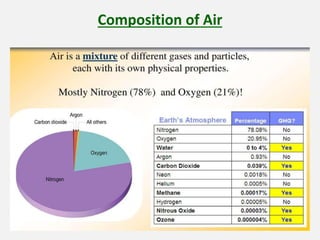
Composition of Air
Composition of Air
Trace gases:
A gas (such as water vapor, ozone, nitrogen oxides,
sulphur dioxide, and carbon dioxide) that is present in the
atmosphere in only small amounts, either because of
its very reactive nature or because it is produced or
emitted at a very low rate.
Structure of Atmosphere
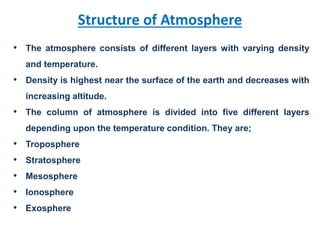
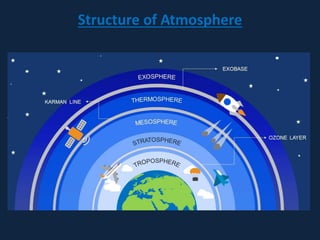
• The atmosphere consists of different layers with varying density
and temperature.
• Density is highest near the surface of the earth and decreases with
increasing altitude.
• The column of atmosphere is divided into five different layers
depending upon the temperature condition. They are;
• Troposphere
• Stratosphere
• Mesosphere
• Ionosphere
• Exosphere
Structure of Atmosphere
Troposphere:
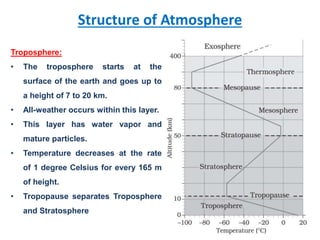
• The troposphere starts at the
surface of the earth and goes up to
a height of 7 to 20 km.
• All-weather occurs within this layer.
• This layer has water vapor and
mature particles.
• Temperature decreases at the rate
of 1 degree Celsius for every 165 m
of height.
• Tropopause separates Troposphere
and Stratosphere
Structure of Atmosphere
Stratosphere:
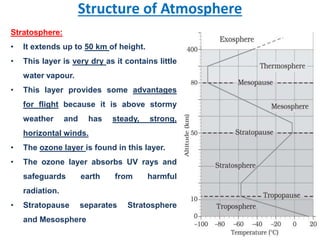
• It extends up to 50 km of height.
• This layer is very dry as it contains little
water vapour.
• This layer provides some advantages
for flight because it is above stormy
weather and has steady, strong,
horizontal winds.
• The ozone layer is found in this layer.
• The ozone layer absorbs UV rays and
safeguards earth from harmful
radiation.
• Stratopause separates Stratosphere
and Mesosphere
Structure of Atmosphere
Mesosphere:
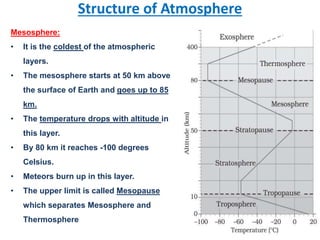
• It is the coldest of the atmospheric
layers.
• The mesosphere starts at 50 km above
the surface of Earth and goes up to 85
km.
• The temperature drops with altitude in
this layer.
• By 80 km it reaches -100 degrees
Celsius.
• Meteors burn up in this layer.
• The upper limit is called Mesopause
which separates Mesosphere and
Thermosphere
Structure of Atmosphere
Thermosphere / Ionosphere:
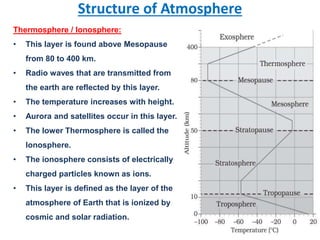
• This layer is found above Mesopause
from 80 to 400 km.
• Radio waves that are transmitted from
the earth are reflected by this layer.
• The temperature increases with height.
• Aurora and satellites occur in this layer.
• The lower Thermosphere is called the
Ionosphere.
• The ionosphere consists of electrically
charged particles known as ions.
• This layer is defined as the layer of the
atmosphere of Earth that is ionized by
cosmic and solar radiation.
Structure of Atmosphere
Exosphere:
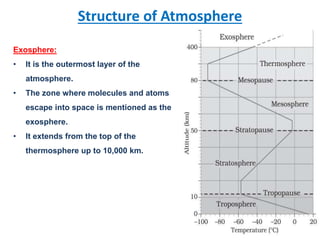
• It is the outermost layer of the
atmosphere.
• The zone where molecules and atoms
escape into space is mentioned as the
exosphere.
• It extends from the top of the
thermosphere up to 10,000 km.
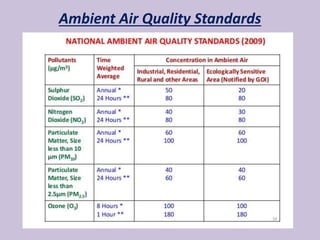
Ambient Air Quality Standards
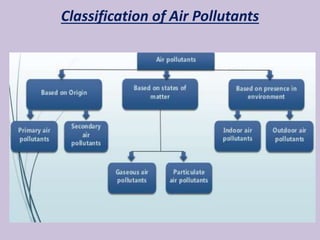
Classification of Air Pollutants
According to Origin
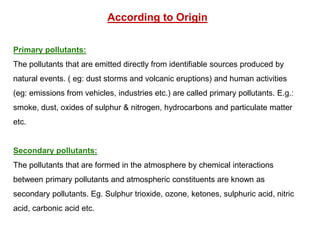
Primary pollutants:
The pollutants that are emitted directly from identifiable sources produced by
natural events. ( eg: dust storms and volcanic eruptions) and human activities
(eg: emissions from vehicles, industries etc.) are called primary pollutants. E.g.:
smoke, dust, oxides of sulphur & nitrogen, hydrocarbons and particulate matter
etc.
Secondary pollutants:
The pollutants that are formed in the atmosphere by chemical interactions
between primary pollutants and atmospheric constituents are known as
secondary pollutants. Eg. Sulphur trioxide, ozone, ketones, sulphuric acid, nitric
acid, carbonic acid etc.
According to state of matter
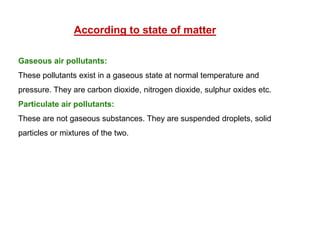
Gaseous air pollutants:
These pollutants exist in a gaseous state at normal temperature and
pressure. They are carbon dioxide, nitrogen dioxide, sulphur oxides etc.
Particulate air pollutants:
These are not gaseous substances. They are suspended droplets, solid
particles or mixtures of the two.
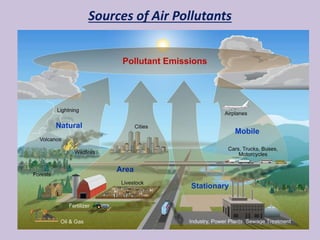
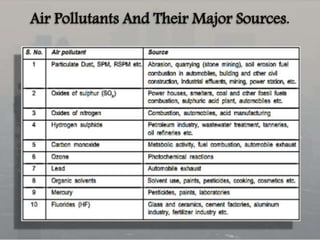
Sources of Air Pollutants
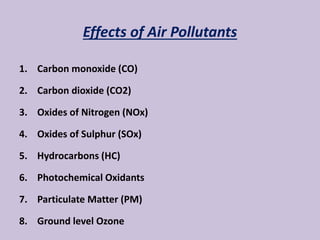
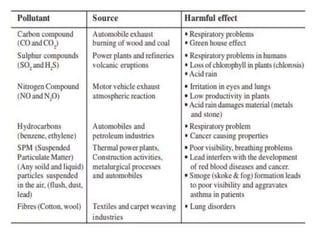
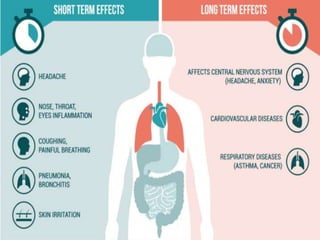
Effects of Air Pollutants
1. Carbon monoxide (CO)
2. Carbon dioxide (CO2)
3. Oxides of Nitrogen (NOx)
4. Oxides of Sulphur (SOx)
5. Hydrocarbons (HC)
6. Photochemical Oxidants
7. Particulate Matter (PM)
8. Ground level Ozone
AIR POLLUTION.ppt
AIR POLLUTION.ppt

AIR POLLUTION.ppt

  • 1.
    AIR POLLUTION •Composition ofAir •Structure of atmosphere • Ambient Air Quality Standards • Classification of air pollutants •Source of common air pollutants •Effects of common air pollutants
  • 2.
    Definition The presence ofunwanted and undesirable foreign particles and gases in the air which may have adverse effects on human, animals, plants or structures. As per IS: 4167 (1966); ā€œAir pollution is the presence in ambient atmosphere of substances, generally resulting from the activity of man, in sufficient concentration, present for sufficient time and causes the harmful effects on humans, plans and animalsā€.
  • 3.
  • 4.
    Composition of Air Tracegases: A gas (such as water vapor, ozone, nitrogen oxides, sulphur dioxide, and carbon dioxide) that is present in the atmosphere in only small amounts, either because of its very reactive nature or because it is produced or emitted at a very low rate.
  • 5.
    Structure of Atmosphere •The atmosphere consists of different layers with varying density and temperature. • Density is highest near the surface of the earth and decreases with increasing altitude. • The column of atmosphere is divided into five different layers depending upon the temperature condition. They are; • Troposphere • Stratosphere • Mesosphere • Ionosphere • Exosphere
  • 6.
  • 7.
    Structure of Atmosphere Troposphere: •The troposphere starts at the surface of the earth and goes up to a height of 7 to 20 km. • All-weather occurs within this layer. • This layer has water vapor and mature particles. • Temperature decreases at the rate of 1 degree Celsius for every 165 m of height. • Tropopause separates Troposphere and Stratosphere
  • 8.
    Structure of Atmosphere Stratosphere: •It extends up to 50 km of height. • This layer is very dry as it contains little water vapour. • This layer provides some advantages for flight because it is above stormy weather and has steady, strong, horizontal winds. • The ozone layer is found in this layer. • The ozone layer absorbs UV rays and safeguards earth from harmful radiation. • Stratopause separates Stratosphere and Mesosphere
  • 9.
    Structure of Atmosphere Mesosphere: •It is the coldest of the atmospheric layers. • The mesosphere starts at 50 km above the surface of Earth and goes up to 85 km. • The temperature drops with altitude in this layer. • By 80 km it reaches -100 degrees Celsius. • Meteors burn up in this layer. • The upper limit is called Mesopause which separates Mesosphere and Thermosphere
  • 10.
    Structure of Atmosphere Thermosphere/ Ionosphere: • This layer is found above Mesopause from 80 to 400 km. • Radio waves that are transmitted from the earth are reflected by this layer. • The temperature increases with height. • Aurora and satellites occur in this layer. • The lower Thermosphere is called the Ionosphere. • The ionosphere consists of electrically charged particles known as ions. • This layer is defined as the layer of the atmosphere of Earth that is ionized by cosmic and solar radiation.
  • 11.
    Structure of Atmosphere Exosphere: •It is the outermost layer of the atmosphere. • The zone where molecules and atoms escape into space is mentioned as the exosphere. • It extends from the top of the thermosphere up to 10,000 km.
  • 12.
  • 13.
  • 14.
    According to Origin Primarypollutants: The pollutants that are emitted directly from identifiable sources produced by natural events. ( eg: dust storms and volcanic eruptions) and human activities (eg: emissions from vehicles, industries etc.) are called primary pollutants. E.g.: smoke, dust, oxides of sulphur & nitrogen, hydrocarbons and particulate matter etc. Secondary pollutants: The pollutants that are formed in the atmosphere by chemical interactions between primary pollutants and atmospheric constituents are known as secondary pollutants. Eg. Sulphur trioxide, ozone, ketones, sulphuric acid, nitric acid, carbonic acid etc.
  • 15.
    According to stateof matter Gaseous air pollutants: These pollutants exist in a gaseous state at normal temperature and pressure. They are carbon dioxide, nitrogen dioxide, sulphur oxides etc. Particulate air pollutants: These are not gaseous substances. They are suspended droplets, solid particles or mixtures of the two.
  • 16.
    Sources of AirPollutants
  • 18.
    Effects of AirPollutants 1. Carbon monoxide (CO) 2. Carbon dioxide (CO2) 3. Oxides of Nitrogen (NOx) 4. Oxides of Sulphur (SOx) 5. Hydrocarbons (HC) 6. Photochemical Oxidants 7. Particulate Matter (PM) 8. Ground level Ozone