AIR POLLUTION CONTROL
METHODS AND EQUIPMETS
PRESENTED BY
JINTO CV 1320214
LOVIN S ABRAHAM 1320217
What is Air Pollution Control ?
 Air pollution control, the techniques employed to
reduce or eliminate the emission into the atmosphere of
substances that can harm the environment or human
health.
 The control of air pollution is one of the principal areas
of pollution control, along with wastewater
treatment, solid-waste management, and hazardous-
waste management.
Top 20 polluted cities
PM2.5 refers to the
diameter measured in
microns of particulates
such as ammonia,
carbon, nitrates and
sulfate -- which are
small enough to pass
into the bloodstream
and cause diseases such
as emphysema and
cancer.
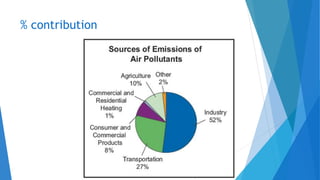
% contribution
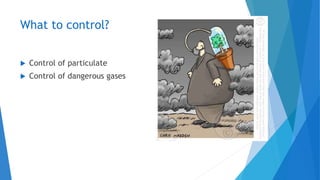
What to control?
 Control of particulate
 Control of dangerous gases
Control system design
 Design changes case by case
 Influenced by Particulate characteristics
 Corrosivity,
 Reactivity,
 Shape,
 Density, and
 Size
 Other design factors
 Air stream characteristics
 Pressure
 Temperature
 Density
 Flow rate
Control system design
continues….
Control of Particulate
1. Cyclones
2. Scrubbers
3. Electrostatic Precipitators
4. Bag house Filters
Waste goes to land fill
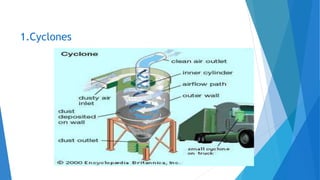
1.Cyclones
1.Cyclones
Advantages and Limitations
 Best at removing relatively coarse particulates
 Achieve 90% of efficiencies for particles larger
than about 20 micrometers.
 Cyclones are not sufficient to meet stringent air
quality standards.
 They are typically used as pre-cleaners and are
followed by more efficient air-cleaning equipment
such as electrostatic precipitators and baghouses
2.Scrubbers
Spray-tower scrubbers can remove 90 % of particulates larger than about 8μm.
3.Electrostatic precipitators
 Give electric charge to particulate
 Remove particulates by electric field
 1,00,000 Volts DC current is used for charging particles
 can remove particulates as small as 1 μm with an efficiency exceeding 99 percent.
 The effectiveness of electrostatic precipitators in removing fly ash from the
combustion gases of fossil-fuel furnaces accounts for their high frequency of use at
power stations.
4.Baghouse filters
4.Baghouse filters
 A fabric-filter dust collector can remove very nearly 100 percent of particles as small as
1 μm and a significant fraction of particles as small as 0.01 μm.
 Energy usage is high
 Air should be cooled
Internet of things and cloud
CONTROL OF GASES
 Absorption
 Adsorption
 Incineration
ABSORPTION
 It includes transfer of a gaseous pollutant from the air into a contacting
liquid, such as water.
 The liquid must be able either to serve as a solvent for the pollutant or to
capture it by means of a chemical reaction.
 Wet scrubbers similar to those described above for controlling suspended
particulates may be used for gas absorption.
 Gas absorption can also be carried out in packed scrubbers, or towers, in
which the liquid is present on a wetted surface rather than as droplets
suspended in the air
 Thermoplastic materials are most widely used as packing for countercurrent scrubber towers.
 These devices usually have gas-removal efficiencies of 90–95 percent.
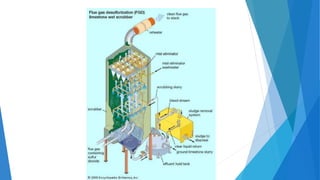
FLUE GAS DESULPHURIZATION
 Sulphur dioxide in flue gas from fossil-fuel power plants can be controlled by means of an
absorption process called flue gas desulfurization (FGD).
 It can be wet scrubbing or dry scrubbing
 In wet FGD systems, flue gases are brought in contact with an absorbent, which can be either a
liquid or a slurry of solid material.
 In dry FGD systems, the absorbent is dry pulverized lime or limestone; once absorption occurs,
the solid particles are removed by means of bag-house filters
 FGD systems are also classified as either regenerable or non-regenerable (throwaway),
depending on whether the sulphur that is removed from the flue gas is recovered or discarded.
ADSORPTION
 When a gas or vapor is brought into contact with a solid, part of it is taken up by the solid. The
molecules that disappear from the gas either enter the inside of the solid, or remain on the
outside attached to the surface. The former phenomenon is termed absorption (or dissolution)
and the latter adsorption.
 The most common industrial adsorbents are activated carbon, silica gel, and alumina, because
they have enormous surface areas per unit weight.
 Activated carbon is the universal standard for purification and removal of trace organic
contaminants from liquid and vapor streams.
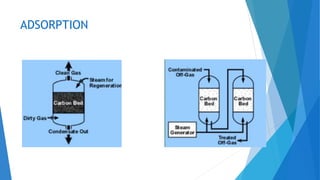
Carbon adsorption systems are either regenerative or non-regenerative.
- Regenerative system usually contains more than one carbon bed. As one bed actively removes
pollutants, another bed is being regenerated for future use.
- Non-regenerative systems have thinner beds of activated carbon. In a non-regenerative
adsorber, the spent carbon is disposed of when it becomes saturated with the pollutant.
CONDENSATION
 Condensation is the process of converting a gas or vapor to liquid. Any gas can
be reduced to a liquid by lowering its temperature and/or increasing its
pressure.
 Condensers are typically used as pre-treatment devices. They can be used
ahead of absorbers, absorbers, and incinerators to reduce the total gas
volume to be treated by more expensive control equipment. Condensers used
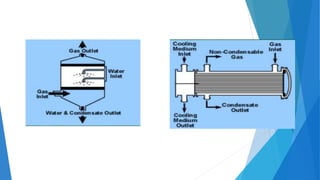
for pollution control are contact condensers and surface condensers.
 In a contact condenser, the gas comes into contact with cold liquid.
 In a surface condenser, the gas contacts a cooled surface in which cooled
liquid or gas is circulated, such as the outside of the tube.
 Removal efficiencies of condensers typically range from 50 percent to more
than 95 percent, depending on design and applications.
INCINERATION
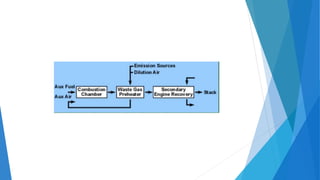
 Incineration, also known as combustion, is most used to control the emissions
of organic compounds from process industries.
 This control technique refers to the rapid oxidation of a substance through
the combination of oxygen with a combustible material in the presence of
heat.
When combustion is complete, the gaseous stream is converted to carbon
dioxide and water vapor.
 Equipment used to control waste gases by combustion can be divided in three
categories:
- Direct combustion or flaring,
- Thermal incineration and
- Catalytic incineration.
DIRECT COMBUSTOR
 Direct combustor is a device in which air and all the combustible waste gases
react at the burner. Complete combustion must occur instantaneously since
there is no residence chamber.
 A flare can be used to control almost any emission stream containing volatile
organic compounds. Studies conducted by EPA have shown that the
destruction efficiency of a flare is about 98 percent.
In thermal incinerators the combustible waste gases pass over or around a
burner flame into a residence chamber where oxidation of the waste gases is
completed. Thermal incinerators can destroy gaseous pollutants at
efficiencies of greater than 99 percent when operated correctly.
 Catalytic incinerators are very similar to thermal incinerators. The main
difference is that after passing through the flame area, the gases pass over a
catalyst bed. A catalyst promotes oxidation at lower temperatures, thereby
reducing fuel costs. Destruction efficiencies greater than 95 percent are
possible using a catalytic incinerator.
REFERENCES
 http://edition.cnn.com/2014/05/08/world/asia/india-pollution-who/
 http://articles.economictimes.indiatimes.com/2015-02-
24/news/59460740_1_ceo-vishal-sikka-infosys-silicon-valley
 http://www.britannica.com/EBchecked/topic/1589060/air-pollution-control
 http://www.eng.utoledo.edu/~akumar/IAP1/Pollution%20Control.htm
 http://www.envergy.co.in/air-pollution-control-equipment.html
 http://nptel.ac.in/courses/105102089/air%20pollution%20(Civil)/Module-
3/3b.htm
Air pollution control methods and equipments

Air pollution control methods and equipments

  • 1.
    AIR POLLUTION CONTROL METHODSAND EQUIPMETS PRESENTED BY JINTO CV 1320214 LOVIN S ABRAHAM 1320217
  • 2.
    What is AirPollution Control ?  Air pollution control, the techniques employed to reduce or eliminate the emission into the atmosphere of substances that can harm the environment or human health.  The control of air pollution is one of the principal areas of pollution control, along with wastewater treatment, solid-waste management, and hazardous- waste management.
  • 3.
    Top 20 pollutedcities PM2.5 refers to the diameter measured in microns of particulates such as ammonia, carbon, nitrates and sulfate -- which are small enough to pass into the bloodstream and cause diseases such as emphysema and cancer.
  • 4.
  • 5.
    What to control? Control of particulate  Control of dangerous gases
  • 6.
    Control system design Design changes case by case  Influenced by Particulate characteristics  Corrosivity,  Reactivity,  Shape,  Density, and  Size
  • 7.
     Other designfactors  Air stream characteristics  Pressure  Temperature  Density  Flow rate Control system design continues….
  • 8.
    Control of Particulate 1.Cyclones 2. Scrubbers 3. Electrostatic Precipitators 4. Bag house Filters Waste goes to land fill
  • 9.
  • 10.
    1.Cyclones Advantages and Limitations Best at removing relatively coarse particulates  Achieve 90% of efficiencies for particles larger than about 20 micrometers.  Cyclones are not sufficient to meet stringent air quality standards.  They are typically used as pre-cleaners and are followed by more efficient air-cleaning equipment such as electrostatic precipitators and baghouses
  • 11.
    2.Scrubbers Spray-tower scrubbers canremove 90 % of particulates larger than about 8μm.
  • 12.
  • 13.
    3.Electrostatic precipitators  Giveelectric charge to particulate  Remove particulates by electric field  1,00,000 Volts DC current is used for charging particles  can remove particulates as small as 1 μm with an efficiency exceeding 99 percent.  The effectiveness of electrostatic precipitators in removing fly ash from the combustion gases of fossil-fuel furnaces accounts for their high frequency of use at power stations.
  • 14.
  • 15.
    4.Baghouse filters  Afabric-filter dust collector can remove very nearly 100 percent of particles as small as 1 μm and a significant fraction of particles as small as 0.01 μm.  Energy usage is high  Air should be cooled
  • 16.
  • 17.
    CONTROL OF GASES Absorption  Adsorption  Incineration
  • 18.
    ABSORPTION  It includestransfer of a gaseous pollutant from the air into a contacting liquid, such as water.  The liquid must be able either to serve as a solvent for the pollutant or to capture it by means of a chemical reaction.  Wet scrubbers similar to those described above for controlling suspended particulates may be used for gas absorption.  Gas absorption can also be carried out in packed scrubbers, or towers, in which the liquid is present on a wetted surface rather than as droplets suspended in the air
  • 19.
     Thermoplastic materialsare most widely used as packing for countercurrent scrubber towers.  These devices usually have gas-removal efficiencies of 90–95 percent. FLUE GAS DESULPHURIZATION  Sulphur dioxide in flue gas from fossil-fuel power plants can be controlled by means of an absorption process called flue gas desulfurization (FGD).  It can be wet scrubbing or dry scrubbing
  • 21.
     In wetFGD systems, flue gases are brought in contact with an absorbent, which can be either a liquid or a slurry of solid material.  In dry FGD systems, the absorbent is dry pulverized lime or limestone; once absorption occurs, the solid particles are removed by means of bag-house filters  FGD systems are also classified as either regenerable or non-regenerable (throwaway), depending on whether the sulphur that is removed from the flue gas is recovered or discarded.
  • 22.
  • 23.
     When agas or vapor is brought into contact with a solid, part of it is taken up by the solid. The molecules that disappear from the gas either enter the inside of the solid, or remain on the outside attached to the surface. The former phenomenon is termed absorption (or dissolution) and the latter adsorption.  The most common industrial adsorbents are activated carbon, silica gel, and alumina, because they have enormous surface areas per unit weight.  Activated carbon is the universal standard for purification and removal of trace organic contaminants from liquid and vapor streams. Carbon adsorption systems are either regenerative or non-regenerative. - Regenerative system usually contains more than one carbon bed. As one bed actively removes pollutants, another bed is being regenerated for future use. - Non-regenerative systems have thinner beds of activated carbon. In a non-regenerative adsorber, the spent carbon is disposed of when it becomes saturated with the pollutant.
  • 24.
    CONDENSATION  Condensation isthe process of converting a gas or vapor to liquid. Any gas can be reduced to a liquid by lowering its temperature and/or increasing its pressure.  Condensers are typically used as pre-treatment devices. They can be used ahead of absorbers, absorbers, and incinerators to reduce the total gas volume to be treated by more expensive control equipment. Condensers used for pollution control are contact condensers and surface condensers.  In a contact condenser, the gas comes into contact with cold liquid.  In a surface condenser, the gas contacts a cooled surface in which cooled liquid or gas is circulated, such as the outside of the tube.  Removal efficiencies of condensers typically range from 50 percent to more than 95 percent, depending on design and applications.
  • 26.
    INCINERATION  Incineration, alsoknown as combustion, is most used to control the emissions of organic compounds from process industries.  This control technique refers to the rapid oxidation of a substance through the combination of oxygen with a combustible material in the presence of heat. When combustion is complete, the gaseous stream is converted to carbon dioxide and water vapor.  Equipment used to control waste gases by combustion can be divided in three categories: - Direct combustion or flaring, - Thermal incineration and - Catalytic incineration.
  • 27.
    DIRECT COMBUSTOR  Directcombustor is a device in which air and all the combustible waste gases react at the burner. Complete combustion must occur instantaneously since there is no residence chamber.  A flare can be used to control almost any emission stream containing volatile organic compounds. Studies conducted by EPA have shown that the destruction efficiency of a flare is about 98 percent. In thermal incinerators the combustible waste gases pass over or around a burner flame into a residence chamber where oxidation of the waste gases is completed. Thermal incinerators can destroy gaseous pollutants at efficiencies of greater than 99 percent when operated correctly.
  • 29.
     Catalytic incineratorsare very similar to thermal incinerators. The main difference is that after passing through the flame area, the gases pass over a catalyst bed. A catalyst promotes oxidation at lower temperatures, thereby reducing fuel costs. Destruction efficiencies greater than 95 percent are possible using a catalytic incinerator.
  • 30.
    REFERENCES  http://edition.cnn.com/2014/05/08/world/asia/india-pollution-who/  http://articles.economictimes.indiatimes.com/2015-02- 24/news/59460740_1_ceo-vishal-sikka-infosys-silicon-valley http://www.britannica.com/EBchecked/topic/1589060/air-pollution-control  http://www.eng.utoledo.edu/~akumar/IAP1/Pollution%20Control.htm  http://www.envergy.co.in/air-pollution-control-equipment.html  http://nptel.ac.in/courses/105102089/air%20pollution%20(Civil)/Module- 3/3b.htm