PHYSICS – Radioactivity
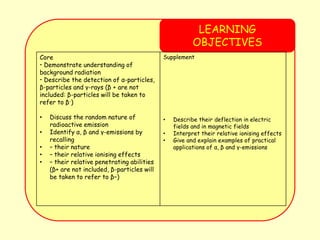
LEARNING
OBJECTIVES
Core
• Demonstrate understanding of
background radiation
• Describe the detection of α-particles,
β-particles and γ-rays (β + are not
included: β-particles will be taken to
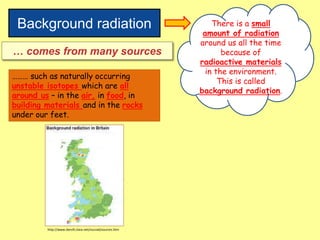
refer to β-)
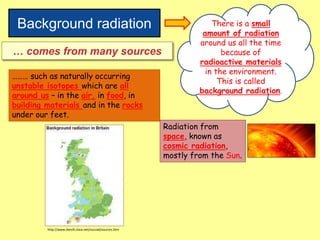
• Discuss the random nature of
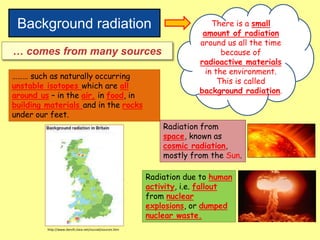
radioactive emission
• Identify α, β and γ-emissions by
recalling
• – their nature
• – their relative ionising effects
• – their relative penetrating abilities
(β+ are not included, β-particles will
be taken to refer to β–)
Supplement
• Describe their deflection in electric
fields and in magnetic fields
• Interpret their relative ionising effects
• Give and explain examples of practical
applications of α, β and γ-emissions
Background radiation There is a small
amount of radiation
around us all the time
because of
radioactive materials
in the environment.
This is called
background radiation.
Background radiation There is a small
amount of radiation
around us all the time
because of
radioactive materials
in the environment.
This is called
background radiation.
… comes from many sources
Background radiation There is a small
amount of radiation
around us all the time
because of
radioactive materials
in the environment.
This is called
background radiation.
… comes from many sources
Hold on a minute
– how do we
know about this
‘background
radiation’ stuff?
Background radiation There is a small
amount of radiation
around us all the time
because of
radioactive materials
in the environment.
This is called
background radiation.
… comes from many sources
Hold on a minute
– how do we
know about this
‘background
radiation’ stuff?
We can monitor levels
of radiation using a
Geiger-Muller tube
and counter.
Background radiation There is a small
amount of radiation
around us all the time
because of
radioactive materials
in the environment.
This is called
background radiation.
… comes from many sources
Hold on a minute
– how do we
know about this
‘background
radiation’ stuff?
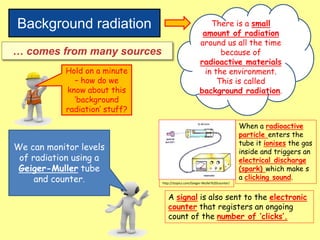
We can monitor levels
of radiation using a
Geiger-Muller tube
and counter. http://ztopics.com/Geiger-Muller%20counter/
When a radioactive
particle enters the
tube it ionises the gas
inside and triggers an
electrical discharge
(spark) which make s
a clicking sound.
A signal is also sent to the electronic
counter that registers an ongoing
count of the number of ‘clicks’.
Background radiation There is a small
amount of radiation
around us all the time
because of
radioactive materials
in the environment.
This is called
background radiation.
… comes from many sources
Examiners are always
keen to ask questions
involving background
radiation. Be careful,
and look out for
questions where you will
be expected to subtract
a value for background
radiation!
Background radiation There is a small
amount of radiation
around us all the time
because of
radioactive materials
in the environment.
This is called
background radiation.
… comes from many sources
……… such as naturally occurring
unstable isotopes which are all
around us – in the air, in food, in
building materials and in the rocks
under our feet.
http://www.darvill.clara.net/nucrad/sources.htm
Background radiation There is a small
amount of radiation
around us all the time
because of
radioactive materials
in the environment.
This is called
background radiation.
… comes from many sources
……… such as naturally occurring
unstable isotopes which are all
around us – in the air, in food, in
building materials and in the rocks
under our feet.
http://www.darvill.clara.net/nucrad/sources.htm
Radiation from
space, known as
cosmic radiation,
mostly from the Sun.
Background radiation There is a small
amount of radiation
around us all the time
because of
radioactive materials
in the environment.
This is called
background radiation.
… comes from many sources
……… such as naturally occurring
unstable isotopes which are all
around us – in the air, in food, in
building materials and in the rocks
under our feet.
http://www.darvill.clara.net/nucrad/sources.htm
Radiation due to human
activity, i.e. fallout
from nuclear
explosions, or dumped
nuclear waste.
Radiation from
space, known as
cosmic radiation,
mostly from the Sun.
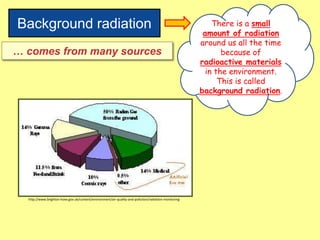
Background radiation There is a small
amount of radiation
around us all the time
because of
radioactive materials
in the environment.
This is called
background radiation.
… comes from many sources
http://www.brighton-hove.gov.uk/content/environment/air-quality-and-pollution/radiation-monitoring
Background radiation There is a small
amount of radiation
around us all the time
because of
radioactive materials
in the environment.
This is called
background radiation.
… comes from many sources
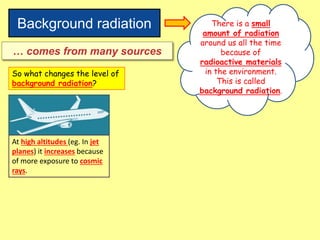
So what changes the level of
background radiation?
At high altitudes (eg. In jet
planes) it increases because
of more exposure to cosmic
rays.
Background radiation There is a small
amount of radiation
around us all the time
because of
radioactive materials
in the environment.
This is called
background radiation.
… comes from many sources
So what changes the level of
background radiation?
At high altitudes (eg. In jet
planes) it increases because
of more exposure to cosmic
rays.
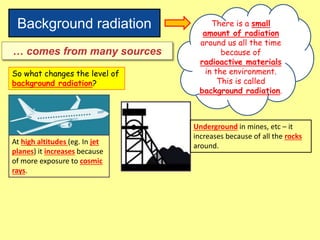
Underground in mines, etc – it
increases because of all the rocks
around.
Background radiation There is a small
amount of radiation
around us all the time
because of
radioactive materials
in the environment.
This is called
background radiation.
… comes from many sources
So what changes the level of
background radiation?
At high altitudes (eg. In jet
planes) it increases because
of more exposure to cosmic
rays.
Underground in mines, etc – it
increases because of all the rocks
around.
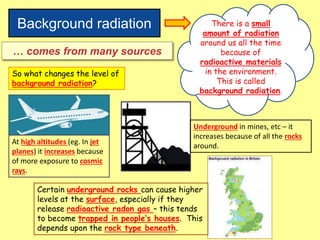
Certain underground rocks can cause higher
levels at the surface, especially if they
release radioactive radon gas – this tends
to become trapped in people’s houses. This
depends upon the rock type beneath.
The three types of radiation
Alpha α
Beta β
Gamma γ
The three types of radiation
Alpha α
Beta β
Gamma γ
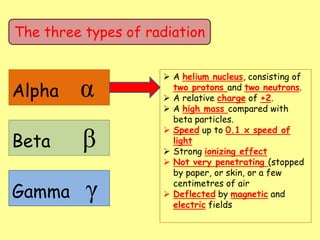
 A helium nucleus, consisting of
two protons and two neutrons.
 A relative charge of +2.
 A high mass compared with
beta particles.
 Speed up to 0.1 x speed of
light
 Strong ionizing effect
 Not very penetrating (stopped
by paper, or skin, or a few
centimetres of air
 Deflected by magnetic and
electric fields
The three types of radiation
Alpha α
Beta β
Gamma γ
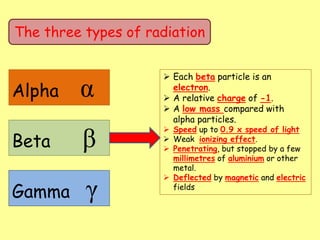
 Each beta particle is an
electron.
 A relative charge of -1.
 A low mass compared with
alpha particles.
 Speed up to 0.9 x speed of light
 Weak ionizing effect.
 Penetrating, but stopped by a few
millimetres of aluminium or other
metal.
 Deflected by magnetic and electric
fields
The three types of radiation
Alpha α
Beta β
Gamma γ
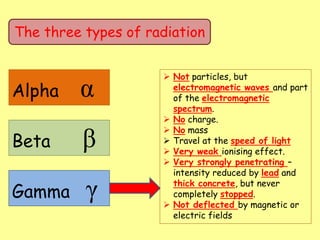
 Not particles, but
electromagnetic waves and part
of the electromagnetic
spectrum.
 No charge.
 No mass
 Travel at the speed of light
 Very weak ionising effect.
 Very strongly penetrating –
intensity reduced by lead and
thick concrete, but never
completely stopped.
 Not deflected by magnetic or
electric fields
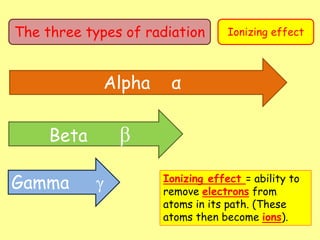
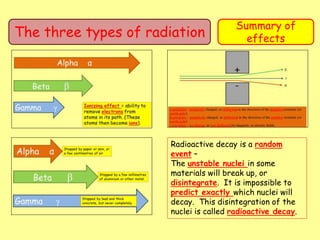
The three types of radiation Ionizing effect
Alpha α
Beta β
Gamma γ Ionizing effect = ability to
remove electrons from
atoms in its path. (These
atoms then become ions).
The three types of radiation
Penetrating
effect
Alpha α
Beta β
Gamma γ
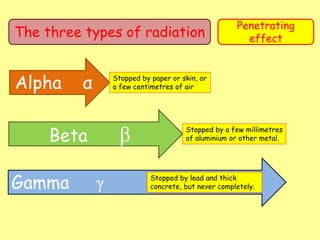
Stopped by paper or skin, or
a few centimetres of air
Stopped by a few millimetres
of aluminium or other metal.
Stopped by lead and thick
concrete, but never completely.
The three types of radiation Effect of fields
+
- α
β
γ
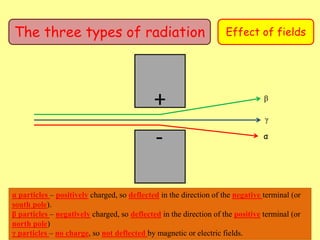
α particles – positively charged, so deflected in the direction of the negative terminal (or
south pole).
β particles – negatively charged, so deflected in the direction of the positive terminal (or
north pole)
γ particles – no charge, so not deflected by magnetic or electric fields.
The three types of radiation
Summary of
effects
Radioactive decay is a random
event –
The unstable nuclei in some
materials will break up, or
disintegrate. It is impossible to
predict exactly which nuclei will
decay. This disintegration of the
nuclei is called radioactive decay.
The three types of radiation Supplement
Applications
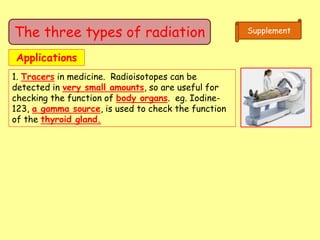
1. Tracers in medicine. Radioisotopes can be
detected in very small amounts, so are useful for
checking the function of body organs. eg. Iodine-
123, a gamma source, is used to check the function
of the thyroid gland.
The three types of radiation Supplement
Applications
1. Tracers in medicine. Radioisotopes can be
detected in very small amounts, so are useful for
checking the function of body organs. eg. Iodine-
123, a gamma source, is used to check the function
of the thyroid gland.
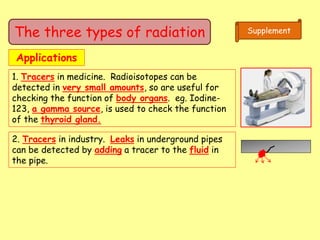
2. Tracers in industry. Leaks in underground pipes
can be detected by adding a tracer to the fluid in
the pipe.
The three types of radiation Supplement
Applications
1. Tracers in medicine. Radioisotopes can be
detected in very small amounts, so are useful for
checking the function of body organs. eg. Iodine-
123, a gamma source, is used to check the function
of the thyroid gland.
2. Tracers in industry. Leaks in underground pipes
can be detected by adding a tracer to the fluid in
the pipe.
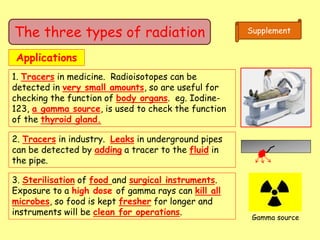
3. Sterilisation of food and surgical instruments.
Exposure to a high dose of gamma rays can kill all
microbes, so food is kept fresher for longer and
instruments will be clean for operations.
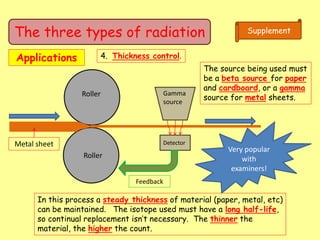
Gamma source
The three types of radiation Supplement
Applications
Roller
Roller
Metal sheet
Gamma
source
Detector
Feedback
In this process a steady thickness of material (paper, metal, etc)
can be maintained. The isotope used must have a long half-life,
so continual replacement isn’t necessary. The thinner the
material, the higher the count.
The source being used must
be a beta source for paper
and cardboard, or a gamma
source for metal sheets.
4. Thickness control.
Very popular
with
examiners!
The three types of radiation Supplement
Applications
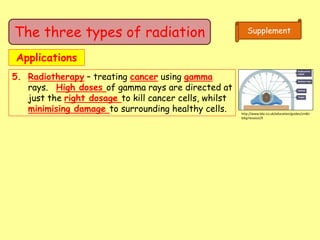
5. Radiotherapy – treating cancer using gamma
rays. High doses of gamma rays are directed at
just the right dosage to kill cancer cells, whilst
minimising damage to surrounding healthy cells. http://www.bbc.co.uk/education/guides/zm8n
b9q/revision/9
The three types of radiation Supplement
Applications
5. Radiotherapy – treating cancer using gamma
rays. High doses of gamma rays are directed at
just the right dosage to kill cancer cells, whilst
minimising damage to surrounding healthy cells. http://www.bbc.co.uk/education/guides/zm8n
b9q/revision/9
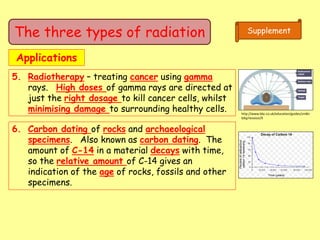
6. Carbon dating of rocks and archaeological
specimens. Also known as carbon dating. The
amount of C-14 in a material decays with time,
so the relative amount of C-14 gives an
indication of the age of rocks, fossils and other
specimens.
The three types of radiation Supplement
Applications
5. Radiotherapy – treating cancer using gamma
rays. High doses of gamma rays are directed at
just the right dosage to kill cancer cells, whilst
minimising damage to surrounding healthy cells. http://www.bbc.co.uk/education/guides/zm8n
b9q/revision/9
6. Carbon dating of rocks and archaeological
specimens. Also known as carbon dating. The
amount of C-14 in a material decays with time,
so the relative amount of C-14 gives an
indication of the age of rocks, fossils and other
specimens.
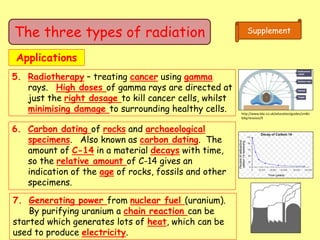
7. Generating power from nuclear fuel (uranium).
By purifying uranium a chain reaction can be
started which generates lots of heat, which can be
used to produce electricity.
LEARNING
OBJECTIVES
Core
• Demonstrate understanding of
background radiation
• Describe the detection of α-particles,
β-particles and γ-rays (β + are not
included: β-particles will be taken to
refer to β-)
• Discuss the random nature of
radioactive emission
• Identify α, β and γ-emissions by
recalling
• – their nature
• – their relative ionising effects
• – their relative penetrating abilities
(β+ are not included, β-particles will
be taken to refer to β–)
Supplement
• Describe their deflection in electric
fields and in magnetic fields
• Interpret their relative ionising effects
• Give and explain examples of practical
applications of α, β and γ-emissions
PHYSICS – Radioactivity
Physics 23   radioactivity

Physics 23 radioactivity

  • 1.
  • 2.
    LEARNING OBJECTIVES Core • Demonstrate understandingof background radiation • Describe the detection of α-particles, β-particles and γ-rays (β + are not included: β-particles will be taken to refer to β-) • Discuss the random nature of radioactive emission • Identify α, β and γ-emissions by recalling • – their nature • – their relative ionising effects • – their relative penetrating abilities (β+ are not included, β-particles will be taken to refer to β–) Supplement • Describe their deflection in electric fields and in magnetic fields • Interpret their relative ionising effects • Give and explain examples of practical applications of α, β and γ-emissions
  • 3.
    Background radiation Thereis a small amount of radiation around us all the time because of radioactive materials in the environment. This is called background radiation.
  • 4.
    Background radiation Thereis a small amount of radiation around us all the time because of radioactive materials in the environment. This is called background radiation. … comes from many sources
  • 5.
    Background radiation Thereis a small amount of radiation around us all the time because of radioactive materials in the environment. This is called background radiation. … comes from many sources Hold on a minute – how do we know about this ‘background radiation’ stuff?
  • 6.
    Background radiation Thereis a small amount of radiation around us all the time because of radioactive materials in the environment. This is called background radiation. … comes from many sources Hold on a minute – how do we know about this ‘background radiation’ stuff? We can monitor levels of radiation using a Geiger-Muller tube and counter.
  • 7.
    Background radiation Thereis a small amount of radiation around us all the time because of radioactive materials in the environment. This is called background radiation. … comes from many sources Hold on a minute – how do we know about this ‘background radiation’ stuff? We can monitor levels of radiation using a Geiger-Muller tube and counter. http://ztopics.com/Geiger-Muller%20counter/ When a radioactive particle enters the tube it ionises the gas inside and triggers an electrical discharge (spark) which make s a clicking sound. A signal is also sent to the electronic counter that registers an ongoing count of the number of ‘clicks’.
  • 8.
    Background radiation Thereis a small amount of radiation around us all the time because of radioactive materials in the environment. This is called background radiation. … comes from many sources Examiners are always keen to ask questions involving background radiation. Be careful, and look out for questions where you will be expected to subtract a value for background radiation!
  • 9.
    Background radiation Thereis a small amount of radiation around us all the time because of radioactive materials in the environment. This is called background radiation. … comes from many sources ……… such as naturally occurring unstable isotopes which are all around us – in the air, in food, in building materials and in the rocks under our feet. http://www.darvill.clara.net/nucrad/sources.htm
  • 10.
    Background radiation Thereis a small amount of radiation around us all the time because of radioactive materials in the environment. This is called background radiation. … comes from many sources ……… such as naturally occurring unstable isotopes which are all around us – in the air, in food, in building materials and in the rocks under our feet. http://www.darvill.clara.net/nucrad/sources.htm Radiation from space, known as cosmic radiation, mostly from the Sun.
  • 11.
    Background radiation Thereis a small amount of radiation around us all the time because of radioactive materials in the environment. This is called background radiation. … comes from many sources ……… such as naturally occurring unstable isotopes which are all around us – in the air, in food, in building materials and in the rocks under our feet. http://www.darvill.clara.net/nucrad/sources.htm Radiation due to human activity, i.e. fallout from nuclear explosions, or dumped nuclear waste. Radiation from space, known as cosmic radiation, mostly from the Sun.
  • 12.
    Background radiation Thereis a small amount of radiation around us all the time because of radioactive materials in the environment. This is called background radiation. … comes from many sources http://www.brighton-hove.gov.uk/content/environment/air-quality-and-pollution/radiation-monitoring
  • 13.
    Background radiation Thereis a small amount of radiation around us all the time because of radioactive materials in the environment. This is called background radiation. … comes from many sources So what changes the level of background radiation? At high altitudes (eg. In jet planes) it increases because of more exposure to cosmic rays.
  • 14.
    Background radiation Thereis a small amount of radiation around us all the time because of radioactive materials in the environment. This is called background radiation. … comes from many sources So what changes the level of background radiation? At high altitudes (eg. In jet planes) it increases because of more exposure to cosmic rays. Underground in mines, etc – it increases because of all the rocks around.
  • 15.
    Background radiation Thereis a small amount of radiation around us all the time because of radioactive materials in the environment. This is called background radiation. … comes from many sources So what changes the level of background radiation? At high altitudes (eg. In jet planes) it increases because of more exposure to cosmic rays. Underground in mines, etc – it increases because of all the rocks around. Certain underground rocks can cause higher levels at the surface, especially if they release radioactive radon gas – this tends to become trapped in people’s houses. This depends upon the rock type beneath.
  • 16.
    The three typesof radiation
  • 17.
    The three typesof radiation Alpha α Beta β Gamma γ
  • 18.
    The three typesof radiation Alpha α Beta β Gamma γ  A helium nucleus, consisting of two protons and two neutrons.  A relative charge of +2.  A high mass compared with beta particles.  Speed up to 0.1 x speed of light  Strong ionizing effect  Not very penetrating (stopped by paper, or skin, or a few centimetres of air  Deflected by magnetic and electric fields
  • 19.
    The three typesof radiation Alpha α Beta β Gamma γ  Each beta particle is an electron.  A relative charge of -1.  A low mass compared with alpha particles.  Speed up to 0.9 x speed of light  Weak ionizing effect.  Penetrating, but stopped by a few millimetres of aluminium or other metal.  Deflected by magnetic and electric fields
  • 20.
    The three typesof radiation Alpha α Beta β Gamma γ  Not particles, but electromagnetic waves and part of the electromagnetic spectrum.  No charge.  No mass  Travel at the speed of light  Very weak ionising effect.  Very strongly penetrating – intensity reduced by lead and thick concrete, but never completely stopped.  Not deflected by magnetic or electric fields
  • 21.
    The three typesof radiation Ionizing effect Alpha α Beta β Gamma γ Ionizing effect = ability to remove electrons from atoms in its path. (These atoms then become ions).
  • 22.
    The three typesof radiation Penetrating effect Alpha α Beta β Gamma γ Stopped by paper or skin, or a few centimetres of air Stopped by a few millimetres of aluminium or other metal. Stopped by lead and thick concrete, but never completely.
  • 23.
    The three typesof radiation Effect of fields + - α β γ α particles – positively charged, so deflected in the direction of the negative terminal (or south pole). β particles – negatively charged, so deflected in the direction of the positive terminal (or north pole) γ particles – no charge, so not deflected by magnetic or electric fields.
  • 24.
    The three typesof radiation Summary of effects Radioactive decay is a random event – The unstable nuclei in some materials will break up, or disintegrate. It is impossible to predict exactly which nuclei will decay. This disintegration of the nuclei is called radioactive decay.
  • 25.
    The three typesof radiation Supplement Applications 1. Tracers in medicine. Radioisotopes can be detected in very small amounts, so are useful for checking the function of body organs. eg. Iodine- 123, a gamma source, is used to check the function of the thyroid gland.
  • 26.
    The three typesof radiation Supplement Applications 1. Tracers in medicine. Radioisotopes can be detected in very small amounts, so are useful for checking the function of body organs. eg. Iodine- 123, a gamma source, is used to check the function of the thyroid gland. 2. Tracers in industry. Leaks in underground pipes can be detected by adding a tracer to the fluid in the pipe.
  • 27.
    The three typesof radiation Supplement Applications 1. Tracers in medicine. Radioisotopes can be detected in very small amounts, so are useful for checking the function of body organs. eg. Iodine- 123, a gamma source, is used to check the function of the thyroid gland. 2. Tracers in industry. Leaks in underground pipes can be detected by adding a tracer to the fluid in the pipe. 3. Sterilisation of food and surgical instruments. Exposure to a high dose of gamma rays can kill all microbes, so food is kept fresher for longer and instruments will be clean for operations. Gamma source
  • 28.
    The three typesof radiation Supplement Applications Roller Roller Metal sheet Gamma source Detector Feedback In this process a steady thickness of material (paper, metal, etc) can be maintained. The isotope used must have a long half-life, so continual replacement isn’t necessary. The thinner the material, the higher the count. The source being used must be a beta source for paper and cardboard, or a gamma source for metal sheets. 4. Thickness control. Very popular with examiners!
  • 29.
    The three typesof radiation Supplement Applications 5. Radiotherapy – treating cancer using gamma rays. High doses of gamma rays are directed at just the right dosage to kill cancer cells, whilst minimising damage to surrounding healthy cells. http://www.bbc.co.uk/education/guides/zm8n b9q/revision/9
  • 30.
    The three typesof radiation Supplement Applications 5. Radiotherapy – treating cancer using gamma rays. High doses of gamma rays are directed at just the right dosage to kill cancer cells, whilst minimising damage to surrounding healthy cells. http://www.bbc.co.uk/education/guides/zm8n b9q/revision/9 6. Carbon dating of rocks and archaeological specimens. Also known as carbon dating. The amount of C-14 in a material decays with time, so the relative amount of C-14 gives an indication of the age of rocks, fossils and other specimens.
  • 31.
    The three typesof radiation Supplement Applications 5. Radiotherapy – treating cancer using gamma rays. High doses of gamma rays are directed at just the right dosage to kill cancer cells, whilst minimising damage to surrounding healthy cells. http://www.bbc.co.uk/education/guides/zm8n b9q/revision/9 6. Carbon dating of rocks and archaeological specimens. Also known as carbon dating. The amount of C-14 in a material decays with time, so the relative amount of C-14 gives an indication of the age of rocks, fossils and other specimens. 7. Generating power from nuclear fuel (uranium). By purifying uranium a chain reaction can be started which generates lots of heat, which can be used to produce electricity.
  • 32.
    LEARNING OBJECTIVES Core • Demonstrate understandingof background radiation • Describe the detection of α-particles, β-particles and γ-rays (β + are not included: β-particles will be taken to refer to β-) • Discuss the random nature of radioactive emission • Identify α, β and γ-emissions by recalling • – their nature • – their relative ionising effects • – their relative penetrating abilities (β+ are not included, β-particles will be taken to refer to β–) Supplement • Describe their deflection in electric fields and in magnetic fields • Interpret their relative ionising effects • Give and explain examples of practical applications of α, β and γ-emissions
  • 33.