What is Radiation?
by Robert Miltenberger, CHP
Website: www.RadiationEffects.org
Email: Support@RadiationEffects.org
Facebook: www.facebook.com/radiationeffects.org/
Group of radiation specialists from around the world whose
goal is to answer the public's questions about the effects low
levels of radiation in order to promote clean energy, nuclear
medicine and other beneficial technologies that employ the
use radiation.
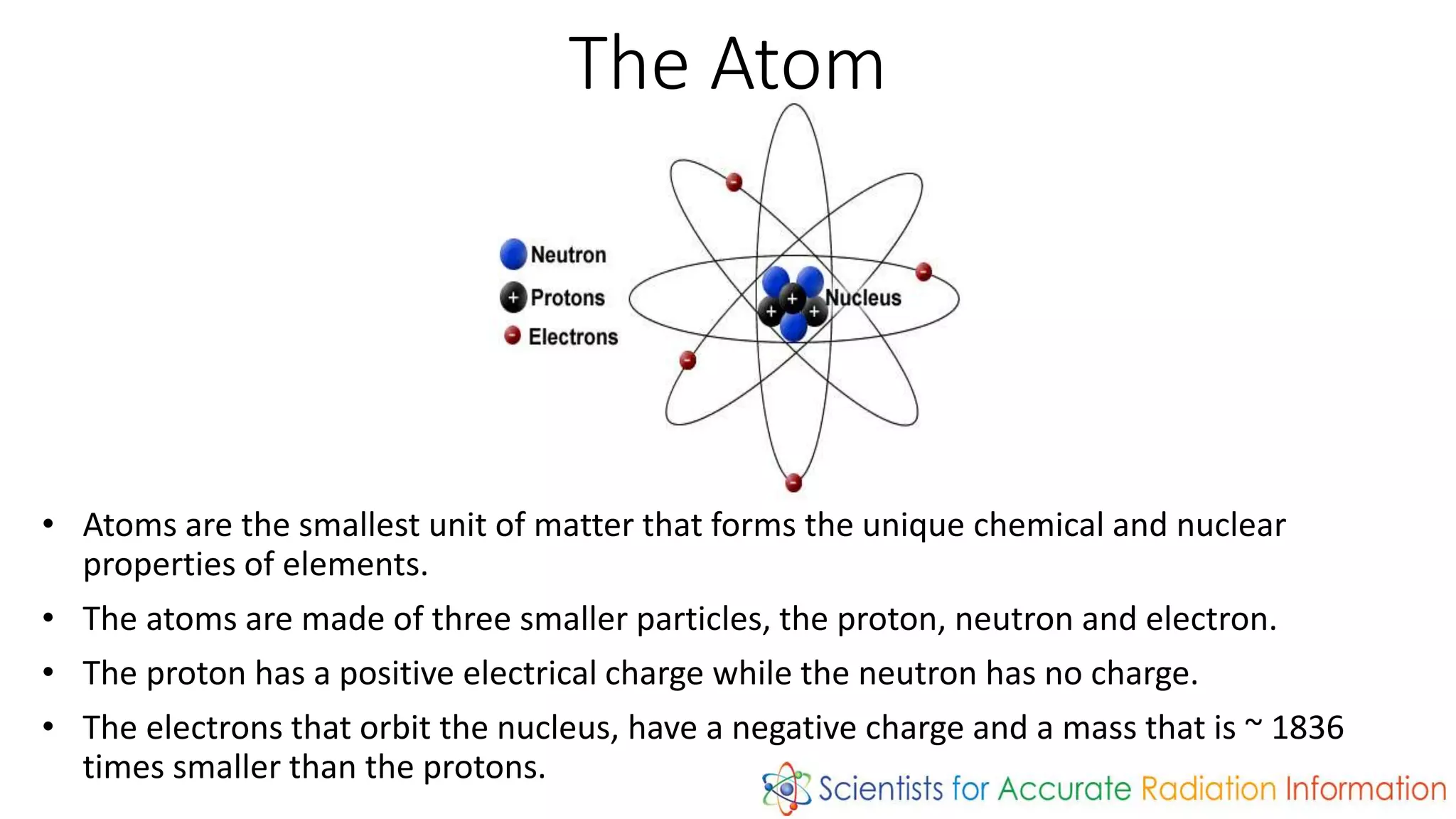
The Atom
• Atoms are the smallest unit of matter that forms the unique chemical and nuclear
properties of elements.
• The atoms are made of three smaller particles, the proton, neutron and electron.
• The proton has a positive electrical charge while the neutron has no charge.
• The electrons that orbit the nucleus, have a negative charge and a mass that is ~ 1836
times smaller than the protons.
Radiation
Radiation is simply energy emitted by a source in the form of electromagnetic (EM) waves or
particles. There are two classification of radiation:
• Non-ionizing Radiation
• Ionizing Radiation
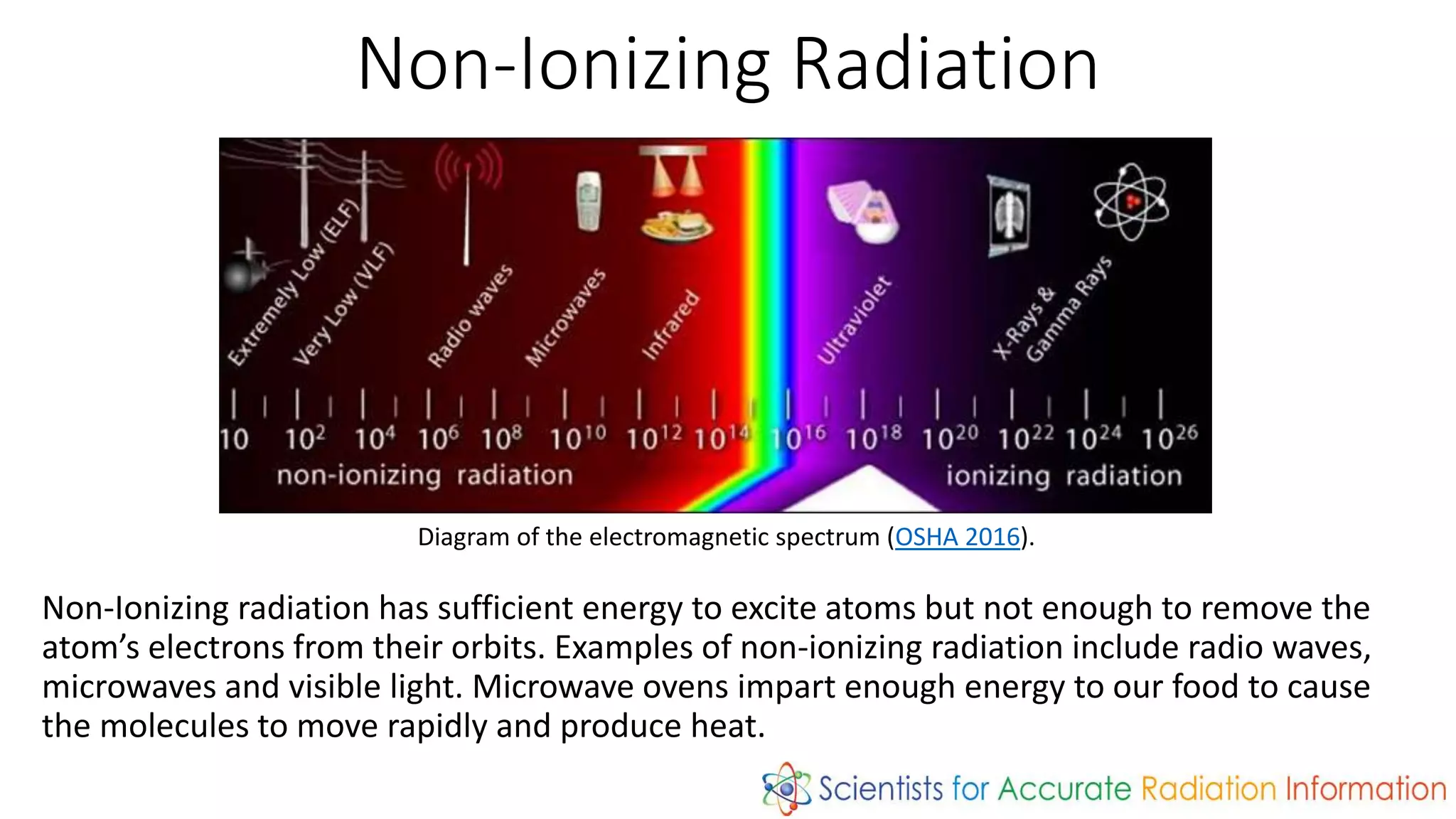
Non-Ionizing Radiation
Non-Ionizing radiation has sufficient energy to excite atoms but not enough to remove the
atom’s electrons from their orbits. Examples of non-ionizing radiation include radio waves,
microwaves and visible light. Microwave ovens impart enough energy to our food to cause
the molecules to move rapidly and produce heat.
Diagram of the electromagnetic spectrum (OSHA 2016).
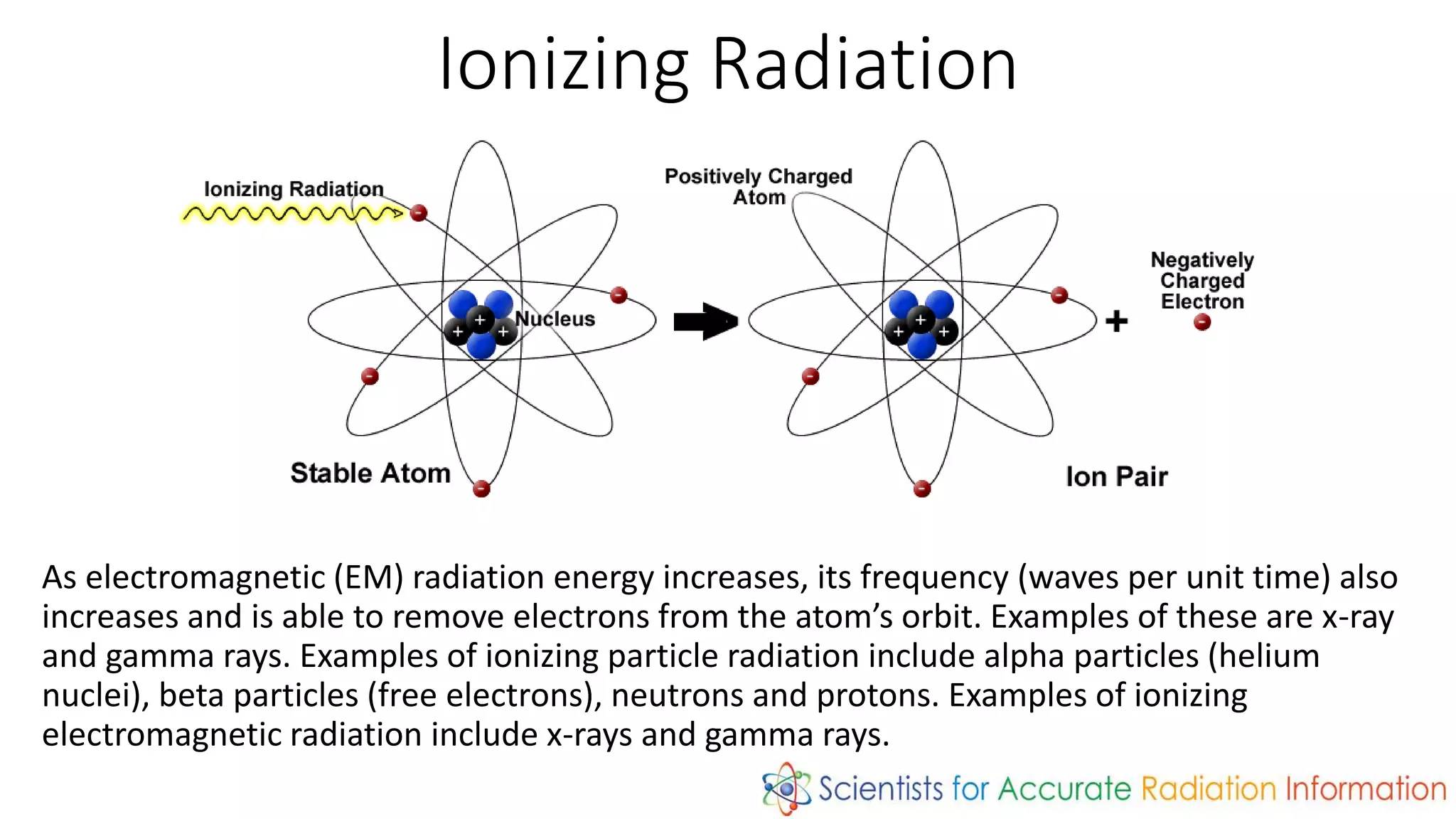
Ionizing Radiation
As electromagnetic (EM) radiation energy increases, its frequency (waves per unit time) also
increases and is able to remove electrons from the atom’s orbit. Examples of these are x-ray
and gamma rays. Examples of ionizing particle radiation include alpha particles (helium
nuclei), beta particles (free electrons), neutrons and protons. Examples of ionizing
electromagnetic radiation include x-rays and gamma rays.
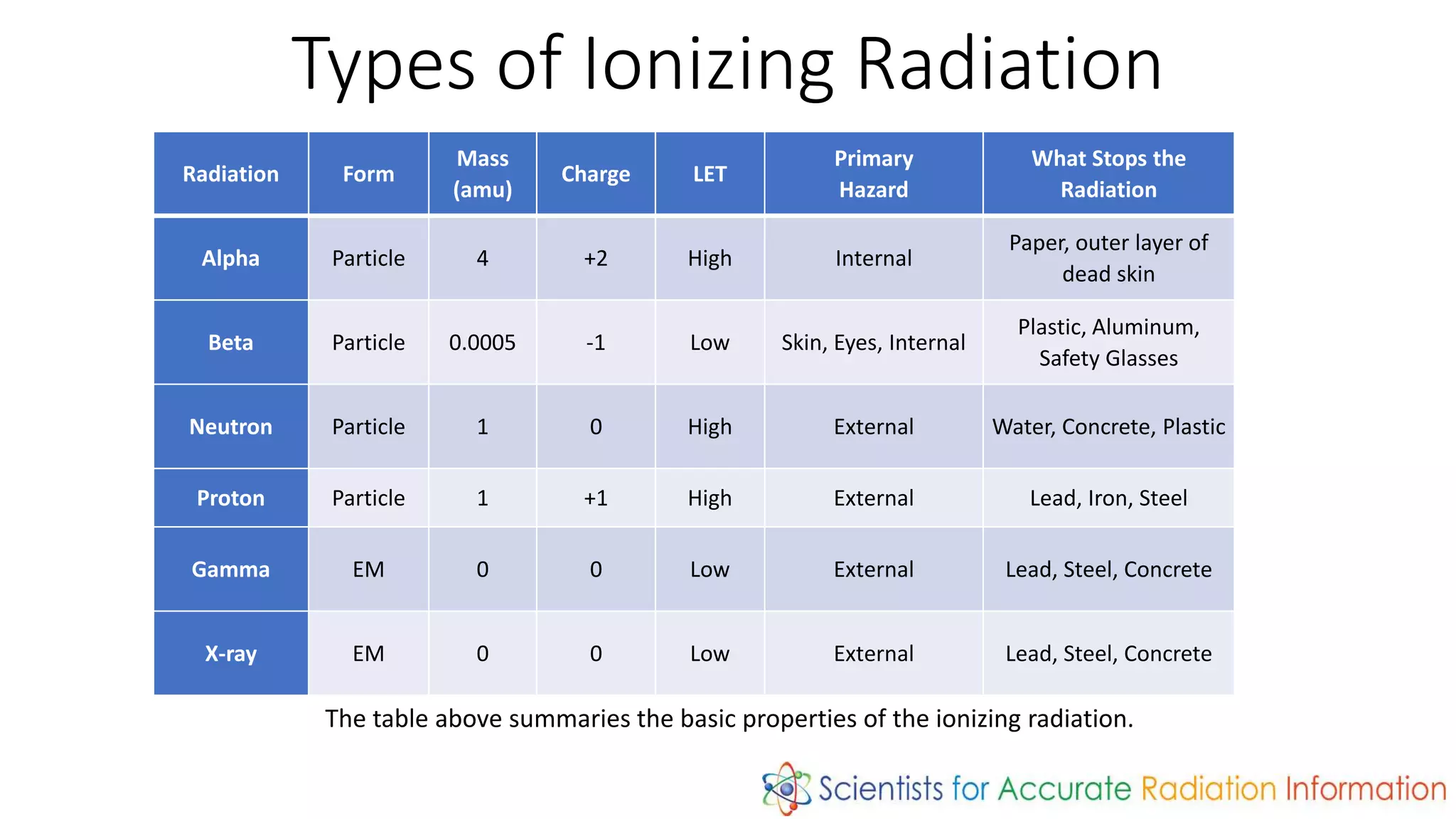
Types of Ionizing Radiation
The table above summaries the basic properties of the ionizing radiation.
Radiation Form
Mass
(amu)
Charge LET
Primary
Hazard
What Stops the
Radiation
Alpha Particle 4 +2 High Internal
Paper, outer layer of
dead skin
Beta Particle 0.0005 -1 Low Skin, Eyes, Internal
Plastic, Aluminum,
Safety Glasses
Neutron Particle 1 0 High External Water, Concrete, Plastic
Proton Particle 1 +1 High External Lead, Iron, Steel
Gamma EM 0 0 Low External Lead, Steel, Concrete
X-ray EM 0 0 Low External Lead, Steel, Concrete
Half-life (T½)
Half-life (T½) is the amount of time it takes for a radioactive isotope to decay to one-
half of its original activity. Some radioactive isotopes have half-lives of billions of years
while other just a few yoctoseconds (10-24 seconds). The properties of radioactive
decay and half-life are very useful for determining the age of rocks and fossils. In
radiometric and carbon dating, the activity of a known isotope is measured to
determine how many half-lives have passed since the rock has formed or a living
organism has died (USGS 2016). The property of radioactive decay is also very useful in
nuclear medicine. Doctors can use isotopes with half-lives just long to perform the
diagnosis or treat the disease but that then decay away soon afterwards to greatly
reduce the radiation dose received by the patient.
Thank you for watching!
Our next presentation
will be on:
“The Sources of Radiation”
Website: www.RadiationEffects.org
Email: Support@RadiationEffects.org
Facebook: www.facebook.com/radiationeffects.org/

What is Radiation?

  • 1.
    What is Radiation? byRobert Miltenberger, CHP Website: www.RadiationEffects.org Email: Support@RadiationEffects.org Facebook: www.facebook.com/radiationeffects.org/
  • 2.
    Group of radiationspecialists from around the world whose goal is to answer the public's questions about the effects low levels of radiation in order to promote clean energy, nuclear medicine and other beneficial technologies that employ the use radiation.
  • 3.
    The Atom • Atomsare the smallest unit of matter that forms the unique chemical and nuclear properties of elements. • The atoms are made of three smaller particles, the proton, neutron and electron. • The proton has a positive electrical charge while the neutron has no charge. • The electrons that orbit the nucleus, have a negative charge and a mass that is ~ 1836 times smaller than the protons.
  • 4.
    Radiation Radiation is simplyenergy emitted by a source in the form of electromagnetic (EM) waves or particles. There are two classification of radiation: • Non-ionizing Radiation • Ionizing Radiation
  • 5.
    Non-Ionizing Radiation Non-Ionizing radiationhas sufficient energy to excite atoms but not enough to remove the atom’s electrons from their orbits. Examples of non-ionizing radiation include radio waves, microwaves and visible light. Microwave ovens impart enough energy to our food to cause the molecules to move rapidly and produce heat. Diagram of the electromagnetic spectrum (OSHA 2016).
  • 6.
    Ionizing Radiation As electromagnetic(EM) radiation energy increases, its frequency (waves per unit time) also increases and is able to remove electrons from the atom’s orbit. Examples of these are x-ray and gamma rays. Examples of ionizing particle radiation include alpha particles (helium nuclei), beta particles (free electrons), neutrons and protons. Examples of ionizing electromagnetic radiation include x-rays and gamma rays.
  • 7.
    Types of IonizingRadiation The table above summaries the basic properties of the ionizing radiation. Radiation Form Mass (amu) Charge LET Primary Hazard What Stops the Radiation Alpha Particle 4 +2 High Internal Paper, outer layer of dead skin Beta Particle 0.0005 -1 Low Skin, Eyes, Internal Plastic, Aluminum, Safety Glasses Neutron Particle 1 0 High External Water, Concrete, Plastic Proton Particle 1 +1 High External Lead, Iron, Steel Gamma EM 0 0 Low External Lead, Steel, Concrete X-ray EM 0 0 Low External Lead, Steel, Concrete
  • 8.
    Half-life (T½) Half-life (T½)is the amount of time it takes for a radioactive isotope to decay to one- half of its original activity. Some radioactive isotopes have half-lives of billions of years while other just a few yoctoseconds (10-24 seconds). The properties of radioactive decay and half-life are very useful for determining the age of rocks and fossils. In radiometric and carbon dating, the activity of a known isotope is measured to determine how many half-lives have passed since the rock has formed or a living organism has died (USGS 2016). The property of radioactive decay is also very useful in nuclear medicine. Doctors can use isotopes with half-lives just long to perform the diagnosis or treat the disease but that then decay away soon afterwards to greatly reduce the radiation dose received by the patient.
  • 9.
    Thank you forwatching! Our next presentation will be on: “The Sources of Radiation” Website: www.RadiationEffects.org Email: Support@RadiationEffects.org Facebook: www.facebook.com/radiationeffects.org/