DATA STRUCTURES & ALGORITHMS
SHORTEST PATH
BY
D SEETHALAKSHMI
ASSISTANT PROFESSOR OF COMPUTER APPLICATIONS
BON SECOURS COLLEGE FOR WOMEN
THANJAVUR
Shortest Path Problem-
In data structures,
 Shortest path problem is a problem of finding the shortest path(s) between vertices of a
given graph.
 Shortest path between two vertices is a path that has the least cost as compared to all other
existing paths.
Shortest Path Algorithms-
Shortest path algorithms are a family of algorithms used for solving the shortest path
problem.
Applications-
Shortest path algorithms have a wide range of applications such as in-
 Google Maps
 Road Networks
 Logistics Research
Types of Shortest Path Problem-
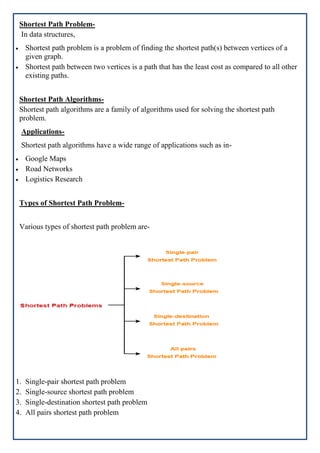
Various types of shortest path problem are-
1. Single-pair shortest path problem
2. Single-source shortest path problem
3. Single-destination shortest path problem
4. All pairs shortest path problem
Single-Pair Shortest Path Problem-
 It is a shortest path problem where the shortest path between a given pair of vertices is
computed.
 A* Search Algorithm is a famous algorithm used for solving single-pair shortest path
problem.
Single-Source Shortest Path Problem-
 It is a shortest path problem where the shortest path from a given source vertex to all other
remaining vertices is computed.
 Dijkstra’s Algorithm and Bellman Ford Algorithm are the famous algorithms used for
solving single-source shortest path problem.
Single-Destination Shortest Path Problem-
 It is a shortest path problem where the shortest path from all the vertices to a single
destination vertex is computed.
 By reversing the direction of each edge in the graph, this problem reduces to single-source
shortest path problem.
 Dijkstra’s Algorithm is a famous algorithm adapted for solving single-destination shortest
path problem.
All Pairs Shortest Path Problem-
 It is a shortest path problem where the shortest path between every pair of vertices is
computed.
 Floyd-Warshall Algorithm and Johnson’s Algorithm are the famous algorithms used for
solving All pairs shortest path problem.
Dijkstra Algorithm | Example | Time Complexity
Dijkstra Algorithm-
 Dijkstra Algorithm is a very famous greedy algorithm.
 It is used for solving the single source shortest path problem.
 It computes the shortest path from one particular source node to all other remaining nodes
of the graph.
Conditions-
It is important to note the following points regarding Dijkstra Algorithm-
 Dijkstra algorithm works only for connected graphs.
 Dijkstra algorithm works only for those graphs that do not contain any negative weight
edge.
 The actual Dijkstra algorithm does not output the shortest paths.
 It only provides the value or cost of the shortest paths.
 By making minor modifications in the actual algorithm, the shortest paths can be easily
obtained.
 Dijkstra algorithm works for directed as well as undirected graphs.
Dijkstra Algorithm-
dist[S] ← 0 // The distance to source vertex is set to 0
Π[S] ← NIL // The predecessor of source vertex is set as NIL
for all v ∈ V - {S} // For all other vertices
do dist[v] ← ∞ // All other distances are set to ∞
Π[v] ← NIL // The predecessor of all other vertices is set as NIL
S ← ∅ // The set of vertices that have been visited 'S' is initially empty
Q ← V // The queue 'Q' initially contains all the vertices
while Q ≠ ∅ // While loop executes till the queue is not empty
do u ← mindistance (Q, dist) // A vertex from Q with the least distance is selected
S ← S ∪ {u} // Vertex 'u' is added to 'S' list of vertices that have been visited
for all v ∈ neighbors[u] // For all the neighboring vertices of vertex 'u'
do if dist[v] > dist[u] + w(u,v) // if any new shortest path is discovered
then dist[v] ← dist[u] + w(u,v) // The new value of the shortest path is selected
return dist
Implementation-
The implementation of above Dijkstra Algorithm is explained in the following steps-
Step-01:
In the first step two sets are defined-
 One set contains all those vertices which have been included in the shortest path tree.
 In the beginning, this set is empty.
 Other set contains all those vertices which are still left to be included in the shortest path
tree.
 In the beginning, this set contains all the vertices of the given graph.
Step-02:
For each vertex of the given graph, two variables are defined as-
 Π[v] which denotes the predecessor of vertex ‘v’
 d[v] which denotes the shortest path estimate of vertex ‘v’ from the source vertex.
Initially, the value of these variables is set as-
 The value of variable ‘Π’ for each vertex is set to NIL i.e. Π[v] = NIL
 The value of variable ‘d’ for source vertex is set to 0 i.e. d[S] = 0
 The value of variable ‘d’ for remaining vertices is set to ∞ i.e. d[v] = ∞
Step-03:
The following procedure is repeated until all the vertices of the graph are processed-
 Among unprocessed vertices, a vertex with minimum value of variable‘d’ is chosen.
 Its outgoing edges are relaxed.
 After relaxing the edges for that vertex, the sets created in step-01 are updated.
What is Edge Relaxation?
Consider the edge (a,b) in the following graph-
Here, d[a] and d[b] denotes the shortest path estimate for vertices a and b respectively from
the source vertex ‘S’.
Now,
If d[a] + w < d[b]
then d[b] = d[a] + w and Π[b] = a
This is called as edge relaxation.
PRACTICE PROBLEM BASED ON DIJKSTRA ALGORITHM-
Problem-
Using Dijkstra’s Algorithm, find the shortest distance from source vertex ‘S’ to remaining
vertices in the following graph-
Also, write the order in which the vertices are visited.
Solution-
Step-01:
The following two sets are created-
 Unvisited set : {S , a , b , c , d , e}
 Visited set : { }
Step-02:
The two variables Π and d are created for each vertex and initialized as-
 Π[S] = Π[a] = Π[b] = Π[c] = Π[d] = Π[e] = NIL
 d[S] = 0
 d[a] = d[b] = d[c] = d[d] = d[e] = ∞
Step-03:
 Vertex ‘S’ is chosen.
 This is because shortest path estimate for vertex ‘S’ is least.
 The outgoing edges of vertex ‘S’ are relaxed.
Before Edge Relaxation-
Now,
 d[S] + 1 = 0 + 1 = 1 < ∞
∴ d[a] = 1 and Π[a] = S
 d[S] + 5 = 0 + 5 = 5 < ∞
∴ d[b] = 5 and Π[b] = S
After edge relaxation, our shortest path tree is-
Now, the sets are updated as-
 Unvisited set : {a , b , c , d , e}
 Visited set : {S}
Step-04:
 Vertex ‘a’ is chosen.
 This is because shortest path estimate for vertex ‘a’ is least.
 The outgoing edges of vertex ‘a’ are relaxed.
Before Edge Relaxation-
Now,
 d[a] + 2 = 1 + 2 = 3 < ∞
∴ d[c] = 3 and Π[c] = a
 d[a] + 1 = 1 + 1 = 2 < ∞
∴ d[d] = 2 and Π[d] = a
 d[b] + 2 = 1 + 2 = 3 < 5
∴ d[b] = 3 and Π[b] = a
After edge relaxation, our shortest path tree is-
Now, the sets are updated as-
 Unvisited set : {b , c , d , e}
 Visited set : {S , a}
Step-05:
 Vertex ‘d’ is chosen.
 This is because shortest path estimate for vertex ‘d’ is least.
 The outgoing edges of vertex ‘d’ are relaxed.
Before Edge Relaxation-
Now,
 d[d] + 2 = 2 + 2 = 4 < ∞
∴ d[e] = 4 and Π[e] = d
After edge relaxation, our shortest path tree is-
Now, the sets are updated as-
 Unvisited set : {b , c , e}
 Visited set : {S , a , d}
Step-06:
 Vertex ‘b’ is chosen.
 This is because shortest path estimate for vertex ‘b’ is least.
 Vertex ‘c’ may also be chosen since for both the vertices, shortest path estimate is least.
 The outgoing edges of vertex ‘b’ are relaxed.
Before Edge Relaxation-
Now,
d[b] + 2 = 3 + 2 = 5 > 2
∴ No change
After edge relaxation, our shortest path tree remains the same as in Step-05.
Now, the sets are updated as-
 Unvisited set : {c , e}
 Visited set : {S , a , d , b}
Step-07:
 Vertex ‘c’ is chosen.
 This is because shortest path estimate for vertex ‘c’ is least.
 The outgoing edges of vertex ‘c’ are relaxed.
Before Edge Relaxation-
Now,
 d[c] + 1 = 3 + 1 = 4 = 4
∴ No change
After edge relaxation, our shortest path tree remains the same as in Step-05.
Now, the sets are updated as-
 Unvisited set : {e}
 Visited set : {S , a , d , b , c}
Step-08:
 Vertex ‘e’ is chosen.
 This is because shortest path estimate for vertex ‘e’ is least.
 The outgoing edges of vertex ‘e’ are relaxed.
 There are no outgoing edges for vertex ‘e’.
 So, our shortest path tree remains the same as in Step-05.
Now, the sets are updated as-
 Unvisited set : { }
 Visited set : {S , a , d , b , c , e}
Now,
 All vertices of the graph are processed.
 Our final shortest path tree is as shown below.
 It represents the shortest path from source vertex ‘S’ to all other remaining vertices.
The order in which all the vertices are processed is :
S , a , d , b , c , e.

Shortest Path Problem.docx

  • 1.
    DATA STRUCTURES &ALGORITHMS SHORTEST PATH BY D SEETHALAKSHMI ASSISTANT PROFESSOR OF COMPUTER APPLICATIONS BON SECOURS COLLEGE FOR WOMEN THANJAVUR
  • 2.
    Shortest Path Problem- Indata structures,  Shortest path problem is a problem of finding the shortest path(s) between vertices of a given graph.  Shortest path between two vertices is a path that has the least cost as compared to all other existing paths. Shortest Path Algorithms- Shortest path algorithms are a family of algorithms used for solving the shortest path problem. Applications- Shortest path algorithms have a wide range of applications such as in-  Google Maps  Road Networks  Logistics Research Types of Shortest Path Problem- Various types of shortest path problem are- 1. Single-pair shortest path problem 2. Single-source shortest path problem 3. Single-destination shortest path problem 4. All pairs shortest path problem
  • 3.
    Single-Pair Shortest PathProblem-  It is a shortest path problem where the shortest path between a given pair of vertices is computed.  A* Search Algorithm is a famous algorithm used for solving single-pair shortest path problem. Single-Source Shortest Path Problem-  It is a shortest path problem where the shortest path from a given source vertex to all other remaining vertices is computed.  Dijkstra’s Algorithm and Bellman Ford Algorithm are the famous algorithms used for solving single-source shortest path problem. Single-Destination Shortest Path Problem-  It is a shortest path problem where the shortest path from all the vertices to a single destination vertex is computed.  By reversing the direction of each edge in the graph, this problem reduces to single-source shortest path problem.  Dijkstra’s Algorithm is a famous algorithm adapted for solving single-destination shortest path problem. All Pairs Shortest Path Problem-  It is a shortest path problem where the shortest path between every pair of vertices is computed.  Floyd-Warshall Algorithm and Johnson’s Algorithm are the famous algorithms used for solving All pairs shortest path problem. Dijkstra Algorithm | Example | Time Complexity Dijkstra Algorithm-  Dijkstra Algorithm is a very famous greedy algorithm.  It is used for solving the single source shortest path problem.  It computes the shortest path from one particular source node to all other remaining nodes of the graph.
  • 4.
    Conditions- It is importantto note the following points regarding Dijkstra Algorithm-  Dijkstra algorithm works only for connected graphs.  Dijkstra algorithm works only for those graphs that do not contain any negative weight edge.  The actual Dijkstra algorithm does not output the shortest paths.  It only provides the value or cost of the shortest paths.  By making minor modifications in the actual algorithm, the shortest paths can be easily obtained.  Dijkstra algorithm works for directed as well as undirected graphs. Dijkstra Algorithm- dist[S] ← 0 // The distance to source vertex is set to 0 Π[S] ← NIL // The predecessor of source vertex is set as NIL for all v ∈ V - {S} // For all other vertices do dist[v] ← ∞ // All other distances are set to ∞ Π[v] ← NIL // The predecessor of all other vertices is set as NIL S ← ∅ // The set of vertices that have been visited 'S' is initially empty Q ← V // The queue 'Q' initially contains all the vertices while Q ≠ ∅ // While loop executes till the queue is not empty do u ← mindistance (Q, dist) // A vertex from Q with the least distance is selected S ← S ∪ {u} // Vertex 'u' is added to 'S' list of vertices that have been visited for all v ∈ neighbors[u] // For all the neighboring vertices of vertex 'u' do if dist[v] > dist[u] + w(u,v) // if any new shortest path is discovered then dist[v] ← dist[u] + w(u,v) // The new value of the shortest path is selected return dist Implementation- The implementation of above Dijkstra Algorithm is explained in the following steps- Step-01: In the first step two sets are defined-  One set contains all those vertices which have been included in the shortest path tree.  In the beginning, this set is empty.  Other set contains all those vertices which are still left to be included in the shortest path tree.  In the beginning, this set contains all the vertices of the given graph.
  • 5.
    Step-02: For each vertexof the given graph, two variables are defined as-  Π[v] which denotes the predecessor of vertex ‘v’  d[v] which denotes the shortest path estimate of vertex ‘v’ from the source vertex. Initially, the value of these variables is set as-  The value of variable ‘Π’ for each vertex is set to NIL i.e. Π[v] = NIL  The value of variable ‘d’ for source vertex is set to 0 i.e. d[S] = 0  The value of variable ‘d’ for remaining vertices is set to ∞ i.e. d[v] = ∞ Step-03: The following procedure is repeated until all the vertices of the graph are processed-  Among unprocessed vertices, a vertex with minimum value of variable‘d’ is chosen.  Its outgoing edges are relaxed.  After relaxing the edges for that vertex, the sets created in step-01 are updated. What is Edge Relaxation? Consider the edge (a,b) in the following graph- Here, d[a] and d[b] denotes the shortest path estimate for vertices a and b respectively from the source vertex ‘S’. Now, If d[a] + w < d[b] then d[b] = d[a] + w and Π[b] = a This is called as edge relaxation.
  • 6.
    PRACTICE PROBLEM BASEDON DIJKSTRA ALGORITHM- Problem- Using Dijkstra’s Algorithm, find the shortest distance from source vertex ‘S’ to remaining vertices in the following graph- Also, write the order in which the vertices are visited. Solution- Step-01: The following two sets are created-  Unvisited set : {S , a , b , c , d , e}  Visited set : { } Step-02: The two variables Π and d are created for each vertex and initialized as-  Π[S] = Π[a] = Π[b] = Π[c] = Π[d] = Π[e] = NIL  d[S] = 0  d[a] = d[b] = d[c] = d[d] = d[e] = ∞ Step-03:  Vertex ‘S’ is chosen.  This is because shortest path estimate for vertex ‘S’ is least.  The outgoing edges of vertex ‘S’ are relaxed. Before Edge Relaxation-
  • 7.
    Now,  d[S] +1 = 0 + 1 = 1 < ∞ ∴ d[a] = 1 and Π[a] = S  d[S] + 5 = 0 + 5 = 5 < ∞ ∴ d[b] = 5 and Π[b] = S After edge relaxation, our shortest path tree is- Now, the sets are updated as-  Unvisited set : {a , b , c , d , e}  Visited set : {S} Step-04:  Vertex ‘a’ is chosen.  This is because shortest path estimate for vertex ‘a’ is least.  The outgoing edges of vertex ‘a’ are relaxed.
  • 8.
    Before Edge Relaxation- Now, d[a] + 2 = 1 + 2 = 3 < ∞ ∴ d[c] = 3 and Π[c] = a  d[a] + 1 = 1 + 1 = 2 < ∞ ∴ d[d] = 2 and Π[d] = a  d[b] + 2 = 1 + 2 = 3 < 5 ∴ d[b] = 3 and Π[b] = a After edge relaxation, our shortest path tree is- Now, the sets are updated as-
  • 9.
     Unvisited set: {b , c , d , e}  Visited set : {S , a} Step-05:  Vertex ‘d’ is chosen.  This is because shortest path estimate for vertex ‘d’ is least.  The outgoing edges of vertex ‘d’ are relaxed. Before Edge Relaxation- Now,  d[d] + 2 = 2 + 2 = 4 < ∞ ∴ d[e] = 4 and Π[e] = d After edge relaxation, our shortest path tree is- Now, the sets are updated as-
  • 10.
     Unvisited set: {b , c , e}  Visited set : {S , a , d} Step-06:  Vertex ‘b’ is chosen.  This is because shortest path estimate for vertex ‘b’ is least.  Vertex ‘c’ may also be chosen since for both the vertices, shortest path estimate is least.  The outgoing edges of vertex ‘b’ are relaxed. Before Edge Relaxation- Now, d[b] + 2 = 3 + 2 = 5 > 2 ∴ No change After edge relaxation, our shortest path tree remains the same as in Step-05. Now, the sets are updated as-  Unvisited set : {c , e}  Visited set : {S , a , d , b} Step-07:  Vertex ‘c’ is chosen.  This is because shortest path estimate for vertex ‘c’ is least.  The outgoing edges of vertex ‘c’ are relaxed. Before Edge Relaxation-
  • 11.
    Now,  d[c] +1 = 3 + 1 = 4 = 4 ∴ No change After edge relaxation, our shortest path tree remains the same as in Step-05. Now, the sets are updated as-  Unvisited set : {e}  Visited set : {S , a , d , b , c} Step-08:  Vertex ‘e’ is chosen.  This is because shortest path estimate for vertex ‘e’ is least.  The outgoing edges of vertex ‘e’ are relaxed.  There are no outgoing edges for vertex ‘e’.  So, our shortest path tree remains the same as in Step-05. Now, the sets are updated as-  Unvisited set : { }  Visited set : {S , a , d , b , c , e} Now,  All vertices of the graph are processed.  Our final shortest path tree is as shown below.  It represents the shortest path from source vertex ‘S’ to all other remaining vertices. The order in which all the vertices are processed is : S , a , d , b , c , e.