DESIGN PATTERNS
         S.SRIKRISHNAN
           FINAL YEAR
DEPARTMENT OF COMPUTER SCIENCE
  SSN COLLEGE OF ENGINEERING
Overview
•   Introduction
•   Software Architecture
•   Issues in Software Development
•   GoF patterns
•   Basic Class relationships
•   Design Principles – 1,2,3
•   Design Principles to Design Patterns
•   Observer Pattern
Introduction
• “Programming is fun, but developing quality
  software is hard” – Craig Larman
• The focus is on OO software development
• Built using OO Framework – Java, .NET,
  Python, C++, Smalltalk etc.
• “Owning a hammer doesn’t make one an
  architect”
• Many issues during development have to be
  resolved
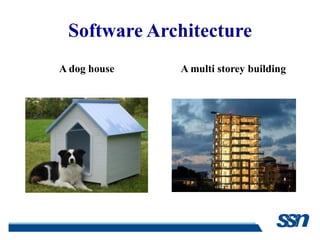
Software Architecture
A dog house   A multi storey building
Differences
•   Scale
•   Process
•   Cost
•   Schedule
•   Skills and development teams
•   Materials and technologies
•   Stakeholders
•   Risks
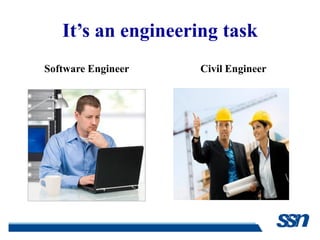
It’s an engineering task
Software Engineer   Civil Engineer
Issues in Software Development
• Unclear requirements
• Continuously changing requirements
• Miscommunications
• How to design the software classes – Huh ! Looks
  like the most difficult problem
• How to assign responsibilities to classes – What
  classes should do what?
• All these imply something - The code being
  developed should be reusable, highly cohesive
  and less coupled
Design Patterns come to our rescue
• They are elements of reusable Object Oriented
  Software
• Try to exploit the wisdom and lessons learnt by the
  OO developers who faced similar design problems
• An object-oriented system's quality can be judged
  looking at the manner in which patterns have been
  used
• Several design patterns have been suggested by the
  GoF (Gang of Four)
GoF – Who are they ?
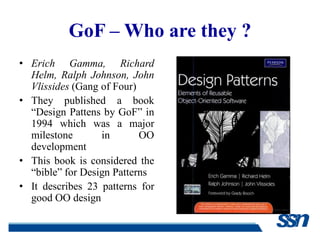
• Erich Gamma, Richard
  Helm, Ralph Johnson, John
  Vlissides (Gang of Four)
• They published a book
  “Design Pattens by GoF” in
  1994 which was a major
  milestone       in       OO
  development
• This book is considered the
  “bible” for Design Patterns
• It describes 23 patterns for
  good OO design
“One man’s pattern is another
man’s primitive building block”
Basic Class Relationships
•   Generalization (Is – a)
•   Realization (Implements – a)
•   Association (Has – a / uses)
•   Composition (Is composed of)
Design Principles
• “Identify the aspects of your application that
  vary and separate them from what stays the
  same”
• “Program to an interface, not an
  implementation”
• “Favor composition over inheritance”
Design Principle – 1
• “Identify the aspects of your application that
  vary and separate them from what stays the
  same”
• Take the parts that vary and encapsulate them
• You can later alter or extend the parts that vary
  without affecting those that don’t
• Let’s see how to apply this for a Duck class
Designing a Duck class
• A duck may fly, quack – depends on the type of duck
  (sub classes of Duck)
• So, can we put quack and fly methods in Duck class?
   – A problem, because all types may not quack or fly
• So, can we have these methods in duck class, and
  override them in sub classes, so that ducks that should
  not fly or quack will override to do nothing?
   – A bigger problem, because, it is unstable to
     changes
Designing a Duck class
• So, what about an interface?
• Lets define an interface Flyable with fly
  method and Quackable with Quack method
• All sub ducks extend Duck class and
  implement the necessary interface(s)
• Does that solve this problem really?
  – No, it shows no improvement
  – Code is still not reusable
Designing a Duck class
• So here lies the problem : Quack and fly
  methods have to be implemented in all the sub
  classes.
• If there is a need to change the flying or
  quacking style, we need to go to all classes and
  modify them
• Let’s try to find a solution to this : Apply the
  previously mentioned principle
Applying the design principle
• Pull out what varies : Quack and Fly behaviour
• Allocate separate interfaces FlyBehaviour and
  QuackBehaviour
• Write 2 classes FlyWithWings and FlyNoWay
  that implements FlyBehaviour
• Write 2 more classes Quack and MuteQuack
  that implements QuackBehaviour
Applying the design principle
• Override fly method in FlyWithWings with
  necessary implementation and in FlyNoWay
  without any implementation
• Override quack method in Quack with
  necessary implementation and in NoQuack
  without any implementation
• Create an association with the Duck class and
  the two encapsulated Behaviour classes :
  FlyBehaviour and QuackBehaviour
Design Principle – 2
• “Program to an interface, not an
  implementation”
• Programming to an interface means
  programming to a super type
• This helps in exploiting polymorphism : the
  actual runtime object isn’t locked into the code
• Objects assigned can be any concrete
  implementation of the super type
Design Principle – 3
•   “Favor composition over inheritance”
•   It adds flexibility to the code
•   It helps encapsulate family of algorithms
•   It helps us change behavior at runtime
•   As seen in the above example, composition
    yields better design than inheritance
From principles to patterns
• All patterns that have been framed adopt the 3
  basic design principles
• When you use a pattern in a description, other
  developers quickly know precisely the design
  you have in your mind
• A team well versed in design patterns can
  move forward more quickly with less room for
  misunderstanding
Observer Pattern
•   Most widely used patterns in the JDK
•   Publisher – Subscriber Pattern
•   Event Delegation Model
•   Different kinds of subscriber objects are
    interested in the state change or events of a
    publisher object, and want to react in their own
    unique way when the publisher generates an
    event.
Observer Pattern
• Define a subscriber or listener interface
• Subscribers implement this interface
• The publisher can dynamically register
  subscribers who are interested in an event and
  notify them when an even occurs.
• We could implement the Observer pattern
  “from scratch” in Java
• Java provides the Observable/Observer classes
  as built-in support for the Observer pattern
Observer Pattern
• The java.util.Observable class is the base Subject
  class. Any Class that wants to be observed
  extends this class
  – Provides methods to add/delete observers
  – Provides methods to notify all observers
  – A subclass only needs to ensure that its observers are
    notified in the appropriate mutators
  – Uses a Vector for storing the observer references
• The java.util.Observer interface is the Observer
  interface.   It must be implemented by any
  observer class
Observer Pattern
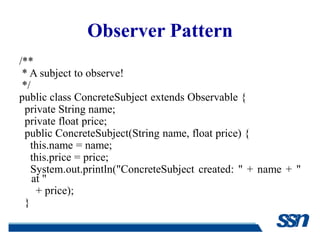
/**
 * A subject to observe!
 */
public class ConcreteSubject extends Observable {
 private String name;
 private float price;
 public ConcreteSubject(String name, float price) {
   this.name = name;
   this.price = price;
   System.out.println("ConcreteSubject created: " + name + "
    at "
     + price);
 }
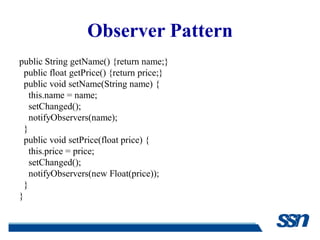
Observer Pattern
public String getName() {return name;}
  public float getPrice() {return price;}
  public void setName(String name) {
    this.name = name;
    setChanged();
    notifyObservers(name);
  }
  public void setPrice(float price) {
    this.price = price;
    setChanged();
    notifyObservers(new Float(price));
  }
}
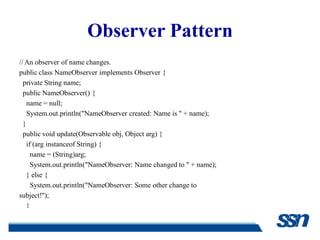
Observer Pattern
// An observer of name changes.
public class NameObserver implements Observer {
  private String name;
  public NameObserver() {
    name = null;
    System.out.println("NameObserver created: Name is " + name);
  }
  public void update(Observable obj, Object arg) {
    if (arg instanceof String) {
      name = (String)arg;
      System.out.println("NameObserver: Name changed to " + name);
    } else {
      System.out.println("NameObserver: Some other change to
subject!");
    }
  }
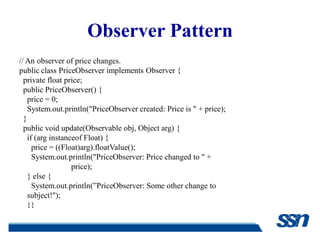
Observer Pattern
// An observer of price changes.
public class PriceObserver implements Observer {
  private float price;
  public PriceObserver() {
    price = 0;
    System.out.println("PriceObserver created: Price is " + price);
  }
  public void update(Observable obj, Object arg) {
    if (arg instanceof Float) {
      price = ((Float)arg).floatValue();
      System.out.println("PriceObserver: Price changed to " +
                   price);
    } else {
      System.out.println(”PriceObserver: Some other change to
    subject!");
    }}
Observer Pattern
// Test program for ConcreteSubject, NameObserver and PriceObserver
public class TestObservers {
  public static void main(String args[]) {
    // Create the Subject and Observers.
    ConcreteSubject s = new ConcreteSubject("Corn Pops", 1.29f);
    NameObserver nameObs = new NameObserver();
    PriceObserver priceObs = new PriceObserver();
    // Add those Observers!
    s.addObserver(nameObs);
    s.addObserver(priceObs);
    // Make changes to the Subject.
    s.setName("Frosted Flakes");
    s.setPrice(4.57f);
    s.setPrice(9.22f);
    s.setName("Sugar Crispies");
  }
}
Observer Pattern
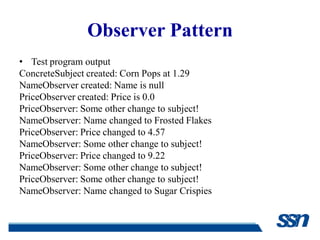
• Test program output
ConcreteSubject created: Corn Pops at 1.29
NameObserver created: Name is null
PriceObserver created: Price is 0.0
PriceObserver: Some other change to subject!
NameObserver: Name changed to Frosted Flakes
PriceObserver: Price changed to 4.57
NameObserver: Some other change to subject!
PriceObserver: Price changed to 9.22
NameObserver: Some other change to subject!
PriceObserver: Some other change to subject!
NameObserver: Name changed to Sugar Crispies
Many more Pattern
•   Decorator Pattern
•   Factory Pattern
•   Singleton Pattern
•   Command Pattern
•   Template Method Pattern
•   Adapter Pattern
•   State Pattern
•   Proxy Pattern etc.
Thank You !

Design Patterns

  • 1.
    DESIGN PATTERNS S.SRIKRISHNAN FINAL YEAR DEPARTMENT OF COMPUTER SCIENCE SSN COLLEGE OF ENGINEERING
  • 2.
    Overview • Introduction • Software Architecture • Issues in Software Development • GoF patterns • Basic Class relationships • Design Principles – 1,2,3 • Design Principles to Design Patterns • Observer Pattern
  • 3.
    Introduction • “Programming isfun, but developing quality software is hard” – Craig Larman • The focus is on OO software development • Built using OO Framework – Java, .NET, Python, C++, Smalltalk etc. • “Owning a hammer doesn’t make one an architect” • Many issues during development have to be resolved
  • 4.
    Software Architecture A doghouse A multi storey building
  • 5.
    Differences • Scale • Process • Cost • Schedule • Skills and development teams • Materials and technologies • Stakeholders • Risks
  • 6.
    It’s an engineeringtask Software Engineer Civil Engineer
  • 7.
    Issues in SoftwareDevelopment • Unclear requirements • Continuously changing requirements • Miscommunications • How to design the software classes – Huh ! Looks like the most difficult problem • How to assign responsibilities to classes – What classes should do what? • All these imply something - The code being developed should be reusable, highly cohesive and less coupled
  • 8.
    Design Patterns cometo our rescue • They are elements of reusable Object Oriented Software • Try to exploit the wisdom and lessons learnt by the OO developers who faced similar design problems • An object-oriented system's quality can be judged looking at the manner in which patterns have been used • Several design patterns have been suggested by the GoF (Gang of Four)
  • 9.
    GoF – Whoare they ? • Erich Gamma, Richard Helm, Ralph Johnson, John Vlissides (Gang of Four) • They published a book “Design Pattens by GoF” in 1994 which was a major milestone in OO development • This book is considered the “bible” for Design Patterns • It describes 23 patterns for good OO design
  • 10.
    “One man’s patternis another man’s primitive building block”
  • 11.
    Basic Class Relationships • Generalization (Is – a) • Realization (Implements – a) • Association (Has – a / uses) • Composition (Is composed of)
  • 12.
    Design Principles • “Identifythe aspects of your application that vary and separate them from what stays the same” • “Program to an interface, not an implementation” • “Favor composition over inheritance”
  • 13.
    Design Principle –1 • “Identify the aspects of your application that vary and separate them from what stays the same” • Take the parts that vary and encapsulate them • You can later alter or extend the parts that vary without affecting those that don’t • Let’s see how to apply this for a Duck class
  • 14.
    Designing a Duckclass • A duck may fly, quack – depends on the type of duck (sub classes of Duck) • So, can we put quack and fly methods in Duck class? – A problem, because all types may not quack or fly • So, can we have these methods in duck class, and override them in sub classes, so that ducks that should not fly or quack will override to do nothing? – A bigger problem, because, it is unstable to changes
  • 15.
    Designing a Duckclass • So, what about an interface? • Lets define an interface Flyable with fly method and Quackable with Quack method • All sub ducks extend Duck class and implement the necessary interface(s) • Does that solve this problem really? – No, it shows no improvement – Code is still not reusable
  • 16.
    Designing a Duckclass • So here lies the problem : Quack and fly methods have to be implemented in all the sub classes. • If there is a need to change the flying or quacking style, we need to go to all classes and modify them • Let’s try to find a solution to this : Apply the previously mentioned principle
  • 17.
    Applying the designprinciple • Pull out what varies : Quack and Fly behaviour • Allocate separate interfaces FlyBehaviour and QuackBehaviour • Write 2 classes FlyWithWings and FlyNoWay that implements FlyBehaviour • Write 2 more classes Quack and MuteQuack that implements QuackBehaviour
  • 18.
    Applying the designprinciple • Override fly method in FlyWithWings with necessary implementation and in FlyNoWay without any implementation • Override quack method in Quack with necessary implementation and in NoQuack without any implementation • Create an association with the Duck class and the two encapsulated Behaviour classes : FlyBehaviour and QuackBehaviour
  • 19.
    Design Principle –2 • “Program to an interface, not an implementation” • Programming to an interface means programming to a super type • This helps in exploiting polymorphism : the actual runtime object isn’t locked into the code • Objects assigned can be any concrete implementation of the super type
  • 20.
    Design Principle –3 • “Favor composition over inheritance” • It adds flexibility to the code • It helps encapsulate family of algorithms • It helps us change behavior at runtime • As seen in the above example, composition yields better design than inheritance
  • 21.
    From principles topatterns • All patterns that have been framed adopt the 3 basic design principles • When you use a pattern in a description, other developers quickly know precisely the design you have in your mind • A team well versed in design patterns can move forward more quickly with less room for misunderstanding
  • 22.
    Observer Pattern • Most widely used patterns in the JDK • Publisher – Subscriber Pattern • Event Delegation Model • Different kinds of subscriber objects are interested in the state change or events of a publisher object, and want to react in their own unique way when the publisher generates an event.
  • 23.
    Observer Pattern • Definea subscriber or listener interface • Subscribers implement this interface • The publisher can dynamically register subscribers who are interested in an event and notify them when an even occurs. • We could implement the Observer pattern “from scratch” in Java • Java provides the Observable/Observer classes as built-in support for the Observer pattern
  • 24.
    Observer Pattern • Thejava.util.Observable class is the base Subject class. Any Class that wants to be observed extends this class – Provides methods to add/delete observers – Provides methods to notify all observers – A subclass only needs to ensure that its observers are notified in the appropriate mutators – Uses a Vector for storing the observer references • The java.util.Observer interface is the Observer interface. It must be implemented by any observer class
  • 25.
    Observer Pattern /** *A subject to observe! */ public class ConcreteSubject extends Observable { private String name; private float price; public ConcreteSubject(String name, float price) { this.name = name; this.price = price; System.out.println("ConcreteSubject created: " + name + " at " + price); }
  • 26.
    Observer Pattern public StringgetName() {return name;} public float getPrice() {return price;} public void setName(String name) { this.name = name; setChanged(); notifyObservers(name); } public void setPrice(float price) { this.price = price; setChanged(); notifyObservers(new Float(price)); } }
  • 27.
    Observer Pattern // Anobserver of name changes. public class NameObserver implements Observer { private String name; public NameObserver() { name = null; System.out.println("NameObserver created: Name is " + name); } public void update(Observable obj, Object arg) { if (arg instanceof String) { name = (String)arg; System.out.println("NameObserver: Name changed to " + name); } else { System.out.println("NameObserver: Some other change to subject!"); } }
  • 28.
    Observer Pattern // Anobserver of price changes. public class PriceObserver implements Observer { private float price; public PriceObserver() { price = 0; System.out.println("PriceObserver created: Price is " + price); } public void update(Observable obj, Object arg) { if (arg instanceof Float) { price = ((Float)arg).floatValue(); System.out.println("PriceObserver: Price changed to " + price); } else { System.out.println(”PriceObserver: Some other change to subject!"); }}
  • 29.
    Observer Pattern // Testprogram for ConcreteSubject, NameObserver and PriceObserver public class TestObservers { public static void main(String args[]) { // Create the Subject and Observers. ConcreteSubject s = new ConcreteSubject("Corn Pops", 1.29f); NameObserver nameObs = new NameObserver(); PriceObserver priceObs = new PriceObserver(); // Add those Observers! s.addObserver(nameObs); s.addObserver(priceObs); // Make changes to the Subject. s.setName("Frosted Flakes"); s.setPrice(4.57f); s.setPrice(9.22f); s.setName("Sugar Crispies"); } }
  • 30.
    Observer Pattern • Testprogram output ConcreteSubject created: Corn Pops at 1.29 NameObserver created: Name is null PriceObserver created: Price is 0.0 PriceObserver: Some other change to subject! NameObserver: Name changed to Frosted Flakes PriceObserver: Price changed to 4.57 NameObserver: Some other change to subject! PriceObserver: Price changed to 9.22 NameObserver: Some other change to subject! PriceObserver: Some other change to subject! NameObserver: Name changed to Sugar Crispies
  • 31.
    Many more Pattern • Decorator Pattern • Factory Pattern • Singleton Pattern • Command Pattern • Template Method Pattern • Adapter Pattern • State Pattern • Proxy Pattern etc.
  • 32.