By Prof. Liwayway Memije-Cruz
TemperatureTemperature
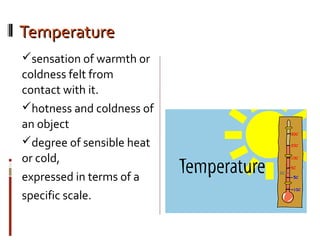
sensation of warmth or
coldness felt from
contact with it.
hotness and coldness of
an object
degree of sensible heat
or cold,
expressed in terms of a
specific scale.
ThermometerThermometer
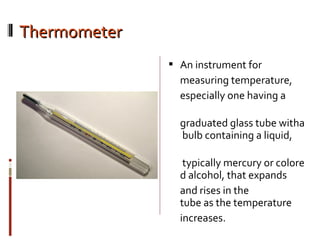
 An instrument for
measuring temperature,
especially one having a
graduated glass tube witha
bulb containing a liquid,
typically mercury or
colored alcohol, that
expands
and rises in the
tube as the temperature
increases.
Celsius ScaleCelsius Scale
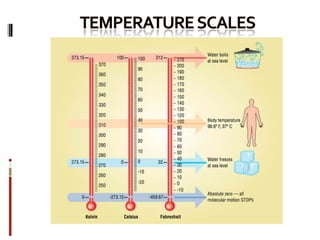
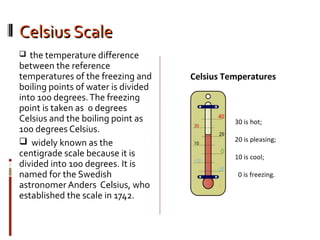
 the temperature difference
between the reference
temperatures of the freezing and
boiling points of water is divided
into 100 degrees.The freezing
point is taken as 0 degrees
Celsius and the boiling point as
100 degrees Celsius.
 widely known as the
centigrade scale because it is
divided into 100 degrees. It is
named for the Swedish
astronomer Anders Celsius, who
established the scale in 1742.
Fahrenheit ScaleFahrenheit Scale
 temperature scale in which
the temperature difference
between two reference
temperatures, the melting
and boiling points of water, is
divided into 180 equal
intervals called degrees.
 The freezing point is taken as
32°F and the boiling point as
212°F.
 The scale was established by
the German-Dutch physicist
Gabriel Daniel Fahrenheit in
1724.
Kelvin ScaleKelvin Scale
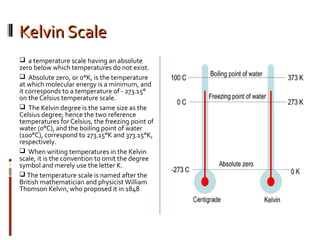
 a temperature scale having an absolute
zero below which temperatures do not exist.
 Absolute zero, or 0°K, is the temperature
at which molecular energy is a minimum, and
it corresponds to a temperature of - 273.15°
on the Celsius temperature scale.
 The Kelvin degree is the same size as the
Celsius degree; hence the two reference
temperatures for Celsius, the freezing point of
water (0°C), and the boiling point of water
(100°C), correspond to 273.15°K and 373.15°K,
respectively.
 When writing temperatures in the Kelvin
scale, it is the convention to omit the degree
symbol and merely use the letter K.
 The temperature scale is named after the
British mathematician and physicistWilliam
Thomson Kelvin, who proposed it in 1848
Rankine ScaleRankine Scale
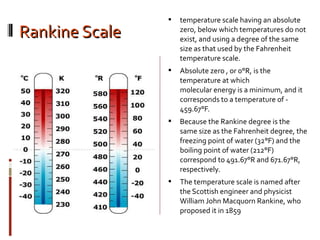
 temperature scale having an absolute
zero, below which temperatures do not
exist, and using a degree of the same
size as that used by the Fahrenheit
temperature scale.
 Absolute zero , or 0°R, is the
temperature at which
molecular energy is a minimum, and it
corresponds to a temperature of -
459.67°F.
 Because the Rankine degree is the
same size as the Fahrenheit degree, the
freezing point of water (32°F) and the
boiling point of water (212°F)
correspond to 491.67°R and 671.67°R,
respectively.
 The temperature scale is named after
the Scottish engineer and physicist
William John Macquorn Rankine, who
proposed it in 1859
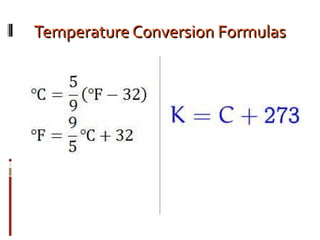
Temperature C0nversion FormulasTemperature C0nversion Formulas
Problems:Problems:
1. Express normal body temperature,
98.6°F, in °C and K.
2. Convert the following temperatures
as directed.
a. 10.0°C = _____ Kelvin
b. 323 K = _____ °C
c. 367 K = ______ °C
d. 200 °C = ______ K
e. 283 °C = _____ K
f. 1111 K = ______ °C
g. 25°C = ______ K
h. 373 K = _____ °C
i. 100°C = _____ K
j. 0°C = _____ K
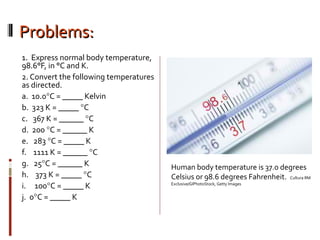
Human body temperature is 37.0 degrees
Celsius or 98.6 degrees Fahrenheit. Cultura RM
Exclusive/GIPhotoStock, Getty Images
Human thermoregulationHuman thermoregulation
Thermoregulation is a
process that allows your
body to maintain its core
internal temperature.
All thermoregulation
mechanisms are designed
to return your body to
homeostasis.This is a
state of equilibrium.
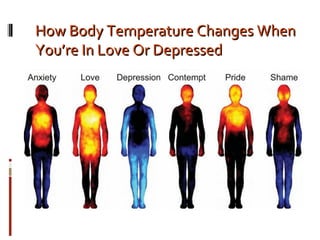
How Body Temperature Changes WhenHow Body Temperature Changes When
You’re In Love Or DepressedYou’re In Love Or Depressed
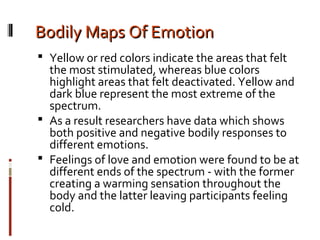
Bodily Maps Of EmotionBodily Maps Of Emotion
 Yellow or red colors indicate the areas that felt
the most stimulated, whereas blue colors
highlight areas that felt deactivated. Yellow and
dark blue represent the most extreme of the
spectrum.
 As a result researchers have data which shows
both positive and negative bodily responses to
different emotions.
 Feelings of love and emotion were found to be at
different ends of the spectrum - with the former
creating a warming sensation throughout the
body and the latter leaving participants feeling
cold.
References:References:
 http://www.infoplease.com/encyclopedia/science/
celsius-temperature-scale.html
 http://www.infoplease.com/encyclopedia/science/
kelvin-temperature-scale.html
 http://www.infoplease.com/encyclopedia/science/
fahrenheit-temperature-scale.html
 http://chemistry.about.com/od/unitconversions/a/
fahrenheit-celsius-kelvin-conversion.htm
 http://eo.ucar.edu/skymath/tmp2.html
 http://www.mathscore.com/math/practice/
Temperature%20Conversion/
 http://www.huffingtonpost.co.uk/2014/01/06/body-
temperature-changes-emotions-love-
depression_n_4549145.html
 http://www.healthline.com/health/thermoregulation#Ove
rview1

All about heat and temperature

  • 1.
    By Prof. LiwaywayMemije-Cruz
  • 2.
    TemperatureTemperature sensation of warmthor coldness felt from contact with it. hotness and coldness of an object degree of sensible heat or cold, expressed in terms of a specific scale.
  • 3.
    ThermometerThermometer  An instrumentfor measuring temperature, especially one having a graduated glass tube witha bulb containing a liquid, typically mercury or colored alcohol, that expands and rises in the tube as the temperature increases.
  • 5.
    Celsius ScaleCelsius Scale the temperature difference between the reference temperatures of the freezing and boiling points of water is divided into 100 degrees.The freezing point is taken as 0 degrees Celsius and the boiling point as 100 degrees Celsius.  widely known as the centigrade scale because it is divided into 100 degrees. It is named for the Swedish astronomer Anders Celsius, who established the scale in 1742.
  • 6.
    Fahrenheit ScaleFahrenheit Scale temperature scale in which the temperature difference between two reference temperatures, the melting and boiling points of water, is divided into 180 equal intervals called degrees.  The freezing point is taken as 32°F and the boiling point as 212°F.  The scale was established by the German-Dutch physicist Gabriel Daniel Fahrenheit in 1724.
  • 7.
    Kelvin ScaleKelvin Scale a temperature scale having an absolute zero below which temperatures do not exist.  Absolute zero, or 0°K, is the temperature at which molecular energy is a minimum, and it corresponds to a temperature of - 273.15° on the Celsius temperature scale.  The Kelvin degree is the same size as the Celsius degree; hence the two reference temperatures for Celsius, the freezing point of water (0°C), and the boiling point of water (100°C), correspond to 273.15°K and 373.15°K, respectively.  When writing temperatures in the Kelvin scale, it is the convention to omit the degree symbol and merely use the letter K.  The temperature scale is named after the British mathematician and physicistWilliam Thomson Kelvin, who proposed it in 1848
  • 8.
    Rankine ScaleRankine Scale temperature scale having an absolute zero, below which temperatures do not exist, and using a degree of the same size as that used by the Fahrenheit temperature scale.  Absolute zero , or 0°R, is the temperature at which molecular energy is a minimum, and it corresponds to a temperature of - 459.67°F.  Because the Rankine degree is the same size as the Fahrenheit degree, the freezing point of water (32°F) and the boiling point of water (212°F) correspond to 491.67°R and 671.67°R, respectively.  The temperature scale is named after the Scottish engineer and physicist William John Macquorn Rankine, who proposed it in 1859
  • 9.
  • 10.
    Problems:Problems: 1. Express normalbody temperature, 98.6°F, in °C and K. 2. Convert the following temperatures as directed. a. 10.0°C = _____ Kelvin b. 323 K = _____ °C c. 367 K = ______ °C d. 200 °C = ______ K e. 283 °C = _____ K f. 1111 K = ______ °C g. 25°C = ______ K h. 373 K = _____ °C i. 100°C = _____ K j. 0°C = _____ K Human body temperature is 37.0 degrees Celsius or 98.6 degrees Fahrenheit. Cultura RM Exclusive/GIPhotoStock, Getty Images
  • 11.
    Human thermoregulationHuman thermoregulation Thermoregulationis a process that allows your body to maintain its core internal temperature. All thermoregulation mechanisms are designed to return your body to homeostasis.This is a state of equilibrium.
  • 13.
    How Body TemperatureChanges WhenHow Body Temperature Changes When You’re In Love Or DepressedYou’re In Love Or Depressed
  • 14.
    Bodily Maps OfEmotionBodily Maps Of Emotion  Yellow or red colors indicate the areas that felt the most stimulated, whereas blue colors highlight areas that felt deactivated. Yellow and dark blue represent the most extreme of the spectrum.  As a result researchers have data which shows both positive and negative bodily responses to different emotions.  Feelings of love and emotion were found to be at different ends of the spectrum - with the former creating a warming sensation throughout the body and the latter leaving participants feeling cold.
  • 15.
    References:References:  http://www.infoplease.com/encyclopedia/science/ celsius-temperature-scale.html  http://www.infoplease.com/encyclopedia/science/ kelvin-temperature-scale.html http://www.infoplease.com/encyclopedia/science/ fahrenheit-temperature-scale.html  http://chemistry.about.com/od/unitconversions/a/ fahrenheit-celsius-kelvin-conversion.htm  http://eo.ucar.edu/skymath/tmp2.html  http://www.mathscore.com/math/practice/ Temperature%20Conversion/  http://www.huffingtonpost.co.uk/2014/01/06/body- temperature-changes-emotions-love- depression_n_4549145.html  http://www.healthline.com/health/thermoregulation#Ove rview1