Water Cycle
Sponge 1 (Day 2)                                                 Student name___________________
Evaporation                                                      Teacher _______________________


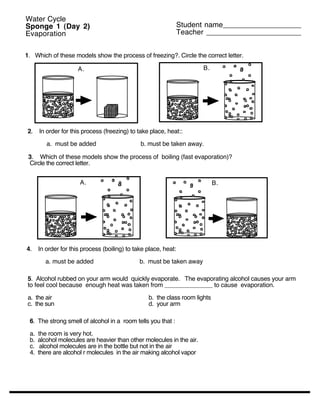
1. Which of these models show the process of freezing?. Circle the correct letter.

                      A.                                               B.


2.    In order for this process (freezing) to take place, heat::

         a. must be added                      b. must be taken away.

 3. Which of these models show the process of boiling (fast evaporation)?
 Circle the correct letter.


                      A.                                                     B.


4.    In order for this process (boiling) to take place, heat:

        a. must be added                       b. must be taken away

5. Alcohol rubbed on your arm would quickly evaporate. The evaporating alcohol causes your arm
to feel cool because enough heat was taken from ______________ to cause evaporation.

a. the air                                        b. the class room lights
c. the sun                                        d. your arm

 6. The strong smell of alcohol in a room tells you that :

 a.   the room is very hot.
 b.   alcohol molecules are heavier than other molecules in the air.
 c.    alcohol molecules are in the bottle but not in the air
 4.   there are alcohol r molecules in the air making alcohol vapor
Sponge 2 (Day 3)
Condensation
  1. What causes matter to change from one state to another, for example from
  liquid water to ice or liquid water to water vapor?

  a. Adding heat                              b. Taking away heat (cooling)
  c. Both a. and b.                           d. strong gravity


 2. In the frozen bottle activity, the teacher filled the bottles with colored water and then froze
 the water. When you observed these bottles, the water that formed on the outside of the
 bottle ____(was or was not)_______the same color as the water in the bottle because

          A. the colored water moved through the plastic to the outside of the bottle
          B the clear water was formed from water molecules in the air around the
              bottle.

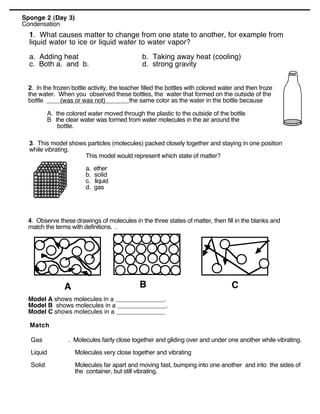
  3. This model shows particles (molecules) packed closely together and staying in one position
  while vibrating.
                     This model would represent which state of matter?

                        a.   ether
                        b.   solid
                        c.   liquid
                        d.   gas


 4. Observe these drawings of molecules in the three states of matter, then fill in the blanks and
 match the terms with definitions. .


                A                            B                                    C
 Model A shows molecules in a ______________.
 Model B shows molecules in a ______________.
 Model C shows molecules in a ______________

  Match

  Gas             . Molecules fairly close together and gliding over and under one another while vibrating.

  Liquid            Molecules very close together and vibrating

  Solid             Molecules far apart and moving fast, bumping into one another and into the sides of
                    the container, but still vibrating.
Sponge 3 (Day 4)
The water cycle
  1. Draw lines connecting the following definitions and terms.

  Evaporation                      The water that seeps into the ground and becomes ground water.

  Condensation                     When a liquid changes to a gas

  Surface Runoff                  The water that runs off into streams, then to lakes and oceans.

  Underground Runoff              When water vapor changes into a liquid.

  2.. Draw lines showing which description best tells how molecules behave in the three states of
  matter, solid, liquid and gas.

  State of matter             description of molecule movement

  Solid                       Molecules rapidly slipping over and under each other
                              but still touching each other and vibrating.

  Liquid                      Molecules packed closely together and vibrating in place

  Gas                         Molecules moving very fast, zinging in straight lines, bumping into each other
                              and into the walls but still vibrating.

 Sponge 4 (Day 5)
 The Water Cycle

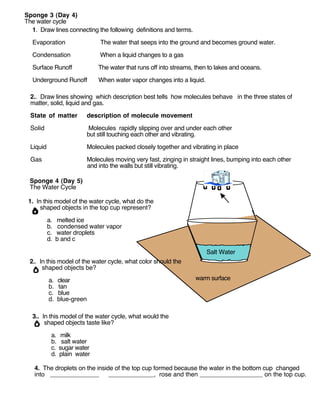
 1. In this model of the water cycle, what do the
      shaped objects in the top cup represent?

           a.   melted ice
           b.    condensed water vapor
           c.   water droplets
           d.   b and c

                                                                            Salt Water
 2.. In this model of the water cycle, what color should the
      shaped objects be?

           a.    clear                                                 warm surface
           b.    tan
           c.    blue
           d.    blue-green

  3.. In this model of the water cycle, what would the
       shaped objects taste like?

            a.    milk
            b.    salt water
            c.   sugar water
            d.   plain water

   4. The droplets on the inside of the top cup formed because the water in the bottom cup changed
   into ______________ _____________, rose and then __________________ on the top cup.
Sponge 5 (Day 6)
The Water Cycle
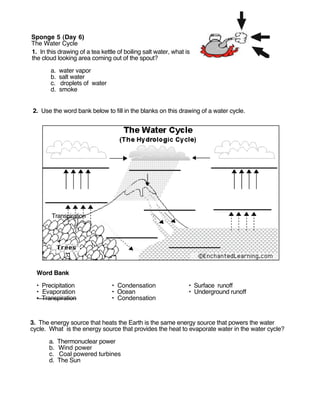
1. In this drawing of a tea kettle of boiling salt water, what is
the cloud looking area coming out of the spout?

       a.   water vapor
       b.   salt water
       c.   droplets of water
       d.   smoke


2. Use the word bank below to fill in the blanks on this drawing of a water cycle.


        Transpiration


  Word Bank

  • Precipitation                • Condensation                 • Surface runoff
  • Evaporation                  • Ocean                        • Underground runoff
  • Transpiration                • Condensation


3. The energy source that heats the Earth is the same energy source that powers the water
cycle. What is the energy source that provides the heat to evaporate water in the water cycle?

       a.   Thermonuclear power
       b.   Wind power
       c.   Coal powered turbines
       d.   The Sun
Sponge 6 (Day 7)
The Water Cycle

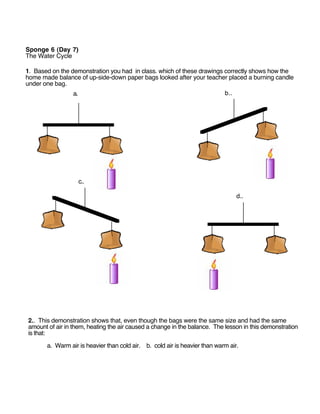
1. Based on the demonstration you had in class. which of these drawings correctly shows how the
home made balance of up-side-down paper bags looked after your teacher placed a burning candle
under one bag.
                 a.                                                     b..


                   c..

                                                                                 d..


2.. This demonstration shows that, even though the bags were the same size and had the same
amount of air in them, heating the air caused a change in the balance. The lesson in this demonstration
is that:

       a. Warm air is heavier than cold air. b. cold air is heavier than warm air.
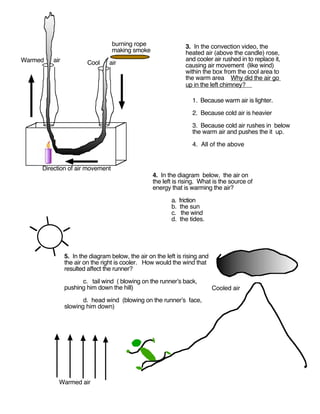
burning rope                   3. In the convection video, the
                                  making smoke                   heated air (above the candle) rose,
Warmed   air                                                     and cooler air rushed in to replace it,
                        Cool     air                             causing air movement (like wind)
                                                                 within the box from the cool area to
                                                                 the warm area Why did the air go
                                                                 up in the left chimney?

                                                                    1. Because warm air is lighter.

                                                                    2. Because cold air is heavier

                                                                    3. Because cold air rushes in below
                                                                    the warm air and pushes the it up.

                                                                    4. All of the above


     Direction of air movement
                                                  4. In the diagram below, the air on
                                                  the left is rising. What is the source of
                                                  energy that is warming the air?

                                                          a.   friction
                                                          b.   the sun
                                                          c.    the wind
                                                          d.   the tides.


               5. In the diagram below, the air on the left is rising and
               the air on the right is cooler. How would the wind that
               resulted affect the runner?

                     c. tail wind ( blowing on the runner’s back,
               pushing him down the hill)                                   Cooled air
                      d. head wind (blowing on the runner’s face,
               slowing him down)


           Warmed air
Sponge 7 (Day 1 of comparing Moon and Earth)
 Weather

1. From the convection video we learned that the temperature of the air’(warm or cold) determines
whether it will be heaver or lighter. Select the correct answer from the list below:

      a. Warmer air rises and cooler air sinks
      b. Warmer air sinks and cooler air rises.
      c. Temperature does not causes air to rise or fall.
      d. The gravity of the Moon causes warm air to rise.

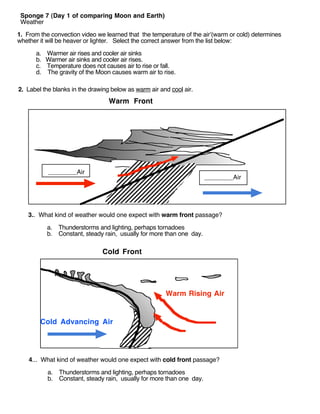
2. Label the blanks in the drawing below as warm air and cool air.
                                  Warm Front


           ________Air
                                                                        ________Air


    3.. What kind of weather would one expect with warm front passage?

          a.    Thunderstorms and lighting, perhaps tornadoes
          b.    Constant, steady rain, usually for more than one day.

                                Cold Front


                                                       Warm Rising Air


        Cold Advancing Air


    4... What kind of weather would one expect with cold front passage?

           a.   Thunderstorms and lighting, perhaps tornadoes
           b.   Constant, steady rain, usually for more than one day.

Water cycle (worksheet(s))

  • 1.
    Water Cycle Sponge 1(Day 2) Student name___________________ Evaporation Teacher _______________________ 1. Which of these models show the process of freezing?. Circle the correct letter. A. B. 2. In order for this process (freezing) to take place, heat:: a. must be added b. must be taken away. 3. Which of these models show the process of boiling (fast evaporation)? Circle the correct letter. A. B. 4. In order for this process (boiling) to take place, heat: a. must be added b. must be taken away 5. Alcohol rubbed on your arm would quickly evaporate. The evaporating alcohol causes your arm to feel cool because enough heat was taken from ______________ to cause evaporation. a. the air b. the class room lights c. the sun d. your arm 6. The strong smell of alcohol in a room tells you that : a. the room is very hot. b. alcohol molecules are heavier than other molecules in the air. c. alcohol molecules are in the bottle but not in the air 4. there are alcohol r molecules in the air making alcohol vapor
  • 2.
    Sponge 2 (Day3) Condensation 1. What causes matter to change from one state to another, for example from liquid water to ice or liquid water to water vapor? a. Adding heat b. Taking away heat (cooling) c. Both a. and b. d. strong gravity 2. In the frozen bottle activity, the teacher filled the bottles with colored water and then froze the water. When you observed these bottles, the water that formed on the outside of the bottle ____(was or was not)_______the same color as the water in the bottle because A. the colored water moved through the plastic to the outside of the bottle B the clear water was formed from water molecules in the air around the bottle. 3. This model shows particles (molecules) packed closely together and staying in one position while vibrating. This model would represent which state of matter? a. ether b. solid c. liquid d. gas 4. Observe these drawings of molecules in the three states of matter, then fill in the blanks and match the terms with definitions. . A B C Model A shows molecules in a ______________. Model B shows molecules in a ______________. Model C shows molecules in a ______________ Match Gas . Molecules fairly close together and gliding over and under one another while vibrating. Liquid Molecules very close together and vibrating Solid Molecules far apart and moving fast, bumping into one another and into the sides of the container, but still vibrating.
  • 3.
    Sponge 3 (Day4) The water cycle 1. Draw lines connecting the following definitions and terms. Evaporation The water that seeps into the ground and becomes ground water. Condensation When a liquid changes to a gas Surface Runoff The water that runs off into streams, then to lakes and oceans. Underground Runoff When water vapor changes into a liquid. 2.. Draw lines showing which description best tells how molecules behave in the three states of matter, solid, liquid and gas. State of matter description of molecule movement Solid Molecules rapidly slipping over and under each other but still touching each other and vibrating. Liquid Molecules packed closely together and vibrating in place Gas Molecules moving very fast, zinging in straight lines, bumping into each other and into the walls but still vibrating. Sponge 4 (Day 5) The Water Cycle 1. In this model of the water cycle, what do the shaped objects in the top cup represent? a. melted ice b. condensed water vapor c. water droplets d. b and c Salt Water 2.. In this model of the water cycle, what color should the shaped objects be? a. clear warm surface b. tan c. blue d. blue-green 3.. In this model of the water cycle, what would the shaped objects taste like? a. milk b. salt water c. sugar water d. plain water 4. The droplets on the inside of the top cup formed because the water in the bottom cup changed into ______________ _____________, rose and then __________________ on the top cup.
  • 4.
    Sponge 5 (Day6) The Water Cycle 1. In this drawing of a tea kettle of boiling salt water, what is the cloud looking area coming out of the spout? a. water vapor b. salt water c. droplets of water d. smoke 2. Use the word bank below to fill in the blanks on this drawing of a water cycle. Transpiration Word Bank • Precipitation • Condensation • Surface runoff • Evaporation • Ocean • Underground runoff • Transpiration • Condensation 3. The energy source that heats the Earth is the same energy source that powers the water cycle. What is the energy source that provides the heat to evaporate water in the water cycle? a. Thermonuclear power b. Wind power c. Coal powered turbines d. The Sun
  • 5.
    Sponge 6 (Day7) The Water Cycle 1. Based on the demonstration you had in class. which of these drawings correctly shows how the home made balance of up-side-down paper bags looked after your teacher placed a burning candle under one bag. a. b.. c.. d.. 2.. This demonstration shows that, even though the bags were the same size and had the same amount of air in them, heating the air caused a change in the balance. The lesson in this demonstration is that: a. Warm air is heavier than cold air. b. cold air is heavier than warm air.
  • 6.
    burning rope 3. In the convection video, the making smoke heated air (above the candle) rose, Warmed air and cooler air rushed in to replace it, Cool air causing air movement (like wind) within the box from the cool area to the warm area Why did the air go up in the left chimney? 1. Because warm air is lighter. 2. Because cold air is heavier 3. Because cold air rushes in below the warm air and pushes the it up. 4. All of the above Direction of air movement 4. In the diagram below, the air on the left is rising. What is the source of energy that is warming the air? a. friction b. the sun c. the wind d. the tides. 5. In the diagram below, the air on the left is rising and the air on the right is cooler. How would the wind that resulted affect the runner? c. tail wind ( blowing on the runner’s back, pushing him down the hill) Cooled air d. head wind (blowing on the runner’s face, slowing him down) Warmed air
  • 7.
    Sponge 7 (Day1 of comparing Moon and Earth) Weather 1. From the convection video we learned that the temperature of the air’(warm or cold) determines whether it will be heaver or lighter. Select the correct answer from the list below: a. Warmer air rises and cooler air sinks b. Warmer air sinks and cooler air rises. c. Temperature does not causes air to rise or fall. d. The gravity of the Moon causes warm air to rise. 2. Label the blanks in the drawing below as warm air and cool air. Warm Front ________Air ________Air 3.. What kind of weather would one expect with warm front passage? a. Thunderstorms and lighting, perhaps tornadoes b. Constant, steady rain, usually for more than one day. Cold Front Warm Rising Air Cold Advancing Air 4... What kind of weather would one expect with cold front passage? a. Thunderstorms and lighting, perhaps tornadoes b. Constant, steady rain, usually for more than one day.