Temperature
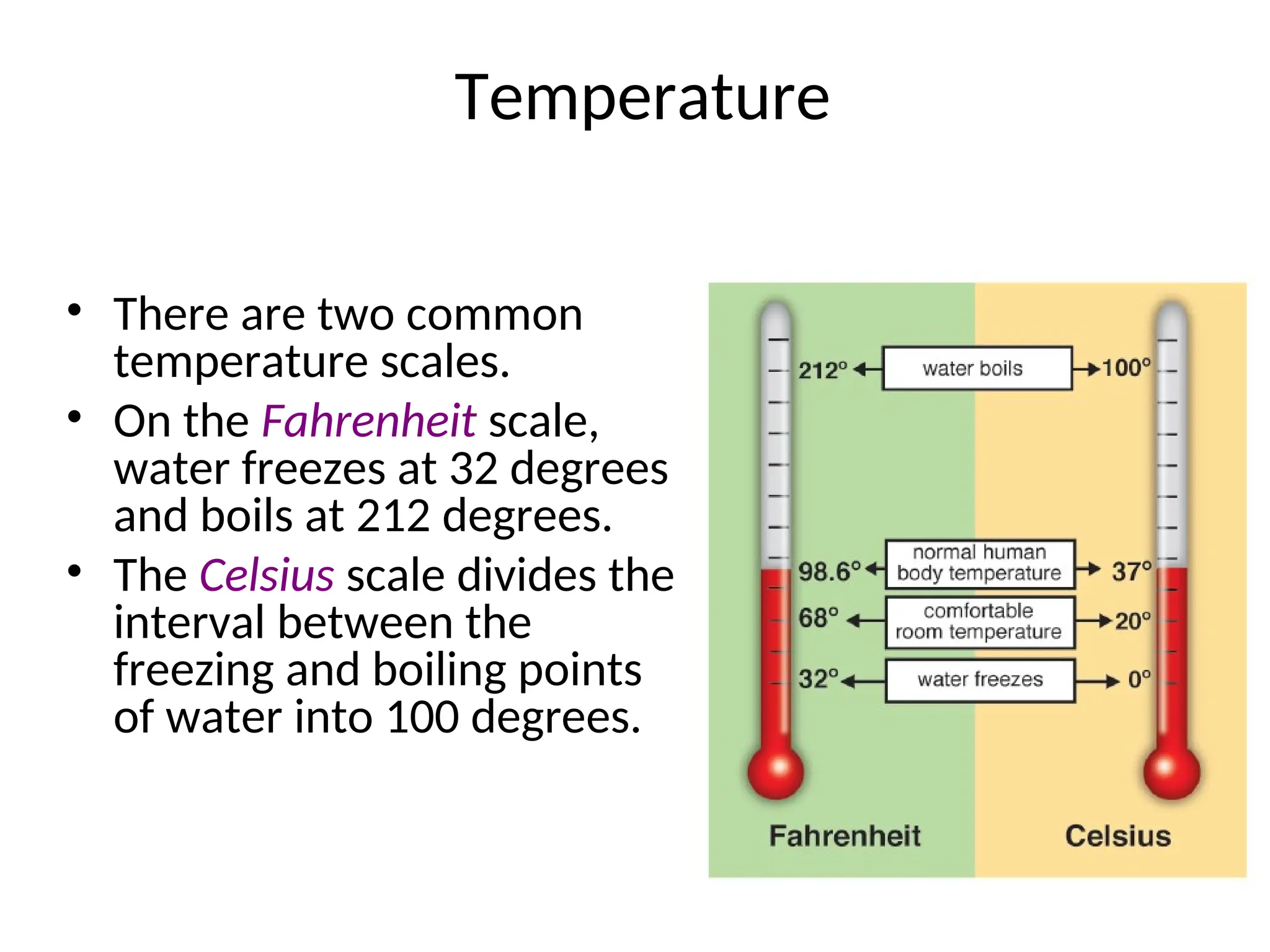
• There are two common
temperature scales.
• On the Fahrenheit scale,
water freezes at 32 degrees
and boils at 212 degrees.
• The Celsius scale divides the
interval between the
freezing and boiling points
of water into 100 degrees.
Solving Problems
A friend in Paris sends you a recipe for a cake. The
French recipe says to bake the cake at a
temperature of 200 °C for 45 minutes.
At what temperature should you set your oven, which
uses the Fahrenheit scale?
Solving Problems
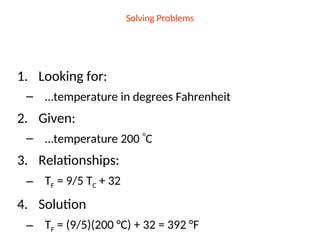
1. Looking for:
– …temperature in degrees Fahrenheit
2. Given:
– …temperature 200 C
3. Relationships:
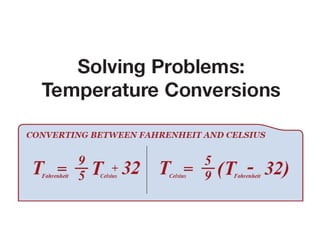
– TF = 9/5 TC + 32
4. Solution
– TF = (9/5)(200 °C) + 32 = 392 °F
Solving Problems
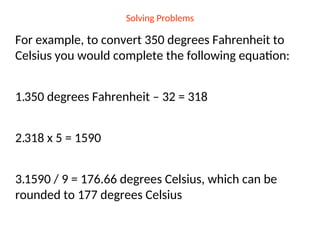
For example, to convert 350 degrees Fahrenheit to
Celsius you would complete the following equation:
1.350 degrees Fahrenheit – 32 = 318
2.318 x 5 = 1590
3.1590 / 9 = 176.66 degrees Celsius, which can be
rounded to 177 degrees Celsius
Absolute zero
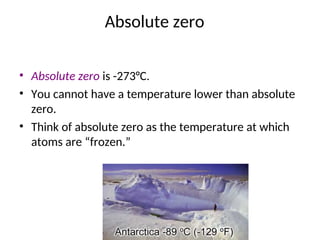
• Absolute zero is -273°C.
• You cannot have a temperature lower than absolute
zero.
• Think of absolute zero as the temperature at which
atoms are “frozen.”
What temperature really is
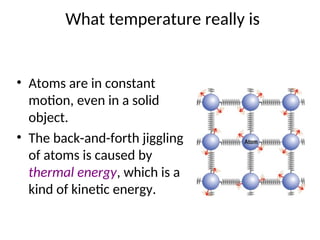
• Atoms are in constant
motion, even in a solid
object.
• The back-and-forth jiggling
of atoms is caused by
thermal energy, which is a
kind of kinetic energy.
What temperature really is
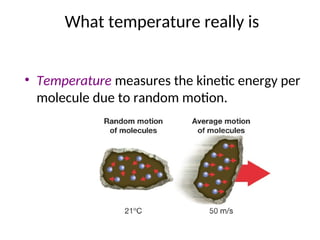
• Temperature measures the kinetic energy per
molecule due to random motion.
How a thermometer works
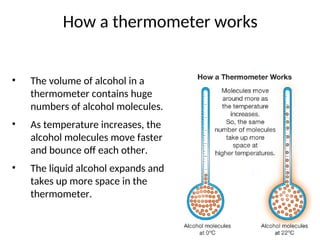
• The volume of alcohol in a
thermometer contains huge
numbers of alcohol molecules.
• As temperature increases, the
alcohol molecules move faster
and bounce off each other.
• The liquid alcohol expands and
takes up more space in the
thermometer.
Measuring temperature
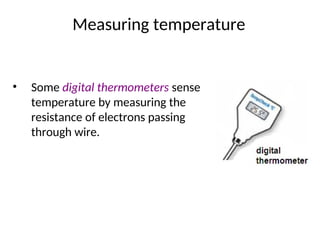
• Some digital thermometers sense
temperature by measuring the
resistance of electrons passing
through wire.
Liquid-crystal thermometers
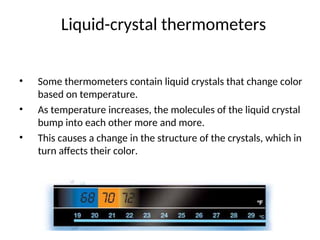
• Some thermometers contain liquid crystals that change color
based on temperature.
• As temperature increases, the molecules of the liquid crystal
bump into each other more and more.
• This causes a change in the structure of the crystals, which in
turn affects their color.
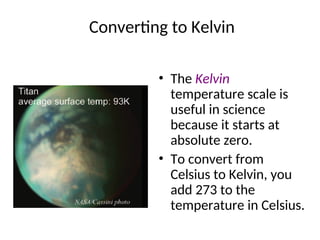
Converting to Kelvin
• The Kelvin
temperature scale is
useful in science
because it starts at
absolute zero.
• To convert from
Celsius to Kelvin, you
add 273 to the
temperature in Celsius.
Time
• Time is usually measured in seconds or
minutes.
• 60 sec = 1 min
• 60 min = 1 hour
• 24 hour = 1 day
Time Conversions
• If you have a car trip that takes you 3.5 hours
how many seconds is that?

Temp_and_Time_F.ppt for grade 7, 8, 9, 10

  • 1.
    Temperature • There aretwo common temperature scales. • On the Fahrenheit scale, water freezes at 32 degrees and boils at 212 degrees. • The Celsius scale divides the interval between the freezing and boiling points of water into 100 degrees.
  • 4.
    Solving Problems A friendin Paris sends you a recipe for a cake. The French recipe says to bake the cake at a temperature of 200 °C for 45 minutes. At what temperature should you set your oven, which uses the Fahrenheit scale?
  • 5.
    Solving Problems 1. Lookingfor: – …temperature in degrees Fahrenheit 2. Given: – …temperature 200 C 3. Relationships: – TF = 9/5 TC + 32 4. Solution – TF = (9/5)(200 °C) + 32 = 392 °F
  • 6.
    Solving Problems For example,to convert 350 degrees Fahrenheit to Celsius you would complete the following equation: 1.350 degrees Fahrenheit – 32 = 318 2.318 x 5 = 1590 3.1590 / 9 = 176.66 degrees Celsius, which can be rounded to 177 degrees Celsius
  • 7.
    Absolute zero • Absolutezero is -273°C. • You cannot have a temperature lower than absolute zero. • Think of absolute zero as the temperature at which atoms are “frozen.”
  • 8.
    What temperature reallyis • Atoms are in constant motion, even in a solid object. • The back-and-forth jiggling of atoms is caused by thermal energy, which is a kind of kinetic energy.
  • 9.
    What temperature reallyis • Temperature measures the kinetic energy per molecule due to random motion.
  • 10.
    How a thermometerworks • The volume of alcohol in a thermometer contains huge numbers of alcohol molecules. • As temperature increases, the alcohol molecules move faster and bounce off each other. • The liquid alcohol expands and takes up more space in the thermometer.
  • 11.
    Measuring temperature • Somedigital thermometers sense temperature by measuring the resistance of electrons passing through wire.
  • 12.
    Liquid-crystal thermometers • Somethermometers contain liquid crystals that change color based on temperature. • As temperature increases, the molecules of the liquid crystal bump into each other more and more. • This causes a change in the structure of the crystals, which in turn affects their color.
  • 13.
    Converting to Kelvin •The Kelvin temperature scale is useful in science because it starts at absolute zero. • To convert from Celsius to Kelvin, you add 273 to the temperature in Celsius.
  • 14.
    Time • Time isusually measured in seconds or minutes. • 60 sec = 1 min • 60 min = 1 hour • 24 hour = 1 day
  • 15.
    Time Conversions • Ifyou have a car trip that takes you 3.5 hours how many seconds is that?