Download to read offline

![Pseudo-Code
disjoint-path(G[n][n],X,Y){
path=path_find(X,Y);
while(path!=NULL){
count++;
delete_path(G,path);
path=path_find(X,Y);
}
return count;
}](https://image.slidesharecdn.com/algorithmtocountnumberofdisjointpaths-121213204452-phpapp01/85/Algorithm-to-count-number-of-disjoint-paths-3-320.jpg)

![path_find(G,X,Y){
for each vertex V in G:
dist[v]:=infinity;
previous[v]:= undefined;
dist[x]:=0;
Q:= set of all nodes in G;
while Q is not empty
u:=vertex in Q with smallest distance in
dist[];](https://image.slidesharecdn.com/algorithmtocountnumberofdisjointpaths-121213204452-phpapp01/85/Algorithm-to-count-number-of-disjoint-paths-5-320.jpg)
![If dist[u]=infinity:
break;
remove u from Q;
for each neighbour v of u:
alt:= dist[u]+1;
if alt<dist[v]:
dist[v]:=alt;
previous[v]=u;](https://image.slidesharecdn.com/algorithmtocountnumberofdisjointpaths-121213204452-phpapp01/85/Algorithm-to-count-number-of-disjoint-paths-6-320.jpg)
![path:=empty sequence;
k=Y;
while (previous[k]!=NULL)
insert k at the end of path;
k:=previous[k];
return path;
}](https://image.slidesharecdn.com/algorithmtocountnumberofdisjointpaths-121213204452-phpapp01/85/Algorithm-to-count-number-of-disjoint-paths-7-320.jpg)


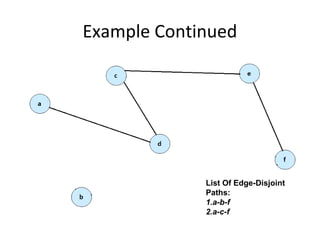




The document outlines an algorithm to find all edge-disjoint paths between a source and target in a graph, utilizing Dijkstra's shortest-path algorithm. It includes pseudo-code for the algorithm, which counts the disjoint paths by repeatedly finding and deleting paths until none remain. The algorithm is applicable to both unweighted and weighted graphs, and can be modified to work for vertex-disjoint paths as well.


![EdTech Europe 2015 [Track 3]: [Mangahigh], ([Mohit Midha], [COO])](https://cdn.slidesharecdn.com/ss_thumbnails/2c-mohitmidha-mangahigh-150708102008-lva1-app6892-thumbnail.jpg?width=640&height=640&fit=bounds)


