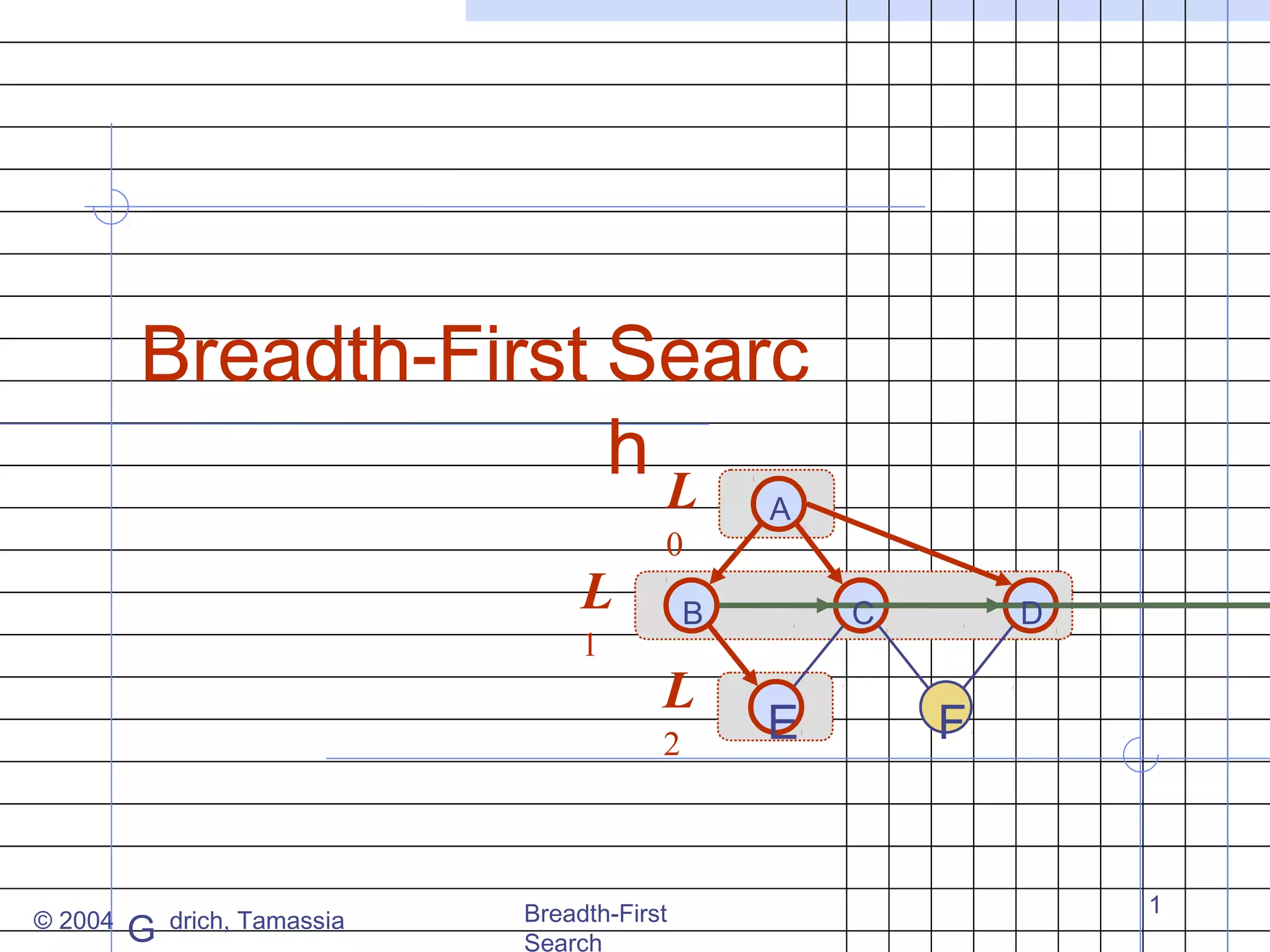
Breadth-First Searc
hL
L
1

0
B

L
2

© 2004

G

drich, Tamassia

A

Breadth-First
Search

C

E

D

F

1
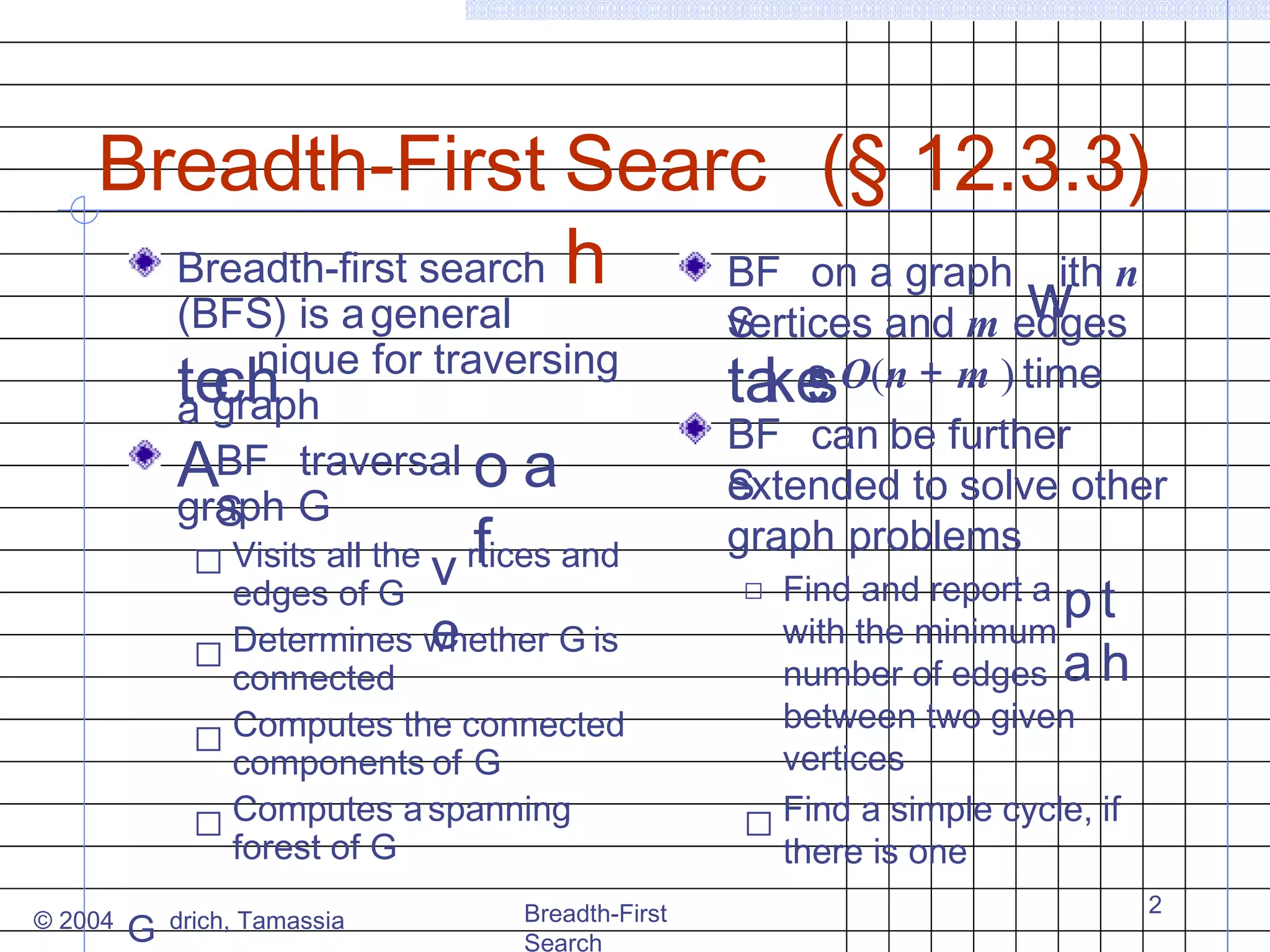
Breadth-First Searc (§ 12.3.3)
Breadth-first search h
BF on a graph ith n
w
(BFS) is a general
nique for traversing
te
ch
a graph
ABF traversal o a
graph G
S

f
v rtices and
edges of G
e
„ Determines whether G is
„ Visits all the

connected
„ Computes the connected
components of G
„ Computes a spanning
forest of G
© 2004

G

drich, Tamassia

Breadth-First
Search

vertices and m edges
S
ta s O(n + m ) time
ke
s
BF can be further
extended to solve other
S
graph problems
Find and report a p t
with the minimum
number of edges a h
between two given
vertices
„ Find a simple cycle, if
there is one
„

2
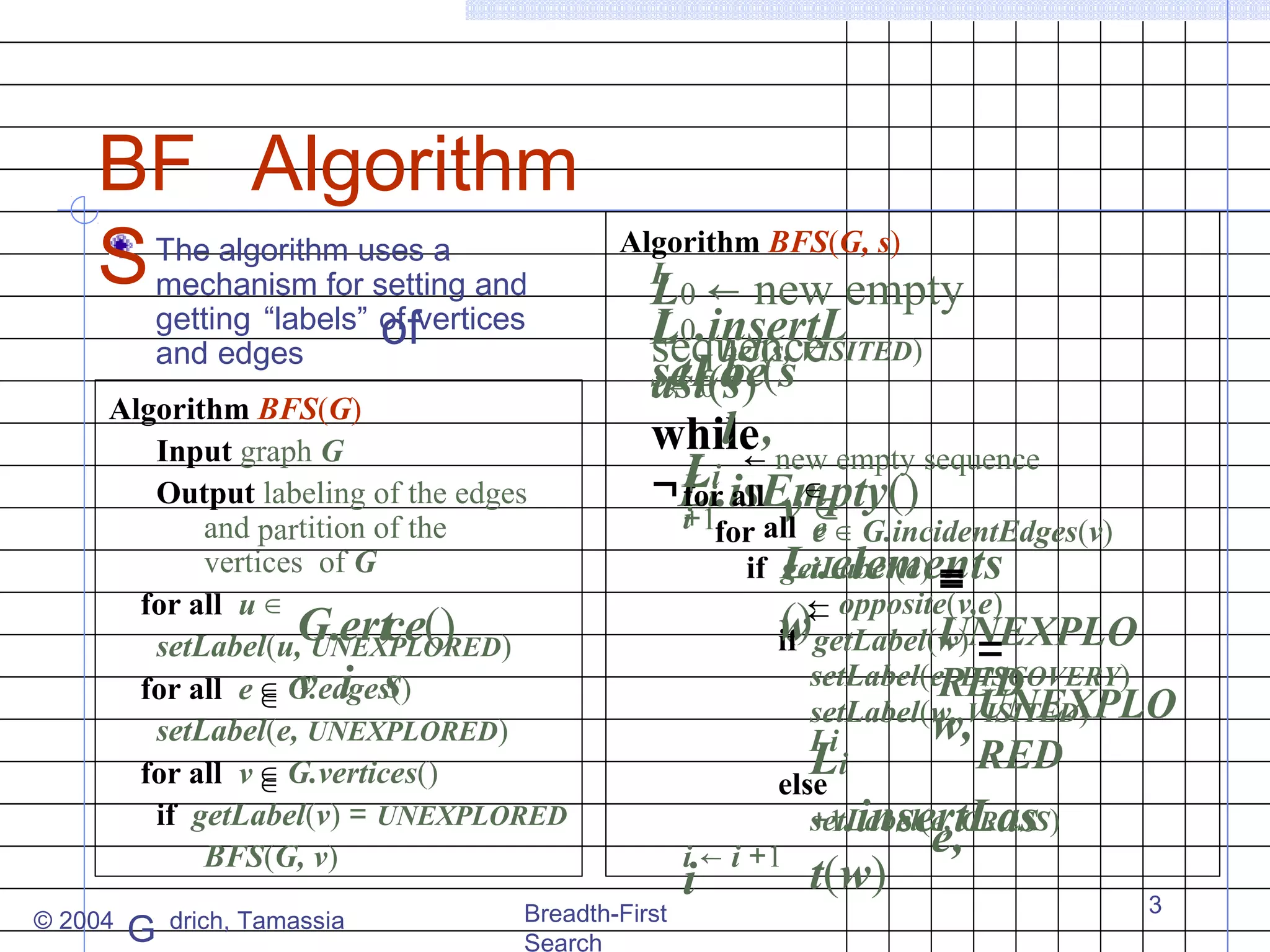
BF Algorithm
The algorithm uses a
S mechanism for setting and
getting “labels” of vertices
of
and edges

Algorithm BFS(G)
Input graph G
Output labeling of the edges
and partition of the
vertices of G
for all u ∈
G.ertce()
setLabel(u, UNEXPLORED)
for all e ∈ G.edges()
∈ v i s
setLabel(e, UNEXPLORED)
for all v ∈ G.vertices()
∈
if getLabel(v) = UNEXPLORED
BFS(G, v)
© 2004

G

drich, Tamassia

Algorithm BFS(G, s)
L
L0 ← new empty
L0.insertL )
bel(s, VISITED
sequence
se 0 be(s
tLa
i←
ast(s)

l
while ,new empty sequence
←
Lii.isEmpty()
for
¬L all v ∈∈
i
+1

Breadth-First
Search

for all e ∈ G.incidentEdges(v)
if Li.elements
getLabel(e)
=
← opposite(v,e)
()
w←
UNEXPLO
if getLabel(w) =
setLabel(e, DISCOVERY)
RED
setLabel(w, VISITED)
w, UNEXPLO
Li
RED
Li
else
setLabel(e, CROSS
+1.insertLas )
e,
i ← i +1

i

t(w)

3
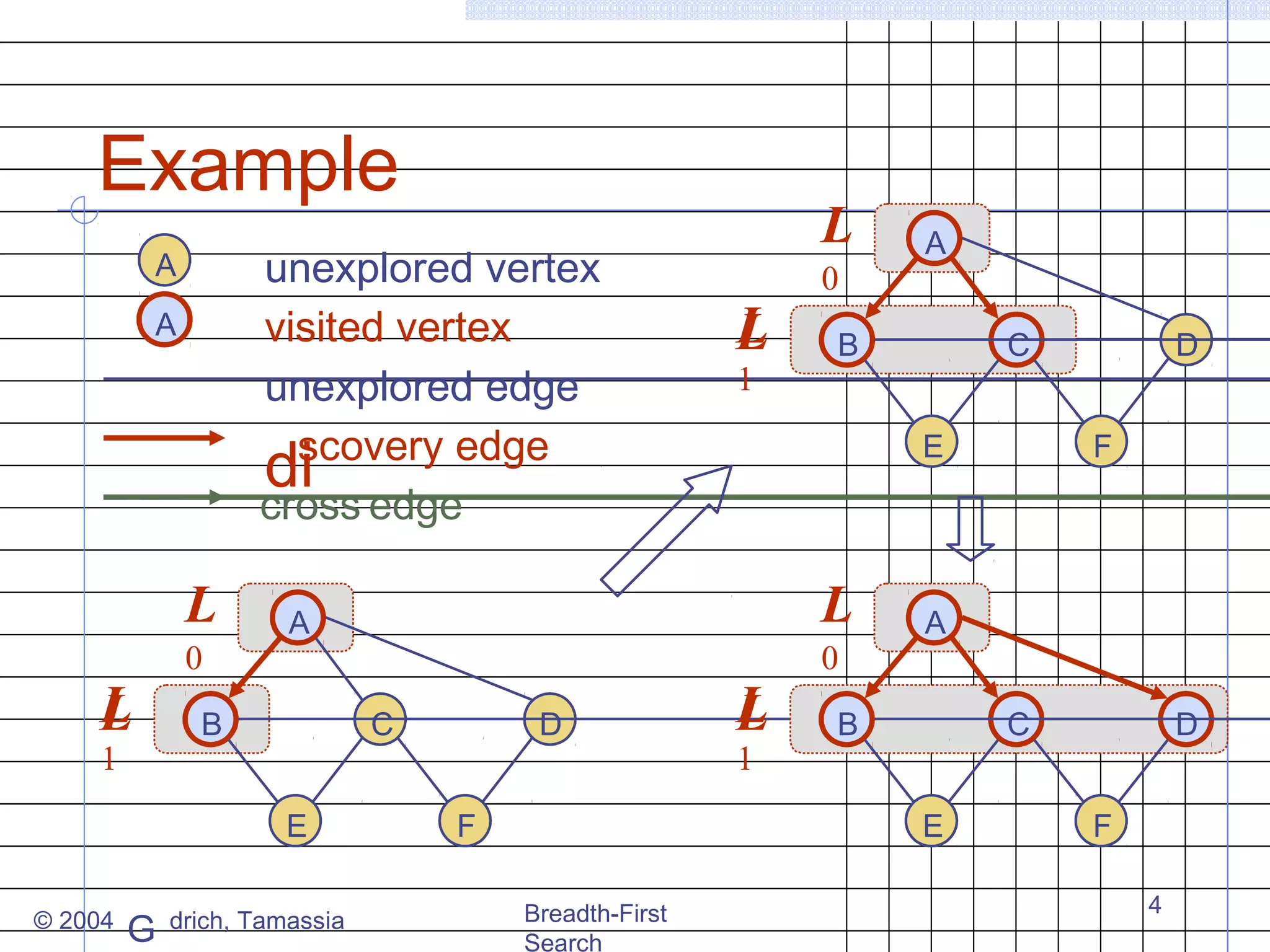
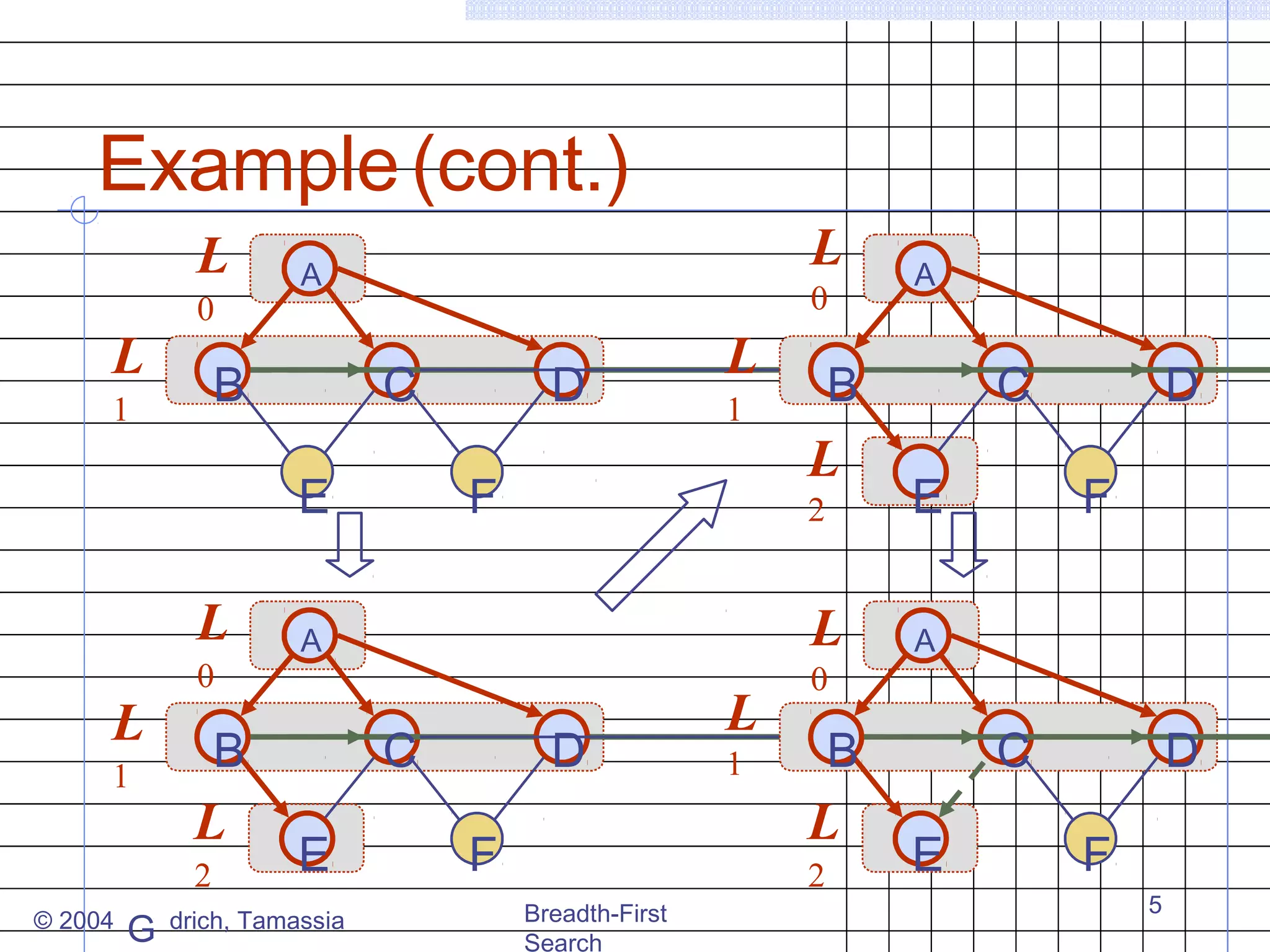
Example
unexplored vertex
visited vertex
unexplored edge
scovery edge
di
cross edge

A
A

L
L
1

0

G

L
1

B

B

L
C

drich, Tamassia

0

D
F

A
C
E

A

E
© 2004

L

L
1

0

F

A

B

C
E

Breadth-First
Search

D

D
F
4
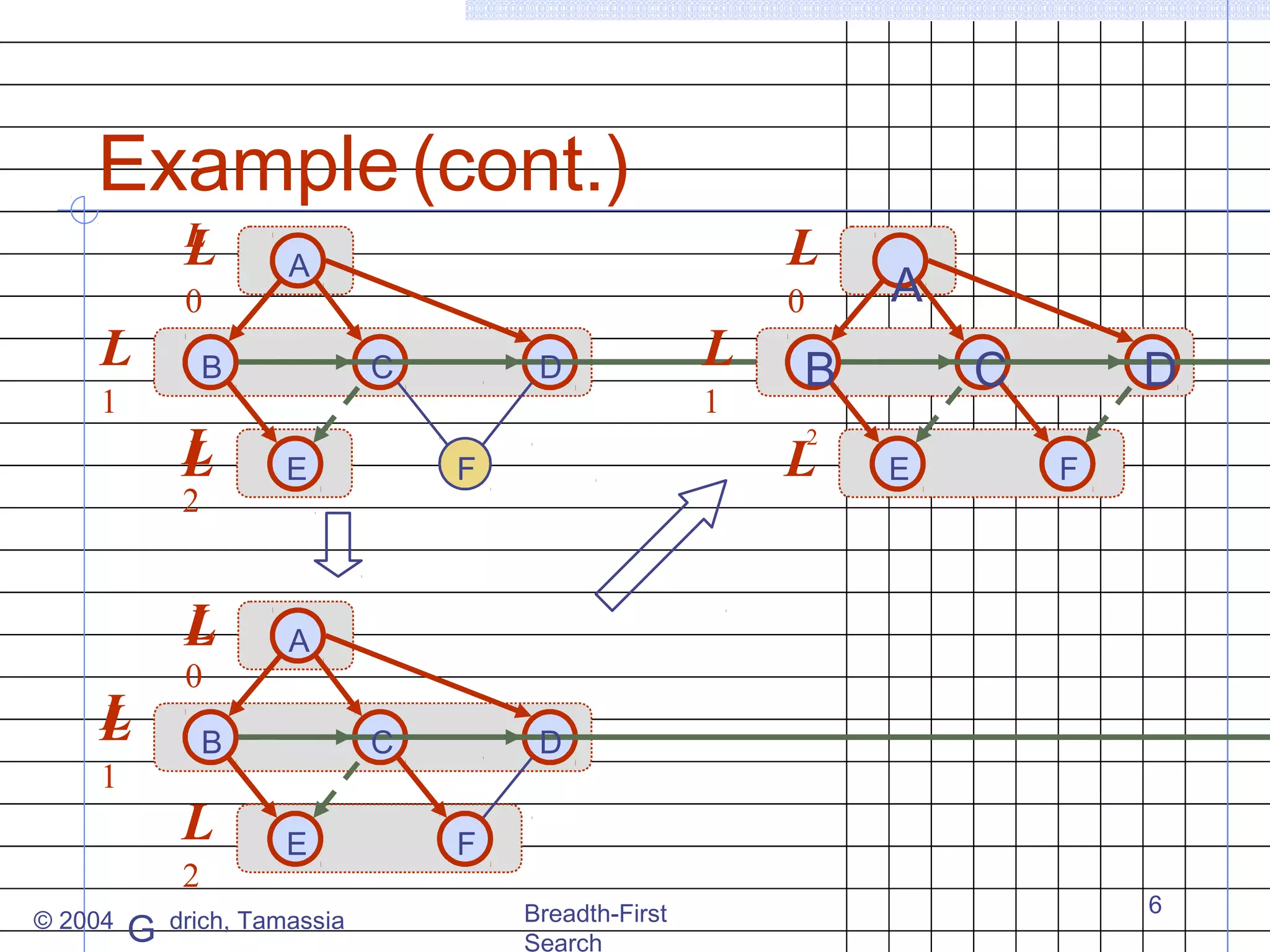
Example (cont.)
L
L

0

B

1

L

A

0

C
E

L
L
1

0

2
© 2004

G

L

F

drich, Tamassia

C

2

D

L

E

L
C

E

B

1

A

B

L

D

L

A

A

0

B

1

L

F

2
Breadth-First
Search

D
F

C
E

D
F
5
Example (cont.)
L

L
L
1

0
B

C

L
L

E

L
1

0

B

L
2

© 2004

G

D

L
1

0

A

B

C

D

A

2

L

L

A

drich, Tamassia

L

F

C
E

2

E

F

D
F
Breadth-First
Search

6
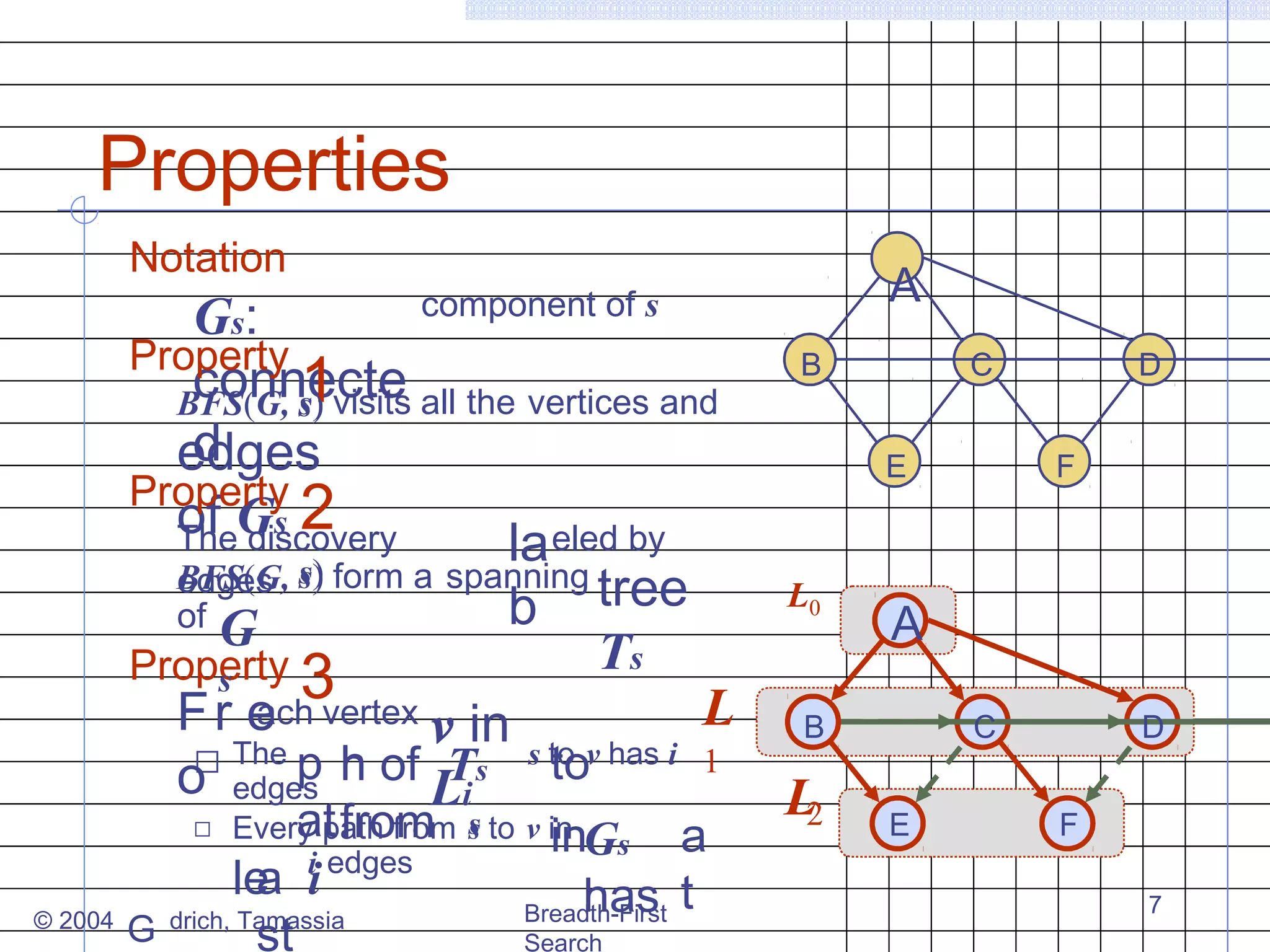
Properties
Notation

G s:
Property
B
connecte all the vertices and
1
BFS(G, s) visits
d
edges
Property
of Gs 2
The discovery
la eled by
BFS(G, s) form a spanning tree
edges
L0
b
of G
Ts
Property 3
s
ach
L B
F r e vertex v in
„ The p h of Ts s to v has i 1
to
o edges
Li
L
2
at from
Every path from s to v in
„

le ii edges
a
© 2004
G drich, Tamassia
st

component of s

inGs a
has t
Breadth-First
Search

A
C
E

D
F

A
C
E

D
F
7
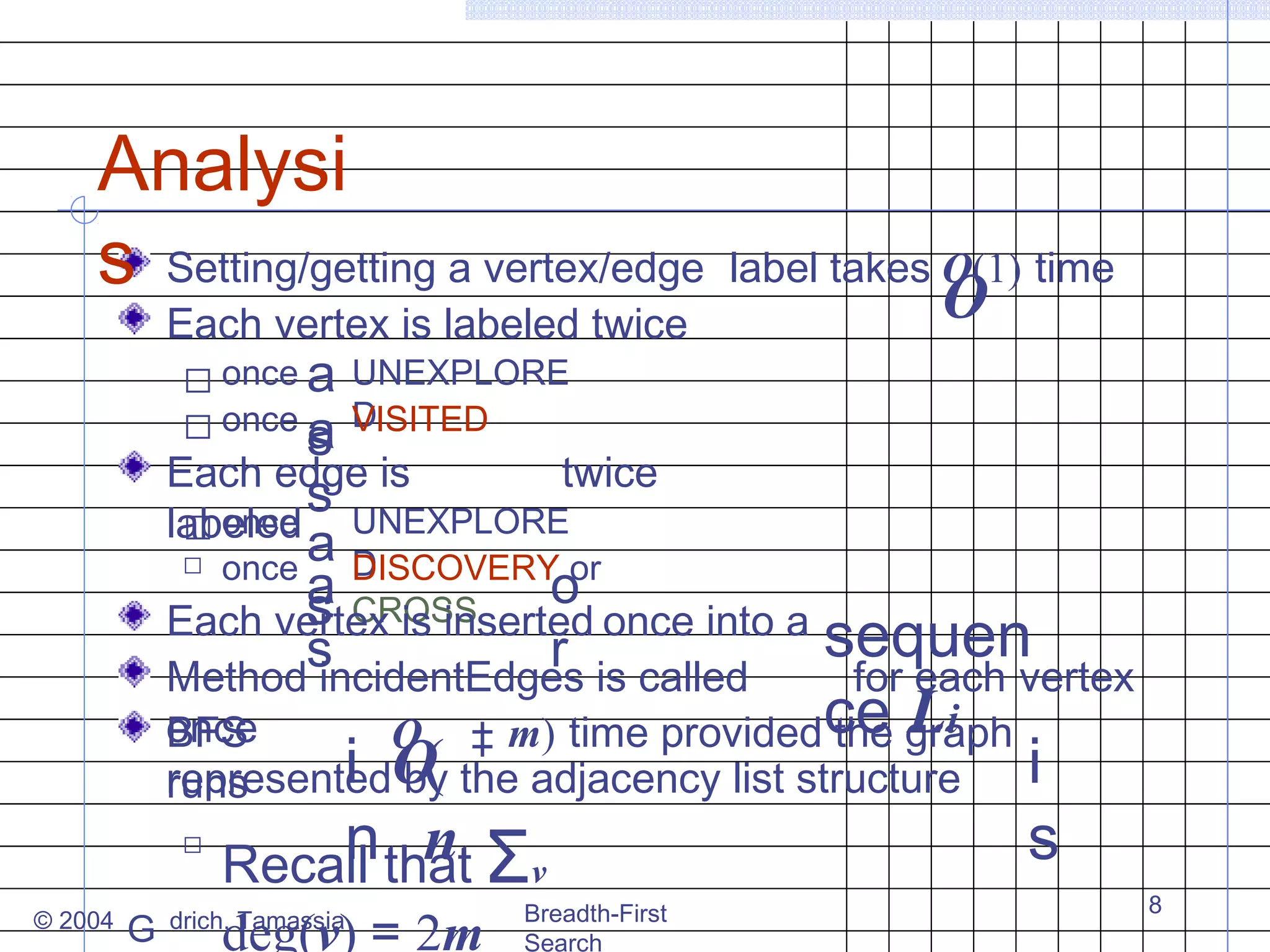
Analysi
s Setting/getting a vertex/edge
Each vertex is labeled twice

label takes O(1) time

O

a UNEXPLORE
aD
s VISITED
Each edge is
s UNEXPLOREtwice
labeled
„ once
aD
once
a DISCOVERYoor
s CROSS
Each vertex is inserted once into a sequen
s
r is called
Method incidentEdges
for each vertex
„ once
„ once

„

once
BFS
the Li
O + m) time providedce graph
i O the adjacency list structure
( +
represented by
runs
„

© 2004

G

n that Σv
n
Recall
deg(v) = 2m

drich, Tamassia

Breadth-First
Search

i
s
8
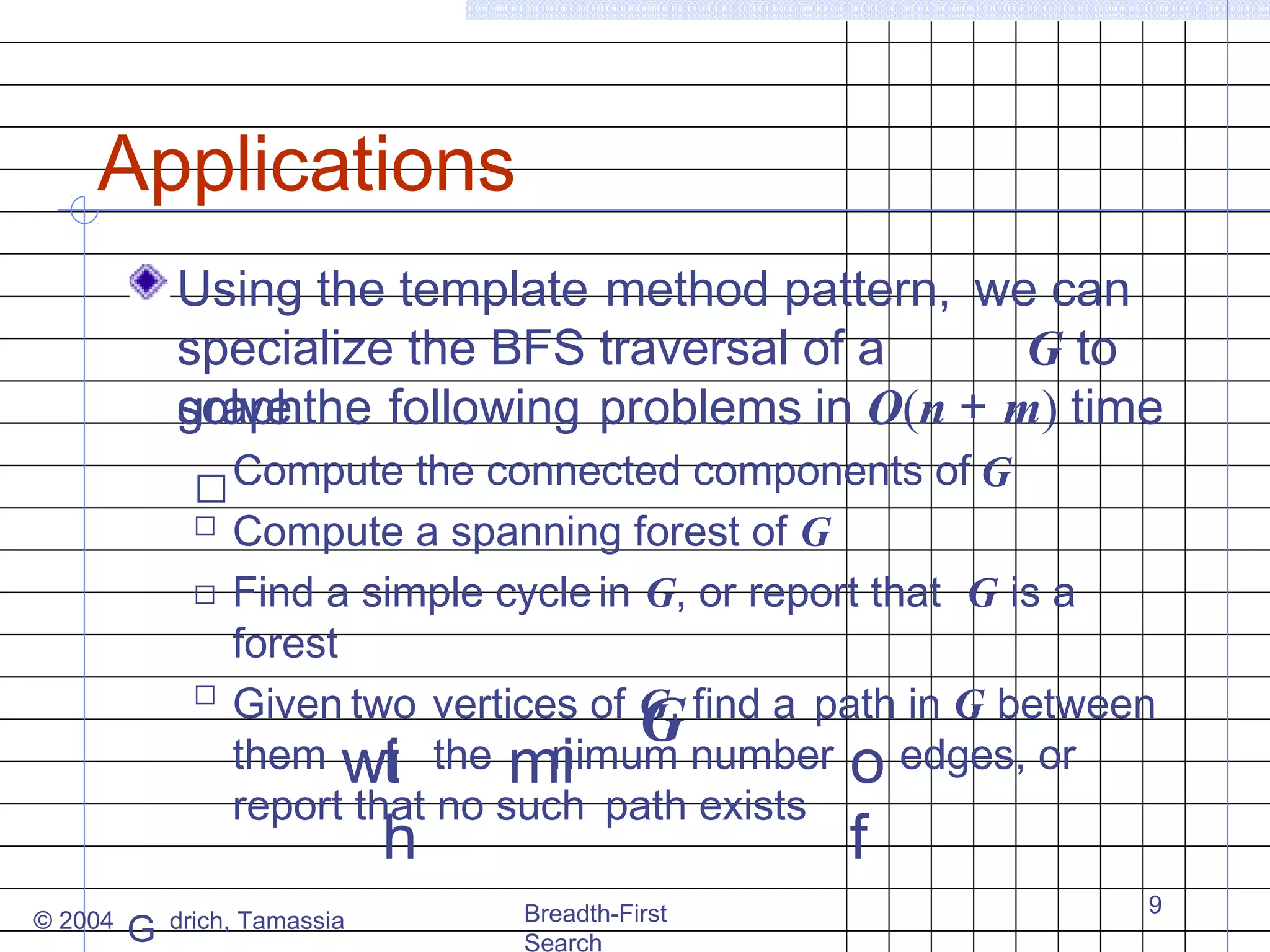
Applications
Using the template method pattern, we can
specialize the BFS traversal of a
G to
solve
graphthe following problems in O(n + m) time
„ Compute the connected components of G
„
„

„

Compute a spanning forest of G
Find a simple cycle in G, or report that G is a
forest
Given two vertices of G, find a path in G between
G number edges, or
them wi the mi
nimum
t
o
report that no such path exists

h

© 2004

G

drich, Tamassia

f

Breadth-First
Search

9
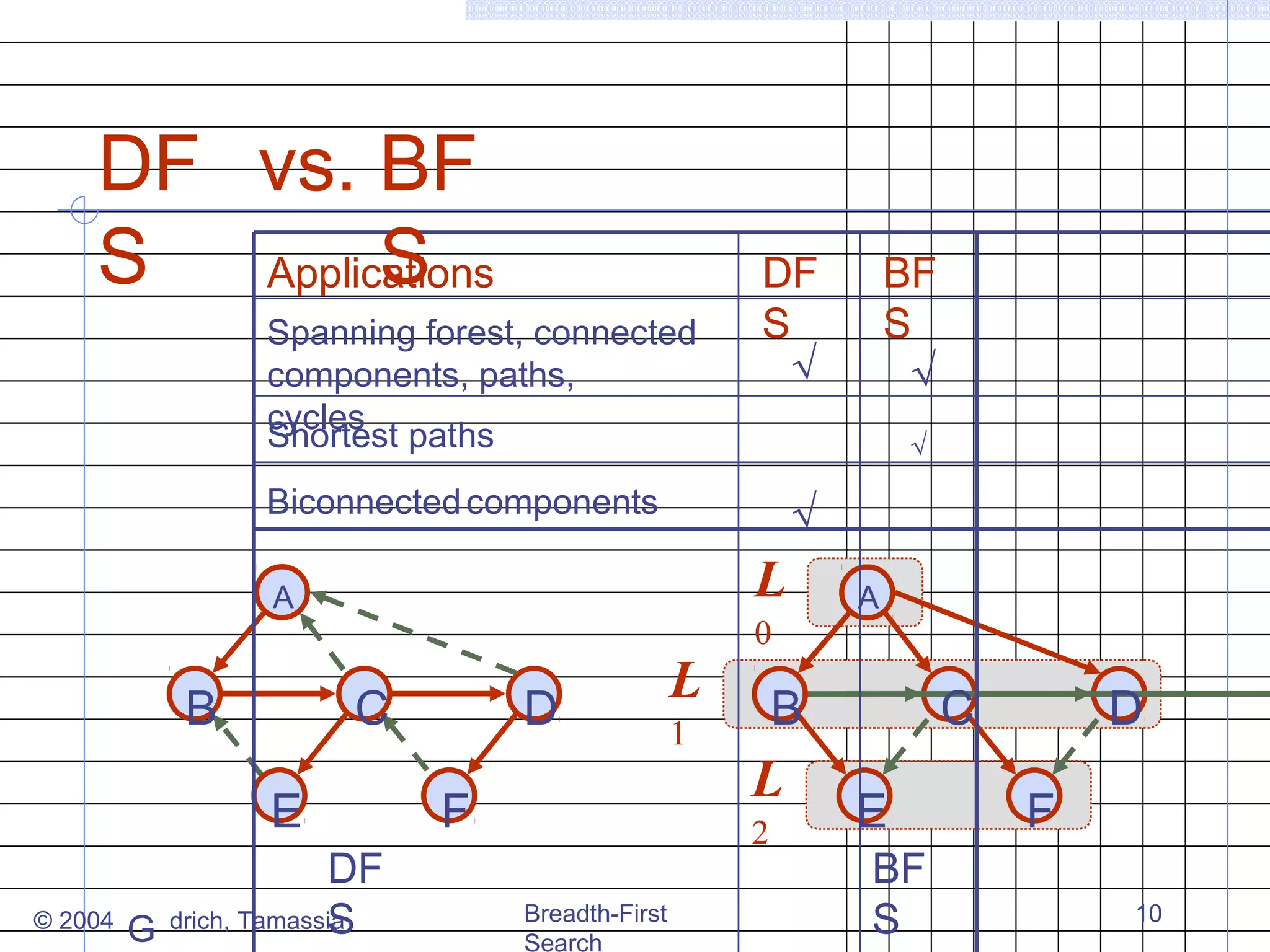
DF vs. BF
S
S
Applications
Spanning forest, connected
components, paths,
cycles
Shortest paths

DF
S

√
√

L

A

C
E

© 2004

DF
S
G drich, Tamassia

D
F

L
1

0

A

B

L
2

Breadth-First
Search

√
√

Biconnected components

B

BF
S

C
E

BF
S

D
F
10
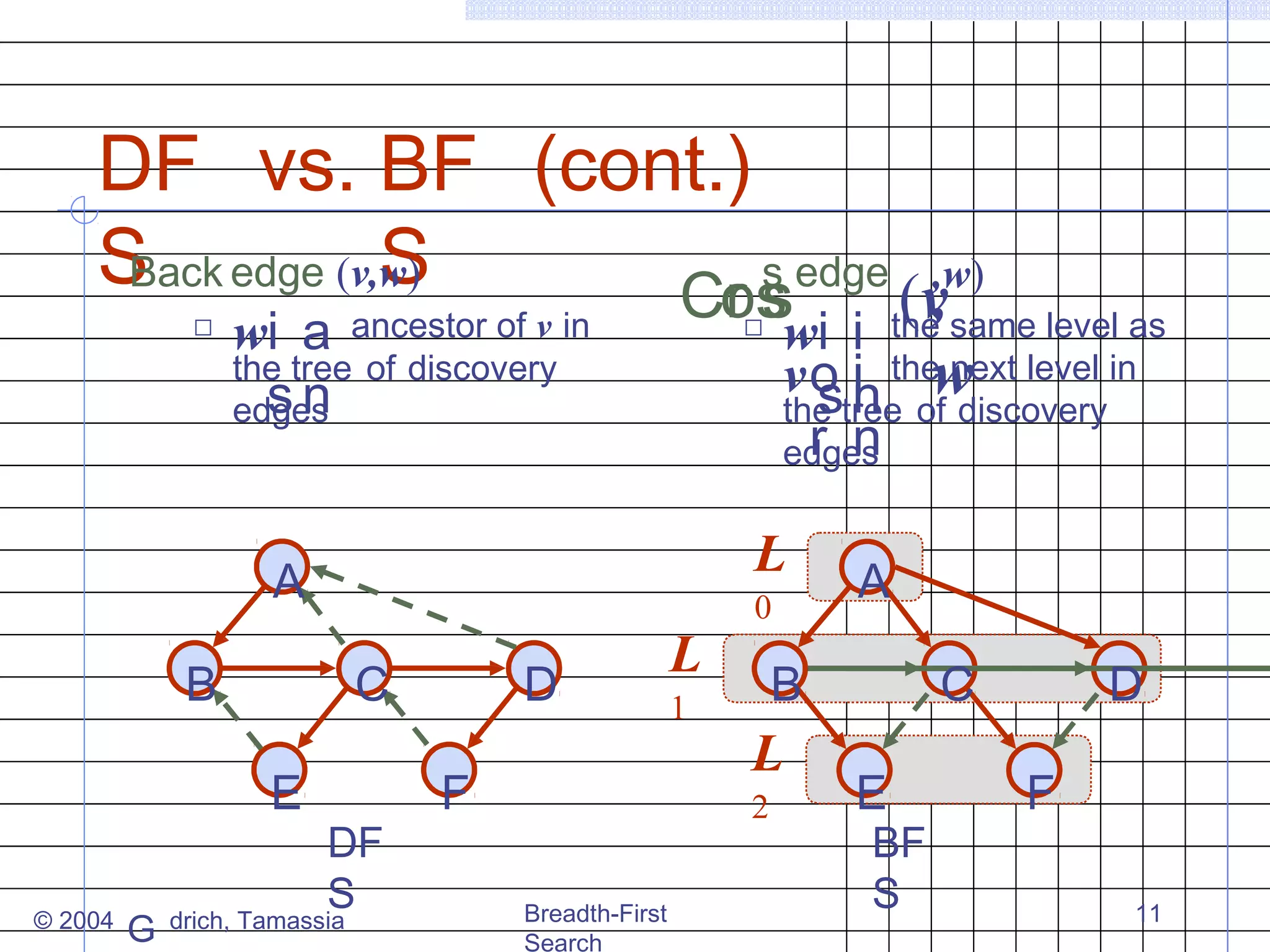
DF vs. BF (cont.)
S edge (v,w)
S
Back
s edge ,w)
Cr swi i the, same level as
os
(v
ancestor of v in
wi a
„

„

next
vo n thew level in
i
s
the tree of discovery
r n
edges

the tree of discovery
sn
edges

L

A
B

C
E

© 2004

G

DF
S
drich, Tamassia

D
F

L
1

0

B

L
2

Breadth-First
Search

A
C
E

BF
S

D
F
11

(148064384) bfs

  • 1.
    Breadth-First Searc hL L 1 0 B L 2 © 2004 G drich,Tamassia A Breadth-First Search C E D F 1
  • 2.
    Breadth-First Searc (§12.3.3) Breadth-first search h BF on a graph ith n w (BFS) is a general nique for traversing te ch a graph ABF traversal o a graph G S f v rtices and edges of G e „ Determines whether G is „ Visits all the connected „ Computes the connected components of G „ Computes a spanning forest of G © 2004 G drich, Tamassia Breadth-First Search vertices and m edges S ta s O(n + m ) time ke s BF can be further extended to solve other S graph problems Find and report a p t with the minimum number of edges a h between two given vertices „ Find a simple cycle, if there is one „ 2
  • 3.
    BF Algorithm The algorithmuses a S mechanism for setting and getting “labels” of vertices of and edges Algorithm BFS(G) Input graph G Output labeling of the edges and partition of the vertices of G for all u ∈ G.ertce() setLabel(u, UNEXPLORED) for all e ∈ G.edges() ∈ v i s setLabel(e, UNEXPLORED) for all v ∈ G.vertices() ∈ if getLabel(v) = UNEXPLORED BFS(G, v) © 2004 G drich, Tamassia Algorithm BFS(G, s) L L0 ← new empty L0.insertL ) bel(s, VISITED sequence se 0 be(s tLa i← ast(s) l while ,new empty sequence ← Lii.isEmpty() for ¬L all v ∈∈ i +1 Breadth-First Search for all e ∈ G.incidentEdges(v) if Li.elements getLabel(e) = ← opposite(v,e) () w← UNEXPLO if getLabel(w) = setLabel(e, DISCOVERY) RED setLabel(w, VISITED) w, UNEXPLO Li RED Li else setLabel(e, CROSS +1.insertLas ) e, i ← i +1 i t(w) 3
  • 4.
    Example unexplored vertex visited vertex unexplorededge scovery edge di cross edge A A L L 1 0 G L 1 B B L C drich, Tamassia 0 D F A C E A E © 2004 L L 1 0 F A B C E Breadth-First Search D D F 4
  • 5.
    Example (cont.) L L 0 B 1 L A 0 C E L L 1 0 2 © 2004 G L F drich,Tamassia C 2 D L E L C E B 1 A B L D L A A 0 B 1 L F 2 Breadth-First Search D F C E D F 5
  • 6.
  • 7.
    Properties Notation G s: Property B connecte allthe vertices and 1 BFS(G, s) visits d edges Property of Gs 2 The discovery la eled by BFS(G, s) form a spanning tree edges L0 b of G Ts Property 3 s ach L B F r e vertex v in „ The p h of Ts s to v has i 1 to o edges Li L 2 at from Every path from s to v in „ le ii edges a © 2004 G drich, Tamassia st component of s inGs a has t Breadth-First Search A C E D F A C E D F 7
  • 8.
    Analysi s Setting/getting avertex/edge Each vertex is labeled twice label takes O(1) time O a UNEXPLORE aD s VISITED Each edge is s UNEXPLOREtwice labeled „ once aD once a DISCOVERYoor s CROSS Each vertex is inserted once into a sequen s r is called Method incidentEdges for each vertex „ once „ once „ once BFS the Li O + m) time providedce graph i O the adjacency list structure ( + represented by runs „ © 2004 G n that Σv n Recall deg(v) = 2m drich, Tamassia Breadth-First Search i s 8
  • 9.
    Applications Using the templatemethod pattern, we can specialize the BFS traversal of a G to solve graphthe following problems in O(n + m) time „ Compute the connected components of G „ „ „ Compute a spanning forest of G Find a simple cycle in G, or report that G is a forest Given two vertices of G, find a path in G between G number edges, or them wi the mi nimum t o report that no such path exists h © 2004 G drich, Tamassia f Breadth-First Search 9
  • 10.
    DF vs. BF S S Applications Spanningforest, connected components, paths, cycles Shortest paths DF S √ √ L A C E © 2004 DF S G drich, Tamassia D F L 1 0 A B L 2 Breadth-First Search √ √ Biconnected components B BF S C E BF S D F 10
  • 11.
    DF vs. BF(cont.) S edge (v,w) S Back s edge ,w) Cr swi i the, same level as os (v ancestor of v in wi a „ „ next vo n thew level in i s the tree of discovery r n edges the tree of discovery sn edges L A B C E © 2004 G DF S drich, Tamassia D F L 1 0 B L 2 Breadth-First Search A C E BF S D F 11