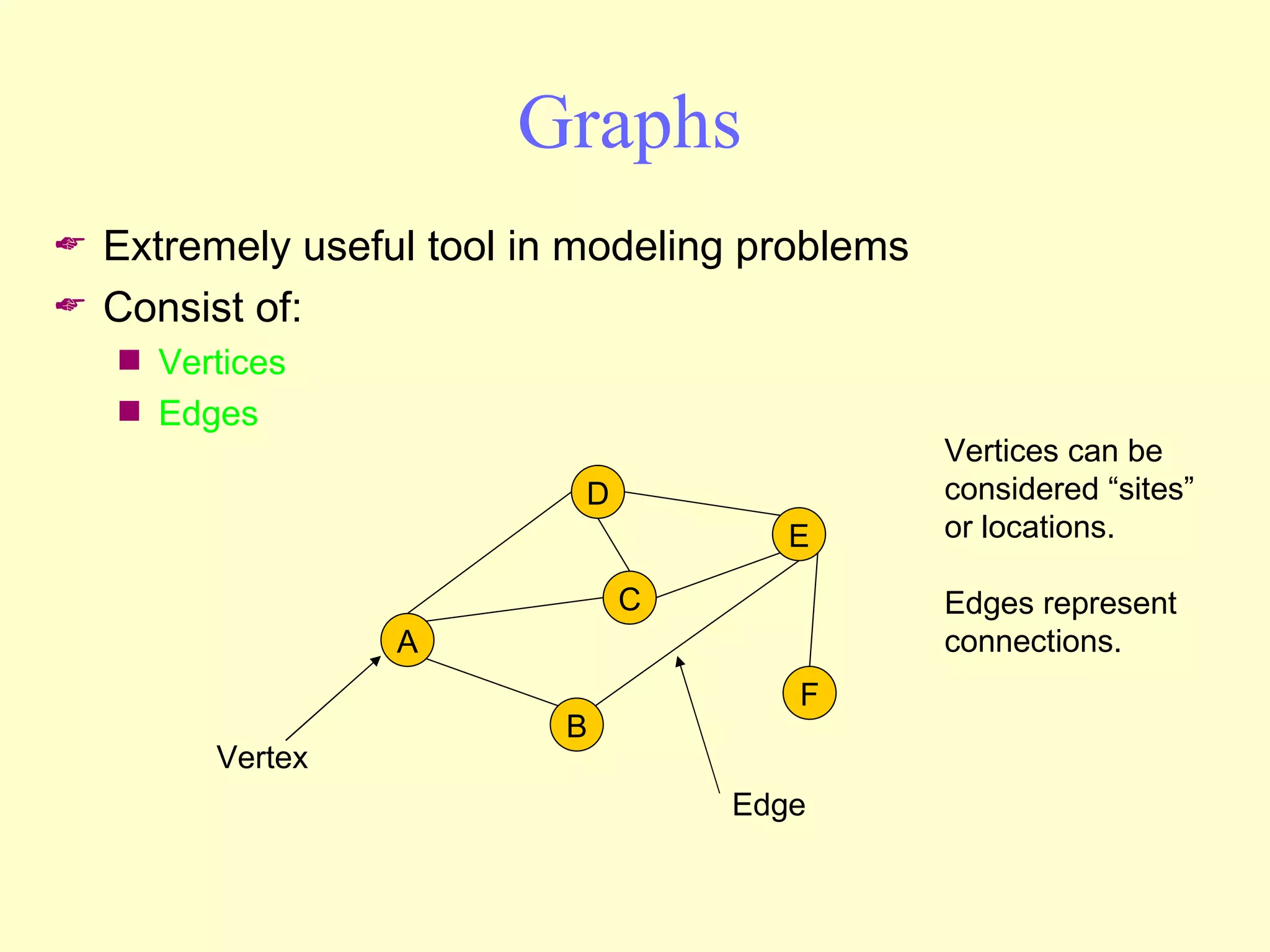
Graphs Extremely useful tool in modeling problems Consist of: Vertices Edges D E A C F B Vertex Edge Vertices can be considered “sites” or locations. Edges represent connections.
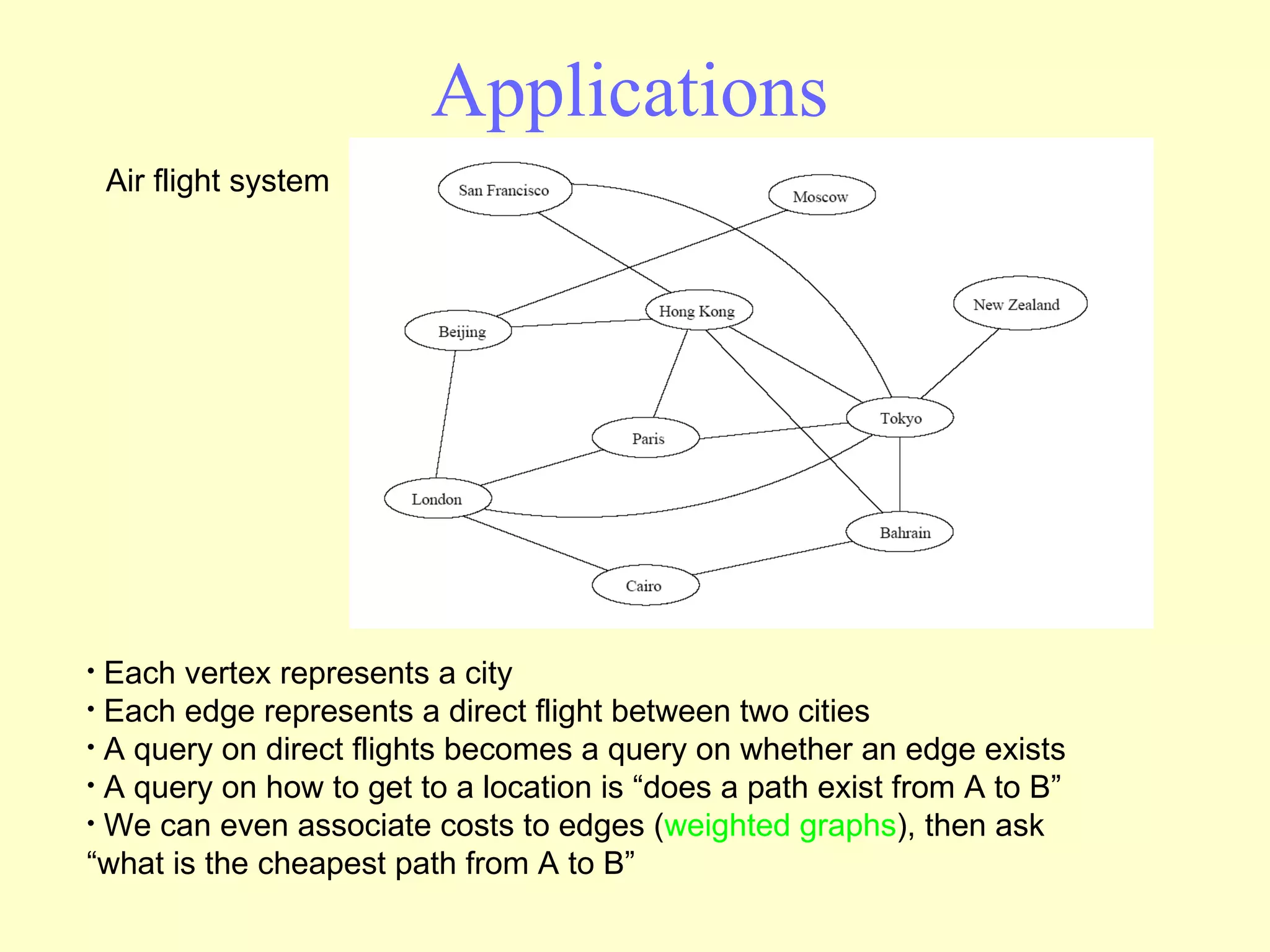
Applications Air flight system Each vertex represents a city Each edge represents a direct flight between two cities A query on direct flights becomes a query on whether an edge exists A query on how to get to a location is “does a path exist from A to B” We can even associate costs to edges ( weighted graphs ), then ask “what is the cheapest path from A to B”
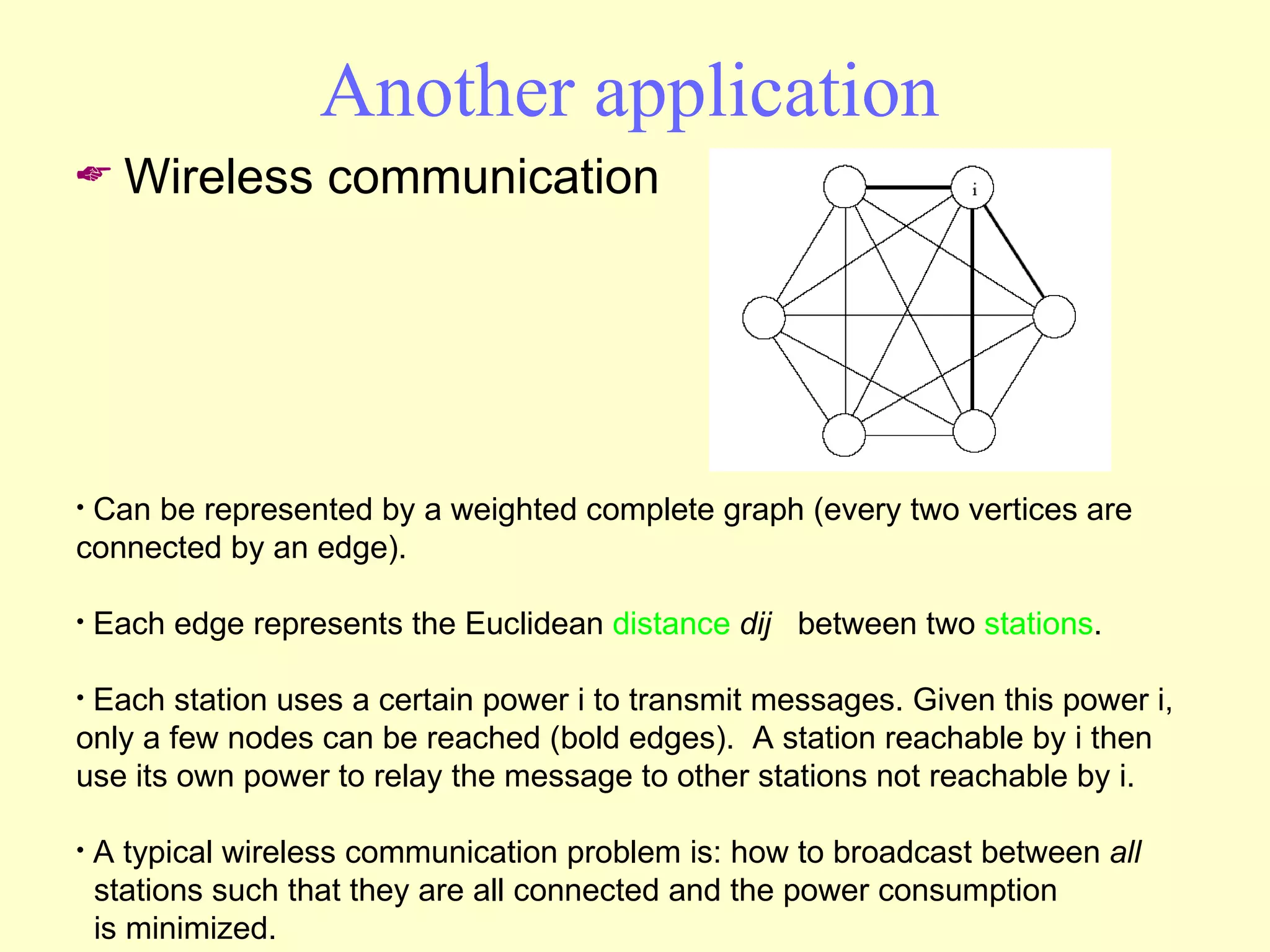
Another application Wireless communication Can be represented by a weighted complete graph (every two vertices are connected by an edge).  Each edge represents the Euclidean  distance   dij   between two  stations .  Each station uses a certain power i to transmit messages. Given this power i, only a few nodes can be reached (bold edges).  A station reachable by i then use its own power to relay the message to other stations not reachable by i. A typical wireless communication problem is: how to broadcast between  all   stations such that they are all connected and the power consumption   is minimized.
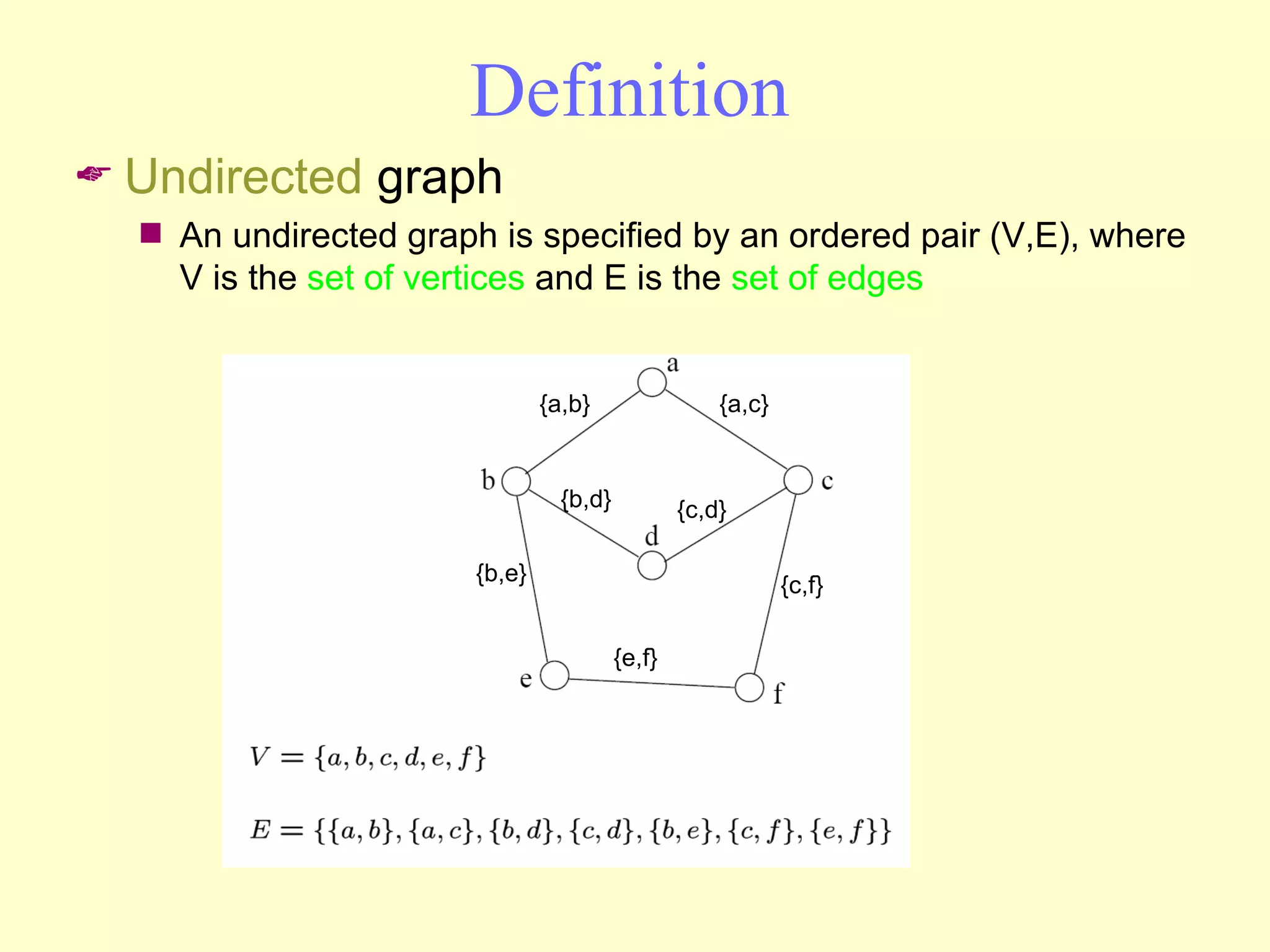
Definition Undirected  graph An undirected graph is specified by an ordered pair (V,E), where V is the  set of vertices  and E is the  set of edges {c,f} {a,c} {a,b} {b,d} {c,d} {e,f} {b,e}
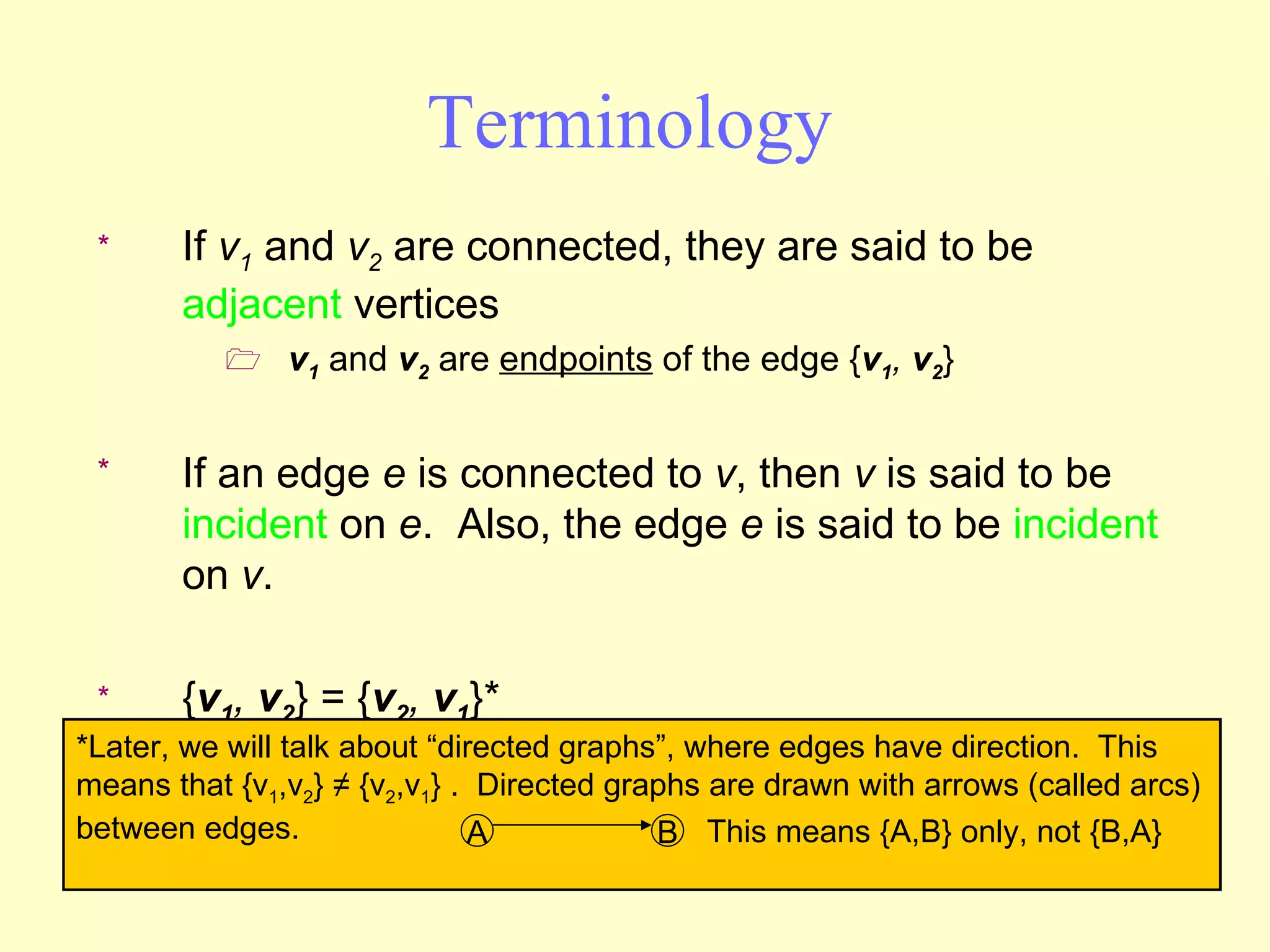
Terminology If  v 1  and  v 2  are connected, they are said to be  adjacent  vertices v 1  and  v 2  are  endpoints  of the edge { v 1 ,  v 2 } If an edge  e  is connected to  v , then  v  is said to be  incident  on  e .  Also, the edge  e  is said to be  incident  on  v . { v 1 ,  v 2 } = { v 2 ,  v 1 }* *Later, we will talk about “directed graphs”, where edges have direction.  This means that {v 1 ,v 2 } ≠ {v 2 ,v 1 } .  Directed graphs are drawn with arrows (called arcs) between edges.  A B This means {A,B} only, not {B,A}
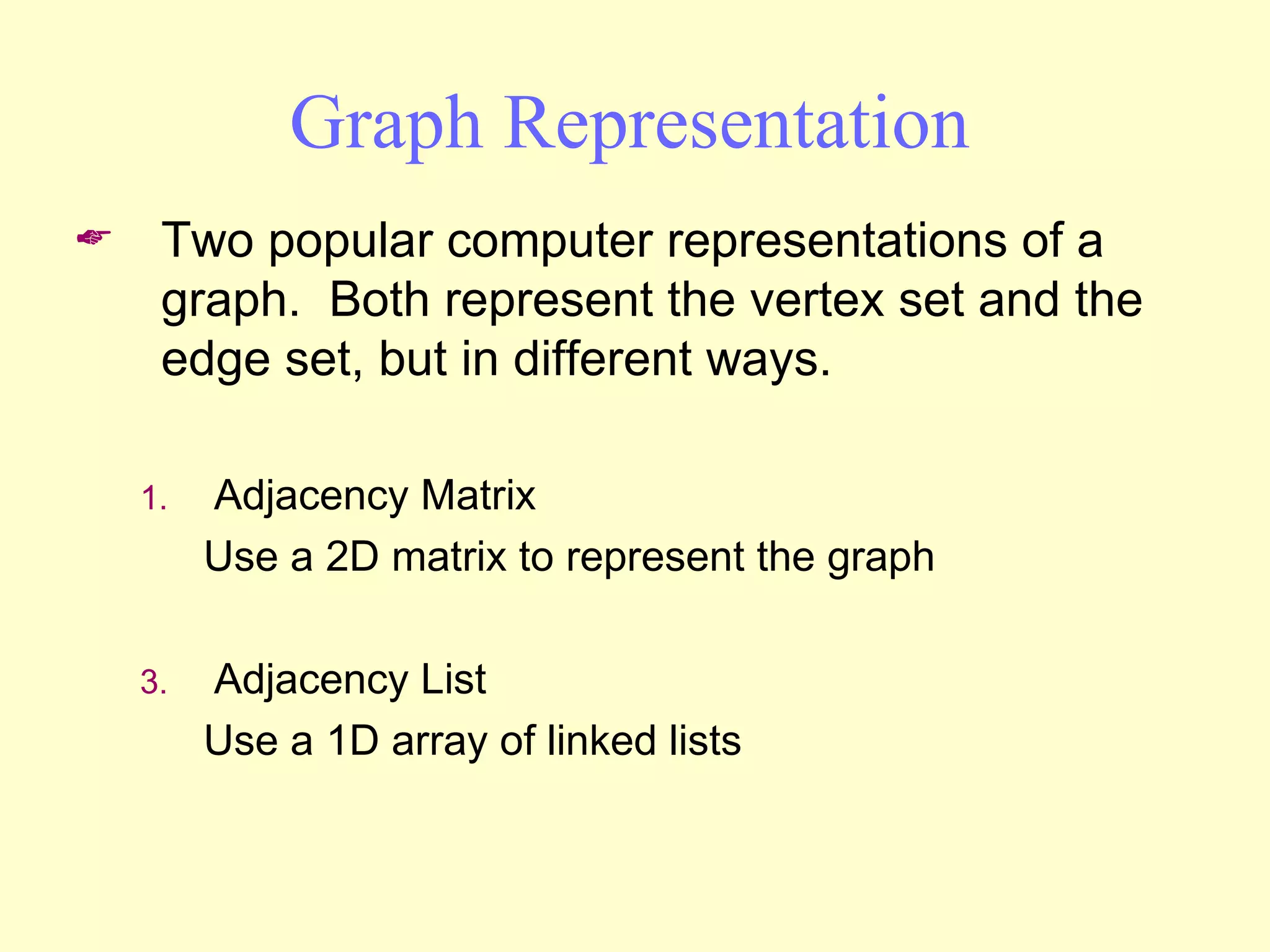
Graph Representation Two popular computer representations of a graph.  Both represent the vertex set and the edge set, but in different ways. Adjacency Matrix Use a 2D matrix to represent the graph Adjacency List Use a 1D array of linked lists
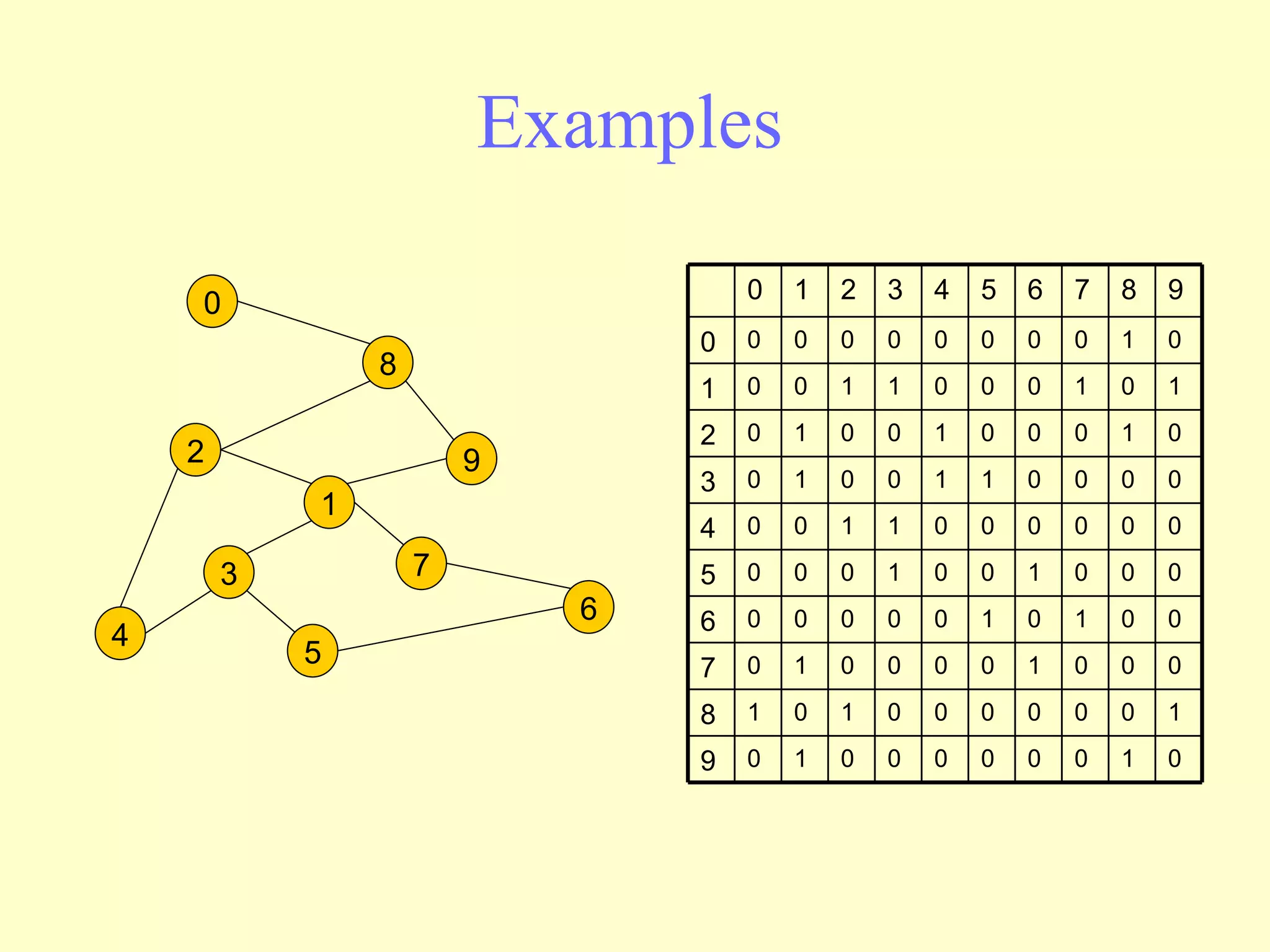
Adjacency Matrix 2D array A[0..n-1, 0..n-1], where  n  is the number of vertices in the graph Each row and column is indexed by the vertex id. - e,g a=0, b=1, c=2, d=3, e=4 An array entry A [i] [j]  is equal to 1 if there is an edge connecting  vertices i and j.  Otherwise, A [i] [j]  is 0. The storage requirement is  Θ (n 2 ).  Not efficient if the graph has few edges. We can detect in O(1) time whether two vertices are connected.
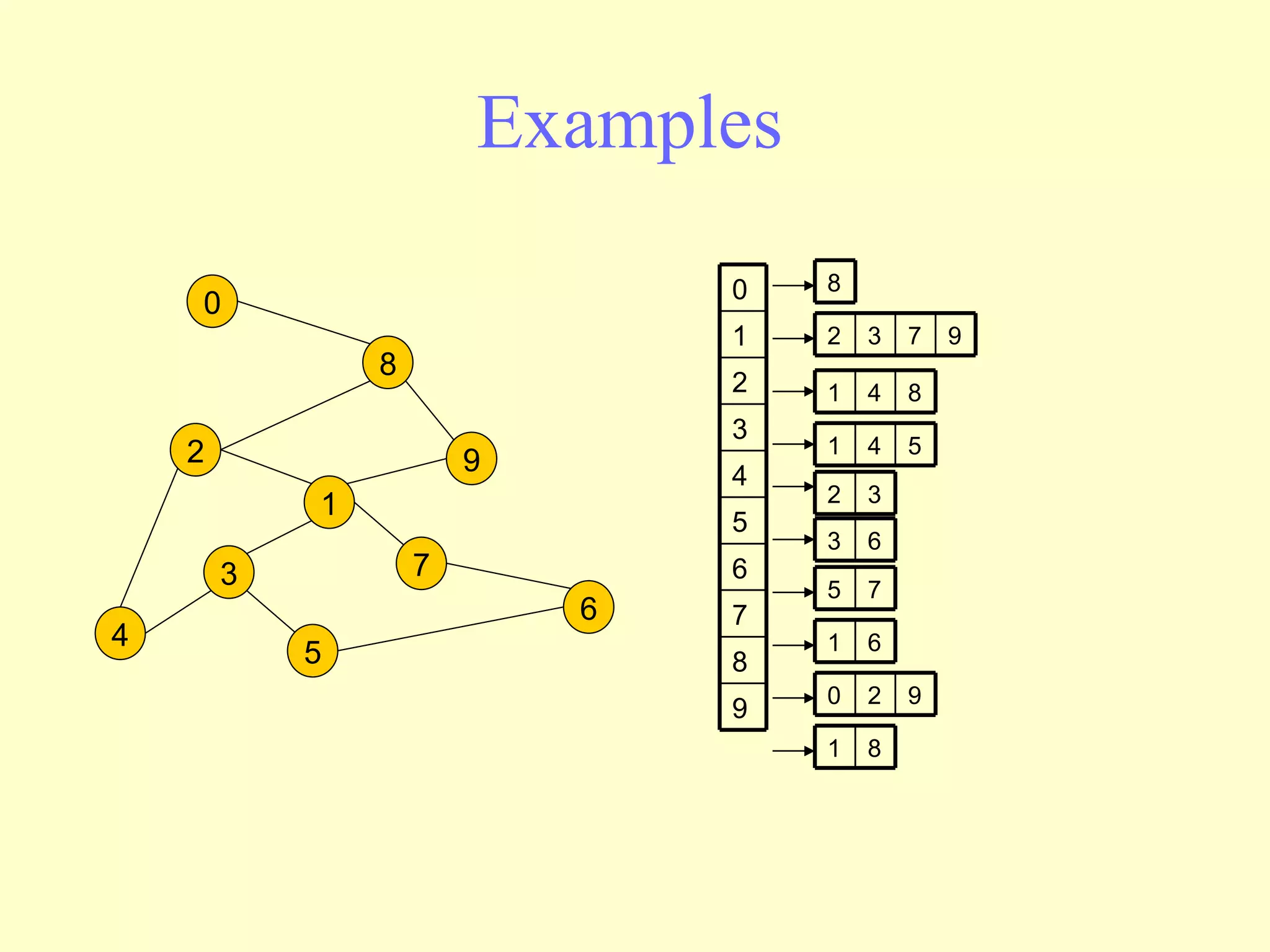
Adjacency list The adjacency list is an array A[0..n-1] of lists, where n is the number of    vertices in the graph. Each array entry is indexed by the vertex id (as with adjacency matrix) The list A[i] stores the ids of the vertices adjacent to i.
Examples 2 4 3 5 1 7 6 9 8 0 0 1 2 3 4 5 6 7 8 9 0 0 0 0 0 0 0 0 0 1 0 1 0 0 1 1 0 0 0 1 0 1 2 0 1 0 0 1 0 0 0 1 0 3 0 1 0 0 1 1 0 0 0 0 4 0 0 1 1 0 0 0 0 0 0 5 0 0 0 1 0 0 1 0 0 0 6 0 0 0 0 0 1 0 1 0 0 7 0 1 0 0 0 0 1 0 0 0 8 1 0 1 0 0 0 0 0 0 1 9 0 1 0 0 0 0 0 0 1 0
Examples 2 4 3 5 1 7 6 9 8 0 0 1 2 3 4 5 6 7 8 9 2 3 7 9 8 1 4 8 1 4 5 2 3 3 6 5 7 1 6 0 2 9 1 8
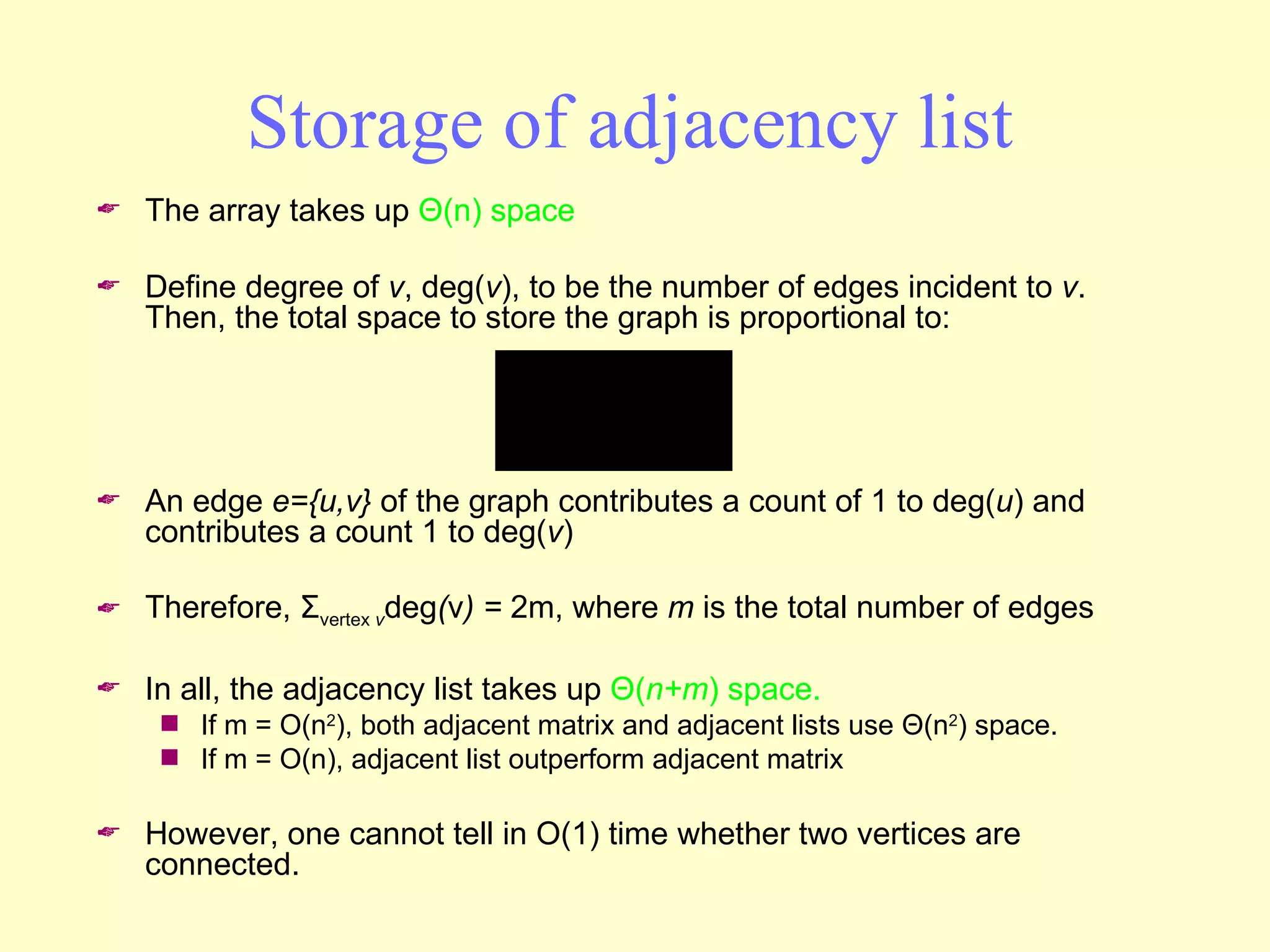
Storage of adjacency list The array takes up  Θ (n) space Define degree of  v , deg( v ), to be the number of edges incident to  v .  Then, the total space to store the graph is proportional to: An edge  e={u,v}  of the graph contributes a count of 1 to deg( u ) and contributes a count 1 to deg( v ) Therefore,  Σ vertex  v deg ( v ) =  2m, where  m  is the total number of edges In all, the adjacency list takes up  Θ ( n+m ) space. If m = O(n 2 ), both adjacent matrix and adjacent lists use  Θ (n 2 ) space. If m = O(n), adjacent list outperform adjacent matrix However, one cannot tell in O(1) time whether two vertices are connected.
Adjacency Lists vs. Matrix Adjacency Lists More compact than adjacency matrices if graph has few edges Requires more time to find if an edge exists Adjacency Matrix Always require n 2  space This can waste a lot of space if the number of edges are sparse Can quickly find if an edge exists
Path between vertices A  path  is a sequence of vertices (v 0 , v 1 , v 2 ,… v k ) such that: For  0 ≤ i < k,  {v i , v i+1 }  is an edge For  0 ≤ i < k-1, v i  ≠ v i+2  That is, the edge {v i , v i+1 } ≠ {v i+1 , v i+2 } Note: a path is allowed to go through the same vertex or the same edge any number of times! The  length  of a path is the number of edges on the path
Types of paths A path is  simple  if and only if it does not contain a vertex more than once. A path is a  cycle  if and only if  v 0 = v k The beginning and end are the same vertex! A path contains a cycle if some vertex appears twice or more
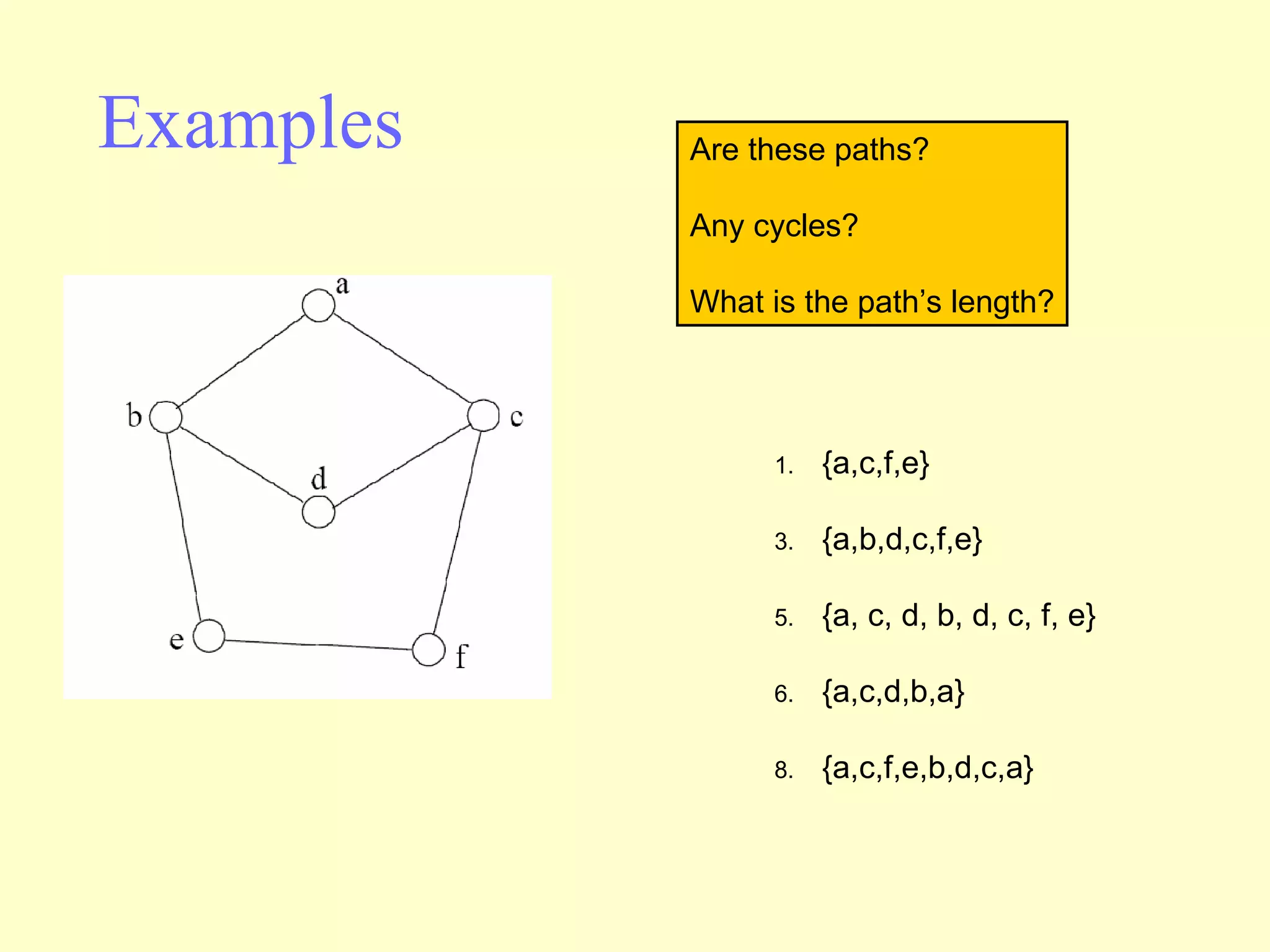
Examples {a,c,f,e} {a,b,d,c,f,e} {a, c, d, b, d, c, f, e} {a,c,d,b,a} {a,c,f,e,b,d,c,a} Are these paths? Any cycles? What is the path’s length?
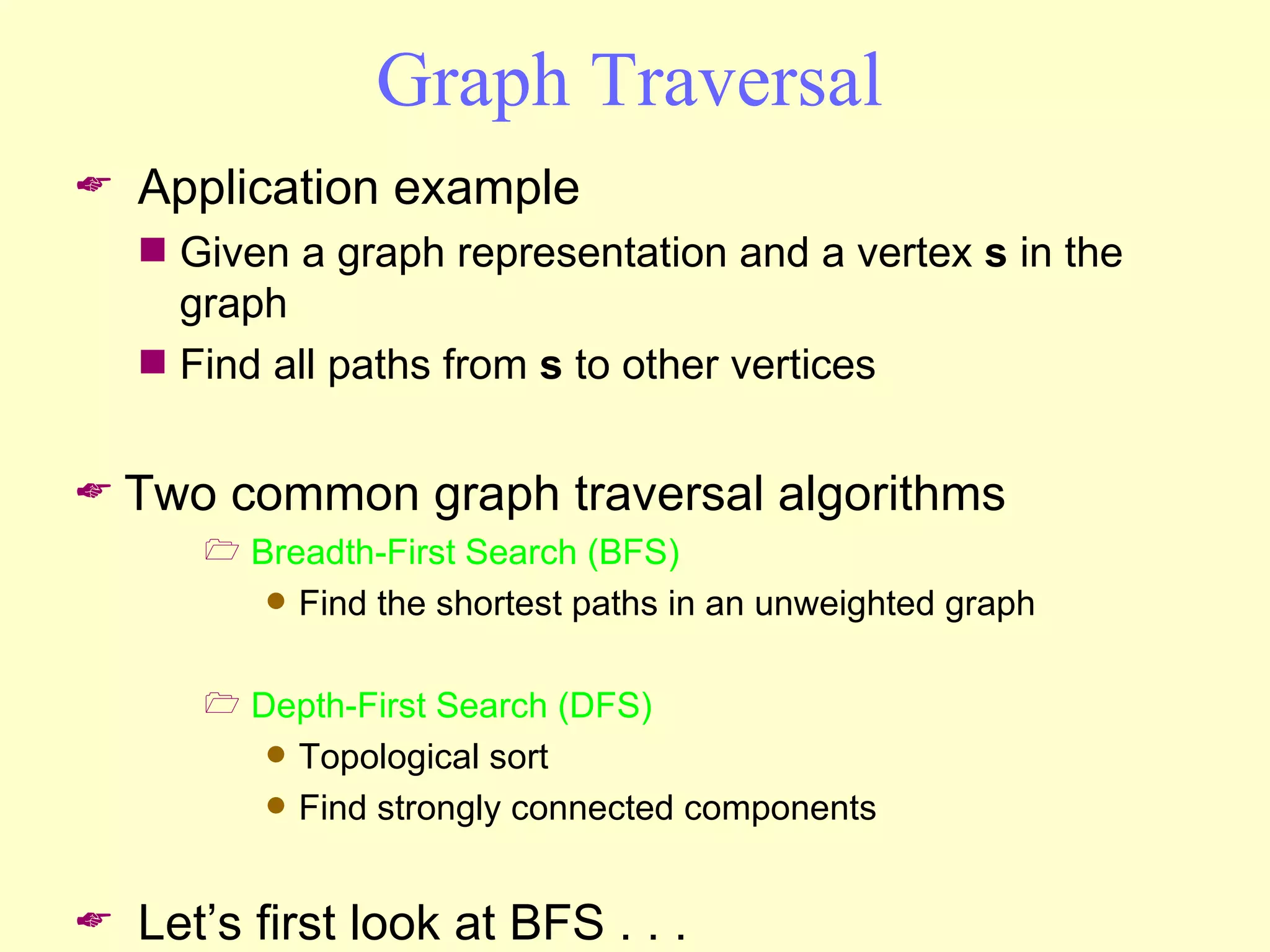
Graph Traversal Application example Given a graph representation and a vertex  s  in the graph Find all paths from  s  to other vertices Two common graph traversal algorithms Breadth-First Search (BFS) Find the shortest paths in an unweighted graph Depth-First Search (DFS) Topological sort Find strongly connected components Let’s first look at BFS . . .
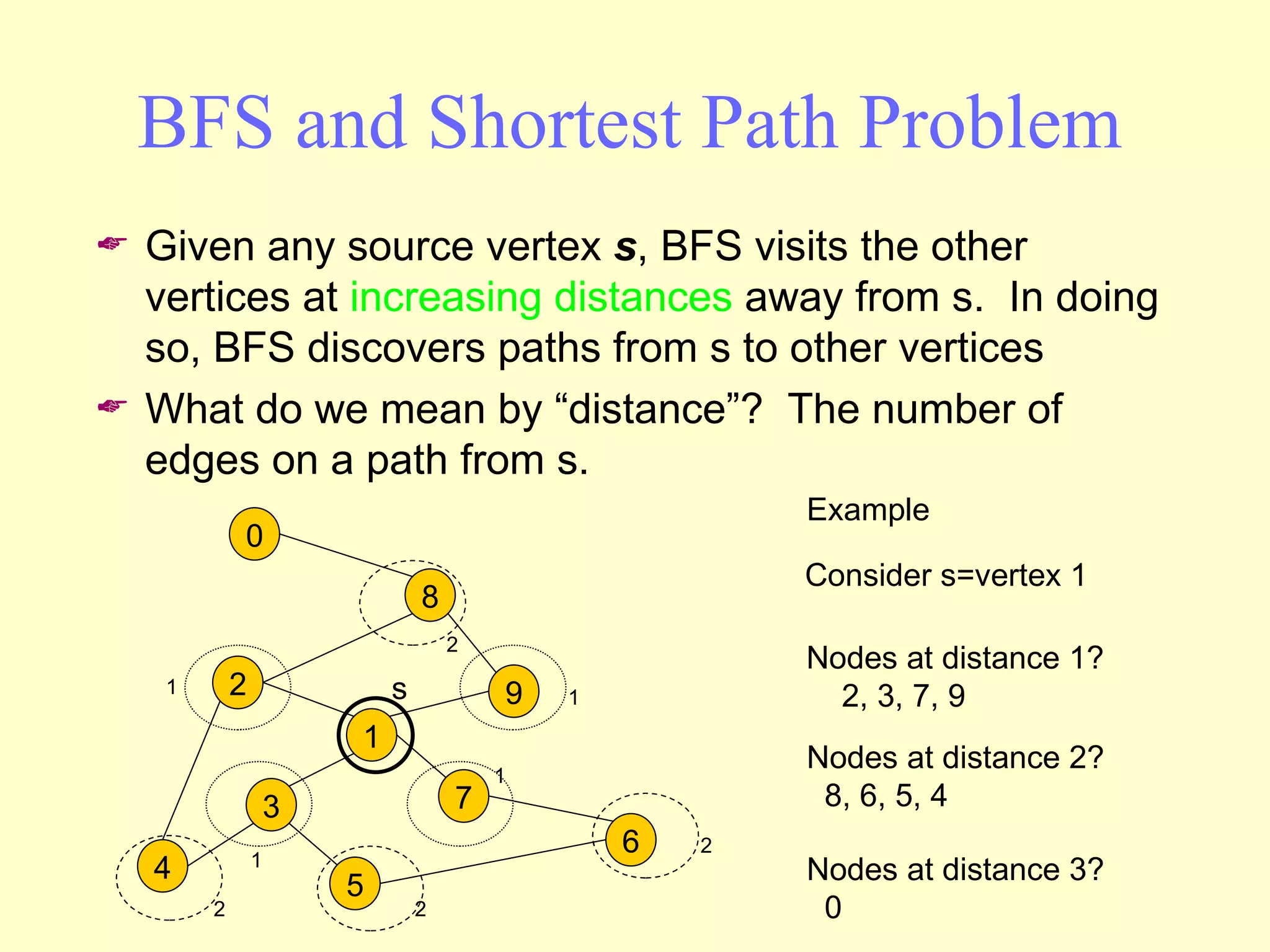
BFS and Shortest Path Problem Given any source vertex  s , BFS visits the other vertices at  increasing distances  away from s.  In doing so, BFS discovers paths from s to other vertices What do we mean by “distance”?  The number of edges on a path from s. Consider s=vertex 1 Nodes at distance 1? 2, 3, 7, 9 Example Nodes at distance 2? 8, 6, 5, 4 Nodes at distance 3? 0 2 4 3 5 1 7 6 9 8 0 1 1 1 1 2 2 2 2 s
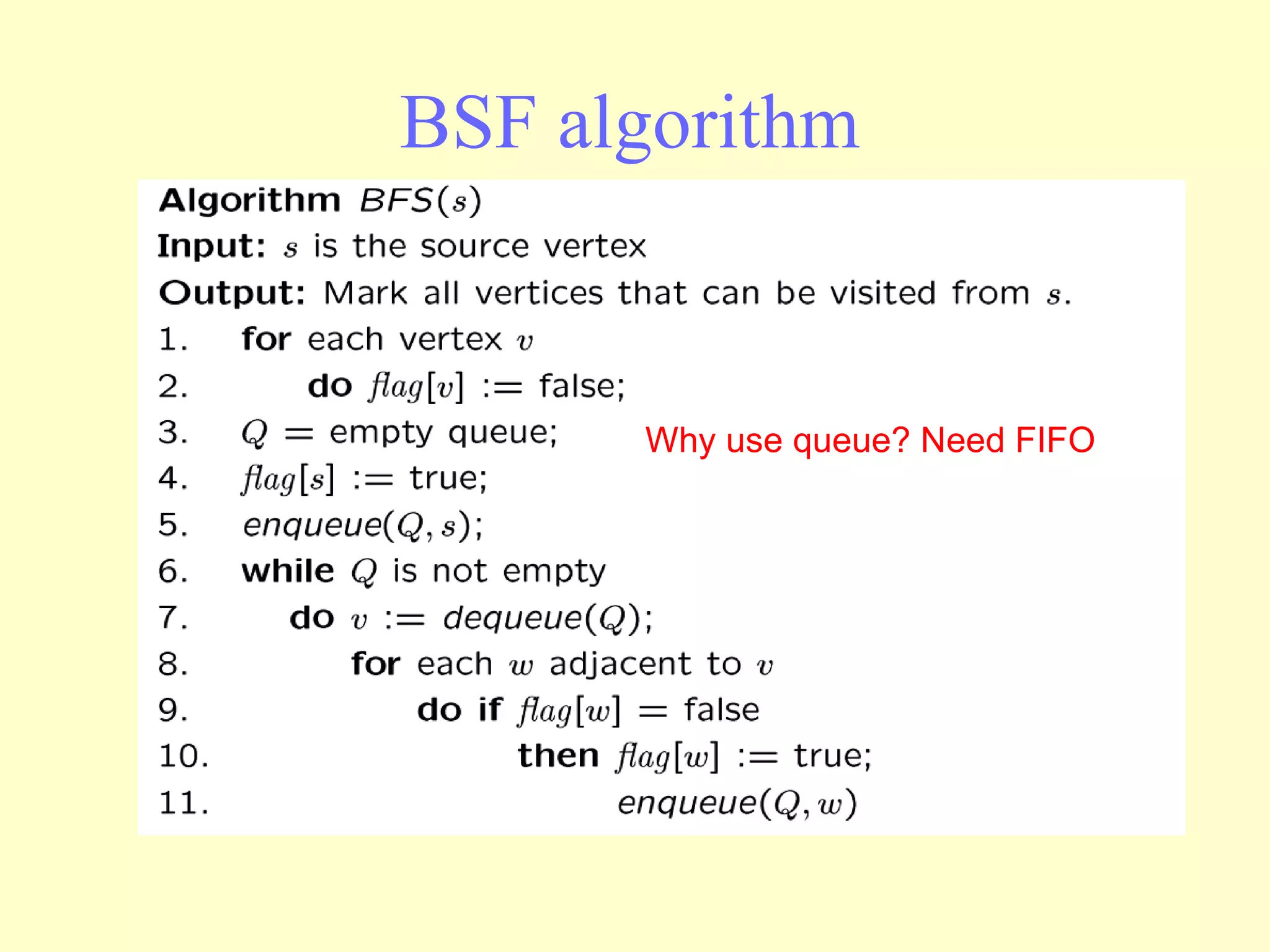
BSF algorithm Why use queue? Need FIFO
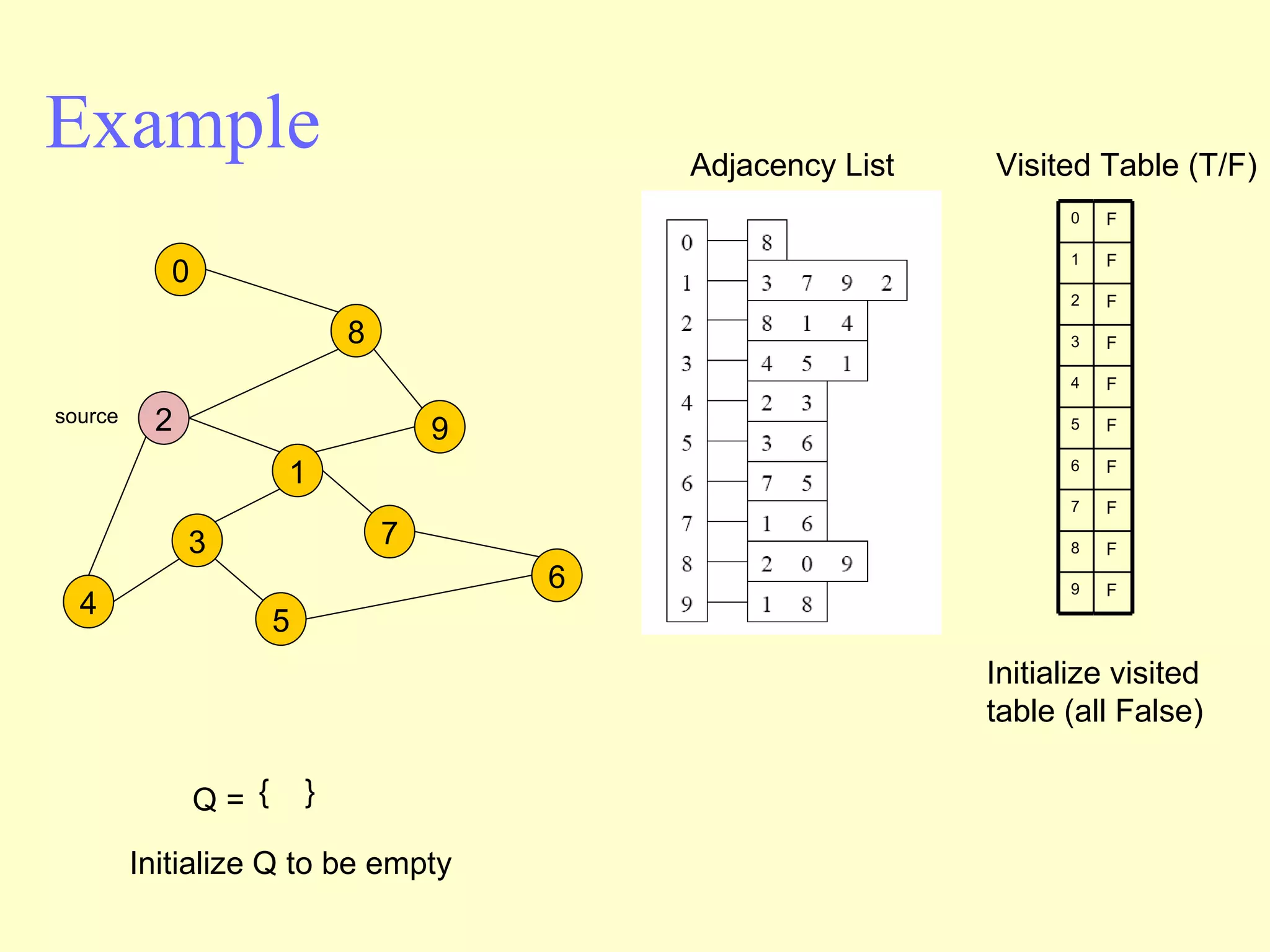
Example Adjacency List source Visited Table (T/F) Q =  {  } Initialize visited table (all False) Initialize Q to be empty 2 4 3 5 1 7 6 9 8 0 0 1 2 3 4 5 6 7 8 9 F F F F F F F F F F
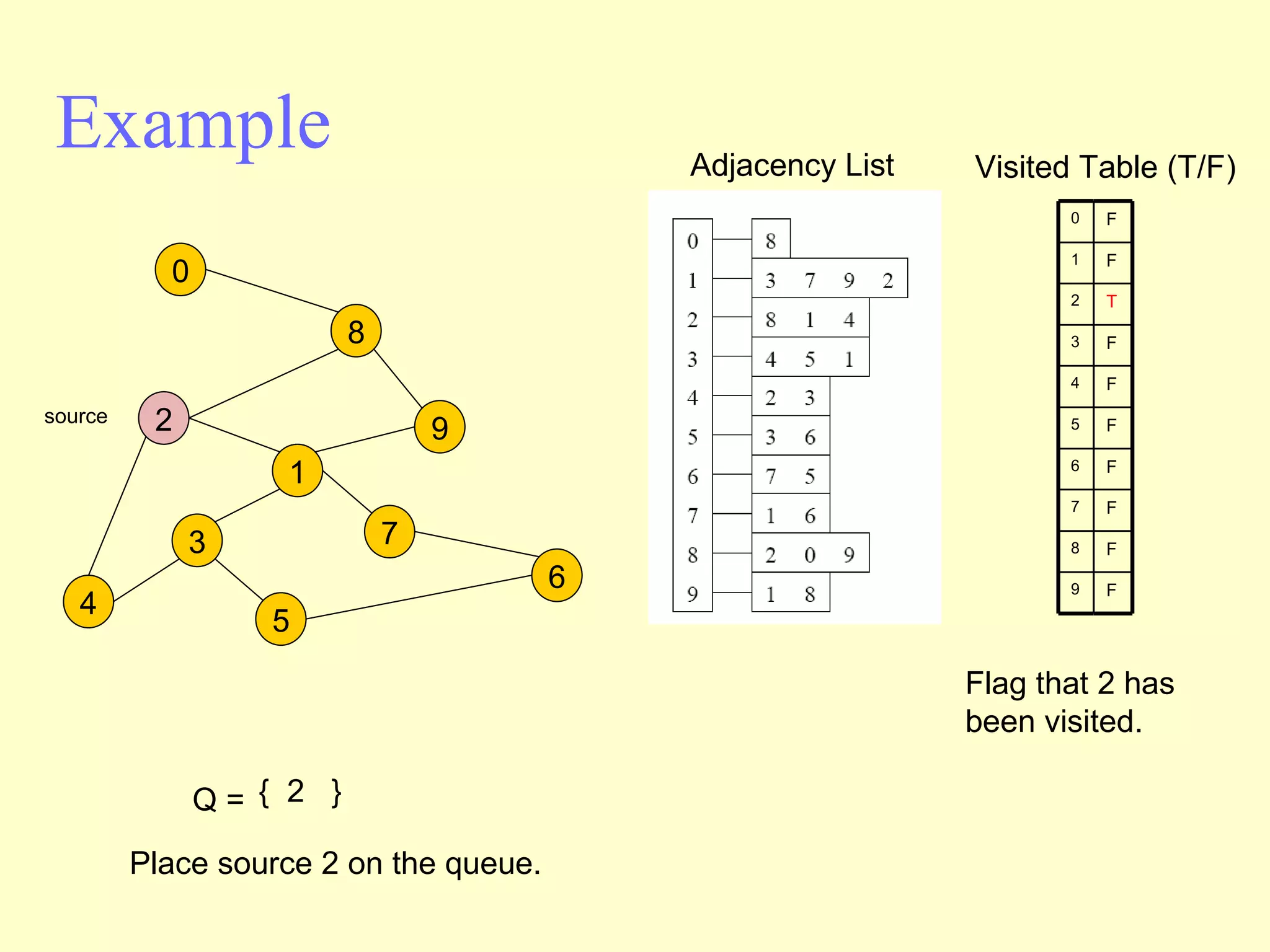
Example Adjacency List source Visited Table (T/F) Q =  {  2  } Flag that 2 has  been visited. Place source 2 on the queue. 2 4 3 5 1 7 6 9 8 0 0 1 2 3 4 5 6 7 8 9 F F T F F F F F F F
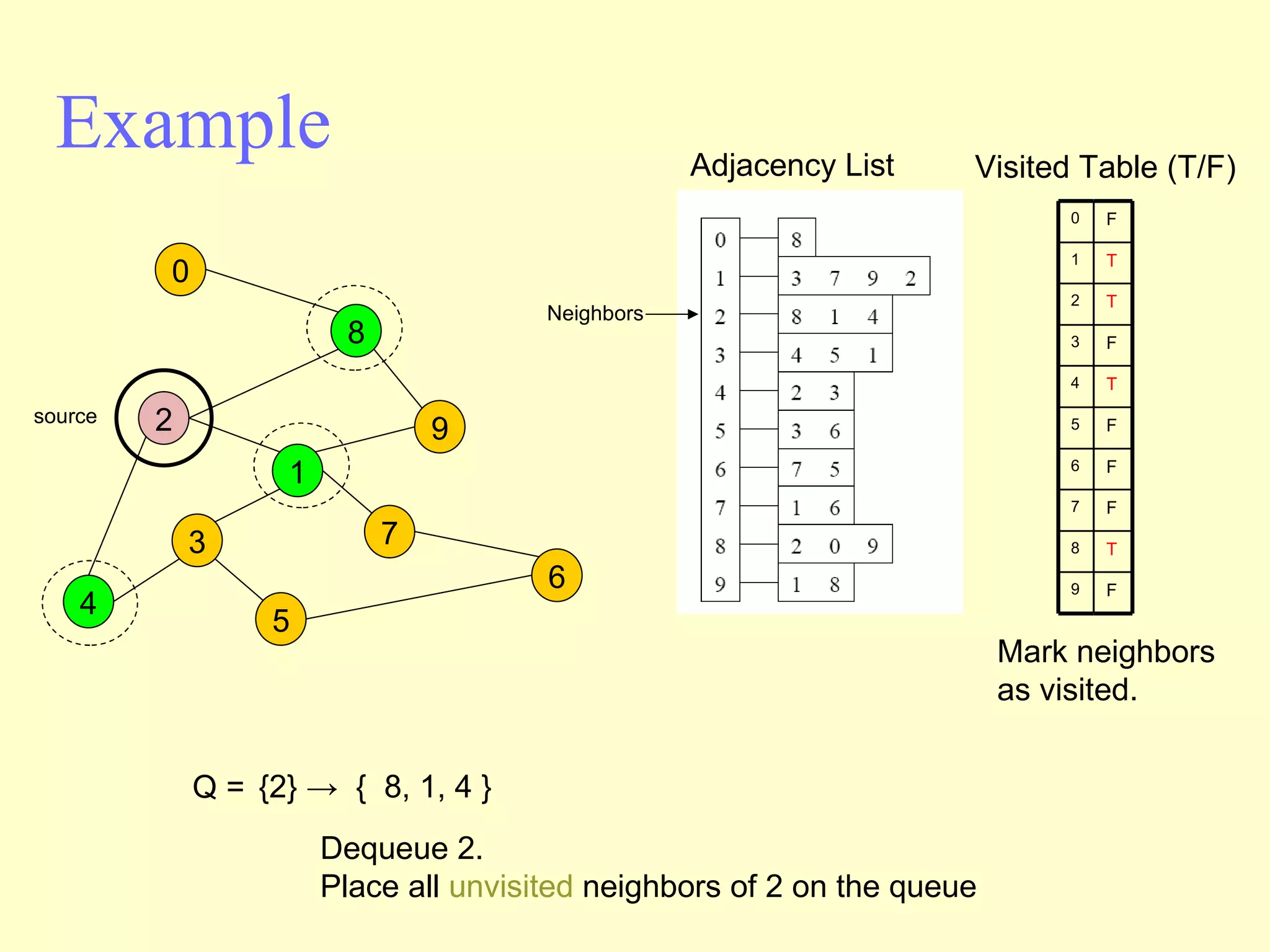
Example Adjacency List source Visited Table (T/F) Q =  {2} ->  {  8, 1, 4 } Mark neighbors as visited. Dequeue 2.  Place all  unvisited  neighbors of 2 on the queue Neighbors 2 4 3 5 1 7 6 9 8 0 0 1 2 3 4 5 6 7 8 9 F T T F T F F F T F
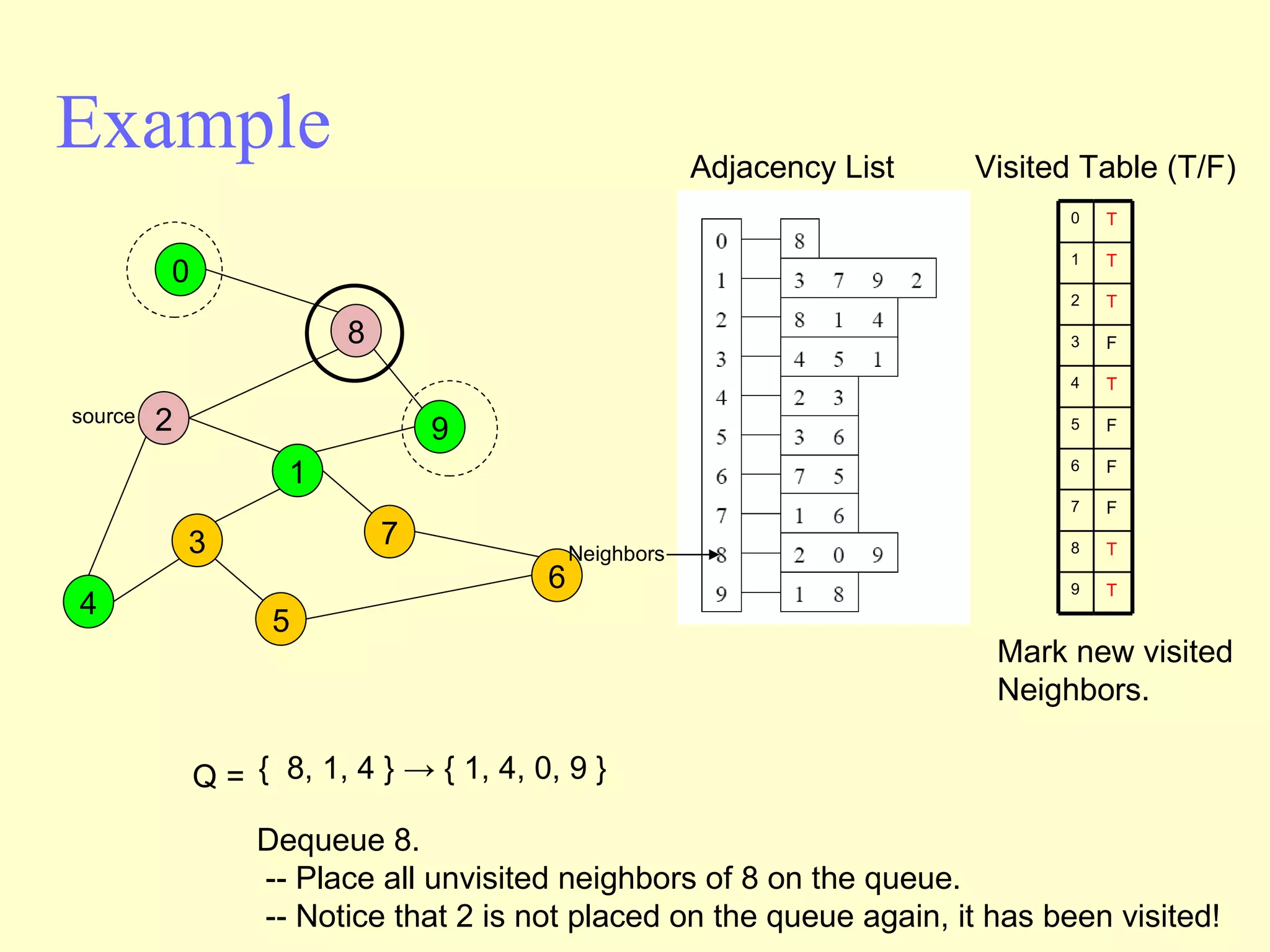
Example Adjacency List source Visited Table (T/F) Q =  {  8, 1, 4 } -> { 1, 4, 0, 9 }  Mark new visited Neighbors. Dequeue 8.  -- Place all unvisited neighbors of 8 on the queue. -- Notice that 2 is not placed on the queue again, it has been visited! Neighbors 2 4 3 5 1 7 6 9 8 0 0 1 2 3 4 5 6 7 8 9 T T T F T F F F T T
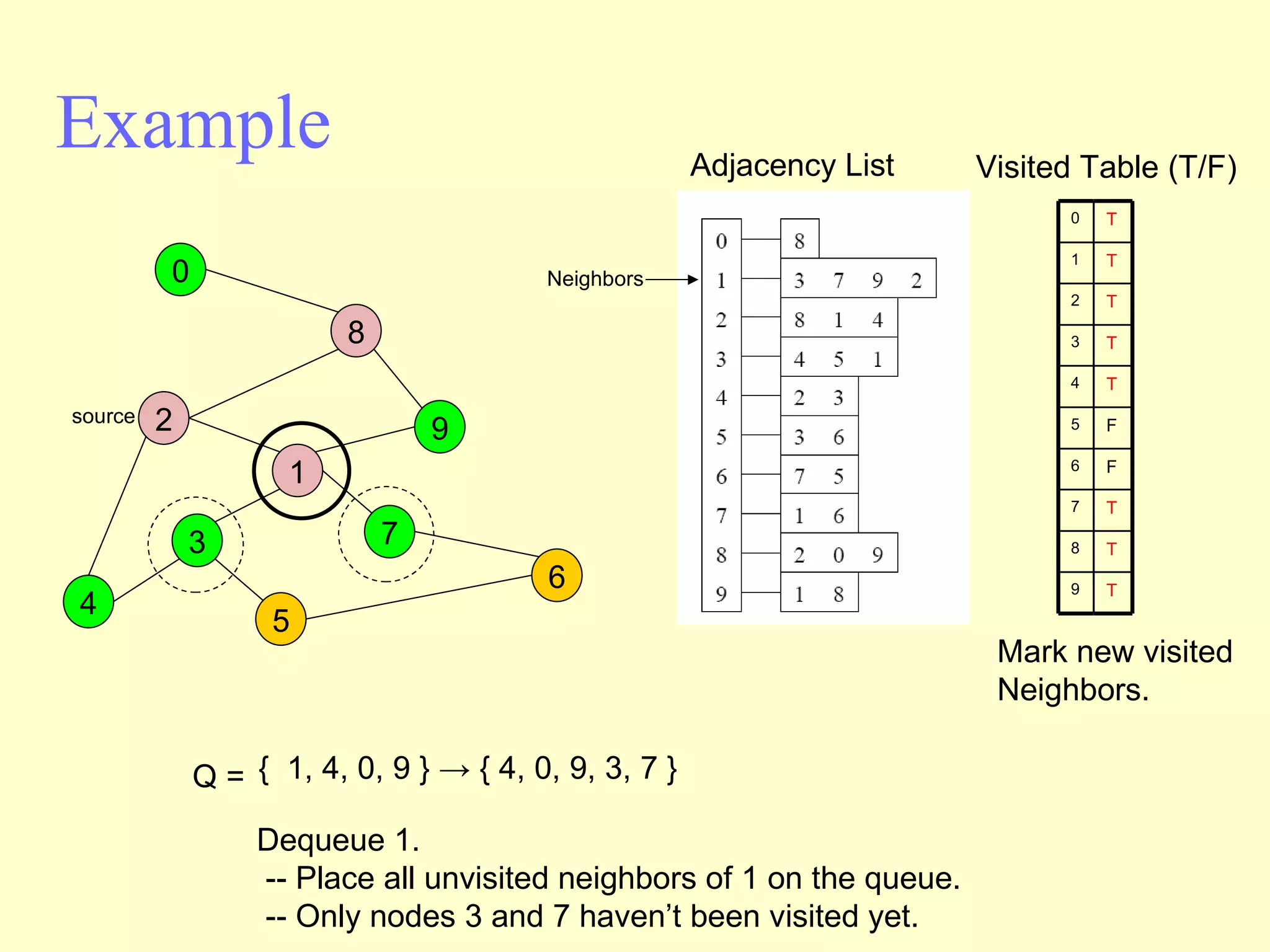
Example Adjacency List source Visited Table (T/F) Q =  {  1, 4, 0, 9 } -> { 4, 0, 9, 3, 7 }  Mark new visited Neighbors. Dequeue 1.  -- Place all unvisited neighbors of 1 on the queue. -- Only nodes 3 and 7 haven’t been visited yet. Neighbors 2 4 3 5 1 7 6 9 8 0 0 1 2 3 4 5 6 7 8 9 T T T T T F F T T T
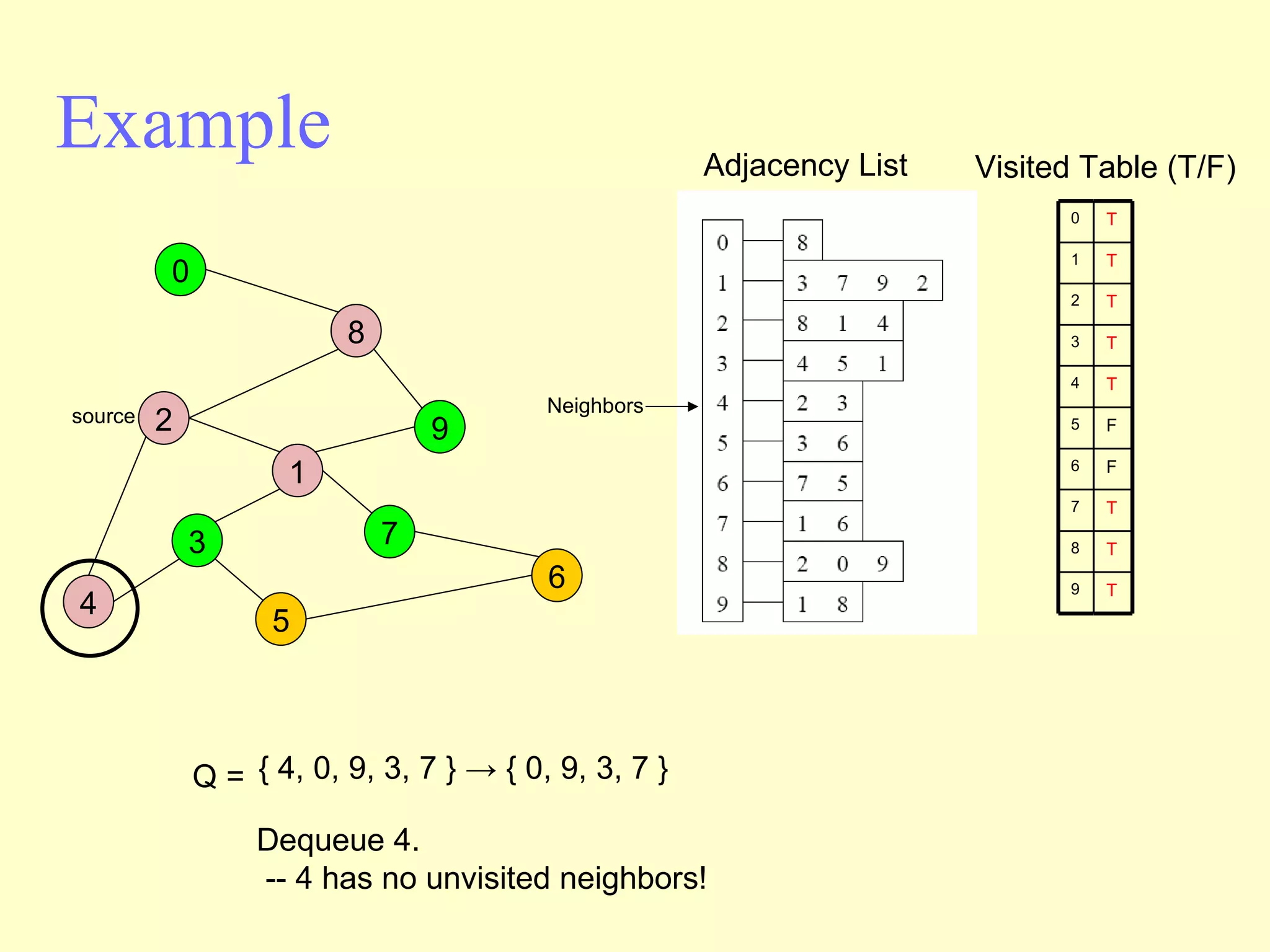
Example Adjacency List source Visited Table (T/F) Q =  { 4, 0, 9, 3, 7 } -> { 0, 9, 3, 7 }  Dequeue 4.  -- 4 has no unvisited neighbors! Neighbors 2 4 3 5 1 7 6 9 8 0 0 1 2 3 4 5 6 7 8 9 T T T T T F F T T T
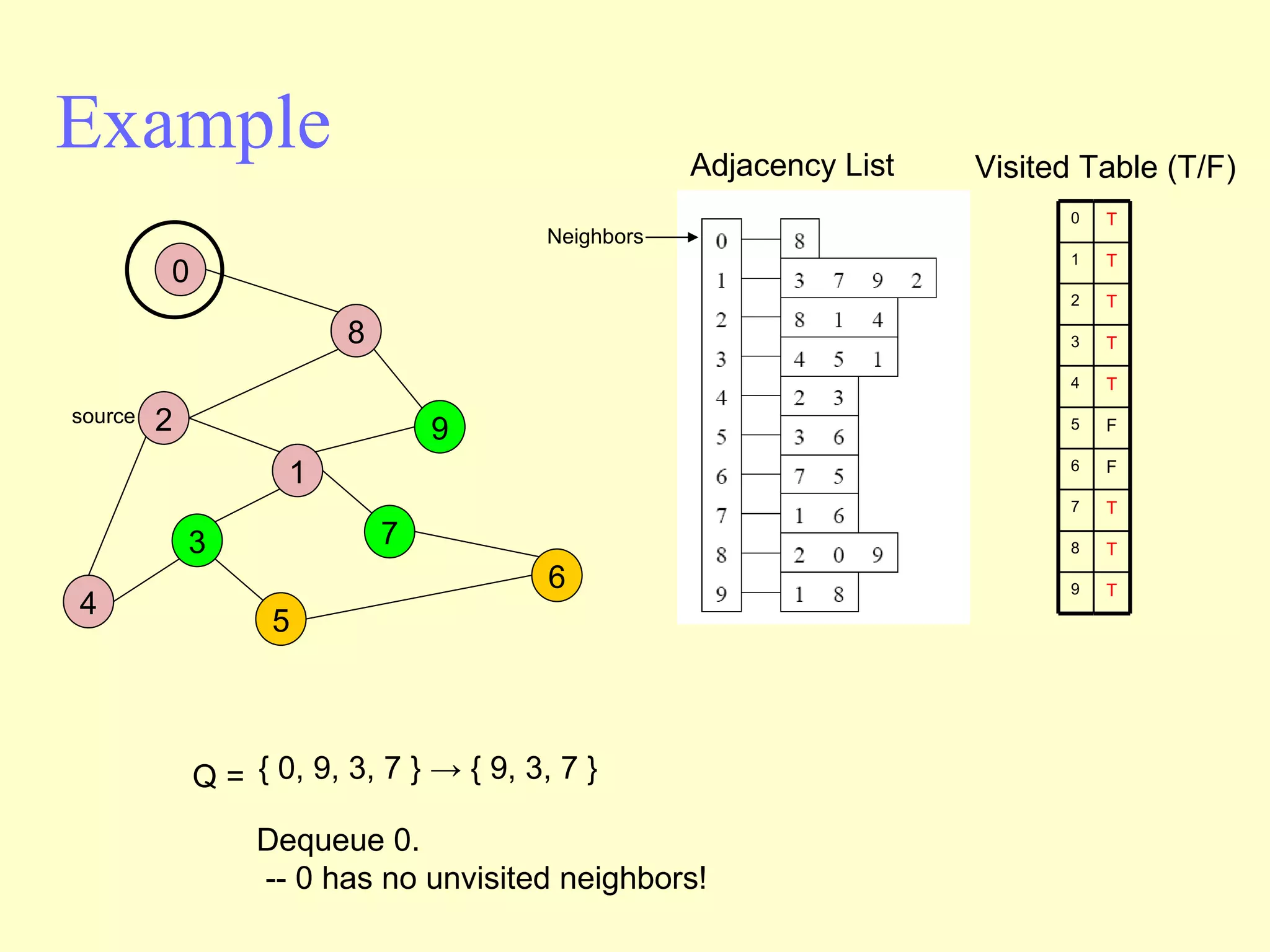
Example Adjacency List source Visited Table (T/F) Q =  { 0, 9, 3, 7 } -> { 9, 3, 7 }  Dequeue 0.  -- 0 has no unvisited neighbors! Neighbors 2 4 3 5 1 7 6 9 8 0 0 1 2 3 4 5 6 7 8 9 T T T T T F F T T T
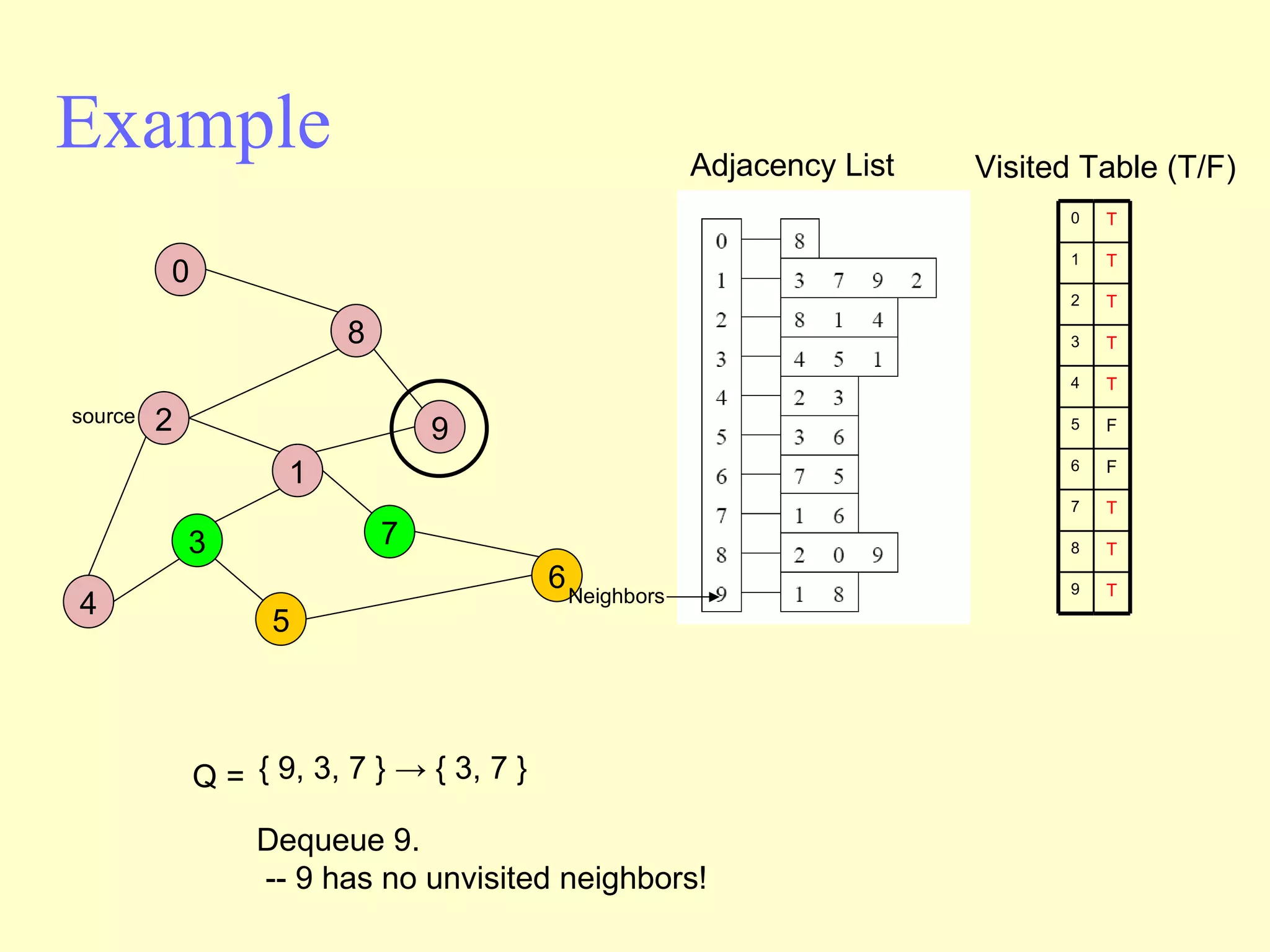
Example Adjacency List source Visited Table (T/F) Q =  { 9, 3, 7 } -> { 3, 7 }  Dequeue 9.  -- 9 has no unvisited neighbors! Neighbors 2 4 3 5 1 7 6 9 8 0 0 1 2 3 4 5 6 7 8 9 T T T T T F F T T T
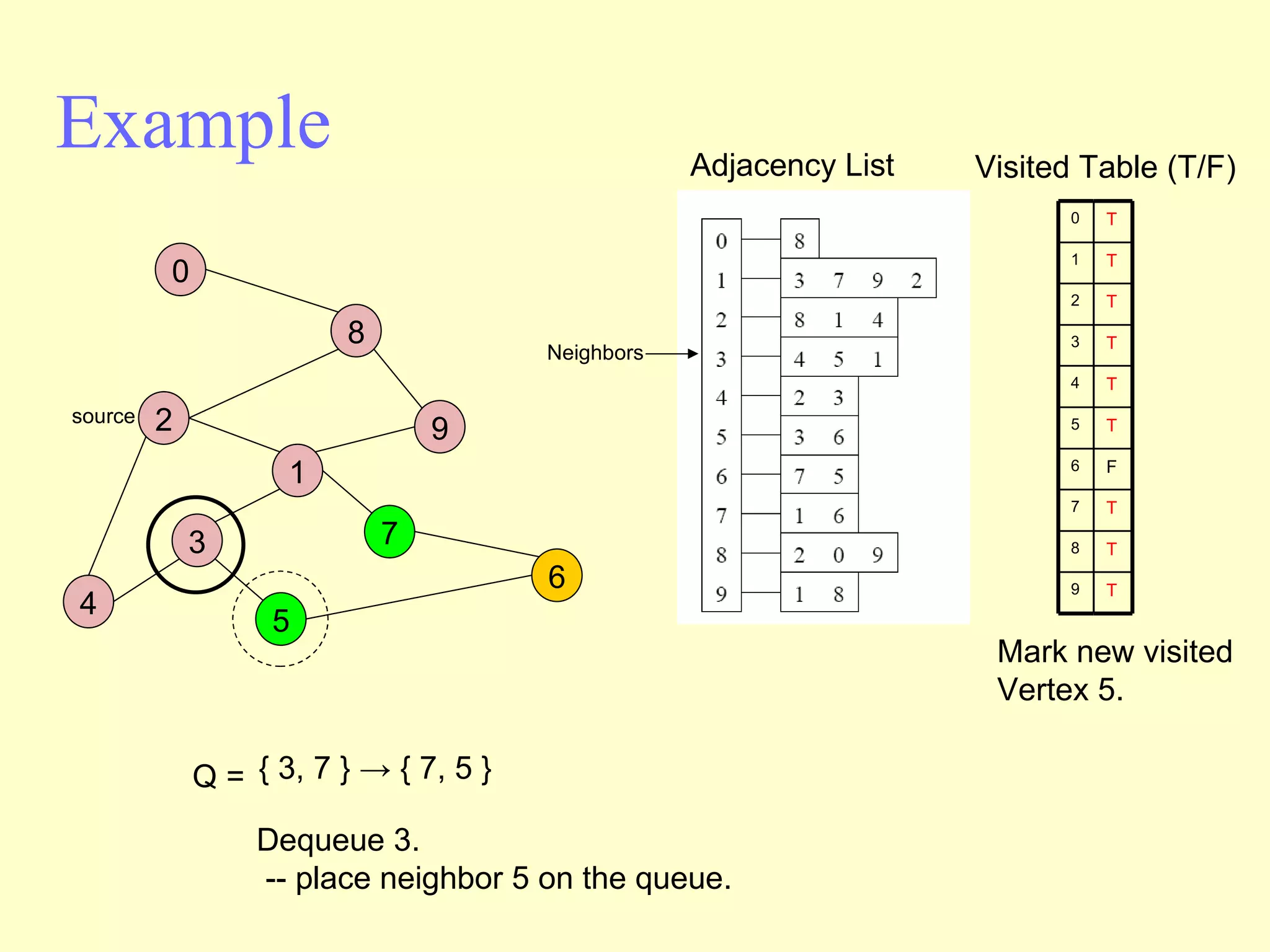
Example Adjacency List source Visited Table (T/F) Q =  { 3, 7 } -> { 7, 5 }  Dequeue 3.  -- place neighbor 5 on the queue. Neighbors Mark new visited Vertex 5. 2 4 3 5 1 7 6 9 8 0 0 1 2 3 4 5 6 7 8 9 T T T T T T F T T T
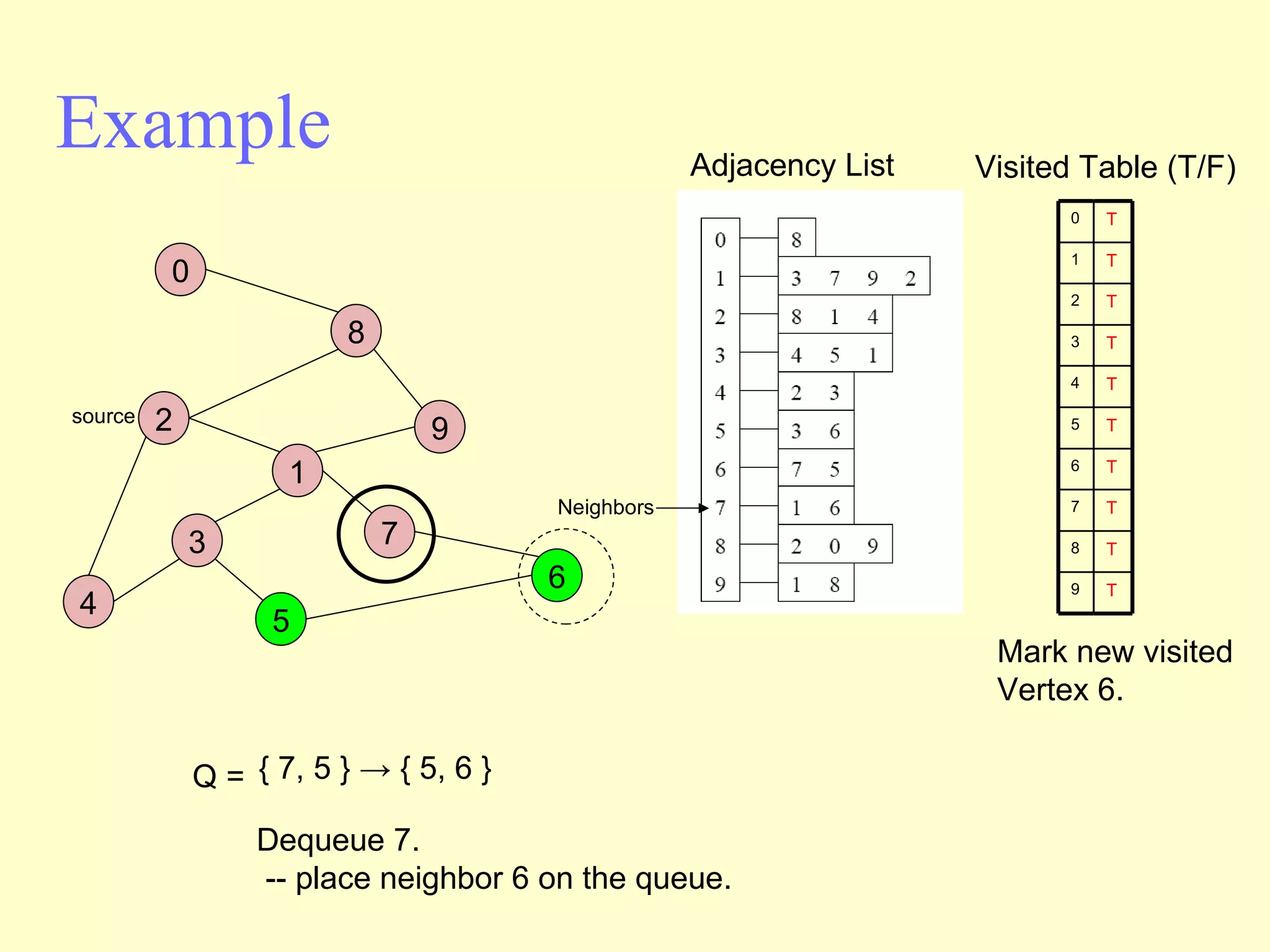
Example Adjacency List source Visited Table (T/F) Q =  { 7, 5 } -> { 5, 6 }  Dequeue 7.  -- place neighbor 6 on the queue. Neighbors Mark new visited Vertex 6. 2 4 3 5 1 7 6 9 8 0 0 1 2 3 4 5 6 7 8 9 T T T T T T T T T T
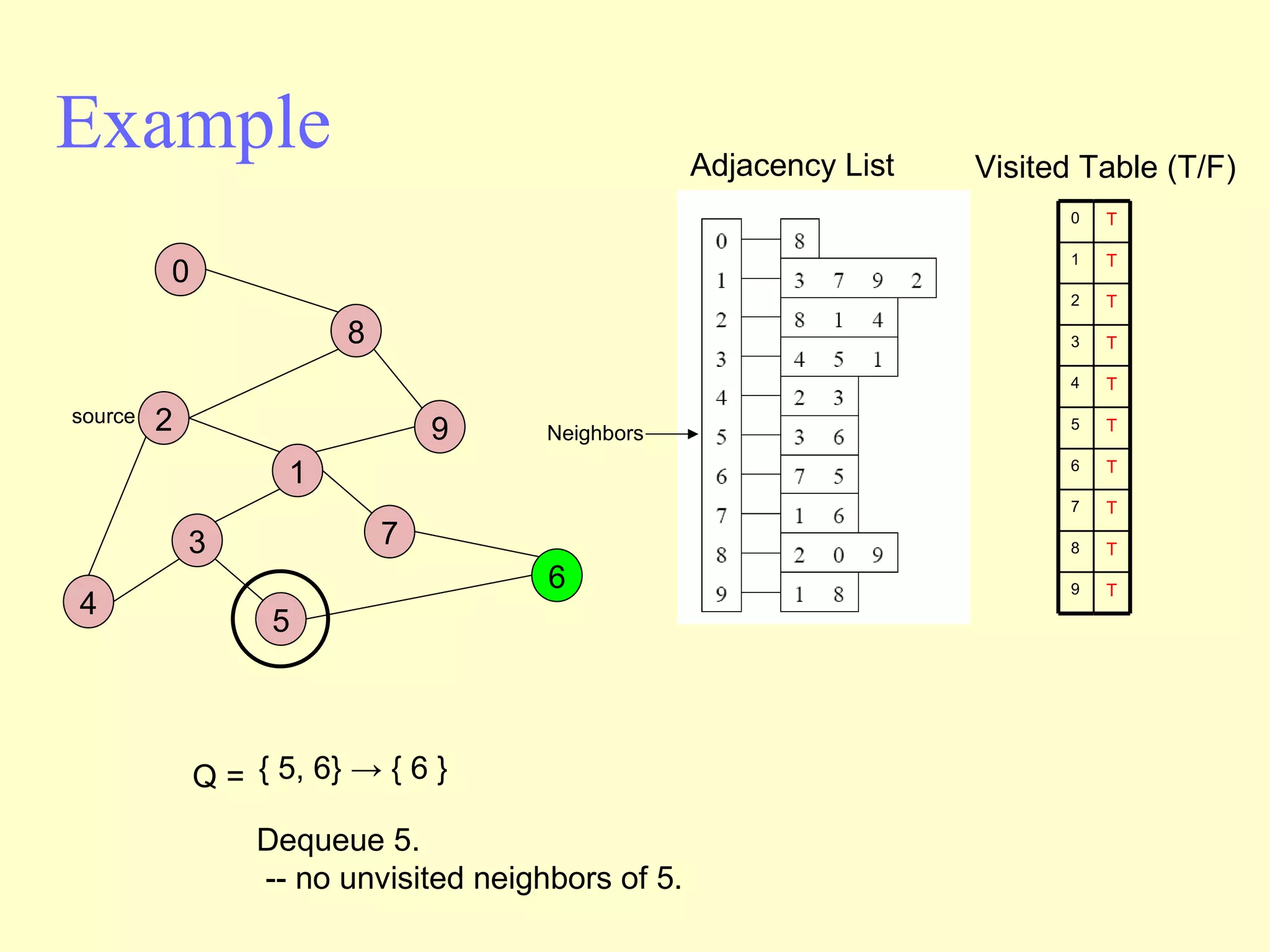
Example Adjacency List source Visited Table (T/F) Q =  { 5, 6} -> { 6 }  Dequeue 5.  -- no unvisited neighbors of 5. Neighbors 2 4 3 5 1 7 6 9 8 0 0 1 2 3 4 5 6 7 8 9 T T T T T T T T T T
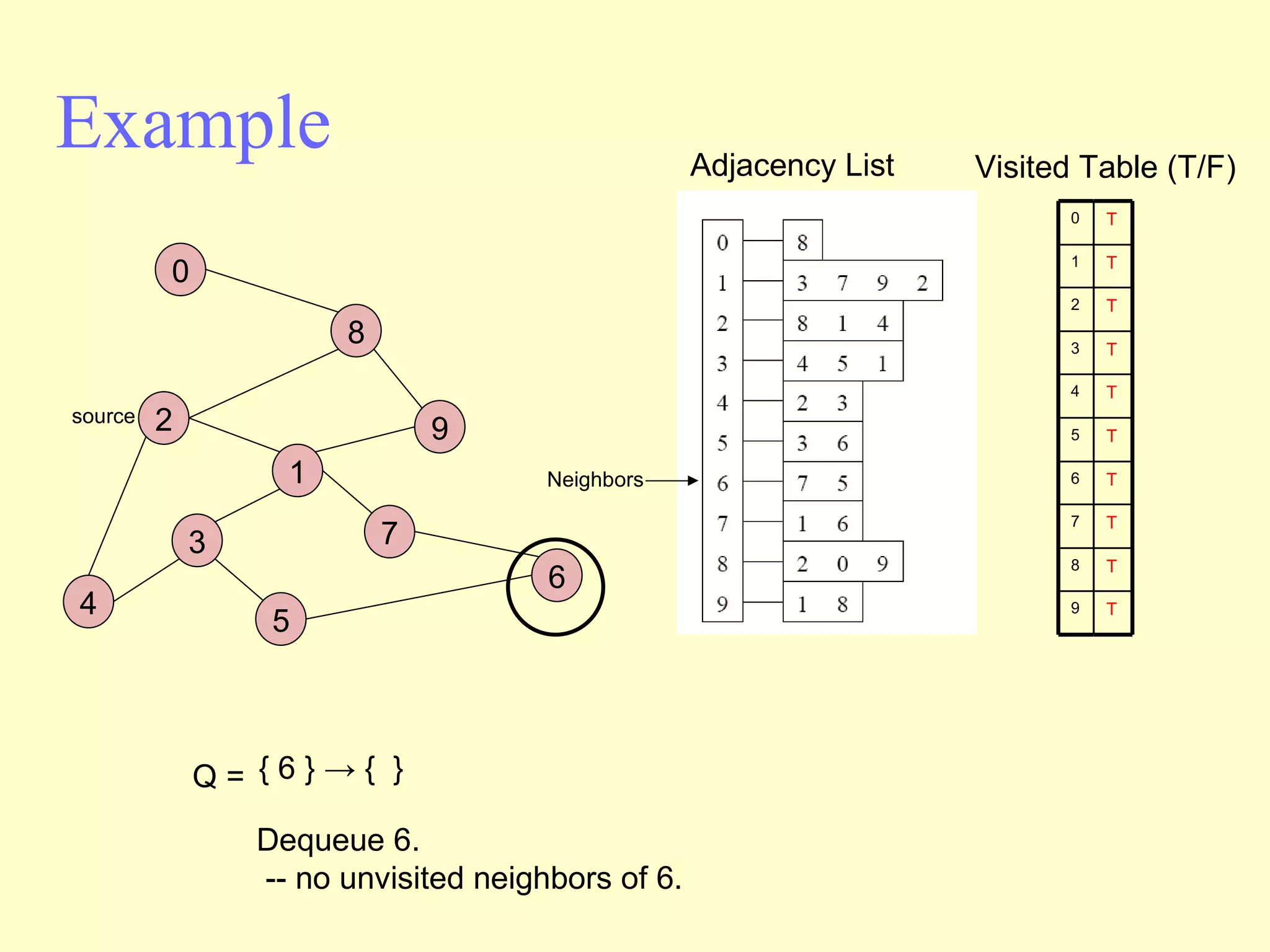
Example Adjacency List source Visited Table (T/F) Q =  { 6 } -> {  }  Dequeue 6.  -- no unvisited neighbors of 6. Neighbors 2 4 3 5 1 7 6 9 8 0 0 1 2 3 4 5 6 7 8 9 T T T T T T T T T T
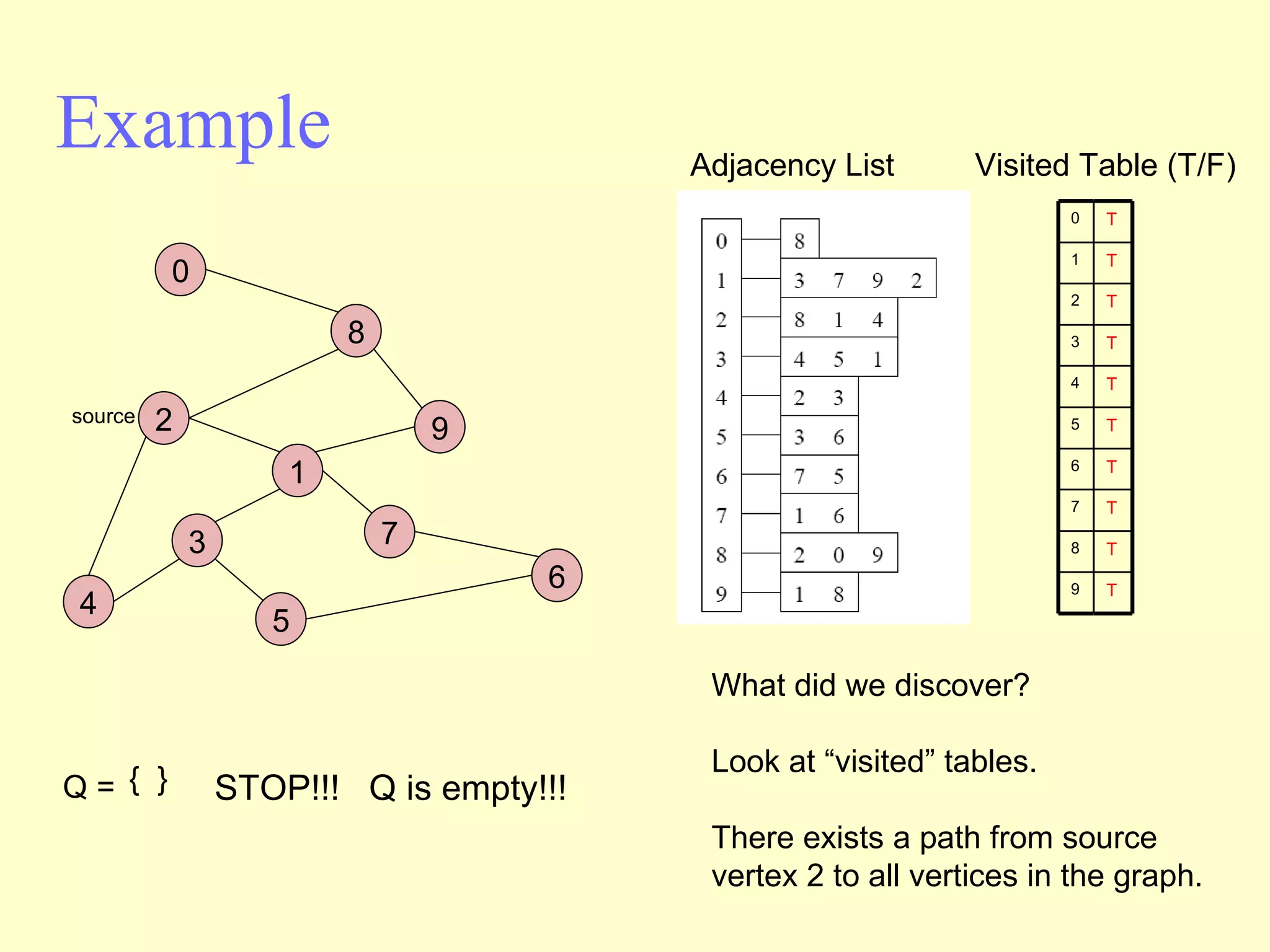
Example Adjacency List source Visited Table (T/F) Q =  {  }  STOP!!!  Q is empty!!! What did we discover? Look at “visited” tables. There exists a path from source vertex 2 to all vertices in the graph. 2 4 3 5 1 7 6 9 8 0 0 1 2 3 4 5 6 7 8 9 T T T T T T T T T T
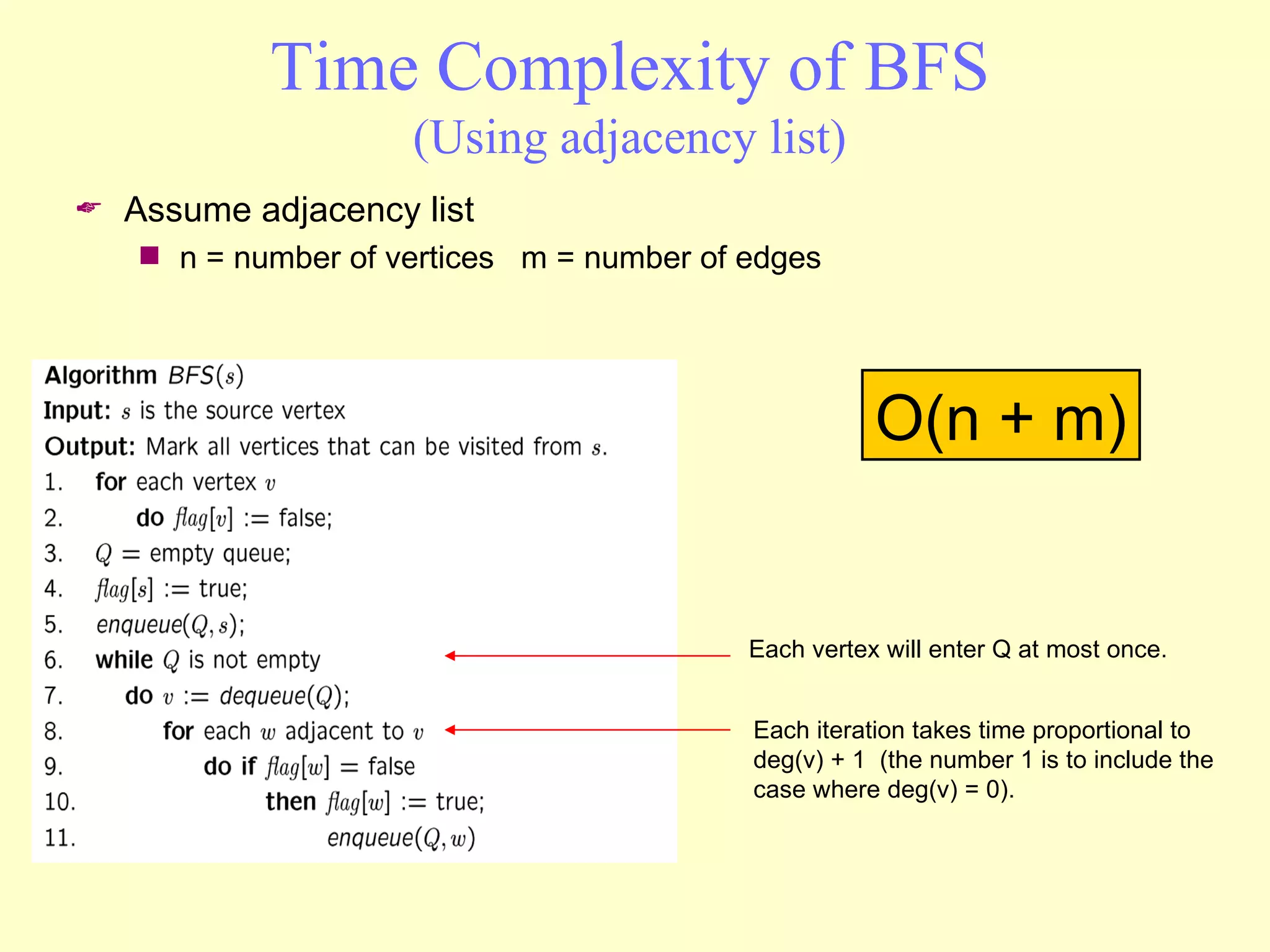
Time Complexity of BFS (Using adjacency list) Assume adjacency list n = number of vertices  m = number of edges Each vertex will enter Q at most once. Each iteration takes time proportional to deg(v) + 1  (the number 1 is to include the case where deg(v) = 0). O(n + m)
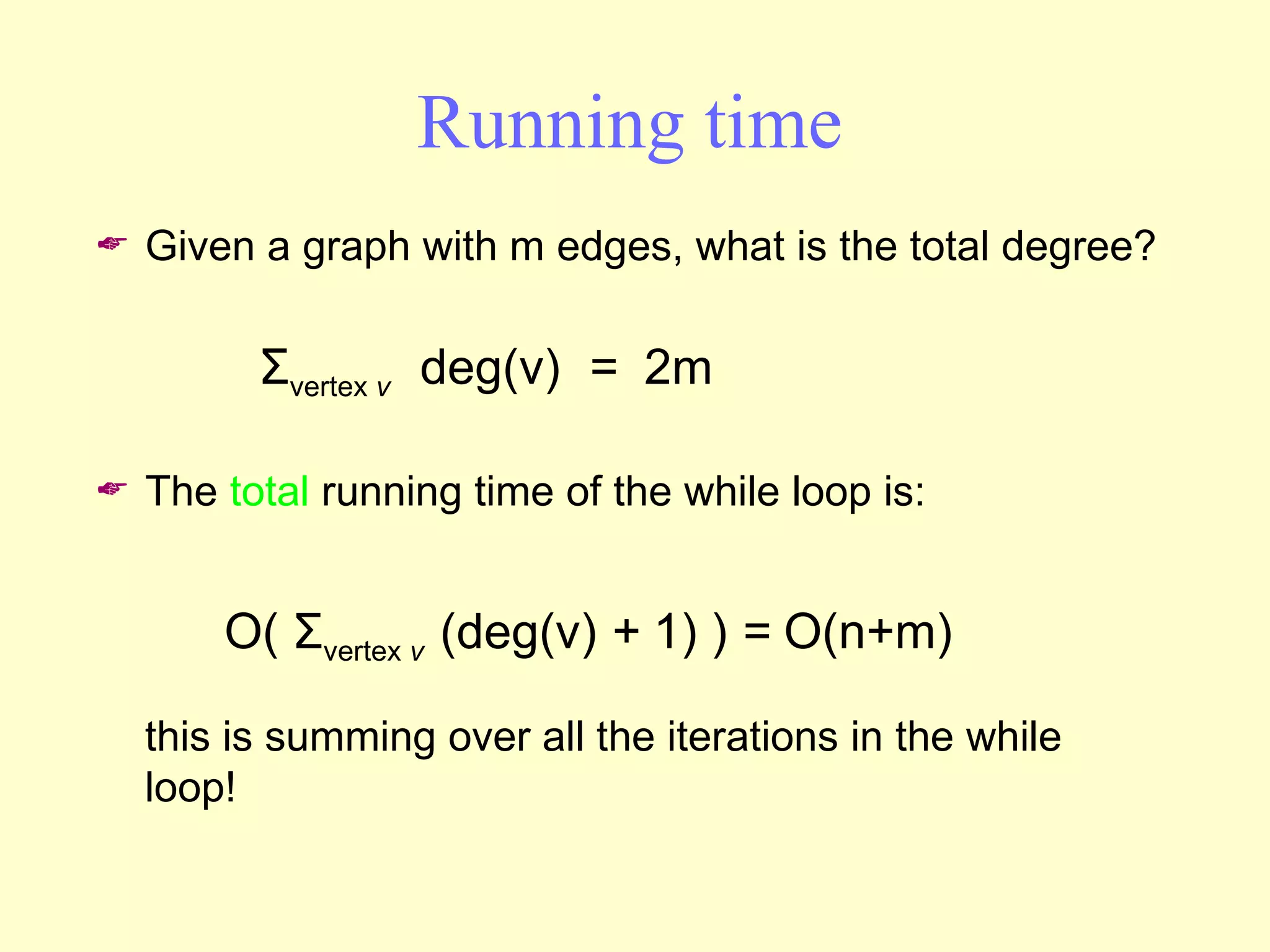
Running time Given a graph with m edges, what is the total degree? The  total  running time of the while loop is: this is summing over all the iterations in the while loop! O(  Σ vertex  v  (deg(v)  +  1) )  =  O(n+m) Σ vertex  v  deg(v)   =   2m

Graphs

  • 1.
    Graphs Extremely usefultool in modeling problems Consist of: Vertices Edges D E A C F B Vertex Edge Vertices can be considered “sites” or locations. Edges represent connections.
  • 2.
    Applications Air flightsystem Each vertex represents a city Each edge represents a direct flight between two cities A query on direct flights becomes a query on whether an edge exists A query on how to get to a location is “does a path exist from A to B” We can even associate costs to edges ( weighted graphs ), then ask “what is the cheapest path from A to B”
  • 3.
    Another application Wirelesscommunication Can be represented by a weighted complete graph (every two vertices are connected by an edge). Each edge represents the Euclidean distance dij between two stations . Each station uses a certain power i to transmit messages. Given this power i, only a few nodes can be reached (bold edges). A station reachable by i then use its own power to relay the message to other stations not reachable by i. A typical wireless communication problem is: how to broadcast between all stations such that they are all connected and the power consumption is minimized.
  • 4.
    Definition Undirected graph An undirected graph is specified by an ordered pair (V,E), where V is the set of vertices and E is the set of edges {c,f} {a,c} {a,b} {b,d} {c,d} {e,f} {b,e}
  • 5.
    Terminology If v 1 and v 2 are connected, they are said to be adjacent vertices v 1 and v 2 are endpoints of the edge { v 1 , v 2 } If an edge e is connected to v , then v is said to be incident on e . Also, the edge e is said to be incident on v . { v 1 , v 2 } = { v 2 , v 1 }* *Later, we will talk about “directed graphs”, where edges have direction. This means that {v 1 ,v 2 } ≠ {v 2 ,v 1 } . Directed graphs are drawn with arrows (called arcs) between edges. A B This means {A,B} only, not {B,A}
  • 6.
    Graph Representation Twopopular computer representations of a graph. Both represent the vertex set and the edge set, but in different ways. Adjacency Matrix Use a 2D matrix to represent the graph Adjacency List Use a 1D array of linked lists
  • 7.
    Adjacency Matrix 2Darray A[0..n-1, 0..n-1], where n is the number of vertices in the graph Each row and column is indexed by the vertex id. - e,g a=0, b=1, c=2, d=3, e=4 An array entry A [i] [j] is equal to 1 if there is an edge connecting vertices i and j. Otherwise, A [i] [j] is 0. The storage requirement is Θ (n 2 ). Not efficient if the graph has few edges. We can detect in O(1) time whether two vertices are connected.
  • 8.
    Adjacency list Theadjacency list is an array A[0..n-1] of lists, where n is the number of vertices in the graph. Each array entry is indexed by the vertex id (as with adjacency matrix) The list A[i] stores the ids of the vertices adjacent to i.
  • 9.
    Examples 2 43 5 1 7 6 9 8 0 0 1 2 3 4 5 6 7 8 9 0 0 0 0 0 0 0 0 0 1 0 1 0 0 1 1 0 0 0 1 0 1 2 0 1 0 0 1 0 0 0 1 0 3 0 1 0 0 1 1 0 0 0 0 4 0 0 1 1 0 0 0 0 0 0 5 0 0 0 1 0 0 1 0 0 0 6 0 0 0 0 0 1 0 1 0 0 7 0 1 0 0 0 0 1 0 0 0 8 1 0 1 0 0 0 0 0 0 1 9 0 1 0 0 0 0 0 0 1 0
  • 10.
    Examples 2 43 5 1 7 6 9 8 0 0 1 2 3 4 5 6 7 8 9 2 3 7 9 8 1 4 8 1 4 5 2 3 3 6 5 7 1 6 0 2 9 1 8
  • 11.
    Storage of adjacencylist The array takes up Θ (n) space Define degree of v , deg( v ), to be the number of edges incident to v . Then, the total space to store the graph is proportional to: An edge e={u,v} of the graph contributes a count of 1 to deg( u ) and contributes a count 1 to deg( v ) Therefore, Σ vertex v deg ( v ) = 2m, where m is the total number of edges In all, the adjacency list takes up Θ ( n+m ) space. If m = O(n 2 ), both adjacent matrix and adjacent lists use Θ (n 2 ) space. If m = O(n), adjacent list outperform adjacent matrix However, one cannot tell in O(1) time whether two vertices are connected.
  • 12.
    Adjacency Lists vs.Matrix Adjacency Lists More compact than adjacency matrices if graph has few edges Requires more time to find if an edge exists Adjacency Matrix Always require n 2 space This can waste a lot of space if the number of edges are sparse Can quickly find if an edge exists
  • 13.
    Path between verticesA path is a sequence of vertices (v 0 , v 1 , v 2 ,… v k ) such that: For 0 ≤ i < k, {v i , v i+1 } is an edge For 0 ≤ i < k-1, v i ≠ v i+2 That is, the edge {v i , v i+1 } ≠ {v i+1 , v i+2 } Note: a path is allowed to go through the same vertex or the same edge any number of times! The length of a path is the number of edges on the path
  • 14.
    Types of pathsA path is simple if and only if it does not contain a vertex more than once. A path is a cycle if and only if v 0 = v k The beginning and end are the same vertex! A path contains a cycle if some vertex appears twice or more
  • 15.
    Examples {a,c,f,e} {a,b,d,c,f,e}{a, c, d, b, d, c, f, e} {a,c,d,b,a} {a,c,f,e,b,d,c,a} Are these paths? Any cycles? What is the path’s length?
  • 16.
    Graph Traversal Applicationexample Given a graph representation and a vertex s in the graph Find all paths from s to other vertices Two common graph traversal algorithms Breadth-First Search (BFS) Find the shortest paths in an unweighted graph Depth-First Search (DFS) Topological sort Find strongly connected components Let’s first look at BFS . . .
  • 17.
    BFS and ShortestPath Problem Given any source vertex s , BFS visits the other vertices at increasing distances away from s. In doing so, BFS discovers paths from s to other vertices What do we mean by “distance”? The number of edges on a path from s. Consider s=vertex 1 Nodes at distance 1? 2, 3, 7, 9 Example Nodes at distance 2? 8, 6, 5, 4 Nodes at distance 3? 0 2 4 3 5 1 7 6 9 8 0 1 1 1 1 2 2 2 2 s
  • 18.
    BSF algorithm Whyuse queue? Need FIFO
  • 19.
    Example Adjacency Listsource Visited Table (T/F) Q = { } Initialize visited table (all False) Initialize Q to be empty 2 4 3 5 1 7 6 9 8 0 0 1 2 3 4 5 6 7 8 9 F F F F F F F F F F
  • 20.
    Example Adjacency Listsource Visited Table (T/F) Q = { 2 } Flag that 2 has been visited. Place source 2 on the queue. 2 4 3 5 1 7 6 9 8 0 0 1 2 3 4 5 6 7 8 9 F F T F F F F F F F
  • 21.
    Example Adjacency Listsource Visited Table (T/F) Q = {2} -> { 8, 1, 4 } Mark neighbors as visited. Dequeue 2. Place all unvisited neighbors of 2 on the queue Neighbors 2 4 3 5 1 7 6 9 8 0 0 1 2 3 4 5 6 7 8 9 F T T F T F F F T F
  • 22.
    Example Adjacency Listsource Visited Table (T/F) Q = { 8, 1, 4 } -> { 1, 4, 0, 9 } Mark new visited Neighbors. Dequeue 8. -- Place all unvisited neighbors of 8 on the queue. -- Notice that 2 is not placed on the queue again, it has been visited! Neighbors 2 4 3 5 1 7 6 9 8 0 0 1 2 3 4 5 6 7 8 9 T T T F T F F F T T
  • 23.
    Example Adjacency Listsource Visited Table (T/F) Q = { 1, 4, 0, 9 } -> { 4, 0, 9, 3, 7 } Mark new visited Neighbors. Dequeue 1. -- Place all unvisited neighbors of 1 on the queue. -- Only nodes 3 and 7 haven’t been visited yet. Neighbors 2 4 3 5 1 7 6 9 8 0 0 1 2 3 4 5 6 7 8 9 T T T T T F F T T T
  • 24.
    Example Adjacency Listsource Visited Table (T/F) Q = { 4, 0, 9, 3, 7 } -> { 0, 9, 3, 7 } Dequeue 4. -- 4 has no unvisited neighbors! Neighbors 2 4 3 5 1 7 6 9 8 0 0 1 2 3 4 5 6 7 8 9 T T T T T F F T T T
  • 25.
    Example Adjacency Listsource Visited Table (T/F) Q = { 0, 9, 3, 7 } -> { 9, 3, 7 } Dequeue 0. -- 0 has no unvisited neighbors! Neighbors 2 4 3 5 1 7 6 9 8 0 0 1 2 3 4 5 6 7 8 9 T T T T T F F T T T
  • 26.
    Example Adjacency Listsource Visited Table (T/F) Q = { 9, 3, 7 } -> { 3, 7 } Dequeue 9. -- 9 has no unvisited neighbors! Neighbors 2 4 3 5 1 7 6 9 8 0 0 1 2 3 4 5 6 7 8 9 T T T T T F F T T T
  • 27.
    Example Adjacency Listsource Visited Table (T/F) Q = { 3, 7 } -> { 7, 5 } Dequeue 3. -- place neighbor 5 on the queue. Neighbors Mark new visited Vertex 5. 2 4 3 5 1 7 6 9 8 0 0 1 2 3 4 5 6 7 8 9 T T T T T T F T T T
  • 28.
    Example Adjacency Listsource Visited Table (T/F) Q = { 7, 5 } -> { 5, 6 } Dequeue 7. -- place neighbor 6 on the queue. Neighbors Mark new visited Vertex 6. 2 4 3 5 1 7 6 9 8 0 0 1 2 3 4 5 6 7 8 9 T T T T T T T T T T
  • 29.
    Example Adjacency Listsource Visited Table (T/F) Q = { 5, 6} -> { 6 } Dequeue 5. -- no unvisited neighbors of 5. Neighbors 2 4 3 5 1 7 6 9 8 0 0 1 2 3 4 5 6 7 8 9 T T T T T T T T T T
  • 30.
    Example Adjacency Listsource Visited Table (T/F) Q = { 6 } -> { } Dequeue 6. -- no unvisited neighbors of 6. Neighbors 2 4 3 5 1 7 6 9 8 0 0 1 2 3 4 5 6 7 8 9 T T T T T T T T T T
  • 31.
    Example Adjacency Listsource Visited Table (T/F) Q = { } STOP!!! Q is empty!!! What did we discover? Look at “visited” tables. There exists a path from source vertex 2 to all vertices in the graph. 2 4 3 5 1 7 6 9 8 0 0 1 2 3 4 5 6 7 8 9 T T T T T T T T T T
  • 32.
    Time Complexity ofBFS (Using adjacency list) Assume adjacency list n = number of vertices m = number of edges Each vertex will enter Q at most once. Each iteration takes time proportional to deg(v) + 1 (the number 1 is to include the case where deg(v) = 0). O(n + m)
  • 33.
    Running time Givena graph with m edges, what is the total degree? The total running time of the while loop is: this is summing over all the iterations in the while loop! O( Σ vertex v (deg(v) + 1) ) = O(n+m) Σ vertex v deg(v) = 2m