MATHS
INFORMATION and
GAMES EVENING
WELCOME!
Wednesday, 20th May 2015
OVERVIEW OF NUMERACY
Mathematics in the NZ Curriculum covers the following strands:
*Number and Algebra
*Geometry and Measurement
*Statistics
- These are interconnected. Some are covered in other subject
areas as well.
-All of these form a teacher’s National Standards OTJ (results
from assessments, teaching etc) to ‘grade’ students as above, at
or below.
- There is a much greater emphasis on NUMBER at all levels,
especially in years 1 to 4.
There are two stages to the
Numeracy Framework:
STRATEGIES and
KNOWLEDGE.
Strategies – the processes
that students use to solve
problems (how they work
them out).
Addition and subtraction
i.e. 29 + 29 = 58
(rounding 30 + 30 = 60 (and then
subtracting off 2 to compensate)
Multiplication and division
i.e. 23 × 3
(20 × 3) + (3 × 3)
60 + 9
= 69
Proportions and ratios
i.e. ¼ of 16
16 ÷ 4 = 4
Knowledge –
Number identification
Number sequence/order/Place Value
Fractions
Basic facts
Students need the supporting number
knowledge to be able to use the
strategies.
A typical Numeracy lesson in the
classroom might look like..
(1) A BASIC FACTS activity
(2) A class HOTSPOT– often a
knowledge concept
(3) Ability based groups rotating
around the following: Learning a
strategy with a teacher,
practising that strategy, playing a
game that involves the strategy.
HOW CAN PARENTS HELP AT
HOME?
- Practise basic facts with your child (at any
level).
- Play Maths games with them.
- Ask your child what they have been doing in
Maths recently – get them to ‘teach’ you the
strategies that they have been learning.
- Check out Maths Websites with your child
(see next slide or class blogs etc).
- Ask your child practical/real life questions –
dividing lollies up or measuring ingredients
in the kitchen.
WEBSITES
www.nzmaths.co.nz/families
www.coolmath-games.com
www.primarygames.com/math/
www.ictgames.com
www.mathszone.co.uk
www.aaamath.com
www.sums.co.uk
http://www.transum.org/Tables/Times_Tables.asp
www.mathsisfun.com
www.coolmath4kids.com
www.tutpup.com
www.bbc.co.uk/bitesize/ks1/maths/
www.oswego.org/ocsd-web/games/mathmagician//cathymath.html
www.mathszone.co.uk/
www.ictgames.com/arrowcards.html
www.ictgames.com/abacusInteger.html
www.bbc.co.uk/schools/ks1bitesize/numeracy/units/fs.shtml
http://www.bbc.co.uk/bitesize/ks1/maths/multiplication/play/popup.shtml
http://www.echalk.co.uk/tasters/taster3/taster.html
http://www.multiplication.com/games/all-games
http://nzmaths.co.nz/student-sites
http://www.homeschoolmath.net/online/math_facts.php
http://www.mathplayground.com/
http://www.multiplication.com/games/play/grand-prix-pro-multiplication
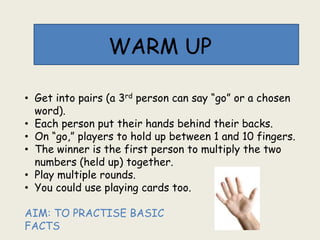
WARM UP
• Get into pairs (a 3rd person can say “go” or a chosen
word).
• Each person put their hands behind their backs.
• On “go,” players to hold up between 1 and 10 fingers.
• The winner is the first person to multiply the two
numbers (held up) together.
• Play multiple rounds.
• You could use playing cards too.
AIM: TO PRACTISE BASIC
FACTS
NUMBER OF THE DAY
Roll a dice to determine three digits
(for example 562:)
* The greatest number you can make by
rearranging them is 652.
* The smallest number you can make is 256.
*Add the digits together.
(5+6+2 = 13).
* Multiply them (5x6x2 = 60).
* Count up in tens
(562, 572, 582, 592, 602..)
• Count down in tens
(562, 552, 542 and so on).
* Count up in hundreds
(562, 662, 762, 862, 962, 1062 etc.).
* Count down in hundreds
(562, 462, 362, 262, 162, 62).
* Subtract the numbers (5-6-2 = -3).
* Multiply by ten
(562, 5,620, 56,200, 562,000 etc).
* Divide by ten
(562, 56.2, 5.62, 0.562, 0.0562).
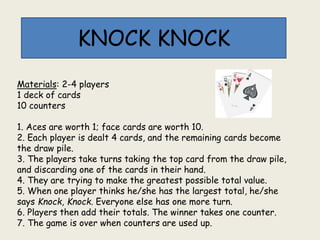
Materials: 2-4 players
1 deck of cards
10 counters
1. Aces are worth 1; face cards are worth 10.
2. Each player is dealt 4 cards, and the remaining cards become
the draw pile.
3. The players take turns taking the top card from the draw pile,
and discarding one of the cards in their hand.
4. They are trying to make the greatest possible total value.
5. When one player thinks he/she has the largest total, he/she
says Knock, Knock. Everyone else has one more turn.
6. Players then add their totals. The winner takes one counter.
7. The game is over when counters are used up.
KNOCK KNOCK
WHAT’S YOUR NUMBER?
Materials: 3 dice
Recording sheet
1. Roll the 3 dice.
2. Arrange all three in order to make 6 different
numbers.
e.g. 3 2 6 326, 263, 632,
362, 236, 623.
3. Record your numbers as in the example above.
4. Order your numbers from least to greatest.
5. Show your numbers using
· pictures
· standard notation
· expanded form
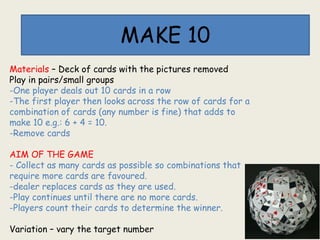
MAKE 10
Materials – Deck of cards with the pictures removed
Play in pairs/small groups
-One player deals out 10 cards in a row
-The first player then looks across the row of cards for a
combination of cards (any number is fine) that adds to
make 10 e.g.: 6 + 4 = 10.
-Remove cards
AIM OF THE GAME
- Collect as many cards as possible so combinations that
require more cards are favoured.
-dealer replaces cards as they are used.
-Play continues until there are no more cards.
-Players count their cards to determine the winner.
Variation – vary the target number
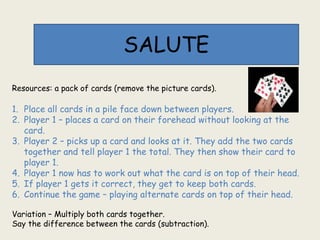
SALUTE
Resources: a pack of cards (remove the picture cards).
1. Place all cards in a pile face down between players.
2. Player 1 – places a card on their forehead without looking at the
card.
3. Player 2 – picks up a card and looks at it. They add the two cards
together and tell player 1 the total. They then show their card to
player 1.
4. Player 1 now has to work out what the card is on top of their head.
5. If player 1 gets it correct, they get to keep both cards.
6. Continue the game – playing alternate cards on top of their head.
Variation – Multiply both cards together.
Say the difference between the cards (subtraction).
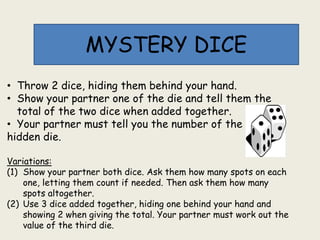
MYSTERY DICE
• Throw 2 dice, hiding them behind your hand.
• Show your partner one of the die and tell them the
total of the two dice when added together.
• Your partner must tell you the number of the
hidden die.
Variations:
(1) Show your partner both dice. Ask them how many spots on each
one, letting them count if needed. Then ask them how many
spots altogether.
(2) Use 3 dice added together, hiding one behind your hand and
showing 2 when giving the total. Your partner must work out the
value of the third die.
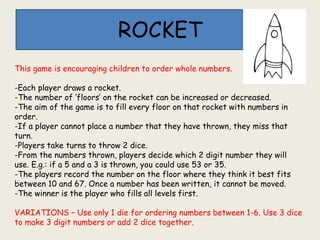
ROCKET
This game is encouraging children to order whole numbers.
-Each player draws a rocket.
-The number of ‘floors’ on the rocket can be increased or decreased.
-The aim of the game is to fill every floor on that rocket with numbers in
order.
-If a player cannot place a number that they have thrown, they miss that
turn.
-Players take turns to throw 2 dice.
-From the numbers thrown, players decide which 2 digit number they will
use. E.g.: if a 5 and a 3 is thrown, you could use 53 or 35.
-The players record the number on the floor where they think it best fits
between 10 and 67. Once a number has been written, it cannot be moved.
-The winner is the player who fills all levels first.
VARIATIONS – Use only 1 die for ordering numbers between 1-6. Use 3 dice
to make 3 digit numbers or add 2 dice together.
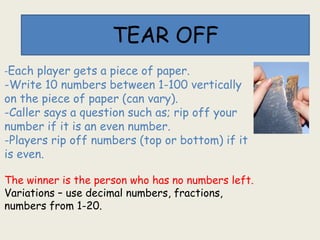
TEAR OFF
-Each player gets a piece of paper.
-Write 10 numbers between 1-100 vertically
on the piece of paper (can vary).
-Caller says a question such as; rip off your
number if it is an even number.
-Players rip off numbers (top or bottom) if it
is even.
The winner is the person who has no numbers left.
Variations – use decimal numbers, fractions,
numbers from 1-20.
FINALLY - HANDOUTS
(1) PowerPoint slides of games
(2) Summary of Strategies
(Addition and Subtraction)
(3) Summary of Strategies (Multiplication
and Division)
Check out class blogs (via school website
www.discovery.school.nz) for more Maths websites.
2015 Maths Information Evening

2015 Maths Information Evening

  • 1.
  • 2.
    OVERVIEW OF NUMERACY Mathematicsin the NZ Curriculum covers the following strands: *Number and Algebra *Geometry and Measurement *Statistics - These are interconnected. Some are covered in other subject areas as well. -All of these form a teacher’s National Standards OTJ (results from assessments, teaching etc) to ‘grade’ students as above, at or below. - There is a much greater emphasis on NUMBER at all levels, especially in years 1 to 4.
  • 3.
    There are twostages to the Numeracy Framework: STRATEGIES and KNOWLEDGE. Strategies – the processes that students use to solve problems (how they work them out).
  • 4.
    Addition and subtraction i.e.29 + 29 = 58 (rounding 30 + 30 = 60 (and then subtracting off 2 to compensate) Multiplication and division i.e. 23 × 3 (20 × 3) + (3 × 3) 60 + 9 = 69 Proportions and ratios i.e. ¼ of 16 16 ÷ 4 = 4
  • 5.
    Knowledge – Number identification Numbersequence/order/Place Value Fractions Basic facts Students need the supporting number knowledge to be able to use the strategies.
  • 6.
    A typical Numeracylesson in the classroom might look like.. (1) A BASIC FACTS activity (2) A class HOTSPOT– often a knowledge concept (3) Ability based groups rotating around the following: Learning a strategy with a teacher, practising that strategy, playing a game that involves the strategy.
  • 7.
    HOW CAN PARENTSHELP AT HOME? - Practise basic facts with your child (at any level). - Play Maths games with them. - Ask your child what they have been doing in Maths recently – get them to ‘teach’ you the strategies that they have been learning. - Check out Maths Websites with your child (see next slide or class blogs etc). - Ask your child practical/real life questions – dividing lollies up or measuring ingredients in the kitchen.
  • 8.
  • 9.
  • 10.
    WARM UP • Getinto pairs (a 3rd person can say “go” or a chosen word). • Each person put their hands behind their backs. • On “go,” players to hold up between 1 and 10 fingers. • The winner is the first person to multiply the two numbers (held up) together. • Play multiple rounds. • You could use playing cards too. AIM: TO PRACTISE BASIC FACTS
  • 11.
    NUMBER OF THEDAY Roll a dice to determine three digits (for example 562:) * The greatest number you can make by rearranging them is 652. * The smallest number you can make is 256. *Add the digits together. (5+6+2 = 13). * Multiply them (5x6x2 = 60). * Count up in tens (562, 572, 582, 592, 602..)
  • 12.
    • Count downin tens (562, 552, 542 and so on). * Count up in hundreds (562, 662, 762, 862, 962, 1062 etc.). * Count down in hundreds (562, 462, 362, 262, 162, 62). * Subtract the numbers (5-6-2 = -3). * Multiply by ten (562, 5,620, 56,200, 562,000 etc). * Divide by ten (562, 56.2, 5.62, 0.562, 0.0562).
  • 13.
    Materials: 2-4 players 1deck of cards 10 counters 1. Aces are worth 1; face cards are worth 10. 2. Each player is dealt 4 cards, and the remaining cards become the draw pile. 3. The players take turns taking the top card from the draw pile, and discarding one of the cards in their hand. 4. They are trying to make the greatest possible total value. 5. When one player thinks he/she has the largest total, he/she says Knock, Knock. Everyone else has one more turn. 6. Players then add their totals. The winner takes one counter. 7. The game is over when counters are used up. KNOCK KNOCK
  • 14.
    WHAT’S YOUR NUMBER? Materials:3 dice Recording sheet 1. Roll the 3 dice. 2. Arrange all three in order to make 6 different numbers. e.g. 3 2 6 326, 263, 632, 362, 236, 623. 3. Record your numbers as in the example above. 4. Order your numbers from least to greatest. 5. Show your numbers using · pictures · standard notation · expanded form
  • 15.
    MAKE 10 Materials –Deck of cards with the pictures removed Play in pairs/small groups -One player deals out 10 cards in a row -The first player then looks across the row of cards for a combination of cards (any number is fine) that adds to make 10 e.g.: 6 + 4 = 10. -Remove cards AIM OF THE GAME - Collect as many cards as possible so combinations that require more cards are favoured. -dealer replaces cards as they are used. -Play continues until there are no more cards. -Players count their cards to determine the winner. Variation – vary the target number
  • 16.
    SALUTE Resources: a packof cards (remove the picture cards). 1. Place all cards in a pile face down between players. 2. Player 1 – places a card on their forehead without looking at the card. 3. Player 2 – picks up a card and looks at it. They add the two cards together and tell player 1 the total. They then show their card to player 1. 4. Player 1 now has to work out what the card is on top of their head. 5. If player 1 gets it correct, they get to keep both cards. 6. Continue the game – playing alternate cards on top of their head. Variation – Multiply both cards together. Say the difference between the cards (subtraction).
  • 17.
    MYSTERY DICE • Throw2 dice, hiding them behind your hand. • Show your partner one of the die and tell them the total of the two dice when added together. • Your partner must tell you the number of the hidden die. Variations: (1) Show your partner both dice. Ask them how many spots on each one, letting them count if needed. Then ask them how many spots altogether. (2) Use 3 dice added together, hiding one behind your hand and showing 2 when giving the total. Your partner must work out the value of the third die.
  • 18.
    ROCKET This game isencouraging children to order whole numbers. -Each player draws a rocket. -The number of ‘floors’ on the rocket can be increased or decreased. -The aim of the game is to fill every floor on that rocket with numbers in order. -If a player cannot place a number that they have thrown, they miss that turn. -Players take turns to throw 2 dice. -From the numbers thrown, players decide which 2 digit number they will use. E.g.: if a 5 and a 3 is thrown, you could use 53 or 35. -The players record the number on the floor where they think it best fits between 10 and 67. Once a number has been written, it cannot be moved. -The winner is the player who fills all levels first. VARIATIONS – Use only 1 die for ordering numbers between 1-6. Use 3 dice to make 3 digit numbers or add 2 dice together.
  • 19.
    TEAR OFF -Each playergets a piece of paper. -Write 10 numbers between 1-100 vertically on the piece of paper (can vary). -Caller says a question such as; rip off your number if it is an even number. -Players rip off numbers (top or bottom) if it is even. The winner is the person who has no numbers left. Variations – use decimal numbers, fractions, numbers from 1-20.
  • 20.
    FINALLY - HANDOUTS (1)PowerPoint slides of games (2) Summary of Strategies (Addition and Subtraction) (3) Summary of Strategies (Multiplication and Division) Check out class blogs (via school website www.discovery.school.nz) for more Maths websites.