Parallel Implementation of Dijkstra’s
and Bellman Ford Algorithm
Team 26 B
● Priyanka Ramanuja Kulkarni
● Meenakshi Muthuraman
● Aslesha Pansare
● Nikhil Kataria
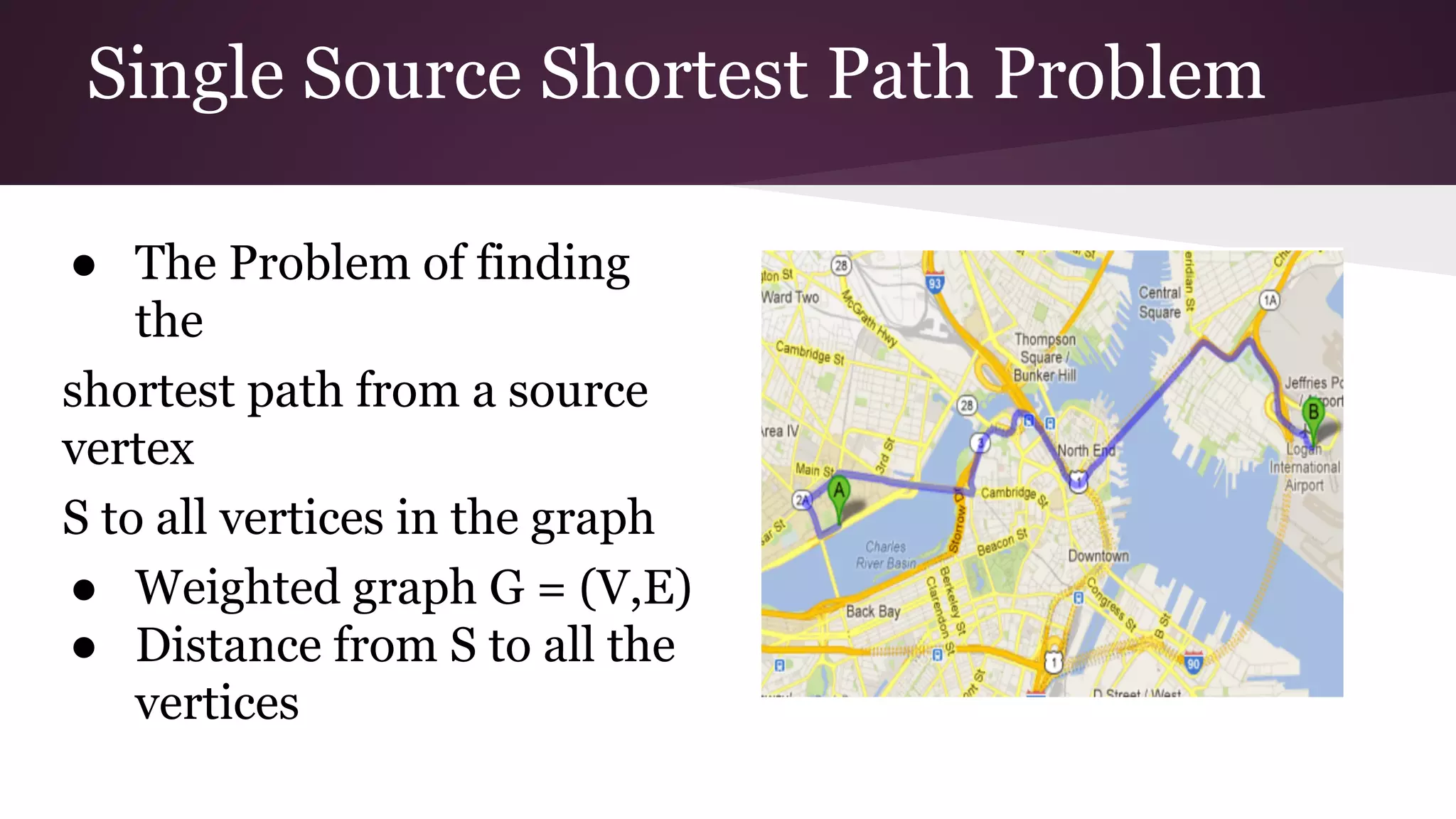
Single Source Shortest Path Problem
● The Problem of finding
the
shortest path from a source
vertex
S to all vertices in the graph
● Weighted graph G = (V,E)
● Distance from S to all the
vertices
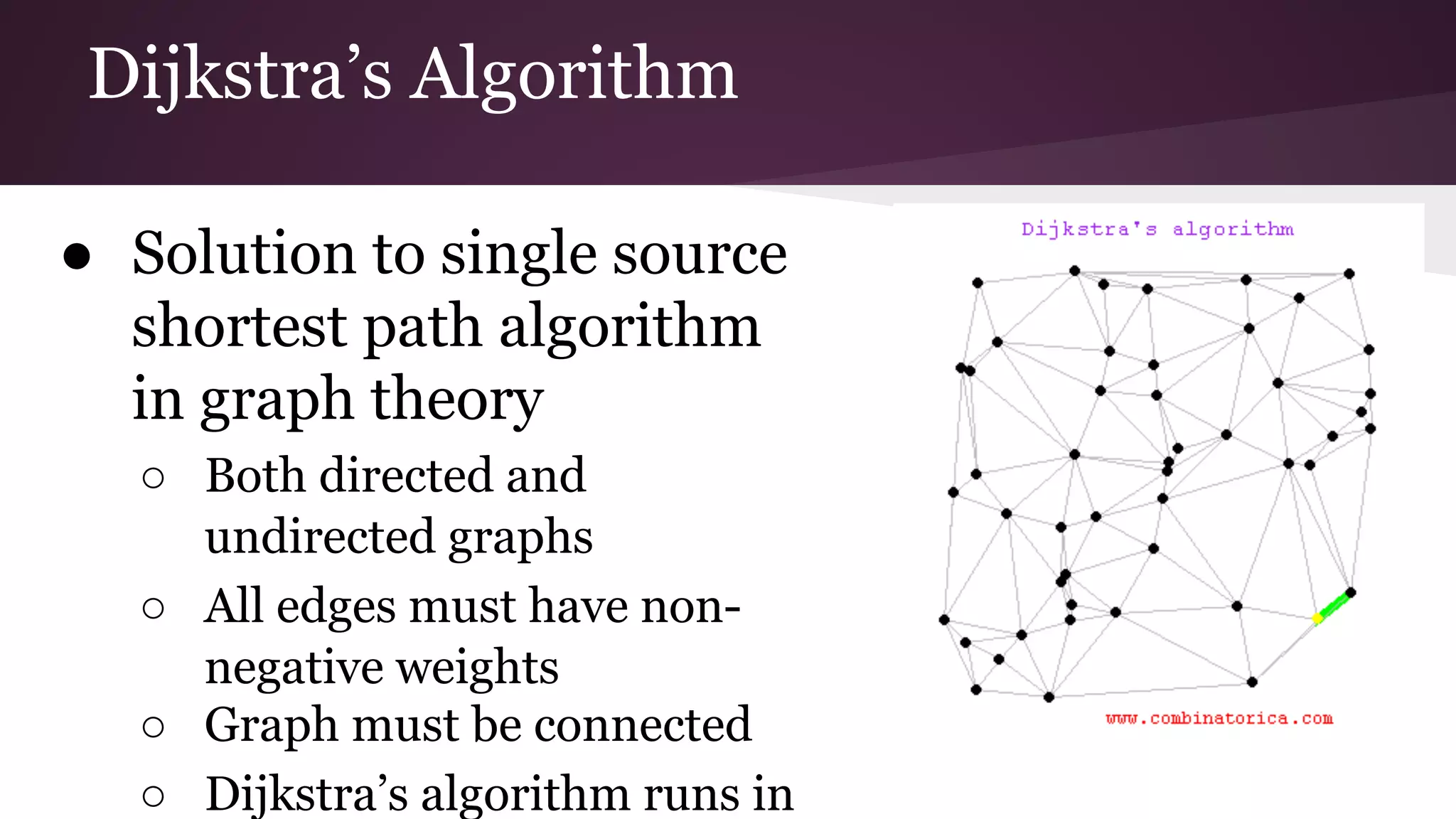
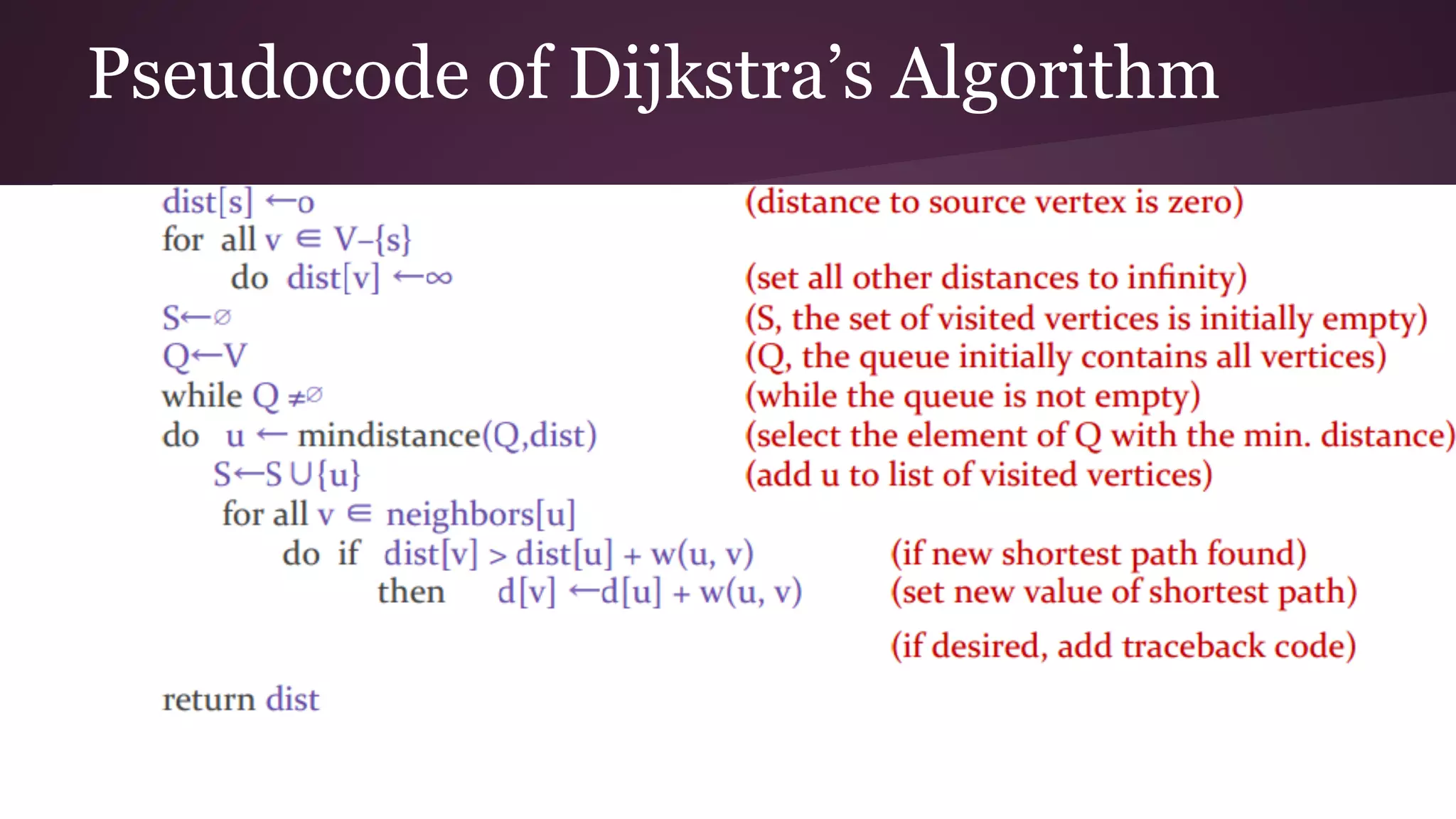
Dijkstra’s Algorithm
● Solution to single source
shortest path algorithm in
graph theory
○ Both directed and
undirected graphs
○ All edges must have non-
negative weights
○ Graph must be connected
○ Dijkstra’s algorithm runs in
Pseudocode of Dijkstra’s Algorithm
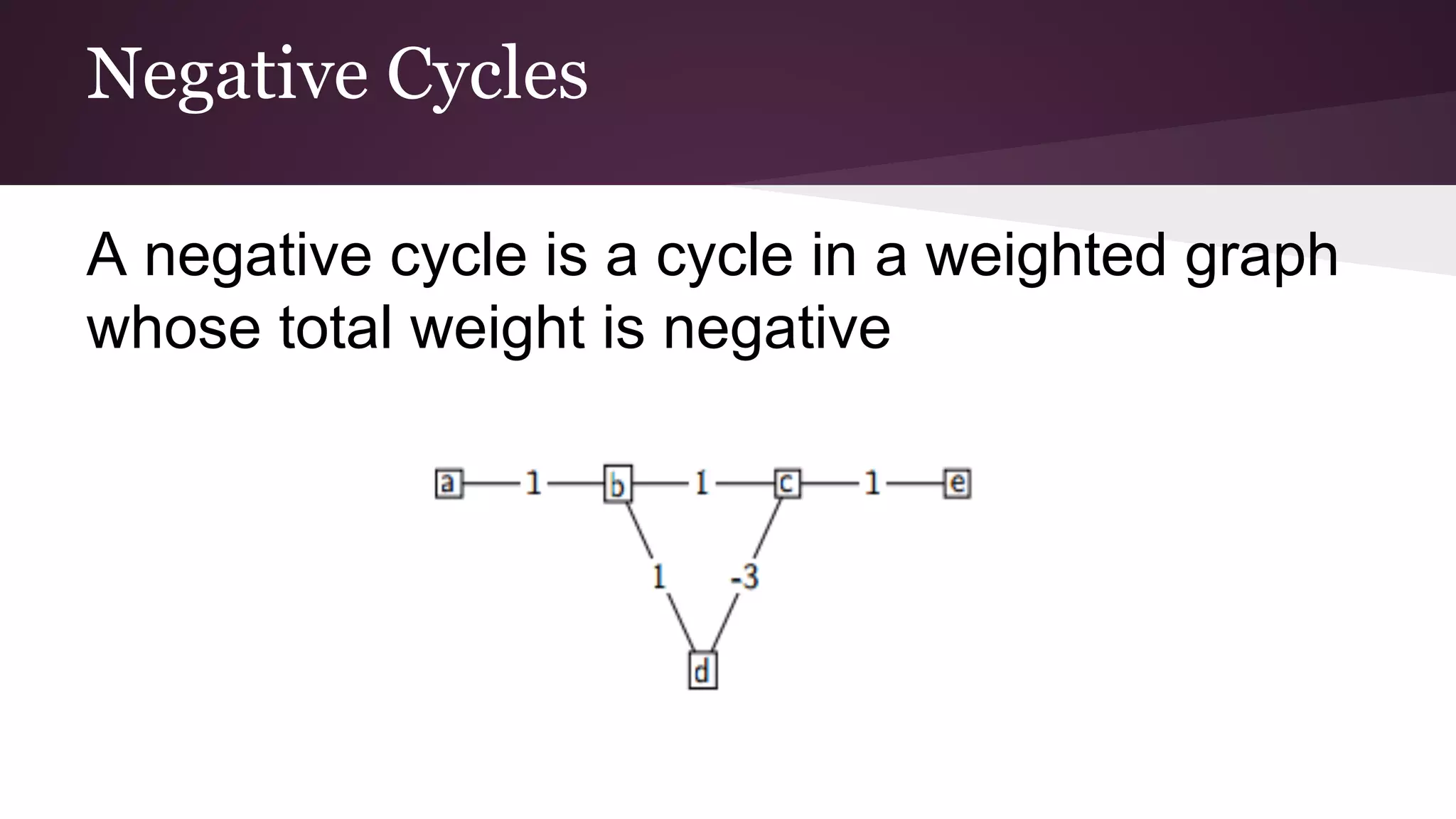
Negative Cycles
A negative cycle is a cycle in a weighted graph
whose total weight is negative
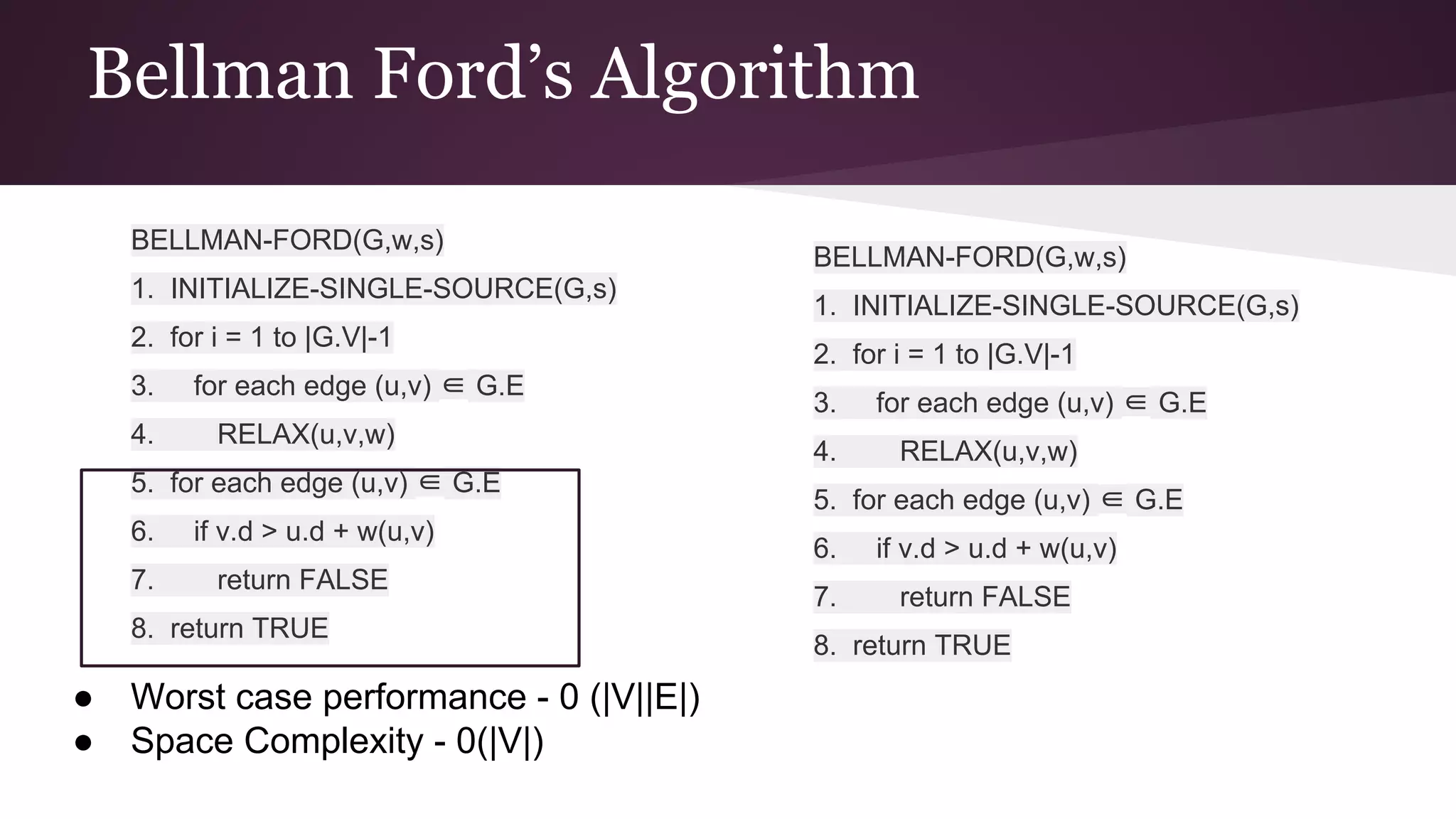
Bellman Ford’s Algorithm
BELLMAN-FORD(G,w,s)
1. INITIALIZE-SINGLE-SOURCE(G,s)
2. for i = 1 to |G.V|-1
3. for each edge (u,v) ∈ G.E
4. RELAX(u,v,w)
5. for each edge (u,v) ∈ G.E
6. if v.d > u.d + w(u,v)
7. return FALSE
8. return TRUE
BELLMAN-FORD(G,w,s)
1. INITIALIZE-SINGLE-SOURCE(G,s)
2. for i = 1 to |G.V|-1
3. for each edge (u,v) ∈ G.E
4. RELAX(u,v,w)
5. for each edge (u,v) ∈ G.E
6. if v.d > u.d + w(u,v)
7. return FALSE
8. return TRUE
● Worst case performance - 0 (|V||E|)
● Space Complexity - 0(|V|)
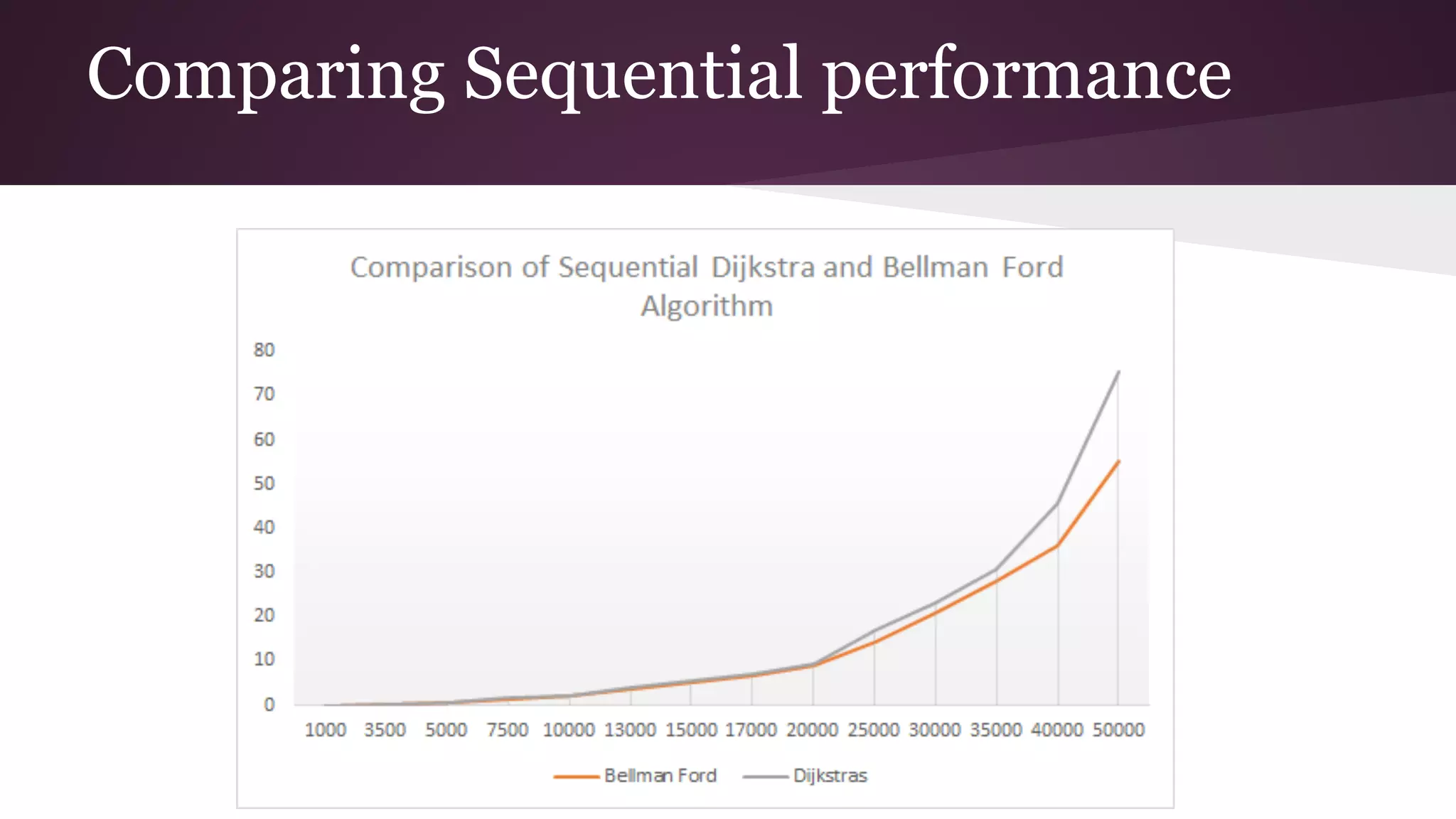
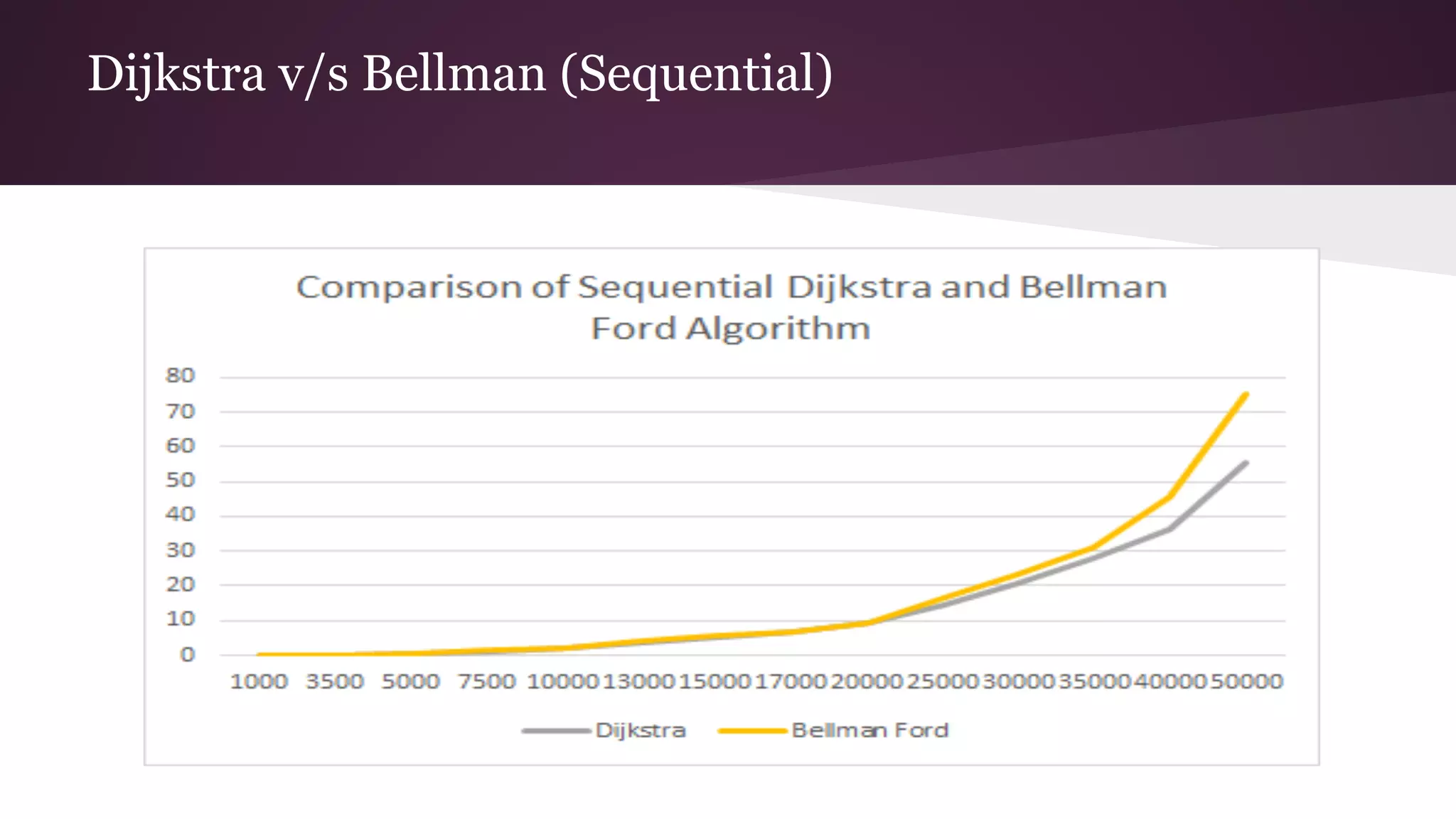
Comparing Sequential performance
Assumptions
● All the edges are undirected
● We consider a sparse matrix for the initial distance
vector
● Each vertex is connected to at least 1 other vertex
● The weights of the edges are assigned randomly with a
restriction on the x-axis
rand()
Parallel Dijkstra’s Algorithm
● On each cluster identify vertices closest to the source
vertex
● Use parallel prefix to select the globally closest vertex
● Broadcast the results to all cores
● On each cluster update the distance vectors
● Running time = 0(V2
/P + V*log(P))
Parallel Approach
1.Allocate
graph nodes to
different processors.
2.Shortest distance is
computed using
parallel prefix.
3. Broadcast the
Result to all nodes after finding
closest path.
❏ MPI_Reduce(MPI_IN_PLACE,nextAN,1,MPI_INT,MPI_SUM,0,MPI_COMM_WORLD);
❏ MPI_Bcast( G->node[0], G->N*G->N, MPI_CHAR, 0, MPI_COMM_WORLD);
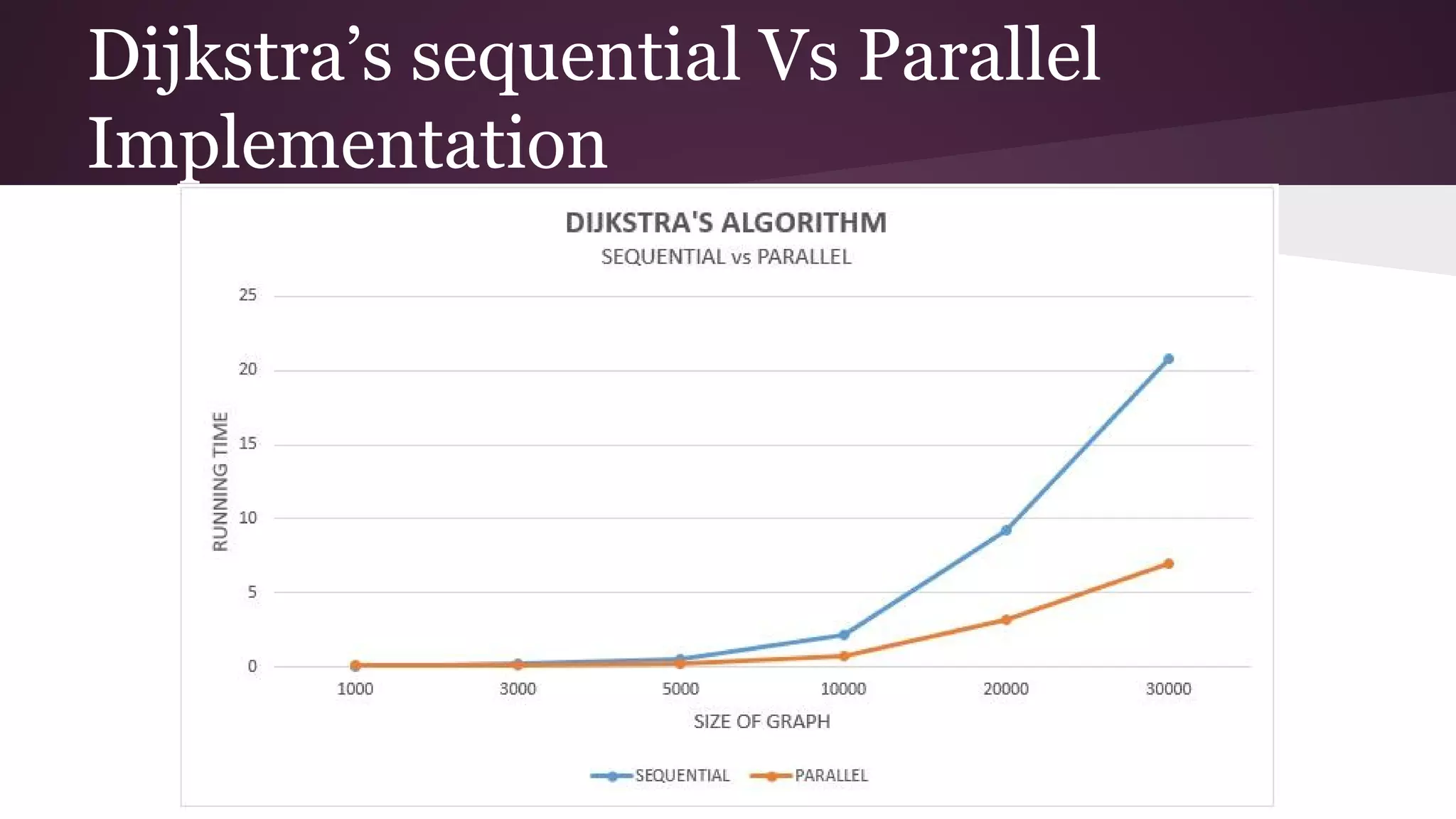
Dijkstra’s sequential Vs Parallel
Implementation
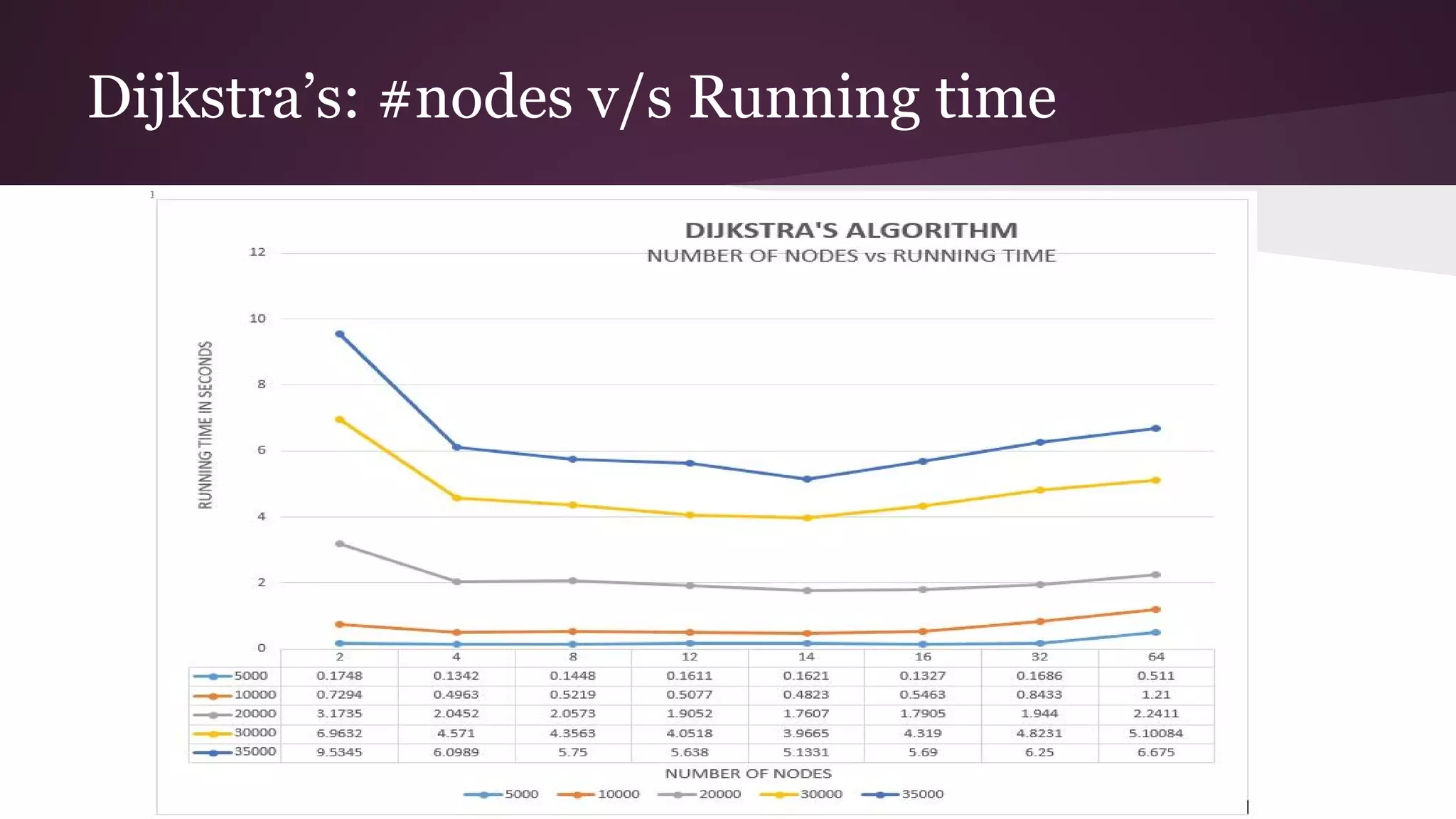
Dijkstra’s: #nodes v/s Running time
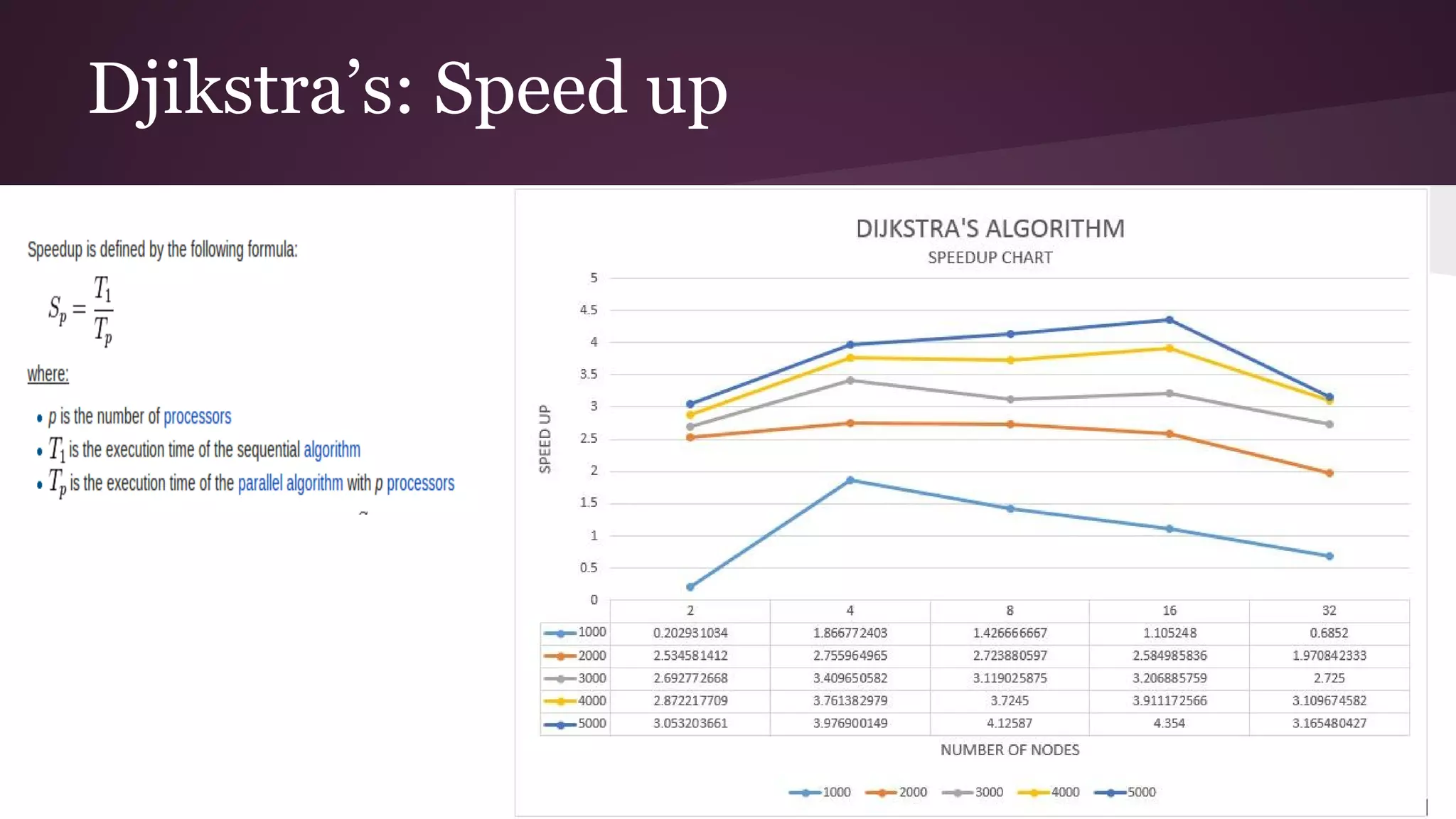
Djikstra’s: Speed up
Dijkstra’s: Cost Analysis
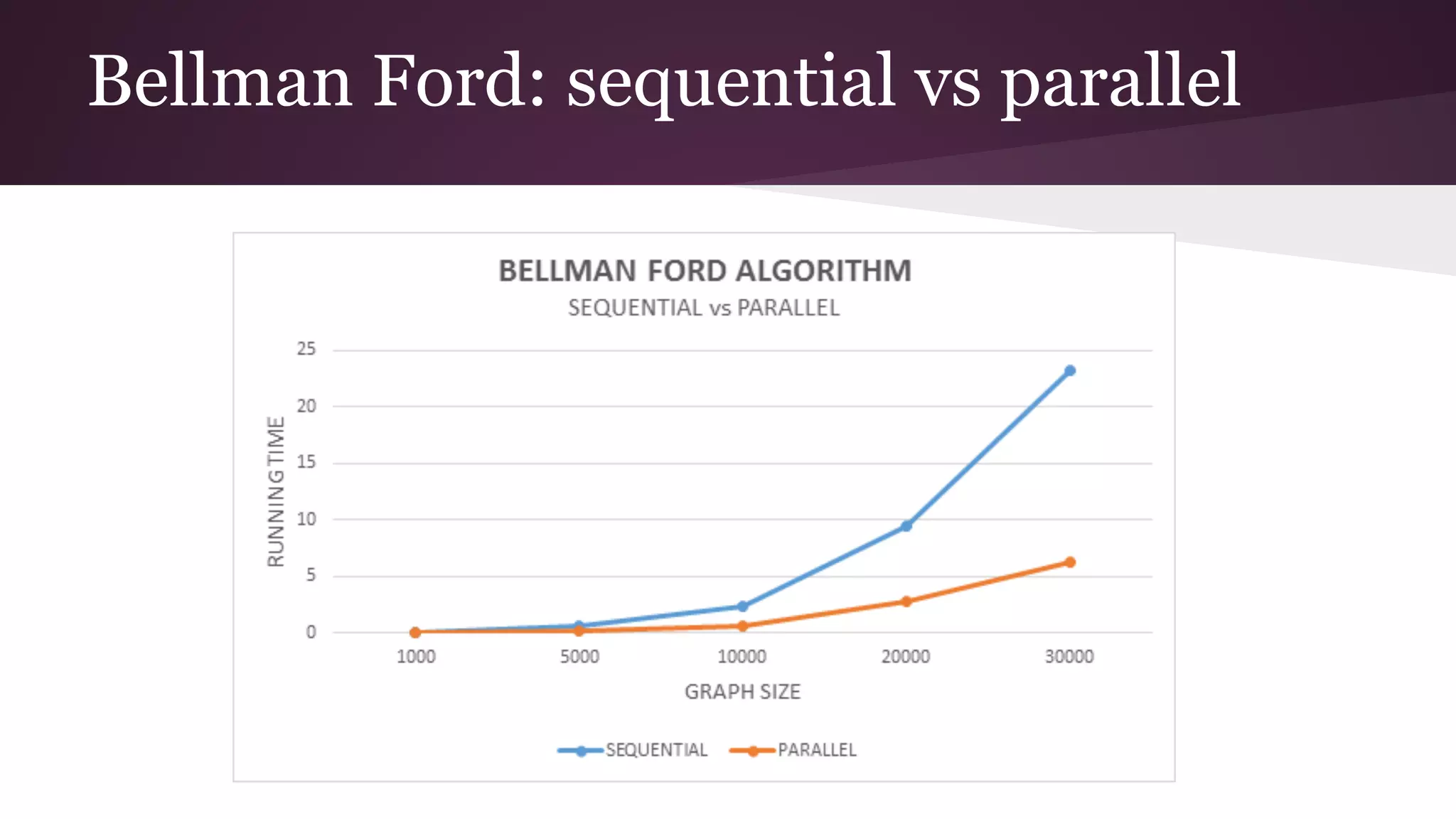
Bellman Ford: sequential vs parallel
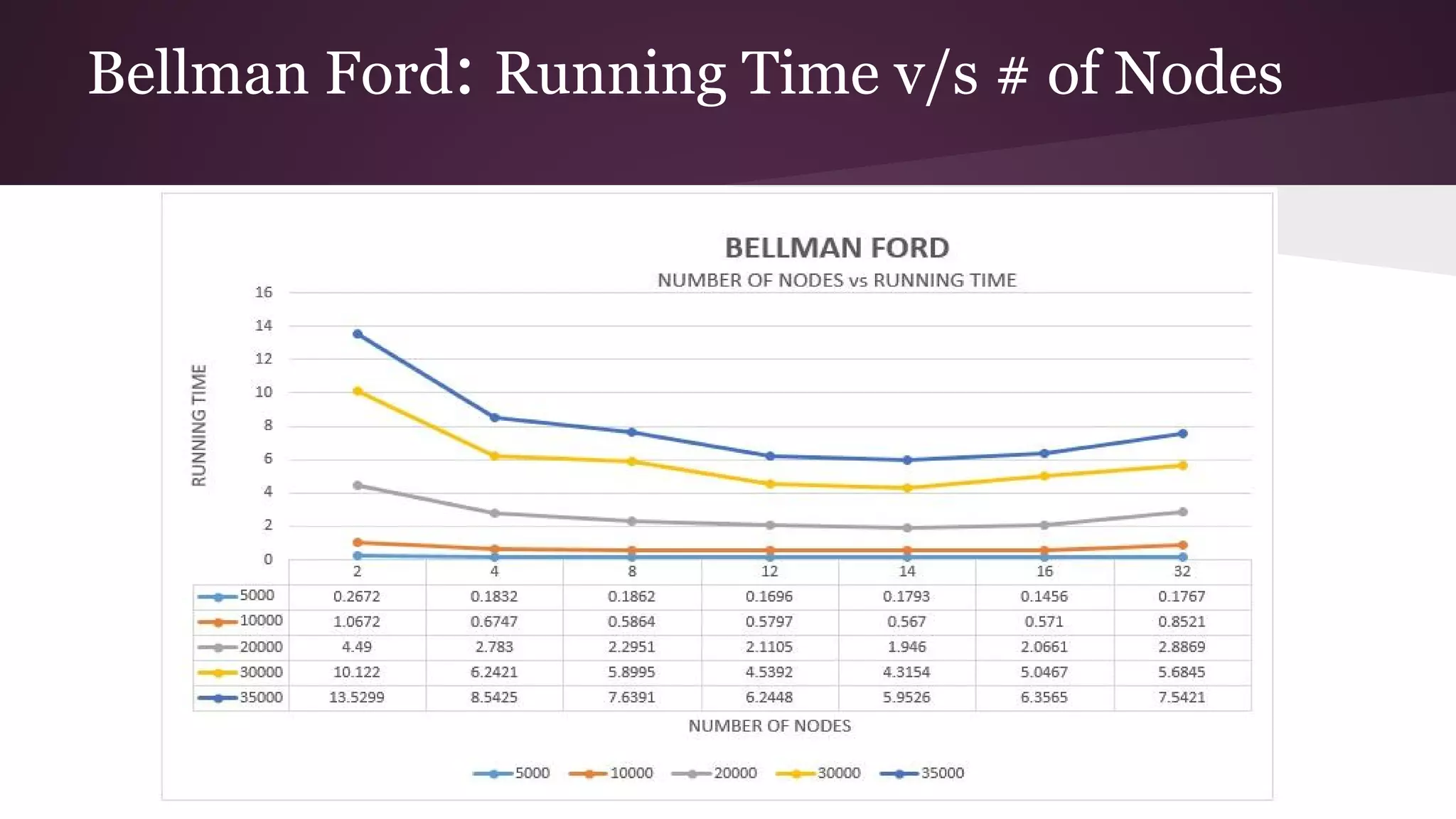
Bellman Ford: Running Time v/s # of Nodes
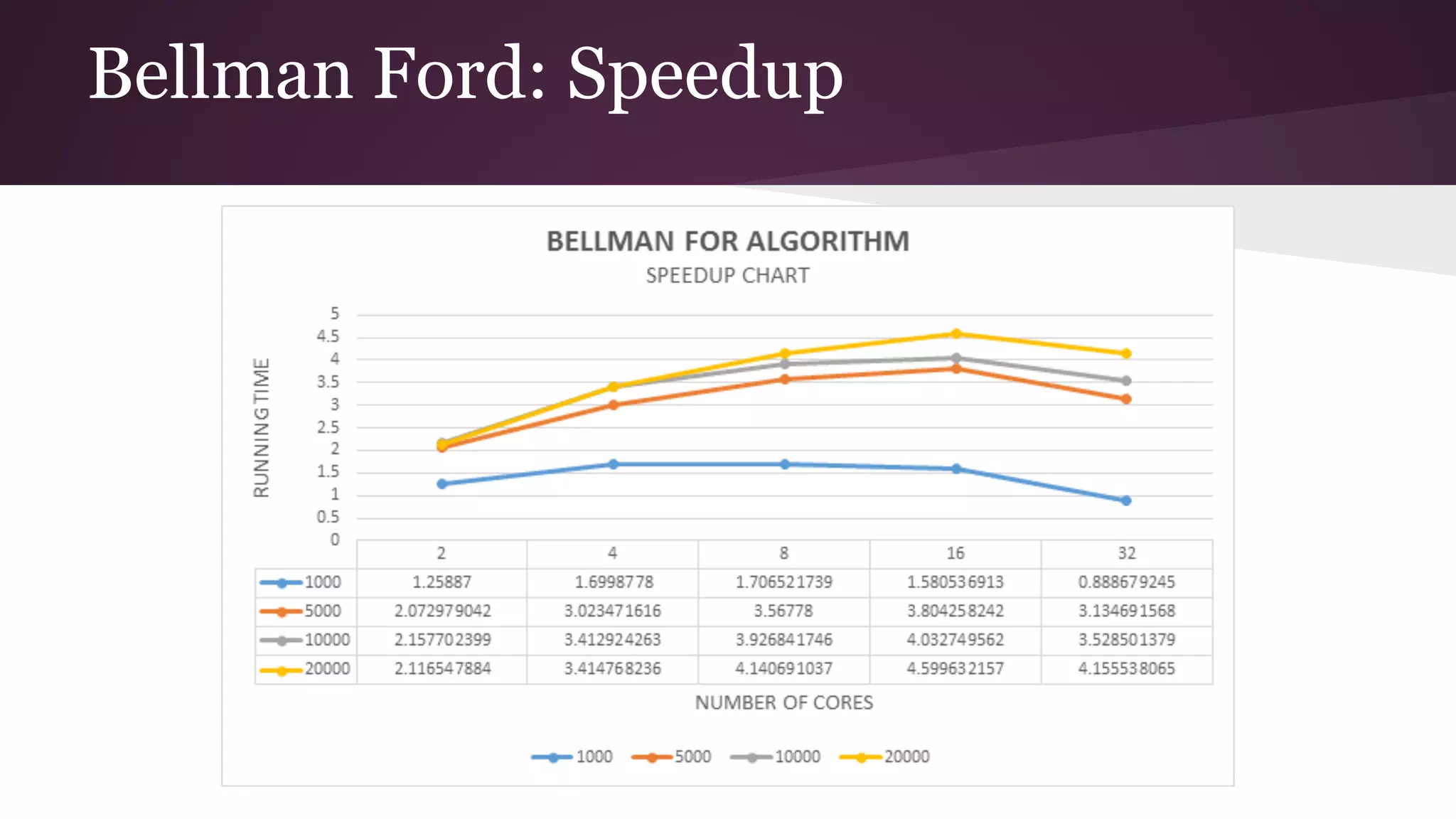
Bellman Ford: Speedup
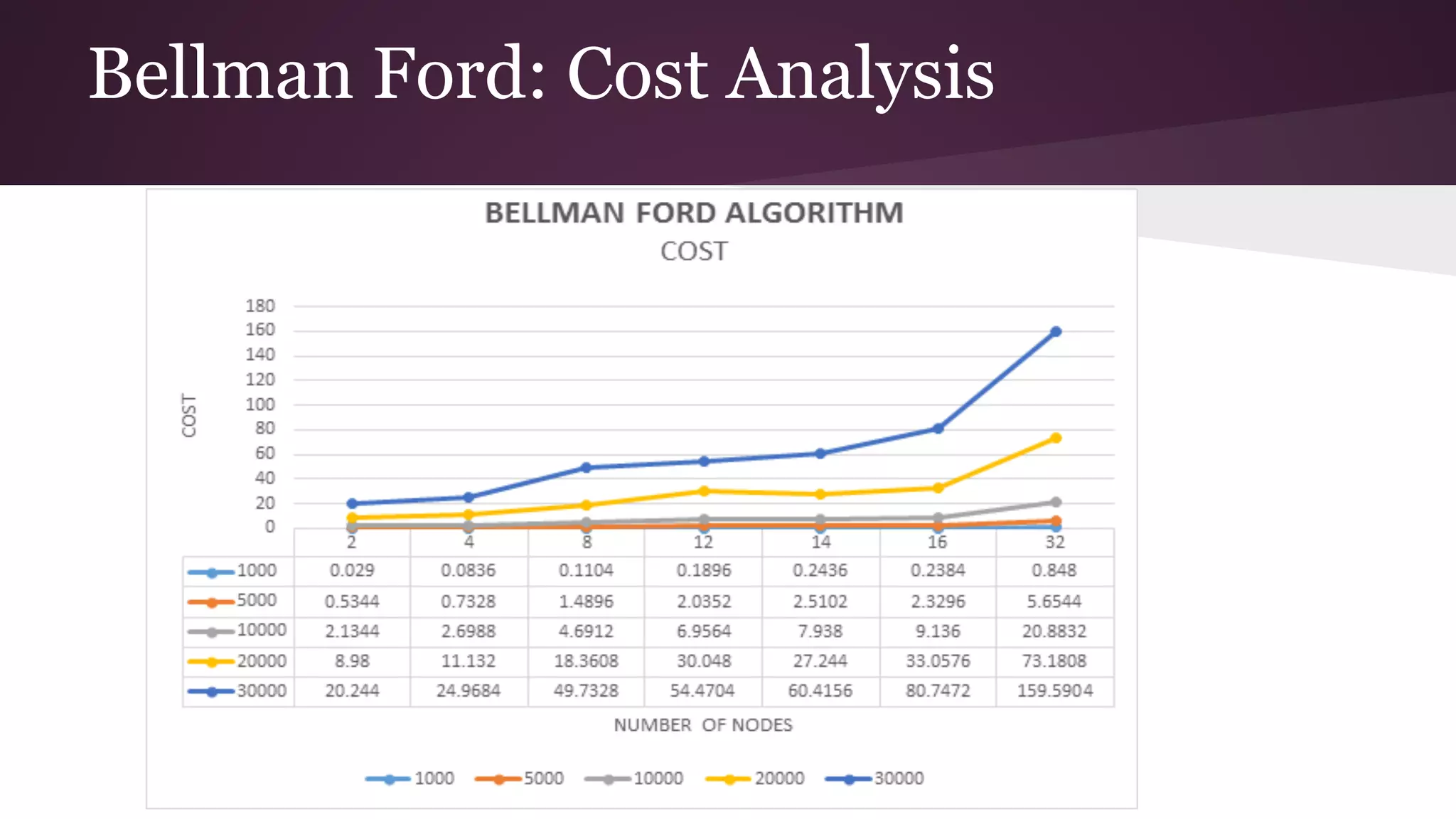
Bellman Ford: Cost Analysis
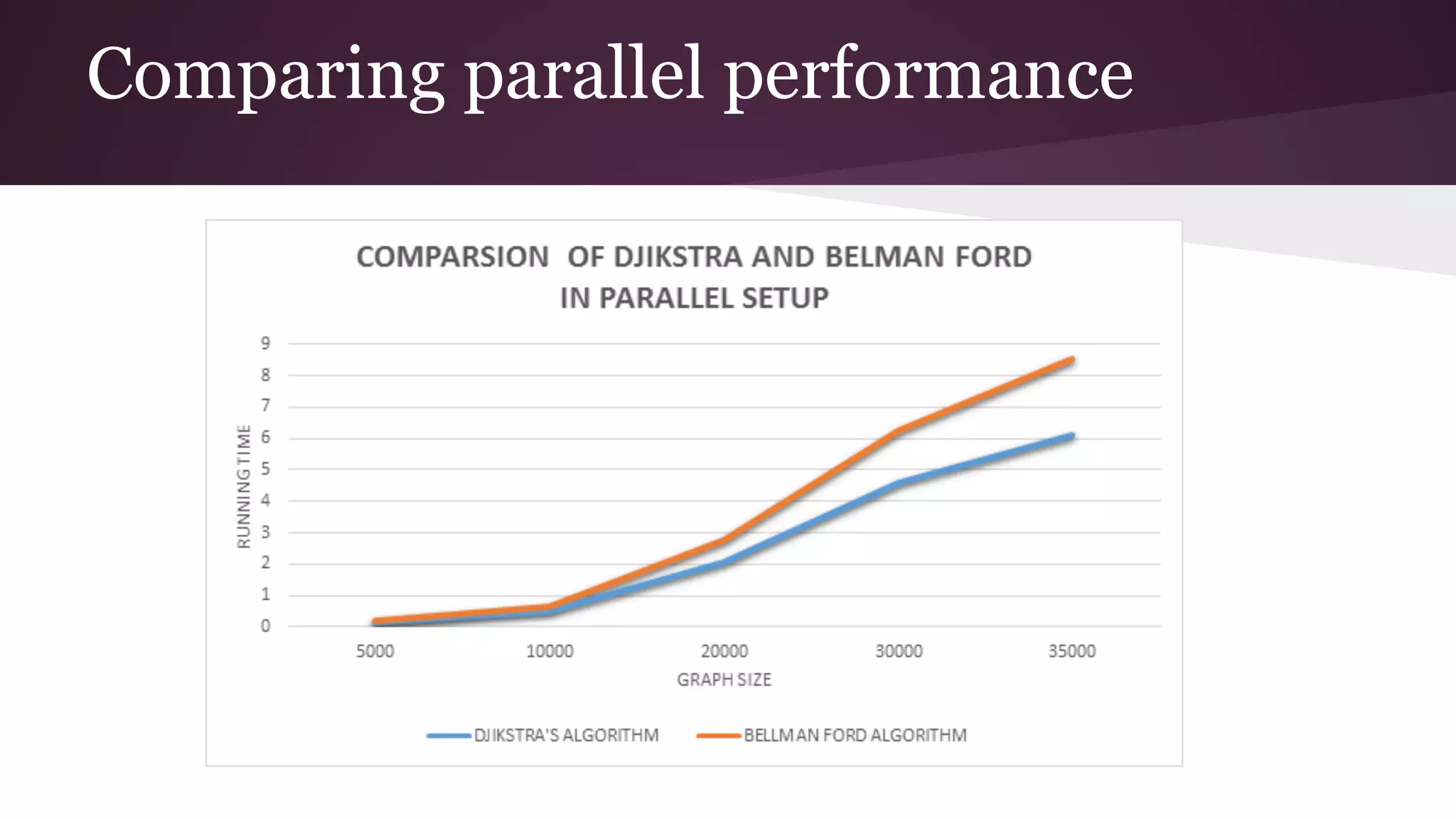
Comparing parallel performance
References
● Implementing Parallel Shortest-Paths Algorithms (1994) by by Marios
Papaefthymiou and Joseph Rodrigue
● Algorithms Sequential & Parallel: A Unified Approach / Edition 2 by Russ
Miller and Lawrence Boxer
● An Experimental Study of a Parallel Shortest Path Algorithm for Solving
Large-Scale Graph Instances by Kamesh Madduri and David A. Bader,
Georgia Institute of Technology and Jonathan W. Berry Sandia National
Laboratories and Joseph R. Crobak, Rutgers University
● Parallel Algorithms by Guy E. Blelloch and Bruce M. Maggs, School of
Computer Science, Carnegie Mellon University
CSE633

CSE633

  • 1.
    Parallel Implementation ofDijkstra’s and Bellman Ford Algorithm Team 26 B ● Priyanka Ramanuja Kulkarni ● Meenakshi Muthuraman ● Aslesha Pansare ● Nikhil Kataria
  • 2.
    Single Source ShortestPath Problem ● The Problem of finding the shortest path from a source vertex S to all vertices in the graph ● Weighted graph G = (V,E) ● Distance from S to all the vertices
  • 3.
    Dijkstra’s Algorithm ● Solutionto single source shortest path algorithm in graph theory ○ Both directed and undirected graphs ○ All edges must have non- negative weights ○ Graph must be connected ○ Dijkstra’s algorithm runs in
  • 4.
  • 5.
    Negative Cycles A negativecycle is a cycle in a weighted graph whose total weight is negative
  • 6.
    Bellman Ford’s Algorithm BELLMAN-FORD(G,w,s) 1.INITIALIZE-SINGLE-SOURCE(G,s) 2. for i = 1 to |G.V|-1 3. for each edge (u,v) ∈ G.E 4. RELAX(u,v,w) 5. for each edge (u,v) ∈ G.E 6. if v.d > u.d + w(u,v) 7. return FALSE 8. return TRUE BELLMAN-FORD(G,w,s) 1. INITIALIZE-SINGLE-SOURCE(G,s) 2. for i = 1 to |G.V|-1 3. for each edge (u,v) ∈ G.E 4. RELAX(u,v,w) 5. for each edge (u,v) ∈ G.E 6. if v.d > u.d + w(u,v) 7. return FALSE 8. return TRUE ● Worst case performance - 0 (|V||E|) ● Space Complexity - 0(|V|)
  • 7.
  • 8.
    Assumptions ● All theedges are undirected ● We consider a sparse matrix for the initial distance vector ● Each vertex is connected to at least 1 other vertex ● The weights of the edges are assigned randomly with a restriction on the x-axis rand()
  • 9.
    Parallel Dijkstra’s Algorithm ●On each cluster identify vertices closest to the source vertex ● Use parallel prefix to select the globally closest vertex ● Broadcast the results to all cores ● On each cluster update the distance vectors ● Running time = 0(V2 /P + V*log(P))
  • 10.
    Parallel Approach 1.Allocate graph nodesto different processors. 2.Shortest distance is computed using parallel prefix. 3. Broadcast the Result to all nodes after finding closest path. ❏ MPI_Reduce(MPI_IN_PLACE,nextAN,1,MPI_INT,MPI_SUM,0,MPI_COMM_WORLD); ❏ MPI_Bcast( G->node[0], G->N*G->N, MPI_CHAR, 0, MPI_COMM_WORLD);
  • 11.
    Dijkstra’s sequential VsParallel Implementation
  • 12.
  • 13.
  • 14.
  • 15.
  • 16.
    Bellman Ford: RunningTime v/s # of Nodes
  • 17.
  • 18.
  • 19.
  • 20.
    References ● Implementing ParallelShortest-Paths Algorithms (1994) by by Marios Papaefthymiou and Joseph Rodrigue ● Algorithms Sequential & Parallel: A Unified Approach / Edition 2 by Russ Miller and Lawrence Boxer ● An Experimental Study of a Parallel Shortest Path Algorithm for Solving Large-Scale Graph Instances by Kamesh Madduri and David A. Bader, Georgia Institute of Technology and Jonathan W. Berry Sandia National Laboratories and Joseph R. Crobak, Rutgers University ● Parallel Algorithms by Guy E. Blelloch and Bruce M. Maggs, School of Computer Science, Carnegie Mellon University