ARIHANT INSTITUTE
OF TEACHERS
TRAINING
NAME: Shendkar Rupali P.
COURSE NO: 103
Teaching and Learning
UNIT:cognitive constructivism
Cognitive Constructivism Theory
 The Cognitive Constructivism Theory of learning and
teaching is based on Piaget’s beliefs that humans cannot be
given information that they immediately understand and use
 Instead, human beings must build their own knowledge and
meaning through experiences.(Cognitive Constructivist
Theories)
 The definition of cognitive is the mental faculty of knowing,
which includes perceiving, recognizing, conceiving, judging,
reasoning, and imagining.(Dictionary.com)
Cognitive Constructivism Theory
 The three areas of Constructivism are cognitive,
social and radical.All three areas of Constructivism
assert that the acquisition of knowledge and
understanding is an ongoing process that is heavily
influenced by a student’s prior knowledge
 The Cognitive Constructivism Theory differs from
the other two in the belief that knowledge is the
result of the accurate internalization and
reconstruction of external reality. (Doolittle &
Camp, 1999)
Cognitive Constructivism Theory
 In other words, the external reality involved in
Cognitive Constructivism is actually “learning”.
 It is consciously being aware of external factors and
using cognitive skills to take these factors and process
it internally with existing knowledge for new
knowledge construction.
 Cognitive Constructivism Theory of learning and
teaching is based on Piaget’s beliefs that humans
cannot be given information that they immediately
understand and use
Cognitive Constructivism Theory
 Instead, human beings must build their own knowledge and
meaning through experiences.(Cognitive Constructivist Theories)
 The definition of cognitive is the mental faculty of knowing, which
includes perceiving, recognizing, conceiving, judging, reasoning,
and imagining.(Dictionary.com)
 The three areas of Constructivism are cognitive, social and radical.
 All three areas of Constructivism assert that the acquisition of
knowledge and understanding is an ongoing process that is heavily
influenced by a student’s prior knowledge
 The Cognitive Constructivism Theory differs from the other two in
the belief that knowledge is the result of the accurate
internalization and reconstruction of external reality. (Doolittle &
Camp, 1999)
The four parts of Cognitive Constructivism
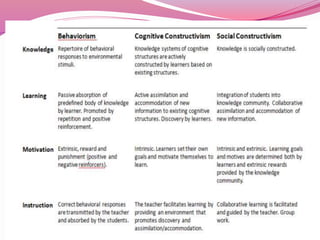
 The four parts of Cognitive Constructivism as stated in the online
resource guide of UC Berkeley are described as follows:
 1)Knowledge –
Actively constructed by learners based on existing structures
rather than socially constructed or as a response to environmental
stimuli.
2)Learning –
Active assimilation and accommodation of new information on
an individual basis rather than in a knowledge community.
3)Motivation –
Learners set their own goals and motivate themselves to learn
rather than relying on positive or negative reinforcement.
4)Instruction –
An environment that promotes discovery and assimilation
/accommodation rather than rote instruction or group learning.
Cognitive Constructivism
 Of the three Constructivism Theories, the Cognitive Constructivism
Theory is the best approach for Career and Technical Education for
several reasons.(Doolittle & Camp, 1999)
 First, authentic experiences are essential in Cognitive Construction.A
real-world, hands on approach is the concept of CTE.These ideals
mirror one another.
 Second, Cognitive Constructivism emphasizes self-regulation and self-
awareness.This is more than simply entry level job skills.Employers
want more than that from their CTE students and expect employees
who have participated in CTE programs to have the skills of problem
solving, self-motivation and self-assessment.

Cognitive Constructivism
 Third, in Cognitive Constructivism, the teacher performs the role of
providing learning experiences for the students through which the
students participate and extract and develop new knowledge from
their involvement. This is precisely the role of teacher-coordinator in
CTE programs.
 Fourth, teachers in Cognitive Constructivism propel the learning
experience through multiple perspectives.
 Giving the student several representations and routes from which to
draw information and retrieve knowledge allows and encourages the
ability to develop a multitude of ways to reach current success and
future success.
 The combination of classroom instruction and training stations in
CTE demonstrates this model.
Cognitive Constructivism
 During the 1930s and 1940s, constructivism was the leading
perspective among public school educators in the United States. In
this theory, the emphasis is placed on the student rather than the
teacher.
 Teachers are seen as facilitators or coaches who assist students
construct their own conceptualizations and solutions to problems.
 The main ideas underpinning constructivism learning theories are not
new. They began with the insights of Socrates who claimed that there
are basic conditions for learning that are in the cognition of the
individual (Kanuka & Anderson, 1998). But it was Piaget's theory of
intellectual growth that had the primary influence on the
development of current positions.
 Specifically, Piaget first emphasized the processes of conceptual
change as interactions between existing cognitive structures and new
experience
 Within this theory falls two schools of thought, social constructivism
and cognitive constructivism:
Cognitive Constructivism
 Within this theory falls two schools of thought, social constructivism
and cognitive constructivism:
 1. Lev Vygotsky, a Russian psychologist and philosopher in the 1930's,
is most often associated with the social constructivist theory.
 He emphasizes the influences of cultural and social contexts in
learning and supports a discovery model of learning.
 This type of model places the teacher in an active role while the
students' mental abilities develop naturally through various paths of
discovery.
Cognitive Constructivism
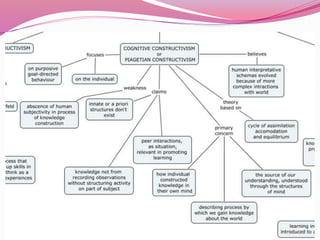
 2. Cognitive constructivism is based on the work of Jean
Piaget. His theory has two major parts: an ages and stages
component that predicts what children can and cannot
understand at different ages, and a theory of development
that describes how learners develop cognitive abilities.
 Piaget's theory of cognitive development proposes that
humans cannot be given information, in which they
immediately understand and use.
 Instead, learners must construct their own knowledge. They
build their knowledge through experience.
 Experiences enable them to create schemas — mental
models of the world. These schemas are changed, enlarged,
and made more sophisticated through two complimentary
processes: assimilation and accommodation.
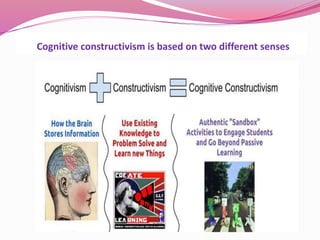
Cognitive constructivism is based on two different senses
 Cognitive constructivism is based on two
different senses of construction.
 First, on the idea that people learn by actively
constructing new knowledge, not by having
information poured into their heads.
 Moreover, constructivism asserts that people
learn with particular effectiveness when they
are engaged in constructing personally
meaningful artifacts (e.g. computer
programs, animations).
Cognitive constructivism is based on two different senses
Cognitive Constructivism
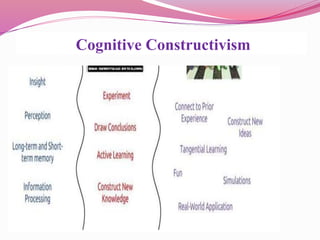
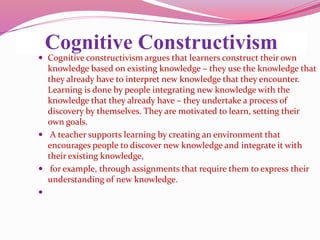
 Cognitive constructivism argues that learners construct their own
knowledge based on existing knowledge – they use the knowledge that
they already have to interpret new knowledge that they encounter.
Learning is done by people integrating new knowledge with the
knowledge that they already have – they undertake a process of
discovery by themselves. They are motivated to learn, setting their
own goals.
 A teacher supports learning by creating an environment that
encourages people to discover new knowledge and integrate it with
their existing knowledge,
 for example, through assignments that require them to express their
understanding of new knowledge.


Aitt cognitive constructivism

  • 1.
  • 2.
    NAME: Shendkar RupaliP. COURSE NO: 103 Teaching and Learning UNIT:cognitive constructivism
  • 3.
    Cognitive Constructivism Theory The Cognitive Constructivism Theory of learning and teaching is based on Piaget’s beliefs that humans cannot be given information that they immediately understand and use  Instead, human beings must build their own knowledge and meaning through experiences.(Cognitive Constructivist Theories)  The definition of cognitive is the mental faculty of knowing, which includes perceiving, recognizing, conceiving, judging, reasoning, and imagining.(Dictionary.com)
  • 4.
    Cognitive Constructivism Theory The three areas of Constructivism are cognitive, social and radical.All three areas of Constructivism assert that the acquisition of knowledge and understanding is an ongoing process that is heavily influenced by a student’s prior knowledge  The Cognitive Constructivism Theory differs from the other two in the belief that knowledge is the result of the accurate internalization and reconstruction of external reality. (Doolittle & Camp, 1999)
  • 5.
    Cognitive Constructivism Theory In other words, the external reality involved in Cognitive Constructivism is actually “learning”.  It is consciously being aware of external factors and using cognitive skills to take these factors and process it internally with existing knowledge for new knowledge construction.  Cognitive Constructivism Theory of learning and teaching is based on Piaget’s beliefs that humans cannot be given information that they immediately understand and use
  • 6.
    Cognitive Constructivism Theory Instead, human beings must build their own knowledge and meaning through experiences.(Cognitive Constructivist Theories)  The definition of cognitive is the mental faculty of knowing, which includes perceiving, recognizing, conceiving, judging, reasoning, and imagining.(Dictionary.com)  The three areas of Constructivism are cognitive, social and radical.  All three areas of Constructivism assert that the acquisition of knowledge and understanding is an ongoing process that is heavily influenced by a student’s prior knowledge  The Cognitive Constructivism Theory differs from the other two in the belief that knowledge is the result of the accurate internalization and reconstruction of external reality. (Doolittle & Camp, 1999)
  • 7.
    The four partsof Cognitive Constructivism  The four parts of Cognitive Constructivism as stated in the online resource guide of UC Berkeley are described as follows:  1)Knowledge – Actively constructed by learners based on existing structures rather than socially constructed or as a response to environmental stimuli. 2)Learning – Active assimilation and accommodation of new information on an individual basis rather than in a knowledge community. 3)Motivation – Learners set their own goals and motivate themselves to learn rather than relying on positive or negative reinforcement. 4)Instruction – An environment that promotes discovery and assimilation /accommodation rather than rote instruction or group learning.
  • 8.
    Cognitive Constructivism  Ofthe three Constructivism Theories, the Cognitive Constructivism Theory is the best approach for Career and Technical Education for several reasons.(Doolittle & Camp, 1999)  First, authentic experiences are essential in Cognitive Construction.A real-world, hands on approach is the concept of CTE.These ideals mirror one another.  Second, Cognitive Constructivism emphasizes self-regulation and self- awareness.This is more than simply entry level job skills.Employers want more than that from their CTE students and expect employees who have participated in CTE programs to have the skills of problem solving, self-motivation and self-assessment. 
  • 9.
    Cognitive Constructivism  Third,in Cognitive Constructivism, the teacher performs the role of providing learning experiences for the students through which the students participate and extract and develop new knowledge from their involvement. This is precisely the role of teacher-coordinator in CTE programs.  Fourth, teachers in Cognitive Constructivism propel the learning experience through multiple perspectives.  Giving the student several representations and routes from which to draw information and retrieve knowledge allows and encourages the ability to develop a multitude of ways to reach current success and future success.  The combination of classroom instruction and training stations in CTE demonstrates this model.
  • 10.
    Cognitive Constructivism  Duringthe 1930s and 1940s, constructivism was the leading perspective among public school educators in the United States. In this theory, the emphasis is placed on the student rather than the teacher.  Teachers are seen as facilitators or coaches who assist students construct their own conceptualizations and solutions to problems.  The main ideas underpinning constructivism learning theories are not new. They began with the insights of Socrates who claimed that there are basic conditions for learning that are in the cognition of the individual (Kanuka & Anderson, 1998). But it was Piaget's theory of intellectual growth that had the primary influence on the development of current positions.  Specifically, Piaget first emphasized the processes of conceptual change as interactions between existing cognitive structures and new experience  Within this theory falls two schools of thought, social constructivism and cognitive constructivism:
  • 11.
    Cognitive Constructivism  Withinthis theory falls two schools of thought, social constructivism and cognitive constructivism:  1. Lev Vygotsky, a Russian psychologist and philosopher in the 1930's, is most often associated with the social constructivist theory.  He emphasizes the influences of cultural and social contexts in learning and supports a discovery model of learning.  This type of model places the teacher in an active role while the students' mental abilities develop naturally through various paths of discovery.
  • 12.
    Cognitive Constructivism  2.Cognitive constructivism is based on the work of Jean Piaget. His theory has two major parts: an ages and stages component that predicts what children can and cannot understand at different ages, and a theory of development that describes how learners develop cognitive abilities.  Piaget's theory of cognitive development proposes that humans cannot be given information, in which they immediately understand and use.  Instead, learners must construct their own knowledge. They build their knowledge through experience.  Experiences enable them to create schemas — mental models of the world. These schemas are changed, enlarged, and made more sophisticated through two complimentary processes: assimilation and accommodation.
  • 13.
    Cognitive constructivism isbased on two different senses  Cognitive constructivism is based on two different senses of construction.  First, on the idea that people learn by actively constructing new knowledge, not by having information poured into their heads.  Moreover, constructivism asserts that people learn with particular effectiveness when they are engaged in constructing personally meaningful artifacts (e.g. computer programs, animations).
  • 14.
    Cognitive constructivism isbased on two different senses
  • 15.
  • 16.
  • 18.
    Cognitive Constructivism  Cognitiveconstructivism argues that learners construct their own knowledge based on existing knowledge – they use the knowledge that they already have to interpret new knowledge that they encounter. Learning is done by people integrating new knowledge with the knowledge that they already have – they undertake a process of discovery by themselves. They are motivated to learn, setting their own goals.  A teacher supports learning by creating an environment that encourages people to discover new knowledge and integrate it with their existing knowledge,  for example, through assignments that require them to express their understanding of new knowledge. 