By Christina M,
Nicole G, and
Kelly G
Team 7
Constructivism is a learning theory that the learner
constructs what he understands.
In this theory, children teach themselves by
observing and watching others. In school,
children take what they have learned and
apply it to better understand.
As a child grows older, he interacts
with different people and has
different experiences. The simple
acts of interaction with others and
forming different views on the world,
children are able to gain new skills
such as forming abstract thinking.
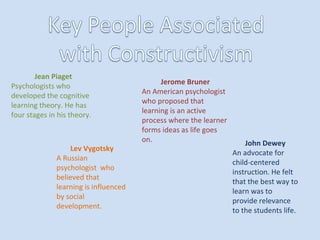
Jean Piaget
Psychologists who
developed the cognitive
learning theory. He has
four stages in his theory.
Jerome Bruner
An American psychologist
who proposed that
learning is an active
process where the learner
forms ideas as life goes
on.
Lev Vygotsky
A Russian
psychologist who
believed that
learning is influenced
by social
development.
John Dewey
An advocate for
child-centered
instruction. He felt
that the best way to
learn was to
provide relevance
to the students life.
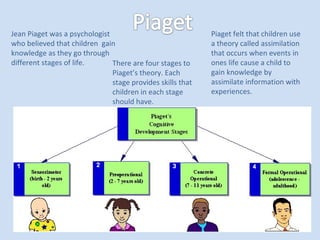
Jean Piaget was a psychologist
who believed that children gain
knowledge as they go through
different stages of life. There are four stages to
Piaget’s theory. Each
stage provides skills that
children in each stage
should have.
Piaget felt that children use
a theory called assimilation
that occurs when events in
ones life cause a child to
gain knowledge by
assimilate information with
experiences.
Lev Vgotsky
• Russian psychologist who studied the cognitive
development in children.
• Believes learning takes place within a child’s social
development and culture. Students should work
collaboratively to share different perspectives.
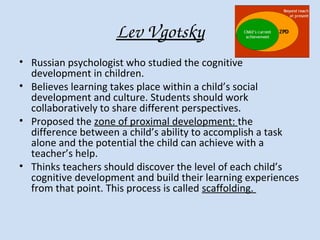
• Proposed the zone of proximal development: the
difference between a child’s ability to accomplish a task
alone and the potential the child can achieve with a
teacher’s help.
• Thinks teachers should discover the level of each child’s
cognitive development and build their learning experiences
from that point. This process is called scaffolding.
Classroom Implications
Teachers should:
• Use physical materials and manipulatives
• Allow student response to drive lessons
• Encourage students to ask questions, and to
think about things by asking open ended
questions
• Encourage students to have conversations with
classmates and adults
• Nurture a students natural curiosity
Classroom Implications
Students should:
• Be willing to learn and practice activities alone
and in groups
• Share ideas and accept those of others
• Allow their ability to accomplish tasks alone to
grow by engaging in hands on activities
• Accept help from teachers
• Use technology to enhance learning experience
• Technology will be an imperative instrument in
building research skills
Thoughts
Overall I like this theory. I like that the
classroom instruction is somewhat
determined or altered according to the needs
of the students. I feel the students will learn
better this way, and that they would also be
more eager to learn.
Credits
ATHERTON J S (2010) Learning and Teaching; Constructivism in learning [On-
line] UK: Available:
http://www.learningandteaching.info/learning/constructivism.htm
Accessed: 22 November 2010
Shelly, Cashman, Gunter, & Gunter, . (2009). Integrating technology and
digital media in the classroom 6th ed.: teachers discovering computers.
Wood, K. C., Smith, H., Grossniklaus, D. (2001). Piaget's Stages of Cognitive
Development. In M. Orey (Ed.), Emerging perspectives on learning,
teaching, and technology. Retrieved <insert date>, from
http://projects.coe.uga.edu/epltt/
Credits
ATHERTON J S (2010) Learning and Teaching; Constructivism in learning [On-
line] UK: Available:
http://www.learningandteaching.info/learning/constructivism.htm
Accessed: 22 November 2010
Shelly, Cashman, Gunter, & Gunter, . (2009). Integrating technology and
digital media in the classroom 6th ed.: teachers discovering computers.
Wood, K. C., Smith, H., Grossniklaus, D. (2001). Piaget's Stages of Cognitive
Development. In M. Orey (Ed.), Emerging perspectives on learning,
teaching, and technology. Retrieved <insert date>, from
http://projects.coe.uga.edu/epltt/

Theory team 7

  • 1.
    By Christina M, NicoleG, and Kelly G Team 7
  • 2.
    Constructivism is alearning theory that the learner constructs what he understands. In this theory, children teach themselves by observing and watching others. In school, children take what they have learned and apply it to better understand. As a child grows older, he interacts with different people and has different experiences. The simple acts of interaction with others and forming different views on the world, children are able to gain new skills such as forming abstract thinking.
  • 3.
    Jean Piaget Psychologists who developedthe cognitive learning theory. He has four stages in his theory. Jerome Bruner An American psychologist who proposed that learning is an active process where the learner forms ideas as life goes on. Lev Vygotsky A Russian psychologist who believed that learning is influenced by social development. John Dewey An advocate for child-centered instruction. He felt that the best way to learn was to provide relevance to the students life.
  • 4.
    Jean Piaget wasa psychologist who believed that children gain knowledge as they go through different stages of life. There are four stages to Piaget’s theory. Each stage provides skills that children in each stage should have. Piaget felt that children use a theory called assimilation that occurs when events in ones life cause a child to gain knowledge by assimilate information with experiences.
  • 5.
    Lev Vgotsky • Russian psychologistwho studied the cognitive development in children. • Believes learning takes place within a child’s social development and culture. Students should work collaboratively to share different perspectives. • Proposed the zone of proximal development: the difference between a child’s ability to accomplish a task alone and the potential the child can achieve with a teacher’s help. • Thinks teachers should discover the level of each child’s cognitive development and build their learning experiences from that point. This process is called scaffolding.
  • 6.
    Classroom Implications Teachers should: •Use physical materials and manipulatives • Allow student response to drive lessons • Encourage students to ask questions, and to think about things by asking open ended questions • Encourage students to have conversations with classmates and adults • Nurture a students natural curiosity
  • 7.
    Classroom Implications Students should: •Be willing to learn and practice activities alone and in groups • Share ideas and accept those of others • Allow their ability to accomplish tasks alone to grow by engaging in hands on activities • Accept help from teachers • Use technology to enhance learning experience • Technology will be an imperative instrument in building research skills
  • 8.
    Thoughts Overall I likethis theory. I like that the classroom instruction is somewhat determined or altered according to the needs of the students. I feel the students will learn better this way, and that they would also be more eager to learn.
  • 9.
    Credits ATHERTON J S(2010) Learning and Teaching; Constructivism in learning [On- line] UK: Available: http://www.learningandteaching.info/learning/constructivism.htm Accessed: 22 November 2010 Shelly, Cashman, Gunter, & Gunter, . (2009). Integrating technology and digital media in the classroom 6th ed.: teachers discovering computers. Wood, K. C., Smith, H., Grossniklaus, D. (2001). Piaget's Stages of Cognitive Development. In M. Orey (Ed.), Emerging perspectives on learning, teaching, and technology. Retrieved <insert date>, from http://projects.coe.uga.edu/epltt/
  • 10.
    Credits ATHERTON J S(2010) Learning and Teaching; Constructivism in learning [On- line] UK: Available: http://www.learningandteaching.info/learning/constructivism.htm Accessed: 22 November 2010 Shelly, Cashman, Gunter, & Gunter, . (2009). Integrating technology and digital media in the classroom 6th ed.: teachers discovering computers. Wood, K. C., Smith, H., Grossniklaus, D. (2001). Piaget's Stages of Cognitive Development. In M. Orey (Ed.), Emerging perspectives on learning, teaching, and technology. Retrieved <insert date>, from http://projects.coe.uga.edu/epltt/