Tenzin Yoezer
Controlled hypotension
Anesthesia
3/11/2022 1
OUTLI
NE
1 Introduction & History
5 Anesthetic management
4 Technique
2
23 Principle of hypotension
Outlines
Definition
3/11/2022 2
Introduction
 BP - One of the vital sign
 Normal BP – preserved CO and good organ perfusion
 Maintaining normotensive – skill of anesthetist
Review Article
Hypotensive Anesthesia versus Normotensive Anesthesia during Major Maxillofacial Surgery: A
Review of the Literature
3/11/2022 3
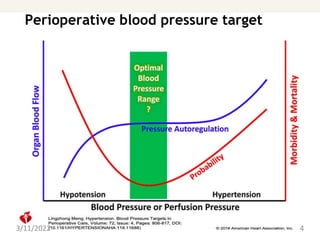
Perioperative blood pressure target
3/11/2022 4
Introduction
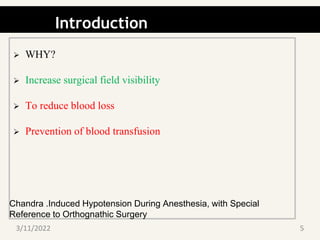
 WHY?
 Increase surgical field visibility
 To reduce blood loss
 Prevention of blood transfusion
Chandra .Induced Hypotension During Anesthesia, with Special
Reference to Orthognathic Surgery
3/11/2022 5
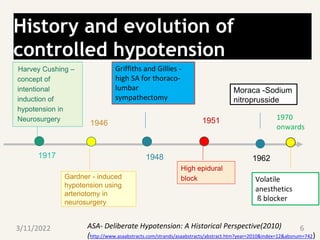
History and evolution of
controlled hypotension
Harvey Cushing –
concept of
intentional
induction of
hypotension in
Neurosurgery
1917
1946
1948
1951
Gardner - induced
hypotension using
arteriotomy in
neurosurgery
High epidural
block
Moraca -Sodium
nitroprusside
1962
Griffiths and Gillies -
high SA for thoraco-
lumbar
sympathectomy
1970
onwards
Volatile
anesthetics
ß blocker
ASA- Deliberate Hypotension: A Historical Perspective(2010)
(http://www.asaabstracts.com/strands/asaabstracts/abstract.htm?year=2010&index=12&absnum=742)
3/11/2022 6
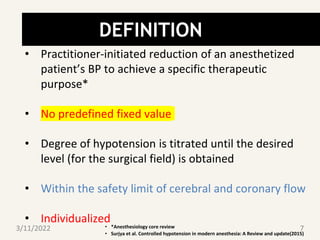
DEFINITION
• Practitioner-initiated reduction of an anesthetized
patient’s BP to achieve a specific therapeutic
purpose*
• No predefined fixed value
• Degree of hypotension is titrated until the desired
level (for the surgical field) is obtained
• Within the safety limit of cerebral and coronary flow
• Individualized
• *Anesthesiology core review
• Surjya et al. Controlled hypotension in modern anesthesia: A Review and update(2015)
3/11/2022 7
Cont…..
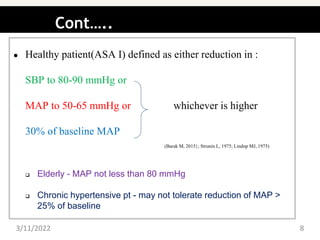
● Healthy patient(ASA I) defined as either reduction in :
SBP to 80-90 mmHg or
MAP to 50-65 mmHg or whichever is higher
30% of baseline MAP
(Barak M, 2015}; Strunin L, 1975; Lindop MJ, 1975)
 Elderly - MAP not less than 80 mmHg
 Chronic hypertensive pt - may not tolerate reduction of MAP >
25% of baseline
3/11/2022 8
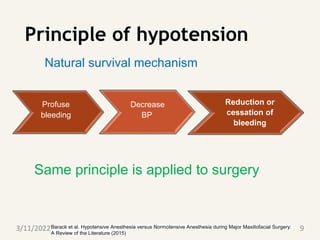
Principle of hypotension
Profuse
bleeding
Decrease
BP
Barack et al. Hypotensive Anesthesia versus Normotensive Anesthesia during Major Maxillofacial Surgery:
A Review of the Literature (2015)
Natural survival mechanism
Reduction or
cessation of
bleeding
Same principle is applied to surgery
3/11/2022 9
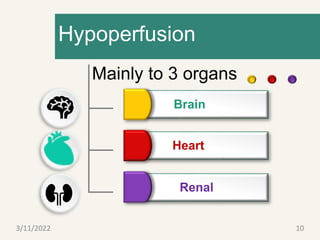
Hypoperfusion
Brain
Renal
Heart
Mainly to 3 organs
3/11/2022 10
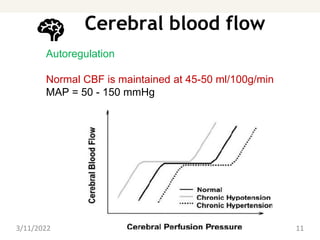
Cerebral blood flow
Autoregulation
Normal CBF is maintained at 45-50 ml/100g/min
MAP = 50 - 150 mmHg
3/11/2022 11
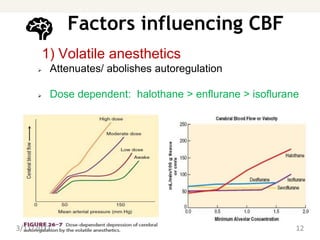
Factors influencing CBF
1) Volatile anesthetics
 Attenuates/ abolishes autoregulation
 Dose dependent: halothane > enflurane > isoflurane
3/11/2022 12
Factors influencing CBF
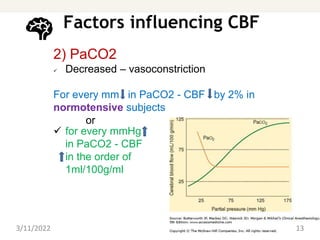
2) PaCO2
 Decreased – vasoconstriction
For every mm in PaCO2 - CBF by 2% in
normotensive subjects
or
 for every mmHg
in PaCO2 - CBF
in the order of
1ml/100g/ml
3/11/2022 13
Factors influencing CBF
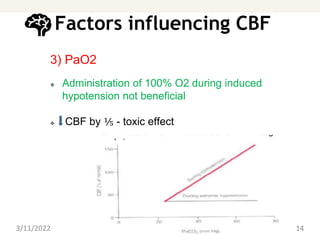
3) PaO2
 Administration of 100% O2 during induced
hypotension not beneficial
 CBF by ⅕ - toxic effect
3/11/2022 14
Factors influencing CBF
4) Vasodilators
Attenuates autoregulation similar to
volatile agents
5) Position
For every 2.5 cm head raised - CPP by 2
mmHg
Head elevation in hypotensive anesthesia
aggravates CBF
3/11/2022 15
Coronary circulation
• Dependent on:
• Aortic diastolic pressure
• Coronary vascular resistance
• Coronary blood flow autoregulation - changes parallel to
demand
• Hypotensive anesthesia -
• decreases coronary blood flow
• decreases myocardial oxygen demand
due to reduction in afterload (usually) or
preload(sometimes)
3/11/2022 16
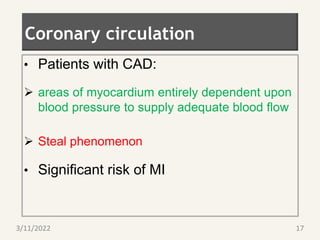
Coronary circulation
• Patients with CAD:
 areas of myocardium entirely dependent upon
blood pressure to supply adequate blood flow
 Steal phenomenon
• Significant risk of MI
3/11/2022 17
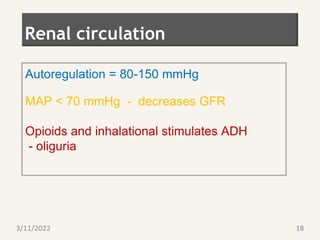
Renal circulation
Autoregulation = 80-150 mmHg
MAP < 70 mmHg - decreases GFR
Opioids and inhalational stimulates ADH
- oliguria
3/11/2022 18
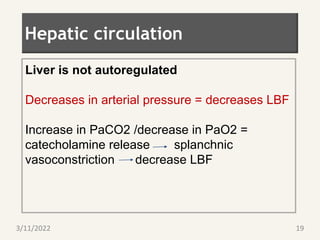
Hepatic circulation
Liver is not autoregulated
Decreases in arterial pressure = decreases LBF
Increase in PaCO2 /decrease in PaO2 =
catecholamine release splanchnic
vasoconstriction decrease LBF
3/11/2022 19
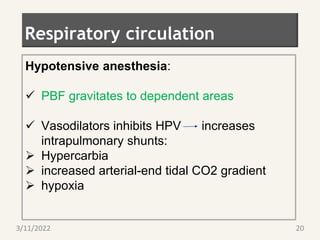
Respiratory circulation
Hypotensive anesthesia:
 PBF gravitates to dependent areas
 Vasodilators inhibits HPV increases
intrapulmonary shunts:
 Hypercarbia
 increased arterial-end tidal CO2 gradient
 hypoxia
3/11/2022 20
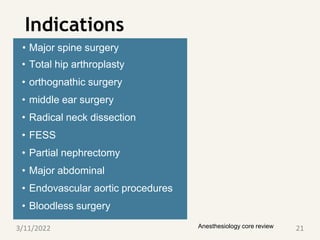
Indications
Anesthesiology core review
• Major spine surgery
• Total hip arthroplasty
• orthognathic surgery
• middle ear surgery
• Radical neck dissection
• FESS
• Partial nephrectomy
• Major abdominal
• Endovascular aortic procedures
• Bloodless surgery
3/11/2022 21
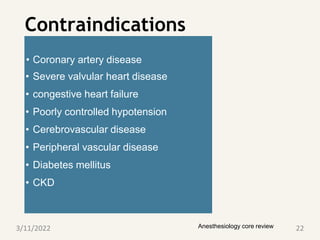
Contraindications
Anesthesiology core review
• Coronary artery disease
• Severe valvular heart disease
• congestive heart failure
• Poorly controlled hypotension
• Cerebrovascular disease
• Peripheral vascular disease
• Diabetes mellitus
• CKD
3/11/2022 22
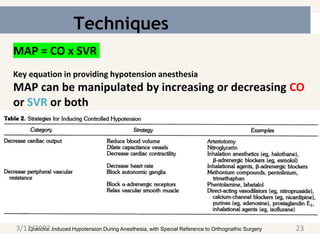
Techniques
Chandra .Induced Hypotension During Anesthesia, with Special Reference to Orthognathic Surgery
MAP = CO x SVR
Key equation in providing hypotension anesthesia
MAP can be manipulated by increasing or decreasing CO
or SVR or both
3/11/2022 23
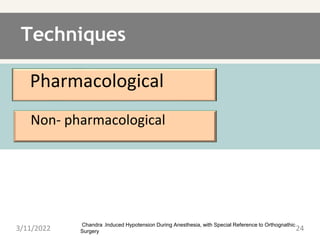
Techniques
Pharmacological
Chandra .Induced Hypotension During Anesthesia, with Special Reference to Orthognathic
Surgery
Non- pharmacological
3/11/2022 24
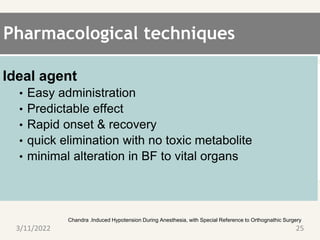
Pharmacological techniques
Ideal agent
• Easy administration
• Predictable effect
• Rapid onset & recovery
• quick elimination with no toxic metabolite
• minimal alteration in BF to vital organs
. Chandra .Induced Hypotension During Anesthesia, with Special Reference to Orthognathic Surgery
3/11/2022 25
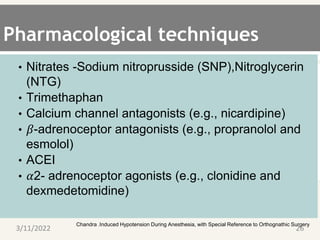
Pharmacological techniques
• Nitrates -Sodium nitroprusside (SNP),Nitroglycerin
(NTG)
• Trimethaphan
• Calcium channel antagonists (e.g., nicardipine)
• 𝛽-adrenoceptor antagonists (e.g., propranolol and
esmolol)
• ACEI
• 𝛼2- adrenoceptor agonists (e.g., clonidine and
dexmedetomidine)
. Chandra .Induced Hypotension During Anesthesia, with Special Reference to Orthognathic Surgery
3/11/2022 26
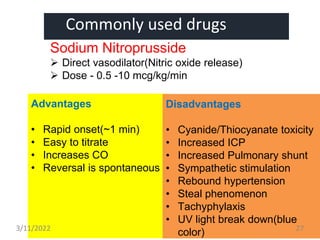
Commonly used drugs
Sodium Nitroprusside
 Direct vasodilator(Nitric oxide release)
 Dose - 0.5 -10 mcg/kg/min
Advantages
• Rapid onset(~1 min)
• Easy to titrate
• Increases CO
• Reversal is spontaneous
Disadvantages
• Cyanide/Thiocyanate toxicity
• Increased ICP
• Increased Pulmonary shunt
• Sympathetic stimulation
• Rebound hypertension
• Steal phenomenon
• Tachyphylaxis
• UV light break down(blue
color)
3/11/2022 27
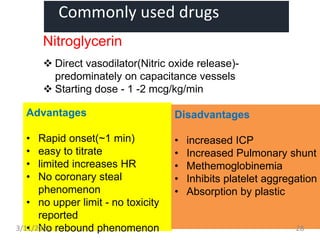
Commonly used drugs
Nitroglycerin
 Direct vasodilator(Nitric oxide release)-
predominately on capacitance vessels
 Starting dose - 1 -2 mcg/kg/min
Advantages
• Rapid onset(~1 min)
• easy to titrate
• limited increases HR
• No coronary steal
phenomenon
• no upper limit - no toxicity
reported
• No rebound phenomenon
Disadvantages
• increased ICP
• Increased Pulmonary shunt
• Methemoglobinemia
• Inhibits platelet aggregation
• Absorption by plastic
3/11/2022 28
Commonly used drugs
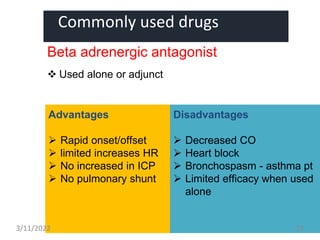
Beta adrenergic antagonist
 Used alone or adjunct
Advantages
 Rapid onset/offset
 limited increases HR
 No increased in ICP
 No pulmonary shunt
Disadvantages
 Decreased CO
 Heart block
 Bronchospasm - asthma pt
 Limited efficacy when used
alone
3/11/2022 29
Commonly used drugs
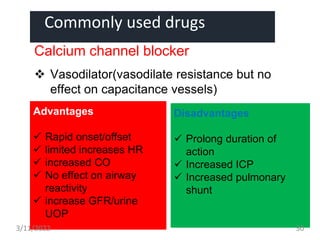
Calcium channel blocker
 Vasodilator(vasodilate resistance but no
effect on capacitance vessels)
Advantages
 Rapid onset/offset
 limited increases HR
 increased CO
 No effect on airway
reactivity
 increase GFR/urine
UOP
Disadvantages
 Prolong duration of
action
 Increased ICP
 Increased pulmonary
shunt
3/11/2022 30
Commonly used drugs
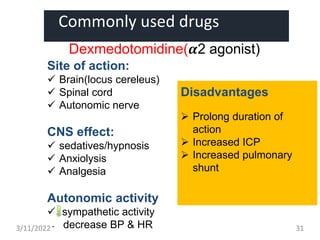
Dexmedotomidine(𝜶2 agonist)
Site of action:
 Brain(locus cereleus)
 Spinal cord
 Autonomic nerve
CNS effect:
 sedatives/hypnosis
 Anxiolysis
 Analgesia
Autonomic activity
 sympathetic activity
- decrease BP & HR
Disadvantages
 Prolong duration of
action
 Increased ICP
 Increased pulmonary
shunt
3/11/2022 31
Commonly used drugs
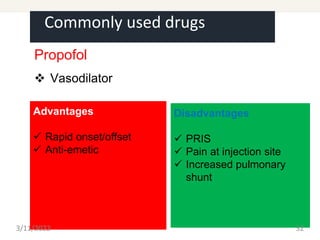
Propofol
 Vasodilator
Advantages
 Rapid onset/offset
 Anti-emetic
Disadvantages
 PRIS
 Pain at injection site
 Increased pulmonary
shunt
3/11/2022 32
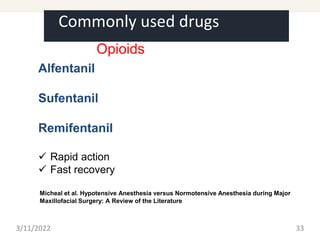
Commonly used drugs
Opioids
Alfentanil
Sufentanil
Remifentanil
 Rapid action
 Fast recovery
3/11/2022 33
Micheal et al. Hypotensive Anesthesia versus Normotensive Anesthesia during Major
Maxillofacial Surgery: A Review of the Literature
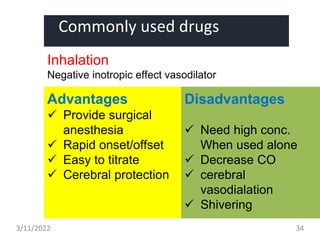
Commonly used drugs
Inhalation
Negative inotropic effect vasodilator
Advantages
 Provide surgical
anesthesia
 Rapid onset/offset
 Easy to titrate
 Cerebral protection
Disadvantages
 Need high conc.
When used alone
 Decrease CO
 cerebral
vasodialation
 Shivering
3/11/2022 34
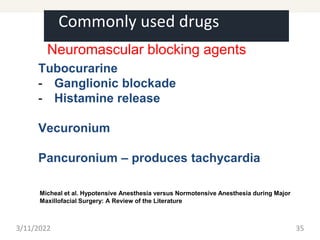
Commonly used drugs
Neuromascular blocking agents
Tubocurarine
- Ganglionic blockade
- Histamine release
Vecuronium
Pancuronium – produces tachycardia
3/11/2022 35
Micheal et al. Hypotensive Anesthesia versus Normotensive Anesthesia during Major
Maxillofacial Surgery: A Review of the Literature
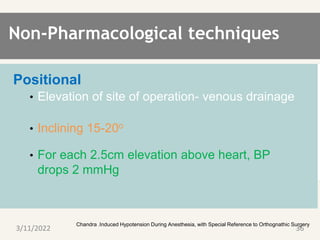
Non-Pharmacological techniques
Positional
• Elevation of site of operation- venous drainage
• Inclining 15-20o
• For each 2.5cm elevation above heart, BP
drops 2 mmHg
. Chandra .Induced Hypotension During Anesthesia, with Special Reference to Orthognathic Surgery
3/11/2022 36
Non-Pharmacological techniques
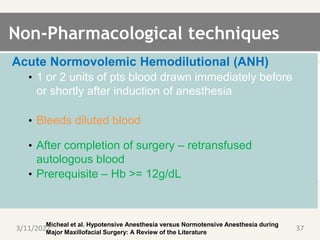
Acute Normovolemic Hemodilutional (ANH)
• 1 or 2 units of pts blood drawn immediately before
or shortly after induction of anesthesia
• Bleeds diluted blood
• After completion of surgery – retransfused
autologous blood
• Prerequisite – Hb >= 12g/dL
Micheal et al. Hypotensive Anesthesia versus Normotensive Anesthesia during
Major Maxillofacial Surgery: A Review of the Literature
3/11/2022 37
Non-Pharmacological techniques
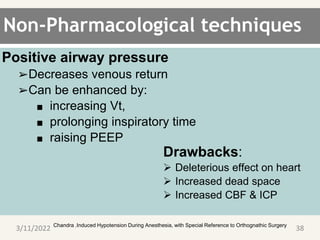
Positive airway pressure
➢Decreases venous return
➢Can be enhanced by:
■ increasing Vt,
■ prolonging inspiratory time
■ raising PEEP
. Chandra .Induced Hypotension During Anesthesia, with Special Reference to Orthognathic Surgery
3/11/2022 38
Drawbacks:
 Deleterious effect on heart
 Increased dead space
 Increased CBF & ICP
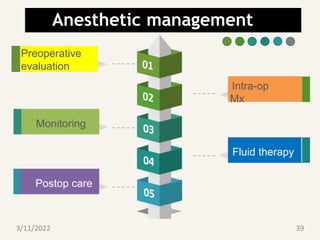
Anesthetic management
Preoperative
evaluation
Postop care
Monitoring
Intra-op
Mx
Fluid therapy
3/11/2022 39
Preoperative  Thorough knowledge by anesthetist
 Proper patient evaluation & selection
 Ix- Hb, urea, S/E, ECG
 Hb of 10g/dL
 Baseline ABG
 Premedication:
 Anxiolysis
 Analgesia
 𝜷 & 𝜶 blocker
 Antihypertensive
 Vagolytics avoided
3/11/2022 40
Intraoperative  Stress free induction
 Enough PIV line
 NMB
 Pressure points
 - avoid nasal
intubation
3/11/2022 41
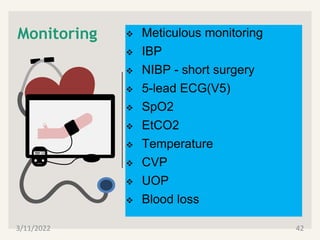
Monitoring  Meticulous monitoring
 IBP
 NIBP - short surgery
 5-lead ECG(V5)
 SpO2
 EtCO2
 Temperature
 CVP
 UOP
 Blood loss
3/11/2022 42
Fluid Therapy
 Proper fluid therapy is essential
 Optimize fluid & electrolytes
before Sx
 Maintenance fluid
 Blood loss replacement if
exceeds 20 -25% of blood
volume
3/11/2022 43
Postop  Rebound hypertension
 Reactionary hemorrhage
 Airway
 Analgesia
 Fluid balance
3/11/2022 44
MCQ
3/11/2022 45
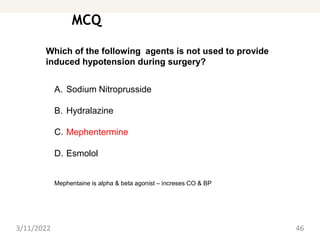
Which of the following agents is not used to provide
induced hypotension during surgery?
A. Sodium Nitroprusside
B. Hydralazine
C. Mephentermine
D. Esmolol
MCQ
3/11/2022 46
Which of the following agents is not used to provide
induced hypotension during surgery?
A. Sodium Nitroprusside
B. Hydralazine
C. Mephentermine
D. Esmolol
Mephentaine is alpha & beta agonist – increses CO & BP
MCQ
3/11/2022 47
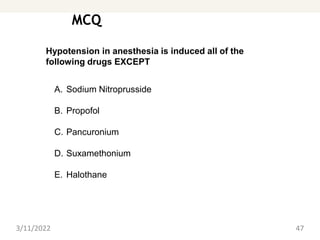
Hypotension in anesthesia is induced all of the
following drugs EXCEPT
A. Sodium Nitroprusside
B. Propofol
C. Pancuronium
D. Suxamethonium
E. Halothane
MCQ
3/11/2022 48
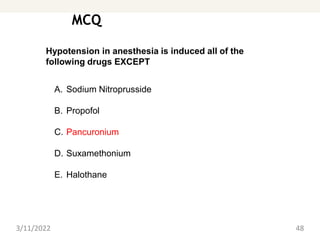
Hypotension in anesthesia is induced all of the
following drugs EXCEPT
A. Sodium Nitroprusside
B. Propofol
C. Pancuronium
D. Suxamethonium
E. Halothane
MCQ
3/11/2022 49
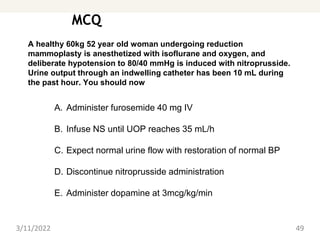
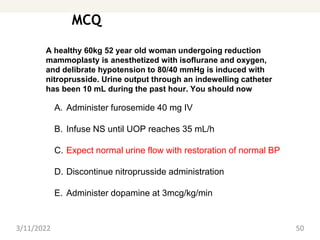
A healthy 60kg 52 year old woman undergoing reduction
mammoplasty is anesthetized with isoflurane and oxygen, and
deliberate hypotension to 80/40 mmHg is induced with nitroprusside.
Urine output through an indwelling catheter has been 10 mL during
the past hour. You should now
A. Administer furosemide 40 mg IV
B. Infuse NS until UOP reaches 35 mL/h
C. Expect normal urine flow with restoration of normal BP
D. Discontinue nitroprusside administration
E. Administer dopamine at 3mcg/kg/min
MCQ
3/11/2022 50
A healthy 60kg 52 year old woman undergoing reduction
mammoplasty is anesthetized with isoflurane and oxygen,
and delibrate hypotension to 80/40 mmHg is induced with
nitroprusside. Urine output through an indewelling catheter
has been 10 mL during the past hour. You should now
A. Administer furosemide 40 mg IV
B. Infuse NS until UOP reaches 35 mL/h
C. Expect normal urine flow with restoration of normal BP
D. Discontinue nitroprusside administration
E. Administer dopamine at 3mcg/kg/min
THANK
YOU
3/11/2022 51

Controlled hypotension in anesthesia

  • 1.
  • 2.
    OUTLI NE 1 Introduction &History 5 Anesthetic management 4 Technique 2 23 Principle of hypotension Outlines Definition 3/11/2022 2
  • 3.
    Introduction  BP -One of the vital sign  Normal BP – preserved CO and good organ perfusion  Maintaining normotensive – skill of anesthetist Review Article Hypotensive Anesthesia versus Normotensive Anesthesia during Major Maxillofacial Surgery: A Review of the Literature 3/11/2022 3
  • 4.
    Perioperative blood pressuretarget 3/11/2022 4
  • 5.
    Introduction  WHY?  Increasesurgical field visibility  To reduce blood loss  Prevention of blood transfusion Chandra .Induced Hypotension During Anesthesia, with Special Reference to Orthognathic Surgery 3/11/2022 5
  • 6.
    History and evolutionof controlled hypotension Harvey Cushing – concept of intentional induction of hypotension in Neurosurgery 1917 1946 1948 1951 Gardner - induced hypotension using arteriotomy in neurosurgery High epidural block Moraca -Sodium nitroprusside 1962 Griffiths and Gillies - high SA for thoraco- lumbar sympathectomy 1970 onwards Volatile anesthetics ß blocker ASA- Deliberate Hypotension: A Historical Perspective(2010) (http://www.asaabstracts.com/strands/asaabstracts/abstract.htm?year=2010&index=12&absnum=742) 3/11/2022 6
  • 7.
    DEFINITION • Practitioner-initiated reductionof an anesthetized patient’s BP to achieve a specific therapeutic purpose* • No predefined fixed value • Degree of hypotension is titrated until the desired level (for the surgical field) is obtained • Within the safety limit of cerebral and coronary flow • Individualized • *Anesthesiology core review • Surjya et al. Controlled hypotension in modern anesthesia: A Review and update(2015) 3/11/2022 7
  • 8.
    Cont….. ● Healthy patient(ASAI) defined as either reduction in : SBP to 80-90 mmHg or MAP to 50-65 mmHg or whichever is higher 30% of baseline MAP (Barak M, 2015}; Strunin L, 1975; Lindop MJ, 1975)  Elderly - MAP not less than 80 mmHg  Chronic hypertensive pt - may not tolerate reduction of MAP > 25% of baseline 3/11/2022 8
  • 9.
    Principle of hypotension Profuse bleeding Decrease BP Baracket al. Hypotensive Anesthesia versus Normotensive Anesthesia during Major Maxillofacial Surgery: A Review of the Literature (2015) Natural survival mechanism Reduction or cessation of bleeding Same principle is applied to surgery 3/11/2022 9
  • 10.
  • 11.
    Cerebral blood flow Autoregulation NormalCBF is maintained at 45-50 ml/100g/min MAP = 50 - 150 mmHg 3/11/2022 11
  • 12.
    Factors influencing CBF 1)Volatile anesthetics  Attenuates/ abolishes autoregulation  Dose dependent: halothane > enflurane > isoflurane 3/11/2022 12
  • 13.
    Factors influencing CBF 2)PaCO2  Decreased – vasoconstriction For every mm in PaCO2 - CBF by 2% in normotensive subjects or  for every mmHg in PaCO2 - CBF in the order of 1ml/100g/ml 3/11/2022 13
  • 14.
    Factors influencing CBF 3)PaO2  Administration of 100% O2 during induced hypotension not beneficial  CBF by ⅕ - toxic effect 3/11/2022 14
  • 15.
    Factors influencing CBF 4)Vasodilators Attenuates autoregulation similar to volatile agents 5) Position For every 2.5 cm head raised - CPP by 2 mmHg Head elevation in hypotensive anesthesia aggravates CBF 3/11/2022 15
  • 16.
    Coronary circulation • Dependenton: • Aortic diastolic pressure • Coronary vascular resistance • Coronary blood flow autoregulation - changes parallel to demand • Hypotensive anesthesia - • decreases coronary blood flow • decreases myocardial oxygen demand due to reduction in afterload (usually) or preload(sometimes) 3/11/2022 16
  • 17.
    Coronary circulation • Patientswith CAD:  areas of myocardium entirely dependent upon blood pressure to supply adequate blood flow  Steal phenomenon • Significant risk of MI 3/11/2022 17
  • 18.
    Renal circulation Autoregulation =80-150 mmHg MAP < 70 mmHg - decreases GFR Opioids and inhalational stimulates ADH - oliguria 3/11/2022 18
  • 19.
    Hepatic circulation Liver isnot autoregulated Decreases in arterial pressure = decreases LBF Increase in PaCO2 /decrease in PaO2 = catecholamine release splanchnic vasoconstriction decrease LBF 3/11/2022 19
  • 20.
    Respiratory circulation Hypotensive anesthesia: PBF gravitates to dependent areas  Vasodilators inhibits HPV increases intrapulmonary shunts:  Hypercarbia  increased arterial-end tidal CO2 gradient  hypoxia 3/11/2022 20
  • 21.
    Indications Anesthesiology core review •Major spine surgery • Total hip arthroplasty • orthognathic surgery • middle ear surgery • Radical neck dissection • FESS • Partial nephrectomy • Major abdominal • Endovascular aortic procedures • Bloodless surgery 3/11/2022 21
  • 22.
    Contraindications Anesthesiology core review •Coronary artery disease • Severe valvular heart disease • congestive heart failure • Poorly controlled hypotension • Cerebrovascular disease • Peripheral vascular disease • Diabetes mellitus • CKD 3/11/2022 22
  • 23.
    Techniques Chandra .Induced HypotensionDuring Anesthesia, with Special Reference to Orthognathic Surgery MAP = CO x SVR Key equation in providing hypotension anesthesia MAP can be manipulated by increasing or decreasing CO or SVR or both 3/11/2022 23
  • 24.
    Techniques Pharmacological Chandra .Induced HypotensionDuring Anesthesia, with Special Reference to Orthognathic Surgery Non- pharmacological 3/11/2022 24
  • 25.
    Pharmacological techniques Ideal agent •Easy administration • Predictable effect • Rapid onset & recovery • quick elimination with no toxic metabolite • minimal alteration in BF to vital organs . Chandra .Induced Hypotension During Anesthesia, with Special Reference to Orthognathic Surgery 3/11/2022 25
  • 26.
    Pharmacological techniques • Nitrates-Sodium nitroprusside (SNP),Nitroglycerin (NTG) • Trimethaphan • Calcium channel antagonists (e.g., nicardipine) • 𝛽-adrenoceptor antagonists (e.g., propranolol and esmolol) • ACEI • 𝛼2- adrenoceptor agonists (e.g., clonidine and dexmedetomidine) . Chandra .Induced Hypotension During Anesthesia, with Special Reference to Orthognathic Surgery 3/11/2022 26
  • 27.
    Commonly used drugs SodiumNitroprusside  Direct vasodilator(Nitric oxide release)  Dose - 0.5 -10 mcg/kg/min Advantages • Rapid onset(~1 min) • Easy to titrate • Increases CO • Reversal is spontaneous Disadvantages • Cyanide/Thiocyanate toxicity • Increased ICP • Increased Pulmonary shunt • Sympathetic stimulation • Rebound hypertension • Steal phenomenon • Tachyphylaxis • UV light break down(blue color) 3/11/2022 27
  • 28.
    Commonly used drugs Nitroglycerin Direct vasodilator(Nitric oxide release)- predominately on capacitance vessels  Starting dose - 1 -2 mcg/kg/min Advantages • Rapid onset(~1 min) • easy to titrate • limited increases HR • No coronary steal phenomenon • no upper limit - no toxicity reported • No rebound phenomenon Disadvantages • increased ICP • Increased Pulmonary shunt • Methemoglobinemia • Inhibits platelet aggregation • Absorption by plastic 3/11/2022 28
  • 29.
    Commonly used drugs Betaadrenergic antagonist  Used alone or adjunct Advantages  Rapid onset/offset  limited increases HR  No increased in ICP  No pulmonary shunt Disadvantages  Decreased CO  Heart block  Bronchospasm - asthma pt  Limited efficacy when used alone 3/11/2022 29
  • 30.
    Commonly used drugs Calciumchannel blocker  Vasodilator(vasodilate resistance but no effect on capacitance vessels) Advantages  Rapid onset/offset  limited increases HR  increased CO  No effect on airway reactivity  increase GFR/urine UOP Disadvantages  Prolong duration of action  Increased ICP  Increased pulmonary shunt 3/11/2022 30
  • 31.
    Commonly used drugs Dexmedotomidine(𝜶2agonist) Site of action:  Brain(locus cereleus)  Spinal cord  Autonomic nerve CNS effect:  sedatives/hypnosis  Anxiolysis  Analgesia Autonomic activity  sympathetic activity - decrease BP & HR Disadvantages  Prolong duration of action  Increased ICP  Increased pulmonary shunt 3/11/2022 31
  • 32.
    Commonly used drugs Propofol Vasodilator Advantages  Rapid onset/offset  Anti-emetic Disadvantages  PRIS  Pain at injection site  Increased pulmonary shunt 3/11/2022 32
  • 33.
    Commonly used drugs Opioids Alfentanil Sufentanil Remifentanil Rapid action  Fast recovery 3/11/2022 33 Micheal et al. Hypotensive Anesthesia versus Normotensive Anesthesia during Major Maxillofacial Surgery: A Review of the Literature
  • 34.
    Commonly used drugs Inhalation Negativeinotropic effect vasodilator Advantages  Provide surgical anesthesia  Rapid onset/offset  Easy to titrate  Cerebral protection Disadvantages  Need high conc. When used alone  Decrease CO  cerebral vasodialation  Shivering 3/11/2022 34
  • 35.
    Commonly used drugs Neuromascularblocking agents Tubocurarine - Ganglionic blockade - Histamine release Vecuronium Pancuronium – produces tachycardia 3/11/2022 35 Micheal et al. Hypotensive Anesthesia versus Normotensive Anesthesia during Major Maxillofacial Surgery: A Review of the Literature
  • 36.
    Non-Pharmacological techniques Positional • Elevationof site of operation- venous drainage • Inclining 15-20o • For each 2.5cm elevation above heart, BP drops 2 mmHg . Chandra .Induced Hypotension During Anesthesia, with Special Reference to Orthognathic Surgery 3/11/2022 36
  • 37.
    Non-Pharmacological techniques Acute NormovolemicHemodilutional (ANH) • 1 or 2 units of pts blood drawn immediately before or shortly after induction of anesthesia • Bleeds diluted blood • After completion of surgery – retransfused autologous blood • Prerequisite – Hb >= 12g/dL Micheal et al. Hypotensive Anesthesia versus Normotensive Anesthesia during Major Maxillofacial Surgery: A Review of the Literature 3/11/2022 37
  • 38.
    Non-Pharmacological techniques Positive airwaypressure ➢Decreases venous return ➢Can be enhanced by: ■ increasing Vt, ■ prolonging inspiratory time ■ raising PEEP . Chandra .Induced Hypotension During Anesthesia, with Special Reference to Orthognathic Surgery 3/11/2022 38 Drawbacks:  Deleterious effect on heart  Increased dead space  Increased CBF & ICP
  • 39.
  • 40.
    Preoperative  Thoroughknowledge by anesthetist  Proper patient evaluation & selection  Ix- Hb, urea, S/E, ECG  Hb of 10g/dL  Baseline ABG  Premedication:  Anxiolysis  Analgesia  𝜷 & 𝜶 blocker  Antihypertensive  Vagolytics avoided 3/11/2022 40
  • 41.
    Intraoperative  Stressfree induction  Enough PIV line  NMB  Pressure points  - avoid nasal intubation 3/11/2022 41
  • 42.
    Monitoring  Meticulousmonitoring  IBP  NIBP - short surgery  5-lead ECG(V5)  SpO2  EtCO2  Temperature  CVP  UOP  Blood loss 3/11/2022 42
  • 43.
    Fluid Therapy  Properfluid therapy is essential  Optimize fluid & electrolytes before Sx  Maintenance fluid  Blood loss replacement if exceeds 20 -25% of blood volume 3/11/2022 43
  • 44.
    Postop  Reboundhypertension  Reactionary hemorrhage  Airway  Analgesia  Fluid balance 3/11/2022 44
  • 45.
    MCQ 3/11/2022 45 Which ofthe following agents is not used to provide induced hypotension during surgery? A. Sodium Nitroprusside B. Hydralazine C. Mephentermine D. Esmolol
  • 46.
    MCQ 3/11/2022 46 Which ofthe following agents is not used to provide induced hypotension during surgery? A. Sodium Nitroprusside B. Hydralazine C. Mephentermine D. Esmolol Mephentaine is alpha & beta agonist – increses CO & BP
  • 47.
    MCQ 3/11/2022 47 Hypotension inanesthesia is induced all of the following drugs EXCEPT A. Sodium Nitroprusside B. Propofol C. Pancuronium D. Suxamethonium E. Halothane
  • 48.
    MCQ 3/11/2022 48 Hypotension inanesthesia is induced all of the following drugs EXCEPT A. Sodium Nitroprusside B. Propofol C. Pancuronium D. Suxamethonium E. Halothane
  • 49.
    MCQ 3/11/2022 49 A healthy60kg 52 year old woman undergoing reduction mammoplasty is anesthetized with isoflurane and oxygen, and deliberate hypotension to 80/40 mmHg is induced with nitroprusside. Urine output through an indwelling catheter has been 10 mL during the past hour. You should now A. Administer furosemide 40 mg IV B. Infuse NS until UOP reaches 35 mL/h C. Expect normal urine flow with restoration of normal BP D. Discontinue nitroprusside administration E. Administer dopamine at 3mcg/kg/min
  • 50.
    MCQ 3/11/2022 50 A healthy60kg 52 year old woman undergoing reduction mammoplasty is anesthetized with isoflurane and oxygen, and delibrate hypotension to 80/40 mmHg is induced with nitroprusside. Urine output through an indewelling catheter has been 10 mL during the past hour. You should now A. Administer furosemide 40 mg IV B. Infuse NS until UOP reaches 35 mL/h C. Expect normal urine flow with restoration of normal BP D. Discontinue nitroprusside administration E. Administer dopamine at 3mcg/kg/min
  • 51.