Airway solutions in an acute 
trauma scenario 
Dr.Venugopalan.P.P 
DA;DNB;MNAMS;MEM[GWU] 
Director ; Emergency Medicine 
Aster DM Health Care Ltd 
Deputy Director ;MIMS Academy 
Founder and executive director -ANGELS
Focus 
• Why? 
• When? 
• How? 
• What is different? 
• What is new ?
Case Scenario 
What is your first priority? 
28year old man was 
brought to ED 
following a motor 
bike accident , Pulse 
112,BP 110/60,Rapid 
breathing , Snoring+ 
SpO2 87 in room air 
and CGS 8/15. Smell 
of alcohol +
Priority –One 
• Airway is the first system to be taken care in 
any trauma victim 
• Compromised airway will endanger the 
patient life more rapidly than any other 
system compromise
Airway Assessment 
How do I know the airway is adequate? 
● Patient is alert and oriented. 
● Patient is talking normally. 
● There is no evidence of injury to 
the head or neck. 
● You have assessed and 
reassessed for deterioration.
Airway Assessment 
Signs and symptoms of airway compromise 
● High index of suspicion 
● Change in voice / sore throat 
● Noisy breathing (snoring and stridor) 
● Dyspnea and agitation
Airway Assessment 
Signs and symptoms of airway compromise (cont.) 
● Tachypnea 
● Abnormal breathing pattern 
● Low oxygen saturation (late sign)
Airway Assessment 
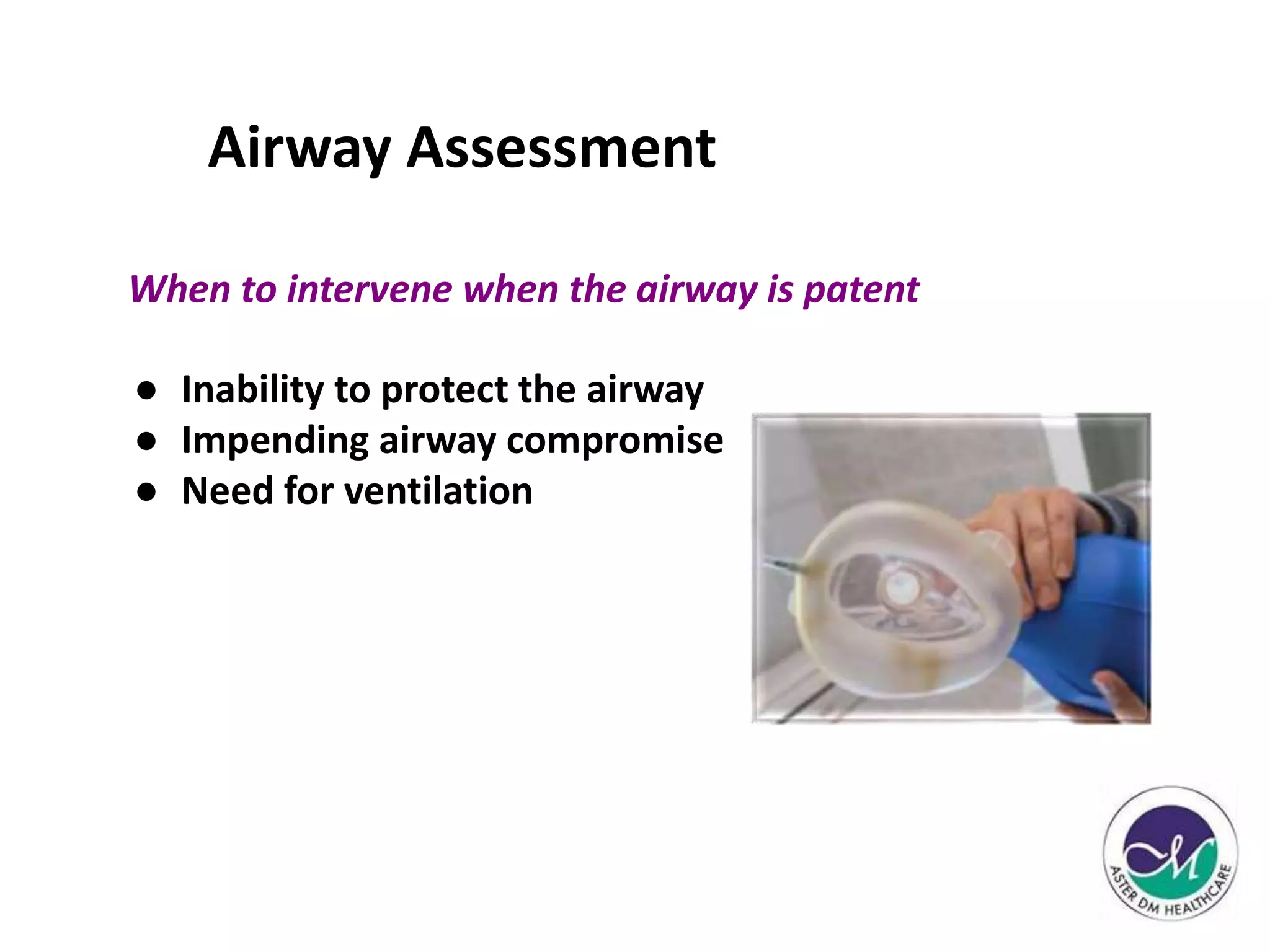
When to intervene when the airway is patent 
● Inability to protect the airway 
● Impending airway compromise 
● Need for ventilation
Trauma :Definitive airway 
• Apnoea 
• Glasgow Coma Scale < 8 or sustained seizure activity. 
• Unstable mid-face trauma. 
• Airway injuries. 
• Large flail segment or respiratory failure. 
• High aspiration risk. 
• Inability to otherwise maintain an airway or 
oxygenation.
Airway Assessment 
Impending Airway Obstruction
Airway Management 
How do I manage the airway of a trauma patient? 
● Supplemental oxygen 
● Basic techniques 
● Basic adjuncts 
● Definitive airway 
● Cuffed tube in the trachea 
● Difficult airway adjuncts 
● Unexpected difficult airway 
● Predicted difficult airway
Airway Management 
Protect the cervical spine during airway 
management! 
Caution
Obstructed airway ? 
• Tongue and Epiglottis 
• Any Foreign materials ? 
Clear it 
Noisy breathing ?
Tongue obstructing 
Airway
Airway Management 
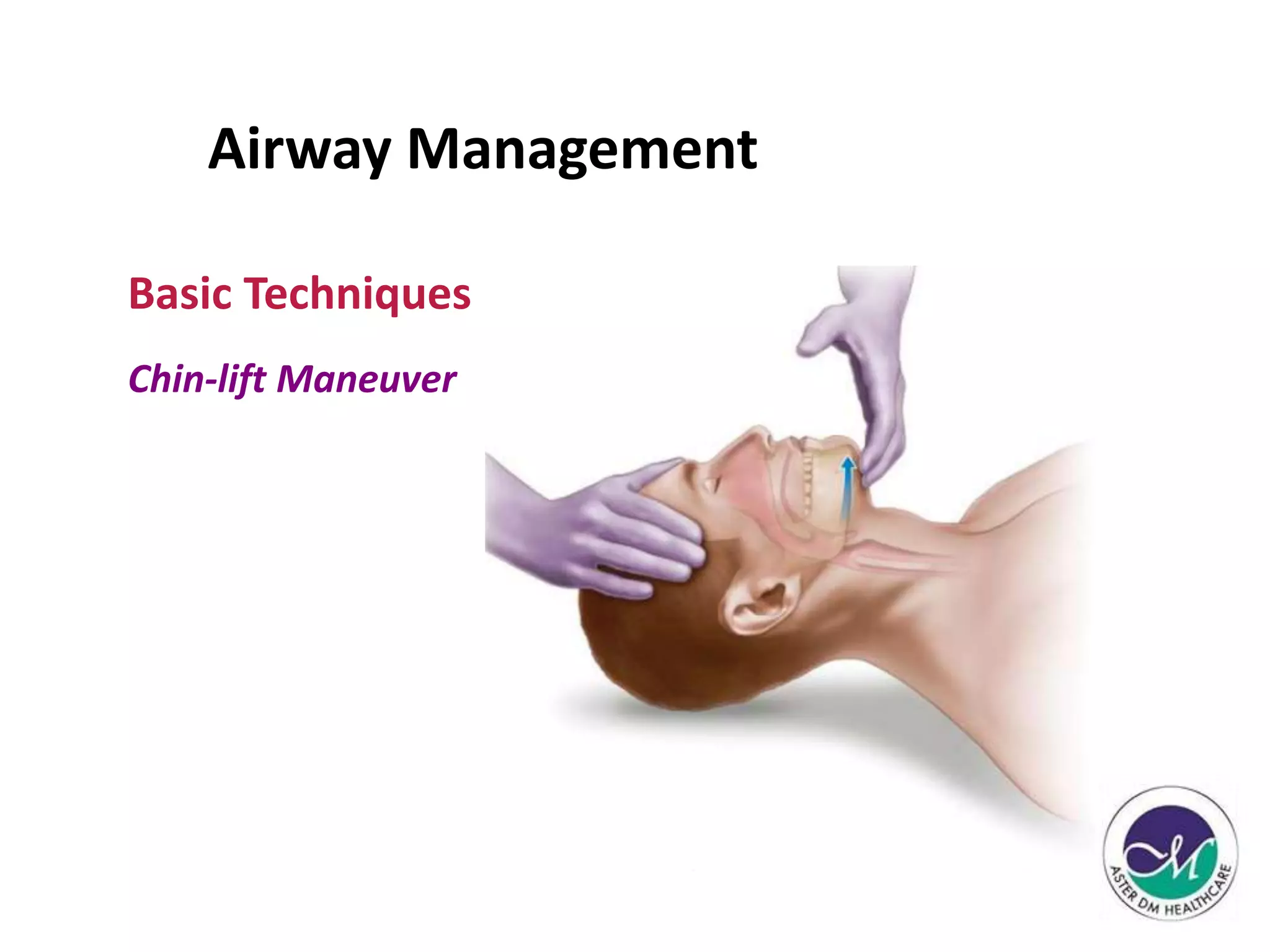
Basic Techniques 
Chin-lift Maneuver
Jaw thrust
Trauma ?
Airway 
Not – Maintainable ? 
Adjuncts
Airway Management 
Basic Adjuncts 
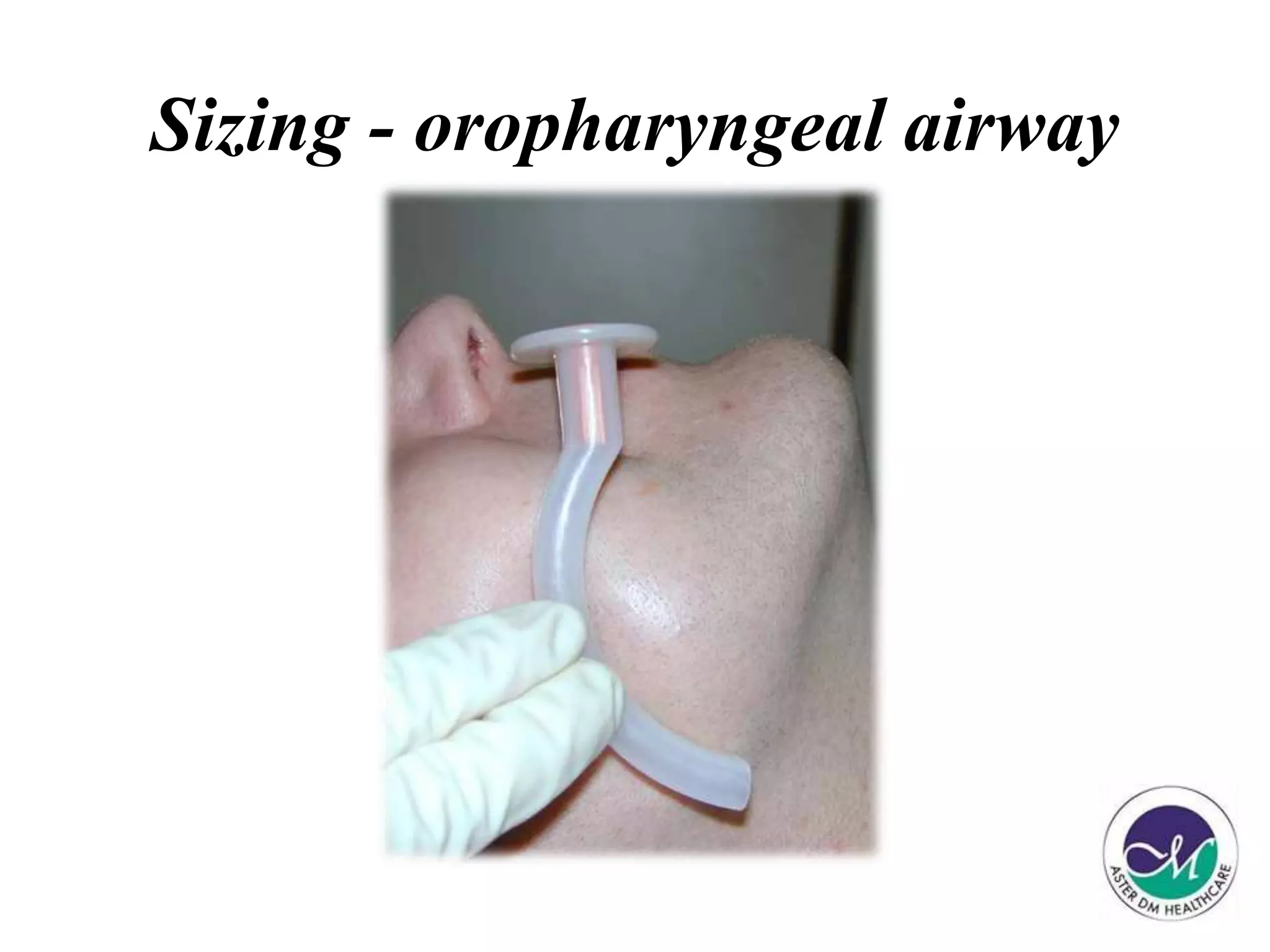
Oropharyngeal airway 
● Patients who can tolerate an oral airway will 
usually need intubation. 
Nasopharyngeal airway 
● Often well tolerated
• Airway Reflexes ? …..No ! 
Choice –OPA !
O P A
Sizing - oropharyngeal airway
• OPA is not tolerating ? 
• Airway reflexes retained ? 
• Inability to open mouth ? 
N P A
N 
P 
A
• Facial and Maxillary injury 
• Fracture Base of skull 
Caution 
Raccoons' eye Battles sign
Airway Management 
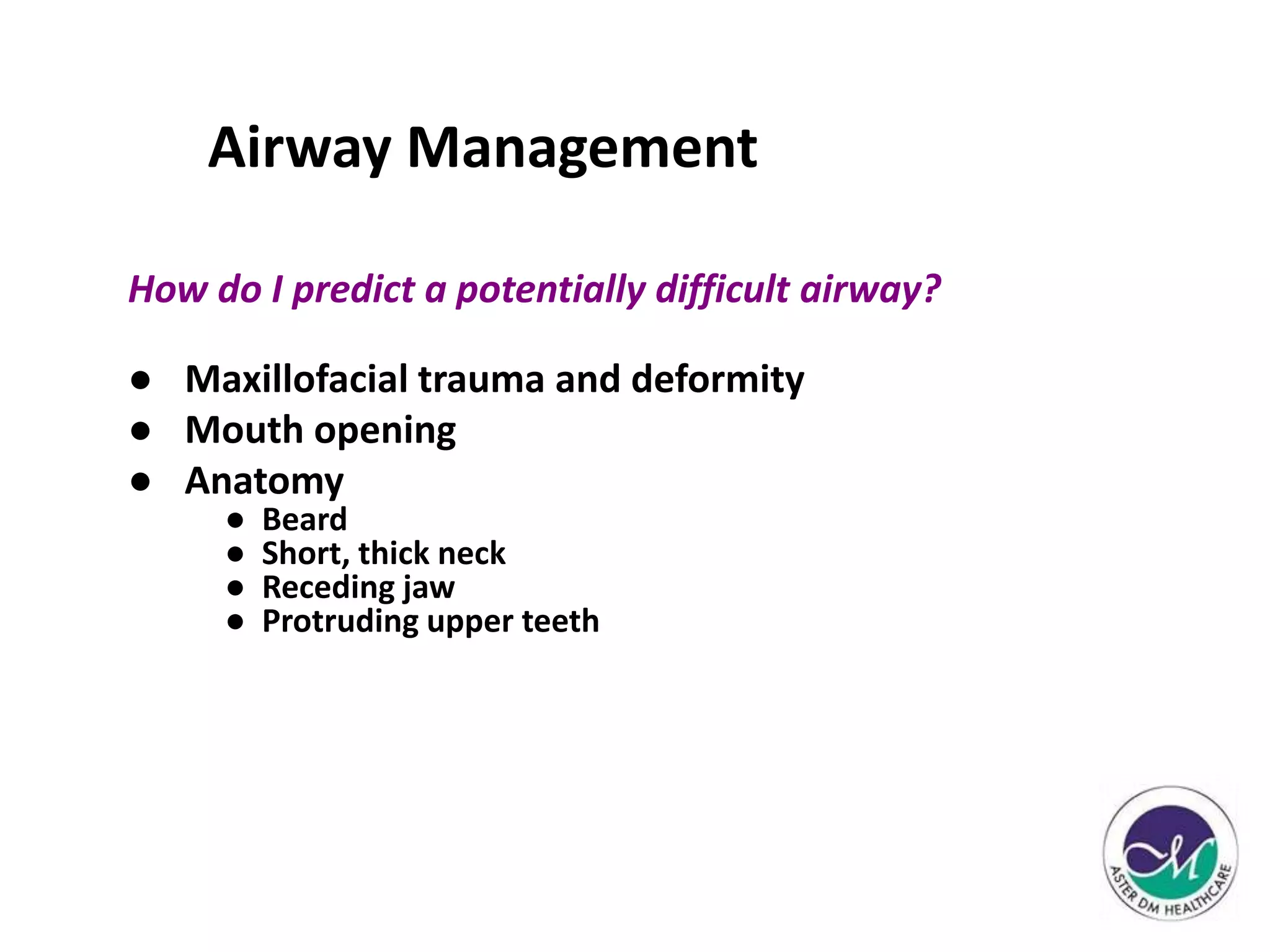
How do I predict a potentially difficult airway? 
● Maxillofacial trauma and deformity 
● Mouth opening 
● Anatomy 
● Beard 
● Short, thick neck 
● Receding jaw 
● Protruding upper teeth
Airway Management 
Is this a difficult airway? 
How would you manage this 
patient?
Airway Management 
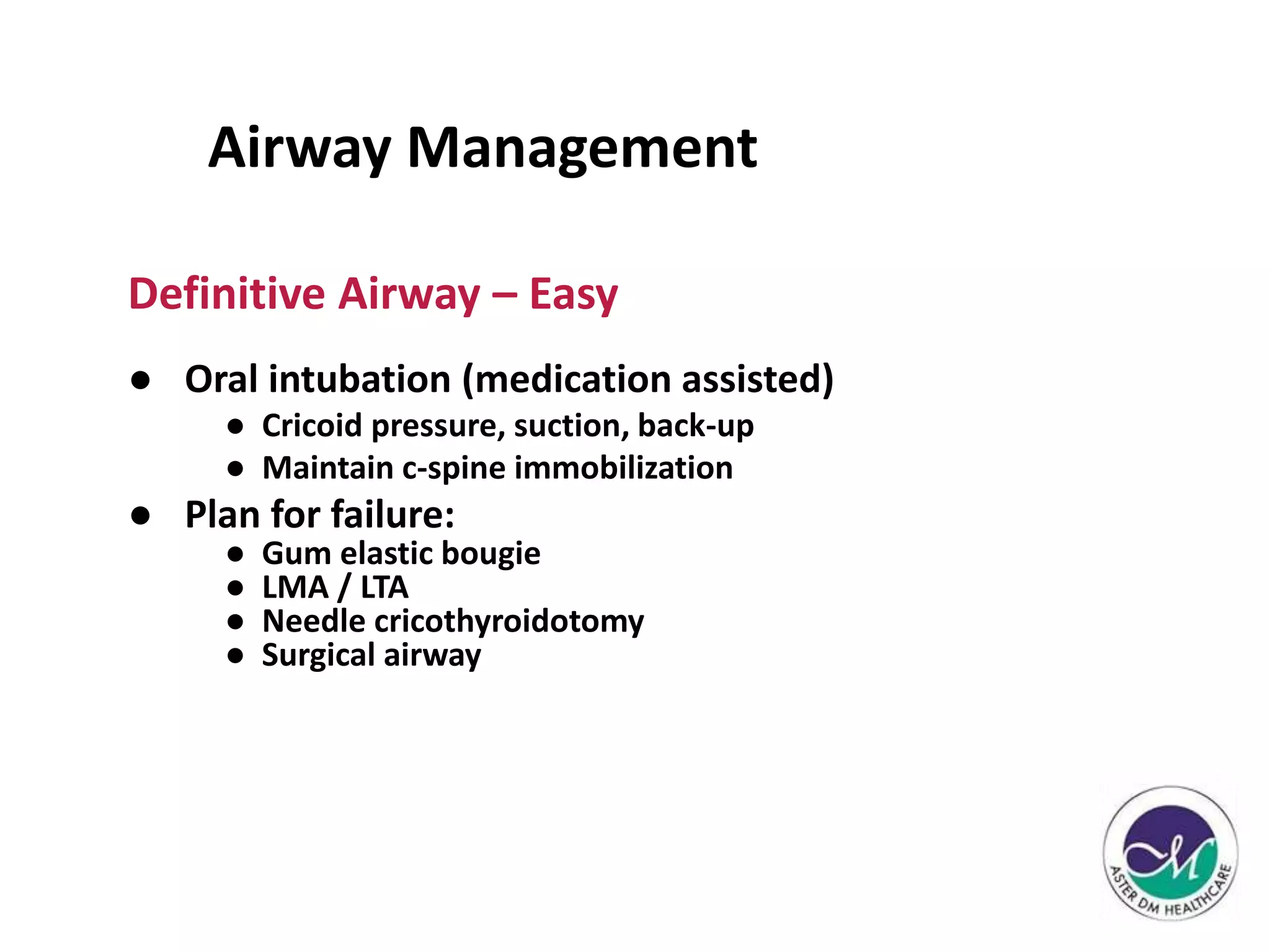
Definitive Airway – Easy 
● Oral intubation (medication assisted) 
● Cricoid pressure, suction, back-up 
● Maintain c-spine immobilization 
● Plan for failure: 
● Gum elastic bougie 
● LMA / LTA 
● Needle cricothyroidotomy 
● Surgical airway
RSI: “7 P’s” 
1. P = Preoxygenation 
2. P = Preparation 
3. P = Pretreatment 
4. P = Paralysis with induction 
5. P = Protection 
6. P = Placement of the tube 
7. P = Post-Intubation management
RSI: Timeline 
T – 10 minutes Prepare 
T – 5 minutes Preoxygenate 
T – 3 minutes Pretreat 
T = 0 Paralysis with 
induction 
T + 30 seconds Protection 
T + 45 seconds Placement 
T + 90 seconds Post-Intubation 
management
Airway Management 
Definitive Airway – Easy 
● Preoxygenate 
● Cricoid pressure 
● Sedate (midazolam) 
● Paralytic (succinylcholine) 
● Intubate 
● Confirm (Auscultate, CO2) 
● Release cricoid pressure and ventilate
Airway Management 
Is this a difficult airway? 
How would you manage this 
patient?
Airway Evaluation 
Problem Airway 
epiglottis Vocal cords
Difficult Airway Assessment 
• 4 D’s 
– Distortion, Disproportion, Dysmobility, Dentition 
• BONES 
– Beard, Obese, No teeth, Elderly, Snores (sleep apnea) 
• SHORT 
– Surgery (head/neck/jaw), Hematoma, Obese, 
Radiation, Tumor 
• LEMON 
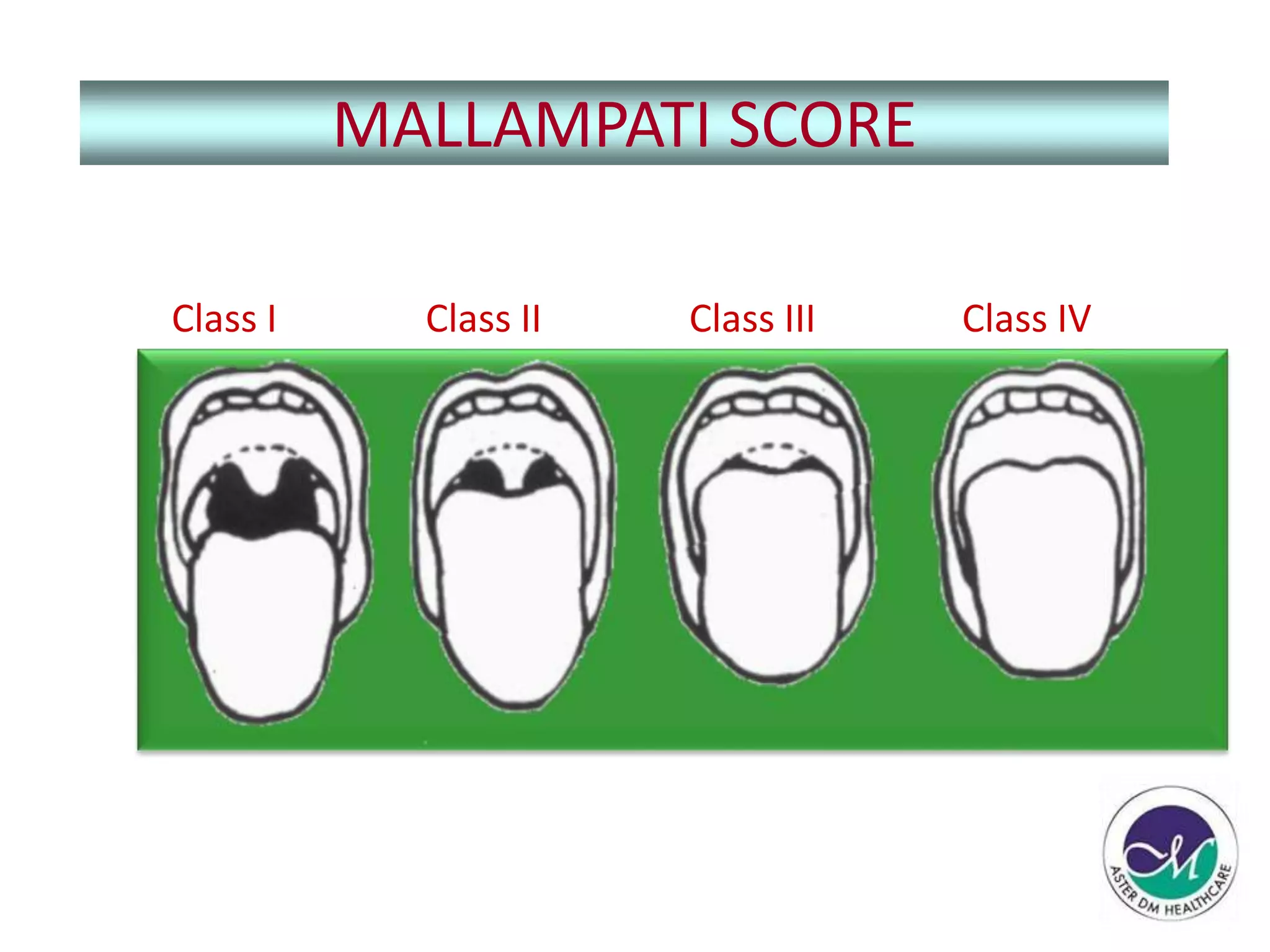
• MALLAMPATI 
• Always have a “Rescue Airway” technique ready
MALLAMPATI SCORE 
Class I Class II Class III Class IV
Anticipate the worst !!!
60-SECOND EXAM “LEMON” 
• Look for external difficulty 
• Evaluate using 3=3=2 rule 
• Mallampati (Class I & II) 
• Obstruction 
• Neck Mobility 
 3 fingers fit in mouth 
 3 fingers fit from mentum 
to hyoid cartilage 
 2 fingers fit from mandible 
to top of thyroid cartilage
McIntyre; The difficult tracheal intubation
Airway Management 
Definitive Airway – Difficult 
● Get help 
● Be prepared 
● Consider rapid sequence intubation vs. awake 
intubation 
● Maintain c-spine immobilization 
● Consider use of: 
● Gum elastic bougie 
● LMA / LTA 
● Surgical airway 
● Other advanced airway techniques, eg, fiberoptic 
intubation
Gum elastic bougie
LMA
Igel
Intubating LMA
Kings LT airway
Video Laryngoscope
Video Assisted Laryngoscope
Other methods 
Useful in semi elective scenarios 
• Fiberoptic intubation
Airway Management 
Definitive Airway 
● Surgical airway 
● Cricothyroidotomy 
Needle 
Surgical
Always 
Do confirm tube positions !!
Airway Confirmation 
How do I know the tube is in the right place? 
● Visualize it going through 
the cords 
● Watch the chest 
● Auscultation 
● Pulse oximeter 
● CO2 detector 
● Radiology
Rule out wrong tube position
End tidal CO2 detection
Esophageal Detector Devices 
(EDD)
Recognize Adequacy of Ventilations 
Pulse oximeter
Approximate Blood oxygen level ! 
SpO2 100% = PaO2 100mm of Hg 
SpO2 90%= PaO2 60mm of Hg 
SpO2 60%= PaO2 30mm of Hg 
SpO2 50%= PaO2 27mm of Hg
Airway Decision Scheme
Airway 
can be 
tricky 
always
www.drvenu.net 
www.emergencymedicinemims.com
Airway solutions in trauma scenarios

Airway solutions in trauma scenarios

  • 1.
    Airway solutions inan acute trauma scenario Dr.Venugopalan.P.P DA;DNB;MNAMS;MEM[GWU] Director ; Emergency Medicine Aster DM Health Care Ltd Deputy Director ;MIMS Academy Founder and executive director -ANGELS
  • 2.
    Focus • Why? • When? • How? • What is different? • What is new ?
  • 3.
    Case Scenario Whatis your first priority? 28year old man was brought to ED following a motor bike accident , Pulse 112,BP 110/60,Rapid breathing , Snoring+ SpO2 87 in room air and CGS 8/15. Smell of alcohol +
  • 4.
    Priority –One •Airway is the first system to be taken care in any trauma victim • Compromised airway will endanger the patient life more rapidly than any other system compromise
  • 5.
    Airway Assessment Howdo I know the airway is adequate? ● Patient is alert and oriented. ● Patient is talking normally. ● There is no evidence of injury to the head or neck. ● You have assessed and reassessed for deterioration.
  • 6.
    Airway Assessment Signsand symptoms of airway compromise ● High index of suspicion ● Change in voice / sore throat ● Noisy breathing (snoring and stridor) ● Dyspnea and agitation
  • 7.
    Airway Assessment Signsand symptoms of airway compromise (cont.) ● Tachypnea ● Abnormal breathing pattern ● Low oxygen saturation (late sign)
  • 8.
    Airway Assessment Whento intervene when the airway is patent ● Inability to protect the airway ● Impending airway compromise ● Need for ventilation
  • 9.
    Trauma :Definitive airway • Apnoea • Glasgow Coma Scale < 8 or sustained seizure activity. • Unstable mid-face trauma. • Airway injuries. • Large flail segment or respiratory failure. • High aspiration risk. • Inability to otherwise maintain an airway or oxygenation.
  • 10.
    Airway Assessment ImpendingAirway Obstruction
  • 11.
    Airway Management Howdo I manage the airway of a trauma patient? ● Supplemental oxygen ● Basic techniques ● Basic adjuncts ● Definitive airway ● Cuffed tube in the trachea ● Difficult airway adjuncts ● Unexpected difficult airway ● Predicted difficult airway
  • 12.
    Airway Management Protectthe cervical spine during airway management! Caution
  • 13.
    Obstructed airway ? • Tongue and Epiglottis • Any Foreign materials ? Clear it Noisy breathing ?
  • 14.
  • 15.
    Airway Management BasicTechniques Chin-lift Maneuver
  • 16.
  • 17.
  • 18.
    Airway Not –Maintainable ? Adjuncts
  • 19.
    Airway Management BasicAdjuncts Oropharyngeal airway ● Patients who can tolerate an oral airway will usually need intubation. Nasopharyngeal airway ● Often well tolerated
  • 20.
    • Airway Reflexes? …..No ! Choice –OPA !
  • 21.
  • 22.
  • 25.
    • OPA isnot tolerating ? • Airway reflexes retained ? • Inability to open mouth ? N P A
  • 26.
  • 28.
    • Facial andMaxillary injury • Fracture Base of skull Caution Raccoons' eye Battles sign
  • 29.
    Airway Management Howdo I predict a potentially difficult airway? ● Maxillofacial trauma and deformity ● Mouth opening ● Anatomy ● Beard ● Short, thick neck ● Receding jaw ● Protruding upper teeth
  • 30.
    Airway Management Isthis a difficult airway? How would you manage this patient?
  • 31.
    Airway Management DefinitiveAirway – Easy ● Oral intubation (medication assisted) ● Cricoid pressure, suction, back-up ● Maintain c-spine immobilization ● Plan for failure: ● Gum elastic bougie ● LMA / LTA ● Needle cricothyroidotomy ● Surgical airway
  • 32.
    RSI: “7 P’s” 1. P = Preoxygenation 2. P = Preparation 3. P = Pretreatment 4. P = Paralysis with induction 5. P = Protection 6. P = Placement of the tube 7. P = Post-Intubation management
  • 33.
    RSI: Timeline T– 10 minutes Prepare T – 5 minutes Preoxygenate T – 3 minutes Pretreat T = 0 Paralysis with induction T + 30 seconds Protection T + 45 seconds Placement T + 90 seconds Post-Intubation management
  • 34.
    Airway Management DefinitiveAirway – Easy ● Preoxygenate ● Cricoid pressure ● Sedate (midazolam) ● Paralytic (succinylcholine) ● Intubate ● Confirm (Auscultate, CO2) ● Release cricoid pressure and ventilate
  • 35.
    Airway Management Isthis a difficult airway? How would you manage this patient?
  • 36.
    Airway Evaluation ProblemAirway epiglottis Vocal cords
  • 37.
    Difficult Airway Assessment • 4 D’s – Distortion, Disproportion, Dysmobility, Dentition • BONES – Beard, Obese, No teeth, Elderly, Snores (sleep apnea) • SHORT – Surgery (head/neck/jaw), Hematoma, Obese, Radiation, Tumor • LEMON • MALLAMPATI • Always have a “Rescue Airway” technique ready
  • 38.
    MALLAMPATI SCORE ClassI Class II Class III Class IV
  • 39.
  • 40.
    60-SECOND EXAM “LEMON” • Look for external difficulty • Evaluate using 3=3=2 rule • Mallampati (Class I & II) • Obstruction • Neck Mobility  3 fingers fit in mouth  3 fingers fit from mentum to hyoid cartilage  2 fingers fit from mandible to top of thyroid cartilage
  • 41.
    McIntyre; The difficulttracheal intubation
  • 42.
    Airway Management DefinitiveAirway – Difficult ● Get help ● Be prepared ● Consider rapid sequence intubation vs. awake intubation ● Maintain c-spine immobilization ● Consider use of: ● Gum elastic bougie ● LMA / LTA ● Surgical airway ● Other advanced airway techniques, eg, fiberoptic intubation
  • 43.
  • 44.
  • 46.
  • 47.
  • 50.
  • 51.
  • 52.
  • 53.
    Other methods Usefulin semi elective scenarios • Fiberoptic intubation
  • 54.
    Airway Management DefinitiveAirway ● Surgical airway ● Cricothyroidotomy Needle Surgical
  • 55.
    Always Do confirmtube positions !!
  • 56.
    Airway Confirmation Howdo I know the tube is in the right place? ● Visualize it going through the cords ● Watch the chest ● Auscultation ● Pulse oximeter ● CO2 detector ● Radiology
  • 57.
    Rule out wrongtube position
  • 58.
    End tidal CO2detection
  • 59.
  • 60.
    Recognize Adequacy ofVentilations Pulse oximeter
  • 61.
    Approximate Blood oxygenlevel ! SpO2 100% = PaO2 100mm of Hg SpO2 90%= PaO2 60mm of Hg SpO2 60%= PaO2 30mm of Hg SpO2 50%= PaO2 27mm of Hg
  • 62.
  • 63.
    Airway can be tricky always
  • 64.