Unit 2
METEOROLOGY
METEOROLOGY
• Meteorology is the scientific study of the
atmosphere, weather, and climate. It involves
observing, understanding, and predicting
atmospheric phenomena, such as temperature,
humidity, wind patterns, air pressure, and
precipitation. Meteorologists use a
combination of observation, data collection,
computer modeling, and analysis to study and
forecast weather conditions.
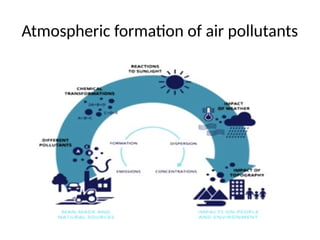
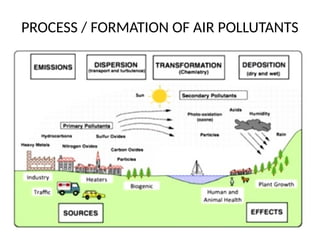
Atmospheric formation of air pollutants
PROCESS / FORMATION OF AIR POLLUTANTS
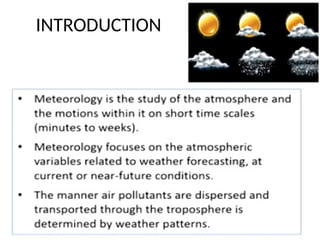
INTRODUCTION
HISTORY
DEFINITION METEOROLOGY
• Meteorology is an atmospheric science that
studies the day to day changes in the atmosphere.
• Some of the basic terms
• Atmosphere: It is the envelope of gas that
surrounds the surface of Earth; the air
• Weather: It is defined as the day to day changes
in the atmosphere caused by shifts in
temperature, air pressure, and humidity
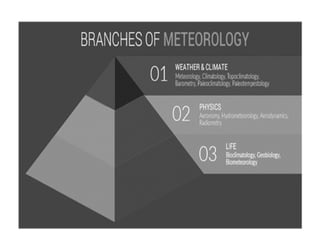
• METEOROLOGISTS are scientists that study
atmospheric sciences that include
• CLIMATOLOGY: the study of climate
• ATMOSPHERIC CHEMISTRY: the study of
chemicals in the air
• ATMOSPHERIC PHY SICS: the study of how air
behaves and
• HYDROMETEOROLOGY: the study of how oceans
interact with weather
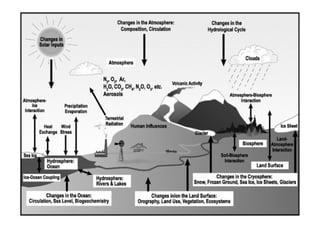
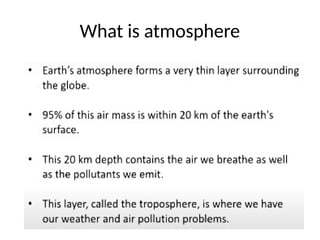
What is atmosphere
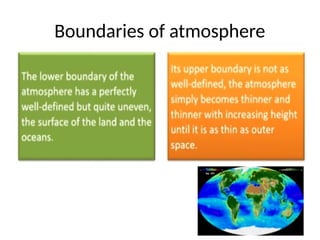
Boundaries of atmosphere
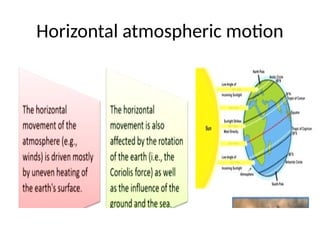
Horizontal atmospheric motion
• The following are the variables which predict the weather.
• 1. Air Temperature depends on AOI, DOI, and IOI (thermometer)
• 2. Air Pressure ––the force exerted by the air overhead
(barometer)
• 3. Humidity the amount of moisture in the air (hygrometer)
• 4.Wind Speed (anemometer)
• 5.Wind Direction (wind vane or weather vane)
• Atmospheric Transparency Visibility –– how clear the air is
(ceiling)
• Visibility -how far ahead you can see (in miles)
• Wind Chill –how cold it feels (combo of temp. and wind)
• Dew point Temperature -the temp. air needs to cool to, in order
for condensation to happen (could forms)
EFFECTS OF METEOROLOGY ON AIR
POLLUTION
• four categories, gaseous pollutants and vapors
(SO 2 , NOx, CO, ozone. Volatile Organic
Compounds), persistent organic pollutants
(dioxins fine particulate Matter (PM 25 , PM 10 ,
and TSP). ), heavy metals (lead, mercury and
Wind speed and dircetion
• Wind speed and direction
• When high pollutant concentrations occur at a
monitoring station, wind das records can
determine the general direction and area of the
emissions. Identifying the sources means
planning to reduce the impacts on air quality.
An instrument called an anemometer measures
wind speed. At our monitoring stations, the type
of anemometer we use is a sonic anemometer.
Temperature
• Temperature Measuring temperature supports air quality
assessment, air quality modelling and forecasting
activities. Temperature and sunlight (solar radiation) play
an important role in the chemical reactions that occur in
the atmosphere to form photochemical smog from other
pollutants. Favorable conditions can lead to increased
concentrations of smog. The most common way of
measuring temperature is to use a material with a
resistance that changes with temperature, such as
platinum wire. A sensor measures this change and
converts it into a temperature reading.
humidity
• Humidity: Like temperature and solar radiation, water
vapour plays an important role in many thermal and
photochemical reactions in the atmosphere. As water
molecules are small and highly polar, they can bind
strongly to many substances. If attached to particles
suspended in the air they can significantly increase the
amount of light scattered by the particles (measuring
visibility). If the water molecules attach to corrosive
gases, such as sulfur dioxide, the gas will dissolve in the
water and form an acid solution that can damage health
and property.
RAINFALL
• Rain has a 'scavenging effect when it washes particulate
matter out of the atmosphere and dissolves gaseous
pollutants. Removing particles improves visibility.
• Where there is frequent high rainfall, air quality is
generally better. If the rain dissolves gaseous pollutants,
such as sulfur dioxide, it can form acid rain resulting in
potential damage to materials or vegetation.
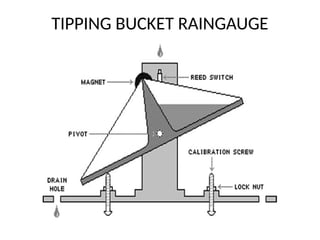
• A common method to measure rainfall is to use a
tipping bucket rain gauge image
TIPPING BUCKET RAINGAUGE
SOLAR RADIATION
• It is important to monitor solar radiation for use in
modelling photochemical smog events, as the
intensity of sunlight has an important influence on
the rate of the chemical reactions that produce the
smog. The cloudiness of the sky, time of day and
geo graphic location all affect sunlight intensity
• An instrument called a pyranometer measures solar
radiation from the output of a type of silicon cell
sensor.
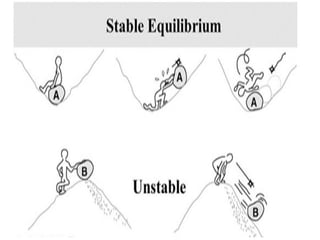
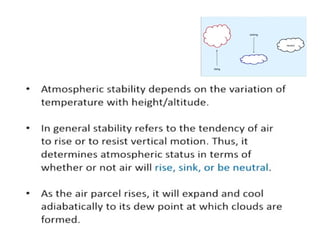
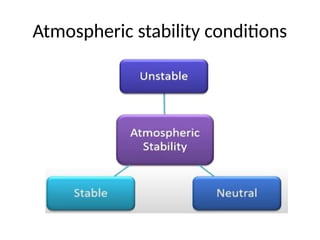
ATMOSPHERIC STABILITY
• It is a measure of the probability of cloud
formation. The secret of weather prediction is
knowing lifting is promoted or resisted. Stability
is an important characteristic of the atmosphere.
It is simply the ability to resist vertical motion.
Stability affects the ability to disperse pollutants.
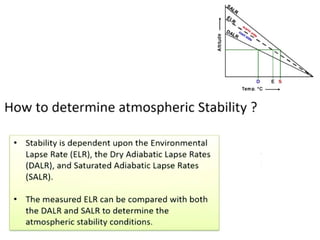
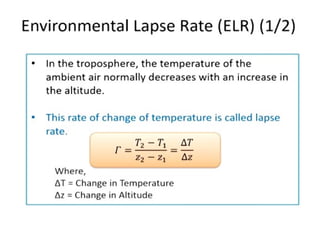
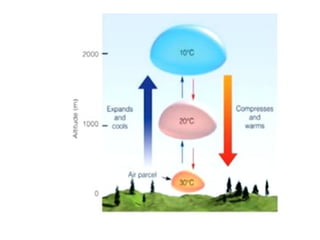
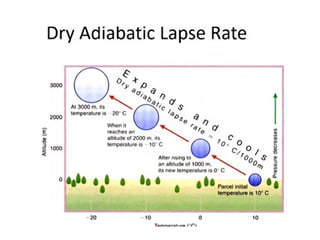
• Lapse rate: A lapse rate is a rate at which
atmospheric temperature decreases Lapse rate is
the negative of the rate of temperature change
with altitude.
LAPSE RATE
• What is lapse rate?
• The Lapse Rate is the rate at which temperature
changes with height in the Atmosphere
• Three relevant lapse rates for the basics of
understanding stability:
• 1. Dry adiabatic lapse rate
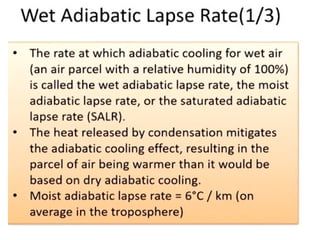
• 2. Moist adiabatic lapse rate and
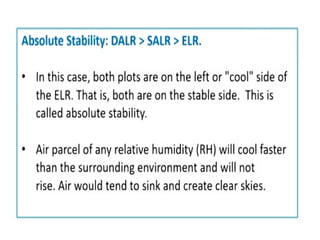
• 3. Environmental lapse rate
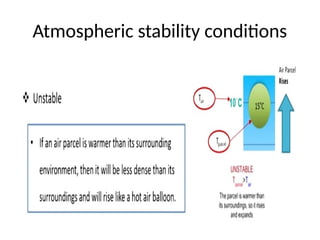
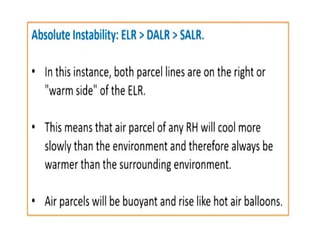
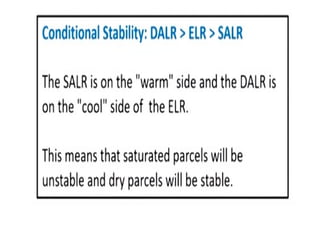
Atmospheric stability conditions
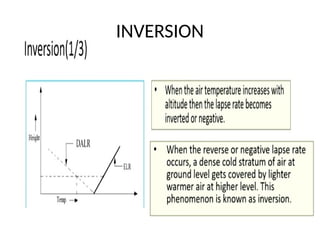
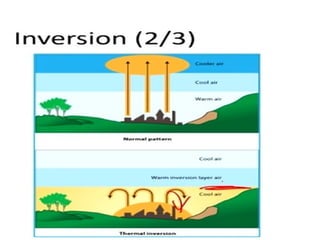
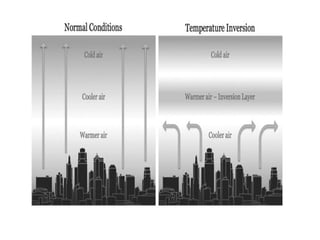
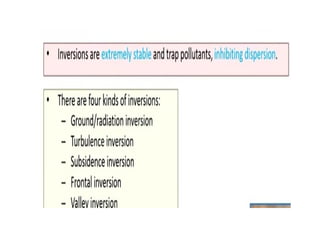
INVERSION
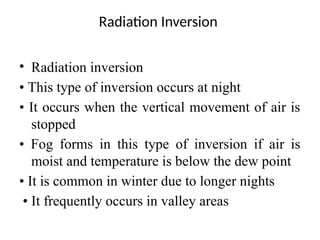
Radiation Inversion
• Radiation inversion
• This type of inversion occurs at night
• It occurs when the vertical movement of air is
stopped
• Fog forms in this type of inversion if air is
moist and temperature is below the dew point
• It is common in winter due to longer nights
• It frequently occurs in valley areas
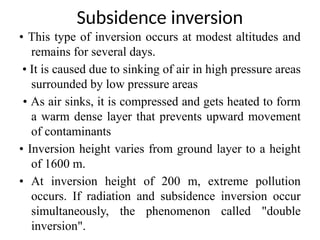
Subsidence inversion
• This type of inversion occurs at modest altitudes and
remains for several days.
• It is caused due to sinking of air in high pressure areas
surrounded by low pressure areas
• As air sinks, it is compressed and gets heated to form
a warm dense layer that prevents upward movement
of contaminants
• Inversion height varies from ground layer to a height
of 1600 m.
• At inversion height of 200 m, extreme pollution
occurs. If radiation and subsidence inversion occur
simultaneously, the phenomenon called "double
inversion".
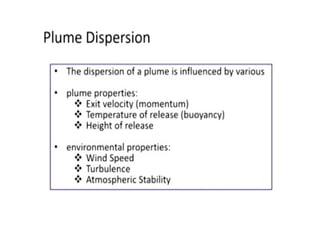
WIND PROFILES AND STACK PLUME PATTERNS
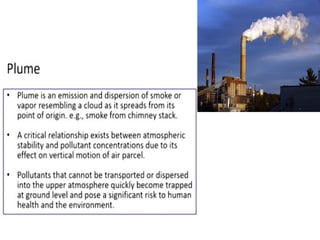
• The dispersion of emitted gases from the source of their
production is known as plume and the source is known as
stack (chimney). The behavior of a plume emitted from any
stack depends on localized air stability. The Geometric
forms of stack plumes are a function of the vertical
temperature and wind profiles, vice versa, by looking at the
plume one can state stability condition and dispersive
capacity of atmosphere. The behavior and dispersion of a
plume entirely depend on the environmental lapse rate
(ELR) influencing the flume behavior are the diurnal
(seasonal) variations in the atmospheric stability and the
long term variations which occur with change in seasons.
PLUME RISE
The height to which the pollutant can rise in
atmosphere at the time of emission
• PLUME DISPERSION
The pollutants can travel/disperse in horizontal/
vertical direction
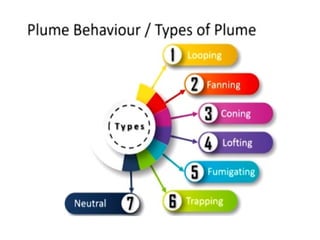
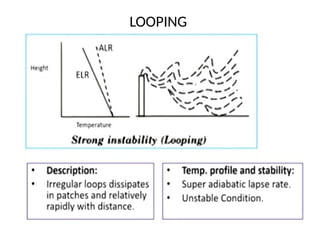
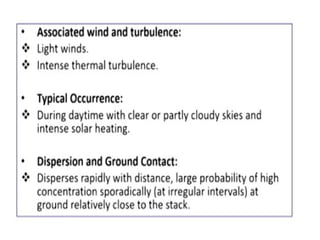
LOOPING
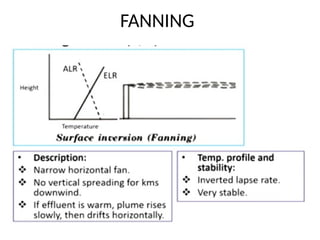
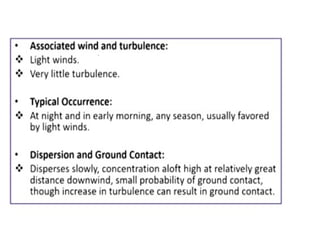
FANNING
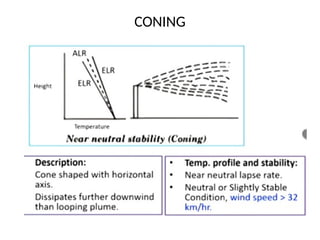
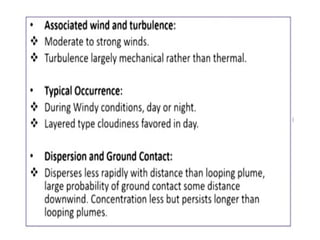
CONING
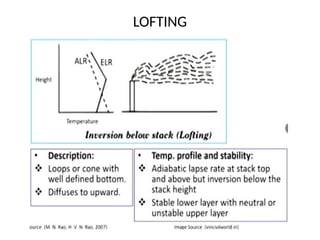
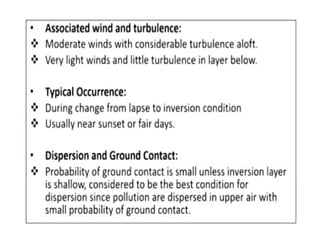
LOFTING
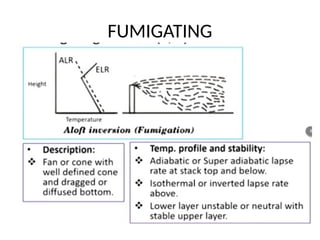
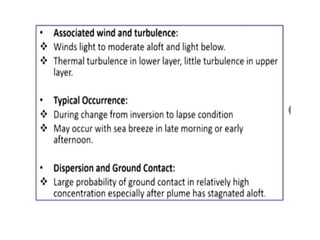
FUMIGATING
ATMOSPHERIC DIFFUSION THEORIES
• DISPERSION MODELS
Dispersion is the process by which contaminants move
through the air and a plume over a large area, thus reducing
the concentration of the pollutants it contains. The plume
spreads both horizontally and vertically.
If it is a gaseous plume, the motion of the molecules follows
the laws of gaseous diffusion.
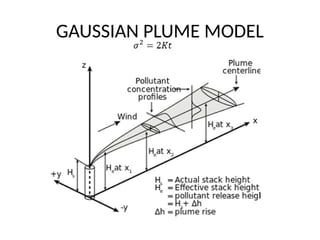
The most commonly used model for the dispersion of
gaseous air pollutants the Gaussian model developed by
Pasquill, in which gases dispersed in the atmosphere are
assumed to exhibit ideal gas behavior.
• Modeling procedure The modeling procedures
can be categorized into four generic classes: •
Gaussian • Numerical • Statistical or empirical
and • Physical
GAUSSIAN PLUME MODEL
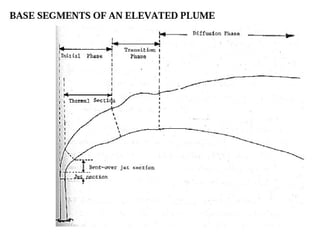
PLUME RISE
• Plume rise is closed related to air pollution, since the
concentration
Types of Plume
• Continuous Plume: The release and the sampling time are
long compared with the travel time.
• Puff Diffusion / Instantaneous Plume: The release time or
sampling time is short when compared with the travel time
Types of Plume Rise
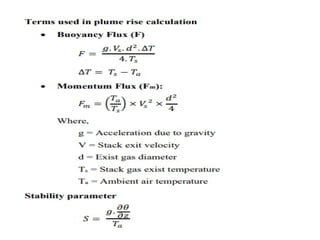
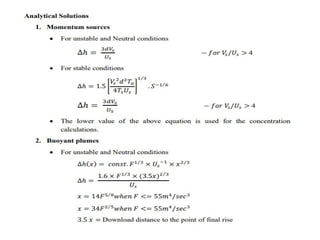
• Buoyancy Effect: Rise due to the temperature difference
between stack plume and ambient air.
• Momentum Rise: Rise due to exit velocity of the effluents
(emissions).
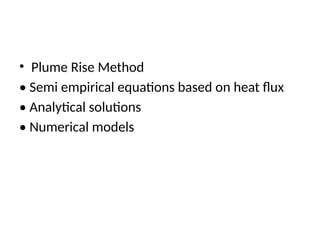
• Plume Rise Method
• Semi empirical equations based on heat flux
• Analytical solutions
• Numerical models
AIR POLUTION AND CONTROL ENGINEERING Unit II

AIR POLUTION AND CONTROL ENGINEERING Unit II

  • 1.
  • 2.
    METEOROLOGY • Meteorology isthe scientific study of the atmosphere, weather, and climate. It involves observing, understanding, and predicting atmospheric phenomena, such as temperature, humidity, wind patterns, air pressure, and precipitation. Meteorologists use a combination of observation, data collection, computer modeling, and analysis to study and forecast weather conditions.
  • 3.
  • 5.
    PROCESS / FORMATIONOF AIR POLLUTANTS
  • 6.
  • 9.
  • 15.
    DEFINITION METEOROLOGY • Meteorologyis an atmospheric science that studies the day to day changes in the atmosphere. • Some of the basic terms • Atmosphere: It is the envelope of gas that surrounds the surface of Earth; the air • Weather: It is defined as the day to day changes in the atmosphere caused by shifts in temperature, air pressure, and humidity
  • 16.
    • METEOROLOGISTS arescientists that study atmospheric sciences that include • CLIMATOLOGY: the study of climate • ATMOSPHERIC CHEMISTRY: the study of chemicals in the air • ATMOSPHERIC PHY SICS: the study of how air behaves and • HYDROMETEOROLOGY: the study of how oceans interact with weather
  • 18.
  • 19.
  • 21.
  • 23.
    • The followingare the variables which predict the weather. • 1. Air Temperature depends on AOI, DOI, and IOI (thermometer) • 2. Air Pressure ––the force exerted by the air overhead (barometer) • 3. Humidity the amount of moisture in the air (hygrometer) • 4.Wind Speed (anemometer) • 5.Wind Direction (wind vane or weather vane) • Atmospheric Transparency Visibility –– how clear the air is (ceiling) • Visibility -how far ahead you can see (in miles) • Wind Chill –how cold it feels (combo of temp. and wind) • Dew point Temperature -the temp. air needs to cool to, in order for condensation to happen (could forms)
  • 24.
    EFFECTS OF METEOROLOGYON AIR POLLUTION • four categories, gaseous pollutants and vapors (SO 2 , NOx, CO, ozone. Volatile Organic Compounds), persistent organic pollutants (dioxins fine particulate Matter (PM 25 , PM 10 , and TSP). ), heavy metals (lead, mercury and
  • 25.
    Wind speed anddircetion • Wind speed and direction • When high pollutant concentrations occur at a monitoring station, wind das records can determine the general direction and area of the emissions. Identifying the sources means planning to reduce the impacts on air quality. An instrument called an anemometer measures wind speed. At our monitoring stations, the type of anemometer we use is a sonic anemometer.
  • 26.
    Temperature • Temperature Measuringtemperature supports air quality assessment, air quality modelling and forecasting activities. Temperature and sunlight (solar radiation) play an important role in the chemical reactions that occur in the atmosphere to form photochemical smog from other pollutants. Favorable conditions can lead to increased concentrations of smog. The most common way of measuring temperature is to use a material with a resistance that changes with temperature, such as platinum wire. A sensor measures this change and converts it into a temperature reading.
  • 27.
    humidity • Humidity: Liketemperature and solar radiation, water vapour plays an important role in many thermal and photochemical reactions in the atmosphere. As water molecules are small and highly polar, they can bind strongly to many substances. If attached to particles suspended in the air they can significantly increase the amount of light scattered by the particles (measuring visibility). If the water molecules attach to corrosive gases, such as sulfur dioxide, the gas will dissolve in the water and form an acid solution that can damage health and property.
  • 28.
    RAINFALL • Rain hasa 'scavenging effect when it washes particulate matter out of the atmosphere and dissolves gaseous pollutants. Removing particles improves visibility. • Where there is frequent high rainfall, air quality is generally better. If the rain dissolves gaseous pollutants, such as sulfur dioxide, it can form acid rain resulting in potential damage to materials or vegetation. • A common method to measure rainfall is to use a tipping bucket rain gauge image
  • 29.
  • 30.
    SOLAR RADIATION • Itis important to monitor solar radiation for use in modelling photochemical smog events, as the intensity of sunlight has an important influence on the rate of the chemical reactions that produce the smog. The cloudiness of the sky, time of day and geo graphic location all affect sunlight intensity • An instrument called a pyranometer measures solar radiation from the output of a type of silicon cell sensor.
  • 31.
    ATMOSPHERIC STABILITY • Itis a measure of the probability of cloud formation. The secret of weather prediction is knowing lifting is promoted or resisted. Stability is an important characteristic of the atmosphere. It is simply the ability to resist vertical motion. Stability affects the ability to disperse pollutants. • Lapse rate: A lapse rate is a rate at which atmospheric temperature decreases Lapse rate is the negative of the rate of temperature change with altitude.
  • 32.
    LAPSE RATE • Whatis lapse rate? • The Lapse Rate is the rate at which temperature changes with height in the Atmosphere • Three relevant lapse rates for the basics of understanding stability: • 1. Dry adiabatic lapse rate • 2. Moist adiabatic lapse rate and • 3. Environmental lapse rate
  • 36.
  • 37.
  • 49.
  • 53.
    Radiation Inversion • Radiationinversion • This type of inversion occurs at night • It occurs when the vertical movement of air is stopped • Fog forms in this type of inversion if air is moist and temperature is below the dew point • It is common in winter due to longer nights • It frequently occurs in valley areas
  • 54.
    Subsidence inversion • Thistype of inversion occurs at modest altitudes and remains for several days. • It is caused due to sinking of air in high pressure areas surrounded by low pressure areas • As air sinks, it is compressed and gets heated to form a warm dense layer that prevents upward movement of contaminants • Inversion height varies from ground layer to a height of 1600 m. • At inversion height of 200 m, extreme pollution occurs. If radiation and subsidence inversion occur simultaneously, the phenomenon called "double inversion".
  • 55.
    WIND PROFILES ANDSTACK PLUME PATTERNS • The dispersion of emitted gases from the source of their production is known as plume and the source is known as stack (chimney). The behavior of a plume emitted from any stack depends on localized air stability. The Geometric forms of stack plumes are a function of the vertical temperature and wind profiles, vice versa, by looking at the plume one can state stability condition and dispersive capacity of atmosphere. The behavior and dispersion of a plume entirely depend on the environmental lapse rate (ELR) influencing the flume behavior are the diurnal (seasonal) variations in the atmospheric stability and the long term variations which occur with change in seasons.
  • 57.
    PLUME RISE The heightto which the pollutant can rise in atmosphere at the time of emission • PLUME DISPERSION The pollutants can travel/disperse in horizontal/ vertical direction
  • 61.
  • 63.
  • 65.
  • 67.
  • 69.
  • 71.
    ATMOSPHERIC DIFFUSION THEORIES •DISPERSION MODELS Dispersion is the process by which contaminants move through the air and a plume over a large area, thus reducing the concentration of the pollutants it contains. The plume spreads both horizontally and vertically. If it is a gaseous plume, the motion of the molecules follows the laws of gaseous diffusion. The most commonly used model for the dispersion of gaseous air pollutants the Gaussian model developed by Pasquill, in which gases dispersed in the atmosphere are assumed to exhibit ideal gas behavior.
  • 72.
    • Modeling procedureThe modeling procedures can be categorized into four generic classes: • Gaussian • Numerical • Statistical or empirical and • Physical
  • 73.
  • 74.
    PLUME RISE • Plumerise is closed related to air pollution, since the concentration Types of Plume • Continuous Plume: The release and the sampling time are long compared with the travel time. • Puff Diffusion / Instantaneous Plume: The release time or sampling time is short when compared with the travel time Types of Plume Rise • Buoyancy Effect: Rise due to the temperature difference between stack plume and ambient air. • Momentum Rise: Rise due to exit velocity of the effluents (emissions).
  • 75.
    • Plume RiseMethod • Semi empirical equations based on heat flux • Analytical solutions • Numerical models