Air Pollution Modeling (AQM) and
APTI
Sandeep Kumar
Centre for Environment Science and Climate Resilient
Agriculture
ICAR-Indian Agricultural Research Institute
New Delhi 110012
Model ?
A model is a simplified picture of reality or real situation.
It doesn’t contain all the features of the real system but
contains the features of interest for the management
issue or scientific problem we wish to solve by its use.
Models are widely used in science to make predictions
and/or to solve problems, and are often used to identify
the best solutions for the management of specific
environmental problems.
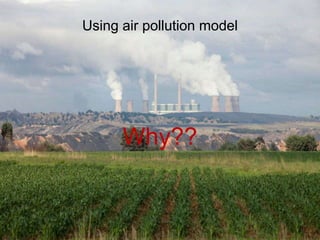
Using air pollution model
Why??
Air pollution measurements give important, quantitative
information about ambient concentrations and
deposition, but they can only describe air quality at
specific locations and times, without giving clear
guidance on the identification of the causes of the air
quality problem.
 Air pollution modeling, instead, can give
 a more complete deterministic description of the air
quality problem, including an analysis of factors and
causes (emission sources, meteorological processes, and
physical and chemical changes), and some guidance on
the implementation of mitigation measures.
Pollutants discharged into the air are transported over
long distances by large-scale air-flows and dispersed by
small-scale air-flows or turbulence, which mix
contaminants with clean air.
This dispersion by the wind is a very complex process
due to the presence of different-sized eddies in
atmospheric flow.
There is no complete theory that describes the
relationship between ambient concentrations of air
pollutants and the causative meteorological factors and
processes.
 Currently, the most commonly used dispersion models
are steady-state Gaussian-plume models.
 Air dispersion models are used to provide an estimate of
a concentration or deposition of a pollutant emitted from
an point, line and area source.
 There are numerous models that are used for both short-
range local scale modelling (<20 km), and long-range,
regional/trans-boundary, air pollution (>50km).
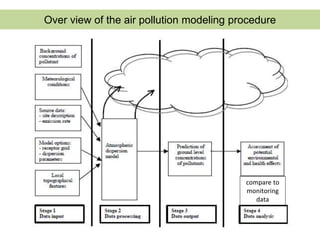
Over view of the air pollution modeling procedure
compare to
monitoring
data
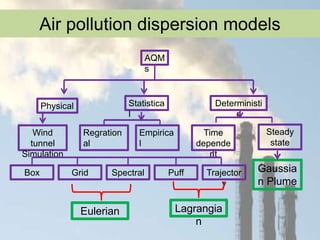
Air pollution dispersion models
AQM
s
Physical Deterministi
c
Statistica
l
Wind
tunnel
Simulation
Regration
al
Empirica
l
Time
depende
nt
Steady
state
Gaussia
n Plume
Trajector
y
PuffSpectralGridBox
Eulerian Lagrangia
n
धन्यवाद

Air pollution modeling

  • 1.
    Air Pollution Modeling(AQM) and APTI Sandeep Kumar Centre for Environment Science and Climate Resilient Agriculture ICAR-Indian Agricultural Research Institute New Delhi 110012
  • 2.
    Model ? A modelis a simplified picture of reality or real situation. It doesn’t contain all the features of the real system but contains the features of interest for the management issue or scientific problem we wish to solve by its use. Models are widely used in science to make predictions and/or to solve problems, and are often used to identify the best solutions for the management of specific environmental problems.
  • 3.
  • 4.
    Air pollution measurementsgive important, quantitative information about ambient concentrations and deposition, but they can only describe air quality at specific locations and times, without giving clear guidance on the identification of the causes of the air quality problem.
  • 5.
     Air pollutionmodeling, instead, can give  a more complete deterministic description of the air quality problem, including an analysis of factors and causes (emission sources, meteorological processes, and physical and chemical changes), and some guidance on the implementation of mitigation measures.
  • 6.
    Pollutants discharged intothe air are transported over long distances by large-scale air-flows and dispersed by small-scale air-flows or turbulence, which mix contaminants with clean air. This dispersion by the wind is a very complex process due to the presence of different-sized eddies in atmospheric flow. There is no complete theory that describes the relationship between ambient concentrations of air pollutants and the causative meteorological factors and processes.
  • 7.
     Currently, themost commonly used dispersion models are steady-state Gaussian-plume models.  Air dispersion models are used to provide an estimate of a concentration or deposition of a pollutant emitted from an point, line and area source.  There are numerous models that are used for both short- range local scale modelling (<20 km), and long-range, regional/trans-boundary, air pollution (>50km).
  • 8.
    Over view ofthe air pollution modeling procedure compare to monitoring data
  • 9.
    Air pollution dispersionmodels AQM s Physical Deterministi c Statistica l Wind tunnel Simulation Regration al Empirica l Time depende nt Steady state Gaussia n Plume Trajector y PuffSpectralGridBox Eulerian Lagrangia n
  • 10.