L-17
Plume Rise Formulae
Air Pollution and Control
(Elective -I)
• Gases that are emitted from stacks are often
pushed out by fans. As the turbulent exhaust
gases exit the stack they mix with ambient air.
This mixing of ambient air into the plume is
called entrainment. As the plume entrains
air into it, the plume diameter grows as it
travels downwind. These gases have
momentum as they enter the atmosphere.
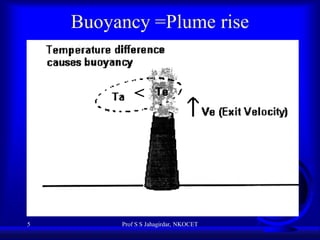
Often these gases are heated and are warmer
than the outdoor air. In these cases the emitted
gases are less dense than the outside air and
are therefore buoyant.
Prof S S Jahagirdar, NKOCET

2
• A combination of the gases' momentum and
buoyancy causes the gases to rise. This is
referred to as plume rise and allows air
pollutants emitted in this gas stream to be
lofted higher in the atmosphere. Since the
plume is higher in the atmosphere and at a
further distance from the ground, the plume
will disperse more before it reaches ground
level.

Prof S S Jahagirdar, NKOCET

3
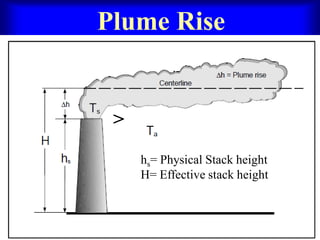
Plume Rise

>
hs= Physical Stack height
H= Effective stack height

Prof S S Jahagirdar, NKOCET

4
Buoyancy =Plume rise

<

5

Prof S S Jahagirdar, NKOCET
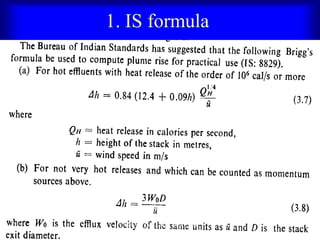
1. IS formula

Prof S S Jahagirdar, NKOCET

6
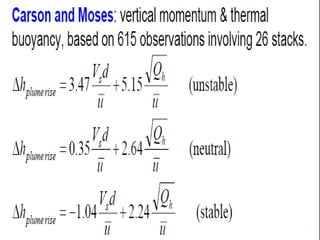
2. Modified Carson and
Moses formula
0.5

h  a.[(Vs .d ) / u ]  b.[(Qh ) / u ]
Stability
Condition

a

b

Unstable

3.47
0.35
-1.04

5.15
2.64
2.24

Neutral
Stable

Prof S S Jahagirdar, NKOCET

7
Prof S S Jahagirdar, NKOCET

8
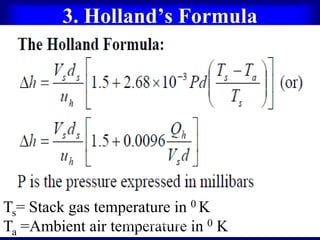
3. Holland’s Formula

Ts= Stack gas temperature in 0 K
Ta =Ambient air temperature in 0 K
Prof S S Jahagirdar, NKOCET

9
4. Concave formula
1/ 2
h

h  2.71[Q

3/ 4

/u ]

It is modified by Thomas

h  4.71[Q

0.444

Prof S S Jahagirdar, NKOCET

/u

0.694

]
10
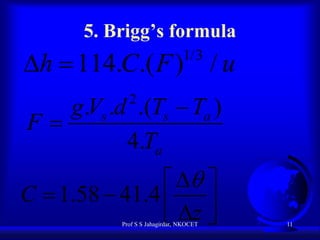
5. Brigg’s formula
1/3

h  114.C.( F )

/u

2

g .Vs .d .(Ts  Ta )
F
4.Ta
  
C  1.58  41.4 

 z 
Prof S S Jahagirdar, NKOCET

11
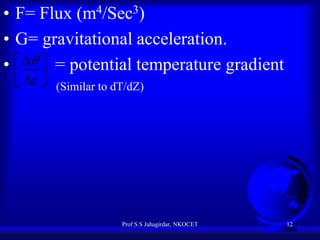
• F= Flux (m4/Sec3)
• G= gravitational acceleration.
•    = potential temperature gradient
 z 
  (Similar to dT/dZ)

Prof S S Jahagirdar, NKOCET

12
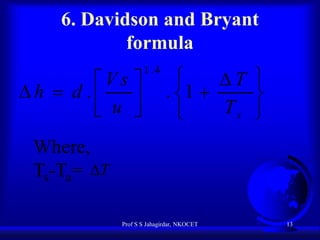
6. Davidson and Bryant
formula

Vs 
h  d .

 u 

1 .4


T 
. 1 

Ts 


Where,
Ts-Ta= T
Prof S S Jahagirdar, NKOCET

13
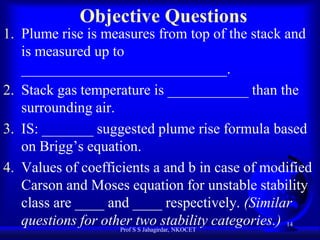
Objective Questions
1. Plume rise is measures from top of the stack and
is measured up to
____________________________.
2. Stack gas temperature is ___________ than the
surrounding air.
3. IS: _______ suggested plume rise formula based
on Brigg’s equation.
4. Values of coefficients a and b in case of modified
Carson and Moses equation for unstable stability
class are ____ and ____ respectively. (Similar
questions for other Stwo stability categories.) 14
Prof S Jahagirdar, NKOCET
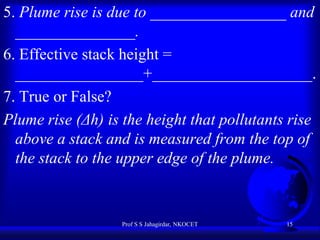
5. Plume rise is due to _________________ and
_______________.
6. Effective stack height =
________________+____________________.
7. True or False?
Plume rise (Δh) is the height that pollutants rise
above a stack and is measured from the top of
the stack to the upper edge of the plume.

Prof S S Jahagirdar, NKOCET

15
Theory Questions
Q1. Explain what is ‘Plume rise’. Give any three
formulae for the same.
Q2. Give IS formula for plume rise.

Prof S S Jahagirdar, NKOCET

16
Go to Problems

Prof S S Jahagirdar, NKOCET

17

AIR POLLUTION CONTROL L 18

  • 1.
    L-17 Plume Rise Formulae AirPollution and Control (Elective -I)
  • 2.
    • Gases thatare emitted from stacks are often pushed out by fans. As the turbulent exhaust gases exit the stack they mix with ambient air. This mixing of ambient air into the plume is called entrainment. As the plume entrains air into it, the plume diameter grows as it travels downwind. These gases have momentum as they enter the atmosphere. Often these gases are heated and are warmer than the outdoor air. In these cases the emitted gases are less dense than the outside air and are therefore buoyant. Prof S S Jahagirdar, NKOCET 2
  • 3.
    • A combinationof the gases' momentum and buoyancy causes the gases to rise. This is referred to as plume rise and allows air pollutants emitted in this gas stream to be lofted higher in the atmosphere. Since the plume is higher in the atmosphere and at a further distance from the ground, the plume will disperse more before it reaches ground level. Prof S S Jahagirdar, NKOCET 3
  • 4.
    Plume Rise > hs= PhysicalStack height H= Effective stack height Prof S S Jahagirdar, NKOCET 4
  • 5.
    Buoyancy =Plume rise < 5 ProfS S Jahagirdar, NKOCET
  • 6.
    1. IS formula ProfS S Jahagirdar, NKOCET 6
  • 7.
    2. Modified Carsonand Moses formula 0.5 h  a.[(Vs .d ) / u ]  b.[(Qh ) / u ] Stability Condition a b Unstable 3.47 0.35 -1.04 5.15 2.64 2.24 Neutral Stable Prof S S Jahagirdar, NKOCET 7
  • 8.
    Prof S SJahagirdar, NKOCET 8
  • 9.
    3. Holland’s Formula Ts=Stack gas temperature in 0 K Ta =Ambient air temperature in 0 K Prof S S Jahagirdar, NKOCET 9
  • 10.
    4. Concave formula 1/2 h h  2.71[Q 3/ 4 /u ] It is modified by Thomas h  4.71[Q 0.444 Prof S S Jahagirdar, NKOCET /u 0.694 ] 10
  • 11.
    5. Brigg’s formula 1/3 h 114.C.( F ) /u 2 g .Vs .d .(Ts  Ta ) F 4.Ta    C  1.58  41.4    z  Prof S S Jahagirdar, NKOCET 11
  • 12.
    • F= Flux(m4/Sec3) • G= gravitational acceleration. •    = potential temperature gradient  z    (Similar to dT/dZ) Prof S S Jahagirdar, NKOCET 12
  • 13.
    6. Davidson andBryant formula Vs  h  d .   u  1 .4  T  . 1   Ts   Where, Ts-Ta= T Prof S S Jahagirdar, NKOCET 13
  • 14.
    Objective Questions 1. Plumerise is measures from top of the stack and is measured up to ____________________________. 2. Stack gas temperature is ___________ than the surrounding air. 3. IS: _______ suggested plume rise formula based on Brigg’s equation. 4. Values of coefficients a and b in case of modified Carson and Moses equation for unstable stability class are ____ and ____ respectively. (Similar questions for other Stwo stability categories.) 14 Prof S Jahagirdar, NKOCET
  • 15.
    5. Plume riseis due to _________________ and _______________. 6. Effective stack height = ________________+____________________. 7. True or False? Plume rise (Δh) is the height that pollutants rise above a stack and is measured from the top of the stack to the upper edge of the plume. Prof S S Jahagirdar, NKOCET 15
  • 16.
    Theory Questions Q1. Explainwhat is ‘Plume rise’. Give any three formulae for the same. Q2. Give IS formula for plume rise. Prof S S Jahagirdar, NKOCET 16
  • 17.
    Go to Problems ProfS S Jahagirdar, NKOCET 17