RADAR Frequencies and Applications
Nithin PB
M.Sc
DOE, CUSAT
Includes...
2
Radar Frequencies
Radar Frequencies
• There is no Fundamental bounds on radar
frequency.
• Any device radiating and receiving the echo can
used as a radar.
• Radars have been operated at frequencies from
few MHz to UV region of the spectrum.
4
Radar Frequencies contd.
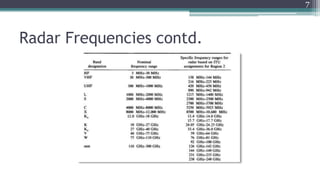
• In practice most radar operate at microwave
frequencies.
• Radar Engineers use letter designations to
denote the general frequency band at which
radar operates.
• These letter bands are accepted by IEEE and U.S
Department of Defense.
5
Radar Frequencies contd.
• The international Telecommunication Union(ITU)
assigns specific frequency bands for radar use.
• Each frequency band has its own particular
characteristics that make it better for certain
applications than for others.
6
Radar Frequencies contd.
7
Radar Frequencies contd.
HF (3 to 3MHz)
• The first operations radars were in this frequency band.
• It has many disadvantageous for radar application.
▫ Large Antennas are required to achieve narrow beam width.
▫ The wave length is high.
▫ The natural ambient noise level is high.
▫ Many targets of interst might be in the Reyleigh region.
8
Radar Frequencies contd.
• Ranges of 200mi were obtained aganist aircracft.
• Used dectect the hostile aircrafts and bombers during
battle.
• EM waves at HF is being refracted by ionosphere this
allowes the over-the-Horizon dectection of aircracft and
other targets.
• HF region of spectrum are quite attractive for
observation of areas(such as oceans).
9
Radar Frequencies contd.
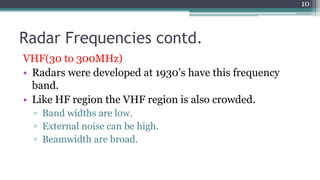
VHF(30 to 300MHz)
• Radars were developed at 1930’s have this frequency
band.
• Like HF region the VHF region is also crowded.
▫ Band widths are low.
▫ External noise can be high.
▫ Beamwidth are broad.
10
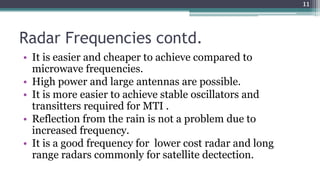
Radar Frequencies contd.
• It is easier and cheaper to achieve compared to
microwave frequencies.
• High power and large antennas are possible.
• It is more easier to achieve stable oscillators and
transitters required for MTI .
• Reflection from the rain is not a problem due to
increased frequency.
• It is a good frequency for lower cost radar and long
range radars commonly for satellite dectection.
11
Radar Frequencies contd.
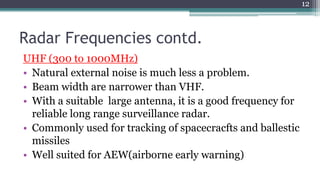
UHF (300 to 1000MHz)
• Natural external noise is much less a problem.
• Beam width are narrower than VHF.
• With a suitable large antenna, it is a good frequency for
reliable long range surveillance radar.
• Commonly used for tracking of spacecracfts and ballestic
missiles
• Well suited for AEW(airborne early warning)
12
Radar Frequencies contd.
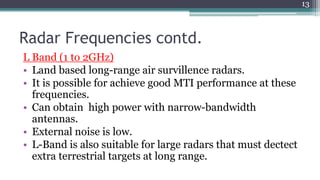
L Band (1 to 2GHz)
• Land based long-range air survillence radars.
• It is possible for achieve good MTI performance at these
frequencies.
• Can obtain high power with narrow-bandwidth
antennas.
• External noise is low.
• L-Band is also suitable for large radars that must dectect
extra terrestrial targets at long range.
13
Radar Frequencies contd.
S Band (2.0 to 4.0 GHz)
• It is more difficult to achieve long range radars.
• As the frequency increases the blind speeds that occur
with MTI radar are more numerous, thus making MTI
less capable.
• The echo from rain can significantly reduce the range of
s-band radars.But it is used to make accurate estimate of
rainfall rate.
14
Radar Frequencies contd.
• It is a good frequency for medium-range air survillance
applications such as airport survillance radar(ASR).
• The narrower beamwidth at this frequency provide good
angular accuracy and resolution.
• Less hostile main-beam jamming.
• Miltary 3D radar and height finding radar are found at
this frequency because of narrower elevation.
• S-Band is also used in LRAASPDR and AWACS.
15
‘Generally, frequencies lower than S band are well
suitedfor air surveillance, Frequencies above S band are
better for information gathering.’
16
Radar Frequencies contd.
C Band (4.0 to 8.0 GHz)
• This band lies between the S and X bands and
can be described as a compromise between the two.
• It is difficult to achieve long-range air surveillance radars
at this frequency.
• C band is used for long-range precision instrumentation
radars used for the accurate tracking of missiles, medium
function weather radar and multifunctionphased array
air defence radar.
17
Radar Frequencies contd.
X Band (8.0 to 12.5 GHz )
• Radar at this frequency has convinent size.
• Bandwidth is high and beamwidth is narrow.
• Antenna size is small.
• X band radars are used for information gathering in high
resolution.
• Used for military weapon control and civil applications.
18
Radar Frequencies contd.
Ku, K and Ka Band (12.5 to 40 GHz)
• The original K-band radars developed during World War
II.
• These frequencies are of interest because of the wide
bandwidths and the narrow beamwidths that can be
achieved with small apertures.
• It is difficult to generate radiate high power.
19
Radar Frequencies contd.
• Limitations due to rain clutter and attenuation are
increasingly difficult at the higher frequencies.
• Not many radar applications are found at there
frequencies.
• The Airport surface detection radar for the location and
control of ground traffic at airports is at Ku band because
of the need for high resolution
20
Radar Frequencies contd.
Millimeter Wavelength (above 40GHz)
• The exceptionally high attenuation caused by the
atmospheric oxygen absorption line at 60 GHz precludes
serious applications in the vicinity of this frequency
within the atmosphere.
• The 94 GHz frequency region is generally what is
thought of as a "typical" frequency representative of
millimeter radar.
21
Radar Frequencies contd.
• There have been no operational radars above Ka band.
• The major reason for the limited utility of this frequency
region is the high attenuation that occurs even in the
"clear” atmosphere.
• The millimeter-wave region is more likely to be of
interest for operation in space,where there is no
atmospheric attenuation
• Used for very short range applications.
22
Radar Frequencies contd.
Laser Frequencies
• Good angular resolution and range resolution.
• Attractive for target information gathering application
such as precision ranging and imaging.
• considered for use from space for measuring profiles of
atmospheric temperature, water vapor, and ozone, as
well as measuring cloud height and tropospheric winds.
• Limitation is that can’t effectively operate at rain,cloud
or fog.
23
Radar Applications
Radar Applications
Air Traffic Control(ATC)
• RADARs are used for safety controlling of the air traffic
• Used in the vicinity of airports for guiding airplanes for
proper landing in adverse weather conditions.
• High resolution RADAR is employed for this purpose.
• RADARs are used with ground control approach (GCA)
system for safe aircraft landing.
25
Radar Applications
Aircraft Navigation
• Weather avoidance RADARs and ground mapping
RADARs are used for navigation.
• Radio altimeter and Doppler navigator are also a form of
RADAR.
• Provide safety to aircraft from potential collision with
other aircraft and objects
26
Radar Applications
Ship Navigation and Safety
• High resolution Shore based RADARs are used.
• RADAR provides safe travel by warning potential
threats.
• Used to find the depth of sea.
27
Radar Applications
Space
• Used for docking and safely landing of spacecrafts.
• Satellite borne RADARs are also used for remote
sensing.
• Ground based RADARs are used to track and detect the
satellites and spacecraft.
28
Radar Applications
Remote sensing and Environment
• Used for detecting weather (meteorological) conditions
of the atmosphere and tracking of planetary conditions.
29
Radar Applications
Law Enforcements
• Highway police force widely uses RADARs to measure
the vehicle speed for safety regulations.
30
Radar Applications
Military Area
• Radars are used in air, naval and ground for defense
purposes.
• used for tracking, surveillance and detection of the
target. Weapon control, Fire control and missile
guidance is usually employed with various types of
RADARs.
• Long range radars are used for track space objects and
ballistic missiles.
31
Radar Applications
Global Ozone Monitoring Experiment (GOME) Applications
• Atmospheric available ozone and NO2 global monitoring
have been going on after the invention of GOME Products
(July 1996).
• Used for retrieving other trace gases relevant to the ozone
chemistry as well as other atmospheric constituents.
• Also used for climatic variable clouds, solar index and
aerosols.
32
Radar Applications
Microwave Sounder (MWR) Applications
• Used for monitoring Antarctic ice cycle ERS-2.
‘Mapping the radiometric properties of the ice-shelf,
gives an important input for the understanding of the
dynamics, decay and growth of ice sheets. This this is
considered to be basic to the understanding of
environmental and climatic changes.’
33
Radar Applications
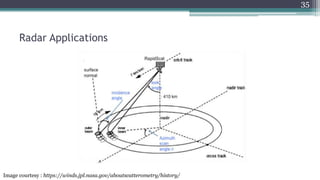
Wind Scatterometer (WSC) Application
• A Scatterometer is a microwave radar sensor used to
measure the reflection or scattering effect produced while
scanning the surface of the earth from an aircraft or a
satellite.
• Used to calculate the surface wind velocity.
34
Details : “https://winds.jpl.nasa.gov/aboutscatterometry/history/
Radar Applications
35
Image courtesy : https://winds.jpl.nasa.gov/aboutscatterometry/history/
Radar Applications
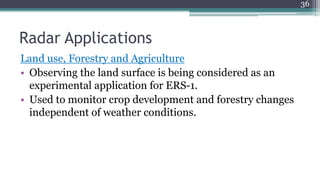
Land use, Forestry and Agriculture
• Observing the land surface is being considered as an
experimental application for ERS-1.
• Used to monitor crop development and forestry changes
independent of weather conditions.
36
Radar Applications
Other Applications
• Used by geologist for studying the position of the earth for
Earthquake detection.
• Scientists use RADAR for better study of movements of
animals, birds and insects.
• Archeologists use it for detecting buried artifacts.
• Many industries and factories use it for safety purposes.
37
Conclusion
38
Thank you
39

Radar frequencies and applications completed

  • 1.
    RADAR Frequencies andApplications Nithin PB M.Sc DOE, CUSAT
  • 2.
  • 3.
  • 4.
    Radar Frequencies • Thereis no Fundamental bounds on radar frequency. • Any device radiating and receiving the echo can used as a radar. • Radars have been operated at frequencies from few MHz to UV region of the spectrum. 4
  • 5.
    Radar Frequencies contd. •In practice most radar operate at microwave frequencies. • Radar Engineers use letter designations to denote the general frequency band at which radar operates. • These letter bands are accepted by IEEE and U.S Department of Defense. 5
  • 6.
    Radar Frequencies contd. •The international Telecommunication Union(ITU) assigns specific frequency bands for radar use. • Each frequency band has its own particular characteristics that make it better for certain applications than for others. 6
  • 7.
  • 8.
    Radar Frequencies contd. HF(3 to 3MHz) • The first operations radars were in this frequency band. • It has many disadvantageous for radar application. ▫ Large Antennas are required to achieve narrow beam width. ▫ The wave length is high. ▫ The natural ambient noise level is high. ▫ Many targets of interst might be in the Reyleigh region. 8
  • 9.
    Radar Frequencies contd. •Ranges of 200mi were obtained aganist aircracft. • Used dectect the hostile aircrafts and bombers during battle. • EM waves at HF is being refracted by ionosphere this allowes the over-the-Horizon dectection of aircracft and other targets. • HF region of spectrum are quite attractive for observation of areas(such as oceans). 9
  • 10.
    Radar Frequencies contd. VHF(30to 300MHz) • Radars were developed at 1930’s have this frequency band. • Like HF region the VHF region is also crowded. ▫ Band widths are low. ▫ External noise can be high. ▫ Beamwidth are broad. 10
  • 11.
    Radar Frequencies contd. •It is easier and cheaper to achieve compared to microwave frequencies. • High power and large antennas are possible. • It is more easier to achieve stable oscillators and transitters required for MTI . • Reflection from the rain is not a problem due to increased frequency. • It is a good frequency for lower cost radar and long range radars commonly for satellite dectection. 11
  • 12.
    Radar Frequencies contd. UHF(300 to 1000MHz) • Natural external noise is much less a problem. • Beam width are narrower than VHF. • With a suitable large antenna, it is a good frequency for reliable long range surveillance radar. • Commonly used for tracking of spacecracfts and ballestic missiles • Well suited for AEW(airborne early warning) 12
  • 13.
    Radar Frequencies contd. LBand (1 to 2GHz) • Land based long-range air survillence radars. • It is possible for achieve good MTI performance at these frequencies. • Can obtain high power with narrow-bandwidth antennas. • External noise is low. • L-Band is also suitable for large radars that must dectect extra terrestrial targets at long range. 13
  • 14.
    Radar Frequencies contd. SBand (2.0 to 4.0 GHz) • It is more difficult to achieve long range radars. • As the frequency increases the blind speeds that occur with MTI radar are more numerous, thus making MTI less capable. • The echo from rain can significantly reduce the range of s-band radars.But it is used to make accurate estimate of rainfall rate. 14
  • 15.
    Radar Frequencies contd. •It is a good frequency for medium-range air survillance applications such as airport survillance radar(ASR). • The narrower beamwidth at this frequency provide good angular accuracy and resolution. • Less hostile main-beam jamming. • Miltary 3D radar and height finding radar are found at this frequency because of narrower elevation. • S-Band is also used in LRAASPDR and AWACS. 15
  • 16.
    ‘Generally, frequencies lowerthan S band are well suitedfor air surveillance, Frequencies above S band are better for information gathering.’ 16
  • 17.
    Radar Frequencies contd. CBand (4.0 to 8.0 GHz) • This band lies between the S and X bands and can be described as a compromise between the two. • It is difficult to achieve long-range air surveillance radars at this frequency. • C band is used for long-range precision instrumentation radars used for the accurate tracking of missiles, medium function weather radar and multifunctionphased array air defence radar. 17
  • 18.
    Radar Frequencies contd. XBand (8.0 to 12.5 GHz ) • Radar at this frequency has convinent size. • Bandwidth is high and beamwidth is narrow. • Antenna size is small. • X band radars are used for information gathering in high resolution. • Used for military weapon control and civil applications. 18
  • 19.
    Radar Frequencies contd. Ku,K and Ka Band (12.5 to 40 GHz) • The original K-band radars developed during World War II. • These frequencies are of interest because of the wide bandwidths and the narrow beamwidths that can be achieved with small apertures. • It is difficult to generate radiate high power. 19
  • 20.
    Radar Frequencies contd. •Limitations due to rain clutter and attenuation are increasingly difficult at the higher frequencies. • Not many radar applications are found at there frequencies. • The Airport surface detection radar for the location and control of ground traffic at airports is at Ku band because of the need for high resolution 20
  • 21.
    Radar Frequencies contd. MillimeterWavelength (above 40GHz) • The exceptionally high attenuation caused by the atmospheric oxygen absorption line at 60 GHz precludes serious applications in the vicinity of this frequency within the atmosphere. • The 94 GHz frequency region is generally what is thought of as a "typical" frequency representative of millimeter radar. 21
  • 22.
    Radar Frequencies contd. •There have been no operational radars above Ka band. • The major reason for the limited utility of this frequency region is the high attenuation that occurs even in the "clear” atmosphere. • The millimeter-wave region is more likely to be of interest for operation in space,where there is no atmospheric attenuation • Used for very short range applications. 22
  • 23.
    Radar Frequencies contd. LaserFrequencies • Good angular resolution and range resolution. • Attractive for target information gathering application such as precision ranging and imaging. • considered for use from space for measuring profiles of atmospheric temperature, water vapor, and ozone, as well as measuring cloud height and tropospheric winds. • Limitation is that can’t effectively operate at rain,cloud or fog. 23
  • 24.
  • 25.
    Radar Applications Air TrafficControl(ATC) • RADARs are used for safety controlling of the air traffic • Used in the vicinity of airports for guiding airplanes for proper landing in adverse weather conditions. • High resolution RADAR is employed for this purpose. • RADARs are used with ground control approach (GCA) system for safe aircraft landing. 25
  • 26.
    Radar Applications Aircraft Navigation •Weather avoidance RADARs and ground mapping RADARs are used for navigation. • Radio altimeter and Doppler navigator are also a form of RADAR. • Provide safety to aircraft from potential collision with other aircraft and objects 26
  • 27.
    Radar Applications Ship Navigationand Safety • High resolution Shore based RADARs are used. • RADAR provides safe travel by warning potential threats. • Used to find the depth of sea. 27
  • 28.
    Radar Applications Space • Usedfor docking and safely landing of spacecrafts. • Satellite borne RADARs are also used for remote sensing. • Ground based RADARs are used to track and detect the satellites and spacecraft. 28
  • 29.
    Radar Applications Remote sensingand Environment • Used for detecting weather (meteorological) conditions of the atmosphere and tracking of planetary conditions. 29
  • 30.
    Radar Applications Law Enforcements •Highway police force widely uses RADARs to measure the vehicle speed for safety regulations. 30
  • 31.
    Radar Applications Military Area •Radars are used in air, naval and ground for defense purposes. • used for tracking, surveillance and detection of the target. Weapon control, Fire control and missile guidance is usually employed with various types of RADARs. • Long range radars are used for track space objects and ballistic missiles. 31
  • 32.
    Radar Applications Global OzoneMonitoring Experiment (GOME) Applications • Atmospheric available ozone and NO2 global monitoring have been going on after the invention of GOME Products (July 1996). • Used for retrieving other trace gases relevant to the ozone chemistry as well as other atmospheric constituents. • Also used for climatic variable clouds, solar index and aerosols. 32
  • 33.
    Radar Applications Microwave Sounder(MWR) Applications • Used for monitoring Antarctic ice cycle ERS-2. ‘Mapping the radiometric properties of the ice-shelf, gives an important input for the understanding of the dynamics, decay and growth of ice sheets. This this is considered to be basic to the understanding of environmental and climatic changes.’ 33
  • 34.
    Radar Applications Wind Scatterometer(WSC) Application • A Scatterometer is a microwave radar sensor used to measure the reflection or scattering effect produced while scanning the surface of the earth from an aircraft or a satellite. • Used to calculate the surface wind velocity. 34 Details : “https://winds.jpl.nasa.gov/aboutscatterometry/history/
  • 35.
    Radar Applications 35 Image courtesy: https://winds.jpl.nasa.gov/aboutscatterometry/history/
  • 36.
    Radar Applications Land use,Forestry and Agriculture • Observing the land surface is being considered as an experimental application for ERS-1. • Used to monitor crop development and forestry changes independent of weather conditions. 36
  • 37.
    Radar Applications Other Applications •Used by geologist for studying the position of the earth for Earthquake detection. • Scientists use RADAR for better study of movements of animals, birds and insects. • Archeologists use it for detecting buried artifacts. • Many industries and factories use it for safety purposes. 37
  • 38.
  • 39.