BIODETERIORATION OF
TEXTILES
k.Siva prakash
INTRODUCTION
The disposal of fabric materials used in textiles is a serious challenge to
waste management. the most common waste management options for
textile materials are used clothing for markets (second-hand clothing),
conversion to new products, wiping and polishing cloths, land& ll and
incineration for energy . Addition to these traditional processing routes,the
cellulosic waste decrease can also be achieved using composting.
The biodegradation of material takes place in three
steps:
– biodeterioration
– biofragmentation
– assimilation.
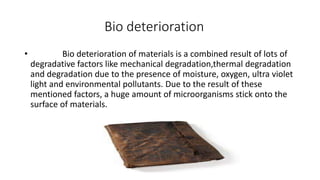
Bio deterioration
• Bio deterioration of materials is a combined result of lots of
degradative factors like mechanical degradation,thermal degradation
and degradation due to the presence of moisture, oxygen, ultra violet
light and environmental pollutants. Due to the result of these
mentioned factors, a huge amount of microorganisms stick onto the
surface of materials.
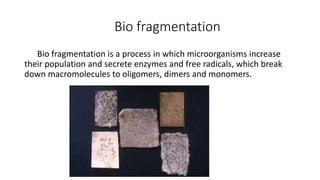
Bio fragmentation
Bio fragmentation is a process in which microorganisms increase
their population and secrete enzymes and free radicals, which break
down macromolecules to oligomers, dimers and monomers.
Assimilation
Assimilation, energy, new biomass and various metabolites used by
microorganisms are produced and simple gaseous molecules and
mineral salts are released into the environment.
An aerobic biodegradation of materials depend upon the
polymers chemical composition and the environment to which
they are exposed. Some of the important factors that directly
influence the rate of biodegradation are as follows:
• presence of microorganisms
• availability of oxygen
• amount of water available
• temperature
• chemical environment (pH, electrolytes, etc).
Microbial Deterioration of Textiles
Biodeterioration is defined as “any undesirable change in the
properties of economically important materials caused by vital activities
of living organisms”.
Biodeterioration includes fouling, rotting, decay, loss of strength of
the material and can be assimilatory or dissimilatory. In assimilatory
deterioration organism utilizes a component of the material as a carbon
or energy source resulting in loss of strength.
Such damage are caused by microbial enzymes breaking down
cellulose in cotton textiles.
Natural fibers like cotton, linen, jute and rayon are composed
principally of cellulose. The fabrics and raw fibers are subjected to
microbial deterioration because of their high organic content.
Products such as starch, derivatives of protein, fats and oils used in
finishing of textiles also promote microbial growth.
Textile made from natural fibres is generally more susceptible to
biodeterioration than are the synthetic man made fibres.
Variety of microorganisms like bacteria, actinomycetes, yeast and
moulds are found associated with deterioration of fabrics.
Growth of microorganisms on textile may cause aesthetic and
structural damage.
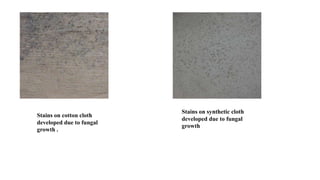
Aesthetic damage includes pigment discoloration, irregular staining
of gray, black and red colour and formation of a biofilm over the surface of
textile.
Stains on cotton cloth
developed due to fungal
growth .
Stains on synthetic cloth
developed due to fungal
growth
Natural Fibres
Textiles made from natural fibres are generally more susceptible to
biodeterioration than are the synthetic (man-made) fibres . This is because
their porous hydrophilic structure retains water, oxygen and nutrients,
providing perfect environments for bacterial growth. Products such as starch,
protein derivatives, fats and oils used in finishing of textiles can also promote
microbial growth. Microorganisms may attack the entire substrate, that is
the textiles fibres or may attack only one components of the substrate, such
as plasticizer contained there in, or grow on dirt that has accumulated on the
surface of a product.
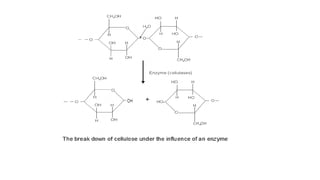
Plants fibres such as cotton, flax (Linen), jute and hemp are very
susceptible to attack by cellulolytic (cellulose-digesting) fungi. Indeed, the
complete degradation of cellulose can be effected by enzymes, produced by
the fungi and known as cellulases.
Animal Fibres:
Animal fibres are more resistance to mildew growth than plant fibres.
Pure silk is less susceptible if completely degummed. Wool decays only
slowly but chemical and mechanical damage during processing can increase
its susceptibility to biodeterioration. When stored under adverse condition
wool will eventually rot by the action of the proteolytic (protein-digesting)
enzymes secretes by many micro-fungi and bacteria .
Synthetic Fibres :
Man-made fibres derived from cellulose are susceptible to microbial
deterioration [1]. Viscose (rayon) is readily attacked by mildews and bacteria,
acetate and triacetate are more resistant although discolouration can
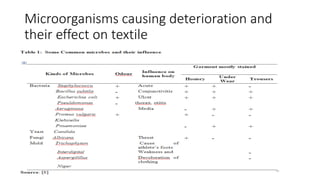
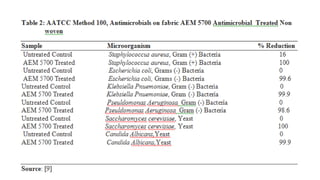
Microorganisms causing deterioration and
their effect on textile
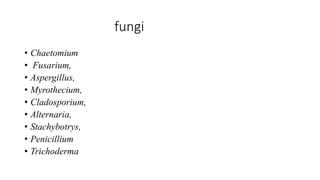
fungi
• Chaetomium
• Fusarium,
• Aspergillus,
• Myrothecium,
• Cladosporium,
• Alternaria,
• Stachybotrys,
• Penicillium
• Trichoderma
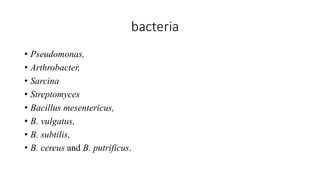
bacteria
• Pseudomonas,
• Arthrobacter,
• Sarcina
• Streptomyces
• Bacillus mesentericus,
• B. vulgatus,
• B. subtilis,
• B. cereus and B. putrificus.
Detection of microbial deterioration of textile
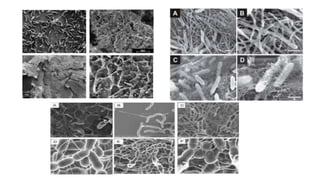
• Deterioration of textile at first observation is detected by musty odor,
discolouration or staining. Textile material suspected to be
deteriorated by microorganism can be directly viewed under
microscope for confirmation of presence of microorganisms on the
surface of textile. Under magnification, fungi look like thread like
structure with conidiophores and spore. Bacterial deteriogens are
difficult to identify under compound microscope but they are
detected by slime produced by them.
• Another means of detection is examination of textile under ultraviolet
light. Microbial growth fluoresces and appear luminescent in UV light.
Prevention and control of microbiological
deterioration
• One of the best method of avoiding microbial deterioration is to use synthetic
materials which are inherently resistant to attack. An alternative strategy is to
apply antimicrobial chemicals known as biocides which are normally incorporated
into the finished textile products. Commonly used biocides in the textile industry
include organo–copper, organo–tin compounds and chlorinated phenols. The
main disadvantage of such treatments is that they impart yellow - green colour to
treated materials.
• Mildew formation on the wool can be prevented by storing them in well-
ventilated surroundings in a cool, dry atmosphere. Some products that are
commonly used to prevent mildew on wool are based on dichloropen (5,5-
dichloro 2,2- dihydroxy diphenylmethane), quaternary ammonium compounds
[n- alkyl dimethyl (ethylbenzyl) ammonium chloride], chlorinated phenols and
fatty esters of chlorinated phenols and organofin compounds.
Textile can be prevented from deterioration by maintaining cool
and dry conditions with adequate ventilation during storage and transport.
Cleanliness of textile surface also prevents deterioration.
Controlled environmental conditions are effective in controlling both
insects and microorganisms.
Relative humidity below 50 % and temperature of 18° C to 24° C
is most effective in preventing textile deterioration.
In order to maintain dry conditions and for removal of moisture,
air dehumidifiers can be used. To avoid moisture from textile desiccating
bags are commonly used.
Bags absorb moisture and keeps the surface of textile dry.
Chemical protection is recommended for the textiles likely to be used in
adverse conditions like wet or damp conditions.
Treatments
• Method to be applied for treatment of biodeteriorating textile
depends upon extent of microbial infestation. Mechanical treatment
like holding the textile material under vacuum removes most of the
active growth. After the removal of vacuum active growth forms
decrease. Gentle air circulation in the form of a dry, cool air flow is
also effective to accomplish this. Dry cleaning is another treatment
option that kills microorganism. In case of heavy deterioration, use of
biocides is recommended and in extreme cases textile should be
sterilized or incinerated to prevent spread of microorganisms.
Use of biocides
• Antimicrobial treatment for textile materials is necessary to fulfill the
following objectives:
1. To avoid cross infection by pathogenic micro-organisms,
2. To control the infestation by microbes,
3. To arrest metabolism in microbes in order to reduce
the formation odor,
4. To safeguard the textile products from staining,
discoloration and quality deterioration
THANK YOU…………………………

Biodeterioration of textiles

  • 1.
  • 2.
    INTRODUCTION The disposal offabric materials used in textiles is a serious challenge to waste management. the most common waste management options for textile materials are used clothing for markets (second-hand clothing), conversion to new products, wiping and polishing cloths, land& ll and incineration for energy . Addition to these traditional processing routes,the cellulosic waste decrease can also be achieved using composting. The biodegradation of material takes place in three steps: – biodeterioration – biofragmentation – assimilation.
  • 3.
    Bio deterioration • Biodeterioration of materials is a combined result of lots of degradative factors like mechanical degradation,thermal degradation and degradation due to the presence of moisture, oxygen, ultra violet light and environmental pollutants. Due to the result of these mentioned factors, a huge amount of microorganisms stick onto the surface of materials.
  • 4.
    Bio fragmentation Bio fragmentationis a process in which microorganisms increase their population and secrete enzymes and free radicals, which break down macromolecules to oligomers, dimers and monomers.
  • 5.
    Assimilation Assimilation, energy, newbiomass and various metabolites used by microorganisms are produced and simple gaseous molecules and mineral salts are released into the environment.
  • 6.
    An aerobic biodegradationof materials depend upon the polymers chemical composition and the environment to which they are exposed. Some of the important factors that directly influence the rate of biodegradation are as follows: • presence of microorganisms • availability of oxygen • amount of water available • temperature • chemical environment (pH, electrolytes, etc).
  • 7.
    Microbial Deterioration ofTextiles Biodeterioration is defined as “any undesirable change in the properties of economically important materials caused by vital activities of living organisms”. Biodeterioration includes fouling, rotting, decay, loss of strength of the material and can be assimilatory or dissimilatory. In assimilatory deterioration organism utilizes a component of the material as a carbon or energy source resulting in loss of strength. Such damage are caused by microbial enzymes breaking down cellulose in cotton textiles.
  • 8.
    Natural fibers likecotton, linen, jute and rayon are composed principally of cellulose. The fabrics and raw fibers are subjected to microbial deterioration because of their high organic content. Products such as starch, derivatives of protein, fats and oils used in finishing of textiles also promote microbial growth. Textile made from natural fibres is generally more susceptible to biodeterioration than are the synthetic man made fibres. Variety of microorganisms like bacteria, actinomycetes, yeast and moulds are found associated with deterioration of fabrics. Growth of microorganisms on textile may cause aesthetic and structural damage. Aesthetic damage includes pigment discoloration, irregular staining of gray, black and red colour and formation of a biofilm over the surface of textile.
  • 9.
    Stains on cottoncloth developed due to fungal growth . Stains on synthetic cloth developed due to fungal growth
  • 10.
    Natural Fibres Textiles madefrom natural fibres are generally more susceptible to biodeterioration than are the synthetic (man-made) fibres . This is because their porous hydrophilic structure retains water, oxygen and nutrients, providing perfect environments for bacterial growth. Products such as starch, protein derivatives, fats and oils used in finishing of textiles can also promote microbial growth. Microorganisms may attack the entire substrate, that is the textiles fibres or may attack only one components of the substrate, such as plasticizer contained there in, or grow on dirt that has accumulated on the surface of a product. Plants fibres such as cotton, flax (Linen), jute and hemp are very susceptible to attack by cellulolytic (cellulose-digesting) fungi. Indeed, the complete degradation of cellulose can be effected by enzymes, produced by the fungi and known as cellulases.
  • 12.
    Animal Fibres: Animal fibresare more resistance to mildew growth than plant fibres. Pure silk is less susceptible if completely degummed. Wool decays only slowly but chemical and mechanical damage during processing can increase its susceptibility to biodeterioration. When stored under adverse condition wool will eventually rot by the action of the proteolytic (protein-digesting) enzymes secretes by many micro-fungi and bacteria . Synthetic Fibres : Man-made fibres derived from cellulose are susceptible to microbial deterioration [1]. Viscose (rayon) is readily attacked by mildews and bacteria, acetate and triacetate are more resistant although discolouration can
  • 13.
    Microorganisms causing deteriorationand their effect on textile
  • 15.
    fungi • Chaetomium • Fusarium, •Aspergillus, • Myrothecium, • Cladosporium, • Alternaria, • Stachybotrys, • Penicillium • Trichoderma
  • 16.
    bacteria • Pseudomonas, • Arthrobacter, •Sarcina • Streptomyces • Bacillus mesentericus, • B. vulgatus, • B. subtilis, • B. cereus and B. putrificus.
  • 17.
    Detection of microbialdeterioration of textile • Deterioration of textile at first observation is detected by musty odor, discolouration or staining. Textile material suspected to be deteriorated by microorganism can be directly viewed under microscope for confirmation of presence of microorganisms on the surface of textile. Under magnification, fungi look like thread like structure with conidiophores and spore. Bacterial deteriogens are difficult to identify under compound microscope but they are detected by slime produced by them. • Another means of detection is examination of textile under ultraviolet light. Microbial growth fluoresces and appear luminescent in UV light.
  • 18.
    Prevention and controlof microbiological deterioration • One of the best method of avoiding microbial deterioration is to use synthetic materials which are inherently resistant to attack. An alternative strategy is to apply antimicrobial chemicals known as biocides which are normally incorporated into the finished textile products. Commonly used biocides in the textile industry include organo–copper, organo–tin compounds and chlorinated phenols. The main disadvantage of such treatments is that they impart yellow - green colour to treated materials. • Mildew formation on the wool can be prevented by storing them in well- ventilated surroundings in a cool, dry atmosphere. Some products that are commonly used to prevent mildew on wool are based on dichloropen (5,5- dichloro 2,2- dihydroxy diphenylmethane), quaternary ammonium compounds [n- alkyl dimethyl (ethylbenzyl) ammonium chloride], chlorinated phenols and fatty esters of chlorinated phenols and organofin compounds.
  • 19.
    Textile can beprevented from deterioration by maintaining cool and dry conditions with adequate ventilation during storage and transport. Cleanliness of textile surface also prevents deterioration. Controlled environmental conditions are effective in controlling both insects and microorganisms. Relative humidity below 50 % and temperature of 18° C to 24° C is most effective in preventing textile deterioration. In order to maintain dry conditions and for removal of moisture, air dehumidifiers can be used. To avoid moisture from textile desiccating bags are commonly used. Bags absorb moisture and keeps the surface of textile dry. Chemical protection is recommended for the textiles likely to be used in adverse conditions like wet or damp conditions.
  • 20.
    Treatments • Method tobe applied for treatment of biodeteriorating textile depends upon extent of microbial infestation. Mechanical treatment like holding the textile material under vacuum removes most of the active growth. After the removal of vacuum active growth forms decrease. Gentle air circulation in the form of a dry, cool air flow is also effective to accomplish this. Dry cleaning is another treatment option that kills microorganism. In case of heavy deterioration, use of biocides is recommended and in extreme cases textile should be sterilized or incinerated to prevent spread of microorganisms.
  • 21.
    Use of biocides •Antimicrobial treatment for textile materials is necessary to fulfill the following objectives: 1. To avoid cross infection by pathogenic micro-organisms, 2. To control the infestation by microbes, 3. To arrest metabolism in microbes in order to reduce the formation odor, 4. To safeguard the textile products from staining, discoloration and quality deterioration
  • 23.