L-11
OZONE DEPLETION
Air Pollution and Control
(Elective(Elective-I)
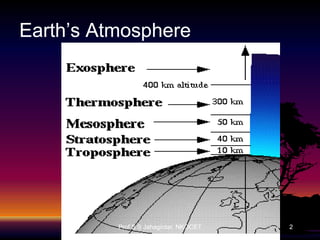
Earth’s Atmosphere

Prof S S Jahagirdar, NKOCET

2
The ozone layer
•
•
•
•

Ozone is an unstable gas
It rapidly breaks down
The ozone layer is only a few cm thick
If the rate of breakdown is faster than
the rate of formation the ozone layer
thins
• This could develop into hole
• An ozone hole was first observed over
the Antarctic in 1985
Prof S S Jahagirdar, NKOCET

3
The Discovery
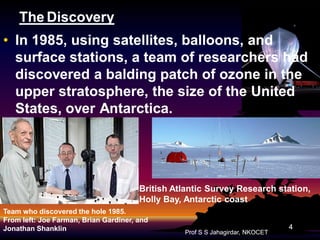
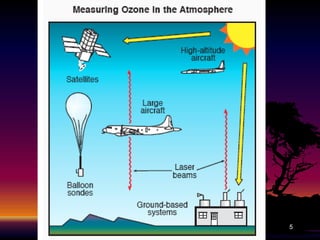
• In 1985, using satellites, balloons, and
surface stations, a team of researchers had
discovered a balding patch of ozone in the
upper stratosphere, the size of the United
States, over Antarctica.

British Atlantic Survey Research station,
Holly Bay, Antarctic coast
Team who discovered the hole 1985.
From left: Joe Farman, Brian Gardiner, and
Jonathan Shanklin

Prof S S Jahagirdar, NKOCET

4
Prof S S Jahagirdar, NKOCET

5
What is ozone?
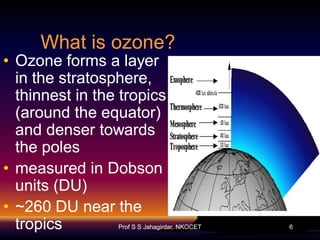
• Ozone forms a layer
in the stratosphere,
thinnest in the tropics
(around the equator)
and denser towards
the poles
• measured in Dobson
units (DU)
• ~260 DU near the
tropics

Prof S S Jahagirdar, NKOCET

6
What is a Dobson unit?
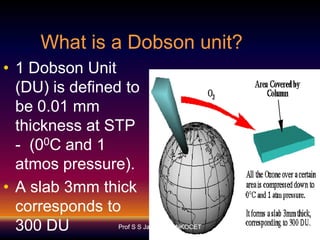
• 1 Dobson Unit
(DU) is defined to
be 0.01 mm
thickness at STP
- (00C and 1
atmos pressure).
• A slab 3mm thick
corresponds to
300 DU

Prof S S Jahagirdar, NKOCET

7
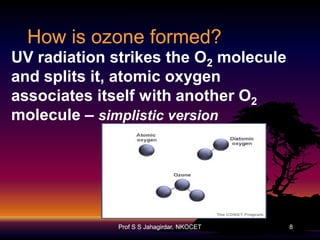
How is ozone formed?
UV radiation strikes the O2 molecule
and splits it, atomic oxygen
associates itself with another O2
molecule – simplistic version

Prof S S Jahagirdar, NKOCET

8
How ironic . . .
• At ground level, ozone is a health
hazardhazard-major constituent of
photochemical smog
• However, in the stratosphere, we
could not survive without it.
• It absorbs potentially harmful ultraultraviolet (UV – 240-320nm harmful)
240radiation
• Protects from skin cancer, etc
9

Prof S S Jahagirdar, NKOCET
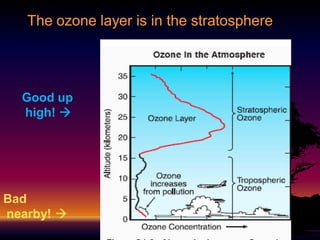
The ozone layer is in the stratosphere

Good up
high! 

Bad
nearby! 
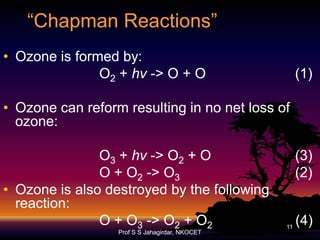
“Chapman Reactions”
• Ozone is formed by:
O2 + hv -> O + O

(1)

• Ozone can reform resulting in no net loss of
ozone:
O3 + hv -> O2 + O
O + O2 -> O3
• Ozone is also destroyed by the following
reaction:
O + O3 -> O2 + O2
Prof S S Jahagirdar, NKOCET

(3)
(2)

11

(4)
Comparison of reactions
• Reaction (2) slower with increasing
altitude
• Reaction (3) faster with increasing altitude
• Lower in stratosphere, atmosphere
denser, UV absorption increases – ozone
peaks 20km
• Closer to surface, UV level decreases,
ozone decreases
Prof S S Jahagirdar, NKOCET

12
The ozone layer

•Ozone is a triatomic form of oxygen
(O3) found in Earth’s upper and
lower atmosphere.
•The ozone layer, situated in the
stratosphere about 15 to 30 km above
the earth's surface.
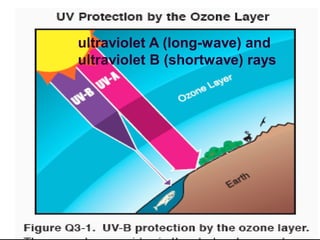
•Ozone protects living organisms by
absorbing harmful ultraviolet
radiation (UVB) from the sun.
Prof S S Jahagirdar, NKOCET

13
ultraviolet A (long-wave) and
ultraviolet B (shortwave) rays

Prof S S Jahagirdar, NKOCET

14
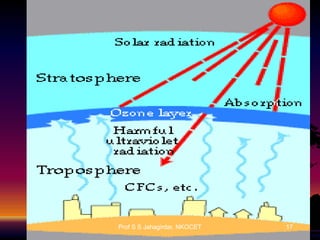
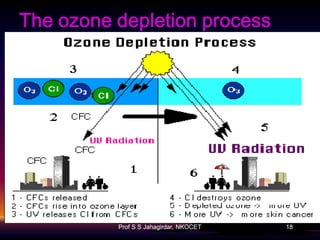
• The ozone layer is being destroyed by
CFCs and other substances.
• Ozone depletion progressing globally
except in the tropical zone.
• Chlorofluoro carbons (CFC’s) and
other halogenated hydrocarbons
contribute to the destruction of
stratospheric ozone.
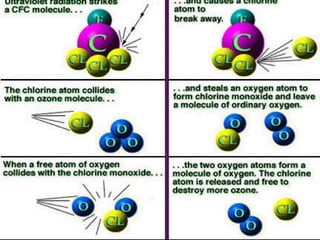
• Just one chlorine and bromine atom can
catalyze the destruction of 100,000 ozone
molecules
15
Prof S S Jahagirdar, NKOCET
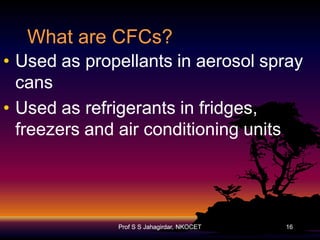
What are CFCs?
• Used as propellants in aerosol spray
cans
• Used as refrigerants in fridges,
freezers and air conditioning units

Prof S S Jahagirdar, NKOCET

16
Prof S S Jahagirdar, NKOCET

17
The ozone depletion process

Prof S S Jahagirdar, NKOCET

18
Too much ultra-violet light can result in:
ultrain:

•
•
•
•
•
•

Skin cancer
Eye damage such as cataracts
Immune system damage
Reduction in phytoplankton
Damage to the DNA in various life-forms
Possibly other things too that we don't
know about at the moment

20
Prof S S Jahagirdar, NKOCET
Effects on Plants
Physiological and developmental
processes of plants are affected by
UVB radiation, even by the amount of
UVB in present-day sunlight.

Prof S S Jahagirdar, NKOCET

21
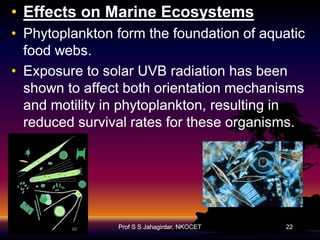
• Effects on Marine Ecosystems
• Phytoplankton form the foundation of aquatic
food webs.
• Exposure to solar UVB radiation has been
shown to affect both orientation mechanisms
and motility in phytoplankton, resulting in
reduced survival rates for these organisms.

Prof S S Jahagirdar, NKOCET

22
• Effects on Biogeochemical Cycles
• Increases in solar UV radiation could affect
terrestrial and aquatic biogeochemical
cycles, thus altering both sources and sinks
of greenhouse and chemically-important
chemicallytrace gases.
• e.g., carbon dioxide (CO2), carbon monoxide
(CO), carbonyl sulfide (COS) and possibly other
gases, including ozone.
• These potential changes would contribute to
biospherebiosphere-atmosphere feedbacks that attenuate
or reinforce the atmospheric buildup of these
23
Prof S S Jahagirdar, NKOCET
gases.
• Effects on Materials
• Synthetic polymers, naturally occurring
biopolymers,
biopolymers, as well as some other materials
of commercial interest are adversely affected by
solar UV radiation.
• Today's materials are somewhat protected
from UVB by special additives.
• Therefore, any increase in solar UVB levels will
therefore accelerate their breakdown, limiting
the length of time for which they are useful
outdoors.
Prof S S Jahagirdar, NKOCET

24
Immune Suppression
•Scientists have found that
overexposure to UV radiation may
suppress proper functioning of the
body’s immune system and the skin’s
natural defenses.
• For example, the skin normally
mounts a defense against foreign
invaders such as cancers and
infections.
Prof S S Jahagirdar, NKOCET

25
• But overexposure to UV radiation can
weaken the immune system, reducing
the skin’s ability to protect against
these invaders.

Prof S S Jahagirdar, NKOCET

26
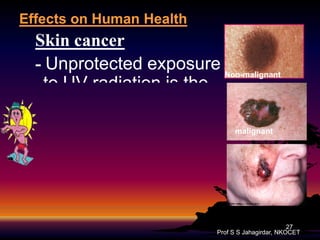
Effects on Human Health

Skin cancer
- Unprotected exposure Non-malignant
to UV radiation is the
most preventable risk
factor for skin cancer. malignant

27
Prof S S Jahagirdar, NKOCET
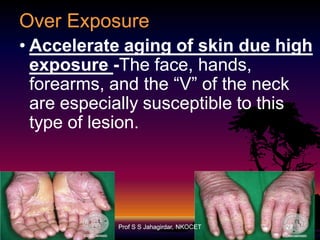
Over Exposure
• Accelerate aging of skin due high
exposure -The face, hands,
forearms, and the “V” of the neck
are especially susceptible to this
type of lesion.

Prof S S Jahagirdar, NKOCET

28
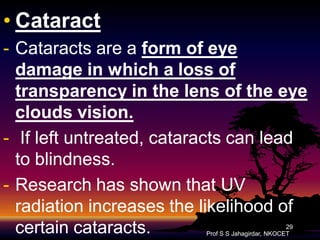
• Cataract
- Cataracts are a form of eye
damage in which a loss of
transparency in the lens of the eye
clouds vision.
- If left untreated, cataracts can lead
to blindness.
- Research has shown that UV
radiation increases the likelihood of
certain cataracts.
29
Prof S S Jahagirdar, NKOCET
What can be done?
• Reduce the use of CFCs
• They are already banned in aerosols
(1987)
• BUT they are still used as refrigerants
• Recycle fridges and air conditioning
plants
Prof S S Jahagirdar, NKOCET

30
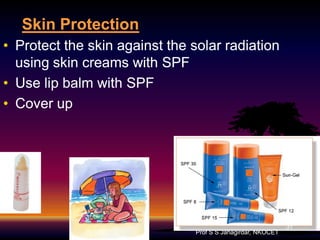
Skin Protection
• Protect the skin against the solar radiation
using skin creams with SPF
• Use lip balm with SPF
• Cover up

Prof S S Jahagirdar, NKOCET

31
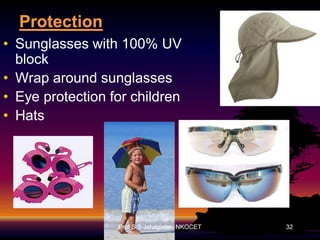
Protection
• Sunglasses with 100% UV
block
• Wrap around sunglasses
• Eye protection for children
• Hats

Prof S S Jahagirdar, NKOCET

32
What Is Being Done to Counter the Effects
of Ozone Depletion?

• Montreal Protocol (adopted in 1987) – panel
of experts was formed to investigate substances
responsible for hole formation
• Established policies that prevent future use of
certain types of chemicals
• Stipulated that the production and
consumption of compounds contributing
towards depletion of ozone in the stratosphere
were to be phased out by the year 2000 (2005
for methylchloroform)
methylchloroform)
33
Prof S S Jahagirdar, NKOCET
The current situation
• The holes developing over the pole suggest
that they may be show an improvement
• BUT CFC molecules take 30 years to rise up
to the stratosphere
• The chlorine radicals last a long time
• The peak ozone damage was supposed to
be in 2000
• Damage could go on another 50 years
© 2007 Paul Billiet ODWS
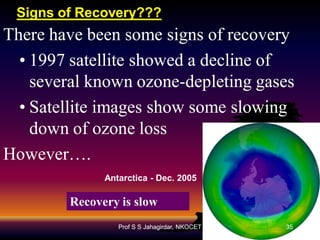
Signs of Recovery???

There have been some signs of recovery
• 1997 satellite showed a decline of
several known ozone-depleting gases
ozone• Satellite images show some slowing
down of ozone loss
However….
Antarctica - Dec. 2005

Recovery is slow
Prof S S Jahagirdar, NKOCET

35
Objective Questions
Q1. Ozone hole was first observed in ____.
Q2. The ozone layer, situated in the stratosphere
about __________km above the earth's
surface.
Q3. _______ is responsible for ozone depletion.
Q4. ___________ protocol was first step towards
reducing use of CFCs.
Q5.Breaking of ozone molecule takes place in
presence of ________________.
Prof S S Jahagirdar, NKOCET

36
Q6. Ozone layer thickness is measured in
____________ units.
Q7. Formation and destruction of ozone in the
atmosphere can be explained by ___________
reactions.
Q8. 1 Du = ____________________________.

Prof S S Jahagirdar, NKOCET

37
Theory Questions
Q1. Explain ‘Ozone depletion process with
respect to following points
- Sources/causes
- Chemical reactions
- Effects
- Remedies
Q2. Define Dobson unit.
Q3. Explain Chapman reactions.
Prof S S Jahagirdar, NKOCET

38
Prof S S Jahagirdar, NKOCET

39
Prof S S Jahagirdar, NKOCET

40

AIR POLLUTION CONTROL L 11

  • 1.
    L-11 OZONE DEPLETION Air Pollutionand Control (Elective(Elective-I)
  • 2.
    Earth’s Atmosphere Prof SS Jahagirdar, NKOCET 2
  • 3.
    The ozone layer • • • • Ozoneis an unstable gas It rapidly breaks down The ozone layer is only a few cm thick If the rate of breakdown is faster than the rate of formation the ozone layer thins • This could develop into hole • An ozone hole was first observed over the Antarctic in 1985 Prof S S Jahagirdar, NKOCET 3
  • 4.
    The Discovery • In1985, using satellites, balloons, and surface stations, a team of researchers had discovered a balding patch of ozone in the upper stratosphere, the size of the United States, over Antarctica. British Atlantic Survey Research station, Holly Bay, Antarctic coast Team who discovered the hole 1985. From left: Joe Farman, Brian Gardiner, and Jonathan Shanklin Prof S S Jahagirdar, NKOCET 4
  • 5.
    Prof S SJahagirdar, NKOCET 5
  • 6.
    What is ozone? •Ozone forms a layer in the stratosphere, thinnest in the tropics (around the equator) and denser towards the poles • measured in Dobson units (DU) • ~260 DU near the tropics Prof S S Jahagirdar, NKOCET 6
  • 7.
    What is aDobson unit? • 1 Dobson Unit (DU) is defined to be 0.01 mm thickness at STP - (00C and 1 atmos pressure). • A slab 3mm thick corresponds to 300 DU Prof S S Jahagirdar, NKOCET 7
  • 8.
    How is ozoneformed? UV radiation strikes the O2 molecule and splits it, atomic oxygen associates itself with another O2 molecule – simplistic version Prof S S Jahagirdar, NKOCET 8
  • 9.
    How ironic .. . • At ground level, ozone is a health hazardhazard-major constituent of photochemical smog • However, in the stratosphere, we could not survive without it. • It absorbs potentially harmful ultraultraviolet (UV – 240-320nm harmful) 240radiation • Protects from skin cancer, etc 9 Prof S S Jahagirdar, NKOCET
  • 10.
    The ozone layeris in the stratosphere Good up high!  Bad nearby! 
  • 11.
    “Chapman Reactions” • Ozoneis formed by: O2 + hv -> O + O (1) • Ozone can reform resulting in no net loss of ozone: O3 + hv -> O2 + O O + O2 -> O3 • Ozone is also destroyed by the following reaction: O + O3 -> O2 + O2 Prof S S Jahagirdar, NKOCET (3) (2) 11 (4)
  • 12.
    Comparison of reactions •Reaction (2) slower with increasing altitude • Reaction (3) faster with increasing altitude • Lower in stratosphere, atmosphere denser, UV absorption increases – ozone peaks 20km • Closer to surface, UV level decreases, ozone decreases Prof S S Jahagirdar, NKOCET 12
  • 13.
    The ozone layer •Ozoneis a triatomic form of oxygen (O3) found in Earth’s upper and lower atmosphere. •The ozone layer, situated in the stratosphere about 15 to 30 km above the earth's surface. •Ozone protects living organisms by absorbing harmful ultraviolet radiation (UVB) from the sun. Prof S S Jahagirdar, NKOCET 13
  • 14.
    ultraviolet A (long-wave)and ultraviolet B (shortwave) rays Prof S S Jahagirdar, NKOCET 14
  • 15.
    • The ozonelayer is being destroyed by CFCs and other substances. • Ozone depletion progressing globally except in the tropical zone. • Chlorofluoro carbons (CFC’s) and other halogenated hydrocarbons contribute to the destruction of stratospheric ozone. • Just one chlorine and bromine atom can catalyze the destruction of 100,000 ozone molecules 15 Prof S S Jahagirdar, NKOCET
  • 16.
    What are CFCs? •Used as propellants in aerosol spray cans • Used as refrigerants in fridges, freezers and air conditioning units Prof S S Jahagirdar, NKOCET 16
  • 17.
    Prof S SJahagirdar, NKOCET 17
  • 18.
    The ozone depletionprocess Prof S S Jahagirdar, NKOCET 18
  • 20.
    Too much ultra-violetlight can result in: ultrain: • • • • • • Skin cancer Eye damage such as cataracts Immune system damage Reduction in phytoplankton Damage to the DNA in various life-forms Possibly other things too that we don't know about at the moment 20 Prof S S Jahagirdar, NKOCET
  • 21.
    Effects on Plants Physiologicaland developmental processes of plants are affected by UVB radiation, even by the amount of UVB in present-day sunlight. Prof S S Jahagirdar, NKOCET 21
  • 22.
    • Effects onMarine Ecosystems • Phytoplankton form the foundation of aquatic food webs. • Exposure to solar UVB radiation has been shown to affect both orientation mechanisms and motility in phytoplankton, resulting in reduced survival rates for these organisms. Prof S S Jahagirdar, NKOCET 22
  • 23.
    • Effects onBiogeochemical Cycles • Increases in solar UV radiation could affect terrestrial and aquatic biogeochemical cycles, thus altering both sources and sinks of greenhouse and chemically-important chemicallytrace gases. • e.g., carbon dioxide (CO2), carbon monoxide (CO), carbonyl sulfide (COS) and possibly other gases, including ozone. • These potential changes would contribute to biospherebiosphere-atmosphere feedbacks that attenuate or reinforce the atmospheric buildup of these 23 Prof S S Jahagirdar, NKOCET gases.
  • 24.
    • Effects onMaterials • Synthetic polymers, naturally occurring biopolymers, biopolymers, as well as some other materials of commercial interest are adversely affected by solar UV radiation. • Today's materials are somewhat protected from UVB by special additives. • Therefore, any increase in solar UVB levels will therefore accelerate their breakdown, limiting the length of time for which they are useful outdoors. Prof S S Jahagirdar, NKOCET 24
  • 25.
    Immune Suppression •Scientists havefound that overexposure to UV radiation may suppress proper functioning of the body’s immune system and the skin’s natural defenses. • For example, the skin normally mounts a defense against foreign invaders such as cancers and infections. Prof S S Jahagirdar, NKOCET 25
  • 26.
    • But overexposureto UV radiation can weaken the immune system, reducing the skin’s ability to protect against these invaders. Prof S S Jahagirdar, NKOCET 26
  • 27.
    Effects on HumanHealth Skin cancer - Unprotected exposure Non-malignant to UV radiation is the most preventable risk factor for skin cancer. malignant 27 Prof S S Jahagirdar, NKOCET
  • 28.
    Over Exposure • Accelerateaging of skin due high exposure -The face, hands, forearms, and the “V” of the neck are especially susceptible to this type of lesion. Prof S S Jahagirdar, NKOCET 28
  • 29.
    • Cataract - Cataractsare a form of eye damage in which a loss of transparency in the lens of the eye clouds vision. - If left untreated, cataracts can lead to blindness. - Research has shown that UV radiation increases the likelihood of certain cataracts. 29 Prof S S Jahagirdar, NKOCET
  • 30.
    What can bedone? • Reduce the use of CFCs • They are already banned in aerosols (1987) • BUT they are still used as refrigerants • Recycle fridges and air conditioning plants Prof S S Jahagirdar, NKOCET 30
  • 31.
    Skin Protection • Protectthe skin against the solar radiation using skin creams with SPF • Use lip balm with SPF • Cover up Prof S S Jahagirdar, NKOCET 31
  • 32.
    Protection • Sunglasses with100% UV block • Wrap around sunglasses • Eye protection for children • Hats Prof S S Jahagirdar, NKOCET 32
  • 33.
    What Is BeingDone to Counter the Effects of Ozone Depletion? • Montreal Protocol (adopted in 1987) – panel of experts was formed to investigate substances responsible for hole formation • Established policies that prevent future use of certain types of chemicals • Stipulated that the production and consumption of compounds contributing towards depletion of ozone in the stratosphere were to be phased out by the year 2000 (2005 for methylchloroform) methylchloroform) 33 Prof S S Jahagirdar, NKOCET
  • 34.
    The current situation •The holes developing over the pole suggest that they may be show an improvement • BUT CFC molecules take 30 years to rise up to the stratosphere • The chlorine radicals last a long time • The peak ozone damage was supposed to be in 2000 • Damage could go on another 50 years © 2007 Paul Billiet ODWS
  • 35.
    Signs of Recovery??? Therehave been some signs of recovery • 1997 satellite showed a decline of several known ozone-depleting gases ozone• Satellite images show some slowing down of ozone loss However…. Antarctica - Dec. 2005 Recovery is slow Prof S S Jahagirdar, NKOCET 35
  • 36.
    Objective Questions Q1. Ozonehole was first observed in ____. Q2. The ozone layer, situated in the stratosphere about __________km above the earth's surface. Q3. _______ is responsible for ozone depletion. Q4. ___________ protocol was first step towards reducing use of CFCs. Q5.Breaking of ozone molecule takes place in presence of ________________. Prof S S Jahagirdar, NKOCET 36
  • 37.
    Q6. Ozone layerthickness is measured in ____________ units. Q7. Formation and destruction of ozone in the atmosphere can be explained by ___________ reactions. Q8. 1 Du = ____________________________. Prof S S Jahagirdar, NKOCET 37
  • 38.
    Theory Questions Q1. Explain‘Ozone depletion process with respect to following points - Sources/causes - Chemical reactions - Effects - Remedies Q2. Define Dobson unit. Q3. Explain Chapman reactions. Prof S S Jahagirdar, NKOCET 38
  • 39.
    Prof S SJahagirdar, NKOCET 39
  • 40.
    Prof S SJahagirdar, NKOCET 40