STEP Conference 2014 – Cleaner Air, Healthier Places Developing evidence-based messages on air pollution and health 18th November 2014 Dr. Colin N. Ramsay Consultant Epidemiologist Health Protection Scotland
Presentation Aims To outline the rationale for the Scottish Government / SEPA / SUAQ Programme project on Air Pollution and Health Impacts (APHIP) 
•Air Pollution and Health in Scotland – the issues behind the project. 
•Why do we need this particular project – the questions the project aims to address. 
•How do we plan to address the questions. 
•What do we hope to achieve – the intended outcomes. 
2
3 
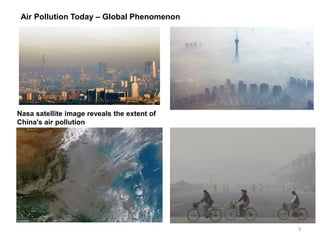
Air Pollution Today – Global Phenomenon 
Nasa satellite image reveals the extent of China's air pollution
4 
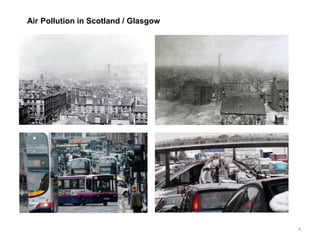
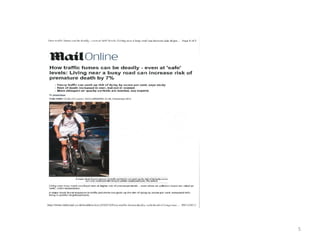
Air Pollution in Scotland / Glasgow
5
6 
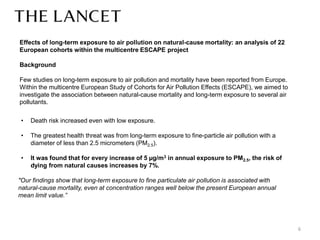
•Death risk increased even with low exposure. 
•The greatest health threat was from long-term exposure to fine-particle air pollution with a diameter of less than 2.5 micrometers (PM2.5). 
•It was found that for every increase of 5 μg/m3 in annual exposure to PM2.5, the risk of dying from natural causes increases by 7%. "Our findings show that long-term exposure to fine particulate air pollution is associated with natural-cause mortality, even at concentration ranges well below the present European annual mean limit value.” 
Effects of long-term exposure to air pollution on natural-cause mortality: an analysis of 22 European cohorts within the multicentre ESCAPE project Background Few studies on long-term exposure to air pollution and mortality have been reported from Europe. Within the multicentre European Study of Cohorts for Air Pollution Effects (ESCAPE), we aimed to investigate the association between natural-cause mortality and long-term exposure to several air pollutants.
Project Title: Air Pollution and Health Impacts Project (APHIP) Project Aim: 
•To develop an evidence-based set of key messages on air pollution and health impacts focused on encouraging people to adopt healthier and less polluting transport options. Funding: 
•By Scottish Government Environment Directorate and SEPA – Scottish Environment on the web (SEWEB) project via Scottish Urban Air Quality Steering Group as part of Research Programme. 
7
The Issue - Air Pollution and Health Impacts in Scotland Current consensus of views on air pollution and health 
•Air pollution is not good for human health. 
•Multiple sources of air pollution; natural and man made (anthropogenic). 
•Anthropogenic air pollution should be controllable, ideally preventable. 
•Transport (road traffic) sourced pollution (particulates, NOx, ozone) is a major contributor to anthropogenic air pollution and health impacts. 
•Changing the pattern of road transport use could reduce air pollution, especially in urban areas. 
•People need to be “encouraged” to change their travel habits and choice of transport: need “key messages”. 
8
The Questions (1) If we want to persuade people to change their behaviour, we have to have a sound evidence-base. - Are we sure the current consensus view is correct? 
•What are the current trends in road transport use in Scotland? 
•How bad is (traffic related) air pollution in Scotland? 
9
10 
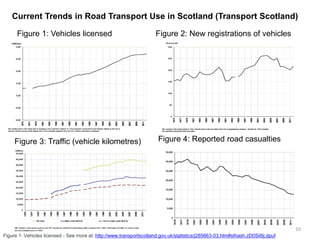
Figure 1: Vehicles licensed - See more at: http://www.transportscotland.gov.uk/statistics/j285663-03.htm#sthash.zD0SiI6j.dpuf 
Figure 1: Vehicles licensed 
Figure 2: New registrations of vehicles 
Figure 3: Traffic (vehicle kilometres) 
Figure 4: Reported road casualties 
Current Trends in Road Transport Use in Scotland (Transport Scotland)
11 
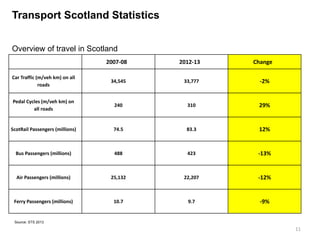
Overview of travel in Scotland 
2007-08 
2012-13 
Change 
Car Traffic (m/veh km) on all roads 
34,545 
33,777 
-2% 
Pedal Cycles (m/veh km) on all roads 
240 
310 
29% 
ScotRail Passengers (millions) 
74.5 
83.3 
12% 
Bus Passengers (millions) 
488 
423 
-13% 
Air Passengers (millions) 
25,132 
22,207 
-12% 
Ferry Passengers (millions) 
10.7 
9.7 
-9% 
Source: STS 2013 
Transport Scotland Statistics
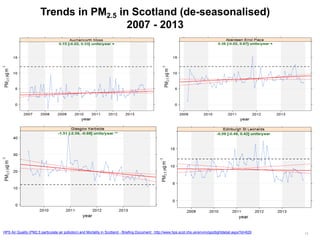
Trends in PM2.5 in Scotland (de-seasonalised) 2007 - 2013 
12 
HPS Air Quality (PM2.5 particulate air pollution) and Mortality in Scotland - Briefing Document: http://www.hps.scot.nhs.uk/enviro/spotlightdetail.aspx?id=629
13 
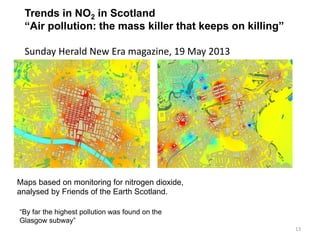
Trends in NO2 in Scotland “Air pollution: the mass killer that keeps on killing” Sunday Herald New Era magazine, 19 May 2013 
“By far the highest pollution was found on the Glasgow subway” 
Maps based on monitoring for nitrogen dioxide, analysed by Friends of the Earth Scotland.
The Questions (2) Assuming the evidence supports the consensus view How do we create “Cleaner Air, Healthier Places”? - What questions is this project trying to answer? 
•What are the health impacts of anthropogenic (traffic related) air pollution generally and in Scotland particularly? 
•How do we effectively encourage people to change their travel habits and choice of transport? 
14
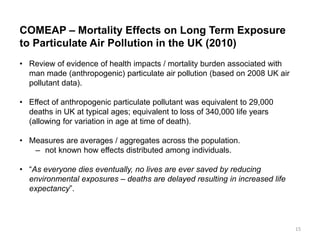
COMEAP – Mortality Effects on Long Term Exposure to Particulate Air Pollution in the UK (2010) 
•Review of evidence of health impacts / mortality burden associated with man made (anthropogenic) particulate air pollution (based on 2008 UK air pollutant data). 
•Effect of anthropogenic particulate pollutant was equivalent to 29,000 deaths in UK at typical ages; equivalent to loss of 340,000 life years (allowing for variation in age at time of death). 
•Measures are averages / aggregates across the population. 
–not known how effects distributed among individuals. 
•“As everyone dies eventually, no lives are ever saved by reducing environmental exposures – deaths are delayed resulting in increased life expectancy”. 
15
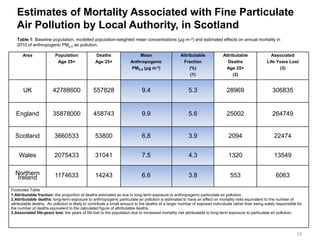
Estimates of Mortality Associated with Fine Particulate Air Pollution by Local Authority, in Scotland 
Area 
Population 
Age 25+ 
Deaths 
Age 25+ 
Mean 
Anthropogenic 
PM2.5 (μg m-3) 
Attributable 
Fraction 
(%) 
(1) 
Attributable 
Deaths 
Age 25+ 
(2) 
Associated 
Life Years Lost 
(3) 
UK 
42788600 
557828 
9.4 
5.3 
28969 
306835 
England 
35878000 
458743 
9.9 
5.6 
25002 
264749 
Scotland 
3660533 
53800 
6.8 
3.9 
2094 
22474 
Wales 
2075433 
31041 
7.5 
4.3 
1320 
13549 
Northern 
Ireland 
1174633 
14243 
6.6 
3.8 
553 
6063 
Footnotes Table 
1.Attributable fraction: the proportion of deaths estimated as due to long-term exposure to anthropogenic particulate air pollution. 
2.Attributable deaths: long-term exposure to anthropogenic particulate air pollution is estimated to have an effect on mortality risks equivalent to the number of attributable deaths. Air pollution is likely to contribute a small amount to the deaths of a larger number of exposed individuals rather than being solely responsible for the number of deaths equivalent to the calculated figure of attributable deaths. 
3.Associated life-years lost: the years of life lost to the population due to increased mortality risk attributable to long-term exposure to particulate air pollution. 
Table 1: Baseline population, modelled population-weighted mean concentrations (μg m-³) and estimated effects on annual mortality in 2010 of anthropogenic PM2.5 air pollution. 
16
17 
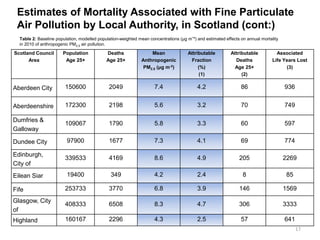
Estimates of Mortality Associated with Fine Particulate Air Pollution by Local Authority, in Scotland (cont:) 
Scotland Council Area 
Population 
Age 25+ 
Deaths 
Age 25+ 
Mean 
Anthropogenic 
PM2.5 (μg m-3) 
Attributable 
Fraction 
(%) 
(1) 
Attributable 
Deaths 
Age 25+ 
(2) 
Associated 
Life Years Lost 
(3) 
Aberdeen City 
150600 
2049 
7.4 
4.2 
86 
936 
Aberdeenshire 
172300 
2198 
5.6 
3.2 
70 
749 
Dumfries & Galloway 
109067 
1790 
5.8 
3.3 
60 
597 
Dundee City 
97900 
1677 
7.3 
4.1 
69 
774 
Edinburgh, City of 
339533 
4169 
8.6 
4.9 
205 
2269 
Eilean Siar 
19400 
349 
4.2 
2.4 
8 
85 
Fife 
253733 
3770 
6.8 
3.9 
146 
1569 
Glasgow, City of 
408333 
6508 
8.3 
4.7 
306 
3333 
Highland 
160167 
2296 
4.3 
2.5 
57 
641 
Table 2: Baseline population, modelled population-weighted mean concentrations (μg m‾³) and estimated effects on annual mortality in 2010 of anthropogenic PM2.5 air pollution.
18 
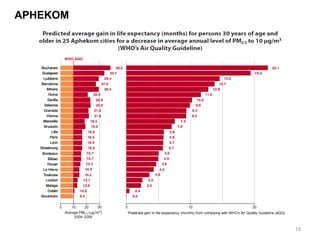
APHEKOM
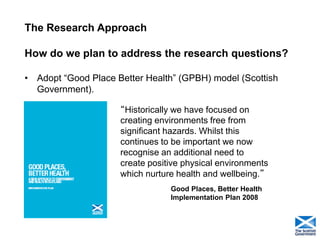
The Research Approach How do we plan to address the research questions? 
•Adopt “Good Place Better Health” (GPBH) model (Scottish Government). 
19 
“Historically we have focused on creating environments free from significant hazards. Whilst this continues to be important we now recognise an additional need to create positive physical environments which nurture health and wellbeing.” 
Good Places, Better Health Implementation Plan 2008
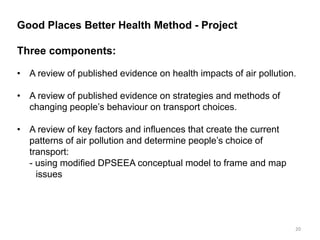
Good Places Better Health Method - Project Three components: 
•A review of published evidence on health impacts of air pollution. 
•A review of published evidence on strategies and methods of changing people’s behaviour on transport choices. 
•A review of key factors and influences that create the current patterns of air pollution and determine people’s choice of transport: - using modified DPSEEA conceptual model to frame and map issues 
20
Research Evidence on Air Pollution and Health Impacts Journal publications 2012 / 2013: 
• Occupational and Environmental Medicine: 85 papers 
• Lancet: 102 papers 
• Epidemiology: 138 papers 
•Research findings sometimes inconsistent / contradictory. 
•Study locations / populations are heterogeneous, hence may not be representative of experience in UK / Scotland. 
•Reliance on systematic reviews of evidence to determine the most robust estimates of health effects. 
•Reliance on expert groups (e.g. COMEAP) and consensus statements for conclusions on impacts of air pollution, for use in policy formulation and to guide public health action. 
21
EU / WHO Initiatives Review of Evidence on Health Aspects of Air Pollution (REVIHAAP) (2013) Provides additional support for effects of PM10 and PM2.5 on short and long term exposures on mortality and morbidity. 
•Long term exposure to PM2.5 is a cause of cardiovascular morbidity and mortality. 
•Evidence of association between PM2.5 and atherosclerosis, adverse birth outcomes, childhood respiratory disease (asthma). 
•Emerging evidence of association between long term PM2.5 exposure and neurodevelopmental / cognitive function (dementia) and chronic metabolic conditions e.g. diabetes. 
22
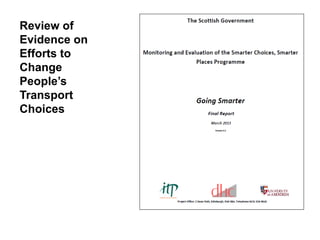
Review of Evidence on Efforts to Change People’s Transport Choices
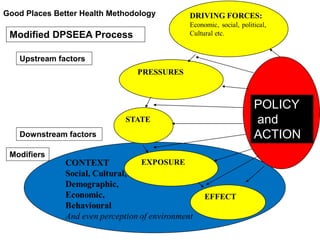
POLICY and ACTION 
Modified DPSEEA Process 
Upstream factors 
Downstream factors 
Good Places Better Health Methodology 
Modifiers
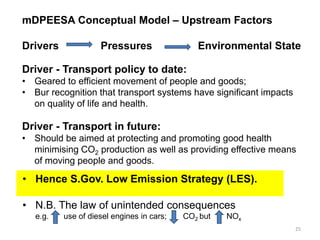
mDPEESA Conceptual Model – Upstream Factors Drivers Pressures Environmental State Driver - Transport policy to date: 
•Geared to efficient movement of people and goods; 
•Bur recognition that transport systems have significant impacts on quality of life and health. Driver - Transport in future: 
•Should be aimed at protecting and promoting good health minimising CO2 production as well as providing effective means of moving people and goods. 
25 
•N.B. The law of unintended consequences e.g. use of diesel engines in cars; CO2 but NOx 
•Hence S.Gov. Low Emission Strategy (LES).
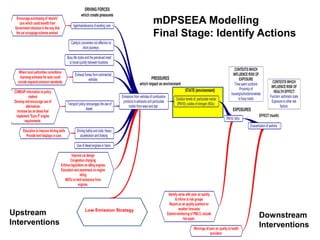
mDPSEEA Modelling Final Stage: Identify Actions 
Low Emission Strategy 
Upstream Interventions 
Downstream Interventions
By-products: 
•Review of evidence on air pollution and health impacts with key messages based on best evidence. 
•Review of evidence on influencing and modifying behaviour linked to reducing air pollution associated with transport use, with key messages on what works in practice, in behaviour modification. 
•mDPSEEA map of relationships between upstream and downstream factors that influence the current environmental state of road traffic related air pollution. Main Output: 
•Formulate key messages aimed at the public, policy makers (and potentially politicians) based on research evidence-base and mDPSEEA map. 
27 
Intended Project Outputs and Outcomes

Developing Evidence Based Messages on Air Pollution and Health Dr. Colin Ramsay

  • 1.
    STEP Conference 2014– Cleaner Air, Healthier Places Developing evidence-based messages on air pollution and health 18th November 2014 Dr. Colin N. Ramsay Consultant Epidemiologist Health Protection Scotland
  • 2.
    Presentation Aims Tooutline the rationale for the Scottish Government / SEPA / SUAQ Programme project on Air Pollution and Health Impacts (APHIP) •Air Pollution and Health in Scotland – the issues behind the project. •Why do we need this particular project – the questions the project aims to address. •How do we plan to address the questions. •What do we hope to achieve – the intended outcomes. 2
  • 3.
    3 Air PollutionToday – Global Phenomenon Nasa satellite image reveals the extent of China's air pollution
  • 4.
    4 Air Pollutionin Scotland / Glasgow
  • 5.
  • 6.
    6 •Death riskincreased even with low exposure. •The greatest health threat was from long-term exposure to fine-particle air pollution with a diameter of less than 2.5 micrometers (PM2.5). •It was found that for every increase of 5 μg/m3 in annual exposure to PM2.5, the risk of dying from natural causes increases by 7%. "Our findings show that long-term exposure to fine particulate air pollution is associated with natural-cause mortality, even at concentration ranges well below the present European annual mean limit value.” Effects of long-term exposure to air pollution on natural-cause mortality: an analysis of 22 European cohorts within the multicentre ESCAPE project Background Few studies on long-term exposure to air pollution and mortality have been reported from Europe. Within the multicentre European Study of Cohorts for Air Pollution Effects (ESCAPE), we aimed to investigate the association between natural-cause mortality and long-term exposure to several air pollutants.
  • 7.
    Project Title: AirPollution and Health Impacts Project (APHIP) Project Aim: •To develop an evidence-based set of key messages on air pollution and health impacts focused on encouraging people to adopt healthier and less polluting transport options. Funding: •By Scottish Government Environment Directorate and SEPA – Scottish Environment on the web (SEWEB) project via Scottish Urban Air Quality Steering Group as part of Research Programme. 7
  • 8.
    The Issue -Air Pollution and Health Impacts in Scotland Current consensus of views on air pollution and health •Air pollution is not good for human health. •Multiple sources of air pollution; natural and man made (anthropogenic). •Anthropogenic air pollution should be controllable, ideally preventable. •Transport (road traffic) sourced pollution (particulates, NOx, ozone) is a major contributor to anthropogenic air pollution and health impacts. •Changing the pattern of road transport use could reduce air pollution, especially in urban areas. •People need to be “encouraged” to change their travel habits and choice of transport: need “key messages”. 8
  • 9.
    The Questions (1)If we want to persuade people to change their behaviour, we have to have a sound evidence-base. - Are we sure the current consensus view is correct? •What are the current trends in road transport use in Scotland? •How bad is (traffic related) air pollution in Scotland? 9
  • 10.
    10 Figure 1:Vehicles licensed - See more at: http://www.transportscotland.gov.uk/statistics/j285663-03.htm#sthash.zD0SiI6j.dpuf Figure 1: Vehicles licensed Figure 2: New registrations of vehicles Figure 3: Traffic (vehicle kilometres) Figure 4: Reported road casualties Current Trends in Road Transport Use in Scotland (Transport Scotland)
  • 11.
    11 Overview oftravel in Scotland 2007-08 2012-13 Change Car Traffic (m/veh km) on all roads 34,545 33,777 -2% Pedal Cycles (m/veh km) on all roads 240 310 29% ScotRail Passengers (millions) 74.5 83.3 12% Bus Passengers (millions) 488 423 -13% Air Passengers (millions) 25,132 22,207 -12% Ferry Passengers (millions) 10.7 9.7 -9% Source: STS 2013 Transport Scotland Statistics
  • 12.
    Trends in PM2.5in Scotland (de-seasonalised) 2007 - 2013 12 HPS Air Quality (PM2.5 particulate air pollution) and Mortality in Scotland - Briefing Document: http://www.hps.scot.nhs.uk/enviro/spotlightdetail.aspx?id=629
  • 13.
    13 Trends inNO2 in Scotland “Air pollution: the mass killer that keeps on killing” Sunday Herald New Era magazine, 19 May 2013 “By far the highest pollution was found on the Glasgow subway” Maps based on monitoring for nitrogen dioxide, analysed by Friends of the Earth Scotland.
  • 14.
    The Questions (2)Assuming the evidence supports the consensus view How do we create “Cleaner Air, Healthier Places”? - What questions is this project trying to answer? •What are the health impacts of anthropogenic (traffic related) air pollution generally and in Scotland particularly? •How do we effectively encourage people to change their travel habits and choice of transport? 14
  • 15.
    COMEAP – MortalityEffects on Long Term Exposure to Particulate Air Pollution in the UK (2010) •Review of evidence of health impacts / mortality burden associated with man made (anthropogenic) particulate air pollution (based on 2008 UK air pollutant data). •Effect of anthropogenic particulate pollutant was equivalent to 29,000 deaths in UK at typical ages; equivalent to loss of 340,000 life years (allowing for variation in age at time of death). •Measures are averages / aggregates across the population. –not known how effects distributed among individuals. •“As everyone dies eventually, no lives are ever saved by reducing environmental exposures – deaths are delayed resulting in increased life expectancy”. 15
  • 16.
    Estimates of MortalityAssociated with Fine Particulate Air Pollution by Local Authority, in Scotland Area Population Age 25+ Deaths Age 25+ Mean Anthropogenic PM2.5 (μg m-3) Attributable Fraction (%) (1) Attributable Deaths Age 25+ (2) Associated Life Years Lost (3) UK 42788600 557828 9.4 5.3 28969 306835 England 35878000 458743 9.9 5.6 25002 264749 Scotland 3660533 53800 6.8 3.9 2094 22474 Wales 2075433 31041 7.5 4.3 1320 13549 Northern Ireland 1174633 14243 6.6 3.8 553 6063 Footnotes Table 1.Attributable fraction: the proportion of deaths estimated as due to long-term exposure to anthropogenic particulate air pollution. 2.Attributable deaths: long-term exposure to anthropogenic particulate air pollution is estimated to have an effect on mortality risks equivalent to the number of attributable deaths. Air pollution is likely to contribute a small amount to the deaths of a larger number of exposed individuals rather than being solely responsible for the number of deaths equivalent to the calculated figure of attributable deaths. 3.Associated life-years lost: the years of life lost to the population due to increased mortality risk attributable to long-term exposure to particulate air pollution. Table 1: Baseline population, modelled population-weighted mean concentrations (μg m-³) and estimated effects on annual mortality in 2010 of anthropogenic PM2.5 air pollution. 16
  • 17.
    17 Estimates ofMortality Associated with Fine Particulate Air Pollution by Local Authority, in Scotland (cont:) Scotland Council Area Population Age 25+ Deaths Age 25+ Mean Anthropogenic PM2.5 (μg m-3) Attributable Fraction (%) (1) Attributable Deaths Age 25+ (2) Associated Life Years Lost (3) Aberdeen City 150600 2049 7.4 4.2 86 936 Aberdeenshire 172300 2198 5.6 3.2 70 749 Dumfries & Galloway 109067 1790 5.8 3.3 60 597 Dundee City 97900 1677 7.3 4.1 69 774 Edinburgh, City of 339533 4169 8.6 4.9 205 2269 Eilean Siar 19400 349 4.2 2.4 8 85 Fife 253733 3770 6.8 3.9 146 1569 Glasgow, City of 408333 6508 8.3 4.7 306 3333 Highland 160167 2296 4.3 2.5 57 641 Table 2: Baseline population, modelled population-weighted mean concentrations (μg m‾³) and estimated effects on annual mortality in 2010 of anthropogenic PM2.5 air pollution.
  • 18.
  • 19.
    The Research ApproachHow do we plan to address the research questions? •Adopt “Good Place Better Health” (GPBH) model (Scottish Government). 19 “Historically we have focused on creating environments free from significant hazards. Whilst this continues to be important we now recognise an additional need to create positive physical environments which nurture health and wellbeing.” Good Places, Better Health Implementation Plan 2008
  • 20.
    Good Places BetterHealth Method - Project Three components: •A review of published evidence on health impacts of air pollution. •A review of published evidence on strategies and methods of changing people’s behaviour on transport choices. •A review of key factors and influences that create the current patterns of air pollution and determine people’s choice of transport: - using modified DPSEEA conceptual model to frame and map issues 20
  • 21.
    Research Evidence onAir Pollution and Health Impacts Journal publications 2012 / 2013: • Occupational and Environmental Medicine: 85 papers • Lancet: 102 papers • Epidemiology: 138 papers •Research findings sometimes inconsistent / contradictory. •Study locations / populations are heterogeneous, hence may not be representative of experience in UK / Scotland. •Reliance on systematic reviews of evidence to determine the most robust estimates of health effects. •Reliance on expert groups (e.g. COMEAP) and consensus statements for conclusions on impacts of air pollution, for use in policy formulation and to guide public health action. 21
  • 22.
    EU / WHOInitiatives Review of Evidence on Health Aspects of Air Pollution (REVIHAAP) (2013) Provides additional support for effects of PM10 and PM2.5 on short and long term exposures on mortality and morbidity. •Long term exposure to PM2.5 is a cause of cardiovascular morbidity and mortality. •Evidence of association between PM2.5 and atherosclerosis, adverse birth outcomes, childhood respiratory disease (asthma). •Emerging evidence of association between long term PM2.5 exposure and neurodevelopmental / cognitive function (dementia) and chronic metabolic conditions e.g. diabetes. 22
  • 23.
    Review of Evidenceon Efforts to Change People’s Transport Choices
  • 24.
    POLICY and ACTION Modified DPSEEA Process Upstream factors Downstream factors Good Places Better Health Methodology Modifiers
  • 25.
    mDPEESA Conceptual Model– Upstream Factors Drivers Pressures Environmental State Driver - Transport policy to date: •Geared to efficient movement of people and goods; •Bur recognition that transport systems have significant impacts on quality of life and health. Driver - Transport in future: •Should be aimed at protecting and promoting good health minimising CO2 production as well as providing effective means of moving people and goods. 25 •N.B. The law of unintended consequences e.g. use of diesel engines in cars; CO2 but NOx •Hence S.Gov. Low Emission Strategy (LES).
  • 26.
    mDPSEEA Modelling FinalStage: Identify Actions Low Emission Strategy Upstream Interventions Downstream Interventions
  • 27.
    By-products: •Review ofevidence on air pollution and health impacts with key messages based on best evidence. •Review of evidence on influencing and modifying behaviour linked to reducing air pollution associated with transport use, with key messages on what works in practice, in behaviour modification. •mDPSEEA map of relationships between upstream and downstream factors that influence the current environmental state of road traffic related air pollution. Main Output: •Formulate key messages aimed at the public, policy makers (and potentially politicians) based on research evidence-base and mDPSEEA map. 27 Intended Project Outputs and Outcomes