Air Pollution and Control
(Elective-I)
L-22  Control of pollutant emission at source,
alternative fuels, process change, removal methods
of particulate, principals of particulate removals.
Various types of particulate control
equipments(Theory and problems),
L-23  Gravity Setting chamber,
L- 25 Cyclone separators,
L- 26 Fabric filters,
L-27 Electrostatic precipitators and
L-28 Scrubbers
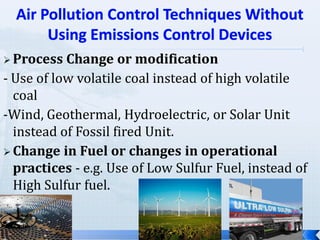
 Process

Change or modification
- Use of low volatile coal instead of high volatile
coal
-Wind, Geothermal, Hydroelectric, or Solar Unit
instead of Fossil fired Unit.
 Change in Fuel or changes in operational
practices - e.g. Use of Low Sulfur Fuel, instead of
High Sulfur fuel.
 Good
-

Operating Practices

Good Housekeeping
Maintenance

Plant Shutdown.
 Replacement or modification of the
process equipment.
-Use of vapour recovery system:- use of
absorbers, condensers and compressors
may be used to control vapour losses





The control of particulate matter is an
important aspect of industrial air
pollution engineering.
Particles are collected by a combination of
several mechanisms.

1)
2)
3)
4)
5)
6)

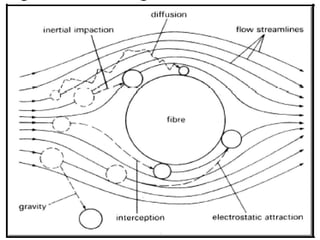
The six available mechanisms are
GRAVITATIONAL SETTLING,
CENTRIFUGAL IMPACTION,
INERTIAL IMPACTION,
DIRECT INTERCEPTION,
DIFFUSION AND
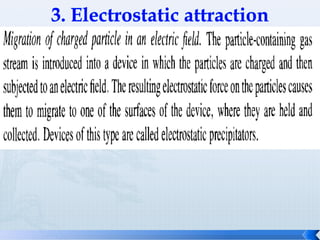
THE ELECTROSTATIC ATTRACTION.
Particles in still air have two forces acting on
them;
(1) a gravitational force downward and
(2) the air resistance (or drag) force upward.
 When particles begin to fall, they quickly reach
a terminal settling velocity, which
represents the constant velocity of a falling
particle when the gravitational force
downward is balanced by the air resistance
(or drag) force upward.

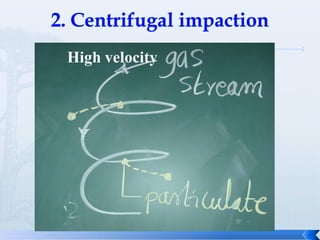
High velocity


Consider a high velocity gas stream
revolving, because of centrifugal action
particulates are separated from gas
stream as their self weight is more than
that of gas molecules.
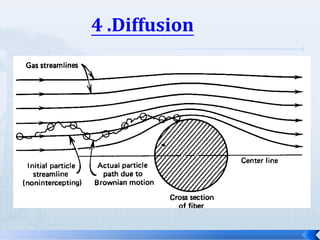
4 .Diffusion




Brownian diffusion becomes the dominant
collection mechanism for particles less than 0.3
micrometer and is especially significant for
particles in the 0.01 to 0.1 micrometer size
range.
Very small particles in a gas stream deflect
slightly when gas molecules strike them. Transfer
of kinetic energy from the rapidly moving gas
molecule to the small particle causes this
deflection, called Brownian diffusion. These
small particles are captured when they impact a
target (e.g. liquid droplet) as a result of this
random movement.
5. Inertial Impaction


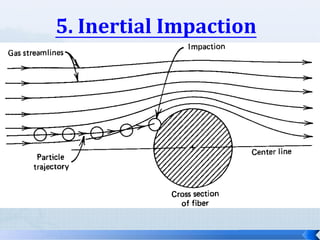
Due to inertia, a particle moving in a gas
stream can strike slowly moving or
stationary obstacles (targets) in its path.
As the gas stream deflects around the
obstacle, the particle continues toward
the object and impacts it. The obstacle
may be a water droplet as shown in the
Figure above.
6. Interception


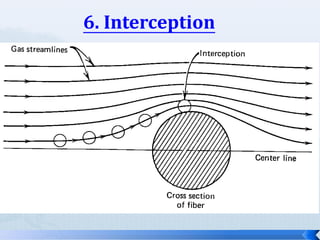
Inertial impaction occurs when obstacles
(e.g. water droplets) are directly in the
path of the particle moving in the gas
stream. Sometimes the obstacle or target
is offset slightly from the direct path of
the moving particle. In this instance, as
the particle approaches the edge of the
obstacle, the obstacle may collect the
particle through a process called
interception.
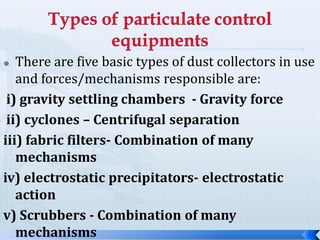
There are five basic types of dust collectors in use
and forces/mechanisms responsible are:
i) gravity settling chambers - Gravity force
ii) cyclones – Centrifugal separation
iii) fabric filters- Combination of many
mechanisms
iv) electrostatic precipitators- electrostatic
action
v) Scrubbers - Combination of many
mechanisms




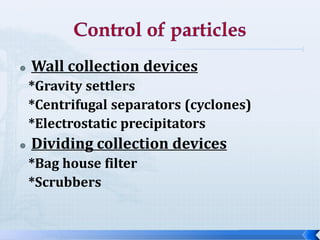
Wall collection devices
*Gravity settlers
*Centrifugal separators (cyclones)
*Electrostatic precipitators



Dividing collection devices
*Bag house filter
*Scrubbers


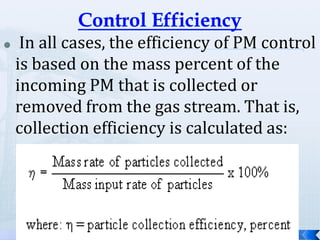
In all cases, the efficiency of PM control
is based on the mass percent of the
incoming PM that is collected or
removed from the gas stream. That is,
collection efficiency is calculated as:
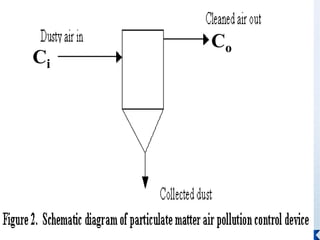
Ci

Co
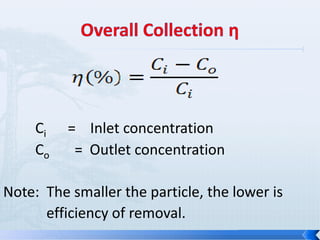
Ci
Co

= Inlet concentration
= Outlet concentration

Note: The smaller the particle, the lower is
efficiency of removal.
Air pollution control devices
operate on a continuously flowing
stream of contaminated air or
exhaust gas.
 The dusty gas flows into the device,
and most of the particles are
separated from the gas stream and
collected as solids, while the entire
air flow continues through the
equipment



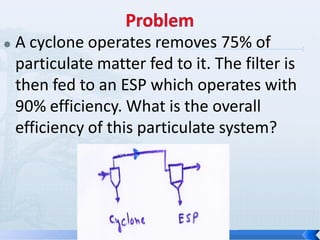
A cyclone operates removes 75% of
particulate matter fed to it. The filter is
then fed to an ESP which operates with
90% efficiency. What is the overall
efficiency of this particulate system?
Step 1:
Assuming an initial feed of 100%, determine the
percentage of the stream fed to the ESP.
100% - (100% x 0.75) = 25%
 Step 2:
Determine final composition after ESP.
25% - (25% x 0.9) = 2.5%
 Step 3:
Determine overall efficiency
Ƞoverall = (initial – final)/ initial
= [(100% - 2.5%)/100% ] = 97.5%

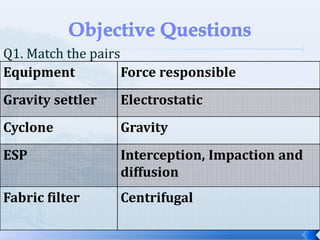
Q1. Match the pairs
Equipment
Force responsible
Gravity settler

Electrostatic

Cyclone

Gravity

ESP

Interception, Impaction and
diffusion

Fabric filter

Centrifugal
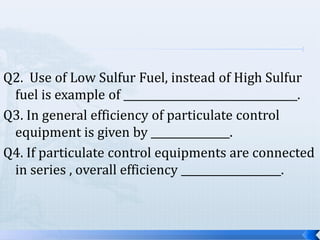
Q2. Use of Low Sulfur Fuel, instead of High Sulfur
fuel is example of _________________________________.
Q3. In general efficiency of particulate control
equipment is given by _______________.
Q4. If particulate control equipments are connected
in series , overall efficiency ___________________.
Q1. Explain different particulate collection
mechanisms with neat sketches.
Q2. Write a short note on ‘Air pollution control
Techniques Without Using Emissions Control
Devices’

L 22 final

  • 1.
    Air Pollution andControl (Elective-I)
  • 2.
    L-22  Controlof pollutant emission at source, alternative fuels, process change, removal methods of particulate, principals of particulate removals. Various types of particulate control equipments(Theory and problems), L-23  Gravity Setting chamber, L- 25 Cyclone separators, L- 26 Fabric filters, L-27 Electrostatic precipitators and L-28 Scrubbers
  • 3.
     Process Change ormodification - Use of low volatile coal instead of high volatile coal -Wind, Geothermal, Hydroelectric, or Solar Unit instead of Fossil fired Unit.  Change in Fuel or changes in operational practices - e.g. Use of Low Sulfur Fuel, instead of High Sulfur fuel.
  • 4.
     Good - Operating Practices GoodHousekeeping Maintenance Plant Shutdown.  Replacement or modification of the process equipment. -Use of vapour recovery system:- use of absorbers, condensers and compressors may be used to control vapour losses 
  • 5.
      The control ofparticulate matter is an important aspect of industrial air pollution engineering. Particles are collected by a combination of several mechanisms.
  • 6.
     1) 2) 3) 4) 5) 6) The six availablemechanisms are GRAVITATIONAL SETTLING, CENTRIFUGAL IMPACTION, INERTIAL IMPACTION, DIRECT INTERCEPTION, DIFFUSION AND THE ELECTROSTATIC ATTRACTION.
  • 7.
    Particles in stillair have two forces acting on them; (1) a gravitational force downward and (2) the air resistance (or drag) force upward.  When particles begin to fall, they quickly reach a terminal settling velocity, which represents the constant velocity of a falling particle when the gravitational force downward is balanced by the air resistance (or drag) force upward. 
  • 8.
  • 9.
     Consider a highvelocity gas stream revolving, because of centrifugal action particulates are separated from gas stream as their self weight is more than that of gas molecules.
  • 11.
  • 12.
      Brownian diffusion becomesthe dominant collection mechanism for particles less than 0.3 micrometer and is especially significant for particles in the 0.01 to 0.1 micrometer size range. Very small particles in a gas stream deflect slightly when gas molecules strike them. Transfer of kinetic energy from the rapidly moving gas molecule to the small particle causes this deflection, called Brownian diffusion. These small particles are captured when they impact a target (e.g. liquid droplet) as a result of this random movement.
  • 13.
  • 14.
     Due to inertia,a particle moving in a gas stream can strike slowly moving or stationary obstacles (targets) in its path. As the gas stream deflects around the obstacle, the particle continues toward the object and impacts it. The obstacle may be a water droplet as shown in the Figure above.
  • 15.
  • 16.
     Inertial impaction occurswhen obstacles (e.g. water droplets) are directly in the path of the particle moving in the gas stream. Sometimes the obstacle or target is offset slightly from the direct path of the moving particle. In this instance, as the particle approaches the edge of the obstacle, the obstacle may collect the particle through a process called interception.
  • 18.
    There are fivebasic types of dust collectors in use and forces/mechanisms responsible are: i) gravity settling chambers - Gravity force ii) cyclones – Centrifugal separation iii) fabric filters- Combination of many mechanisms iv) electrostatic precipitators- electrostatic action v) Scrubbers - Combination of many mechanisms 
  • 19.
     Wall collection devices *Gravitysettlers *Centrifugal separators (cyclones) *Electrostatic precipitators  Dividing collection devices *Bag house filter *Scrubbers
  • 20.
     In all cases,the efficiency of PM control is based on the mass percent of the incoming PM that is collected or removed from the gas stream. That is, collection efficiency is calculated as:
  • 21.
  • 22.
    Ci Co = Inlet concentration =Outlet concentration Note: The smaller the particle, the lower is efficiency of removal.
  • 23.
    Air pollution controldevices operate on a continuously flowing stream of contaminated air or exhaust gas.  The dusty gas flows into the device, and most of the particles are separated from the gas stream and collected as solids, while the entire air flow continues through the equipment 
  • 24.
     A cyclone operatesremoves 75% of particulate matter fed to it. The filter is then fed to an ESP which operates with 90% efficiency. What is the overall efficiency of this particulate system?
  • 25.
    Step 1: Assuming aninitial feed of 100%, determine the percentage of the stream fed to the ESP. 100% - (100% x 0.75) = 25%  Step 2: Determine final composition after ESP. 25% - (25% x 0.9) = 2.5%  Step 3: Determine overall efficiency Ƞoverall = (initial – final)/ initial = [(100% - 2.5%)/100% ] = 97.5% 
  • 26.
    Q1. Match thepairs Equipment Force responsible Gravity settler Electrostatic Cyclone Gravity ESP Interception, Impaction and diffusion Fabric filter Centrifugal
  • 27.
    Q2. Use ofLow Sulfur Fuel, instead of High Sulfur fuel is example of _________________________________. Q3. In general efficiency of particulate control equipment is given by _______________. Q4. If particulate control equipments are connected in series , overall efficiency ___________________.
  • 28.
    Q1. Explain differentparticulate collection mechanisms with neat sketches. Q2. Write a short note on ‘Air pollution control Techniques Without Using Emissions Control Devices’