 What is ozone layer?
 Who discover the ozone layer and when?
 What is ozone depletion?
 What happen to the ozone layer on this
day?
 What is the purpose of ozone layer?
 The ozone layer was built of what
chemicals?
 What will happen if ozone layer is
completely depleted?
 How fast the ozone depletion grows?
 How to prevent the ozone depletion?
 References
 Prepared by
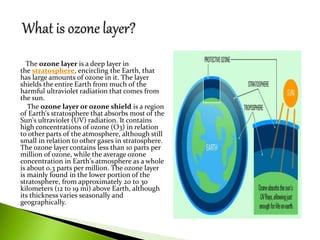
The ozone layer is a deep layer in
the stratosphere, encircling the Earth, that
has large amounts of ozone in it. The layer
shields the entire Earth from much of the
harmful ultraviolet radiation that comes from
the sun.
The ozone layer or ozone shield is a region
of Earth's stratosphere that absorbs most of the
Sun's ultraviolet (UV) radiation. It contains
high concentrations of ozone (O3) in relation
to other parts of the atmosphere, although still
small in relation to other gases in stratosphere.
The ozone layer contains less than 10 parts per
million of ozone, while the average ozone
concentration in Earth's atmosphere as a whole
is about 0.3 parts per million. The ozone layer
is mainly found in the lower portion of the
stratosphere, from approximately 20 to 30
kilometers (12 to 19 mi) above Earth, although
its thickness varies seasonally and
geographically.
The ozone layer was discovered in
1913 by the French physicists
Charles Fabry and Henri Buisson.
Measurements of the sun showed
that the radiation sent out from its
surface and reaching the ground on
Earth is usually consistent with the
spectrum of a black body with a
temperature in the range of 5,500–
6,000 K (5,227 to 5,727 °C), except
that there was no radiation below a
wavelength of about 310 nm at the
ultraviolet end of the spectrum. It
was deduced that the missing
radiation was being absorbed by
something in the atmosphere.
Eventually the spectrum of the
missing radiation was matched to
only one known chemical, ozone.
Charles Fabry
Henri Buisson.
Ozone layer depletion, is simply the wearing out (reduction) of the amount
of ozone in the stratosphere. Unlike pollution, which has many types and
causes, Ozone depletion has been pinned down to one major human activity.
Ozone layer depletion is one of the most serious problems faced by our
planet earth. It is also one of the prime reasons which are leading to global
warming. (ANKIT JAIN)
The depletion of ozone layer in Atlantic.
Before climate change, the world’s
scientists were warning us about the
hole in the ozone layer. Hannah
Osborne looks back at how an
environmental disaster was averted
and asks what the future holds.
There is a hole in the ozone layer
and it’s going to kill us all. Thirty
years ago that was a global worry.
Scientists had discovered
chlorofluorocarbons (CFCs) were
destroying the planet’s ozone – a
colourless gas that absorbs harmful
UV rays from the Sun, protecting life
on Earth. ( Metro news; Hannah
Osborne)
When the ozone layer absorbs the sun's ultraviolet radiation, it
creates a source of heat and regulates the temperature of the Earth's
atmosphere. If the ozone didn't filter the sun's ultraviolet radiation,
most of it would reach the Earth's surface, which would be dangerous
for plants and animals. The function of the ozone layer is to shield
the Earth from the harmful ultraviolet rays of the sun and to keep the
Earth warm. (phys.educbritania.com)
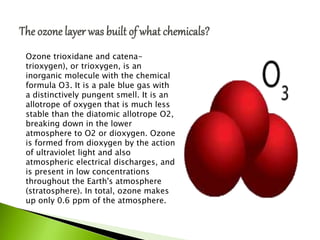
Ozone trioxidane and catena-
trioxygen), or trioxygen, is an
inorganic molecule with the chemical
formula O3. It is a pale blue gas with
a distinctively pungent smell. It is an
allotrope of oxygen that is much less
stable than the diatomic allotrope O2,
breaking down in the lower
atmosphere to O2 or dioxygen. Ozone
is formed from dioxygen by the action
of ultraviolet light and also
atmospheric electrical discharges, and
is present in low concentrations
throughout the Earth's atmosphere
(stratosphere). In total, ozone makes
up only 0.6 ppm of the atmosphere.
Land and Water Life Would Suffer
 Without the ozone layer’s protection
from the sun, people, animals and plant
life would be destroyed. Even underwater
life would not be safe since UV rays can
penetrate clear water to a certain depth
before being absorbed.
Increase in Disease
 However, increased exposure to the
sun’s radiation can also cause blindness
and cataracts and, alarmingly, some
experts now believe that the amount of
protection we receive from vaccinations
(for diseases such as measles) could be
reduced in people exposed to higher
levels of UV-B rays.
Our Food Chain
 Many biological systems are damaged
by exposure to UV-B and research has
shown that its effects are proportional
to the time and intensity of exposure
and of course, small and delicate
organisms are much more vulnerable
to damage than larger species, such
as humans.
Annual Antarctic Ozone Hole Larger and
Formed Later in 2015
 The 2015 Antarctic ozone hole area was
larger and formed later than in recent
years, said scientists from NASA and the
National Oceanic and Atmospheric
Administration (NOAA).
 On Oct. 2, 2015, the ozone hole
expanded to its peak of 28.2 million
square kilometers (10.9 million square
miles), an area larger than the continent
of North America. Throughout October,
the hole remained large and set many
area daily records. Unusually cold
temperature and weak dynamics in the
Antarctic stratosphere this year resulted
in this larger ozone hole. In comparison,
last year the ozone hole peaked at 24.1
million square kilometers (9.3 million
square miles) on Sept. 11, 2014.
Compared to the 1991-2014 period, the
2015 ozone hole average area was the
fourth largest.
5 ways to prevent ozone depletion
1. Limit private vehicle driving
 A very easy way to control ozone depletion would be to limit or reduce the amount of driving as vehicular
emissions eventually result in smog which is a culprit in the deterioration of the ozone layer. Car pooling,
taking public transport, walking, using a bicycle would limit the usage of individual transportation. It would be
a great option to switch to cars/vehicles that have a hybrid or electric zero-emission engine.
2. Use eco-friendly household cleaning products
 Usage of eco-friendly and natural cleaning products for household chores is a great way to prevent ozone
depletion. This is because many of these cleaning agents contain toxic chemicals that interfere with the ozone
layer. A lot of supermarkets and health stores sell cleaning products that are toxic-free and made out of
natural ingredients.
3. Avoid using pesticides
 Pesticides may be an easy solution for getting rid of weed, but are harmful for the ozone layer. The best
solution for this would be to try using natural remedies, rather than heading out for pesticides. You can
perhaps try to weed manually or mow your garden consistently so as to avoid weed-growth.
4. Developing stringent regulations for rocket launches
 The world is progressing in scientific discoveries by leaps and bounds. A lot of rocket launches are happening
the world over without consideration of the fact that it can damage the ozone layer if it is not regulated soon. A
study shows that the harm caused by rocket launches would outpace the harm caused due to CFCs. At present,
the global rocket launches do not contribute hugely to ozone layer depletion, but over the course of time, due
to the advancement of the space industry, it will become a major contributor to ozone depletion. All types of
rocket engines result in combustion by products that are ozone-destroying compounds that are expelled
directly in the middle and upper stratosphere layer – near the ozone layer.
5. Banning the use of dangerous nitrous oxide
 Due to the worldwide alarm caused by a study in the late 70s about the alarming rate at which the ozone was
being depleted, nations around the globe got together and formed the Montreal Protocol in the year 1989 with
a strong aim to stop the usage of CFCs. However, the protocol did not include nitrous oxide which is the most
fatal chemical that can destroy the ozone layer and is still in use. Governments across the world should take a
strong stand for banning the use of this harmful compound to save the ozone layer.
 https://www.google.com.ph/webhp?sourceid=chrome-
instant&ion=1&espv=2&ie=UTF-8#q=ozone+layer&
 https://en.wikipedia.org/wiki/Ozone_layer
 https://www.google.com.ph/webhp?sourceid=chrome-
instant&ion=1&espv=2&ie=UTF-
8#q=what+happen+to+the+ozone+layer+on+this+day&
 http://www.7continents5oceans.com/ozone-layer-depletion-causes-effects-
andsolutions
 https://www.google.com.ph/webhp?sourceid=chrome-
instant&ion=1&espv=2&ie=UTF-
8#q=what+is+the+purpose+of+ozone+layer&
 https://www.google.com.ph/webhp?sourceid=chrome-
instant&ion=1&espv=2&ie=UTF-
8#q=the+ozone+layer+was+built+of+what+chemicals
 https://www.google.com.ph/webhp?sourceid=chrome-
instant&ion=1&espv=2&ie=UTF-
8#q=the+ozone+layer+was+built+of+what+chemicals
 https://www.google.com.ph/webhp?sourceid=chrome-
instant&ion=1&espv=2&ie=UTF-8#q=How+fast+the+ozone+depletion+grows
 https://www.google.com.ph/webhp?sourceid=chrome-
instant&ion=1&espv=2&ie=UTF-8#q=How+to+prevent+the+ozone+depletion
Khalid Mindalano Cyrus Carmelotes Jerald Danial

Ozone layer

  • 2.
     What isozone layer?  Who discover the ozone layer and when?  What is ozone depletion?  What happen to the ozone layer on this day?  What is the purpose of ozone layer?  The ozone layer was built of what chemicals?  What will happen if ozone layer is completely depleted?  How fast the ozone depletion grows?  How to prevent the ozone depletion?  References  Prepared by
  • 3.
    The ozone layeris a deep layer in the stratosphere, encircling the Earth, that has large amounts of ozone in it. The layer shields the entire Earth from much of the harmful ultraviolet radiation that comes from the sun. The ozone layer or ozone shield is a region of Earth's stratosphere that absorbs most of the Sun's ultraviolet (UV) radiation. It contains high concentrations of ozone (O3) in relation to other parts of the atmosphere, although still small in relation to other gases in stratosphere. The ozone layer contains less than 10 parts per million of ozone, while the average ozone concentration in Earth's atmosphere as a whole is about 0.3 parts per million. The ozone layer is mainly found in the lower portion of the stratosphere, from approximately 20 to 30 kilometers (12 to 19 mi) above Earth, although its thickness varies seasonally and geographically.
  • 4.
    The ozone layerwas discovered in 1913 by the French physicists Charles Fabry and Henri Buisson. Measurements of the sun showed that the radiation sent out from its surface and reaching the ground on Earth is usually consistent with the spectrum of a black body with a temperature in the range of 5,500– 6,000 K (5,227 to 5,727 °C), except that there was no radiation below a wavelength of about 310 nm at the ultraviolet end of the spectrum. It was deduced that the missing radiation was being absorbed by something in the atmosphere. Eventually the spectrum of the missing radiation was matched to only one known chemical, ozone. Charles Fabry Henri Buisson.
  • 5.
    Ozone layer depletion,is simply the wearing out (reduction) of the amount of ozone in the stratosphere. Unlike pollution, which has many types and causes, Ozone depletion has been pinned down to one major human activity. Ozone layer depletion is one of the most serious problems faced by our planet earth. It is also one of the prime reasons which are leading to global warming. (ANKIT JAIN) The depletion of ozone layer in Atlantic.
  • 6.
    Before climate change,the world’s scientists were warning us about the hole in the ozone layer. Hannah Osborne looks back at how an environmental disaster was averted and asks what the future holds. There is a hole in the ozone layer and it’s going to kill us all. Thirty years ago that was a global worry. Scientists had discovered chlorofluorocarbons (CFCs) were destroying the planet’s ozone – a colourless gas that absorbs harmful UV rays from the Sun, protecting life on Earth. ( Metro news; Hannah Osborne)
  • 7.
    When the ozonelayer absorbs the sun's ultraviolet radiation, it creates a source of heat and regulates the temperature of the Earth's atmosphere. If the ozone didn't filter the sun's ultraviolet radiation, most of it would reach the Earth's surface, which would be dangerous for plants and animals. The function of the ozone layer is to shield the Earth from the harmful ultraviolet rays of the sun and to keep the Earth warm. (phys.educbritania.com)
  • 8.
    Ozone trioxidane andcatena- trioxygen), or trioxygen, is an inorganic molecule with the chemical formula O3. It is a pale blue gas with a distinctively pungent smell. It is an allotrope of oxygen that is much less stable than the diatomic allotrope O2, breaking down in the lower atmosphere to O2 or dioxygen. Ozone is formed from dioxygen by the action of ultraviolet light and also atmospheric electrical discharges, and is present in low concentrations throughout the Earth's atmosphere (stratosphere). In total, ozone makes up only 0.6 ppm of the atmosphere.
  • 9.
    Land and WaterLife Would Suffer  Without the ozone layer’s protection from the sun, people, animals and plant life would be destroyed. Even underwater life would not be safe since UV rays can penetrate clear water to a certain depth before being absorbed. Increase in Disease  However, increased exposure to the sun’s radiation can also cause blindness and cataracts and, alarmingly, some experts now believe that the amount of protection we receive from vaccinations (for diseases such as measles) could be reduced in people exposed to higher levels of UV-B rays. Our Food Chain  Many biological systems are damaged by exposure to UV-B and research has shown that its effects are proportional to the time and intensity of exposure and of course, small and delicate organisms are much more vulnerable to damage than larger species, such as humans.
  • 10.
    Annual Antarctic OzoneHole Larger and Formed Later in 2015  The 2015 Antarctic ozone hole area was larger and formed later than in recent years, said scientists from NASA and the National Oceanic and Atmospheric Administration (NOAA).  On Oct. 2, 2015, the ozone hole expanded to its peak of 28.2 million square kilometers (10.9 million square miles), an area larger than the continent of North America. Throughout October, the hole remained large and set many area daily records. Unusually cold temperature and weak dynamics in the Antarctic stratosphere this year resulted in this larger ozone hole. In comparison, last year the ozone hole peaked at 24.1 million square kilometers (9.3 million square miles) on Sept. 11, 2014. Compared to the 1991-2014 period, the 2015 ozone hole average area was the fourth largest.
  • 11.
    5 ways toprevent ozone depletion 1. Limit private vehicle driving  A very easy way to control ozone depletion would be to limit or reduce the amount of driving as vehicular emissions eventually result in smog which is a culprit in the deterioration of the ozone layer. Car pooling, taking public transport, walking, using a bicycle would limit the usage of individual transportation. It would be a great option to switch to cars/vehicles that have a hybrid or electric zero-emission engine. 2. Use eco-friendly household cleaning products  Usage of eco-friendly and natural cleaning products for household chores is a great way to prevent ozone depletion. This is because many of these cleaning agents contain toxic chemicals that interfere with the ozone layer. A lot of supermarkets and health stores sell cleaning products that are toxic-free and made out of natural ingredients. 3. Avoid using pesticides  Pesticides may be an easy solution for getting rid of weed, but are harmful for the ozone layer. The best solution for this would be to try using natural remedies, rather than heading out for pesticides. You can perhaps try to weed manually or mow your garden consistently so as to avoid weed-growth. 4. Developing stringent regulations for rocket launches  The world is progressing in scientific discoveries by leaps and bounds. A lot of rocket launches are happening the world over without consideration of the fact that it can damage the ozone layer if it is not regulated soon. A study shows that the harm caused by rocket launches would outpace the harm caused due to CFCs. At present, the global rocket launches do not contribute hugely to ozone layer depletion, but over the course of time, due to the advancement of the space industry, it will become a major contributor to ozone depletion. All types of rocket engines result in combustion by products that are ozone-destroying compounds that are expelled directly in the middle and upper stratosphere layer – near the ozone layer. 5. Banning the use of dangerous nitrous oxide  Due to the worldwide alarm caused by a study in the late 70s about the alarming rate at which the ozone was being depleted, nations around the globe got together and formed the Montreal Protocol in the year 1989 with a strong aim to stop the usage of CFCs. However, the protocol did not include nitrous oxide which is the most fatal chemical that can destroy the ozone layer and is still in use. Governments across the world should take a strong stand for banning the use of this harmful compound to save the ozone layer.
  • 12.
     https://www.google.com.ph/webhp?sourceid=chrome- instant&ion=1&espv=2&ie=UTF-8#q=ozone+layer&  https://en.wikipedia.org/wiki/Ozone_layer https://www.google.com.ph/webhp?sourceid=chrome- instant&ion=1&espv=2&ie=UTF- 8#q=what+happen+to+the+ozone+layer+on+this+day&  http://www.7continents5oceans.com/ozone-layer-depletion-causes-effects- andsolutions  https://www.google.com.ph/webhp?sourceid=chrome- instant&ion=1&espv=2&ie=UTF- 8#q=what+is+the+purpose+of+ozone+layer&  https://www.google.com.ph/webhp?sourceid=chrome- instant&ion=1&espv=2&ie=UTF- 8#q=the+ozone+layer+was+built+of+what+chemicals  https://www.google.com.ph/webhp?sourceid=chrome- instant&ion=1&espv=2&ie=UTF- 8#q=the+ozone+layer+was+built+of+what+chemicals  https://www.google.com.ph/webhp?sourceid=chrome- instant&ion=1&espv=2&ie=UTF-8#q=How+fast+the+ozone+depletion+grows  https://www.google.com.ph/webhp?sourceid=chrome- instant&ion=1&espv=2&ie=UTF-8#q=How+to+prevent+the+ozone+depletion
  • 13.
    Khalid Mindalano CyrusCarmelotes Jerald Danial