Water Efficiency in Thermal power Plant:
An Outline of Cooling Technology in India
Speaker: Kalyan Bhattacharya, Vice President – E & BD
Paharpur Cooling Towers Ltd, Kolkata, INDIA
 Water is one of the vital inputs for thermal power generation.
 Water has the highest specific heat amongst all materials
available in abundance, hence, ideal as cooling fluid. (Sp Heat
of Water = 1 Kcal/Kg deg C)
 Process cooling in the condenser, ash disposal, removal of
heat generated in plant auxiliaries and various other activities
require water.
 Large coal based Power Plants are likely to come up in future.
 Difficulties are already being faced in existing thermal power
plants due to non-availability of water and expected to be
aggravated in future with more coal fire TPP coming up.
Introduction:
Water Insufficiency issues of Existing Plants:
NTPC’s 2100 MW Farakka STPP
in West Bengal has come to a
halt due to falling water level
in the Feeder Canal. This is in
the news and the crisis is
continuing.
Effect is being felt in
Jharkhand, Orrisa, Bihar and
Bengal.
Non-availability of water is
encountered in existing Power
Plants which are situated in
coal bearing states like Orissa,
Jharkhand and Chhattisgarh.
Consumption Areas of Water in Power Plant:
Water is used in almost all areas/ facilities of thermal power
stations in one way or other. A typical list of plant systems/
applications requiring consumptive water is indicated as below:
– Cooling water system (Condenser & ACW)
– Ash handling system
– Power cycle make up
– Coal dust suppression system
– Service water system
– Potable water system
– Gardening
– Evaporation from raw water reservoir
Typical Water Consumption Figures
Plant water consumption is governed by a number of factors
such as :
Quality of raw water, type of condenser cooling system, Quality of
coal, Ash utilization, Type of ash disposal system, Waste water
management aspects etc.
In the past, power stations were designed with water systems having
liberal considerations and high design margins.
The consumptive water requirement for coal based plants with
cooling towers used to be about 7 m3/h per MW
In recent times, plants have been designed with reduced Plant water
consumption rate in the range 3.5 - 4 m3/h per MW
Water consumption of a typical Coal Based TPP
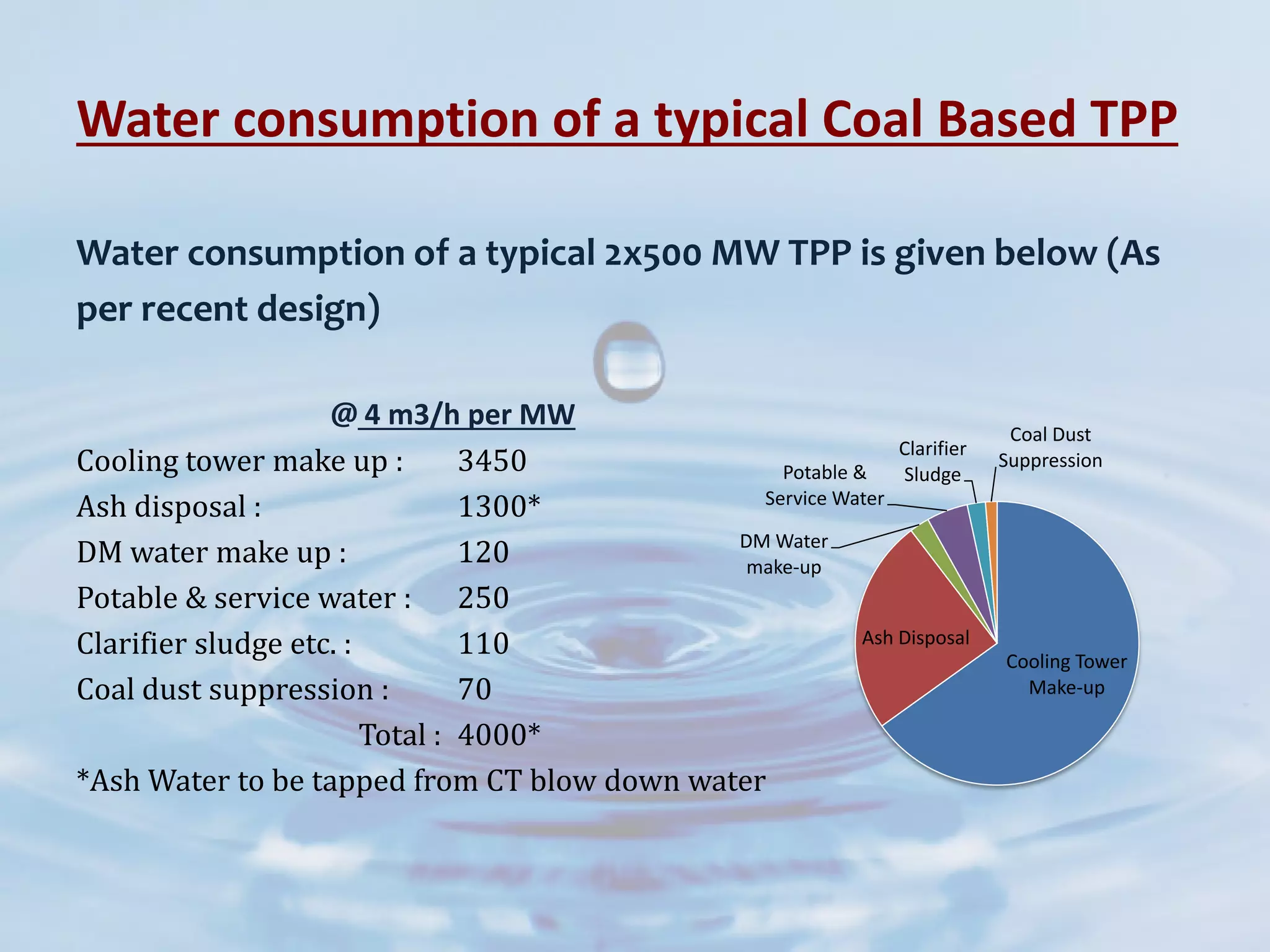
Water consumption of a typical 2x500 MW TPP is given below (As
per recent design)
@ 4 m3/h per MW
Cooling tower make up : 3450
Ash disposal : 1300*
DM water make up : 120
Potable & service water : 250
Clarifier sludge etc. : 110
Coal dust suppression : 70
Total : 4000*
*Ash Water to be tapped from CT blow down water
Cooling Tower
Make-up
Ash Disposal
DM Water
make-up
Potable &
Service Water
Clarifier
Sludge
Coal Dust
Suppression
MoEF Notification:
Ministry of Environment, Forest and Climate Change (MoEF)
in its recent notification dated December 07, 2015 on
Environment (Protection) Amendment Rules, 2015 have
notified the following:
I. All plants with Once Through Cooling (OTC) shall install Cooling Tower
(CT) and achieve specific water consumption upto maximum of
3.5m3/MWh within a period of two years from the date of publication
of this notification.
II. All existing CT-based plants shall have to reduce specific water
consumption upto maximum of 3.5m3/MWh within a period of two
years from the date of publication of this notification.
III. New plants to be installed after 1st January, 2017 shall have to meet
specific water consumption upto maximum of 2.5 m3/MWh and achieve
zero waste water discharged
Cooling Water System:
Cooling Systems in Practice in India:
1. Cooling Tower (IDCT / NDCT) – Wet Cooling
2. Air Cooled Condenser – Dry Cooling
3. Once Through Cooling – To be replaced as per Dec 7, 2015 Notification
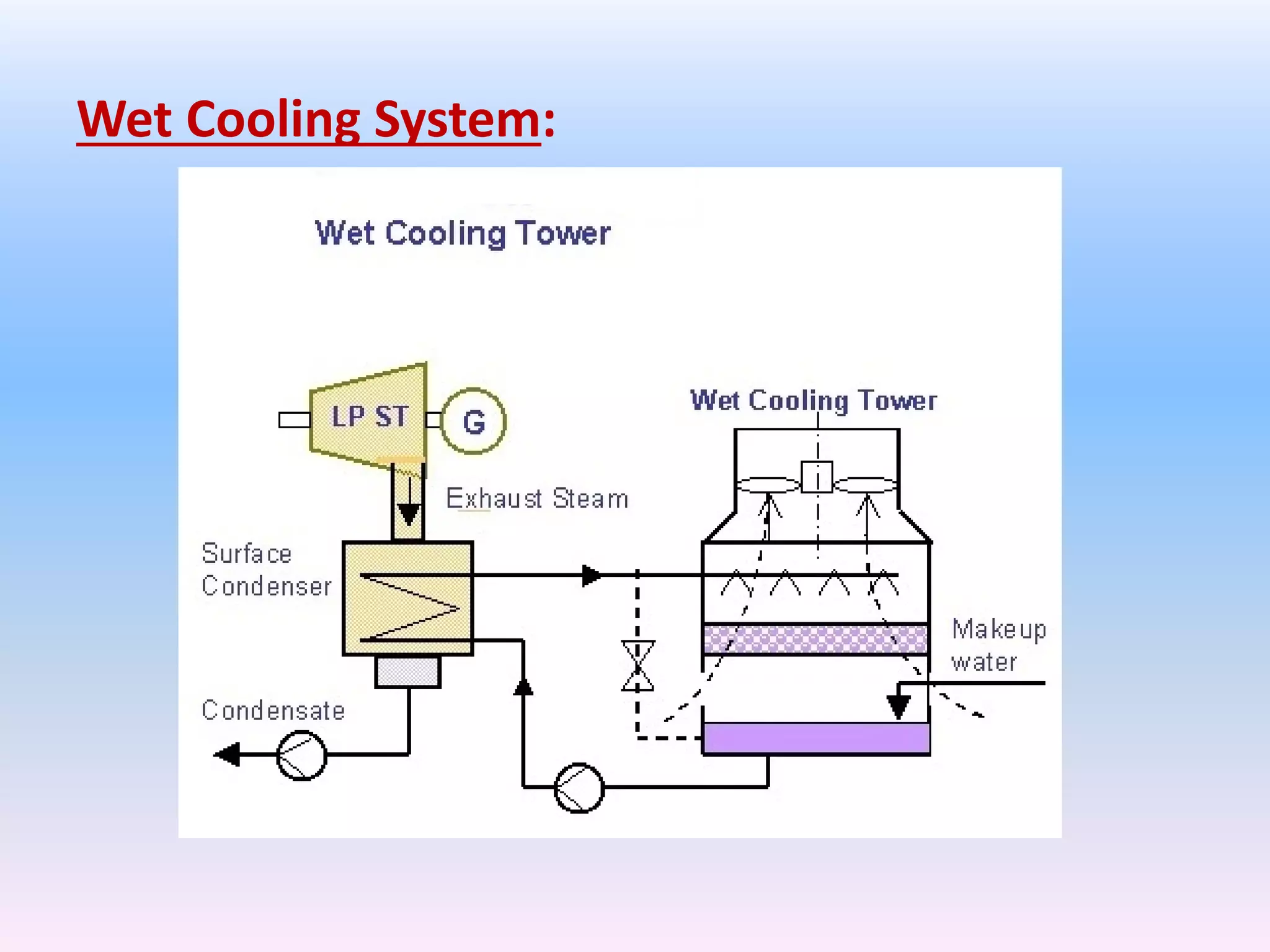
Wet Cooling System:
Natural Draught Cooling Tower
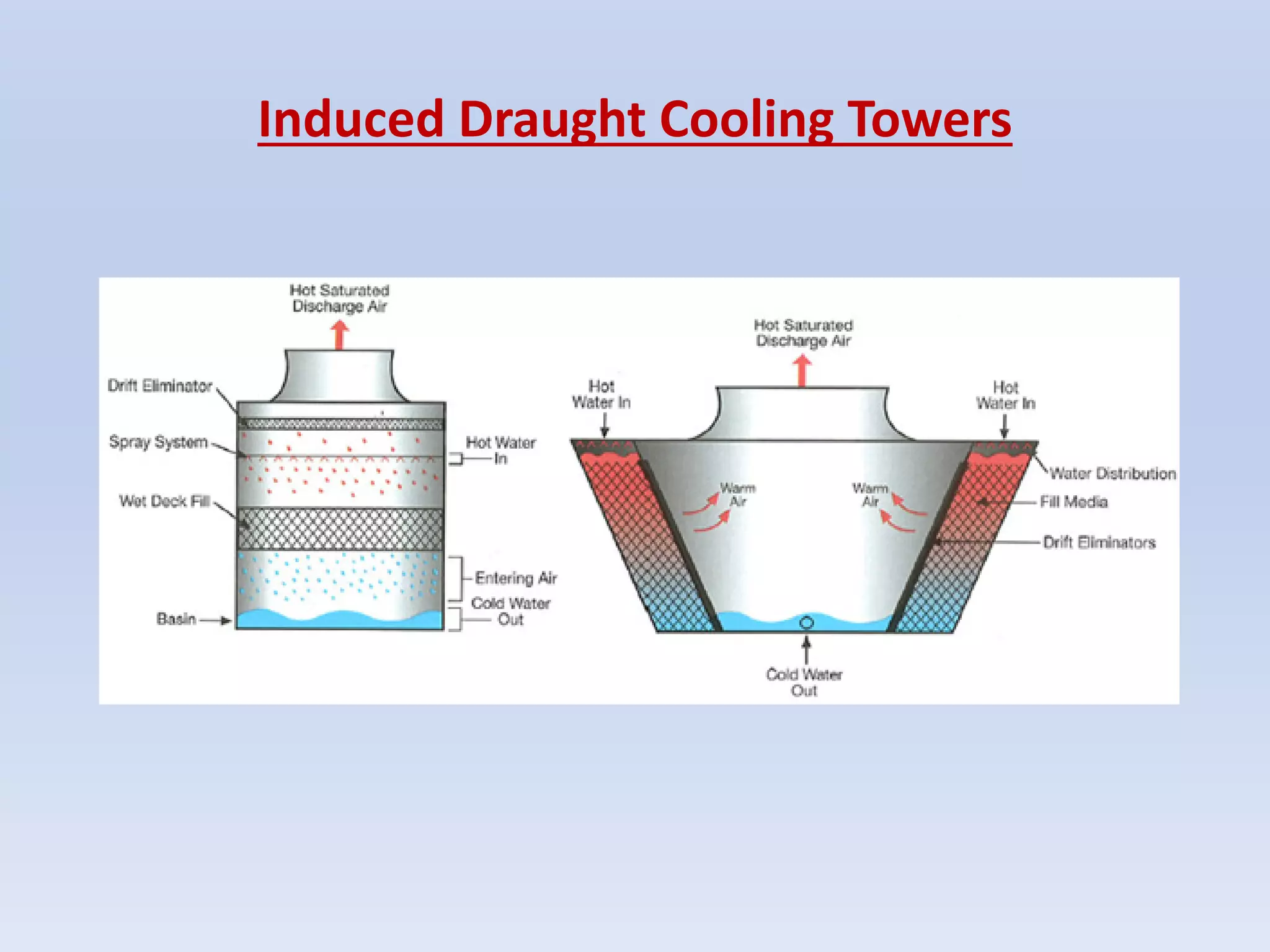
Induced Draught Cooling Towers
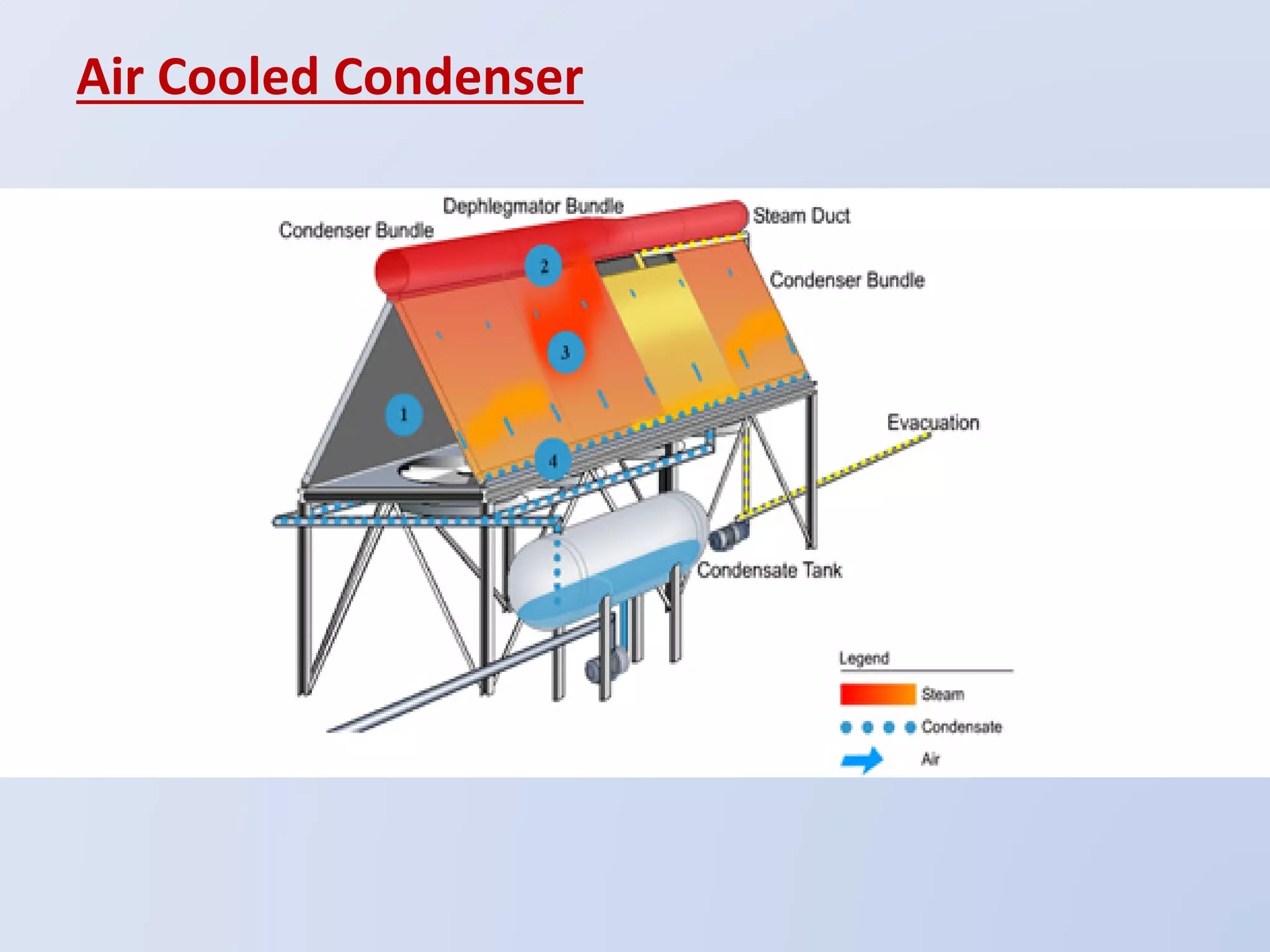
Dry Cooling System
Air Cooled Condenser
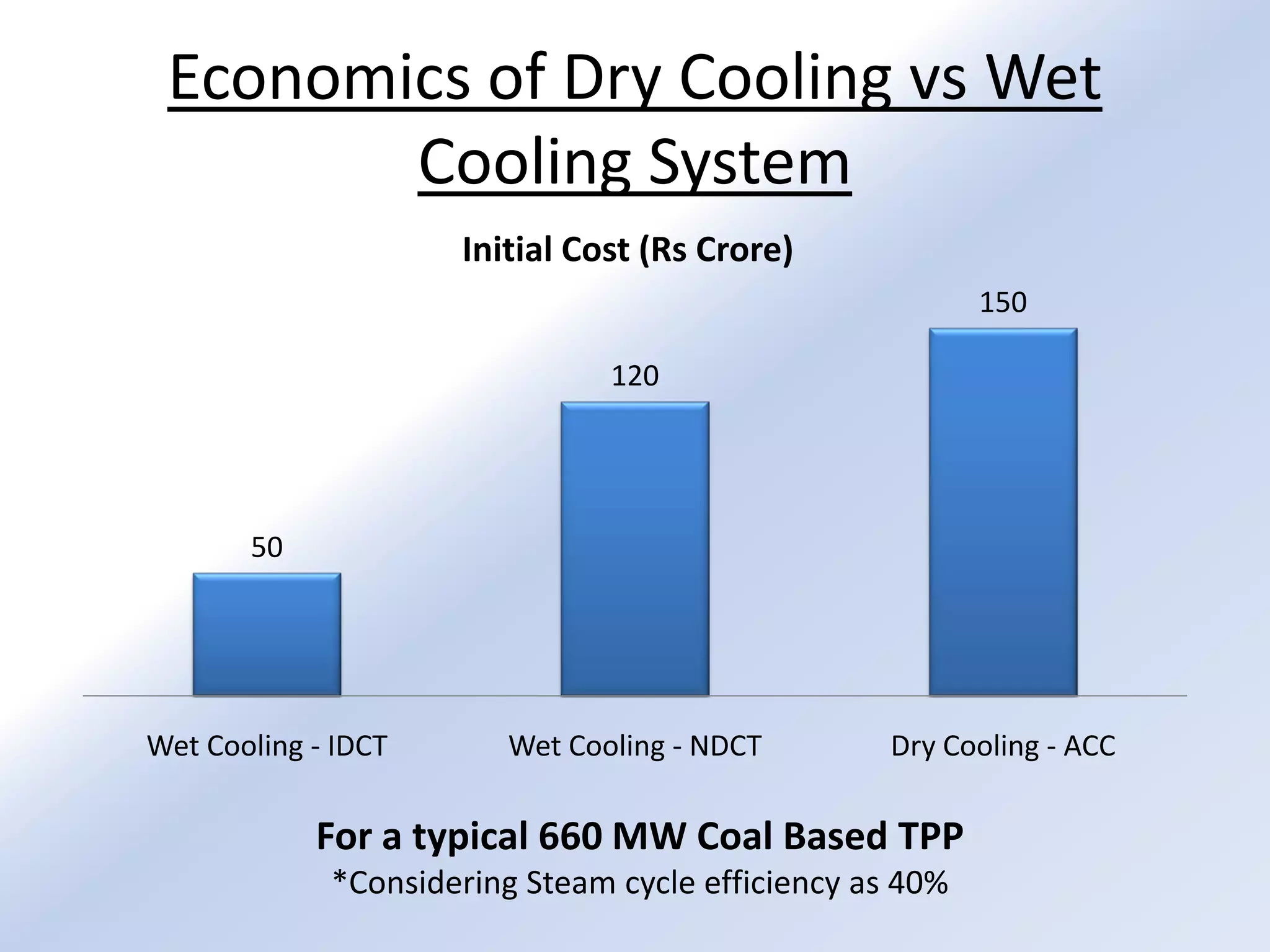
Economics of Dry Cooling vs Wet
Cooling System
50
120
150
Wet Cooling - IDCT Wet Cooling - NDCT Dry Cooling - ACC
Initial Cost (Rs Crore)
For a typical 660 MW Coal Based TPP
*Considering Steam cycle efficiency as 40%
Space Requirement of Dry Cooling vs
Wet Cooling System(NDCT & IDCT)
8000
15000
14000
Wet Cooling - IDCT Wet Cooling - NDCT Dry Cooling - ACC
Foot Print Area (Sq M)
For a typical 660 MW Coal Based TPP
*Considering Steam cycle efficiency as 40%
Power Consumption of Dry Cooling vs
Wet Cooling System
6500
5000
8000
Wet Cooling - IDCT Wet Cooling - NDCT Dry Cooling - ACC
Aux. Power Consumption* (KW)
For a typical 660 MW Coal Based TPP
*Considering above plan area.
#CW Pump Power included for IDCT & NDCT.
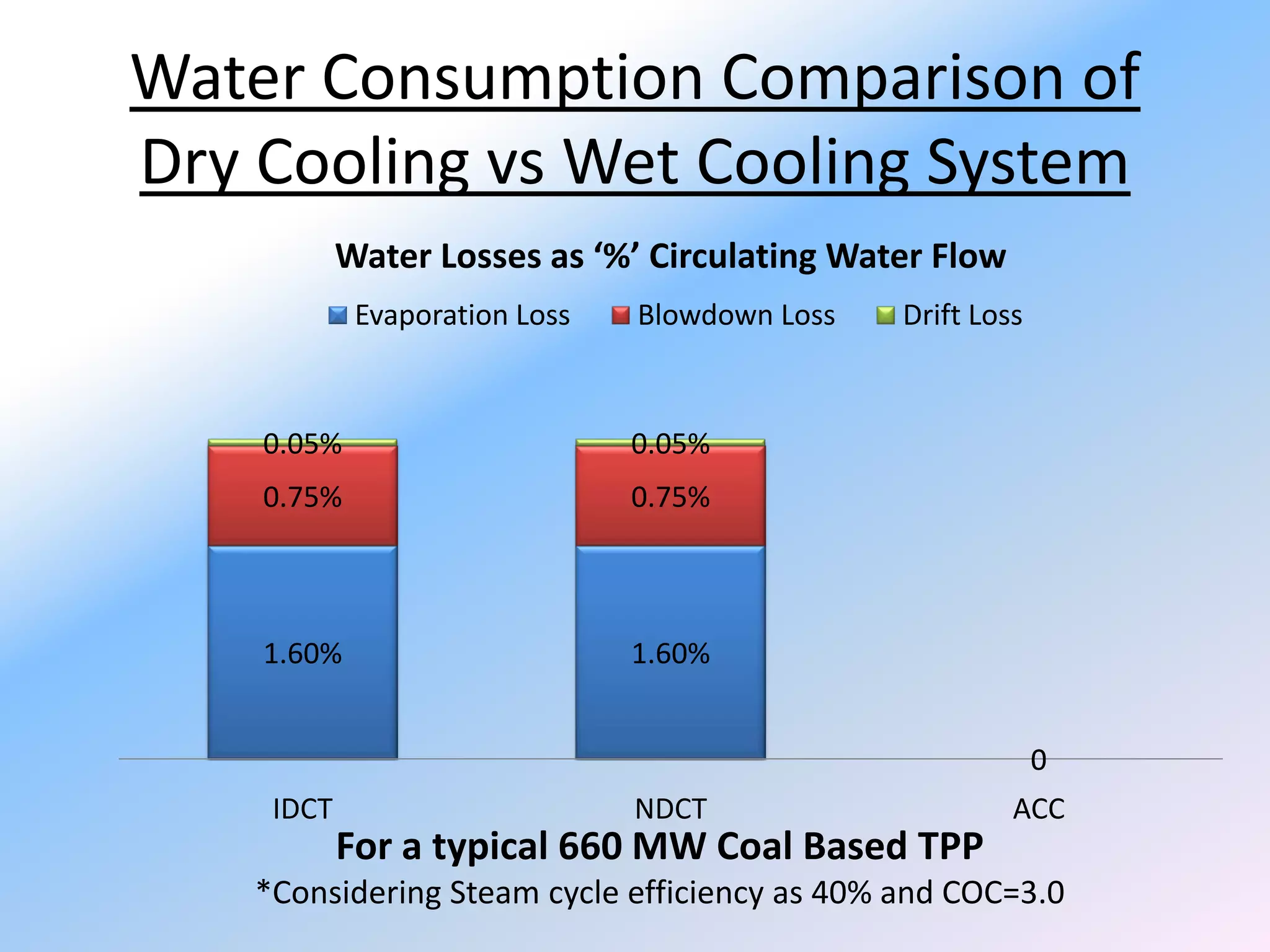
Water Consumption Comparison of
Dry Cooling vs Wet Cooling System
1.60% 1.60%
0
0.75% 0.75%
0
0.05% 0.05%
0
IDCT NDCT ACC
Water Losses as ‘%’ Circulating Water Flow
Evaporation Loss Blowdown Loss Drift Loss
For a typical 660 MW Coal Based TPP
*Considering Steam cycle efficiency as 40% and COC=3.0
Water Conservation Techniques for CW System
 Replace Once Through Cooling System with Cooling Towers /
Air Cooled Condensers
 Implementation of High operating COC (Cycles of
Concentration) to reduce the blow-down loss
Increasing COC to 5 from COC=3.0, Blow-down loss will reduce
by 50%.
 Installation of Air Cooled Condensers
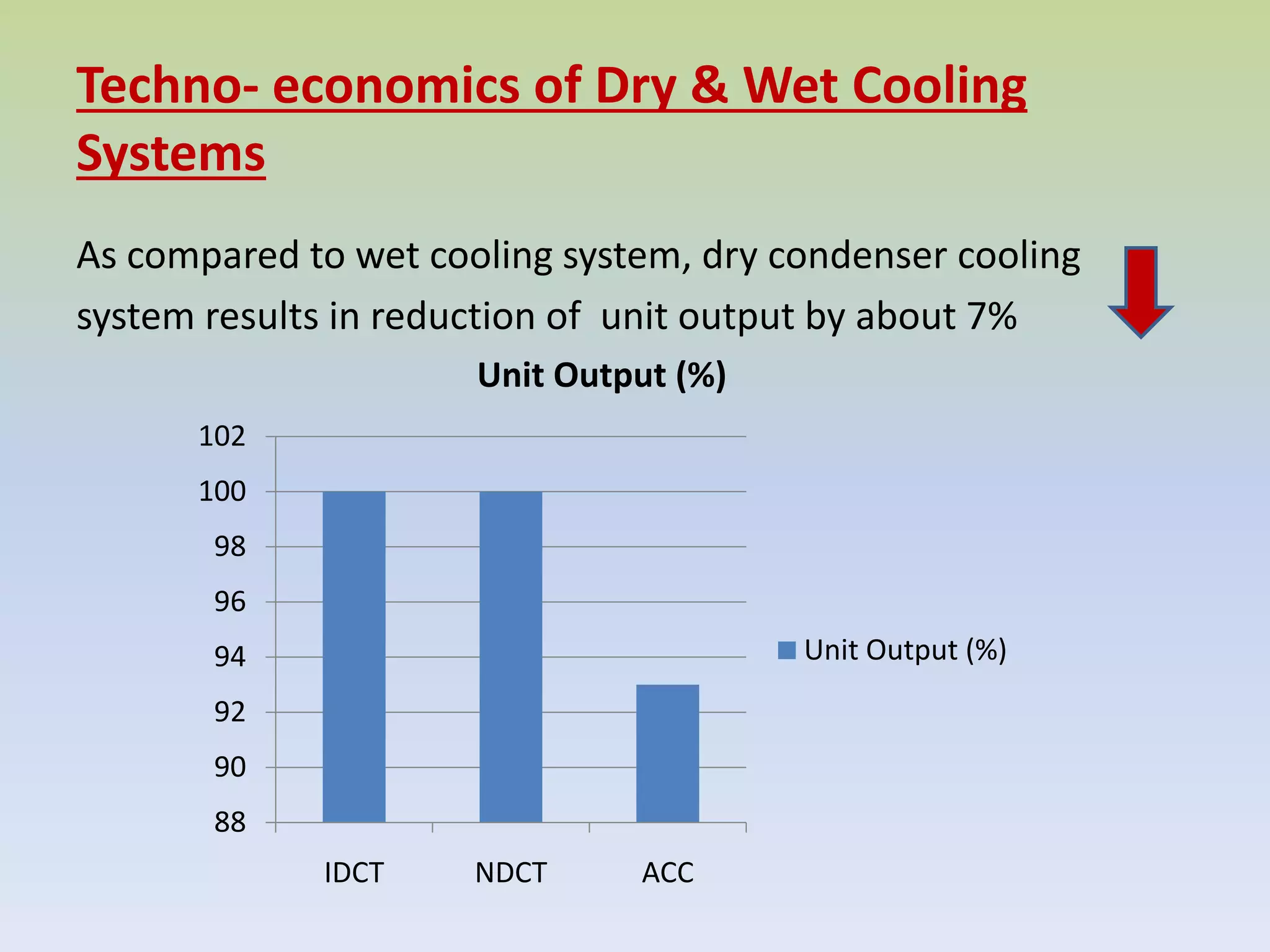
Techno- economics of Dry & Wet Cooling
Systems
As compared to wet cooling system, dry condenser cooling
system results in reduction of unit output by about 7%
88
90
92
94
96
98
100
102
IDCT NDCT ACC
Unit Output (%)
Unit Output (%)
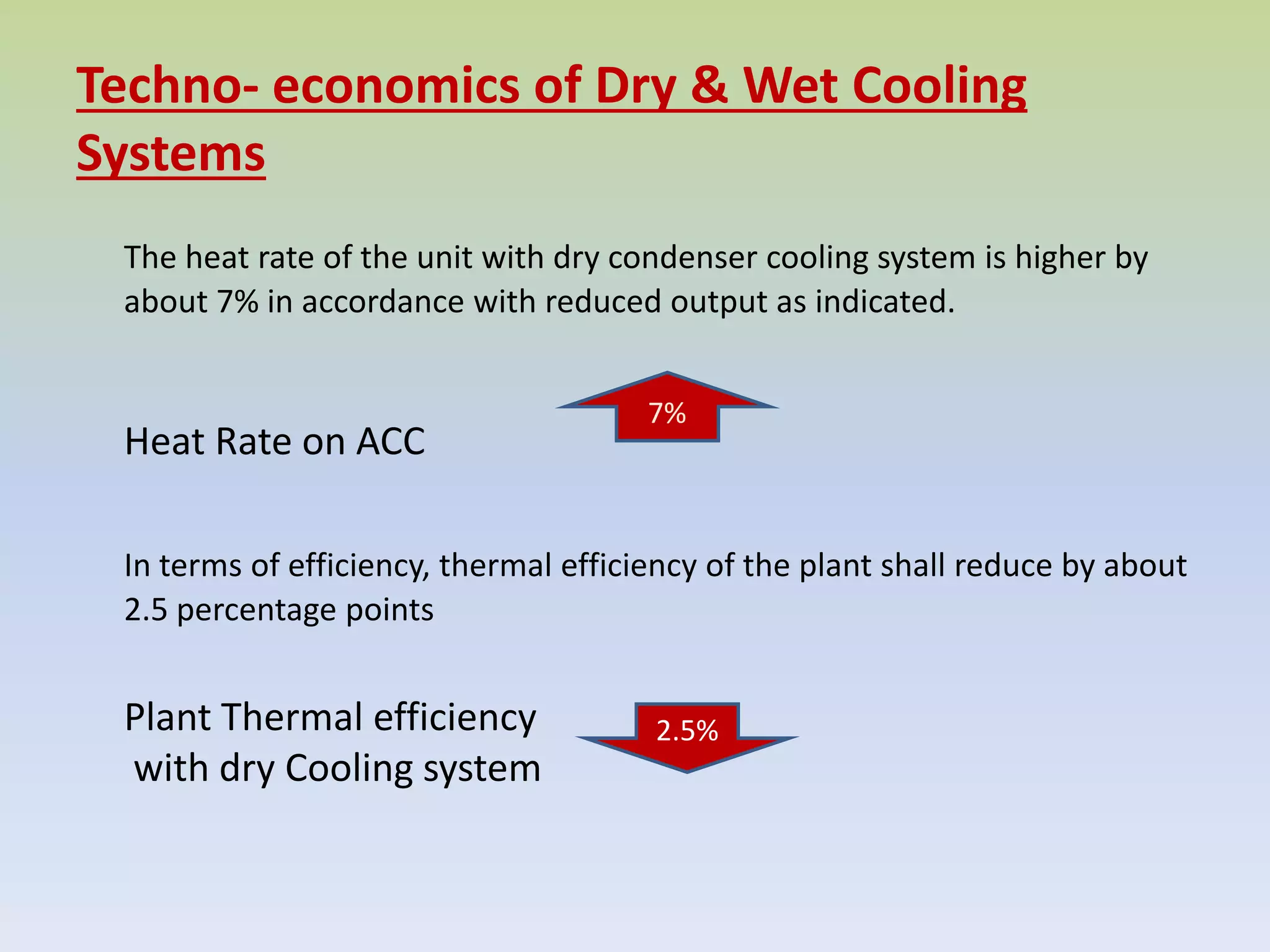
Techno- economics of Dry & Wet Cooling
Systems
The heat rate of the unit with dry condenser cooling system is higher by
about 7% in accordance with reduced output as indicated.
Heat Rate on ACC
In terms of efficiency, thermal efficiency of the plant shall reduce by about
2.5 percentage points
Plant Thermal efficiency
with dry Cooling system
7%
2.5%
Techno- economics of Dry & Wet Cooling
Systems
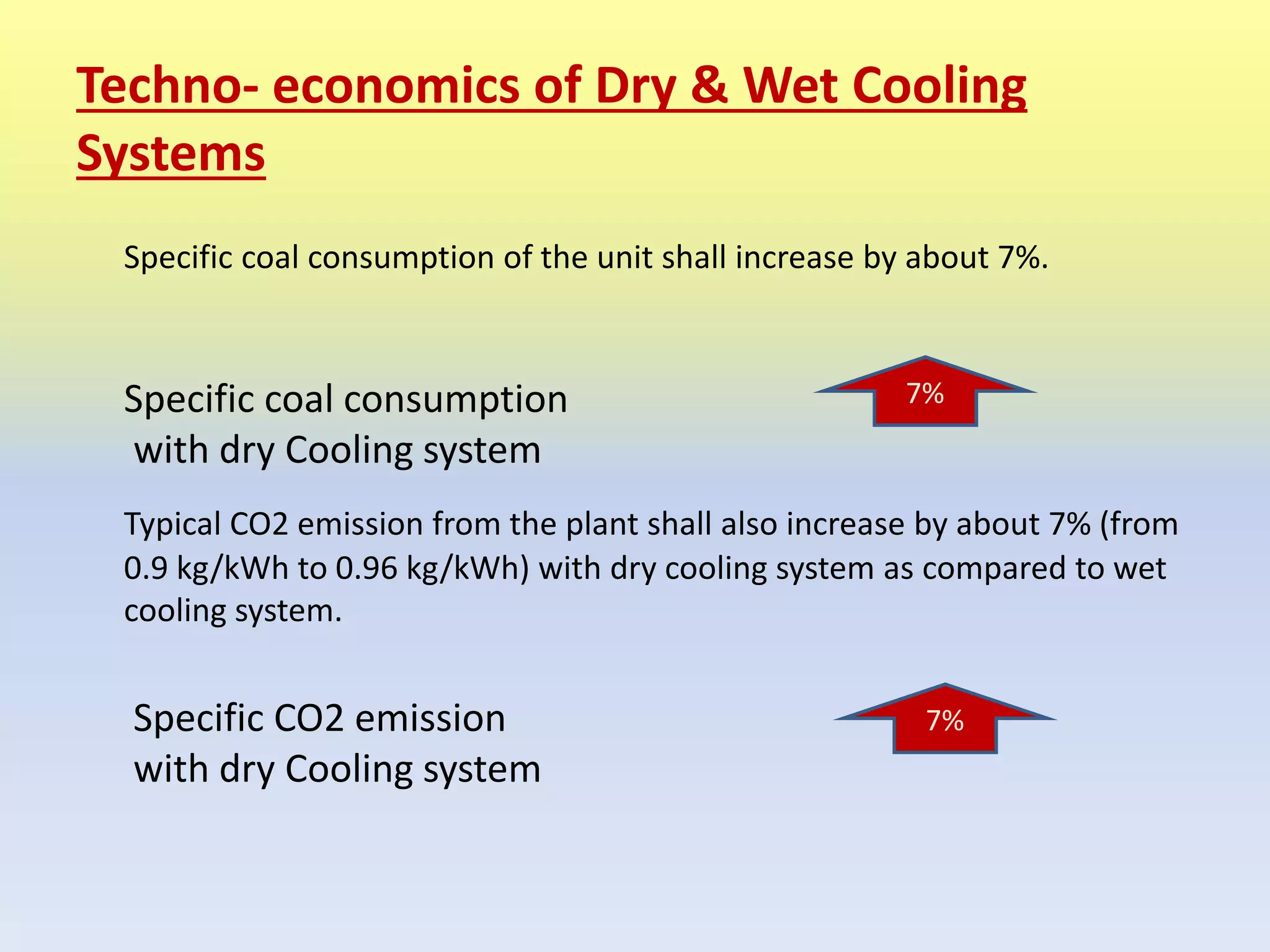
Specific coal consumption of the unit shall increase by about 7%.
Specific coal consumption
with dry Cooling system
Typical CO2 emission from the plant shall also increase by about 7% (from
0.9 kg/kWh to 0.96 kg/kWh) with dry cooling system as compared to wet
cooling system.
Specific CO2 emission
with dry Cooling system
7%
7%
Techno- economics of Dry & Wet Cooling
Systems
For a conventional 500 MW unit, Aux Power Consumption is 6.5 % with
IDCT, 6 % with NDCT based CW system and 6.8 % of gross output for plant
with direct cooling air cooled condensers
5.6
5.8
6
6.2
6.4
6.6
6.8
7
IDCT NDCT ACC
Plant Auxiliary Power Consumption (% of
Rated Plant Output)
Auxiliary Power
Consumption (%
of Rated Output)
Techno- economics of Dry & Wet Cooling
Systems
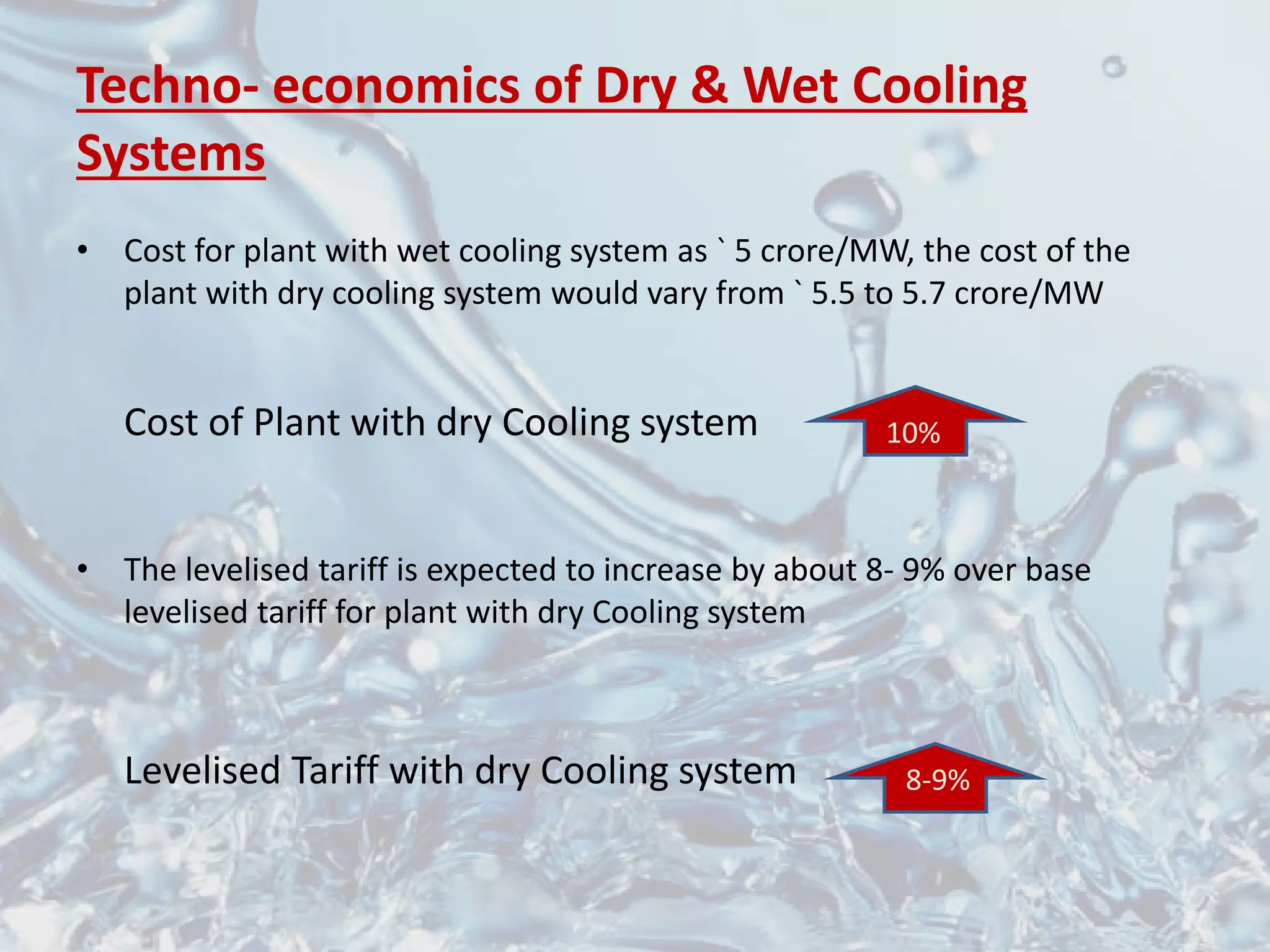
• Cost for plant with wet cooling system as ` 5 crore/MW, the cost of the
plant with dry cooling system would vary from ` 5.5 to 5.7 crore/MW
Cost of Plant with dry Cooling system
• The levelised tariff is expected to increase by about 8- 9% over base
levelised tariff for plant with dry Cooling system
Levelised Tariff with dry Cooling system
10%
8-9%
Key Findings
• Dry condenser cooling system can be considered for the sites where
availability of water is very scarce. In such case, the requirement of plant
consumptive water shall reduce by about 80%.
• However, for typical Indian conditions, dry cooling system shall result in
reduction of plant output by about 7% and correspondingly, gross heat
rate shall increase by 7%.
• The capital cost per MW of the plant, shall increase by about 10%.
#These are indicative values as per data considered in the report.
Conclusion
Dry cooling systems, as such, are costly technologies and are
not comparable to wet cooling system on techno economic
considerations.
However, for sites where water availability is scarce or
unreliable, dry cooling system using air-cooled steam
condenser offers the only solution for power plant
installation.
When we are discussing changeover from once-through
cooling system to a cooling tower system, there is no point in
considering a dry cooling system as the need for this
changeover is to reduce the water requirement and not
eliminate it completely. And, it is safe to pre-suppose that, if
the plant was working on once through system abundant
water is available.
Conclusion (Cont.)
In such changeover cases, it is important to tailor the
dimensions of the cooling tower to suit the available space
as experience shows that the existing power plants are
likely to be very tight on open space. It is also important to
select cooling towers which can be installed quickly as the
time permitted by the Ministry of Environment for the
changeover is short (it has to be implemented within 6th
December 2017).
To meet these requirements, it is our considered
recommendation that you look seriously at cooling towers
with pultruded FRP or treated wood structure.
Water Efficiency in Thermal Power plants

Water Efficiency in Thermal Power plants

  • 1.
    Water Efficiency inThermal power Plant: An Outline of Cooling Technology in India Speaker: Kalyan Bhattacharya, Vice President – E & BD Paharpur Cooling Towers Ltd, Kolkata, INDIA
  • 2.
     Water isone of the vital inputs for thermal power generation.  Water has the highest specific heat amongst all materials available in abundance, hence, ideal as cooling fluid. (Sp Heat of Water = 1 Kcal/Kg deg C)  Process cooling in the condenser, ash disposal, removal of heat generated in plant auxiliaries and various other activities require water.  Large coal based Power Plants are likely to come up in future.  Difficulties are already being faced in existing thermal power plants due to non-availability of water and expected to be aggravated in future with more coal fire TPP coming up. Introduction:
  • 3.
    Water Insufficiency issuesof Existing Plants: NTPC’s 2100 MW Farakka STPP in West Bengal has come to a halt due to falling water level in the Feeder Canal. This is in the news and the crisis is continuing. Effect is being felt in Jharkhand, Orrisa, Bihar and Bengal. Non-availability of water is encountered in existing Power Plants which are situated in coal bearing states like Orissa, Jharkhand and Chhattisgarh.
  • 4.
    Consumption Areas ofWater in Power Plant: Water is used in almost all areas/ facilities of thermal power stations in one way or other. A typical list of plant systems/ applications requiring consumptive water is indicated as below: – Cooling water system (Condenser & ACW) – Ash handling system – Power cycle make up – Coal dust suppression system – Service water system – Potable water system – Gardening – Evaporation from raw water reservoir
  • 5.
    Typical Water ConsumptionFigures Plant water consumption is governed by a number of factors such as : Quality of raw water, type of condenser cooling system, Quality of coal, Ash utilization, Type of ash disposal system, Waste water management aspects etc. In the past, power stations were designed with water systems having liberal considerations and high design margins. The consumptive water requirement for coal based plants with cooling towers used to be about 7 m3/h per MW In recent times, plants have been designed with reduced Plant water consumption rate in the range 3.5 - 4 m3/h per MW
  • 6.
    Water consumption ofa typical Coal Based TPP Water consumption of a typical 2x500 MW TPP is given below (As per recent design) @ 4 m3/h per MW Cooling tower make up : 3450 Ash disposal : 1300* DM water make up : 120 Potable & service water : 250 Clarifier sludge etc. : 110 Coal dust suppression : 70 Total : 4000* *Ash Water to be tapped from CT blow down water Cooling Tower Make-up Ash Disposal DM Water make-up Potable & Service Water Clarifier Sludge Coal Dust Suppression
  • 7.
    MoEF Notification: Ministry ofEnvironment, Forest and Climate Change (MoEF) in its recent notification dated December 07, 2015 on Environment (Protection) Amendment Rules, 2015 have notified the following: I. All plants with Once Through Cooling (OTC) shall install Cooling Tower (CT) and achieve specific water consumption upto maximum of 3.5m3/MWh within a period of two years from the date of publication of this notification. II. All existing CT-based plants shall have to reduce specific water consumption upto maximum of 3.5m3/MWh within a period of two years from the date of publication of this notification. III. New plants to be installed after 1st January, 2017 shall have to meet specific water consumption upto maximum of 2.5 m3/MWh and achieve zero waste water discharged
  • 8.
    Cooling Water System: CoolingSystems in Practice in India: 1. Cooling Tower (IDCT / NDCT) – Wet Cooling 2. Air Cooled Condenser – Dry Cooling 3. Once Through Cooling – To be replaced as per Dec 7, 2015 Notification
  • 9.
  • 10.
  • 11.
  • 12.
    Dry Cooling System AirCooled Condenser
  • 13.
  • 14.
    Economics of DryCooling vs Wet Cooling System 50 120 150 Wet Cooling - IDCT Wet Cooling - NDCT Dry Cooling - ACC Initial Cost (Rs Crore) For a typical 660 MW Coal Based TPP *Considering Steam cycle efficiency as 40%
  • 15.
    Space Requirement ofDry Cooling vs Wet Cooling System(NDCT & IDCT) 8000 15000 14000 Wet Cooling - IDCT Wet Cooling - NDCT Dry Cooling - ACC Foot Print Area (Sq M) For a typical 660 MW Coal Based TPP *Considering Steam cycle efficiency as 40%
  • 16.
    Power Consumption ofDry Cooling vs Wet Cooling System 6500 5000 8000 Wet Cooling - IDCT Wet Cooling - NDCT Dry Cooling - ACC Aux. Power Consumption* (KW) For a typical 660 MW Coal Based TPP *Considering above plan area. #CW Pump Power included for IDCT & NDCT.
  • 17.
    Water Consumption Comparisonof Dry Cooling vs Wet Cooling System 1.60% 1.60% 0 0.75% 0.75% 0 0.05% 0.05% 0 IDCT NDCT ACC Water Losses as ‘%’ Circulating Water Flow Evaporation Loss Blowdown Loss Drift Loss For a typical 660 MW Coal Based TPP *Considering Steam cycle efficiency as 40% and COC=3.0
  • 18.
    Water Conservation Techniquesfor CW System  Replace Once Through Cooling System with Cooling Towers / Air Cooled Condensers  Implementation of High operating COC (Cycles of Concentration) to reduce the blow-down loss Increasing COC to 5 from COC=3.0, Blow-down loss will reduce by 50%.  Installation of Air Cooled Condensers
  • 19.
    Techno- economics ofDry & Wet Cooling Systems As compared to wet cooling system, dry condenser cooling system results in reduction of unit output by about 7% 88 90 92 94 96 98 100 102 IDCT NDCT ACC Unit Output (%) Unit Output (%)
  • 20.
    Techno- economics ofDry & Wet Cooling Systems The heat rate of the unit with dry condenser cooling system is higher by about 7% in accordance with reduced output as indicated. Heat Rate on ACC In terms of efficiency, thermal efficiency of the plant shall reduce by about 2.5 percentage points Plant Thermal efficiency with dry Cooling system 7% 2.5%
  • 21.
    Techno- economics ofDry & Wet Cooling Systems Specific coal consumption of the unit shall increase by about 7%. Specific coal consumption with dry Cooling system Typical CO2 emission from the plant shall also increase by about 7% (from 0.9 kg/kWh to 0.96 kg/kWh) with dry cooling system as compared to wet cooling system. Specific CO2 emission with dry Cooling system 7% 7%
  • 22.
    Techno- economics ofDry & Wet Cooling Systems For a conventional 500 MW unit, Aux Power Consumption is 6.5 % with IDCT, 6 % with NDCT based CW system and 6.8 % of gross output for plant with direct cooling air cooled condensers 5.6 5.8 6 6.2 6.4 6.6 6.8 7 IDCT NDCT ACC Plant Auxiliary Power Consumption (% of Rated Plant Output) Auxiliary Power Consumption (% of Rated Output)
  • 23.
    Techno- economics ofDry & Wet Cooling Systems • Cost for plant with wet cooling system as ` 5 crore/MW, the cost of the plant with dry cooling system would vary from ` 5.5 to 5.7 crore/MW Cost of Plant with dry Cooling system • The levelised tariff is expected to increase by about 8- 9% over base levelised tariff for plant with dry Cooling system Levelised Tariff with dry Cooling system 10% 8-9%
  • 24.
    Key Findings • Drycondenser cooling system can be considered for the sites where availability of water is very scarce. In such case, the requirement of plant consumptive water shall reduce by about 80%. • However, for typical Indian conditions, dry cooling system shall result in reduction of plant output by about 7% and correspondingly, gross heat rate shall increase by 7%. • The capital cost per MW of the plant, shall increase by about 10%. #These are indicative values as per data considered in the report.
  • 25.
    Conclusion Dry cooling systems,as such, are costly technologies and are not comparable to wet cooling system on techno economic considerations. However, for sites where water availability is scarce or unreliable, dry cooling system using air-cooled steam condenser offers the only solution for power plant installation. When we are discussing changeover from once-through cooling system to a cooling tower system, there is no point in considering a dry cooling system as the need for this changeover is to reduce the water requirement and not eliminate it completely. And, it is safe to pre-suppose that, if the plant was working on once through system abundant water is available.
  • 26.
    Conclusion (Cont.) In suchchangeover cases, it is important to tailor the dimensions of the cooling tower to suit the available space as experience shows that the existing power plants are likely to be very tight on open space. It is also important to select cooling towers which can be installed quickly as the time permitted by the Ministry of Environment for the changeover is short (it has to be implemented within 6th December 2017). To meet these requirements, it is our considered recommendation that you look seriously at cooling towers with pultruded FRP or treated wood structure.