Physical agents :-
1
1. SUNLIGHT
2. DRYING
3. HEAT -DRY HEAT & MOIST HEAT
4. FILTRATION
5. RADIATION
6. ULTRASONIC & SONIC VIBRATIONS
2
•Sunlight:-
•It has bactericidal activity &plays an important
role in the spontaneous sterilisation
•Active germicidal effect….U.V rays &heat rays
•
•Drying:-
• 4/5ths of weight of bacterial cell is due to water.
•Moisture is essential for growth of bacteria
deleterious effect on many bacteria
Unreliable,,,,,Spores are unaffected 3
• Heat :- Is the most reliable & commonly
employed method of sterilization…
• - Dry heat.
• - Moist heat.
4
Heat:
• Heat: Kills microorganisms by denaturing their
enzymes and other proteins. Heat resistance
varies widely among microbes.
• Thermal Death Point (TDP): Lowest
temperature at which all of the microbes in a
liquid suspension will be killed in ten minutes.
• Thermal Death Time (TDT): Minimal length
of time in which all bacteria will be killed at a
given temperature.
• Decimal Reduction Time (DRT): Time in
minutes at which 90% of bacteria at a given
temperature will be killed. Used in canning
industry. 5
Dry heat:-
• MECHANISM OF ACTION:-
--Protein Denaturation
--Oxidative damage
--Toxic effect of elevated
level of electrolytes
ADVANTAGE -CAN BE EASILY EMPLOYED.
DISADVANTAGE -POOR PENETRATION
POWER
6
1]FLAMING
2]INCINERATION
3]HOT AIR OVEN
7
1) FLAMING
The articles are passed on the Bunsen flame.
articles are made red hot
Articles Sterilized:
– Inoculating loop of wires.
– Forceps.
– Spatulas.
– Mouths of culture tubes.
8
2)INCINERATION
Contaminated material in bulk is sterilized &
disposed by burning in an incinerator.
Articles sterilized:
- surgical dressings
-disposable syringes
- contaminated lab materials
-animal carcass
-bedding.
9
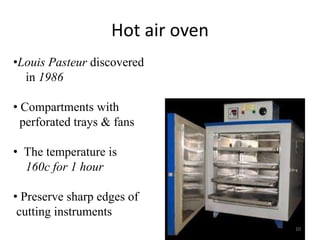
Hot air oven
•Louis Pasteur discovered
in 1986
• Compartments with
perforated trays & fans
• The temperature is
160c for 1 hour
• Preserve sharp edges of
cutting instruments
10
Articles to be sterilized:-
Scissors
Scalpels
Glass syringes
Swabs
Liquid paraffin
Dusting powder
Fats & Grease
Glassware
Forceps
11
Precautions
• Not to be overloaded.
• Must be fitted with fans...
• Rubber materials (except silicone material) or any inflammable
material….
• Allowed to cool for 2 hrs before opening the doors…
• Temp. should not exceed 180°c because glass ware kept inside
for sterilization will get a smoky appearance.
• The glassware kept inside should be totally dry or they will
break.
12
HOT AIR OVEN
 Advantage:-
 Economical.
 Does not rust metals.
 Easily monitored .
 Used for unhydrous oils &
powder.
• Disadvantage:-
 Difficult to control temp.
 Slow penetration.
 Cannot be used for plastics,
textiles, rubber or metal
solder joints.
 Time consuming
13
STERILISATION CONTROL
• Chemical:
• BROWNE’S TUBE use routinely.
• Green color indicates proper sterilization
• Biological :
• Nontoxigenic strains of
CLOSTRIDIUM TETANI
• Spores germination indicates improper
sterilization
14
GLASS BEAD STERILISER
• Heat transfer device
• Glass beads & Salt
• ARTICLES STERILISED:
• Endodontic Files & Burs
• Temperature is 220°C
• Time is 10 sec.
• Useful for chair side sterilization
15
Moist heat
• Used to disinfect, sanitize, and sterilize
• Kills by denaturing proteins and destroying
cytoplasmic membranes
• More effective than dry heat; water better
conductor of heat than air
16
Types of moist heat-
• Below 100°C. (Pasteurization)
• At 100°C . ( Tyndallisation )
• Above 100°C . ( Under pressure )
17
TEMPERATURE BELOW 100°C
• Pasteurization
• Definition: a process in which fluids are heated at
temperatures below boiling point to kill
pathogenic microorganisms in the vegetative
state without altering the fluid’s palatability.
• Holder’s process (63°C for 30 min)
• Flash process (72°C for 15-20 sec)
• Cooling quickly to 13c or lower
• Significance: kills vegetative pathogens
• Applications: milk, beer
18
TEMPERATURE AT 100°C
• (a)Boiling:
• Vegetative Bacteria killed at 90-100°c
• Time required is 10-30 min
• Endospores, protozoan cysts, and some viruses can
survive boiling
• Sterilization promoted by use of 2% Na bicarbonate
19
(b) Tyndallisation –
• For media containing sugar or gelatin exposure of
steam at 100°c for 20 min for 3 successive days.
(c) Koch or Arnold steamer
• Exposure with steam at 100°c for 90 min ensures
sterilization
20
TEMPERATURE ABOVE 100°C
• Steam under Pressure (AUTOCLAVE):
• Principle: Water boils when
its vapour pressure equals
that of the surrounding atmosphere.
• Saturated steam has penetrative
power
• When pressure  temp of water
• Oldest method
• 121°C (250°F)..15-20 min..15 lbs.
21
Operation Principle
• When water is heated in a closed container, saturated steam is
produced under pressure.
• According to Boyle’s Law, when volume of the steam, is kept
constant, the temperature is directly proportional to pressure.
• If the pressure is reduced it boils at a lower temperature. If the
pressure rises, it boils at a greater temperature.
• At 15 lbs pressure 121 C temperature can be obtained.
• Moist heat coagulates cell proteins of the microorganisms and
thus kills all the living entities (including spores) in 15 to 20
minutes.
• Hot saturated steam is efficient means of destroying
microorganisms, since it penetrates rapidly and gives up its latent
heat as it condenses on the cooler objects.
22
23
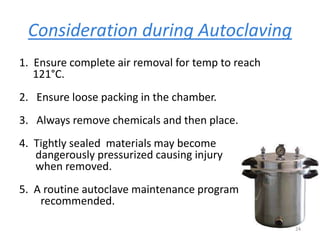
Consideration during Autoclaving
1. Ensure complete air removal for temp to reach
121°C.
2. Ensure loose packing in the chamber.
3. Always remove chemicals and then place.
4. Tightly sealed materials may become
dangerously pressurized causing injury
when removed.
5. A routine autoclave maintenance program
recommended.
24
Times and temperature for heat
sterilisation
Method Temperature Holding time
Autoclave 1210C 15min
126 0C 10 min
134 0C 3min
Hot air oven 1600C 45min
170 0C 18min
180 0C 7.5min
*Recommendations of the medical research council.
25
Advantage:
1) Economical.
2) Good penetration.
3) Short cycle time.
4) Easily monitored.
5) No special chemicals or
exhaust required.
Disadvantage:-
1) Carbon steel gets damaged.
2) Moisture retention.
3) Dulling of unprotected
cutting ages.
4) Destruction of heat
sensitive materials.
5) Deposits with use of hard
water.
26
Uses
 Disposable syringes.
 Non disposable syringes.
 Glassware.
 Metal instruments.
 Surgical dressing.
 Surgical instruments.
 Laboratory equipment.
 Culture media.
 Pharmaceutical products. 27
Chemiclaving
 Low temperature steam &
formaldehyde (LTSF):-
 Dry saturated steam +
formaldehyde (alkylation)
 Temp  127-132° C at 20-40
psi for 30 mins.
 Adv:-
- Short time cycle.
- Limits rust on high
carbon steel.
- Easily monitored.
 Disadv:-
- Instruments must be dry.
- Damages textiles & liquids.
- Costly.
- Unpleasant odor.
- Good ventilation required.
28
Monitoring of sterilization
Biological:
 Killing externally added microorganisms (resistant bacterial spore
preparations) during a sterilization cycle .
 Bacillus stereothermophilus (NCA Strain 1518), known to be
extremely resistant to moist heat is used…
 Total destruction of such a strain is known to occur under steam
sterilization conditions in ~9 minutes at 250º F, and in ~1 minute at
272ºF.
 If the system is free from these spores after a sterilization cycle, it
may be inferred that the microorganisms contaminating the
sterilized materials will be totally destroyed well before this period
of time.
29
Chemical monitoring
• Physico-chemical transformation of a chemical system
on exposure to moist heat is made useful.
• An ideal chemical indicator will indicate the temporal
sequences of exposure to steam or other sterilants by
distinct color changes.
• Time-temperature effects trigger these well
discernible color changes at a stipulated time period.
30
• Physical:-
• Physical monitoring involves the use of color
change and other indicators .
• Their purpose is simply to identify items that
have been processed through a sterilizer.
• However they are not perfectly reliable as
they change color either early or late. 31
FILTRATION
• Used to sterilize heat labile liquids like sera,
sugar solutions .
• Bacteria free filtrate
• not Virus
• TYPES:
(a)Candles filters
(b)Asbestos disc filters.
(c)Sintered glass filters
(d)Membrane filters.
32
• (a)Candle filters:
-- Use for purification of water
• Types:
--Unglazed ceramic filters
--Diatomaceous earth fillers
• (b)Asbestos filters:
--Disposable
--High adsorbing capacity
--Alkalinize filtered liquids
--Carcinogenic potential
-- e.g- Seitz &Sterimat filters
33
• (c)Sintered glass filters:
--Heat fusing finely powdered glass particles
--Low absorptive
--Brittle & expensive
• (d)Membrane filters:
--Made from Cellulose esters
--Pore diameter 0.22mm used widely
--Used in:
-- water purification
-- sterilization & sterility testing
-- preparation of solution for parental use
34
Radiation
Ionizing
 X ray, gamma, beta rays.
 Use : Plastics, culture
plates, catheters, tubes.
 Adv : Large scale use.
 Disadv : Sporicidial
effect?
Non ionizing
 Infrared, UV radiations.
 Use: Entryways, OT,
laboatories.
 Disadv: Longer wavelength
hence poor penetration.
35
Ionizing Radiation:
‘X’- rays ,gamma rays, cosmic rays.
• cold sterilization.
• very high penetrating power.
• lethal to DNA and other cell constituents
• effective for heat labile items
36
Non Ionizing radiation
U. V. rays:
• Bring down the number of microorganism
present in air.
• Sterilization of Operation Theaters and
biological safety cabinets.
• Disadvantage: Low-penetrating power.
37
Articles sterilized:
• Syringes
• swabs
• Catheters
• Needles
• Oils
• Grease
• Cannulas
• Metal foils
• Culture plates
38
Lasers:-
 LASER – Light Amplification by Stimulated Emission of Radiation
 Recent experiments indicate that laser beams can be used to
sterilize instruments & the air in operating rooms, as well as for a
wound surface.
 Various types include CO2 , Argon , NdYAG etc…
39
DENTAL EQUIPMENTS STERILISATION
EQUIPMENTS
• SURGICAL
INSTRUMENTS
• SHARP INSTRUMENTS
• OTHER MATERIALS
• SYRINGES
METHOD OF STERILSATION
• AUTOCLAVE
• HOT AIR OVEN
• AUTOCLAVE
• IRRADIATION
40
Surgical hand piece sterilization
41
Should Do
• Remove bur and disconnect handpiece from
chair.
• Wipe handpiece with alcohol.
• Locate appropriate hole and spray lube for 2-3
seconds.
• Attach handpiece to swivel unit and insert bur.
• Run handpiece for 30 seconds to eliminate lube.
• Wipe handpiece with alcohol
42
Should Do
• Insert in autoclave bag…….paper on at least one
side of bag.
• Load in autoclave with cellophane side down.
• Remove from autoclave immediately after all
cycles are complete.
• Always allow cooling to room temperature, paper
side up.
• Do not force cool with water or other means.
43
Should not do
• Do not immerse hand piece in any solvent,
cleaner or ultrasonic solution.
• Do not clean hand piece in ultrasonic cleaners or
dry heat sterilizers.
• Do not exceed temperature of 135°C.
• Do not use chemical disinfectants, when
combined with heat of the autoclave,
disinfectants may significantly reduce hand piece
life
• Do not use all cellophane bags
44

Sree

  • 1.
  • 2.
    1. SUNLIGHT 2. DRYING 3.HEAT -DRY HEAT & MOIST HEAT 4. FILTRATION 5. RADIATION 6. ULTRASONIC & SONIC VIBRATIONS 2
  • 3.
    •Sunlight:- •It has bactericidalactivity &plays an important role in the spontaneous sterilisation •Active germicidal effect….U.V rays &heat rays • •Drying:- • 4/5ths of weight of bacterial cell is due to water. •Moisture is essential for growth of bacteria deleterious effect on many bacteria Unreliable,,,,,Spores are unaffected 3
  • 4.
    • Heat :-Is the most reliable & commonly employed method of sterilization… • - Dry heat. • - Moist heat. 4
  • 5.
    Heat: • Heat: Killsmicroorganisms by denaturing their enzymes and other proteins. Heat resistance varies widely among microbes. • Thermal Death Point (TDP): Lowest temperature at which all of the microbes in a liquid suspension will be killed in ten minutes. • Thermal Death Time (TDT): Minimal length of time in which all bacteria will be killed at a given temperature. • Decimal Reduction Time (DRT): Time in minutes at which 90% of bacteria at a given temperature will be killed. Used in canning industry. 5
  • 6.
    Dry heat:- • MECHANISMOF ACTION:- --Protein Denaturation --Oxidative damage --Toxic effect of elevated level of electrolytes ADVANTAGE -CAN BE EASILY EMPLOYED. DISADVANTAGE -POOR PENETRATION POWER 6
  • 7.
  • 8.
    1) FLAMING The articlesare passed on the Bunsen flame. articles are made red hot Articles Sterilized: – Inoculating loop of wires. – Forceps. – Spatulas. – Mouths of culture tubes. 8
  • 9.
    2)INCINERATION Contaminated material inbulk is sterilized & disposed by burning in an incinerator. Articles sterilized: - surgical dressings -disposable syringes - contaminated lab materials -animal carcass -bedding. 9
  • 10.
    Hot air oven •LouisPasteur discovered in 1986 • Compartments with perforated trays & fans • The temperature is 160c for 1 hour • Preserve sharp edges of cutting instruments 10
  • 11.
    Articles to besterilized:- Scissors Scalpels Glass syringes Swabs Liquid paraffin Dusting powder Fats & Grease Glassware Forceps 11
  • 12.
    Precautions • Not tobe overloaded. • Must be fitted with fans... • Rubber materials (except silicone material) or any inflammable material…. • Allowed to cool for 2 hrs before opening the doors… • Temp. should not exceed 180°c because glass ware kept inside for sterilization will get a smoky appearance. • The glassware kept inside should be totally dry or they will break. 12
  • 13.
    HOT AIR OVEN Advantage:-  Economical.  Does not rust metals.  Easily monitored .  Used for unhydrous oils & powder. • Disadvantage:-  Difficult to control temp.  Slow penetration.  Cannot be used for plastics, textiles, rubber or metal solder joints.  Time consuming 13
  • 14.
    STERILISATION CONTROL • Chemical: •BROWNE’S TUBE use routinely. • Green color indicates proper sterilization • Biological : • Nontoxigenic strains of CLOSTRIDIUM TETANI • Spores germination indicates improper sterilization 14
  • 15.
    GLASS BEAD STERILISER •Heat transfer device • Glass beads & Salt • ARTICLES STERILISED: • Endodontic Files & Burs • Temperature is 220°C • Time is 10 sec. • Useful for chair side sterilization 15
  • 16.
    Moist heat • Usedto disinfect, sanitize, and sterilize • Kills by denaturing proteins and destroying cytoplasmic membranes • More effective than dry heat; water better conductor of heat than air 16
  • 17.
    Types of moistheat- • Below 100°C. (Pasteurization) • At 100°C . ( Tyndallisation ) • Above 100°C . ( Under pressure ) 17
  • 18.
    TEMPERATURE BELOW 100°C •Pasteurization • Definition: a process in which fluids are heated at temperatures below boiling point to kill pathogenic microorganisms in the vegetative state without altering the fluid’s palatability. • Holder’s process (63°C for 30 min) • Flash process (72°C for 15-20 sec) • Cooling quickly to 13c or lower • Significance: kills vegetative pathogens • Applications: milk, beer 18
  • 19.
    TEMPERATURE AT 100°C •(a)Boiling: • Vegetative Bacteria killed at 90-100°c • Time required is 10-30 min • Endospores, protozoan cysts, and some viruses can survive boiling • Sterilization promoted by use of 2% Na bicarbonate 19
  • 20.
    (b) Tyndallisation – •For media containing sugar or gelatin exposure of steam at 100°c for 20 min for 3 successive days. (c) Koch or Arnold steamer • Exposure with steam at 100°c for 90 min ensures sterilization 20
  • 21.
    TEMPERATURE ABOVE 100°C •Steam under Pressure (AUTOCLAVE): • Principle: Water boils when its vapour pressure equals that of the surrounding atmosphere. • Saturated steam has penetrative power • When pressure  temp of water • Oldest method • 121°C (250°F)..15-20 min..15 lbs. 21
  • 22.
    Operation Principle • Whenwater is heated in a closed container, saturated steam is produced under pressure. • According to Boyle’s Law, when volume of the steam, is kept constant, the temperature is directly proportional to pressure. • If the pressure is reduced it boils at a lower temperature. If the pressure rises, it boils at a greater temperature. • At 15 lbs pressure 121 C temperature can be obtained. • Moist heat coagulates cell proteins of the microorganisms and thus kills all the living entities (including spores) in 15 to 20 minutes. • Hot saturated steam is efficient means of destroying microorganisms, since it penetrates rapidly and gives up its latent heat as it condenses on the cooler objects. 22
  • 23.
  • 24.
    Consideration during Autoclaving 1.Ensure complete air removal for temp to reach 121°C. 2. Ensure loose packing in the chamber. 3. Always remove chemicals and then place. 4. Tightly sealed materials may become dangerously pressurized causing injury when removed. 5. A routine autoclave maintenance program recommended. 24
  • 25.
    Times and temperaturefor heat sterilisation Method Temperature Holding time Autoclave 1210C 15min 126 0C 10 min 134 0C 3min Hot air oven 1600C 45min 170 0C 18min 180 0C 7.5min *Recommendations of the medical research council. 25
  • 26.
    Advantage: 1) Economical. 2) Goodpenetration. 3) Short cycle time. 4) Easily monitored. 5) No special chemicals or exhaust required. Disadvantage:- 1) Carbon steel gets damaged. 2) Moisture retention. 3) Dulling of unprotected cutting ages. 4) Destruction of heat sensitive materials. 5) Deposits with use of hard water. 26
  • 27.
    Uses  Disposable syringes. Non disposable syringes.  Glassware.  Metal instruments.  Surgical dressing.  Surgical instruments.  Laboratory equipment.  Culture media.  Pharmaceutical products. 27
  • 28.
    Chemiclaving  Low temperaturesteam & formaldehyde (LTSF):-  Dry saturated steam + formaldehyde (alkylation)  Temp  127-132° C at 20-40 psi for 30 mins.  Adv:- - Short time cycle. - Limits rust on high carbon steel. - Easily monitored.  Disadv:- - Instruments must be dry. - Damages textiles & liquids. - Costly. - Unpleasant odor. - Good ventilation required. 28
  • 29.
    Monitoring of sterilization Biological: Killing externally added microorganisms (resistant bacterial spore preparations) during a sterilization cycle .  Bacillus stereothermophilus (NCA Strain 1518), known to be extremely resistant to moist heat is used…  Total destruction of such a strain is known to occur under steam sterilization conditions in ~9 minutes at 250º F, and in ~1 minute at 272ºF.  If the system is free from these spores after a sterilization cycle, it may be inferred that the microorganisms contaminating the sterilized materials will be totally destroyed well before this period of time. 29
  • 30.
    Chemical monitoring • Physico-chemicaltransformation of a chemical system on exposure to moist heat is made useful. • An ideal chemical indicator will indicate the temporal sequences of exposure to steam or other sterilants by distinct color changes. • Time-temperature effects trigger these well discernible color changes at a stipulated time period. 30
  • 31.
    • Physical:- • Physicalmonitoring involves the use of color change and other indicators . • Their purpose is simply to identify items that have been processed through a sterilizer. • However they are not perfectly reliable as they change color either early or late. 31
  • 32.
    FILTRATION • Used tosterilize heat labile liquids like sera, sugar solutions . • Bacteria free filtrate • not Virus • TYPES: (a)Candles filters (b)Asbestos disc filters. (c)Sintered glass filters (d)Membrane filters. 32
  • 33.
    • (a)Candle filters: --Use for purification of water • Types: --Unglazed ceramic filters --Diatomaceous earth fillers • (b)Asbestos filters: --Disposable --High adsorbing capacity --Alkalinize filtered liquids --Carcinogenic potential -- e.g- Seitz &Sterimat filters 33
  • 34.
    • (c)Sintered glassfilters: --Heat fusing finely powdered glass particles --Low absorptive --Brittle & expensive • (d)Membrane filters: --Made from Cellulose esters --Pore diameter 0.22mm used widely --Used in: -- water purification -- sterilization & sterility testing -- preparation of solution for parental use 34
  • 35.
    Radiation Ionizing  X ray,gamma, beta rays.  Use : Plastics, culture plates, catheters, tubes.  Adv : Large scale use.  Disadv : Sporicidial effect? Non ionizing  Infrared, UV radiations.  Use: Entryways, OT, laboatories.  Disadv: Longer wavelength hence poor penetration. 35
  • 36.
    Ionizing Radiation: ‘X’- rays,gamma rays, cosmic rays. • cold sterilization. • very high penetrating power. • lethal to DNA and other cell constituents • effective for heat labile items 36
  • 37.
    Non Ionizing radiation U.V. rays: • Bring down the number of microorganism present in air. • Sterilization of Operation Theaters and biological safety cabinets. • Disadvantage: Low-penetrating power. 37
  • 38.
    Articles sterilized: • Syringes •swabs • Catheters • Needles • Oils • Grease • Cannulas • Metal foils • Culture plates 38
  • 39.
    Lasers:-  LASER –Light Amplification by Stimulated Emission of Radiation  Recent experiments indicate that laser beams can be used to sterilize instruments & the air in operating rooms, as well as for a wound surface.  Various types include CO2 , Argon , NdYAG etc… 39
  • 40.
    DENTAL EQUIPMENTS STERILISATION EQUIPMENTS •SURGICAL INSTRUMENTS • SHARP INSTRUMENTS • OTHER MATERIALS • SYRINGES METHOD OF STERILSATION • AUTOCLAVE • HOT AIR OVEN • AUTOCLAVE • IRRADIATION 40
  • 41.
    Surgical hand piecesterilization 41
  • 42.
    Should Do • Removebur and disconnect handpiece from chair. • Wipe handpiece with alcohol. • Locate appropriate hole and spray lube for 2-3 seconds. • Attach handpiece to swivel unit and insert bur. • Run handpiece for 30 seconds to eliminate lube. • Wipe handpiece with alcohol 42
  • 43.
    Should Do • Insertin autoclave bag…….paper on at least one side of bag. • Load in autoclave with cellophane side down. • Remove from autoclave immediately after all cycles are complete. • Always allow cooling to room temperature, paper side up. • Do not force cool with water or other means. 43
  • 44.
    Should not do •Do not immerse hand piece in any solvent, cleaner or ultrasonic solution. • Do not clean hand piece in ultrasonic cleaners or dry heat sterilizers. • Do not exceed temperature of 135°C. • Do not use chemical disinfectants, when combined with heat of the autoclave, disinfectants may significantly reduce hand piece life • Do not use all cellophane bags 44

Editor's Notes

  • #7 The killing effect of dry heat is due to
  • #10 It is an
  • #11 Most widely used method by dry heat
  • #13 To ensure even distribution of air
  • #19 Coxiella burnetii survive Holder method.
  • #22 When pressure inside a closed vessel increases the temp at which water boils also increases