







“ A Simple view on a complex matter”
• Virtually no practical and engineering material is
stable. The rate of decay varies depending upon the
material and its environment.
• The human system cannot endure
– Temp above 50 C or below 20 C
– Pressures above or below our atmospheres
– Presence of harmful gases such as CO, H2S, and
H2.
• Thus, analogous to human system, engineering
materials also require protection like
– coatings, inhibitors, alloy addition, design
procedures, maintenance, inspection and re-
furnishing.
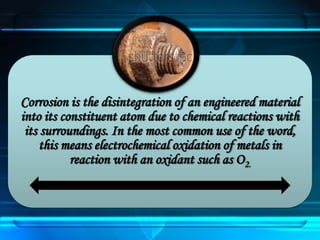
Corrosion is the disintegration of an engineered material
into its constituent atom due to chemical reactions with
its surroundings. In the most common use of the word,
this means electrochemical oxidation of metals in
reaction with an oxidant such as O2.
EFFECTS OF CORROSION
• Reduces Strength
• Life time is reduced
• Metallic properties are lost
• Wastage of metal
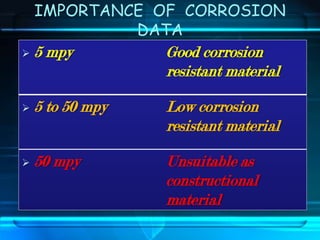
IMPORTANCE OF CORROSION
DATA
 5 mpy Good corrosion
resistant material
 5 to 50 mpy Low corrosion
resistant material
 50 mpy Unsuitable as
constructional
material
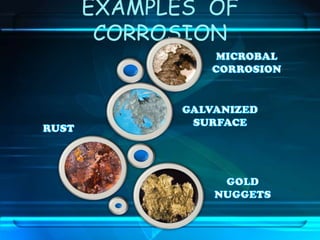
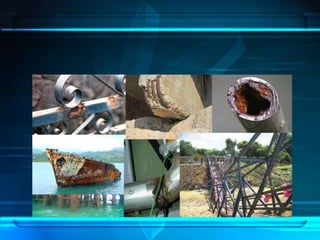
EXAMPLES OF
CORROSION
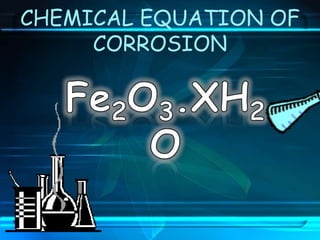
CHEMICAL EQUATION OF
CORROSION
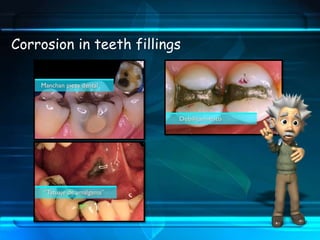
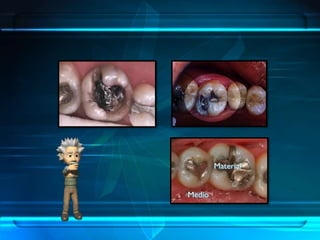
Corrosion in teeth fillings
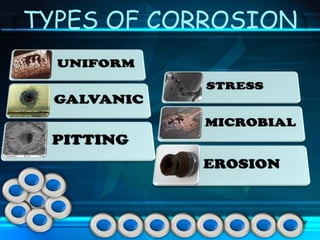
TYPES OF CORROSION
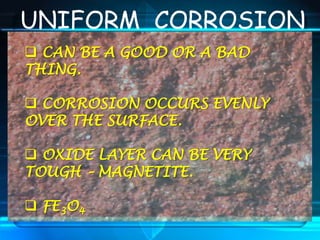
UNIFORM CORROSION
 CAN BE A GOOD OR A BAD
THING.
 CORROSION OCCURS EVENLY
OVER THE SURFACE.
 OXIDE LAYER CAN BE VERY
TOUGH – MAGNETITE.
 FE3O4
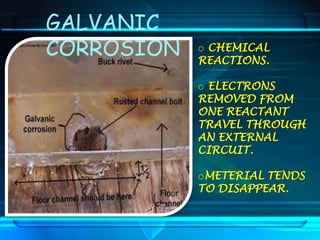
GALVANIC
CORROSION o CHEMICAL
REACTIONS.
o ELECTRONS
REMOVED FROM
ONE REACTANT
TRAVEL THROUGH
AN EXTERNAL
CIRCUIT.
oMETERIAL TENDS
TO DISAPPEAR.
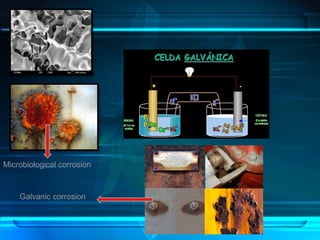
Microbiological corrosion
Galvanic corrosion
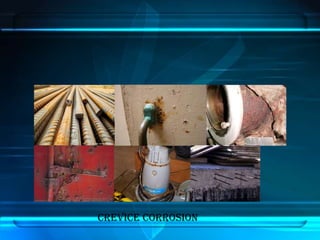
Crevice Corrosion
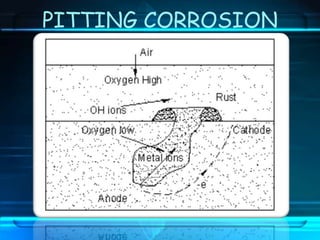
PITTING CORROSION
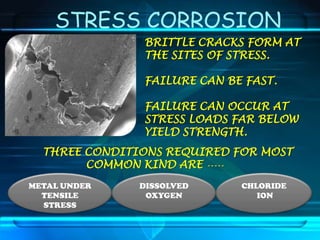
STRESS CORROSION
BRITTLE CRACKS FORM AT
THE SITES OF STRESS.
FAILURE CAN BE FAST.
FAILURE CAN OCCUR AT
STRESS LOADS FAR BELOW
YIELD STRENGTH.
THREE CONDITIONS REQUIRED FOR MOST
COMMON KIND ARE -----
METAL UNDER
TENSILE
STRESS
DISSOLVED
OXYGEN
CHLORIDE
ION
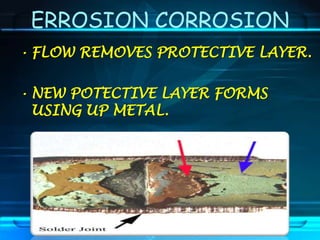
ERROSION CORROSION
• FLOW REMOVES PROTECTIVE LAYER.
• NEW POTECTIVE LAYER FORMS
USING UP METAL.
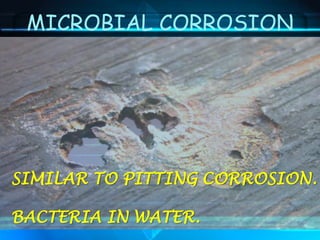
MICROBIAL CORROSION
SIMILAR TO PITTING CORROSION.
BACTERIA IN WATER.
Economic Impact of Corrosion
Annual estimated direct cost of corrosion
in the U.S. was approximately $276 billion
(approximately 3.2% of the US GDP.
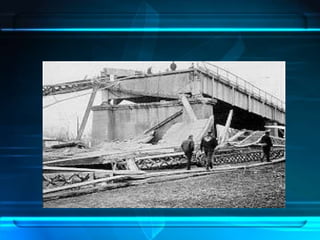
Rust was the reason for the failure of
Mianus river bridge in 1983 and Silver
Bridge disaster of West Virginia in 1967
PREVENTIONS OF
CORROSION
ACIVE CORROSION
PROTECTION
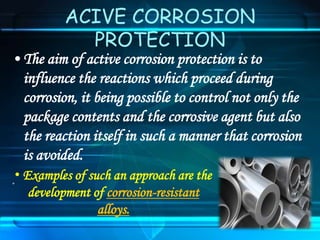
• The aim of active corrosion protection is to
influence the reactions which proceed during
corrosion, it being possible to control not only the
package contents and the corrosive agent but also
the reaction itself in such a manner that corrosion
is avoided.
.• Examples of such an approach are the
development of corrosion-resistant
alloys.
PERMANENT CORROSION
PROTECTION
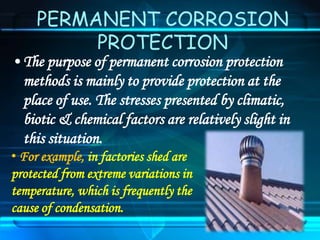
• The purpose of permanent corrosion protection
methods is mainly to provide protection at the
place of use. The stresses presented by climatic,
biotic & chemical factors are relatively slight in
this situation.
• For example, in factories shed are
protected from extreme variations in
temperature, which is frequently the
cause of condensation.
What are the remedies or protective
measures
• Apply coatings on the metal
surface
• Removal of oxygen
• Control of pH
• Inhibitors
• Change of potential
But knowing beforehand the possible
effect of corrosion led to the development
of different softwares and models for
corrosion rate prediction
Various available softwares
Softwares have been developed by various organizations
but few of the well known software builders are :-
 OHIO UNIVERSITY
 ELECTRONIC CORROSION ENGINEERS
 HONEYWELL
Multicorp and Freecorp are the products of Ohio
University
Honeywell has developed PREDICT-6.0 and PREDICTPIPE-
3.0
Two corrosion models have been developed by
ELECTRONIC CORROSION ENGINEERS and NORSOK
Multicorp v4.2
 Effect of multiphase flow
(two- and three-phase flow)
 Effect of temperature (1-100
C)
 Effect of CO2 partial pressure
(0 – 2 MPa)
 Effect of H2S content (0 – 1
MPa)
 Effect of organic acids (0 –
10,000 ppm)
 Effect of pH and brine
chemistry (pH3 – pH7)
 Effect of steel type
 Effect of inhibition by crude
oil and/or corrosion inhibitors
 Magnitude and morphology of
localized attack
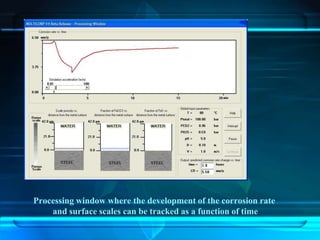
Processing window where the development of the corrosion rate
and surface scales can be tracked as a function of time
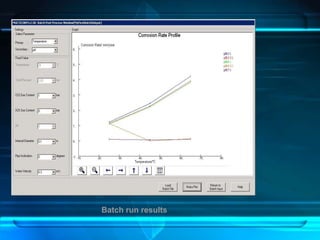
Batch run results
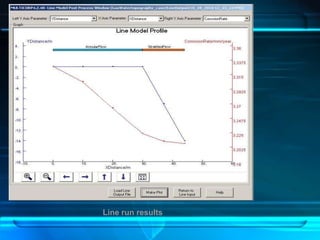
Line run results
Norsok m-506
This model calculates the CO2 corrosion
rate on the basis of given temperature,
pH , CO2 partial pressure and shear stress
Electronic Corrosion Engineers
• It consists of a tubing project and a
pipeline project
Created & Edited by –
ABHIJEET DASH
REFERENCES
• http://www.corrosioncenter.ohiou.edu/software/multicor
p/
• https://www.honeywellprocess.com/en-
US/explore/products/advanced-applications/asset-
management/corrosion-prediction-and-
assessment/Pages/predict-6.0.aspx
• https://www.honeywellprocess.com/en-
US/explore/products/advanced-applications/asset-
management/corrosion-prediction-and-
assessment/Pages/predictpipe-3-0.aspx
• http://www.corrosionhelp.com/services.htm#Electroche
mical Analysis
• http://www.corrosionservice.com/

corrosion

  • 1.
    “ A Simpleview on a complex matter”
  • 2.
    • Virtually nopractical and engineering material is stable. The rate of decay varies depending upon the material and its environment. • The human system cannot endure – Temp above 50 C or below 20 C – Pressures above or below our atmospheres – Presence of harmful gases such as CO, H2S, and H2. • Thus, analogous to human system, engineering materials also require protection like – coatings, inhibitors, alloy addition, design procedures, maintenance, inspection and re- furnishing.
  • 3.
    Corrosion is thedisintegration of an engineered material into its constituent atom due to chemical reactions with its surroundings. In the most common use of the word, this means electrochemical oxidation of metals in reaction with an oxidant such as O2.
  • 4.
    EFFECTS OF CORROSION •Reduces Strength • Life time is reduced • Metallic properties are lost • Wastage of metal
  • 5.
    IMPORTANCE OF CORROSION DATA 5 mpy Good corrosion resistant material  5 to 50 mpy Low corrosion resistant material  50 mpy Unsuitable as constructional material
  • 6.
  • 7.
  • 9.
  • 12.
  • 13.
    UNIFORM CORROSION  CANBE A GOOD OR A BAD THING.  CORROSION OCCURS EVENLY OVER THE SURFACE.  OXIDE LAYER CAN BE VERY TOUGH – MAGNETITE.  FE3O4
  • 14.
    GALVANIC CORROSION o CHEMICAL REACTIONS. oELECTRONS REMOVED FROM ONE REACTANT TRAVEL THROUGH AN EXTERNAL CIRCUIT. oMETERIAL TENDS TO DISAPPEAR.
  • 15.
  • 16.
  • 17.
  • 18.
    STRESS CORROSION BRITTLE CRACKSFORM AT THE SITES OF STRESS. FAILURE CAN BE FAST. FAILURE CAN OCCUR AT STRESS LOADS FAR BELOW YIELD STRENGTH. THREE CONDITIONS REQUIRED FOR MOST COMMON KIND ARE ----- METAL UNDER TENSILE STRESS DISSOLVED OXYGEN CHLORIDE ION
  • 19.
    ERROSION CORROSION • FLOWREMOVES PROTECTIVE LAYER. • NEW POTECTIVE LAYER FORMS USING UP METAL.
  • 20.
    MICROBIAL CORROSION SIMILAR TOPITTING CORROSION. BACTERIA IN WATER.
  • 21.
    Economic Impact ofCorrosion Annual estimated direct cost of corrosion in the U.S. was approximately $276 billion (approximately 3.2% of the US GDP. Rust was the reason for the failure of Mianus river bridge in 1983 and Silver Bridge disaster of West Virginia in 1967
  • 24.
  • 25.
    ACIVE CORROSION PROTECTION • Theaim of active corrosion protection is to influence the reactions which proceed during corrosion, it being possible to control not only the package contents and the corrosive agent but also the reaction itself in such a manner that corrosion is avoided. .• Examples of such an approach are the development of corrosion-resistant alloys.
  • 26.
    PERMANENT CORROSION PROTECTION • Thepurpose of permanent corrosion protection methods is mainly to provide protection at the place of use. The stresses presented by climatic, biotic & chemical factors are relatively slight in this situation. • For example, in factories shed are protected from extreme variations in temperature, which is frequently the cause of condensation.
  • 27.
    What are theremedies or protective measures • Apply coatings on the metal surface • Removal of oxygen • Control of pH • Inhibitors • Change of potential But knowing beforehand the possible effect of corrosion led to the development of different softwares and models for corrosion rate prediction
  • 28.
    Various available softwares Softwareshave been developed by various organizations but few of the well known software builders are :-  OHIO UNIVERSITY  ELECTRONIC CORROSION ENGINEERS  HONEYWELL Multicorp and Freecorp are the products of Ohio University Honeywell has developed PREDICT-6.0 and PREDICTPIPE- 3.0 Two corrosion models have been developed by ELECTRONIC CORROSION ENGINEERS and NORSOK
  • 29.
  • 30.
     Effect ofmultiphase flow (two- and three-phase flow)  Effect of temperature (1-100 C)  Effect of CO2 partial pressure (0 – 2 MPa)  Effect of H2S content (0 – 1 MPa)  Effect of organic acids (0 – 10,000 ppm)  Effect of pH and brine chemistry (pH3 – pH7)  Effect of steel type  Effect of inhibition by crude oil and/or corrosion inhibitors  Magnitude and morphology of localized attack
  • 31.
    Processing window wherethe development of the corrosion rate and surface scales can be tracked as a function of time
  • 32.
  • 33.
  • 34.
    Norsok m-506 This modelcalculates the CO2 corrosion rate on the basis of given temperature, pH , CO2 partial pressure and shear stress
  • 35.
    Electronic Corrosion Engineers •It consists of a tubing project and a pipeline project
  • 36.
    Created & Editedby – ABHIJEET DASH
  • 37.
    REFERENCES • http://www.corrosioncenter.ohiou.edu/software/multicor p/ • https://www.honeywellprocess.com/en- US/explore/products/advanced-applications/asset- management/corrosion-prediction-and- assessment/Pages/predict-6.0.aspx •https://www.honeywellprocess.com/en- US/explore/products/advanced-applications/asset- management/corrosion-prediction-and- assessment/Pages/predictpipe-3-0.aspx • http://www.corrosionhelp.com/services.htm#Electroche mical Analysis • http://www.corrosionservice.com/