






1
2
By JGC Annamalai
(IN IRON AND STEEL)
1
Effects of Alloying Elements in Iron and Steel Page
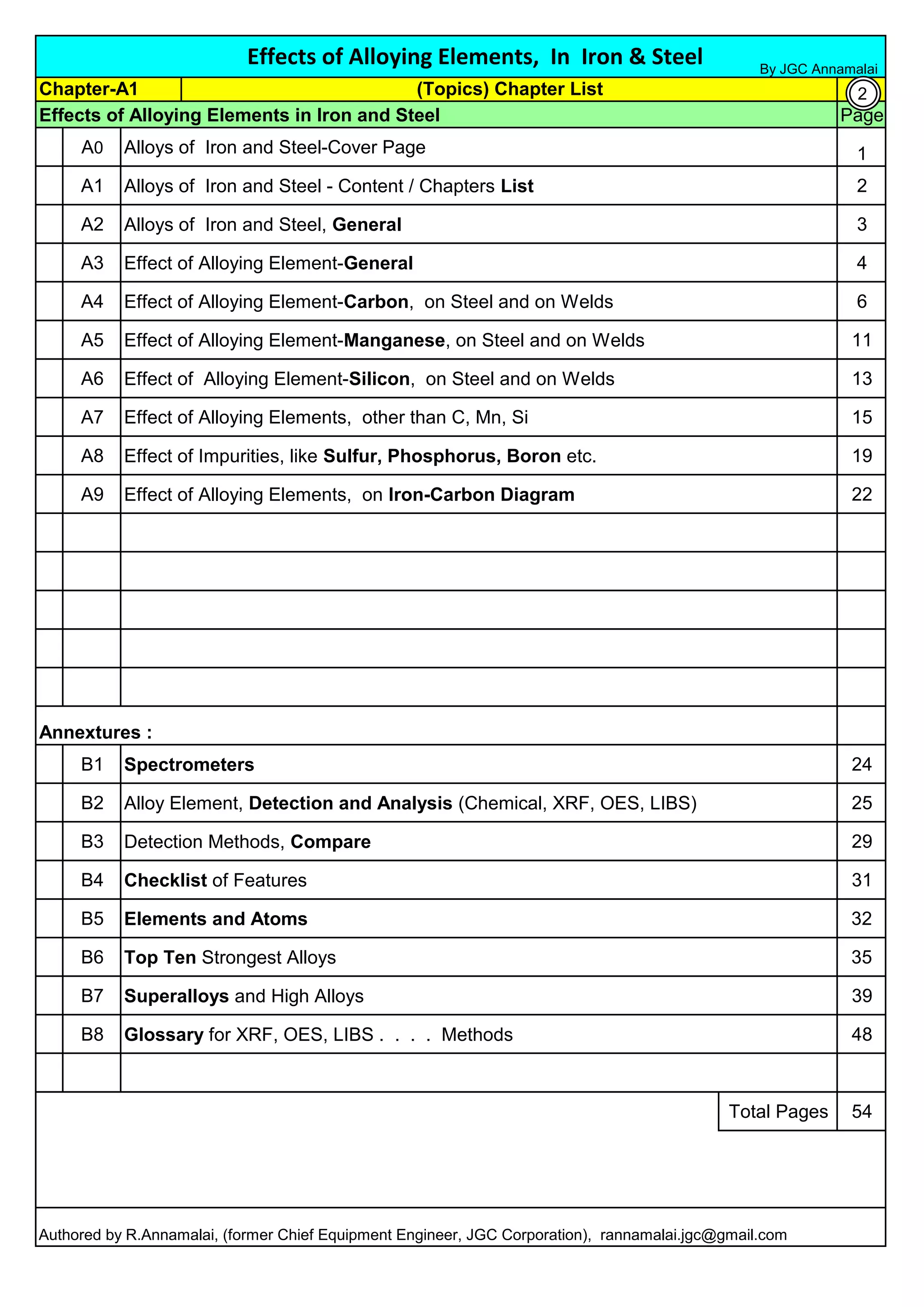
A0 Alloys of Iron and Steel-Cover Page 1
A1 Alloys of Iron and Steel - Content / Chapters List 2
A2 Alloys of Iron and Steel, General 3
A3 Effect of Alloying Element-General 4
A4 Effect of Alloying Element-Carbon, on Steel and on Welds 6
A5 Effect of Alloying Element-Manganese, on Steel and on Welds 11
A6 Effect of Alloying Element-Silicon, on Steel and on Welds 13
A7 Effect of Alloying Elements, other than C, Mn, Si 15
A8 Effect of Impurities, like Sulfur, Phosphorus, Boron etc. 19
A9 Effect of Alloying Elements, on Iron-Carbon Diagram 22
Annextures :
B1 Spectrometers 24
B2 Alloy Element, Detection and Analysis (Chemical, XRF, OES, LIBS) 25
B3 Detection Methods, Compare 29
B4 Checklist of Features 31
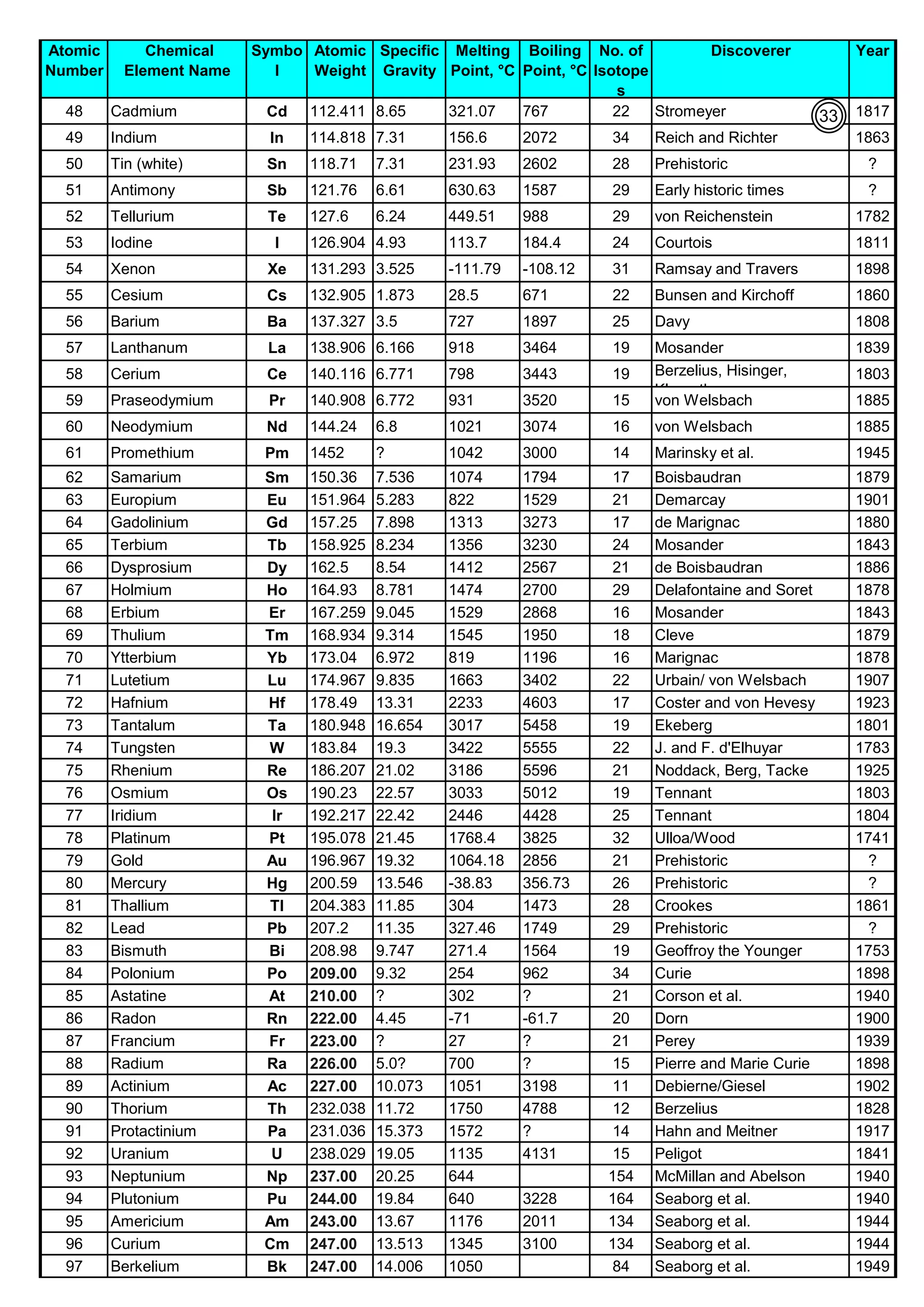
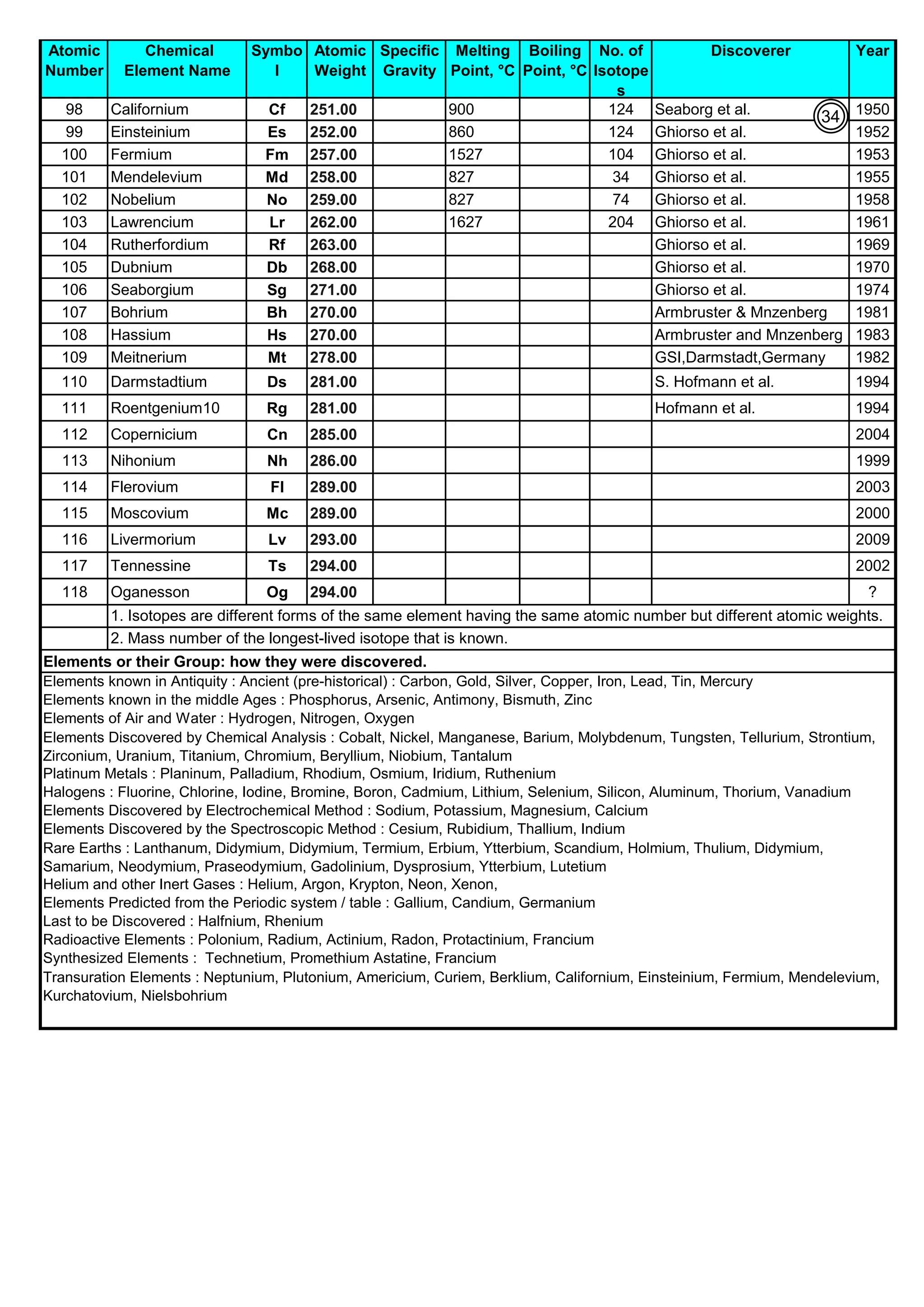
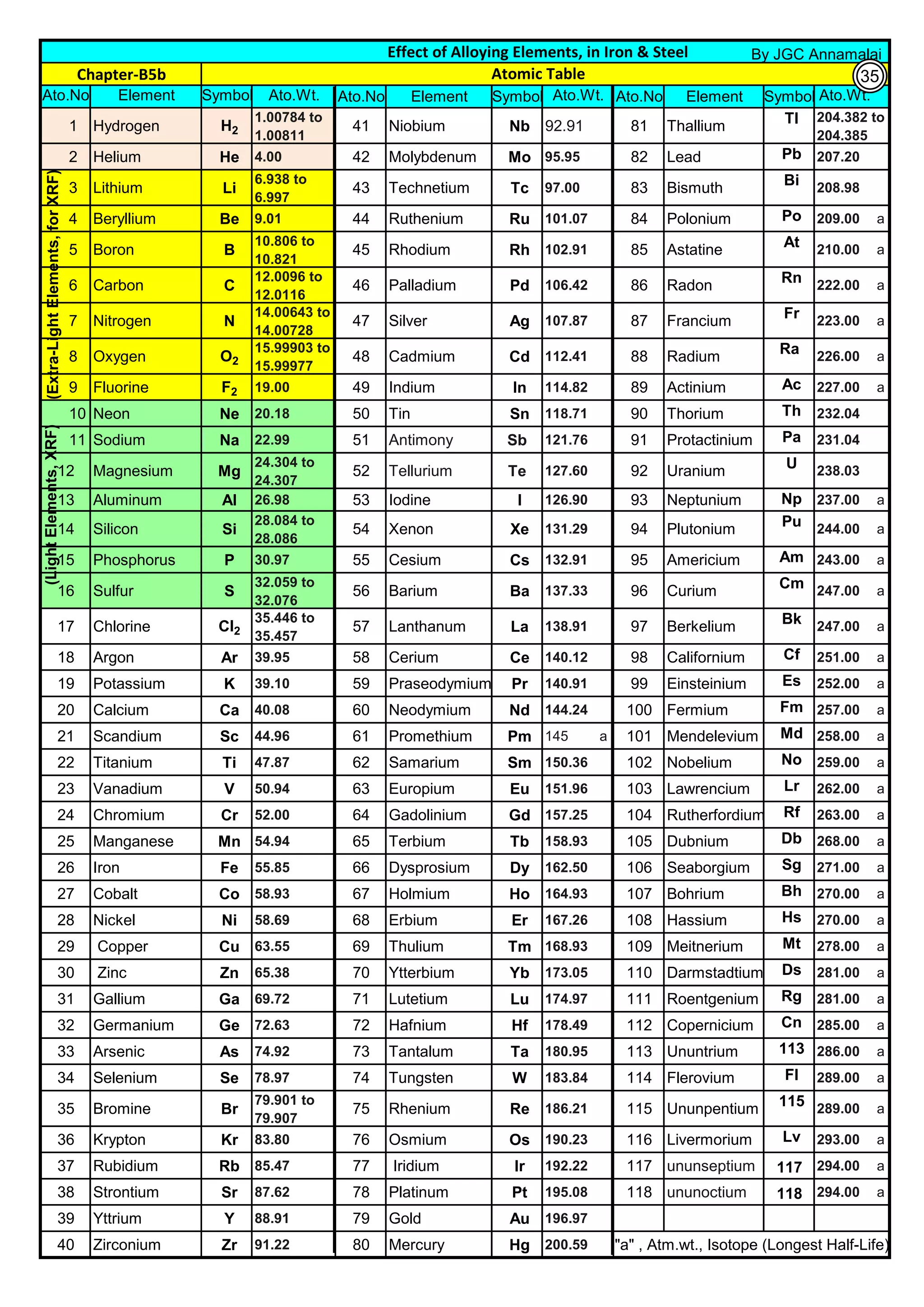
B5 Elements and Atoms 32
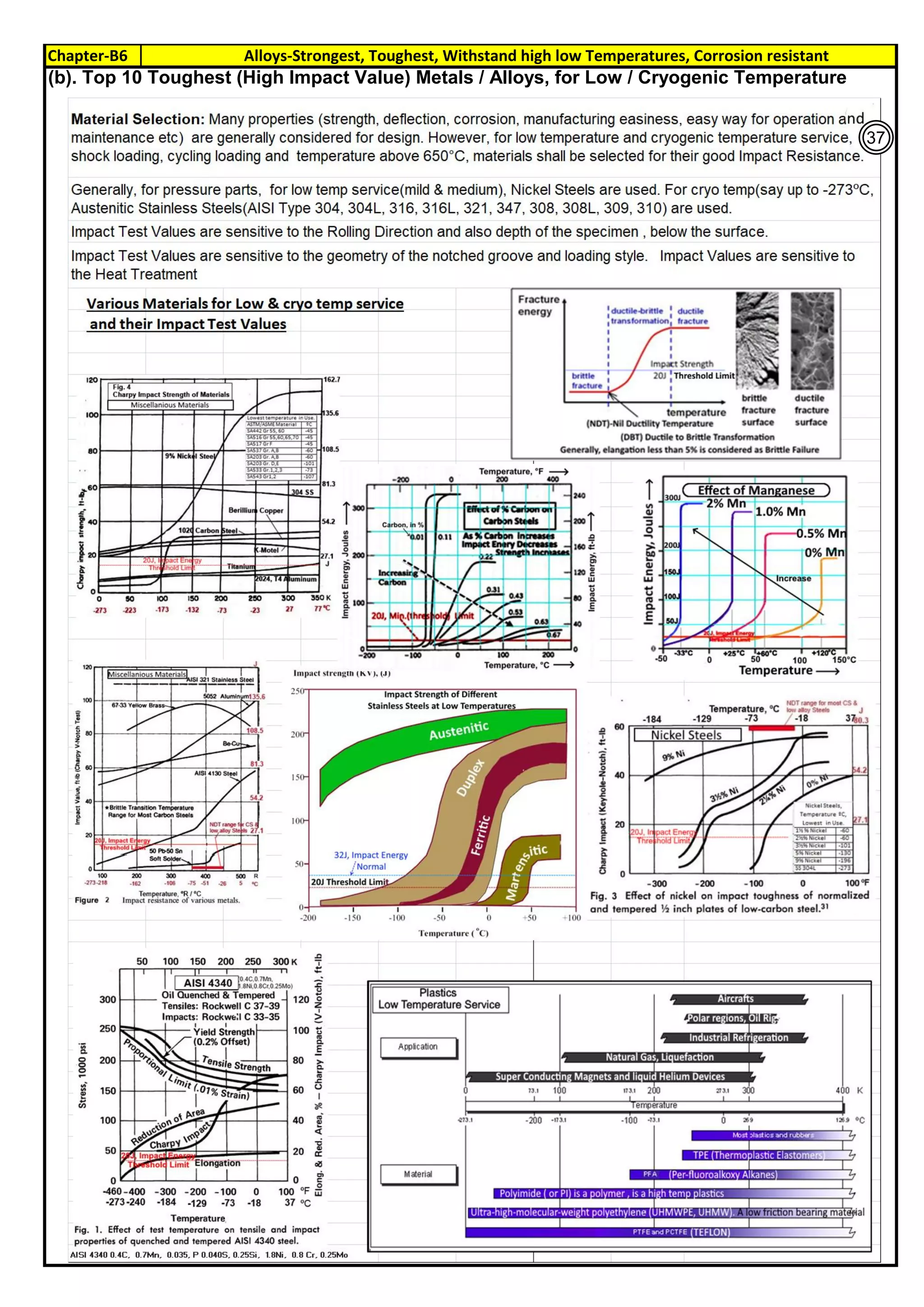
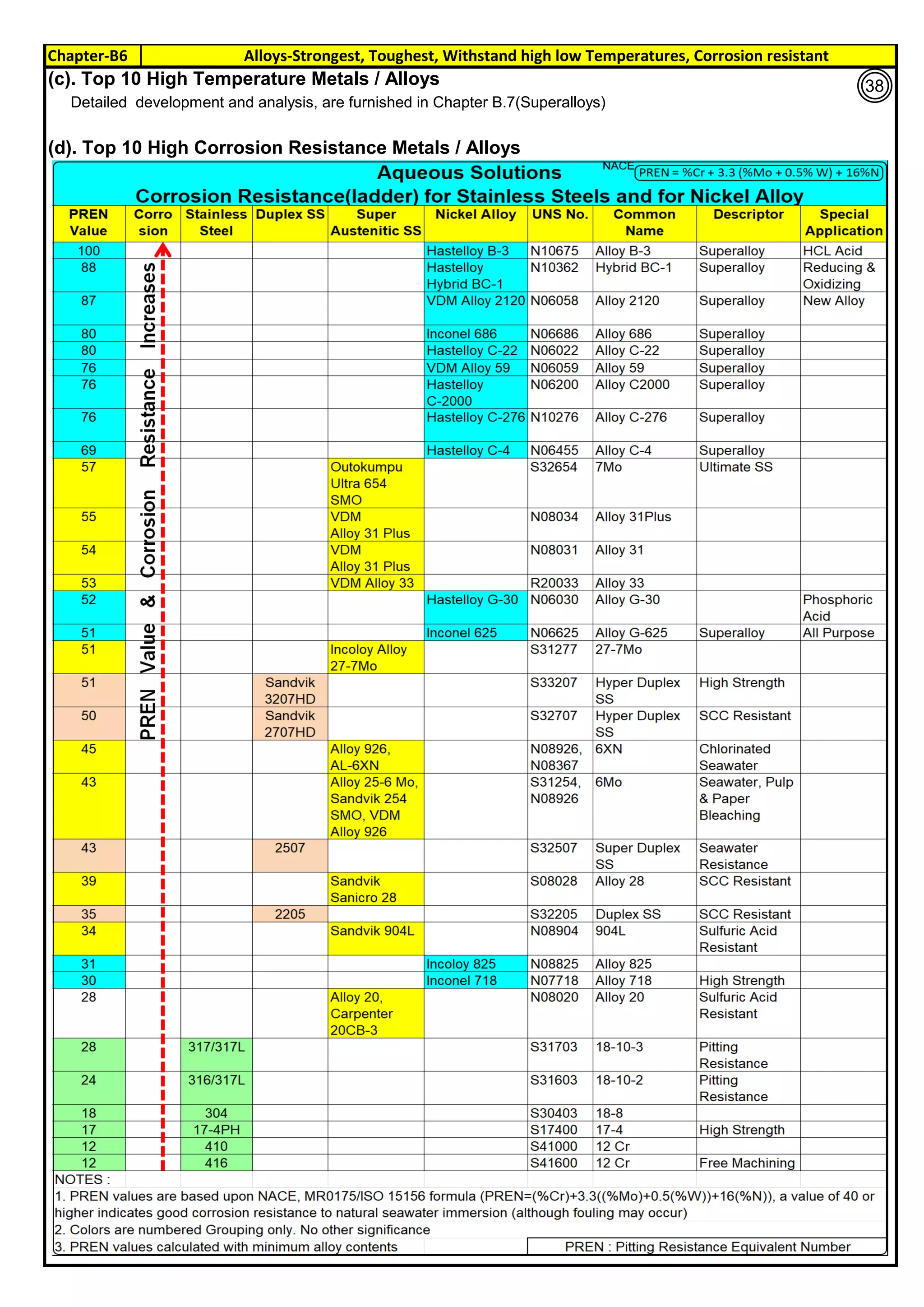
B6 Top Ten Strongest Alloys 35
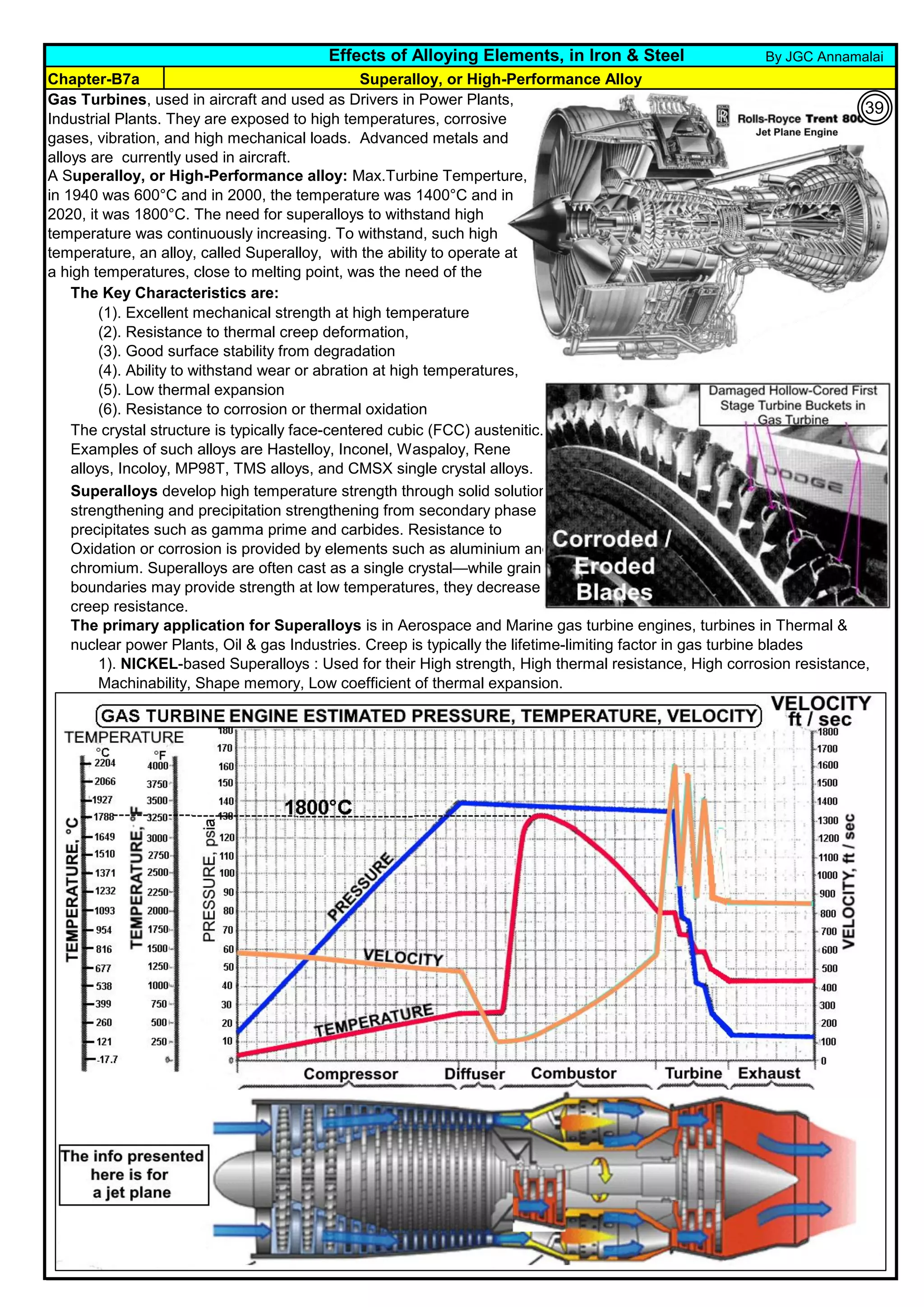
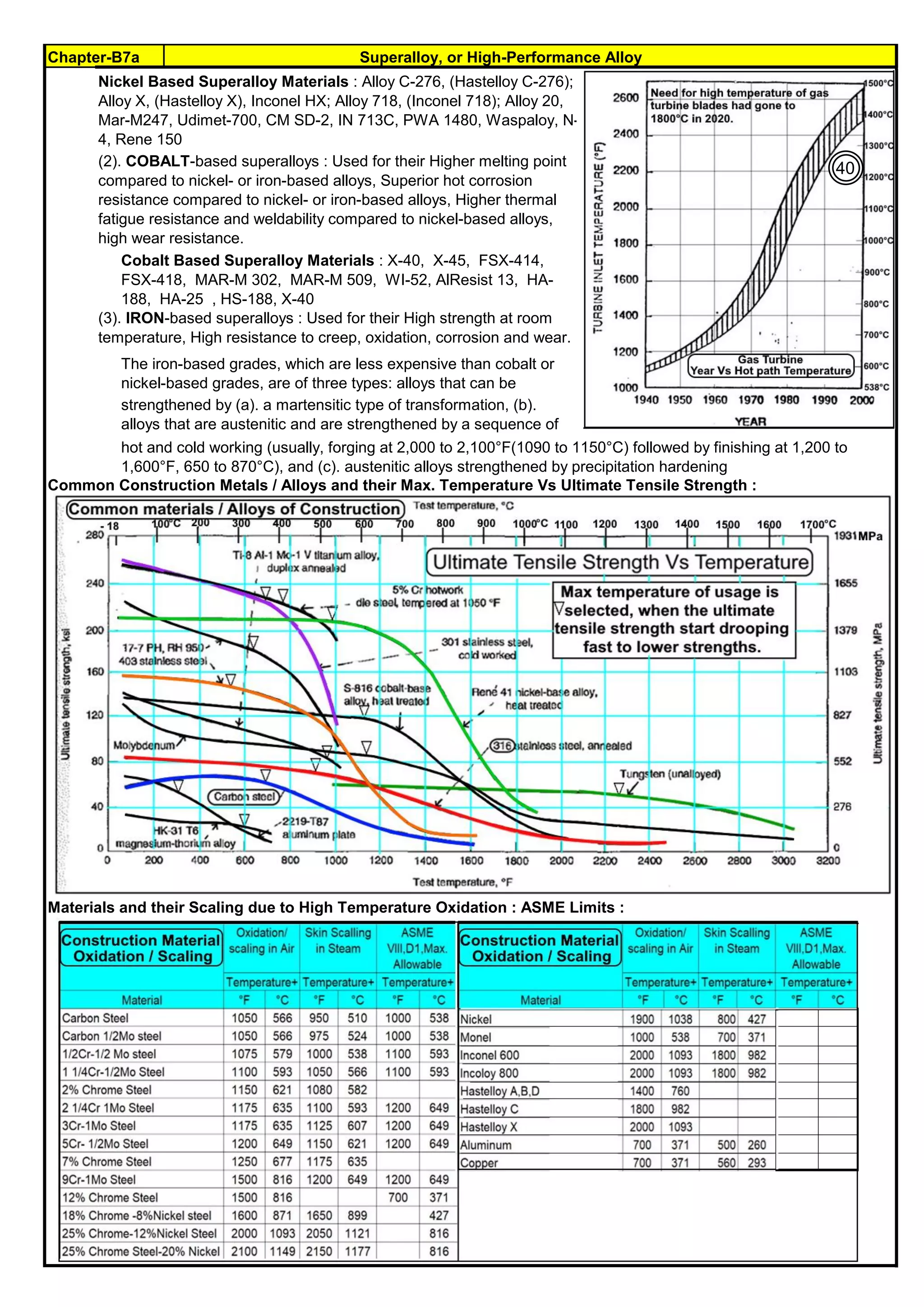
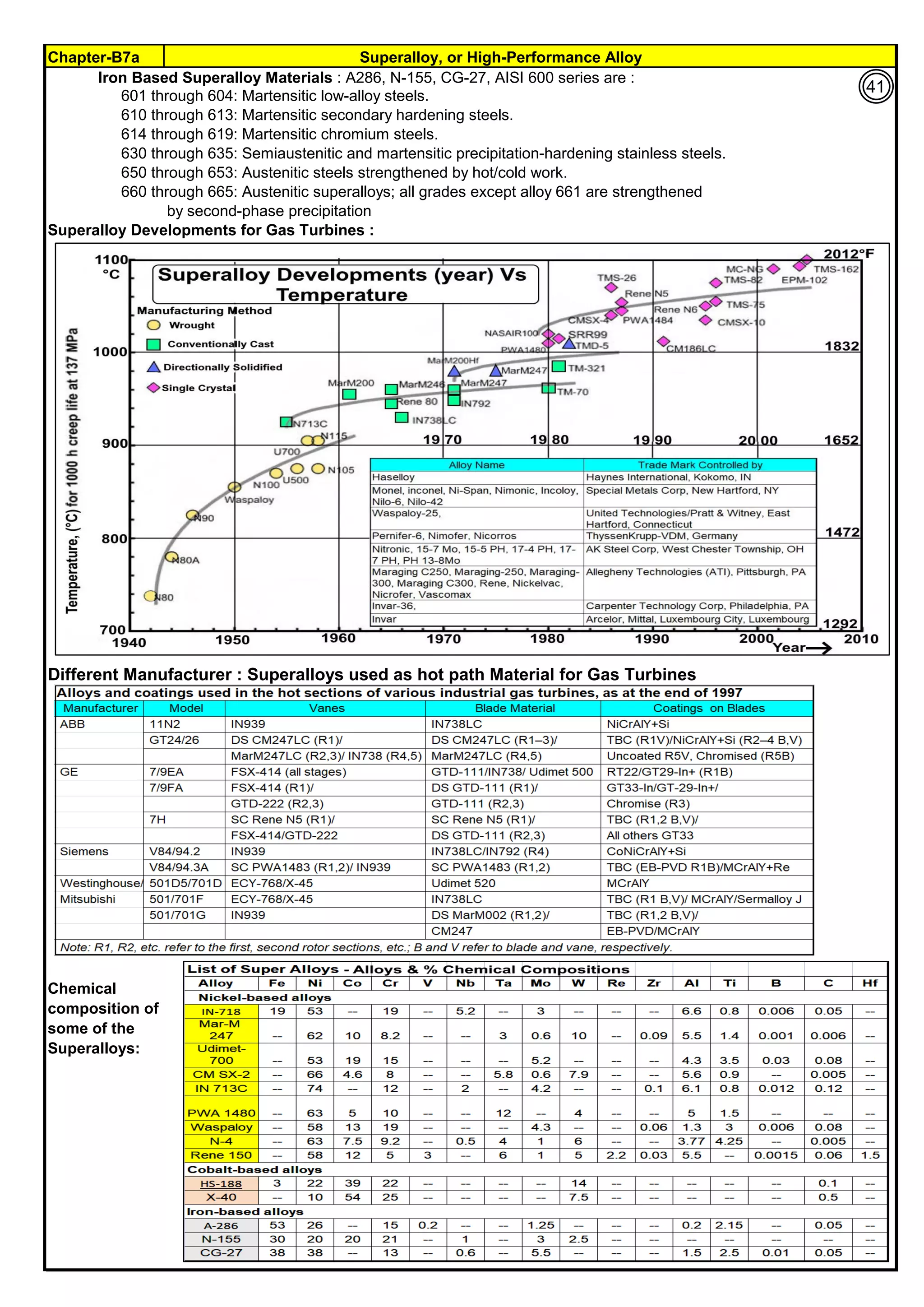
B7 Superalloys and High Alloys 39
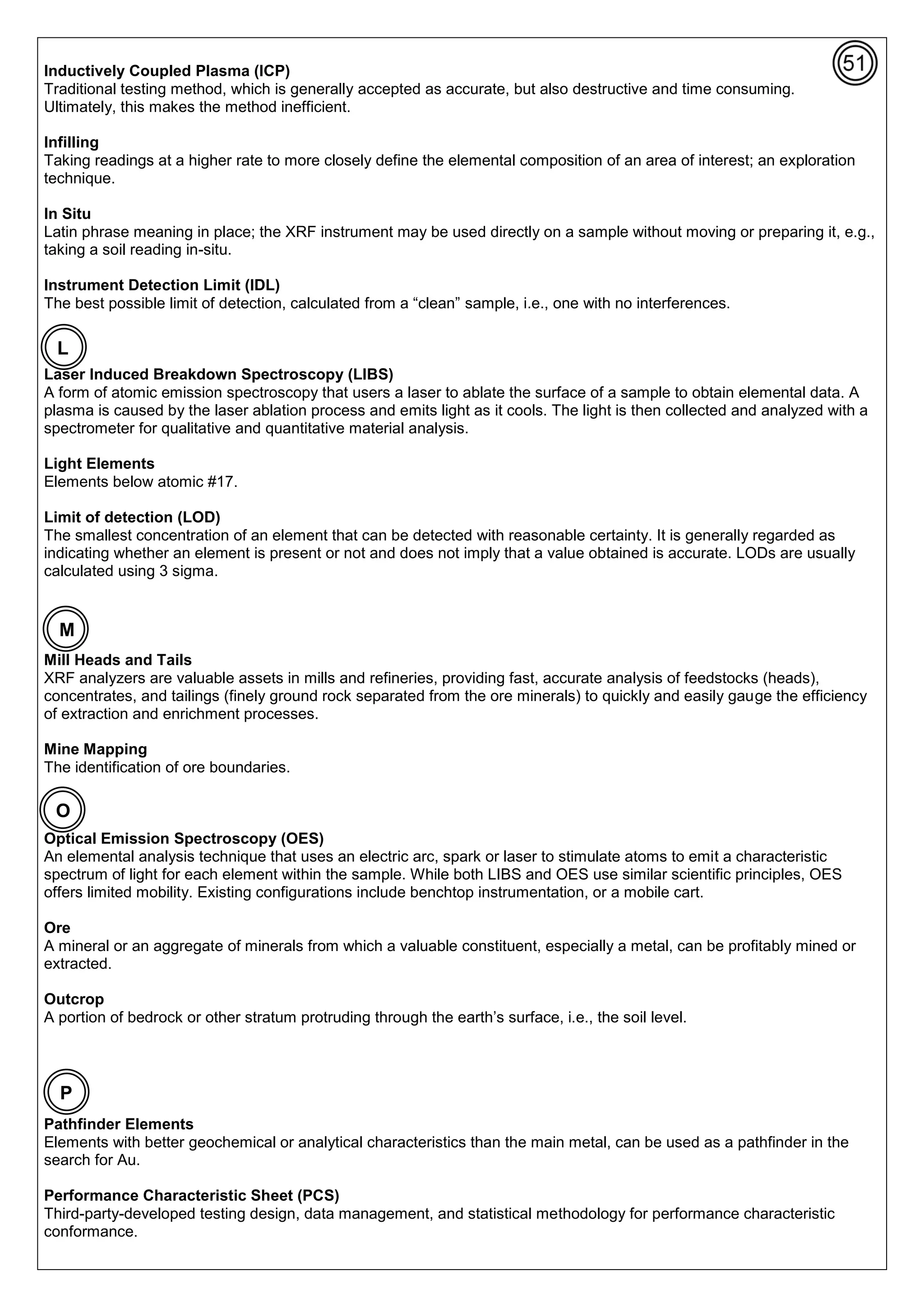
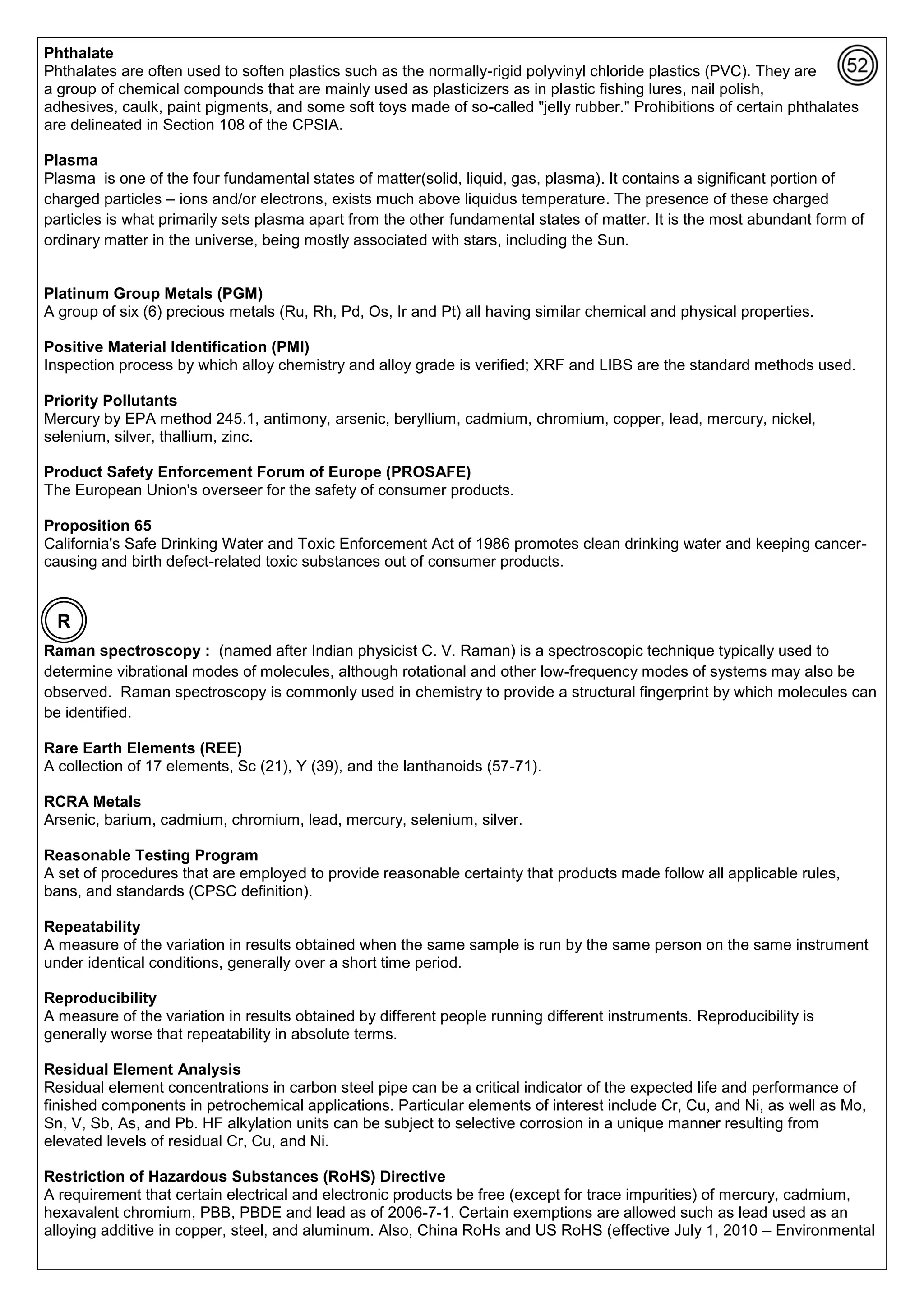
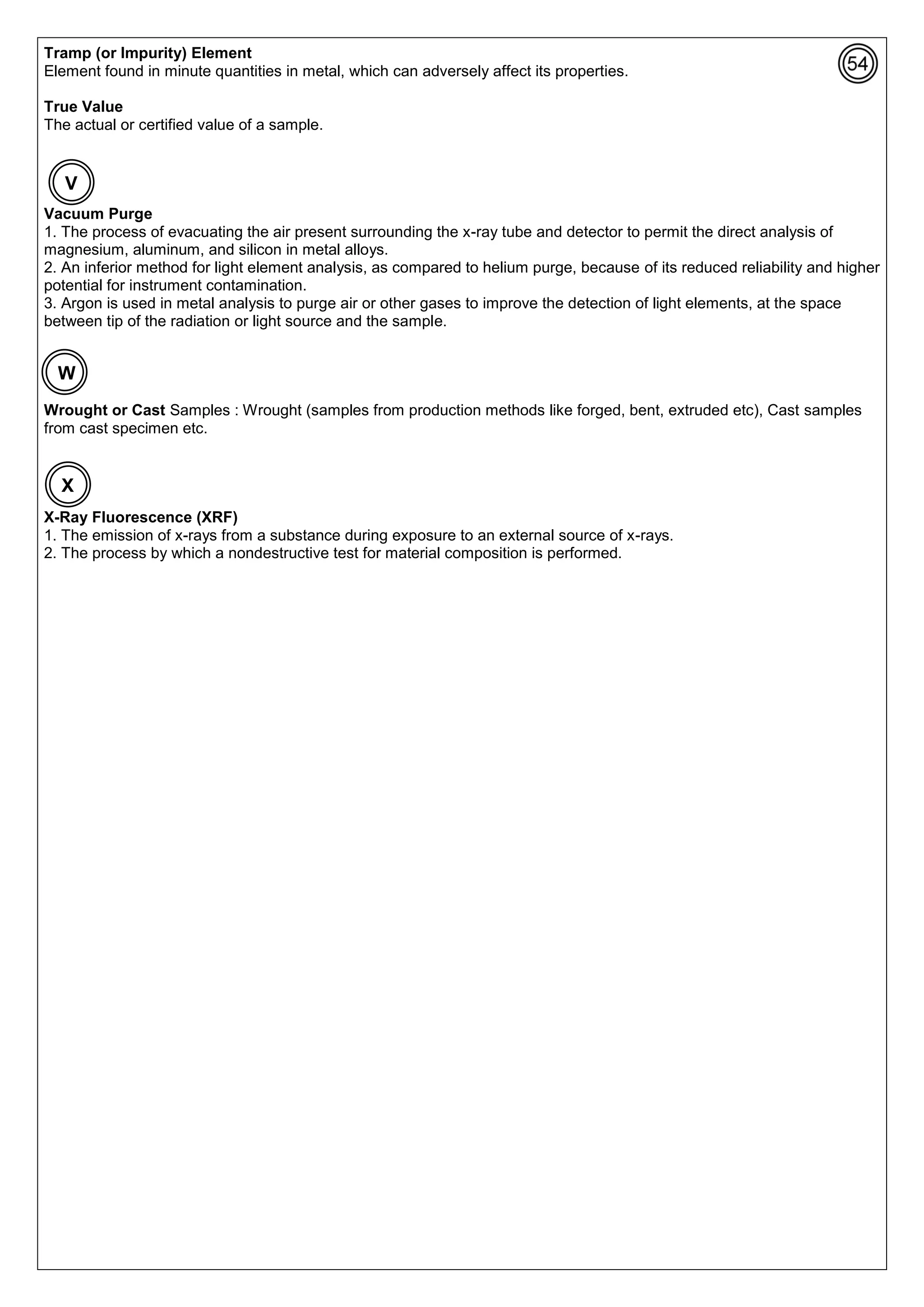
B8 Glossary for XRF, OES, LIBS . . . . Methods 48
Total Pages 54
Chapter-A1 (Topics) Chapter List
Authored by R.Annamalai, (former Chief Equipment Engineer, JGC Corporation), rannamalai.jgc@gmail.com
Effects of Alloying Elements, In Iron & Steel By JGC Annamalai
2
Chapter-A2
(1). Alloys are usually harder and stronger than their components but very often less ductile and less malleable. (Hardness
of gold is increased by addition of copper to it).
(2). The melting point of an alloy is always lower than the melting points of the constituent metals.
(3). Other properties such as reaction(corrosion) towards atmospheric oxygen and moisture, mechanical strength, ductility,
color etc, also undergoes a change when alloy is made from its constituents metals.
This change of properties are very useful and makes an alloy beneficial.
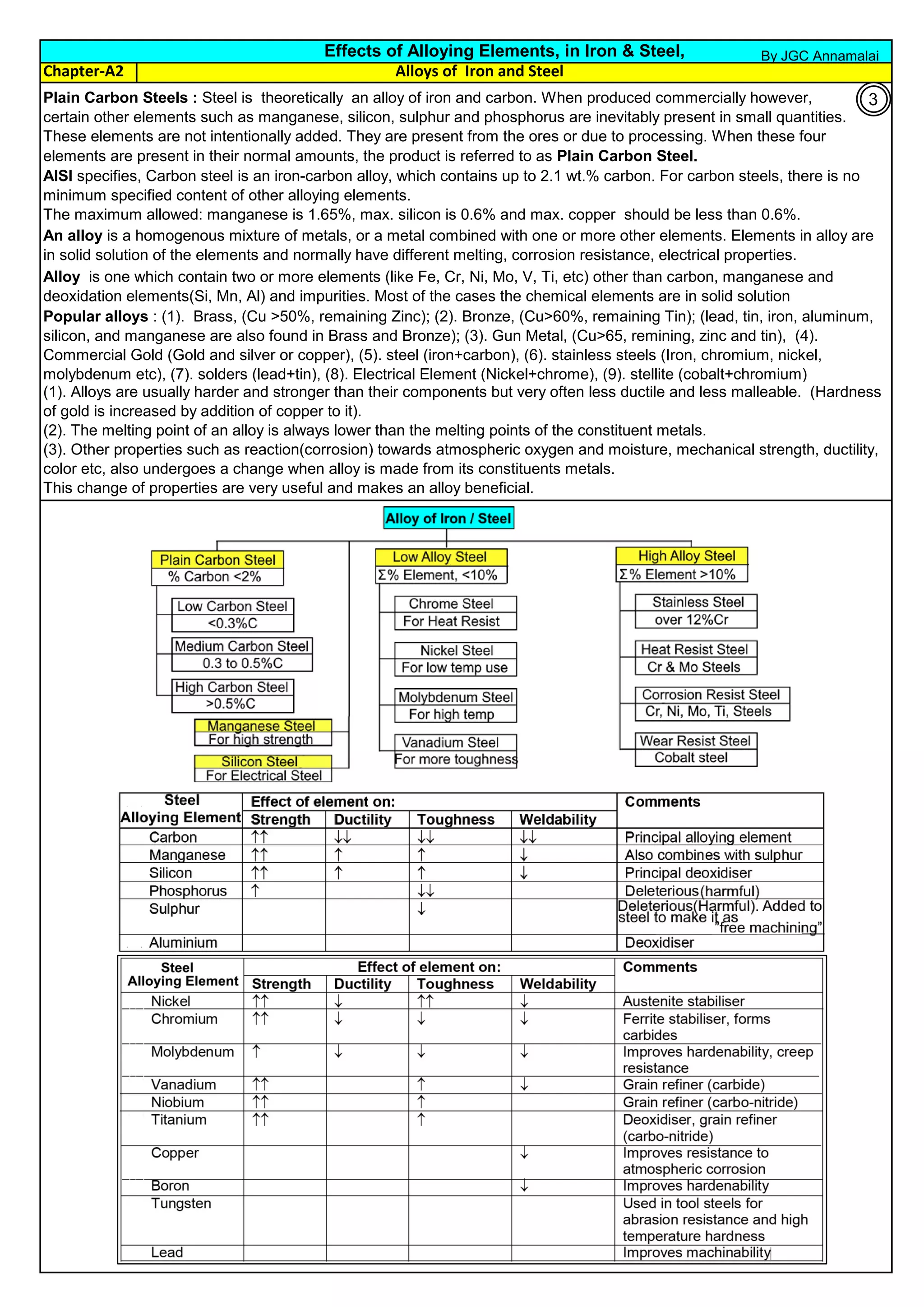
Plain Carbon Steels : Steel is theoretically an alloy of iron and carbon. When produced commercially however,
certain other elements such as manganese, silicon, sulphur and phosphorus are inevitably present in small quantities.
These elements are not intentionally added. They are present from the ores or due to processing. When these four
elements are present in their normal amounts, the product is referred to as Plain Carbon Steel.
Alloy is one which contain two or more elements (like Fe, Cr, Ni, Mo, V, Ti, etc) other than carbon, manganese and
deoxidation elements(Si, Mn, Al) and impurities. Most of the cases the chemical elements are in solid solution
Effects of Alloying Elements, in Iron & Steel,
Alloys of Iron and Steel
An alloy is a homogenous mixture of metals, or a metal combined with one or more other elements. Elements in alloy are
in solid solution of the elements and normally have different melting, corrosion resistance, electrical properties.
AISI specifies, Carbon steel is an iron-carbon alloy, which contains up to 2.1 wt.% carbon. For carbon steels, there is no
minimum specified content of other alloying elements.
The maximum allowed: manganese is 1.65%, max. silicon is 0.6% and max. copper should be less than 0.6%.
Popular alloys : (1). Brass, (Cu >50%, remaining Zinc); (2). Bronze, (Cu>60%, remaining Tin); (lead, tin, iron, aluminum,
silicon, and manganese are also found in Brass and Bronze); (3). Gun Metal, (Cu>65, remining, zinc and tin), (4).
Commercial Gold (Gold and silver or copper), (5). steel (iron+carbon), (6). stainless steels (Iron, chromium, nickel,
molybdenum etc), (7). solders (lead+tin), (8). Electrical Element (Nickel+chrome), (9). stellite (cobalt+chromium)
By JGC Annamalai
3
Effects of Alloy
Element in Steel
(%)
Percentage
Positive Effects Negative Effects
Carbon increasing C% Strength Ductility
Hardness Weldability
max. 2.0% Hardenability
Manganese 0.30/1.15 Surface Quality Machinability
(Favoring MnS to FeS inclusions) Weldability
Strength Machinability
1.20/1.65 Surface Quality Weldability
Over 1.65 Hardenability Machinability
Weldability
Phosphorus 0.040 Max (No special benefits) Ductility, Toughness
0.04/0.12 Machinability Ductility, Toughness
(Desirable chip formation) Impact Resistance
Sulfur Under ~ 0.006 Surface Quality Machinability
(Due to absence of sulfur) (Poor chip formation)
0.01/0.05 (No special benefits) Chemical Impurity
0.06/0.40 Machinability Traverse Properties
Additive Impact Resistance
Weldability
Cold Formability
Silicon 0.10/0.40 Deoxidizer Machinability
Over 1.00 Strength of Ferrite Machinability
Sag Resistance Decarburization
(Spring Steel)
Nickel 0.01/0.25 Strength (Microalloy) Machinability
0.30/0.80 Hardenability Machinability
~1.00/4.00 Low-Temperature Machinability
Toughness
Chromium 0.01/0.25 Strength (Microalloy) Machinability
0.30/0.80 Hardenability Machinability
~1.00/2.00 Abrasion Resistance (Carbide Formation) Machinability
High Temperature Strength
Hardenability
Molybdenum 0.08/.060 Hardenability Machinability
Creep Strength Weldability
High Temperature
Strength
Copper 0.20 Max. Strength (Microalloy) Surface Quality
0.20/0.50 Corrosion Resistance Surface Quality
Forgeability
Over 1.00 Yield Strength (Alloy) Ductility
Impact Resistance
Forgeability
Nitrogen 0.020 Max. Strength (Microalloy) Cold Formability
Yield Strength (Microalloy) Ductility
Aluminum 0.95/1.30 Deoxidizer Machinability
Grain Refiner
Ability to Nitride
Columbium Deoxidizer Machinability
Grain Refiner Weldability
Strength (Microalloy) Toughness
Carbide Formation Hardenability (via Carbon Impoverishment)
4
Effects of Alloy
Element in Steel
(%)
Percentage
Positive Effects Negative Effects
Vanadium 0.05/0.20 Deoxidizer Machinability
Grain Refiner Ductility
Strength (Microalloy)
Wear Resistance
Titanium Deoxidizer Machinability
Grain Refiner
Nitrogen Scavenger
Boron 0.0005 Min. Hardenability Weldability
Nitrogen Scavenger Low-Temperature
Toughness
Lead/Bismuth 0.10/0.40 Machinability Embrittlement @ 600+ Degree F
Tellurium Machinability Surface Quality (Member of Sulfur Family)
(Sulfide Inclusion Modifier)
Calcium Machinability Susceptibility to Rolling Contact Fatigue
Inclusion Modifier
Desulfurization
Castability
5
Chapter-A4 Effect of Carbon on Steel Castings and on Welds
(1)
(2)
(3)
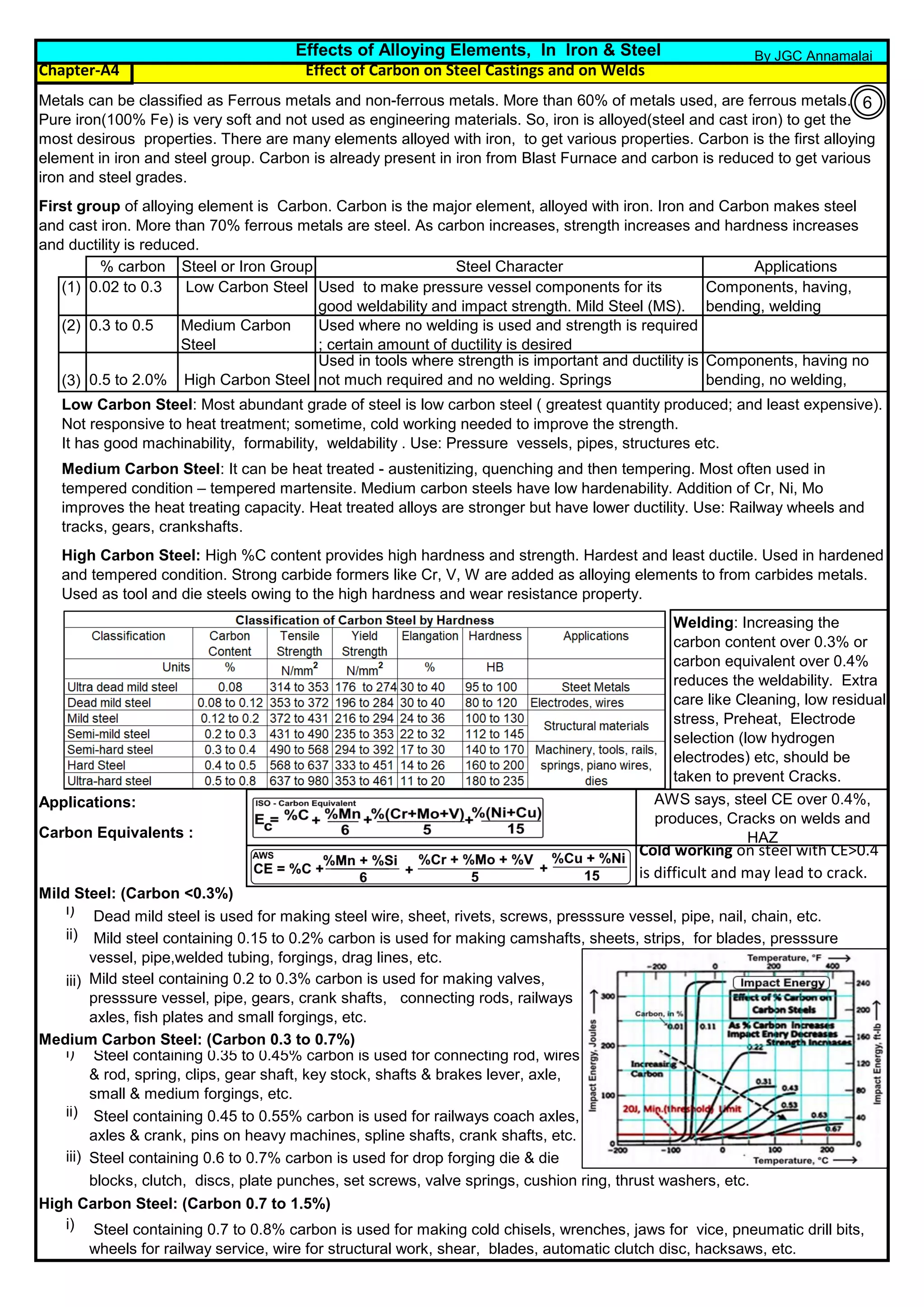
Applications:
Carbon Equivalents :
Mild Steel: (Carbon <0.3%)
i) Dead mild steel is used for making steel wire, sheet, rivets, screws, presssure vessel, pipe, nail, chain, etc.
ii)
iii)
Medium Carbon Steel: (Carbon 0.3 to 0.7%)
i)
ii)
iii)
High Carbon Steel: (Carbon 0.7 to 1.5%)
i)
Welding: Increasing the
carbon content over 0.3% or
carbon equivalent over 0.4%
reduces the weldability. Extra
care like Cleaning, low residual
stress, Preheat, Electrode
selection (low hydrogen
electrodes) etc, should be
taken to prevent Cracks.
Steel containing 0.6 to 0.7% carbon is used for drop forging die & die
blocks, clutch, discs, plate punches, set screws, valve springs, cushion ring, thrust washers, etc.
Mild steel containing 0.2 to 0.3% carbon is used for making valves,
presssure vessel, pipe, gears, crank shafts, connecting rods, railways
axles, fish plates and small forgings, etc.
Steel containing 0.35 to 0.45% carbon is used for connecting rod, wires
& rod, spring, clips, gear shaft, key stock, shafts & brakes lever, axle,
small & medium forgings, etc.
Steel containing 0.45 to 0.55% carbon is used for railways coach axles,
axles & crank, pins on heavy machines, spline shafts, crank shafts, etc.
High Carbon Steel: High %C content provides high hardness and strength. Hardest and least ductile. Used in hardened
and tempered condition. Strong carbide formers like Cr, V, W are added as alloying elements to from carbides metals.
Used as tool and die steels owing to the high hardness and wear resistance property.
Medium Carbon
Steel
0.5 to 2.0%
0.3 to 0.5 Used where no welding is used and strength is required
; certain amount of ductility is desired
Low Carbon Steel: Most abundant grade of steel is low carbon steel ( greatest quantity produced; and least expensive).
Not responsive to heat treatment; sometime, cold working needed to improve the strength.
It has good machinability, formability, weldability . Use: Pressure vessels, pipes, structures etc.
Medium Carbon Steel: It can be heat treated - austenitizing, quenching and then tempering. Most often used in
tempered condition – tempered martensite. Medium carbon steels have low hardenability. Addition of Cr, Ni, Mo
improves the heat treating capacity. Heat treated alloys are stronger but have lower ductility. Use: Railway wheels and
tracks, gears, crankshafts.
Effects of Alloying Elements, In Iron & Steel
Components, having no
bending, no welding,
0.02 to 0.3
Steel or Iron Group
% carbon
Low Carbon Steel Used to make pressure vessel components for its
good weldability and impact strength. Mild Steel (MS).
Steel Character Applications
Components, having,
bending, welding
High Carbon Steel
Metals can be classified as Ferrous metals and non-ferrous metals. More than 60% of metals used, are ferrous metals.
Pure iron(100% Fe) is very soft and not used as engineering materials. So, iron is alloyed(steel and cast iron) to get the
most desirous properties. There are many elements alloyed with iron, to get various properties. Carbon is the first alloying
element in iron and steel group. Carbon is already present in iron from Blast Furnace and carbon is reduced to get various
iron and steel grades.
First group of alloying element is Carbon. Carbon is the major element, alloyed with iron. Iron and Carbon makes steel
and cast iron. More than 70% ferrous metals are steel. As carbon increases, strength increases and hardness increases
and ductility is reduced.
Used in tools where strength is important and ductility is
not much required and no welding. Springs
AWS says, steel CE over 0.4%,
produces, Cracks on welds and
HAZ
Mild steel containing 0.15 to 0.2% carbon is used for making camshafts, sheets, strips, for blades, presssure
vessel, pipe,welded tubing, forgings, drag lines, etc.
Steel containing 0.7 to 0.8% carbon is used for making cold chisels, wrenches, jaws for vice, pneumatic drill bits,
wheels for railway service, wire for structural work, shear, blades, automatic clutch disc, hacksaws, etc.
Cold working on steel with CE>0.4
is difficult and may lead to crack.
By JGC Annamalai
6
Chapter-A4 Effect of Carbon on Steel Castings and on Welds
By JGC Annamalai
ii)
iii)
iv)
v)
vi)
vii)
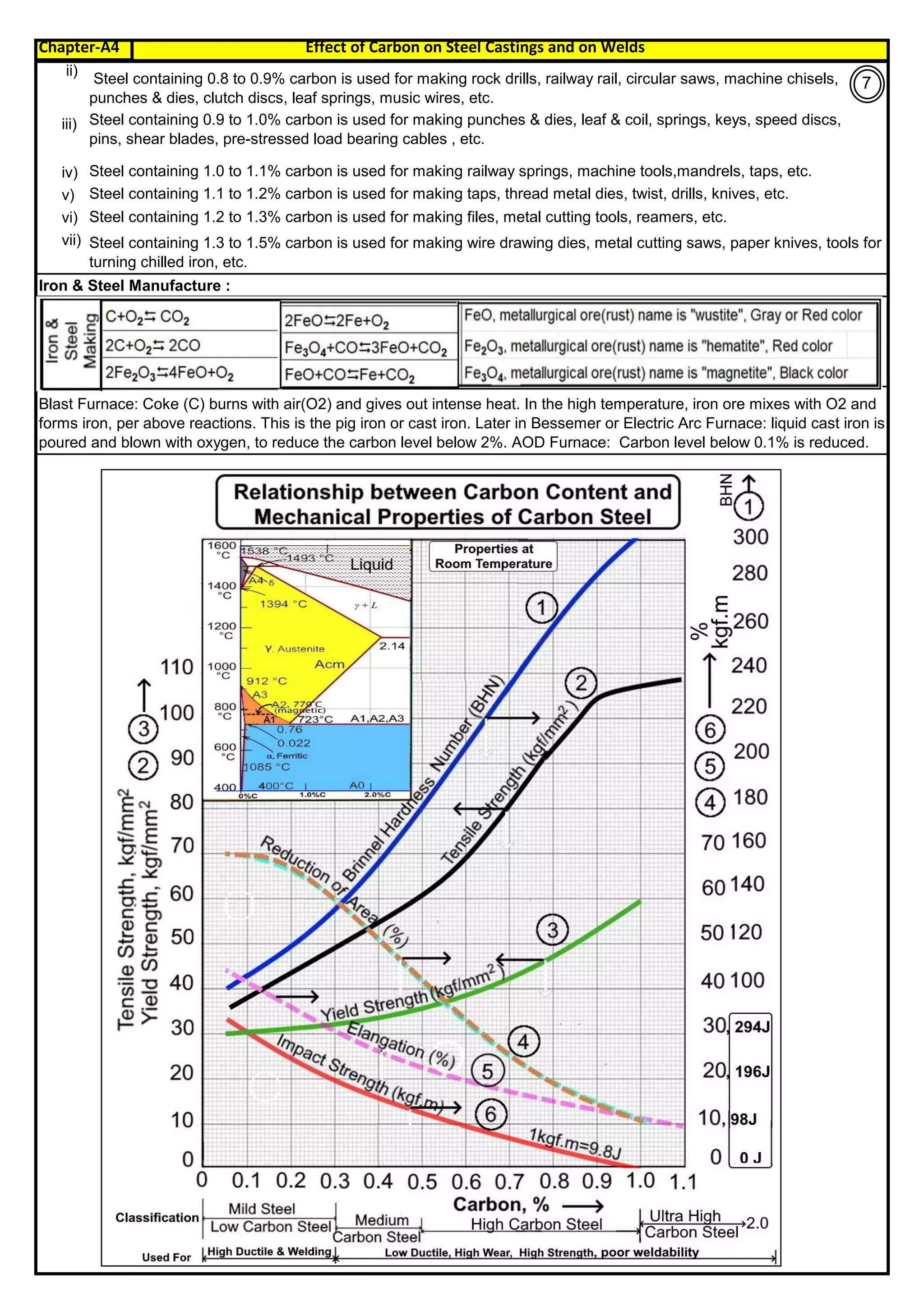
Iron & Steel Manufacture :
Blast Furnace: Coke (C) burns with air(O2) and gives out intense heat. In the high temperature, iron ore mixes with O2 and
forms iron, per above reactions. This is the pig iron or cast iron. Later in Bessemer or Electric Arc Furnace: liquid cast iron is
poured and blown with oxygen, to reduce the carbon level below 2%. AOD Furnace: Carbon level below 0.1% is reduced.
Steel containing 1.3 to 1.5% carbon is used for making wire drawing dies, metal cutting saws, paper knives, tools for
turning chilled iron, etc.
Steel containing 1.1 to 1.2% carbon is used for making taps, thread metal dies, twist, drills, knives, etc.
Steel containing 1.2 to 1.3% carbon is used for making files, metal cutting tools, reamers, etc.
Steel containing 0.8 to 0.9% carbon is used for making rock drills, railway rail, circular saws, machine chisels,
punches & dies, clutch discs, leaf springs, music wires, etc.
Steel containing 0.9 to 1.0% carbon is used for making punches & dies, leaf & coil, springs, keys, speed discs,
pins, shear blades, pre-stressed load bearing cables , etc.
Steel containing 1.0 to 1.1% carbon is used for making railway springs, machine tools,mandrels, taps, etc.
7
Chapter-A4 Effect of Carbon on Steel Castings and on Welds
By JGC Annamalai
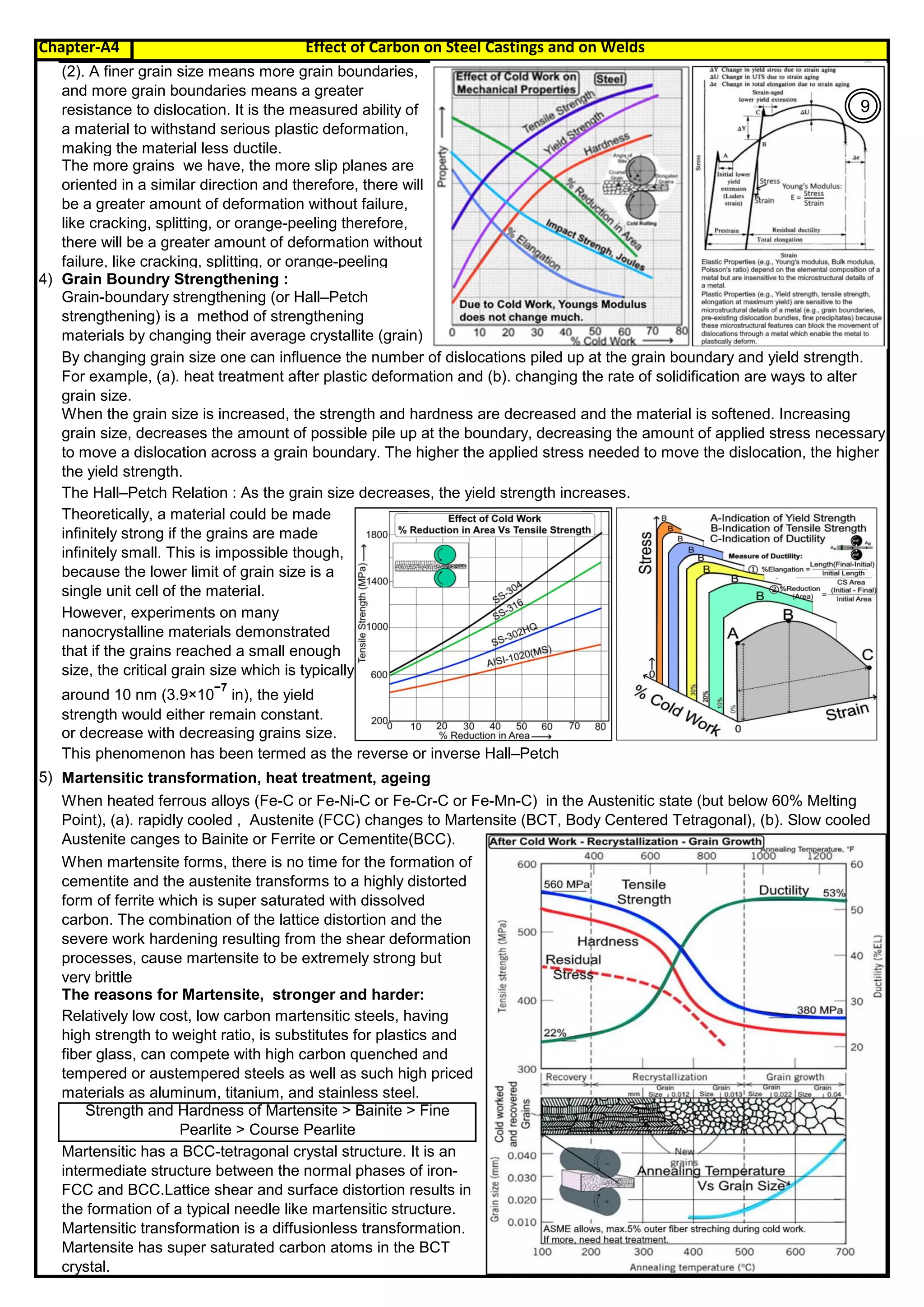
As we add carbon to steel, the following properties are changed:
Advantages: (1). Tensile , Yield Strength are increased, (2). Hardness is increased
Dis-advantages: (1). Ductility(%-Elongation& Area Reduction) is reduced, (2). Impact value reduced, (3). Difficult Welding.
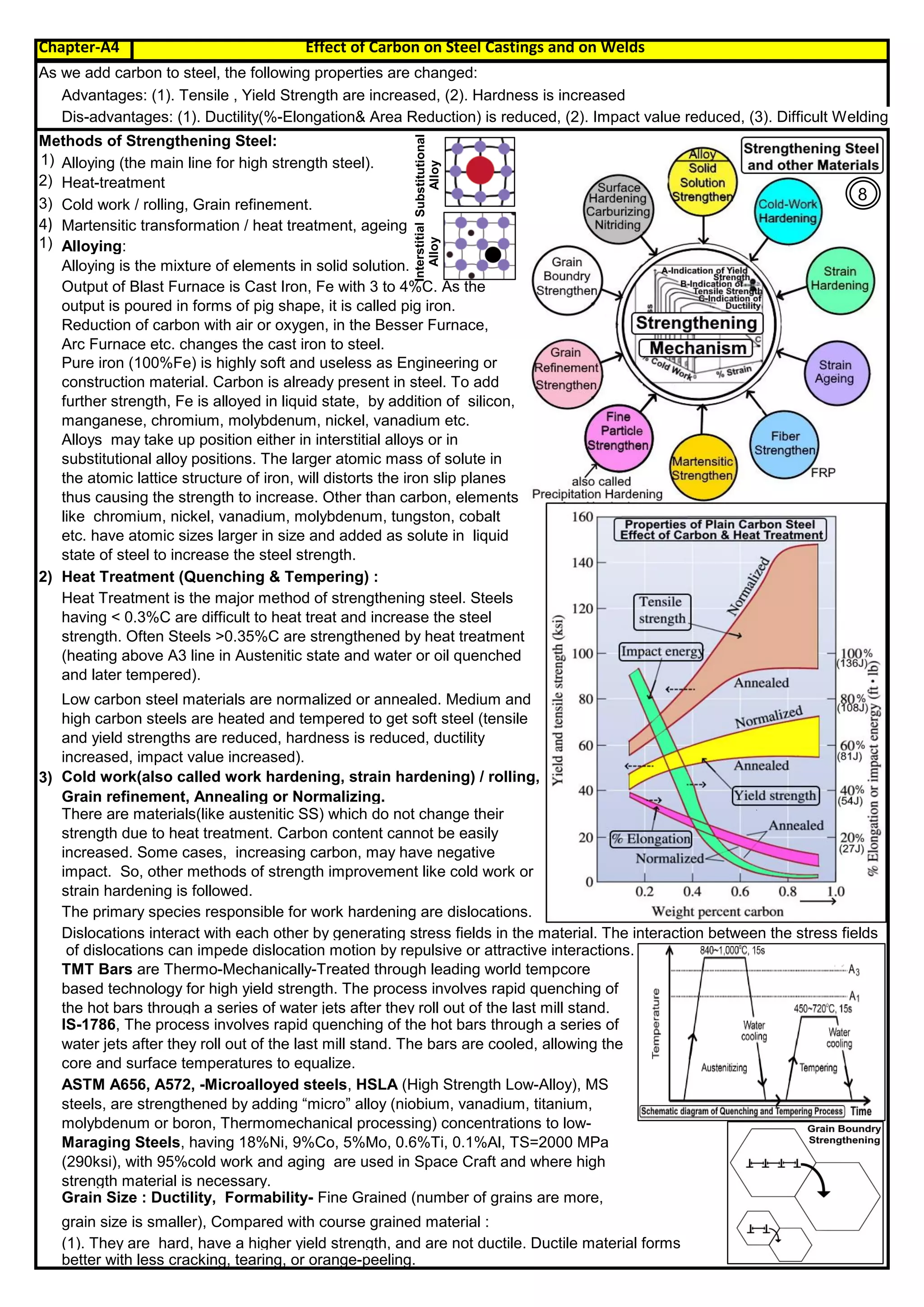
Methods of Strengthening Steel:
1) Alloying (the main line for high strength steel).
2) Heat-treatment
3) Cold work / rolling, Grain refinement.
4) Martensitic transformation / heat treatment, ageing
1)
Alloying is the mixture of elements in solid solution.
2) Heat Treatment (Quenching & Tempering) :
3)
Grain Size : Ductility, Formability- Fine Grained (number of grains are more,
grain size is smaller), Compared with course grained material :
ASTM A656, A572, -Microalloyed steels, HSLA (High Strength Low-Alloy), MS
steels, are strengthened by adding “micro” alloy (niobium, vanadium, titanium,
molybdenum or boron, Thermomechanical processing) concentrations to low-
Pure iron (100%Fe) is highly soft and useless as Engineering or
construction material. Carbon is already present in steel. To add
further strength, Fe is alloyed in liquid state, by addition of silicon,
manganese, chromium, molybdenum, nickel, vanadium etc.
Alloys may take up position either in interstitial alloys or in
substitutional alloy positions. The larger atomic mass of solute in
the atomic lattice structure of iron, will distorts the iron slip planes
thus causing the strength to increase. Other than carbon, elements
like chromium, nickel, vanadium, molybdenum, tungston, cobalt
etc. have atomic sizes larger in size and added as solute in liquid
state of steel to increase the steel strength.
Alloying:
TMT Bars are Thermo-Mechanically-Treated through leading world tempcore
based technology for high yield strength. The process involves rapid quenching of
the hot bars through a series of water jets after they roll out of the last mill stand.
(1). They are hard, have a higher yield strength, and are not ductile. Ductile material forms
better with less cracking, tearing, or orange-peeling.
Heat Treatment is the major method of strengthening steel. Steels
having < 0.3%C are difficult to heat treat and increase the steel
strength. Often Steels >0.35%C are strengthened by heat treatment
(heating above A3 line in Austenitic state and water or oil quenched
and later tempered).
IS-1786, The process involves rapid quenching of the hot bars through a series of
water jets after they roll out of the last mill stand. The bars are cooled, allowing the
core and surface temperatures to equalize.
Maraging Steels, having 18%Ni, 9%Co, 5%Mo, 0.6%Ti, 0.1%Al, TS=2000 MPa
(290ksi), with 95%cold work and aging are used in Space Craft and where high
strength material is necessary.
There are materials(like austenitic SS) which do not change their
strength due to heat treatment. Carbon content cannot be easily
increased. Some cases, increasing carbon, may have negative
impact. So, other methods of strength improvement like cold work or
strain hardening is followed.
of dislocations can impede dislocation motion by repulsive or attractive interactions.
Output of Blast Furnace is Cast Iron, Fe with 3 to 4%C. As the
output is poured in forms of pig shape, it is called pig iron.
Reduction of carbon with air or oxygen, in the Besser Furnace,
Arc Furnace etc. changes the cast iron to steel.
The primary species responsible for work hardening are dislocations.
Dislocations interact with each other by generating stress fields
Dislocations interact with each other by generating stress fields in the material. The interaction between the stress fields
Low carbon steel materials are normalized or annealed. Medium and
high carbon steels are heated and tempered to get soft steel (tensile
and yield strengths are reduced, hardness is reduced, ductility
increased, impact value increased).
Cold work(also called work hardening, strain hardening) / rolling,
Grain refinement, Annealing or Normalizing.
Interstitial
Alloy
Substitutional
Alloy
8
Chapter-A4 Effect of Carbon on Steel Castings and on Welds
By JGC Annamalai
4) Grain Boundry Strengthening :
5) Martensitic transformation, heat treatment, ageing
Grain-boundary strengthening (or Hall–Petch
strengthening) is a method of strengthening
materials by changing their average crystallite (grain)
The reasons for Martensite, stronger and harder:
This phenomenon has been termed as the reverse or inverse Hall–Petch
relation.
When martensite forms, there is no time for the formation of
cementite and the austenite transforms to a highly distorted
form of ferrite which is super saturated with dissolved
carbon. The combination of the lattice distortion and the
severe work hardening resulting from the shear deformation
processes, cause martensite to be extremely strong but
very brittle
or decrease with decreasing grains size.
When heated ferrous alloys (Fe-C or Fe-Ni-C or Fe-Cr-C or Fe-Mn-C) in the Austenitic state (but below 60% Melting
Point), (a). rapidly cooled , Austenite (FCC) changes to Martensite (BCT, Body Centered Tetragonal), (b). Slow cooled
Austenite canges to Bainite or Ferrite or Cementite(BCC).
Theoretically, a material could be made
infinitely strong if the grains are made
infinitely small. This is impossible though,
because the lower limit of grain size is a
single unit cell of the material.
However, experiments on many
nanocrystalline materials demonstrated
that if the grains reached a small enough
size, the critical grain size which is typically
around 10 nm (3.9×10
−7
in), the yield
strength would either remain constant.
Relatively low cost, low carbon martensitic steels, having
high strength to weight ratio, is substitutes for plastics and
fiber glass, can compete with high carbon quenched and
tempered or austempered steels as well as such high priced
materials as aluminum, titanium, and stainless steel.
Strength and Hardness of Martensite > Bainite > Fine
Pearlite > Course Pearlite
Martensitic has a BCC-tetragonal crystal structure. It is an
intermediate structure between the normal phases of iron-
FCC and BCC.Lattice shear and surface distortion results in
the formation of a typical needle like martensitic structure.
Martensitic transformation is a diffusionless transformation.
Martensite has super saturated carbon atoms in the BCT
crystal.
By changing grain size one can influence the number of dislocations piled up at the grain boundary and yield strength.
For example, (a). heat treatment after plastic deformation and (b). changing the rate of solidification are ways to alter
grain size.
When the grain size is increased, the strength and hardness are decreased and the material is softened. Increasing
grain size, decreases the amount of possible pile up at the boundary, decreasing the amount of applied stress necessary
to move a dislocation across a grain boundary. The higher the applied stress needed to move the dislocation, the higher
the yield strength.
The Hall–Petch Relation : As the grain size decreases, the yield strength increases.
(2). A finer grain size means more grain boundaries,
and more grain boundaries means a greater
resistance to dislocation. It is the measured ability of
a material to withstand serious plastic deformation,
making the material less ductile.
The more grains we have, the more slip planes are
oriented in a similar direction and therefore, there will
be a greater amount of deformation without failure,
like cracking, splitting, or orange-peeling therefore,
there will be a greater amount of deformation without
failure, like cracking, splitting, or orange-peeling
9
Chapter-A4 Effect of Carbon on Steel Castings and on Welds
By JGC Annamalai
0.05 Dead mild Steel
0.084-0.15 Mild Steel
0.15 Mild Steel
0.10-0.30 Mild Steel
0.254-0.40 Medium carbon Steel
0.30-0.45 Medium carbon
0.40-0.50 Medium carbon
0.554-0.65 High carbon Steel
0.654-0.75 High carbon Steel
0.75-0.85 High carbon Steel
0.854-0.95 High carbon Steel
0.95-1.10 High carbon Steel Knives, axes, screwing taps and dies, milling cutters
Punches, shear blades, high tensile wire
Chisels, die blocks for forging
Hammers, saws, cylinder liners
Forging dies, springs, railway rails
%Carbon Name
Sheet, strip, wire, rod, nails, screws, reinforcing bars
Sheet, strip, car bodies, tinplate, wire, rod, tubes
Shafts, gears, forgings, castings, springs
High tensile tube, shafts
Bright drawn bar
Steel plate, tube, pipe, structural steel sections for welding
Case carburizing type
Applications
ASTM grain size number(n) is
related with, the number of
grains(N) that we can count, in
one sq.inch, in 100X
magnification by the relation,
N=2
(n-1)
. So ASTM grain size
number increases with
decreasing grain size.
Plain carbon steels are broadly classified as:
Low carbon or mild steel (0.05-0.3%C), with high ductility and ease of forming;
Medium carbon steel (0.3-0.6%C), in which heat treatment can double the strength and hardness but retain good ductility;
High carbon steel (> 0.6%C), which has great hardness and high strength and is used for tools, dies, springs, etc.
10
Chapter-A5
1)
2)
3)
4)
Effect of Manganese, as an Alloying
Element :
Manganese is a hard, brittle, silvery white metal derived from the Latin word 'magnes', meaning magnet. Originally
discovered in 1774, manganese is the fifth most abundant metal present on the Earth’s crust. Pre-historic cave painters of
the French’s Lascaux region used this metal in the form of manganese dioxide or black ore pyrolusite, 30,000 years ago.
Effects of Alloying Elements, in Iron & Steel
Manganese in the form of Fe-Mn or Si-Mn is consumed in bulk form primarily in the production of steel, which is intentionally
present in nearly all steels, is used as a steel desulphurizer(Mn has more affinity with S and forms MnS, a low melting point-
low density slag) and as deoxidizer(Mn has more affinity to oxygen and forms MnO, a low melting point, low density slag).
Mn improves the tensile strength, workability, toughness, hardness and resistance to abrasion. By removing S from steel,
Mn prevents the steel from becoming brittle during the hot rolling process.
Manganese is used in Iron & Steel Industry as (1). Deoxidizer(oxygen killer), as (2). Desulphurizer, and as (3). Hardening
(Strengthening) element. Manganese is used also as an alloy with metals such as aluminum and copper.
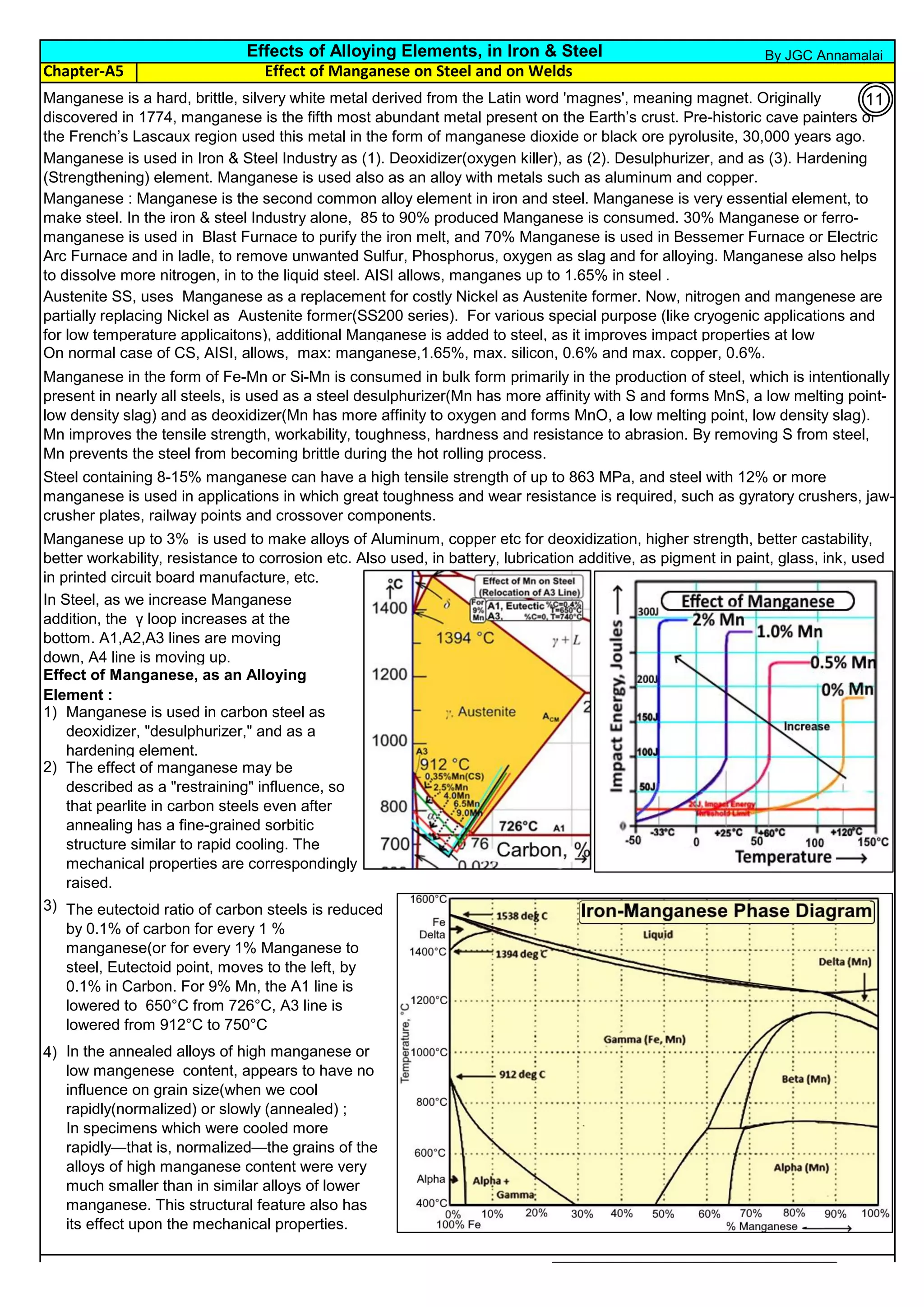
In Steel, as we increase Manganese
addition, the γ loop increases at the
bottom. A1,A2,A3 lines are moving
down, A4 line is moving up.
Steel containing 8-15% manganese can have a high tensile strength of up to 863 MPa, and steel with 12% or more
manganese is used in applications in which great toughness and wear resistance is required, such as gyratory crushers, jaw-
crusher plates, railway points and crossover components.
Manganese up to 3% is used to make alloys of Aluminum, copper etc for deoxidization, higher strength, better castability,
better workability, resistance to corrosion etc. Also used, in battery, lubrication additive, as pigment in paint, glass, ink, used
in printed circuit board manufacture, etc.
Manganese : Manganese is the second common alloy element in iron and steel. Manganese is very essential element, to
make steel. In the iron & steel Industry alone, 85 to 90% produced Manganese is consumed. 30% Manganese or ferro-
manganese is used in Blast Furnace to purify the iron melt, and 70% Manganese is used in Bessemer Furnace or Electric
Arc Furnace and in ladle, to remove unwanted Sulfur, Phosphorus, oxygen as slag and for alloying. Manganese also helps
to dissolve more nitrogen, in to the liquid steel. AISI allows, manganes up to 1.65% in steel .
Austenite SS, uses Manganese as a replacement for costly Nickel as Austenite former. Now, nitrogen and mangenese are
partially replacing Nickel as Austenite former(SS200 series). For various special purpose (like cryogenic applications and
for low temperature applicaitons), additional Manganese is added to steel, as it improves impact properties at low
On normal case of CS, AISI, allows, max: manganese,1.65%, max. silicon, 0.6% and max. copper, 0.6%.
Effect of Manganese on Steel and on Welds
In the annealed alloys of high manganese or
low mangenese content, appears to have no
influence on grain size(when we cool
rapidly(normalized) or slowly (annealed) ;
In specimens which were cooled more
rapidly—that is, normalized—the grains of the
alloys of high manganese content were very
much smaller than in similar alloys of lower
manganese. This structural feature also has
its effect upon the mechanical properties.
Manganese is used in carbon steel as
deoxidizer, "desulphurizer," and as a
hardening element.
The effect of manganese may be
described as a "restraining" influence, so
that pearlite in carbon steels even after
annealing has a fine-grained sorbitic
structure similar to rapid cooling. The
mechanical properties are correspondingly
raised.
The eutectoid ratio of carbon steels is reduced
by 0.1% of carbon for every 1 %
manganese(or for every 1% Manganese to
steel, Eutectoid point, moves to the left, by
0.1% in Carbon. For 9% Mn, the A1 line is
lowered to 650°C from 726°C, A3 line is
lowered from 912°C to 750°C
By JGC Annamalai
11
Chapter-A5 Effect of Manganese on Steel and on Welds
By JGC Annamalai
Effect of Manganese, as an Alloying Element :
1)
2)
3)
4)
5)
6)
7)
8)
9).
10)
<0.4% Mn in steel, is used to de-sulfurize the steel and reduce hot-shortness.
Manganese is one of the least expensive of alloying elements and is always present as a deoxidizer and to reduce hot
shortness.
>0.8% Mn, in steel, when the manganese content exceeds 0.80%, it acts as an alloying element to increase the strength
and hardness in high carbon steels. Fine-grained manganese steels have excellent toughness and strength.
>10% Mn in steel, remain austenitic after cooling and are known as Hadfield manganese steel. After heat treatment, this
steel has excellent toughness and wear resistance as well as high strength and ductility. Work hardening occurs as the
austenite is strain hardened to martensite
(a). For welding purposes, the ratio of manganese to sulphur should be at least 10 to 1. Manganese content of less than
0.30% may promote internal porosity and cracking in the weld bead. Cracking can also result if the content is over 0.80%.
Steel with low Manganese Sulphide ratio may contain sulphur in the form of iron Sulphide (FeS), which can cause cracking
(a “hot-short” condition) in the weld.
(b). As a sulphide former, Manganese prefers to combine with S and forms manganese sulfide, avoiding the formation of
iron sulphides and starts floating at liquid state. Iron sulphides are the low melting point phases that become liquid at hot
rolling temperatures and which, consequently, generate surface cracking.
(c). Manganese can form manganese sulfide (MnS) with sulfur and helps the machining, and simultaneously prevents the
brittleness from sulfur, making it useful for the surface finish of carbon steel.
(d). Addition of Manganese to steel, will move the Eutectic point close to the Y-axis(0% Carbon) and lower the Eutectic
Temperature , say, average, carbon- 0.12%C and Eutectic temperature 9°C is reduced for every 1% manganese addition.
This will help Forging Vendors and Heat Treaters, to reach the Austenitising temperature for forging, heat treatment etc.
faster and at more economical way. 9% manganese addition, lowers the Eutectic point to Carbon=0.4% and
temperature=650°C, from normal 0.8%C and 726°C. A3 point is moved to 740°C from 912°C.
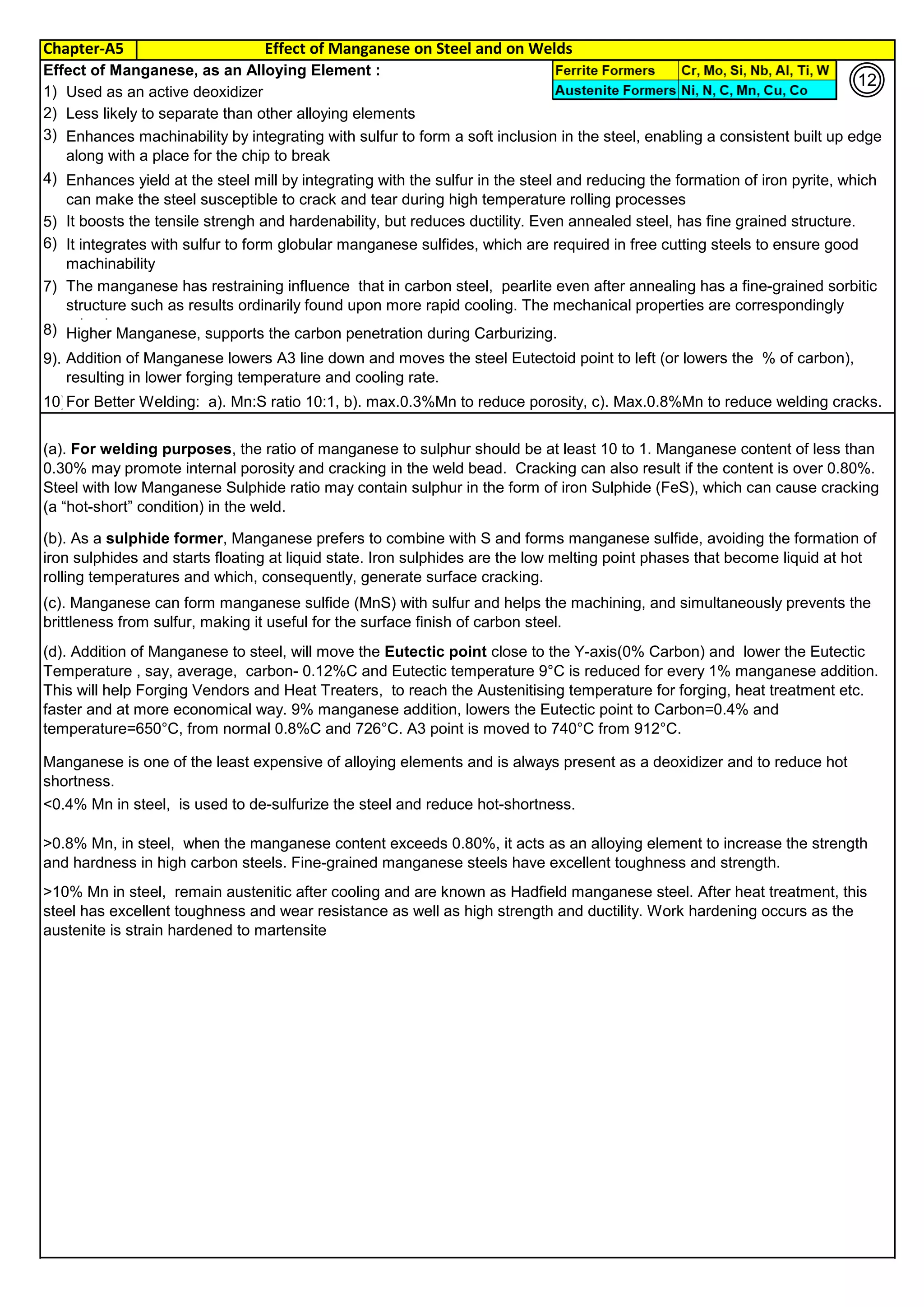
For Better Welding: a). Mn:S ratio 10:1, b). max.0.3%Mn to reduce porosity, c). Max.0.8%Mn to reduce welding cracks.
Used as an active deoxidizer
Less likely to separate than other alloying elements
Enhances machinability by integrating with sulfur to form a soft inclusion in the steel, enabling a consistent built up edge
along with a place for the chip to break
Enhances yield at the steel mill by integrating with the sulfur in the steel and reducing the formation of iron pyrite, which
can make the steel susceptible to crack and tear during high temperature rolling processes
It boosts the tensile strengh and hardenability, but reduces ductility. Even annealed steel, has fine grained structure.
It integrates with sulfur to form globular manganese sulfides, which are required in free cutting steels to ensure good
machinability
The manganese has restraining influence that in carbon steel, pearlite even after annealing has a fine-grained sorbitic
structure such as results ordinarily found upon more rapid cooling. The mechanical properties are correspondingly
raised.
Higher Manganese, supports the carbon penetration during Carburizing.
Addition of Manganese lowers A3 line down and moves the steel Eutectoid point to left (or lowers the % of carbon),
resulting in lower forging temperature and cooling rate.
12
Chapter-A6
Galvanizing : Elements like, carbon in excess of about 0.25 %, phosphorus in excess of 0.04 %, or manganese in excess
of about 1.3 % in steel will cause unacceptable coatings with a mottled or dull gray appearance. Steels with silicon in the
range 0.04 % to 0.15 % or above 0.22 % is said to have excess galvanizing growth effect. Highly cold worked objects are
said to have high residual stresses and aging. These steels will have embrittlement on galvanizing.
Effects of Alloying Elements, in Iron & Steel,
Though Silicon is abundant on the Earth Crest(about 90% is silicon salts), it is seldom found as elemental Silicon. Silicon
has high offinity to oxygen and forms SiO2 immediately (normal sand). Among the common deoxidizers, like carbon,
manganese, aluminum, silicon find first place. Silicon in the form of Ferro-silicon, Silico-Manganese are used as
deoxidizer(also called oxygen killer, oxidizer) in the steel industry and as easy-flow aiding agent in liquid metals in
Foundries. Silicon, along with Manganese is used in Steel Industry as (1). Deoxidizer(oxygen killer), as (2). Desulphurizer,
and as (3). Hardening (alloying) element. Large number of silicates are found in the Cement and in refractories. On plain-
carbon steels, max.0.6% silicon is allowed. Foundries, may use up to 1.5%Si. Solidum silicate or Silicate oil is used as
binder in sand molds in the foundries and in electrode flux coating.
Silicon is not welcome in iron and steel in some grades, like steel used for galvanizing purpose. Silicon and zinc forms Fe-Si
alloy compound and often silicon over 0.4% in galvanized iron and steel, causes the surface darker and may need
additional zinc deposit to zinc to compensate silicon and to shine white.
After the invention of semi-conductors and use of Silicon in semi-conductors, chips, solar panels, electronic and
instrumentation and in computers etc from 1960, the use of pure silicon has incresed, many folds.
Silicon steel or electrical steel (Si up to 6%) is used in electrical motor and transformer coil laminations. They have lower
hysterisis and eddy current losses.
Hot Work : Similar to Mn, silicon also gives higher strength and hardness. However, larger percentage of Silicon, leads to
cracking during rolling and other hot works and Silicon over 0.04% should be avoided. Foundries(where Hot Forming work
is not involved, like, valves, pumps etc castings), may use up to 1.5% Si, to have better liquid metal flow inside mold voids.
Effect of Silicon on Steel and on Welds
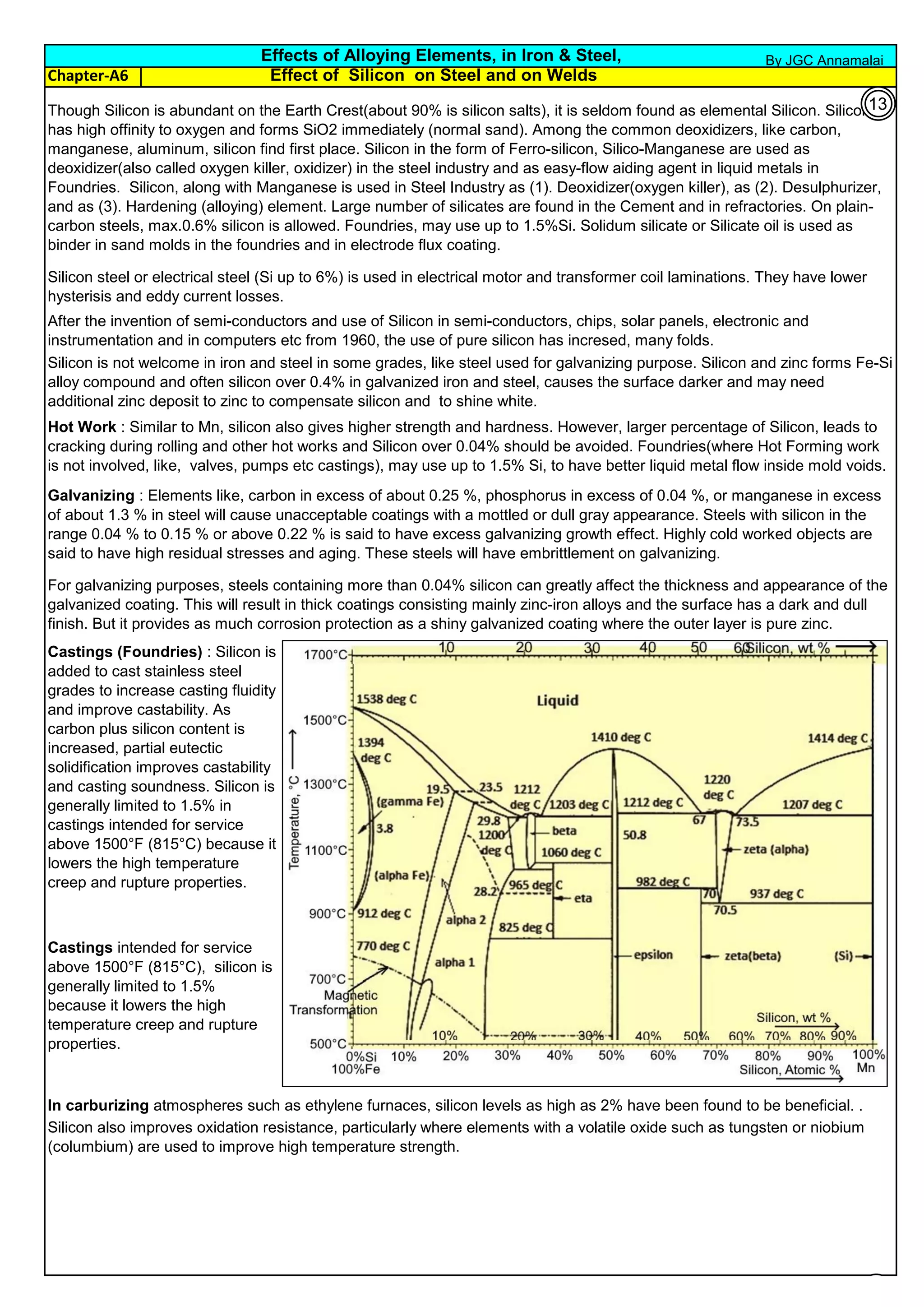
Castings (Foundries) : Silicon is
added to cast stainless steel
grades to increase casting fluidity
and improve castability. As
carbon plus silicon content is
increased, partial eutectic
solidification improves castability
and casting soundness. Silicon is
generally limited to 1.5% in
castings intended for service
above 1500°F (815°C) because it
lowers the high temperature
creep and rupture properties.
Castings intended for service
above 1500°F (815°C), silicon is
generally limited to 1.5%
because it lowers the high
temperature creep and rupture
properties.
In carburizing atmospheres such as ethylene furnaces, silicon levels as high as 2% have been found to be beneficial. .
Silicon also improves oxidation resistance, particularly where elements with a volatile oxide such as tungsten or niobium
(columbium) are used to improve high temperature strength.
For galvanizing purposes, steels containing more than 0.04% silicon can greatly affect the thickness and appearance of the
galvanized coating. This will result in thick coatings consisting mainly zinc-iron alloys and the surface has a dark and dull
finish. But it provides as much corrosion protection as a shiny galvanized coating where the outer layer is pure zinc.
By JGC Annamalai
13
Chapter-A6 Effect of Silicon on Steel and on Welds
By JGC Annamalai
Lamination sheets for Transformers, motors etc : Electrical Steel :
Ill Effects of Silicon :
For galvanizing purposes, steels containing more than 0.04% silicon can greatly affect the thickness and appearance of
the galvanized coating. This will result in thick coatings consisting mainly zinc-iron alloys and the surface has a dark and dull
finish. But it provides as much corrosion protection as a shiny galvanized coating where the outer layer is pure zinc.
Silicon increases the electrical resistivity of iron by a factor of about 5; this change decreases the induced eddy currents and
narrows the hysteresis loop of the material, thus lowering the core loss by about three times compared to conventional
steel.Electrical steel is an iron alloy which may have from zero to 6.5% silicon (Si:5Fe). Commercial alloys usually have
silicon content up to 3.2% (higher concentrations result in brittleness during cold rolling). Manganese and aluminum can be
added up to 0.5%.
Electrical steel (lamination steel, silicon electrical steel, silicon steel, relay steel, transformer steel) is an iron alloy tailored to
produce specific magnetic properties: small hysteresis area resulting in low power loss per cycle, low core loss, and high
permeability.
Electrical steel is usually manufactured in cold-rolled strips less than 2 mm thick. These strips are cut to shape to make
laminations which are stacked together to form the laminated cores of transformers, and the stator and rotor of electric
motors. Laminations may be cut to their finished shape by a punch and die or, in smaller quantities, may be cut by a laser,
or by wire
In welding, silicon is detrimental to surface quality, especially in the low carbon, resulphurized grades. It aggravates
cracking tendencies when the carbon content is fairly high. For best welding condition, silicon content should not exceed
0.10%. However, amounts up to 0.30% are not as serious as high sulphur or phosphorus content
14
Chapter-A7
Impurities, Phosphorus :
Alloying Element : Chromium :
Alloying Element : Nickel :
Effects of Alloying Elements, in Iron & Steel
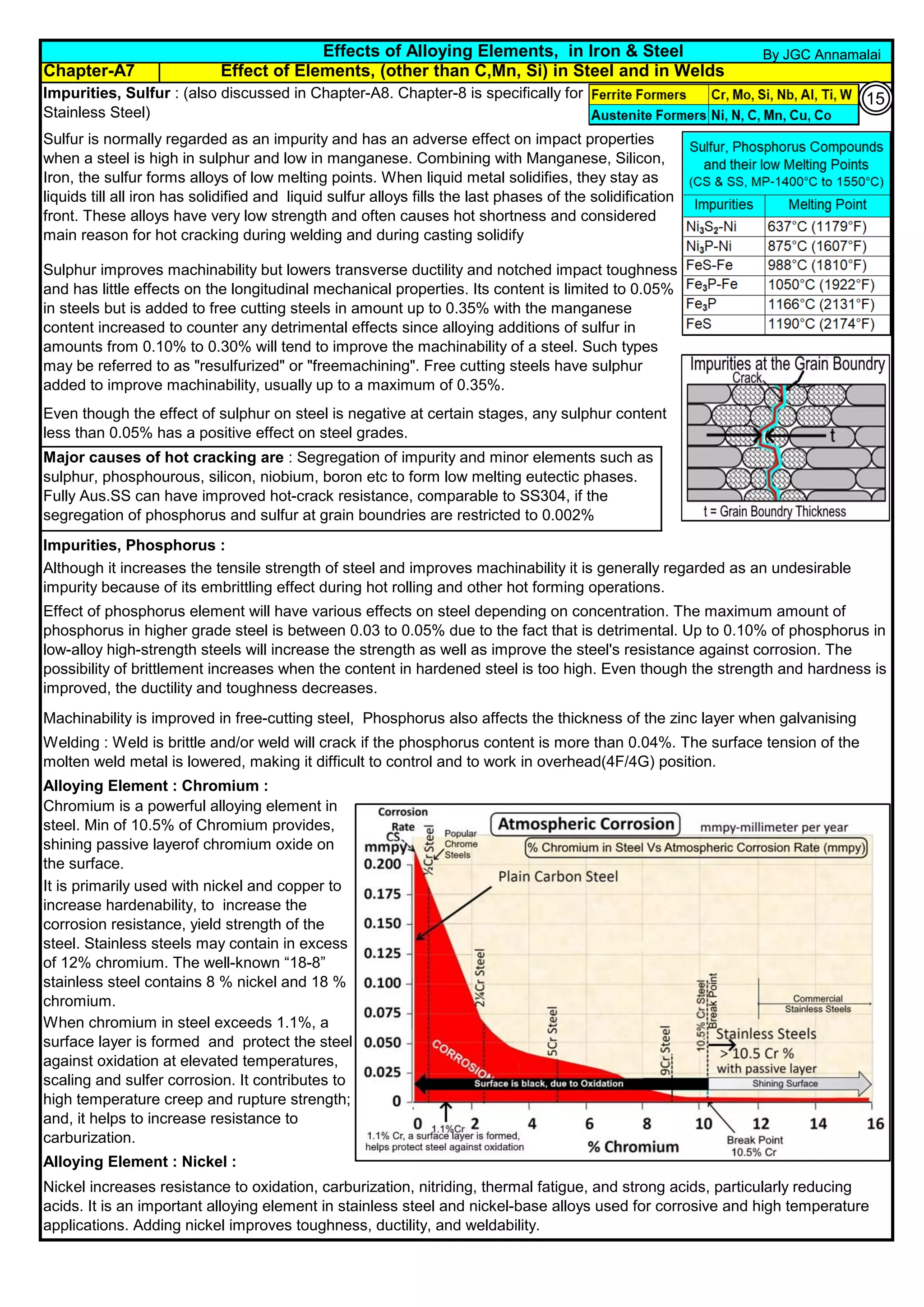
When chromium in steel exceeds 1.1%, a
surface layer is formed and protect the steel
against oxidation at elevated temperatures,
scaling and sulfer corrosion. It contributes to
high temperature creep and rupture strength;
and, it helps to increase resistance to
carburization.
Nickel increases resistance to oxidation, carburization, nitriding, thermal fatigue, and strong acids, particularly reducing
acids. It is an important alloying element in stainless steel and nickel-base alloys used for corrosive and high temperature
applications. Adding nickel improves toughness, ductility, and weldability.
Effect of phosphorus element will have various effects on steel depending on concentration. The maximum amount of
phosphorus in higher grade steel is between 0.03 to 0.05% due to the fact that is detrimental. Up to 0.10% of phosphorus in
low-alloy high-strength steels will increase the strength as well as improve the steel's resistance against corrosion. The
possibility of brittlement increases when the content in hardened steel is too high. Even though the strength and hardness is
improved, the ductility and toughness decreases.
Machinability is improved in free-cutting steel, Phosphorus also affects the thickness of the zinc layer when galvanising
steel.
Welding : Weld is brittle and/or weld will crack if the phosphorus content is more than 0.04%. The surface tension of the
molten weld metal is lowered, making it difficult to control and to work in overhead(4F/4G) position.
Impurities, Sulfur : (also discussed in Chapter-A8. Chapter-8 is specifically for
Stainless Steel)
Chromium is a powerful alloying element in
steel. Min of 10.5% of Chromium provides,
shining passive layerof chromium oxide on
the surface.
Sulfur is normally regarded as an impurity and has an adverse effect on impact properties
when a steel is high in sulphur and low in manganese. Combining with Manganese, Silicon,
Iron, the sulfur forms alloys of low melting points. When liquid metal solidifies, they stay as
liquids till all iron has solidified and liquid sulfur alloys fills the last phases of the solidification
front. These alloys have very low strength and often causes hot shortness and considered
main reason for hot cracking during welding and during casting solidify
Sulphur improves machinability but lowers transverse ductility and notched impact toughness
and has little effects on the longitudinal mechanical properties. Its content is limited to 0.05%
in steels but is added to free cutting steels in amount up to 0.35% with the manganese
content increased to counter any detrimental effects since alloying additions of sulfur in
amounts from 0.10% to 0.30% will tend to improve the machinability of a steel. Such types
may be referred to as "resulfurized" or "freemachining". Free cutting steels have sulphur
added to improve machinability, usually up to a maximum of 0.35%.
Even though the effect of sulphur on steel is negative at certain stages, any sulphur content
less than 0.05% has a positive effect on steel grades.
Major causes of hot cracking are : Segregation of impurity and minor elements such as
sulphur, phosphourous, silicon, niobium, boron etc to form low melting eutectic phases.
Fully Aus.SS can have improved hot-crack resistance, comparable to SS304, if the
segregation of phosphorus and sulfur at grain boundries are restricted to 0.002%
Although it increases the tensile strength of steel and improves machinability it is generally regarded as an undesirable
impurity because of its embrittling effect during hot rolling and other hot forming operations.
It is primarily used with nickel and copper to
increase hardenability, to increase the
corrosion resistance, yield strength of the
steel. Stainless steels may contain in excess
of 12% chromium. The well-known “18-8”
stainless steel contains 8 % nickel and 18 %
chromium.
Effect of Elements, (other than C,Mn, Si) in Steel and in Welds
By JGC Annamalai
14
By JGC Annamalai
15
Chapter-A7 Effect of Elements, (other than C,Mn, Si) in Steel and in Welds
By JGC Annamalai
By JGC Annamalai
Alloying Element : Molybdenum :
Alloying Element : Vanadium :
Alloying Element : Tungsten :
Alloying Element : Cobolt :
Cobalt improves strength at high temperatures and magnetic permeability
Alloying Element : Nitrogen :
Alloying Element : Boron :
Alloying Element : Titanium :
Alloying Element : Niobium (Earlier name was Columbium)
Nickel is austenite former. Min.7% Chromium, makes the stainless steel as Austenitic Stainless Steel.
Nitrogen acts very similar to Carbon in the alloy. N substitutes C in small amounts (or even large, with modern technologies)
to increase hardness. Obviously, Nitrogen forms Nitrides, not Carbides. INFI has N, and there's few more, with Sandvik
being the champion, having 3% N in the alloy, completely substituting C. Sadly, not available for knife makers. Because
Nitrogen is less prone to form Chromium nitrides than Carbon is to form Chromium carbides, its presence improves
corrosion resistance, leaving more free Chromium in the alloy. Since Nitrogen is less reactive in forming Nitrides, it can be
used for added hardness without increasing carbide size and volume, e.g. Sandvik 14C28N steel.
It is used with chromium, vanadium, molybdenum, or manganese to produce high speed steel used in cutting tools.
Tungsten steel is said to be "red-hard" or hard enough to cut after it becomes red-hot.
SS321, uses, Titanium for chromium stabilizing.
The biggest advantage of boron is that a small amount can be added to get the same result as other elements required in
large amount in terms of added hardenability. Typical range in steel alloys is 0.0005 to 0.003%.
During the heat treatment process boron, a replacement for other elements, is added to increase the hardenability of
medium carbon steel. The cutting performance for high-speed steels is increased but at the expense of the forging quality. It
is also possible that the content of boron can be too high which decreases hardenability, toughness as well as cause
embrittlement. The percentage carbon present in the steel also plays a role in the hardenability effect of boron. As boron's
effect on hardenability increases, the amount of carbon should proportionally be decreased.
One more reason to add Nickel in alloy, is to create brighter portions in damascus steels. It increases Elastic modulus.
SS 200 series stainless steels, use nitrogen and manganese, to replace costly Nickel.
Ti is a very strong, very lightweight metal that can be used alone or alloyed with steels. It is added to steel to give them high
strength at high temperatures. Modern jet engines use titanium steels.
Nickel is often used in combination with other alloying elements, especially chromium and molybdenum. Stainless steels
contain between 8% and 14% nickel. Low temperature service steels contains nickel as nickel improves impact strength.
After heat treatment the steel maintains its hardness at high temperature making it particularly suitable for cutting tools.
Tungsten in the form of tungsten carbide, (1). Gives steel high hardness even at red heats, (2). Promotes fine grains, (3).
Resists heat, (4). Promote strength at elevated temperatures
Increases hardness, also allows for higher quenching temperatures (during the heat treatment procedure). Intensifies the
individual effects of other elements in more complex steels. Co is not a carbide former, however adding Cobalt to the alloy
allows for higher attainable hardness and higher red hot hardness.
Molybdenum has effects similar to manganese and vanadium, and is often used in combination with one or the other. This
element is a strong carbide former and is usually present in alloy steels in amounts less than 1%. It increases hardenability
and elevated temperature strength and also improves corrosion resistance as well as increased creep strength. It is added
to stainless steels to increase their resistance to corrosion and is also used in high speed tool steels.
The effects of Vanadium chemical element are similar to those of Mn, Mo, and Cb. When used with other alloying elements
it restricts grain growth, refines grain size, increases hardenability, fracture toughness, and resistance to shock loading.
Softening at high temperatures, fatigue stress and wear resistance are improved. At greater than 0.05% Vanadium, there
may be a tendency for the steel to become embrittled during thermal stress relief treatments.
Vanadium is used in nitriding, heat resisting, tool and spring steels together with other alloying elements.
When boron is added to steel, precaution must be taken to ensure that it does not react with oxygen or nitrogen as the
combination of boron with either one of the two, will make the boron useless.
Niobium is a key grain refining element, as well a strength-enhancing elements in steel production. Niobium is a strong
carbide former and forms very hard, very small, simple carbides. Improves ductility, hardness, wear and corrosion
resistance. Also, refines grain structure. Formerly known as Columbium. SS347, uses, niobium for chromium stabilizing.
The most important effect and the purpose of boron in steel is to drastically improve the hardenability.
Ti is used to control grain size growth, which improves toughness. Also transforms sulfide inclusions form elongated to
globular, improving strength and corrosion resistance as well as toughness and ductility
16
Chapter-A7 Effect of Elements, (other than C,Mn, Si) in Steel and in Welds
By JGC Annamalai
By JGC Annamalai
Effects of Common Alloying Elements in Steel:
Effects of alloying elements on steel (Properties Enhancement)
Boron (B) : Small amounts substantially increase hardenability. Boron-treated steels will usually contain 0.0005–0.003%
boron. Although boron is effective with low-carbon alloy steels, its effectiveness decreases with increasing carbon
content. Boron is not recommended for steels containing over 0.6% carbon.
Manganese (Mn) : Increases hardenability and is a carbide former (Mn3C) above a threshold value. In constructional
steel alloys, manganese substantially increases the critical cooling rate and therefore facilitates deep hardening.
Nickel (Ni) : Increases hardenability by decreasing the critical cooling rate necessary to produce hardening as a result of
quenching and affects austenite transformation by depressing Ac and Ar critical temperatures. Nickel does not form
carbide structures. When combined with chromium, nickel produces alloy steels with higher elastic ratios, greater
hardenability, higher impact strength, and fatigue resistance than is possible with carbon steels.
Vanadium (V) : Increases strength, hardness, and resistance to shock impact. It retards grain growth permitting higher
quenching temperatures. Vanadium also enhances the red hardness properties of high-speed metal cutting tools and
intensifies the individual effects of other major elements.
Cobalt (Co) : Increases strength and hardness and permits higher quenching temperatures. Cobalt also intensifies the
individual effects of other major elements in more complex steels. Most of the teeths of Earth-Movers has Cobalt Steel.
Aluminum (Al) : A deoxidizer and degasifier, which retards grain growth and is used to control austenitic grain structure.
In nitriding steels, aluminum aids in producing a uniformly hard and strong nitride base when used in amounts 1.00%-
1.25%.
Titanium Columbium or Niobium and Tantalum (Ti, Cb, or Nb, Ta) : All used as stabilizing elements in stainless
steels, each has a high affinity for carbon and forms carbides, which are uniformly dispersed throughout the steel. Thus,
localized depletion of carbon at grain boundaries is prevented.
Lead (Pb) : While not strictly an alloying element, lead is added to improve machining characteristics. It is almost
completely insoluble in steel. Minute lead particles, well dispersed, reduce friction where the cutting edge contacts the
work. The addition of lead also improves chip-breaking formations. Lead is found in Babbit and bearing steels.
Silicon (Si) : A deoxidizer and degasifier, which increases tensile and yield strength, hardness, forgeability, and
magnetic permeability. Motor, transformer core steel laminations have Silicon, up to 6%
Chromium (Cr) : Increases a material’s tensile strength, hardness, hardenability, and toughness. Chromium also
creates resistance to wear, abrasion, corrosion, and scaling at elevated temperatures. Addition of chromium, more than
10.5% to steels makes it Stainless Steels.
Nickel (Ni) : Stabilizes the austenitic structure enhancing mechanical properties and fabrication characteristics. Nickel
increases strength and hardness without sacrificing ductility and toughness. It also increases resistance to corrosion and
scaling at elevated temperatures when introduced in suitable quantities in high-chromium stainless steels. Addition of
min 6.6% Nickel to ferritic stainless steel makes it as Austenitic Stainless Steels.
Molybdenum (Mo) : Increases strength, hardness, hardenability, and toughness, as well as creep resistance and
strength at elevated temperatures. Molybdenum improves machinability, resistance to corrosion, and intensifies the
effects of other alloying elements. In hot-work steels, it increases red-hardness properties.
Tungsten (W) : Increases strength, hardness, and toughness. Tungsten steels have superior hot-working and greater
cutting efficiency at elevated temperatures. Most of the machine cutting tools, has Tungsten Steels
Sulfur (S) : Improves machinability in free-cutting steels, but without sufficient manganese it produces brittleness at red
heat. Sulfur can also decrease weldability, impact toughness, and ductility.
By definition, steel is a combination of iron and carbon. It is alloyed with various elements to improve physical properties and
to produce special properties, such as resistance to corrosion or heat. Specific effects of the addition of such elements are
outlined below:
Carbon (C) : Although carbon is not usually considered as an alloying element, it is the most important constituent of
steel. Carbon raises tensile strength, hardness, resistance to wear and abrasion; it conversely lowers ductility,
toughness, and machinability.
Manganese (Mn) : A deoxidizer and degasifier, which reacts with sulfur to improve forgeability. It increases tensile
strength, hardness, hardenability, and resistance to wear, while decreasing tendency toward soaling and distortion.
Manganese raises the rate of carbon-penetration in carburizing. Mn, Al, Si are used as oxygen killers in furnaces.
Phosphorus (P) : Increases strength and hardness and improves machinability, however, it adds marked brittleness or
cold-shortness to steel.
17
Chapter-A7 Effect of Elements, (other than C,Mn, Si) in Steel and in Welds
By JGC Annamalai
By JGC Annamalai
Vanadium (V) : Vanadium is a strong carbide-forming element. Increases hardenability and promotes finer grain size.
The presence of vanadium decreases high-temperature grain growth. Vanadium exhibits a secondary hardening effect
upon tempering and increases hardness at elevated temperatures.
Silicon (Si) : Silicon increases the critical temperature by amounts that vary with the carbon content; therefore required
austenitizing temperatures are increased. Silicon is not a carbide former. Provides relatively small increase in
hardenability and strengthens low-alloy steels but primarily used in low concentrations as a potent deoxidizer
Chromium (Cr) : Chromium is a strong carbide former, and in the presence of carbon and iron, chromium forms a
complex series of carbide structures. Complex chromium carbides dissolve in austenite slowly. Chromium greatly
increases hardenability and increases oxidation and corrosion resistance and increases the Ac3 critical temperature. If
sufficient austenitizing times are utilized, chromium provides a substantial improvement in the depth of hardening
because the critical cooling rate is decreased.
Molybdenum (Mo) : Molybdenum increases the Ac3 critical temperature in constructional steels at concentrations of
0.1–0.60% and depending on the molybdenum and carbon content, may form complex carbide structures. Increases
hardenability and is more potent than chromium but often used in combination with nickel and/or chromium. In solid
solution, molybdenum decreases transformation rates, and this increases the depth of hardening.
18
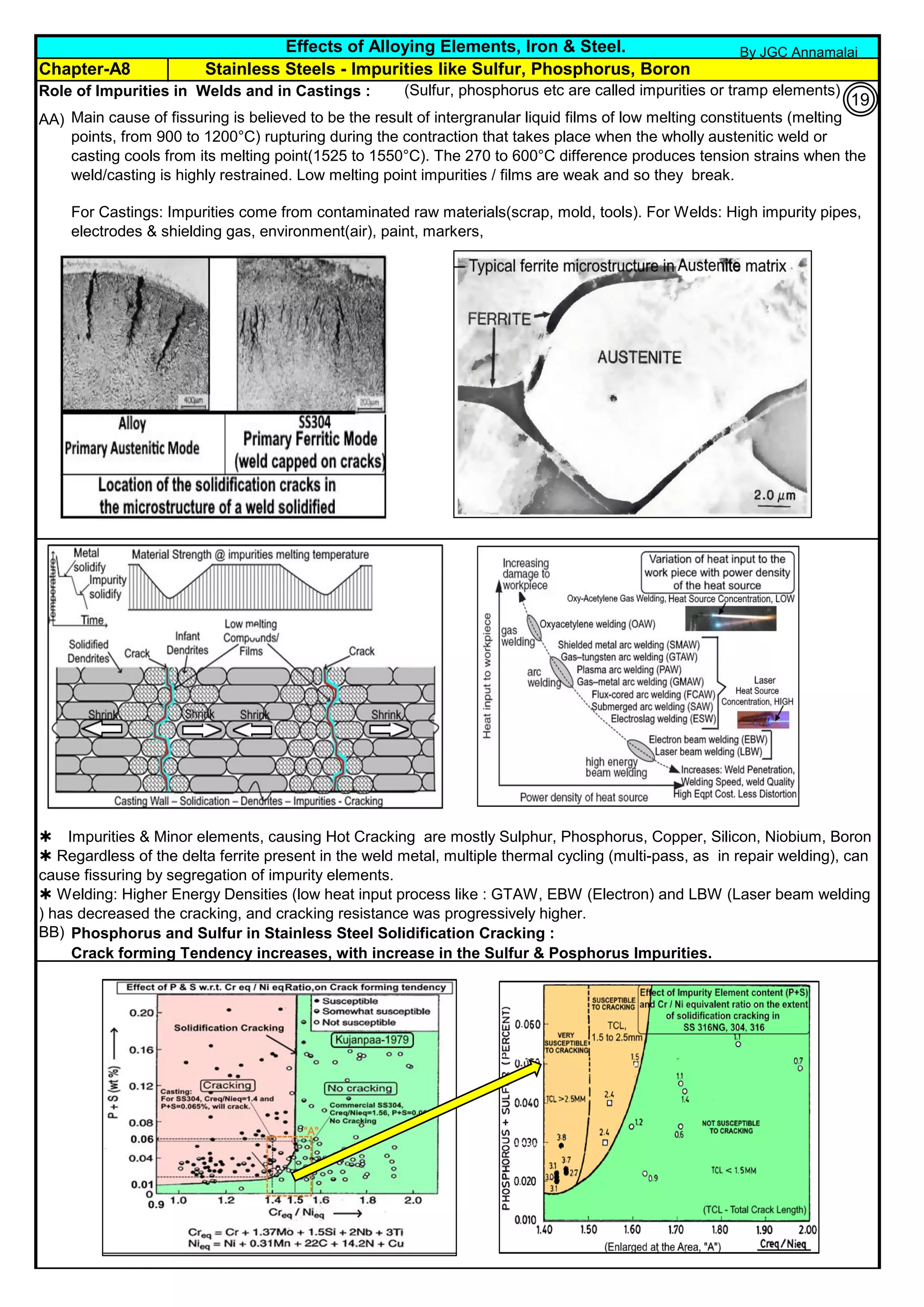
Role of Impurities in Welds and in Castings : (Sulfur, phosphorus etc are called impurities or tramp elements)
AA)
BB)
Impurities & Minor elements, causing Hot Cracking are mostly Sulphur, Phosphorus, Copper, Silicon, Niobium, Boron
 Regardless of the delta ferrite present in the weld metal, multiple thermal cycling (multi-pass, as in repair welding), can
cause fissuring by segregation of impurity elements.
 Welding: Higher Energy Densities (low heat input process like : GTAW, EBW (Electron) and LBW (Laser beam welding
) has decreased the cracking, and cracking resistance was progressively higher.
Phosphorus and Sulfur in Stainless Steel Solidification Cracking :
Crack forming Tendency increases, with increase in the Sulfur & Posphorus Impurities.
Main cause of fissuring is believed to be the result of intergranular liquid films of low melting constituents (melting
points, from 900 to 1200°C) rupturing during the contraction that takes place when the wholly austenitic weld or
casting cools from its melting point(1525 to 1550°C). The 270 to 600°C difference produces tension strains when the
weld/casting is highly restrained. Low melting point impurities / films are weak and so they break.
For Castings: Impurities come from contaminated raw materials(scrap, mold, tools). For Welds: High impurity pipes,
electrodes & shielding gas, environment(air), paint, markers,
Effects of Alloying Elements, Iron & Steel.
Chapter-A8 Stainless Steels - Impurities like Sulfur, Phosphorus, Boron
By JGC Annamalai
19
Chapter-A8 Stainless Steels - Impurities like Sulfur, Phosphorus, Boron
By JGC Annamalai
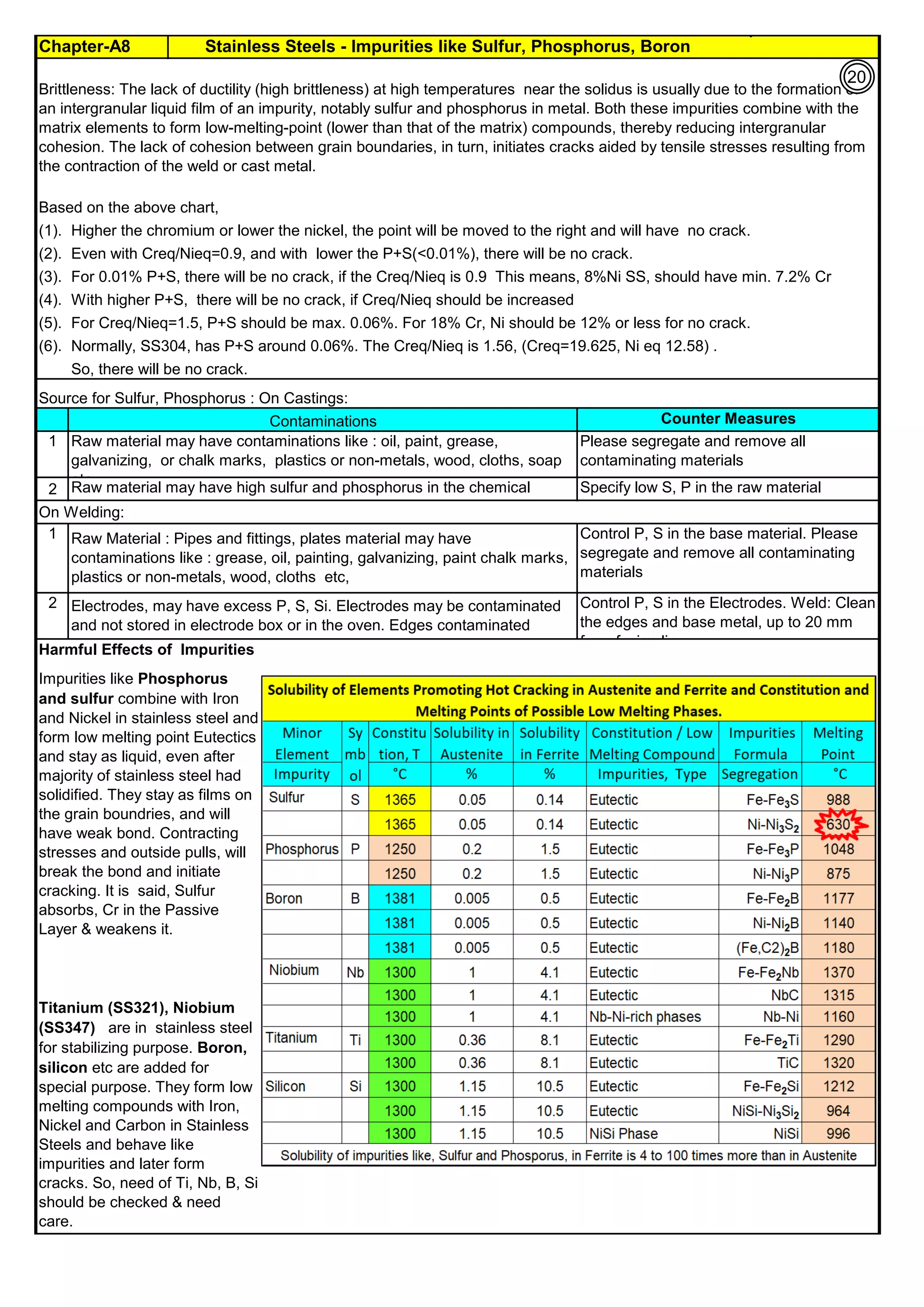
Based on the above chart,
(1). Higher the chromium or lower the nickel, the point will be moved to the right and will have no crack.
(2). Even with Creq/Nieq=0.9, and with lower the P+S(<0.01%), there will be no crack.
(3). For 0.01% P+S, there will be no crack, if the Creq/Nieq is 0.9 This means, 8%Ni SS, should have min. 7.2% Cr
(4). With higher P+S, there will be no crack, if Creq/Nieq should be increased
(5). For Creq/Nieq=1.5, P+S should be max. 0.06%. For 18% Cr, Ni should be 12% or less for no crack.
(6). Normally, SS304, has P+S around 0.06%. The Creq/Nieq is 1.56, (Creq=19.625, Ni eq 12.58) .
So, there will be no crack.
Source for Sulfur, Phosphorus : On Castings:
2
On Welding:
1
Harmful Effects of Impurities
Raw Material : Pipes and fittings, plates material may have
contaminations like : grease, oil, painting, galvanizing, paint chalk marks,
plastics or non-metals, wood, cloths etc,
Control P, S in the base material. Please
segregate and remove all contaminating
materials
Impurities like Phosphorus
and sulfur combine with Iron
and Nickel in stainless steel and
form low melting point Eutectics
and stay as liquid, even after
majority of stainless steel had
solidified. They stay as films on
the grain boundries, and will
have weak bond. Contracting
stresses and outside pulls, will
break the bond and initiate
cracking. It is said, Sulfur
absorbs, Cr in the Passive
Layer & weakens it.
Titanium (SS321), Niobium
(SS347) are in stainless steel
for stabilizing purpose. Boron,
silicon etc are added for
special purpose. They form low
melting compounds with Iron,
Nickel and Carbon in Stainless
Steels and behave like
impurities and later form
cracks. So, need of Ti, Nb, B, Si
should be checked & need
care.
2 Electrodes, may have excess P, S, Si. Electrodes may be contaminated
and not stored in electrode box or in the oven. Edges contaminated
Control P, S in the Electrodes. Weld: Clean
the edges and base metal, up to 20 mm
from fusion line
1 Raw material may have contaminations like : oil, paint, grease,
galvanizing, or chalk marks, plastics or non-metals, wood, cloths, soap
etc,
Please segregate and remove all
contaminating materials
Raw material may have high sulfur and phosphorus in the chemical
analysis
Specify low S, P in the raw material
Contaminations Counter Measures
Brittleness: The lack of ductility (high brittleness) at high temperatures near the solidus is usually due to the formation of
an intergranular liquid film of an impurity, notably sulfur and phosphorus in metal. Both these impurities combine with the
matrix elements to form low-melting-point (lower than that of the matrix) compounds, thereby reducing intergranular
cohesion. The lack of cohesion between grain boundaries, in turn, initiates cracks aided by tensile stresses resulting from
the contraction of the weld or cast metal.
20
Chapter-A8 Stainless Steels - Impurities like Sulfur, Phosphorus, Boron
By JGC Annamalai
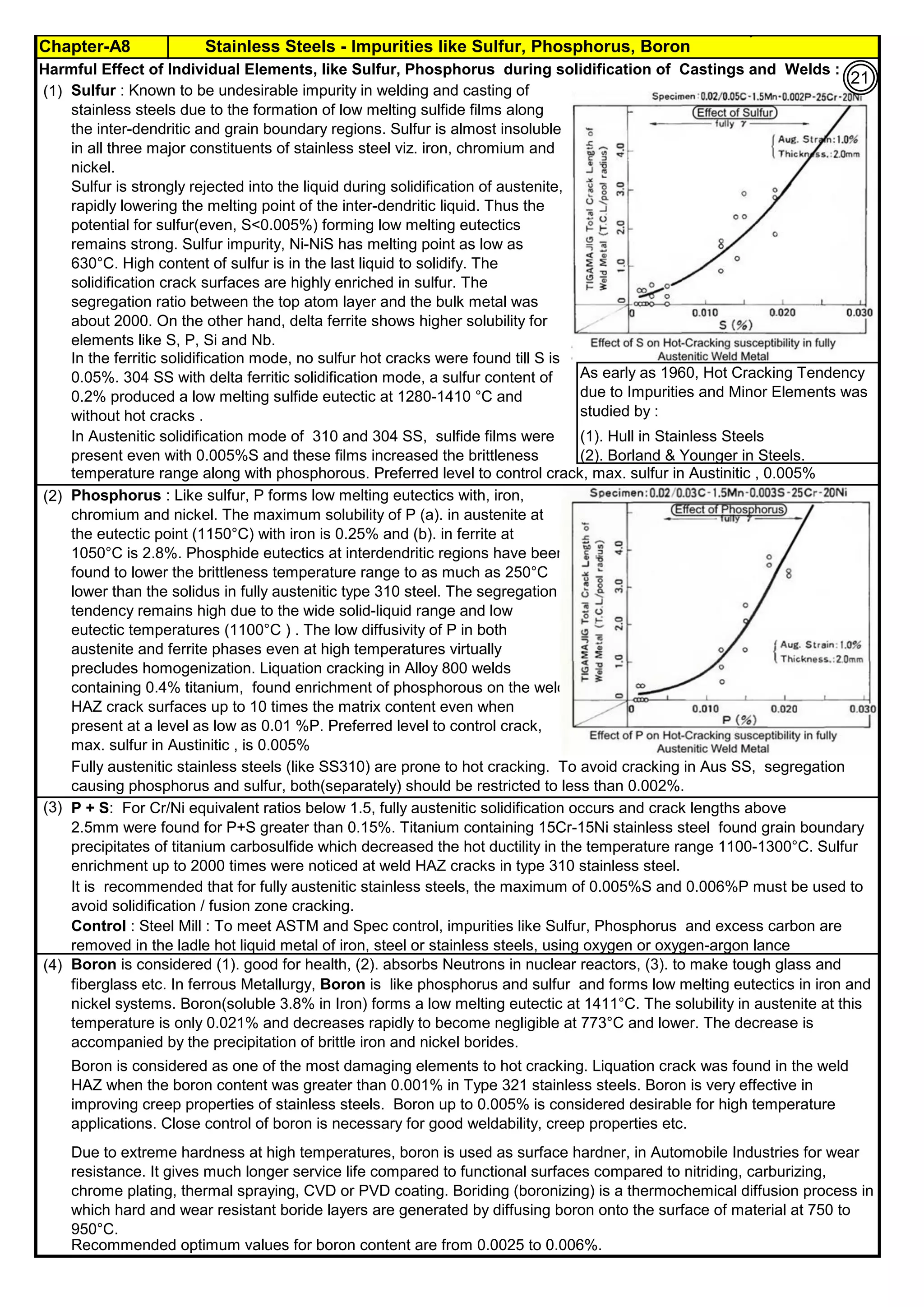
Harmful Effect of Individual Elements, like Sulfur, Phosphorus during solidification of Castings and Welds :
(1)
(2)
(3)
(4)
Recommended optimum values for boron content are from 0.0025 to 0.006%.
In Austenitic solidification mode of 310 and 304 SS, sulfide films were
present even with 0.005%S and these films increased the brittleness
(1). Hull in Stainless Steels
(2). Borland & Younger in Steels.
temperature range along with phosphorous. Preferred level to control crack, max. sulfur in Austinitic , 0.005%
Phosphorus : Like sulfur, P forms low melting eutectics with, iron,
chromium and nickel. The maximum solubility of P (a). in austenite at
the eutectic point (1150°C) with iron is 0.25% and (b). in ferrite at
1050°C is 2.8%. Phosphide eutectics at interdendritic regions have been
found to lower the brittleness temperature range to as much as 250°C
lower than the solidus in fully austenitic type 310 steel. The segregation
tendency remains high due to the wide solid-liquid range and low
eutectic temperatures (1100°C ) . The low diffusivity of P in both
austenite and ferrite phases even at high temperatures virtually
precludes homogenization. Liquation cracking in Alloy 800 welds
containing 0.4% titanium, found enrichment of phosphorous on the weld
HAZ crack surfaces up to 10 times the matrix content even when
present at a level as low as 0.01 %P. Preferred level to control crack,
max. sulfur in Austinitic , is 0.005%
Fully austenitic stainless steels (like SS310) are prone to hot cracking. To avoid cracking in Aus SS, segregation
causing phosphorus and sulfur, both(separately) should be restricted to less than 0.002%.
P + S: For Cr/Ni equivalent ratios below 1.5, fully austenitic solidification occurs and crack lengths above
2.5mm were found for P+S greater than 0.15%. Titanium containing 15Cr-15Ni stainless steel found grain boundary
precipitates of titanium carbosulfide which decreased the hot ductility in the temperature range 1100-1300°C. Sulfur
enrichment up to 2000 times were noticed at weld HAZ cracks in type 310 stainless steel.
Control : Steel Mill : To meet ASTM and Spec control, impurities like Sulfur, Phosphorus and excess carbon are
removed in the ladle hot liquid metal of iron, steel or stainless steels, using oxygen or oxygen-argon lance
It is recommended that for fully austenitic stainless steels, the maximum of 0.005%S and 0.006%P must be used to
avoid solidification / fusion zone cracking.
Boron is considered (1). good for health, (2). absorbs Neutrons in nuclear reactors, (3). to make tough glass and
fiberglass etc. In ferrous Metallurgy, Boron is like phosphorus and sulfur and forms low melting eutectics in iron and
nickel systems. Boron(soluble 3.8% in Iron) forms a low melting eutectic at 1411°C. The solubility in austenite at this
temperature is only 0.021% and decreases rapidly to become negligible at 773°C and lower. The decrease is
accompanied by the precipitation of brittle iron and nickel borides.
Boron is considered as one of the most damaging elements to hot cracking. Liquation crack was found in the weld
HAZ when the boron content was greater than 0.001% in Type 321 stainless steels. Boron is very effective in
improving creep properties of stainless steels. Boron up to 0.005% is considered desirable for high temperature
applications. Close control of boron is necessary for good weldability, creep properties etc.
Due to extreme hardness at high temperatures, boron is used as surface hardner, in Automobile Industries for wear
resistance. It gives much longer service life compared to functional surfaces compared to nitriding, carburizing,
chrome plating, thermal spraying, CVD or PVD coating. Boriding (boronizing) is a thermochemical diffusion process in
which hard and wear resistant boride layers are generated by diffusing boron onto the surface of material at 750 to
950°C.
As early as 1960, Hot Cracking Tendency
due to Impurities and Minor Elements was
studied by :
In the ferritic solidification mode, no sulfur hot cracks were found till S is
0.05%. 304 SS with delta ferritic solidification mode, a sulfur content of
0.2% produced a low melting sulfide eutectic at 1280-1410 °C and
without hot cracks .
Sulfur : Known to be undesirable impurity in welding and casting of
stainless steels due to the formation of low melting sulfide films along
the inter-dendritic and grain boundary regions. Sulfur is almost insoluble
in all three major constituents of stainless steel viz. iron, chromium and
nickel.
Sulfur is strongly rejected into the liquid during solidification of austenite,
rapidly lowering the melting point of the inter-dendritic liquid. Thus the
potential for sulfur(even, S<0.005%) forming low melting eutectics
remains strong. Sulfur impurity, Ni-NiS has melting point as low as
630°C. High content of sulfur is in the last liquid to solidify. The
solidification crack surfaces are highly enriched in sulfur. The
segregation ratio between the top atom layer and the bulk metal was
about 2000. On the other hand, delta ferrite shows higher solubility for
elements like S, P, Si and Nb.
21
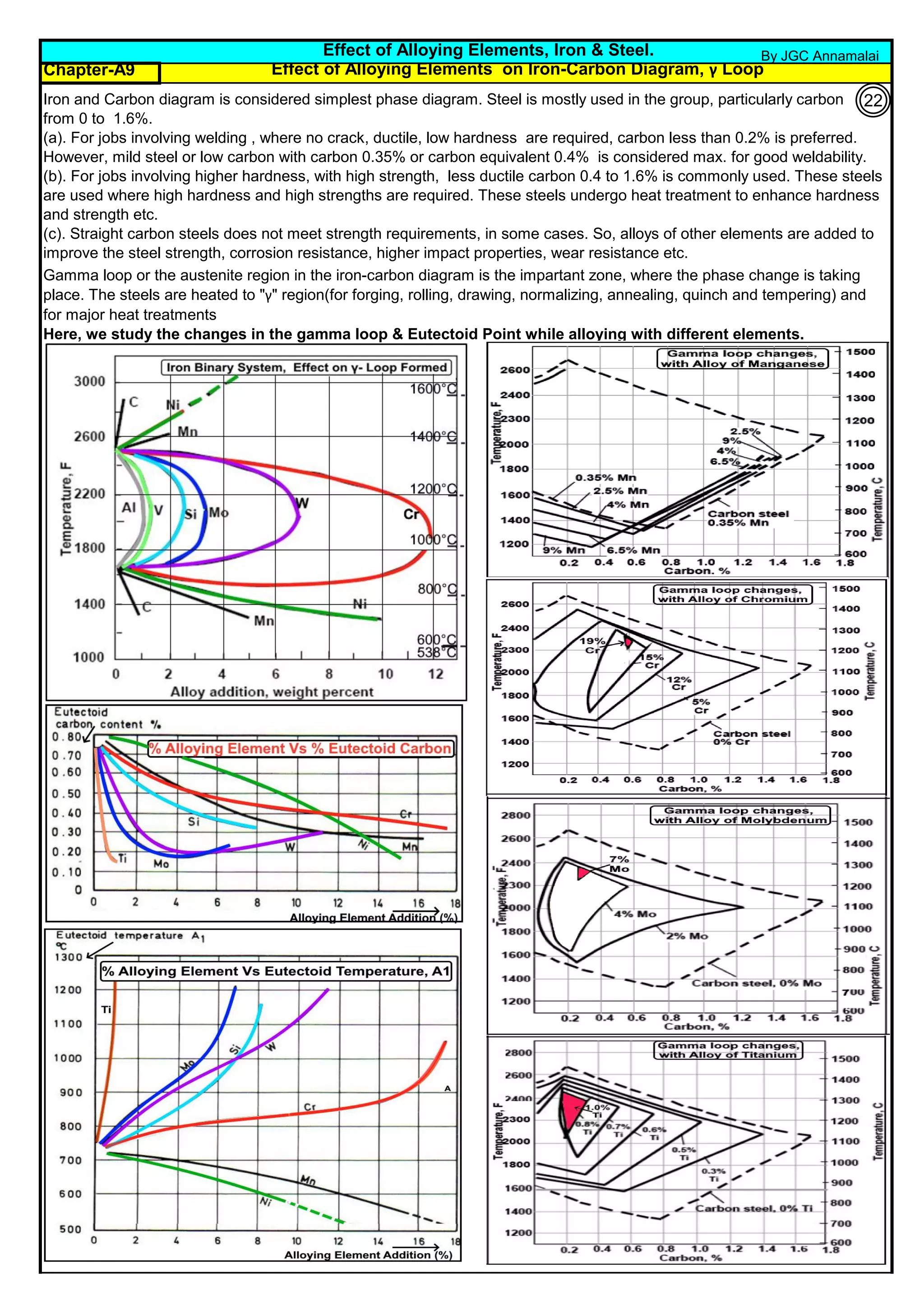
Chapter-A9
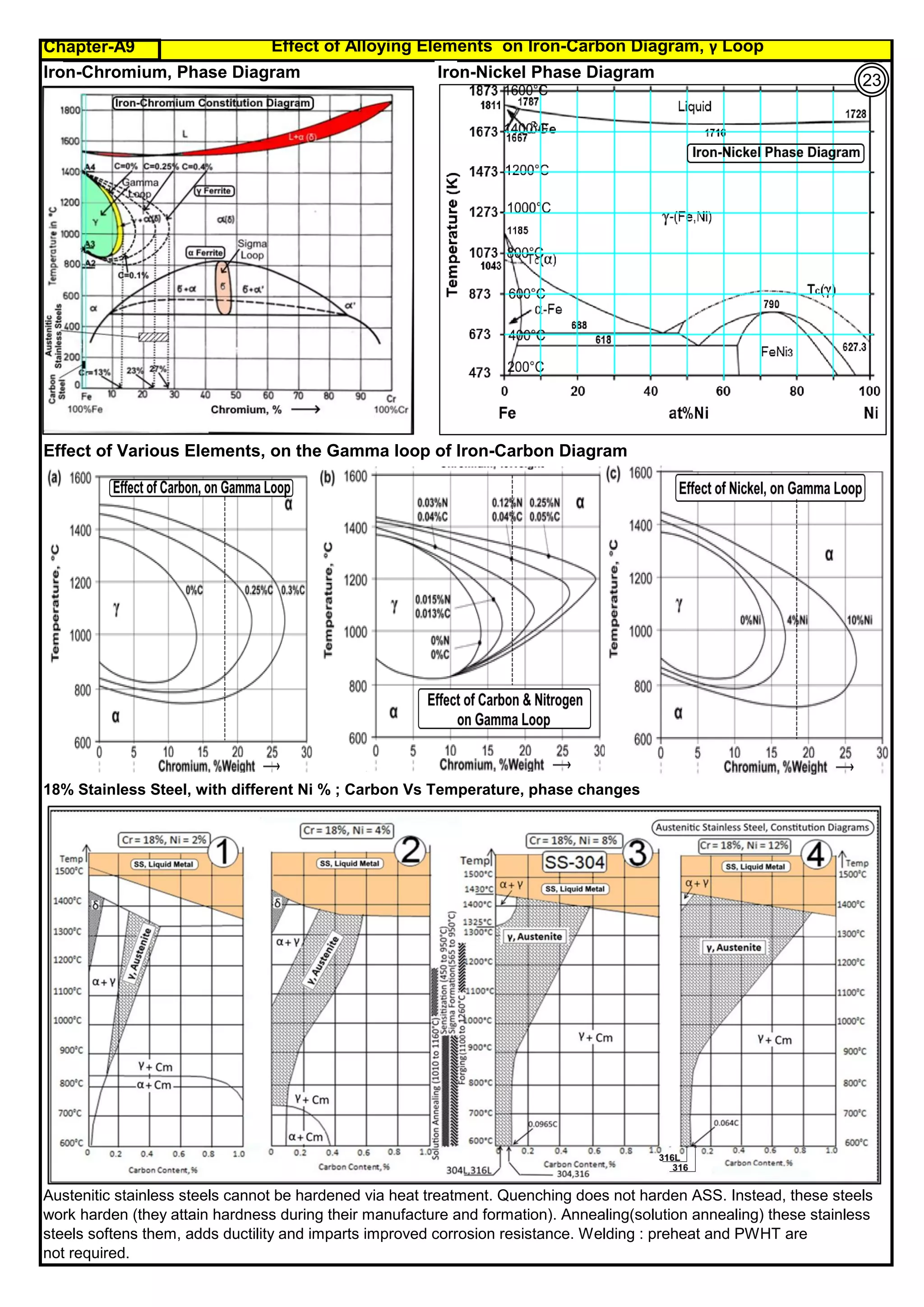
Here, we study the changes in the gamma loop & Eutectoid Point while alloying with different elements.
Gamma loop or the austenite region in the iron-carbon diagram is the impartant zone, where the phase change is taking
place. The steels are heated to "γ" region(for forging, rolling, drawing, normalizing, annealing, quinch and tempering) and
for major heat treatments
Effect of Alloying Elements, Iron & Steel.
Iron and Carbon diagram is considered simplest phase diagram. Steel is mostly used in the group, particularly carbon
from 0 to 1.6%.
(a). For jobs involving welding , where no crack, ductile, low hardness are required, carbon less than 0.2% is preferred.
However, mild steel or low carbon with carbon 0.35% or carbon equivalent 0.4% is considered max. for good weldability.
(b). For jobs involving higher hardness, with high strength, less ductile carbon 0.4 to 1.6% is commonly used. These steels
are used where high hardness and high strengths are required. These steels undergo heat treatment to enhance hardness
and strength etc.
(c). Straight carbon steels does not meet strength requirements, in some cases. So, alloys of other elements are added to
improve the steel strength, corrosion resistance, higher impact properties, wear resistance etc.
Effect of Alloying Elements on Iron-Carbon Diagram, γ Loop
By JGC Annamalai
22
Chapter-A9 Effect of Alloying Elements on Iron-Carbon Diagram, γ Loop
By JGC Annamalai
Iron-Chromium, Phase Diagram Iron-Nickel Phase Diagram
Effect of Various Elements, on the Gamma loop of Iron-Carbon Diagram
18% Stainless Steel, with different Ni % ; Carbon Vs Temperature, phase changes
Austenitic stainless steels cannot be hardened via heat treatment. Quenching does not harden ASS. Instead, these steels
work harden (they attain hardness during their manufacture and formation). Annealing(solution annealing) these stainless
steels softens them, adds ductility and imparts improved corrosion resistance. Welding : preheat and PWHT are
not required.
23
Chapter-B1
Spectrometers :
Uses of Spectrometers / Metal Analyzers:
After the attack on World Trade Center, in Sep 11, 2001, Authorities started to use more
spectrometers to detect the weapons and explosives in solid / plastics, liquid, gas forms.
The security was tightened, in the Airports, Ship Ports, Train and Bus Stations,
Offices and other suspected places.
General : Process Control and Monitoring; Indentification of Chemical Compounds, Medical Diagnostics; Chemical
Analysis; Material and Polymer Analysis; Raman Spectroscopy; Color Measurements; Environmental Monitoring;
Authentication and Anti-Counterfeiting; Light Measurements; Quality Control; Water Quality Analysis; History and
archeology; Food analysis for Heavy metals; pharmaceutical; Security check; Fire or smoke detection/alarm;
Inner-workings of a spectrometer , the components working etc. are designed to achieve a
desired outcome, Touch on facility on some of the accessories are also available.
Once the light is imaged onto the detector the photons are then converted into electrons
which are digitized and read out through a USB (or serial port) to a computer. The
software then interpolates the signal based on the number of pixels in the detector and the
linear dispersion of the diffraction grating to create a calibration that enables the data to be
plotted as a function of wavelength over the given spectral range. This data can then be
used and manipulated for countless spectroscopic applications,
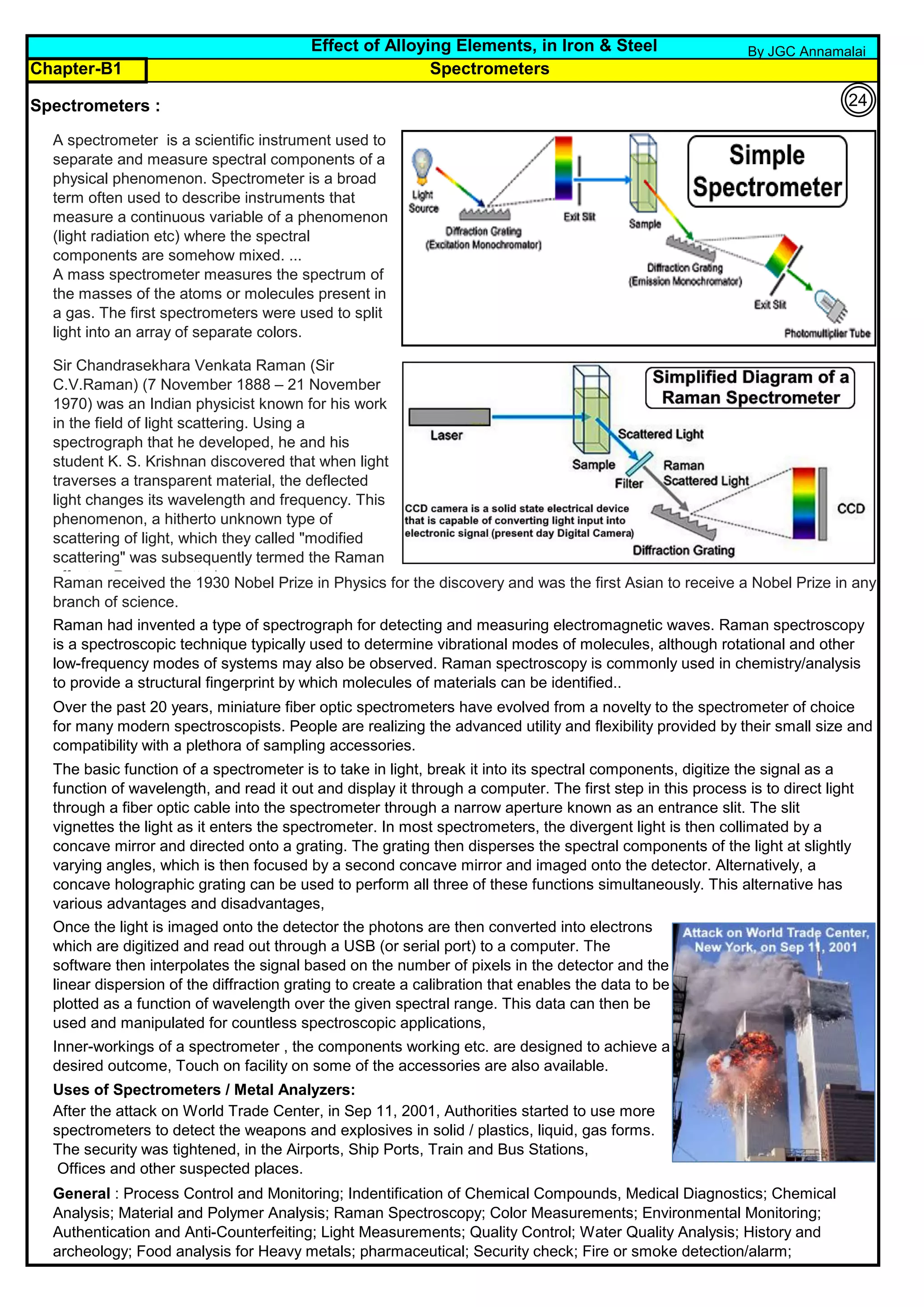
The basic function of a spectrometer is to take in light, break it into its spectral components, digitize the signal as a
function of wavelength, and read it out and display it through a computer. The first step in this process is to direct light
through a fiber optic cable into the spectrometer through a narrow aperture known as an entrance slit. The slit
vignettes the light as it enters the spectrometer. In most spectrometers, the divergent light is then collimated by a
concave mirror and directed onto a grating. The grating then disperses the spectral components of the light at slightly
varying angles, which is then focused by a second concave mirror and imaged onto the detector. Alternatively, a
concave holographic grating can be used to perform all three of these functions simultaneously. This alternative has
various advantages and disadvantages,
Raman had invented a type of spectrograph for detecting and measuring electromagnetic waves. Raman spectroscopy
is a spectroscopic technique typically used to determine vibrational modes of molecules, although rotational and other
low-frequency modes of systems may also be observed. Raman spectroscopy is commonly used in chemistry/analysis
to provide a structural fingerprint by which molecules of materials can be identified..
Effect of Alloying Elements, in Iron & Steel
Over the past 20 years, miniature fiber optic spectrometers have evolved from a novelty to the spectrometer of choice
for many modern spectroscopists. People are realizing the advanced utility and flexibility provided by their small size and
compatibility with a plethora of sampling accessories.
A spectrometer is a scientific instrument used to
separate and measure spectral components of a
physical phenomenon. Spectrometer is a broad
term often used to describe instruments that
measure a continuous variable of a phenomenon
(light radiation etc) where the spectral
components are somehow mixed. ...
A mass spectrometer measures the spectrum of
the masses of the atoms or molecules present in
a gas. The first spectrometers were used to split
light into an array of separate colors.
Spectrometers
Raman received the 1930 Nobel Prize in Physics for the discovery and was the first Asian to receive a Nobel Prize in any
branch of science.
Sir Chandrasekhara Venkata Raman (Sir
C.V.Raman) (7 November 1888 – 21 November
1970) was an Indian physicist known for his work
in the field of light scattering. Using a
spectrograph that he developed, he and his
student K. S. Krishnan discovered that when light
traverses a transparent material, the deflected
light changes its wavelength and frequency. This
phenomenon, a hitherto unknown type of
scattering of light, which they called "modified
scattering" was subsequently termed the Raman
effect or Raman scattering.
By JGC Annamalai
24
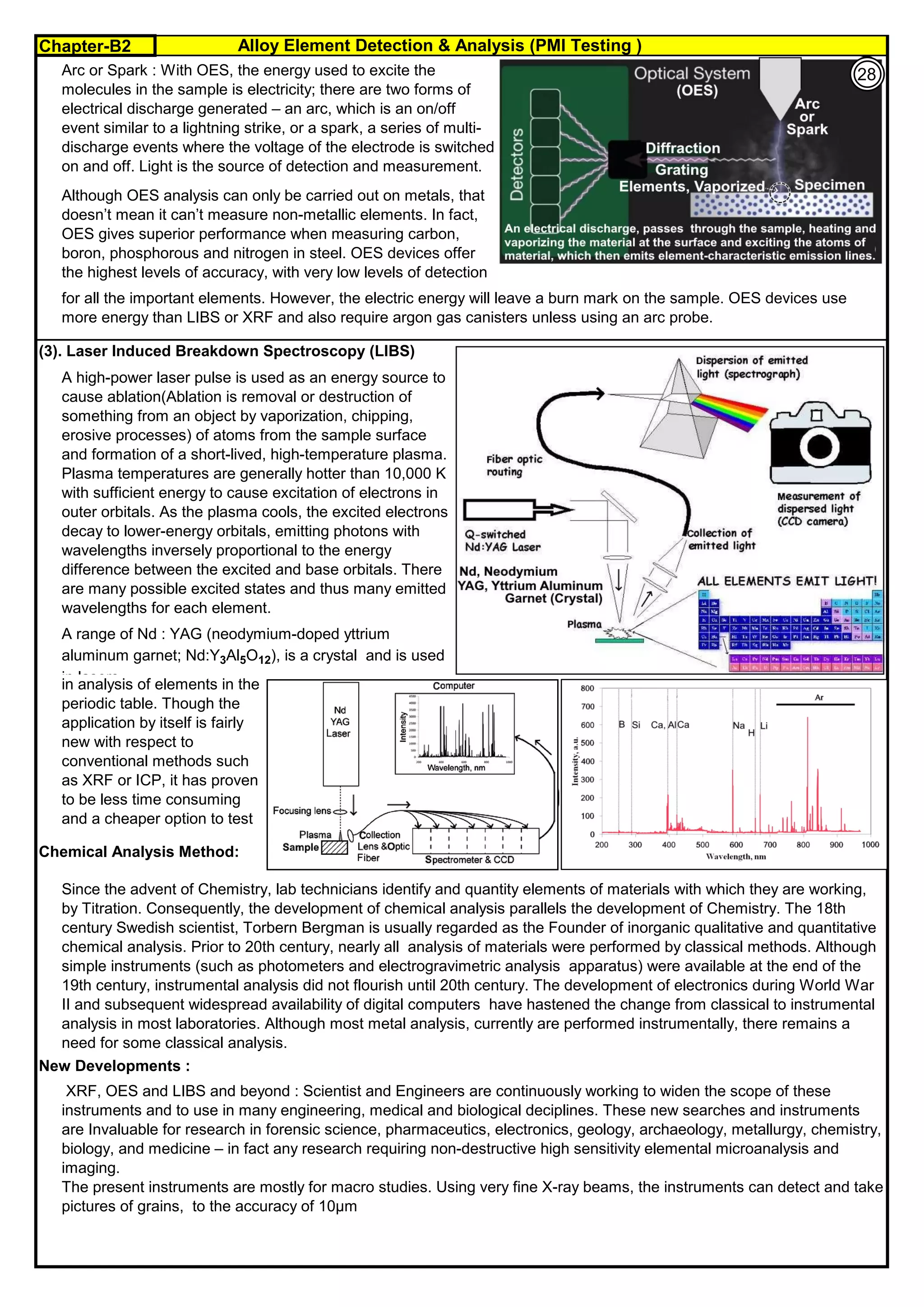
Chapter-B2
Developments :
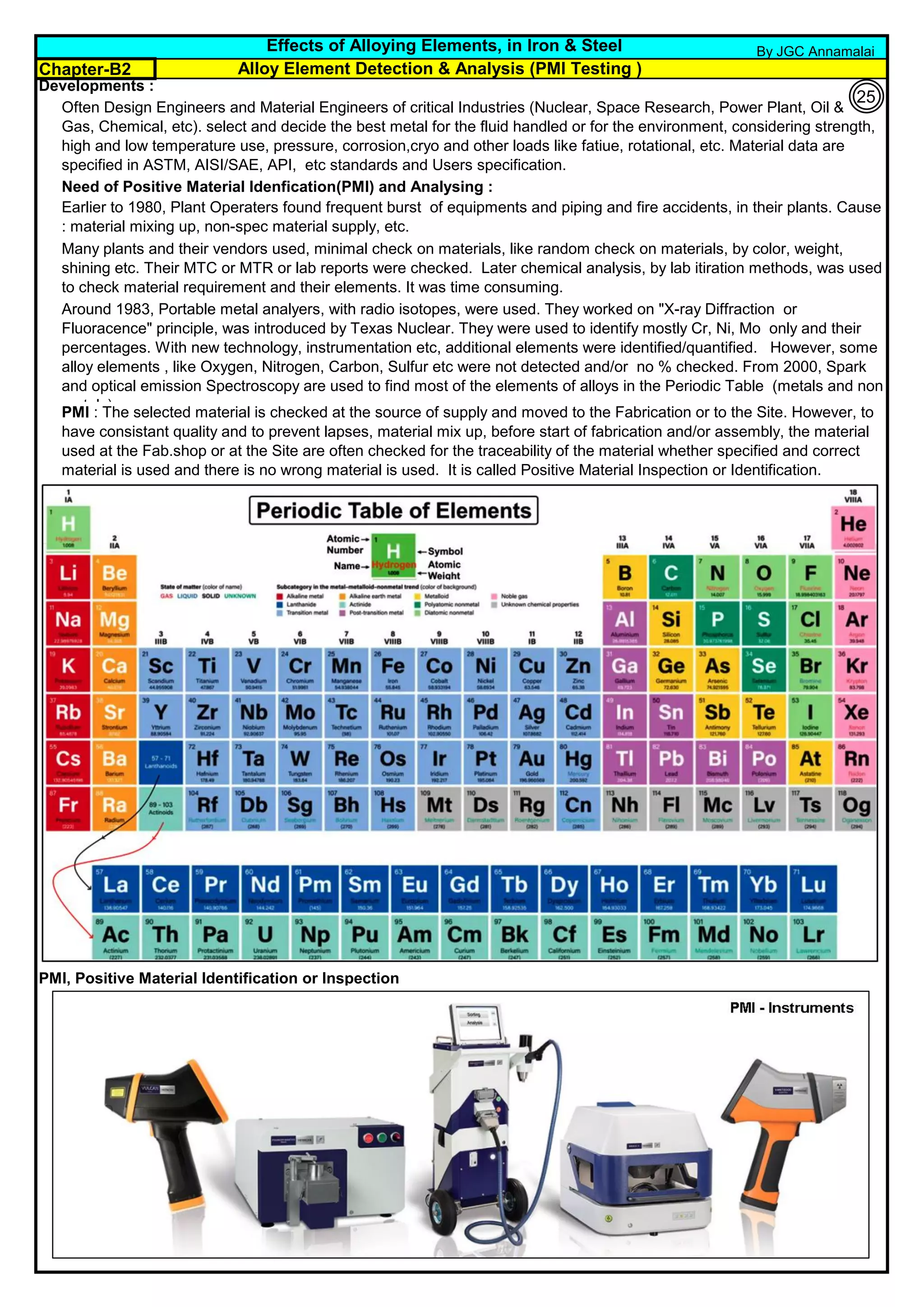
PMI, Positive Material Identification or Inspection
Effects of Alloying Elements, in Iron & Steel
Alloy Element Detection & Analysis (PMI Testing )
PMI : The selected material is checked at the source of supply and moved to the Fabrication or to the Site. However, to
have consistant quality and to prevent lapses, material mix up, before start of fabrication and/or assembly, the material
used at the Fab.shop or at the Site are often checked for the traceability of the material whether specified and correct
material is used and there is no wrong material is used. It is called Positive Material Inspection or Identification.
Often Design Engineers and Material Engineers of critical Industries (Nuclear, Space Research, Power Plant, Oil &
Gas, Chemical, etc). select and decide the best metal for the fluid handled or for the environment, considering strength,
high and low temperature use, pressure, corrosion,cryo and other loads like fatiue, rotational, etc. Material data are
specified in ASTM, AISI/SAE, API, etc standards and Users specification.
Need of Positive Material Idenfication(PMI) and Analysing :
Earlier to 1980, Plant Operaters found frequent burst of equipments and piping and fire accidents, in their plants. Cause
: material mixing up, non-spec material supply, etc.
Many plants and their vendors used, minimal check on materials, like random check on materials, by color, weight,
shining etc. Their MTC or MTR or lab reports were checked. Later chemical analysis, by lab itiration methods, was used
to check material requirement and their elements. It was time consuming.
Around 1983, Portable metal analyers, with radio isotopes, were used. They worked on "X-ray Diffraction or
Fluoracence" principle, was introduced by Texas Nuclear. They were used to identify mostly Cr, Ni, Mo only and their
percentages. With new technology, instrumentation etc, additional elements were identified/quantified. However, some
alloy elements , like Oxygen, Nitrogen, Carbon, Sulfur etc were not detected and/or no % checked. From 2000, Spark
and optical emission Spectroscopy are used to find most of the elements of alloys in the Periodic Table (metals and non
metals).
By JGC Annamalai
25
Chapter-B2 Alloy Element Detection & Analysis (PMI Testing )
By JGC Annamalai
Advantages of using PMI :




 Failure Analysis PMI – it is vital that the cause is identified and
resolved to avoid repeat failures
 Ensure compliance with local government and legal requirements
 Reduce risk of company liability with documented safety standards
Some Definitions :
Major Functions of PMI :
(1). Verify alloying elements and other metals in seconds.
(2). Enhance material traceability. To avoid metal/material mix-up.
(3). Confirm the integrity of plant equipment and materials, whether the supplied materials is per P.O. requirements.
Arc : Common: Part of a curve or circle. Electric: Continuous flow or stream of charged sparks, as in arc welding.
Positive material identification (PMI) is an essential non-destructive testing (NDT) method utilized to verify that
supplied materials conform to the proper standards and specifications. Specifically, PMI is used to confirm that the
chemical composition of the metallic parts has the correct percentage of key elements, this ensures that material
properties such as corrosion resistance meets the requirements and the material meets, the specified standards and
specifications.
PMI is a widely adopted as non-destructive testing method and there are
several standards and recommended practices for it.
The following API and ASTM documents cover the use of the handheld
XRF and other applicable techniques.
API RP 578 – Material Verification Program for New and Existing Alloy
Piping Systems, - guidelines for a quality assurance system to verify the
alloy components.
Diffractometers : - used to measure crystal structure, grain size, texture,
and/or residual stress of materials and compounds through the
interaction of X-ray beams, gamma rays, electron beams, or neutron
beams with a sample
Security System Services :- checks in Airport, protected area,
courthouses, jails etc. Scan or take picture of whole body, using portable
or hand-held X-ray systems and X-ray generators. computed
radiographic (CR) systems, digital radiographic
Spark : Common: an ignited or fiery particle such as is thrown off by
burning wood or produced by one hard body striking as lighter and
grinderagainst another. Electric : short discharge between poles
ASTM E1476 - Standard Guide for Metals Identification, Grade
Verification, and Sorting.
X-ray Instruments and X-ray Systems : - use material penetrating X-
rays or gamma radiation to capture images of the internal structure of a
part or finished product. They are mostly portable (also called handheld
or mobile)
Ensure that products and components have been manufactured
using the correct alloy
Ensure material conforms to the correct standard and specification
Ensure welded components have used the correct filler material
X-ray sources : - lamps that generate or produce X-rays, a form of
electromagnetic radiation, for non-destructive testing (NDT) or inspection
Find knowingly or unknowingly mixed-up alloys
X-ray fluorescence spectrometers (XRFs) : - portable, use a
spectroscopic technique that is commonly used with solids, in which X-
rays are used to excite a sample and generate secondary X-rays.
Positive Material Identification (PMI) : Driven by Country and / or Company regulations and as a result of material mix-
ups, mis-labelled shipments and industrial accidents, companies are increasingly relying on analysis quickly and
accurately to determine the chemical composition of materials and alloys. Positive Material Identification (PMI) testing
has established itself as a solution for ensuring product quality, a safe manufacturing environment and quick results.
Uses of Spectroscope : for research in metallurgy, forensics, polymers, electronics, archaeology, environmental
analysis, geology, mining, pharmaceutics, chemistry, biology, and medicine – in fact any research requiring non-
destructive high sensitivity elemental micro analysis and imaging.
26
Chapter-B2 Alloy Element Detection & Analysis (PMI Testing )
By JGC Annamalai
The most predominant techniques for Elemental Analysis are :
1) Fluorescence Spectrometry (AES/AFS)
2) Inductively Coupled Plasma Mass Spectrometry (ICP-MS)
3) Inductively Coupled Plasma Optical Emission Spectrometry (ICP-OES)
4) Neutron Activation Analysis (NAA)
5) X-Ray Fluorescence (XRF)
6) Anodic Striping Voltammetry (AVS)
1. Thermo Fisher 4. Shimadzu
Suppliers 2. Hitachi High Tech 5. Texas Nuclear
3. Bruker
These are 3 Popular Technologies for Element Detection, Analysis and quantifying the Elements, in Alloys :
(1). X-ray Fluorescence (XRF) also called Atomic Fluorescence (ARF), X-ray Diffraction (XRD)
(2). Optical Emission Spectrometry (OES),
(3). Laser Induced Breakdown Spectroscopy (LIBS)
(1). X-ray Fluorescence (XRF)
(2). Optical Emission Spectrometry (OES),
XRF or XRD : This method was first proposed by Glocker and Schreiber in 1928.
Earlier years, most of the metal or element detection instruments, were very large in size and carried in large boxes or
moved in a cart. Due to the advent and development of systems and instruments, the size of the test apparatus were
shrunk and now they are mostly handheld or carried in a compact box. Some of the detectors now weigh about 1 kg.
Popular Element Analyzer
Brands:
XRF is suitable for solids, liquids and powders,
and in most circumstances, it is NDT
WDXRF can find from beryllium (Be) to
Uranium (U), more low denser elements)
Primary X-rays are generated by the source and directed at the sample’s surface. When the beam hits the atoms in the
sample, they react by generating secondary X-rays that are collected and processed by a detector. Today, the method is
used as a non-destructive analytical technique, and as a process control tool in many extractive and processing
industries. In principle, the lightest element that can be analysed/detected is Beryllium (Z = 4), but due to instrumental
limitations and low X-ray yields for the light elements, it is often difficult to quantify elements lighter than Sodium (Z =
11), unless background corrections and very comprehensive inter-element corrections are made. For improvement,
Vacuum(around 10 Pa residual pressure, 0.075 torr) or Argon or Helium purging is used, instead of air medium at the X-
ray port.
EDXRF can find all elements from sodium
(Na) to uranium (U),
27
Chapter-B2 Alloy Element Detection & Analysis (PMI Testing )
By JGC Annamalai
(3). Laser Induced Breakdown Spectroscopy (LIBS)
Chemical Analysis Method:
New Developments :
Since the advent of Chemistry, lab technicians identify and quantity elements of materials with which they are working,
by Titration. Consequently, the development of chemical analysis parallels the development of Chemistry. The 18th
century Swedish scientist, Torbern Bergman is usually regarded as the Founder of inorganic qualitative and quantitative
chemical analysis. Prior to 20th century, nearly all analysis of materials were performed by classical methods. Although
simple instruments (such as photometers and electrogravimetric analysis apparatus) were available at the end of the
19th century, instrumental analysis did not flourish until 20th century. The development of electronics during World War
II and subsequent widespread availability of digital computers have hastened the change from classical to instrumental
analysis in most laboratories. Although most metal analysis, currently are performed instrumentally, there remains a
need for some classical analysis.
XRF, OES and LIBS and beyond : Scientist and Engineers are continuously working to widen the scope of these
instruments and to use in many engineering, medical and biological deciplines. These new searches and instruments
are Invaluable for research in forensic science, pharmaceutics, electronics, geology, archaeology, metallurgy, chemistry,
biology, and medicine – in fact any research requiring non-destructive high sensitivity elemental microanalysis and
imaging.
The present instruments are mostly for macro studies. Using very fine X-ray beams, the instruments can detect and take
pictures of grains, to the accuracy of 10μm
A high-power laser pulse is used as an energy source to
cause ablation(Ablation is removal or destruction of
something from an object by vaporization, chipping,
erosive processes) of atoms from the sample surface
and formation of a short-lived, high-temperature plasma.
Plasma temperatures are generally hotter than 10,000 K
with sufficient energy to cause excitation of electrons in
outer orbitals. As the plasma cools, the excited electrons
decay to lower-energy orbitals, emitting photons with
wavelengths inversely proportional to the energy
difference between the excited and base orbitals. There
are many possible excited states and thus many emitted
wavelengths for each element.
A range of Nd : YAG (neodymium-doped yttrium
aluminum garnet; Nd:Y3Al5O12), is a crystal and is used
in lasers
in analysis of elements in the
periodic table. Though the
application by itself is fairly
new with respect to
conventional methods such
as XRF or ICP, it has proven
to be less time consuming
and a cheaper option to test
Arc or Spark : With OES, the energy used to excite the
molecules in the sample is electricity; there are two forms of
electrical discharge generated – an arc, which is an on/off
event similar to a lightning strike, or a spark, a series of multi-
discharge events where the voltage of the electrode is switched
on and off. Light is the source of detection and measurement.
Although OES analysis can only be carried out on metals, that
doesn’t mean it can’t measure non-metallic elements. In fact,
OES gives superior performance when measuring carbon,
boron, phosphorous and nitrogen in steel. OES devices offer
the highest levels of accuracy, with very low levels of detection
for all the important elements. However, the electric energy will leave a burn mark on the sample. OES devices use
more energy than LIBS or XRF and also require argon gas canisters unless using an arc probe.
28
Chapter-B3
Property XRF OES LIBS
Source of
Detection
X-Ray hits the atoms and produces secondary
X-Ray
Arc or Spark, produces light from
elements
Laser ablates the elements and light is
emited from elements.
Working
Principle
XRF(X-Ray Fluorescence) is the most
commonly used Non-Destructive Test (NDT)
method offering the user a portable handheld
analyzer that delivers fast, accurate results.
Handheld XRF analyzers use an x-ray tube to
emit an x-ray beam into a sample, exciting the
electrons and displacing them from the inner
shell. The vacancy from the inner shell then
gets replaced with an electron from an outer
shell. As this electron fills the vacancy of the
inner shell it releases energy in the form of a
secondary X-ray. This release of secondary
energy is known as fluorescence.
OES(Optical Emission Spectroscopy)
involves applying electrical arc energy
generated between the electrode and
metal sample in an argon atmosphere.
Vaporized atoms are brought to a high
energy state and light is emitted. High
energy promotes the atoms into excited
electronic states that subsequently emit
light when they return to the ground
electron state. The excited atoms and ions
of each element have a characteristic
emission spectral line. The light channels
through photo multiplying detectors and
measure the presence and intensity of
each element
LIBS(Laser-Induced Breakdown
Spectroscopy) is a type of atomic emission
spectroscopy that employs a laser to ablate
or vaporize a microscopic layer of a
sample’s surface. The resultant plasma
caused by this laser ablation process emits
light as it cools. Each element emits light
at a characteristic wavelength, which is
isolated by a grating and detected via a
spectrometer.This light is then collected and
analyzed with a spectrometer for
quantitative and qualitative material
/element analysis
Time / Speed Normally require 5 minutes for 6 samples.
Each test require about 15 seconds for
analysis.
Within 30 Seconds
It’s very fast – a test can be carried out in
just one second.
Location of
Test
Portable & hand-held. The test can be
conducted on the job or at Site.
Portable & hand-held. The test can be
conducted on the job or at Site.
Portable & hand-held. The test can be
conducted on the job or at Site.
Determining
Impurities
Normally 10 elements are determined. Mostly
impurities will be covered in the 10 elements.
OES is superior when measuring carbon,
boron, phosphorous and nitrogen in steel
Can also measure : H2, He, Li, Be, B, C, N2,
O2, F2, Ne, Na.
Accuracy There is no weighing, volume measurement,
so % error is reduced. Accuracy range
obtained is about 0.1%
Versatile and reliable for general metal
element analysis/PMI. Highest levels of
accuracy, with very Low Levels of
detection.
Versatile and reliable for general metal
element analysis/PMI.
Sample
volume and
location area
Actual objects can be taken for element
determination. The area of arcing/charred
location is about 1 or 2 mm dia(some are as
low as 10 µm). Often PMI procedures ignore
such tiny surface damage.
Used since say from 1980 New and Very latest
Dedicated test speciments
are prepared
Compare Chemical Analysis, XRF, OES, LIBS PMI - Metal Analyzers
Wet method. Normally
require, 2 days for 6 samples
The test samples are
prepared and tested in the
Lab
Due to time limitation,
determining level of impurites
is often overlooked.
Weighing, volume
measurement, transferring
etc jobs reduce the % of
accuracy.
Traditional
Chemical Analysis Method
Old and Traditional method.
Samples are either in the
chip or powder form, often
dissolved in some solutions.
The solutions are titrated.
The Chemistry Lab
Technicians identify the
elements,and quantify the
elements of the alloy
materials
29
Property XRF OES LIBS
Chemical Analysis Method
Merits Can Analyze, when samples are hot,
conductive and non-conductive substances,
metals and non-metals, in granular and liquid
forms(like soil and fuel oil).
Analyze most elements in the Periodic
Table, sometimes non-metallic elements.
It’s very fast – a test can be carried
out in just one second. Analyze/
measure light elements.
Limitations Radiation;
Light elements((H2, He, Li, Be, B, C, N2, O2,
F2, Ne, Na).analysis with handheld XRF can
be challenging because the secondary/
fluorescent X-rays from lighter elements
(Z<18) are less energetic and are greatly
attenuated as the X-rays pass through air.
Also, sample preparation is highly
recommended. It is difficult to distinguish
SS316 and SS316L or 316H.
High electrical energy. The electric(arc or
spark) energy will leave a burn mark on
the sample. OES uses more energy than
LIBS or XRF and also require argon gas
for shielding the arc or spark. Surface
needs, mechanical sanding before the test
and removal of the surface burn, after the
completion of the test
Samples can be conductive or non-
conductive but need to have a solid surface
that is clear of dirt and contaminants before
testing. LIBS will leave a small laser burn on
the sample. Argon is needed to analyze
carbon. Sample preparation is required for
analysis.
Weight 3 kg 50kg(processor-25kg, Argon-20kg+ cart,
gun-3kg)
3kg
Avg.₹ 2000000 / Pc (Rs.400000 to 3600000)
Avg.$.27000
Light Elements: Neon, Sodium, Magnesium, Aluminum, Silicon, Phosphorus, Sulfur
Extra Light Elements: Hydrogen, Helium, Lithium, Beryllium, Boron, Carbon, Nitrogen,
Oxygen, Fluorine
The system is bulky and difficult to transport to elevated places at the Site.
Requires argon gas for accurate results. Requires large battery power
Very Quick detection and analyzing.
Unit is light weight and compact and handheld
Can also measure : H2, He, Li, Be, B, C, N2, O2, F2, Ne, Na.
Significant surface preparation is required ; A burn mark is left on the material
Cost
Need extra preparation on the test surface. Have burn marks on laser affected surface
Requires Argon shielding to the Laser, during carbon analysis
Very little surface preparation is required on the sample
Can sample small pieces of material such as wire
Can also measure : H2, He, Li, Be, B, C, N2, O2, F2, Ne, Na.
Advantages
LIBS
XRF
OES
Widely used. The unit is light and easy to use
Disadvantages
Can only measure a few hundred microns into the surface of the sample for light alloys
and a few tens of microns for heavier alloys
All(light Metal) elements can not be detected with this technique
Most popular. Mostly at room
temperature, can be in
solids, in powder or chip
forms.
Time consumption,
sometime, 2 days to wait.
30
Chapter-B4
Features to look for when purchasing a hand held metal analyzer.
1. Analytical Range. Ensure that the analyzer can measure key elements, such as carbon (C).
2. Repeatability. Variances in measurements will result in irregularities of finished goods. By verifying repeatability,
we can guarantee the quality of your processes
3. Lightweight. Fatigue is likely to set in sooner with instruments weighing over 7 pounds(3,2 kg).
4. Hot Swap Battery. Reduce downtime with a hot swap battery when power is depleted.
5. Cameras. A micro camera can precisely pinpoint your exact measurement, while a macro camera can collect
sample imagery.
6. Miniaturized Geometry. Evaluate whether you’ll be able to access tight welds, corners, and joints.
8. WiFi Connectivity. Off-site workers may need access to key analytical information. Determine if you’ll be able to
obtain data with WiFi connectivity.
9. Easy Navigation. A tilting, color touchscreen and directional keys make it easy for users to navigate through
menus and sample readings. Ensure that touchscreens can also be operated with gloves on.
10. Splash/ Dust proof. Look for a minimum rating of IP54 to ensure splash and dustproof claims are validated.
11. Explore Training
XRF & LIBS Safety Training
Radiation Detection User Training
7. Safety Interlocks. Check for multiple robust laser safety interlocks to ensure that users are protected during
operation.
Effect of Alloying Elements, in Iron & Steel
Checklist of Features of Analyzers / Spectrometers
31
By JGC Annamalai
Chapter-B5a
Atomic
Number
Chemical
Element Name
Symbo
l
Atomic
Weight
Specific
Gravity
Melting
Point, °C
Boiling
Point, °C
No. of
Isotope
s
Discoverer Year
1 Hydrogen H 1.00794 0.0705 -259.34 -252.87 3 Cavendish 1766
2 Helium He 4.0026 0.17855 -272.2 -268.93 5 Janssen 1868
3 Lithium Li 6.941 0.534 180.5 1342 5 Arfvedson 1817
4 Beryllium Be 9.01218 1.848 1287 2471 6 Vauquelin 1798
5 Boron B 10.811 2.377 2075 4000 6 Gay-Lussac and Davy 1808
6 Carbon C 12.0107 1.8?3.58 4492 (G) 3825 7 Prehistoric ?
7 Nitrogen N 14.0067 0.8085 -210 -195.79 8 Rutherford 1772
8 Oxygen O 15.9994 1.145 -218.79 -182.95 8 Priestley/Scheele 1774
9 Fluorine F 18.9984 1.1085 -219.67 -188.12 6 Moissan 1886
10 Neon Ne 20.1797 0.8999 -248.59 -246.08 8 Ramsay and Travers 1898
11 Sodium Na 22.9898 0.971 97.8 883 7 Davy 1807
12 Magnesium Mg 24.305 1.738 650 1090 8 Black 1755
13 Aluminum Al 26.9815 2.6989 660.32 2519 8 Whler 1827
14 Silicon Si 28.0855 2.33 1414 3265 8 Berzelius 1824
15 Phosphorous P 30.9738 1.82 44.15 280.5 7 Brand 1669
16 Sulfur S 32.065 2.071 95.3 444.6 10 Prehistoric ?
17 Chlorine Cl 35.453 1.565 -101.5 -34.04 11 Scheele 1774
18 Argon Ar 39.948 1.78375 -189.35 -185.85 8 Rayleigh and Ramsay 1894
19 Potassium K 39.0983 0.862 63.5 759 10 Davy 1807
20 Calcium Ca 40.078 1.55 842 1484 14 Davy 1808
21 Scandium Sc 44.9559 2.989 1541 2836 15 Nilson 1878
22 Titanium Ti 47.867 4.55 1668 3287 9 Gregor 1791
23 Vanadium V 50.9415 6.11 1910 3407 9 del Rio 1801
24 Chromium Cr 51.9961 7.18-7.20 1907 2671 9 Vauquelin 1797
25 Manganese Mn 54.938 7.21745 1246 2061 11
Gahn, Scheele, and
Bergman
1774
26 Iron Fe 55.845 7.894 1538 2861 10 Prehistoric ?
27 Cobalt Co 58.9332 8.9 1495 2927 14 Brandt
c.173
5
28 Nickel Ni 58.6934 8.902 1455 2913 11 Cronstedt 1751
29 Copper Cu 63.546 8.96 1084.62 2562 11 Prehistoric ?
30 Zinc Zn 65.39 7.133 419.5 907 15 Prehistoric ?
31 Gallium Ga 69.723 5.904 29.76 2204 14 de Boisbaudran 1875
32 Germanium Ge 72.64 5.323 938.25 2833 17 Winkler 1886
33 Arsenic (gray) As 74.9216 5.73 817 603 14 Albertus Magnus 1250
34 Selenium Se 78.96 4.79 220.5 685 20 Berzelius 1817
35 Bromine Br 79.904 3.125 -7.2 58.8 19 Balard 1826
36 Krypton Kr 83.8 3.7335 -157.38 -153.22 23 Ramsay and Travers 1898
37 Rubidium Rb 85.4678 1.532 39.3 688 20 Bunsen and Kirchoff 1861
38 Strontium Sr 87.62 2.54 777 1382 18 Davy 1808
39 Yttrium Y 88.9059 4.457 1522 3345 21 Gadolin 1794
40 Zirconium Zr 91.224 6.5063 1855 4409 20 Klaproth 1789
41 Niobium/Columbiu
m
Nb 92.9064 8.57 2477 4744 24 Hatchett 1801
42 Molybdenum Mo 95.94 10.22 2623 4639 20 Scheele 1778
43 Technetium Tc 982 11.503 2157 4265 23 Perrier and Segr 1937
44 Ruthenium Ru 101.07 12.44 2334 4150 16 Klaus 1844
45 Rhodium Rh 102.906 12.41 1964 3695 20 Wollaston 1803
46 Palladium Pd 106.42 12.02 1554.9 2963 21 Wollaston 1803
47 Silver Ag 107.868 10.5 961.78 2162 27 Prehistoric ?
Properties of Elements / Atoms :
Light
Elements
Extra-Light
Elements By JGC Annamalai
32
Atomic
Number
Chemical
Element Name
Symbo
l
Atomic
Weight
Specific
Gravity
Melting
Point, °C
Boiling
Point, °C
No. of
Isotope
s
Discoverer Year
By JGC Annamalai
48 Cadmium Cd 112.411 8.65 321.07 767 22 Stromeyer 1817
49 Indium In 114.818 7.31 156.6 2072 34 Reich and Richter 1863
50 Tin (white) Sn 118.71 7.31 231.93 2602 28 Prehistoric ?
51 Antimony Sb 121.76 6.61 630.63 1587 29 Early historic times ?
52 Tellurium Te 127.6 6.24 449.51 988 29 von Reichenstein 1782
53 Iodine I 126.904 4.93 113.7 184.4 24 Courtois 1811
54 Xenon Xe 131.293 3.525 -111.79 -108.12 31 Ramsay and Travers 1898
55 Cesium Cs 132.905 1.873 28.5 671 22 Bunsen and Kirchoff 1860
56 Barium Ba 137.327 3.5 727 1897 25 Davy 1808
57 Lanthanum La 138.906 6.166 918 3464 19 Mosander 1839
58 Cerium Ce 140.116 6.771 798 3443 19 Berzelius, Hisinger,
Klaproth
1803
59 Praseodymium Pr 140.908 6.772 931 3520 15 von Welsbach 1885
60 Neodymium Nd 144.24 6.8 1021 3074 16 von Welsbach 1885
61 Promethium Pm 1452 ? 1042 3000 14 Marinsky et al. 1945
62 Samarium Sm 150.36 7.536 1074 1794 17 Boisbaudran 1879
63 Europium Eu 151.964 5.283 822 1529 21 Demarcay 1901
64 Gadolinium Gd 157.25 7.898 1313 3273 17 de Marignac 1880
65 Terbium Tb 158.925 8.234 1356 3230 24 Mosander 1843
66 Dysprosium Dy 162.5 8.54 1412 2567 21 de Boisbaudran 1886
67 Holmium Ho 164.93 8.781 1474 2700 29 Delafontaine and Soret 1878
68 Erbium Er 167.259 9.045 1529 2868 16 Mosander 1843
69 Thulium Tm 168.934 9.314 1545 1950 18 Cleve 1879
70 Ytterbium Yb 173.04 6.972 819 1196 16 Marignac 1878
71 Lutetium Lu 174.967 9.835 1663 3402 22 Urbain/ von Welsbach 1907
72 Hafnium Hf 178.49 13.31 2233 4603 17 Coster and von Hevesy 1923
73 Tantalum Ta 180.948 16.654 3017 5458 19 Ekeberg 1801
74 Tungsten W 183.84 19.3 3422 5555 22 J. and F. d'Elhuyar 1783
75 Rhenium Re 186.207 21.02 3186 5596 21 Noddack, Berg, Tacke 1925
76 Osmium Os 190.23 22.57 3033 5012 19 Tennant 1803
77 Iridium Ir 192.217 22.42 2446 4428 25 Tennant 1804
78 Platinum Pt 195.078 21.45 1768.4 3825 32 Ulloa/Wood 1741
79 Gold Au 196.967 19.32 1064.18 2856 21 Prehistoric ?
80 Mercury Hg 200.59 13.546 -38.83 356.73 26 Prehistoric ?
81 Thallium Tl 204.383 11.85 304 1473 28 Crookes 1861
82 Lead Pb 207.2 11.35 327.46 1749 29 Prehistoric ?
83 Bismuth Bi 208.98 9.747 271.4 1564 19 Geoffroy the Younger 1753
84 Polonium Po 209.00 9.32 254 962 34 Curie 1898
85 Astatine At 210.00 ? 302 ? 21 Corson et al. 1940
86 Radon Rn 222.00 4.45 -71 -61.7 20 Dorn 1900
87 Francium Fr 223.00 ? 27 ? 21 Perey 1939
88 Radium Ra 226.00 5.0? 700 ? 15 Pierre and Marie Curie 1898
89 Actinium Ac 227.00 10.073 1051 3198 11 Debierne/Giesel 1902
90 Thorium Th 232.038 11.72 1750 4788 12 Berzelius 1828
91 Protactinium Pa 231.036 15.373 1572 ? 14 Hahn and Meitner 1917
92 Uranium U 238.029 19.05 1135 4131 15 Peligot 1841
93 Neptunium Np 237.00 20.25 644 154 McMillan and Abelson 1940
94 Plutonium Pu 244.00 19.84 640 3228 164 Seaborg et al. 1940
95 Americium Am 243.00 13.67 1176 2011 134 Seaborg et al. 1944
96 Curium Cm 247.00 13.513 1345 3100 134 Seaborg et al. 1944
97 Berkelium Bk 247.00 14.006 1050 84 Seaborg et al. 1949
33
Atomic
Number
Chemical
Element Name
Symbo
l
Atomic
Weight
Specific
Gravity
Melting
Point, °C
Boiling
Point, °C
No. of
Isotope
s
Discoverer Year
By JGC Annamalai
98 Californium Cf 251.00 900 124 Seaborg et al. 1950
99 Einsteinium Es 252.00 860 124 Ghiorso et al. 1952
100 Fermium Fm 257.00 1527 104 Ghiorso et al. 1953
101 Mendelevium Md 258.00 827 34 Ghiorso et al. 1955
102 Nobelium No 259.00 827 74 Ghiorso et al. 1958
103 Lawrencium Lr 262.00 1627 204 Ghiorso et al. 1961
104 Rutherfordium Rf 263.00 Ghiorso et al. 1969
105 Dubnium Db 268.00 Ghiorso et al. 1970
106 Seaborgium Sg 271.00 Ghiorso et al. 1974
107 Bohrium Bh 270.00 Armbruster & Mnzenberg 1981
108 Hassium Hs 270.00 Armbruster and Mnzenberg 1983
109 Meitnerium Mt 278.00 GSI,Darmstadt,Germany 1982
110 Darmstadtium Ds 281.00 S. Hofmann et al. 1994
111 Roentgenium10 Rg 281.00 Hofmann et al. 1994
112 Copernicium Cn 285.00 2004
113 Nihonium Nh 286.00 1999
114 Flerovium Fl 289.00 2003
115 Moscovium Mc 289.00 2000
116 Livermorium Lv 293.00 2009
117 Tennessine Ts 294.00 2002
118 Oganesson Og 294.00 ?
Elements or their Group: how they were discovered.
Transuration Elements : Neptunium, Plutonium, Americium, Curiem, Berklium, Californium, Einsteinium, Fermium, Mendelevium,
Kurchatovium, Nielsbohrium
Elements Discovered by Chemical Analysis : Cobalt, Nickel, Manganese, Barium, Molybdenum, Tungsten, Tellurium, Strontium,
Zirconium, Uranium, Titanium, Chromium, Beryllium, Niobium, Tantalum
Platinum Metals : Planinum, Palladium, Rhodium, Osmium, Iridium, Ruthenium
Halogens : Fluorine, Chlorine, Iodine, Bromine, Boron, Cadmium, Lithium, Selenium, Silicon, Aluminum, Thorium, Vanadium
Elements Discovered by Electrochemical Method : Sodium, Potassium, Magnesium, Calcium
Elements Discovered by the Spectroscopic Method : Cesium, Rubidium, Thallium, Indium
Rare Earths : Lanthanum, Didymium, Didymium, Termium, Erbium, Ytterbium, Scandium, Holmium, Thulium, Didymium,
Samarium, Neodymium, Praseodymium, Gadolinium, Dysprosium, Ytterbium, Lutetium
Helium and other Inert Gases : Helium, Argon, Krypton, Neon, Xenon,
Elements Predicted from the Periodic system / table : Gallium, Candium, Germanium
Last to be Discovered : Halfnium, Rhenium
Radioactive Elements : Polonium, Radium, Actinium, Radon, Protactinium, Francium
Synthesized Elements : Technetium, Promethium Astatine, Francium
Elements of Air and Water : Hydrogen, Nitrogen, Oxygen
1. Isotopes are different forms of the same element having the same atomic number but different atomic weights.
2. Mass number of the longest-lived isotope that is known.
Elements known in Antiquity : Ancient (pre-historical) : Carbon, Gold, Silver, Copper, Iron, Lead, Tin, Mercury
Elements known in the middle Ages : Phosphorus, Arsenic, Antimony, Bismuth, Zinc
34
Ato.No Element Symbol Ato.Wt. Ato.No Element Symbol Ato.Wt. Ato.No Element Symbol Ato.Wt.
1 Hydrogen H2
1.00784 to
1.00811
41 Niobium Nb 92.91 81 Thallium Tl
2 Helium He 4.00 42 Molybdenum Mo 95.95 82 Lead Pb 207.20
3 Lithium Li
6.938 to
6.997
43 Technetium Tc 97.00 83 Bismuth Bi 208.98
4 Beryllium Be 9.01 44 Ruthenium Ru 101.07 84 Polonium Po 209.00 a
5 Boron B
10.806 to
10.821
45 Rhodium Rh 102.91 85 Astatine At 210.00 a
6 Carbon C
12.0096 to
12.0116
46 Palladium Pd 106.42 86 Radon Rn 222.00 a
7 Nitrogen N
14.00643 to
14.00728
47 Silver Ag 107.87 87 Francium Fr 223.00 a
8 Oxygen O2
15.99903 to
15.99977
48 Cadmium Cd 112.41 88 Radium Ra 226.00 a
9 Fluorine F2 19.00 49 Indium In 114.82 89 Actinium Ac 227.00 a
10 Neon Ne 20.18 50 Tin Sn 118.71 90 Thorium Th 232.04
11 Sodium Na 22.99 51 Antimony Sb 121.76 91 Protactinium Pa 231.04
12 Magnesium Mg
24.304 to
24.307
52 Tellurium Te 127.60 92 Uranium U 238.03
13 Aluminum Al 26.98 53 Iodine I 126.90 93 Neptunium Np 237.00 a
14 Silicon Si
28.084 to
28.086
54 Xenon Xe 131.29 94 Plutonium Pu 244.00 a
15 Phosphorus P 30.97 55 Cesium Cs 132.91 95 Americium Am 243.00 a
16 Sulfur S
32.059 to
32.076
56 Barium Ba 137.33 96 Curium Cm 247.00 a
17 Chlorine Cl2
35.446 to
35.457
57 Lanthanum La 138.91 97 Berkelium Bk 247.00 a
18 Argon Ar 39.95 58 Cerium Ce 140.12 98 Californium Cf 251.00 a
19 Potassium K 39.10 59 Praseodymium Pr 140.91 99 Einsteinium Es 252.00 a
20 Calcium Ca 40.08 60 Neodymium Nd 144.24 100 Fermium Fm 257.00 a
21 Scandium Sc 44.96 61 Promethium Pm 145 a 101 Mendelevium Md 258.00 a
22 Titanium Ti 47.87 62 Samarium Sm 150.36 102 Nobelium No 259.00 a
23 Vanadium V 50.94 63 Europium Eu 151.96 103 Lawrencium Lr 262.00 a
24 Chromium Cr 52.00 64 Gadolinium Gd 157.25 104 Rutherfordium Rf 263.00 a
25 Manganese Mn 54.94 65 Terbium Tb 158.93 105 Dubnium Db 268.00 a
26 Iron Fe 55.85 66 Dysprosium Dy 162.50 106 Seaborgium Sg 271.00 a
27 Cobalt Co 58.93 67 Holmium Ho 164.93 107 Bohrium Bh 270.00 a
28 Nickel Ni 58.69 68 Erbium Er 167.26 108 Hassium Hs 270.00 a
29 Copper Cu 63.55 69 Thulium Tm 168.93 109 Meitnerium Mt 278.00 a
30 Zinc Zn 65.38 70 Ytterbium Yb 173.05 110 Darmstadtium Ds 281.00 a
31 Gallium Ga 69.72 71 Lutetium Lu 174.97 111 Roentgenium Rg 281.00 a
32 Germanium Ge 72.63 72 Hafnium Hf 178.49 112 Copernicium Cn 285.00 a
33 Arsenic As 74.92 73 Tantalum Ta 180.95 113 Ununtrium 113 286.00 a
34 Selenium Se 78.97 74 Tungsten W 183.84 114 Flerovium Fl 289.00 a
35 Bromine Br
79.901 to
79.907
75 Rhenium Re 186.21 115 Ununpentium 115 289.00 a
36 Krypton Kr 83.80 76 Osmium Os 190.23 116 Livermorium Lv 293.00 a
37 Rubidium Rb 85.47 77 Iridium Ir 192.22 117 ununseptium 117 294.00 a
38 Strontium Sr 87.62 78 Platinum Pt 195.08 118 ununoctium 118 294.00 a
39 Yttrium Y 88.91 79 Gold Au 196.97
40 Zirconium Zr 91.22 80 Mercury Hg 200.59 "a" , Atm.wt., Isotope (Longest Half-Life)
Chapter-B5b Atomic Table
204.382 to
204.385
Effect of Alloying Elements, in Iron & Steel By JGC Annamalai
(Extra-Light
Elements,
for
XRF)
(Light
Elements,
XRF)
35
Chapter-B6
(a). Top 10 Strongest Metals/Alloys in the World
1 Carbon Steel
 Carbon Steel has a Yield Strength of 260 Mega Pascals
 Tensile Strength of 580 Moa
 Around 6 on the Mohs scale
 Is highly impact resistant
 Steel can be up to 1000 times stronger than iron
2 Steel-iron-nickel Alloy
 It has a yield strength of 1,420 Mpa
 Tensile strength of 1,460 Mpa
 Iron and nickel are the most abundant metals in metallic meteorites and in the dense metal cores
of planets such as Earth.
3 Stainless Steel
 Yield strength as much as 1,560 Mpa
 Tensile strength up to 1,600 Mpa
 Highly impact resistant
 Between 5.5 to 6.3 on the Mohs scale
4 Tungsten
 Tensile strength at 1,725 Mpa
 Yield strength at 750 Mpa
 Low impact resistance
 Rates 7.5 on the Mohs scale of hardness
5 Tungsten Carbide
6 Titanium
7 Titanium Aluminide
8 Inconel
9 Chromium
10 Magnesium Alloys
Effects of Alloying Elements, in Iron & Steel,
Alloys-Strongest, Toughest, Withstand high low Temperatures, Corrosion resistant
Note: The material strength can be changed by chemical composition, rolling/forging, heat treatment and other
strengthening methods. So, pin pointing specific material is difficult. Maraging (Martensitic Aged) steels are said to
have very high strength.
By JGC Annamalai
36
Chapter-B6 Alloys-Strongest, Toughest, Withstand high low Temperatures, Corrosion resistant
By JGC Annamalai
(b). Top 10 Toughest (High Impact Value) Metals / Alloys, for Low / Cryogenic Temperature
37
Chapter-B6 Alloys-Strongest, Toughest, Withstand high low Temperatures, Corrosion resistant
By JGC Annamalai
(c). Top 10 High Temperature Metals / Alloys
Detailed development and analysis, are furnished in Chapter B.7(Superalloys)
(d). Top 10 High Corrosion Resistance Metals / Alloys
38
Chapter-B7a
(1). Excellent mechanical strength at high temperature
(2). Resistance to thermal creep deformation,
(3). Good surface stability from degradation
(4). Ability to withstand wear or abration at high temperatures,
(5). Low thermal expansion
(6). Resistance to corrosion or thermal oxidation
The crystal structure is typically face-centered cubic (FCC) austenitic.
Examples of such alloys are Hastelloy, Inconel, Waspaloy, Rene
alloys, Incoloy, MP98T, TMS alloys, and CMSX single crystal alloys.
A Superalloy, or High-Performance alloy: Max.Turbine Temperture,
in 1940 was 600°C and in 2000, the temperature was 1400°C and in
2020, it was 1800°C. The need for superalloys to withstand high
temperature was continuously increasing. To withstand, such high
temperature, an alloy, called Superalloy, with the ability to operate at
a high temperatures, close to melting point, was the need of the
Industry.
The Key Characteristics are:
Superalloy, or High-Performance Alloy
Gas Turbines, used in aircraft and used as Drivers in Power Plants,
Industrial Plants. They are exposed to high temperatures, corrosive
gases, vibration, and high mechanical loads. Advanced metals and
alloys are currently used in aircraft.
Effects of Alloying Elements, in Iron & Steel
1). NICKEL-based Superalloys : Used for their High strength, High thermal resistance, High corrosion resistance,
Machinability, Shape memory, Low coefficient of thermal expansion.
The primary application for Superalloys is in Aerospace and Marine gas turbine engines, turbines in Thermal &
nuclear power Plants, Oil & gas Industries. Creep is typically the lifetime-limiting factor in gas turbine blades
Superalloys develop high temperature strength through solid solution
strengthening and precipitation strengthening from secondary phase
precipitates such as gamma prime and carbides. Resistance to
Oxidation or corrosion is provided by elements such as aluminium and
chromium. Superalloys are often cast as a single crystal—while grain
boundaries may provide strength at low temperatures, they decrease
creep resistance.
By JGC Annamalai
39
Chapter-B7a Superalloy, or High-Performance Alloy
Common Construction Metals / Alloys and their Max. Temperature Vs Ultimate Tensile Strength :
Materials and their Scaling due to High Temperature Oxidation : ASME Limits :
Nickel Based Superalloy Materials : Alloy C-276, (Hastelloy C-276);
Alloy X, (Hastelloy X), Inconel HX; Alloy 718, (Inconel 718); Alloy 20,
Mar-M247, Udimet-700, CM SD-2, IN 713C, PWA 1480, Waspaloy, N-
4, Rene 150
(2). COBALT-based superalloys : Used for their Higher melting point
compared to nickel- or iron-based alloys, Superior hot corrosion
resistance compared to nickel- or iron-based alloys, Higher thermal
fatigue resistance and weldability compared to nickel-based alloys,
high wear resistance.
Cobalt Based Superalloy Materials : X-40, X-45, FSX-414,
FSX-418, MAR-M 302, MAR-M 509, WI-52, AlResist 13, HA-
188, HA-25 , HS-188, X-40
(3). IRON-based superalloys : Used for their High strength at room
temperature, High resistance to creep, oxidation, corrosion and wear.
The iron-based grades, which are less expensive than cobalt or
nickel-based grades, are of three types: alloys that can be
strengthened by (a). a martensitic type of transformation, (b).
alloys that are austenitic and are strengthened by a sequence of
hot and cold working (usually, forging at 2,000 to 2,100°F(1090 to 1150°C) followed by finishing at 1,200 to
1,600°F, 650 to 870°C), and (c). austenitic alloys strengthened by precipitation hardening
40
Chapter-B7a Superalloy, or High-Performance Alloy
601 through 604: Martensitic low-alloy steels.
610 through 613: Martensitic secondary hardening steels.
614 through 619: Martensitic chromium steels.
630 through 635: Semiaustenitic and martensitic precipitation-hardening stainless steels.
650 through 653: Austenitic steels strengthened by hot/cold work.
660 through 665: Austenitic superalloys; all grades except alloy 661 are strengthened
by second-phase precipitation
Superalloy Developments for Gas Turbines :
Different Manufacturer : Superalloys used as hot path Material for Gas Turbines
Chemical
composition of
some of the
Superalloys:
Iron Based Superalloy Materials : A286, N-155, CG-27, AISI 600 series are :
41
Chapter-B7a Superalloy, or High-Performance Alloy
Manufacturing Process :
One or more of the following processes are used to complete the manufacturing of Superalloys :
(depending on the location of the part and the shape of the part, the manufacturing process may differ).
(1). Investment Casting , (5). Directional Solidification,
(2). Vacuum Induction Melting (VIM) , (6). Single-Crystal Growth,
(3). Secondary Melting , (7). Powder Metallurgy (P/M),
(4). Conversion (8). Radiolysis Process (a radiation method)
High Alloys and their equivalents :
Stainless steels, nickel and high alloys for high chemical resistances:
Moderate Duty (<PREN-50)
Nickel-based Superalloys are selected for : High strength, High thermal resistance, High corrosion resistance,
Machinability, Shape memory, Low coefficient of thermal expansion
Cobalt-based Superalloys are selected for : Compared to Nickel or Iron-based alloys Cobalt alloys have Higher melting
point , Superior hot corrosion resistance , Higher thermal fatigue resistance and weldability
Iron-based Superalloys are selected for : High strength at room temperature, High resistance to creep, oxidation,
corrosion and wear
42
Chapter-B7a Superalloy, or High-Performance Alloy
Corrosion Resistance (Moderate): Stainless steels and High Nickel High alloys, Mechanical Properties and PREN
43
Chapter-B7a Superalloy, or High-Performance Alloy
Corrosion Resistance (High) : Stainless steels and High Nickel High alloys and PREN 44
ChapterB7b
Alloy Cr Co Mo W Al Ti Ta Nb Re Ru Hf C B Zr Ni
AM1 7.0 8.0 2.0 5.0 5.0 1.8 8.0 1.0 — — — — — — Bal
AM3 8.0 5.5 2.25 5.0 6.0 2.0 3.5 — — — — — — — Bal
CM186LC 6.0 9.3 0.5 8.4 5.7 0.7 3.4 — 3.0 — 1.4 0.07 0.015 0.005 Bal
CM247LC 8.0 9.3 0.5 9.5 5.6 0.7 3.2 — — — 1.4 0.07 0.015 0.010 Bal
CMSX-2 8.0 5.0 0.6 8.0 5.6 1.0 6.0 — — — — — — — Bal
CMSX-3 8.0 4.8 0.6 8.0 5.6 1.0 6.3 — — — 0.1 — — — Bal
CMSX-4 6.5 9.6 0.6 6.4 5.6 1.0 6.5 — 3.0 — 0.1 — — — Bal
CMSX-6 10.0 5.0 3.0 — 4.8 4.7 6.0 — — — 0.1 — — — Bal
CMSX-10 2.0 3.0 0.4 5.0 5.7 0.2 8.0 — 6.0 — 0.03 — — — Bal
EPM-102 2.0 16.5 2.0 6.0 5.55 — 8.25 — 5.95 3.0 0.15 0.03 — — Bal
GTD-111 14.0 9.5 1.5 3.8 3.0 5.0 3.15 0.07 — — — 0.10 0.014 0.007 Bal
GTD-222 22.5 19.1 — 2.0 1.2 2.3 0.94 0.8 — — — 0.08 0.004 0.02 Bal
IN100 10.0 15.0 3.0 — 5.5 4.7 — — — — — 0.18 0.014 0.06 Bal
IN-713LC 12.0 — 4.5 — 5.9 0.6 — 2.0 — — — 0.05 0.01 0.10 Bal
IN-738LC 16.0 8.5 1.75 2.6 3.4 3.4 1.75 0.9 — — — 0.11 0.01 0.04 Bal
IN-792 12.4 9.2 1.9 3.9 3.5 3.9 4.2 — — — — 0.07 0.016 0.018 Bal
IN-939 22.4 19.0 — 2.0 1.9 3.7 — 1.0 — — — 0.15 0.009 0.10 Bal
Mar-M002 8.0 10.0 — 10.0 5.5 1.5 2.6 — — — 1.5 0.15 0.015 0.03 Bal
Mar-M246 9.0 10.0 2.5 10.0 5.5 1.5 1.5 — — — 1.5 0.15 0.015 0.05 Bal
Mar-M247 8.0 10.0 0.6 10.0 5.5 1.0 3.0 — — — 1.5 0.15 0.015 0.03 Bal
Mar-M200Hf 8.0 9.0 — 12.0 5.0 1.9 — 1.0 — — 2.0 0.13 0.015 0.03 Bal
Mar-M421 15.0 10.8 1.8 3.3 4.5 1.6 — 2.3 — — — 0.18 0.019 0.04 Bal
MC2 8.0 5.0 2.0 8.0 5.0 1.5 6.0 — — — 0.1 — — — Bal
MC-NG 4.0 — 1.0 5.0 6.0 0.5 5.0 — 4.0 4.0 0.1 — — — Bal
MX4 2.0 16.5 2.0 6.0 5.55 — 8.25 — 5.95 3.0 0.15 0.03 — — Bal
Nasair 100 9.0 — 1.0 10.5 5.75 1.2 3.3 — — — — — — — Bal
PWA1422 9.0 10.0 — 12.0 5.0 2.0 — 1.0 — — 1.5 0.14 0.015 0.1 Bal
PWA1426 6.5 10.0 1.7 6.5 6.0 — 4.0 — 3.0 — 1.5 0.10 0.015 0.1 Bal
PWA1480 10.0 5.0 — 4.0 5.0 1.5 12.0 — — — — — — — Bal
PWA1483 12.2 9.2 1.9 3.8 3.6 4.2 5.0 — — — — 0.07 — — Bal
PWA1484 5.0 10.0 2.0 6.0 5.6 — 9.0 — 3.0 — 0.1 — — — Bal
PWA1487 5.0 10.0 1.9 5.9 5.6 — 8.4 — 3.0 — 0.25 — — — Bal
PWA1497 2.0 16.5 2.0 6.0 5.55 — 8.25 — 5.95 3.0 0.15 0.03 — — Bal
Rene 80 14.0 9.0 4.0 4.0 3.0 4.7 — — — — 0.8 0.16 0.015 0.01 Bal
Rene 125 9.0 10.0 2.0 7.0 1.4 2.5 3.8 — — — 0.05 0.11 0.017 0.05 Bal
Rene 142 6.8 12.0 1.5 4.9 6.15 — 6.35 — 2.8 — 1.5 0.12 0.015 0.02 Bal
Rene 220 18.0 12.0 3.0 — 0.5 1.0 3.0 5.0 — — — 0.02 0.010 — Bal
Rene N4 9.0 8.0 2.0 6.0 3.7 4.2 4.0 0.5 — — — — — — Bal
Rene N5 7.0 8.0 2.0 5.0 6.2 — 7.0 — 3.0 — 0.2 — — — Bal
Rene N6 4.2 12.5 1.4 6.0 5.75 — 7.2 — 5.4 — 0.15 0.05 0.004 — Bal
RR2000 10.0 15.0 3.0 — 5.5 4.0 — — — — — — — — Bal
SRR99 8.0 5.0 — 10.0 5.5 2.2 12.0 — — — — — — — Bal
TMS-75 3.0 12.0 2.0 6.0 6.0 — 6.0 — 5.0 — 0.1 — — — Bal
TMS-138 2.9 5.9 2.9 5.9 5.9 — 5.6 — 4.9 2.0 0.1 — — — Bal
TMS-162 2.9 5.8 3.9 5.8 5.8 — 5.6 — 4.9 6.0 0.09 — — — Bal
Superalloys in Cast form : Chemical Composition, % 45
Chapter:B7c
Alloy Cr Co Mo W Nb Al Ti Ta Fe Hf C B Zr Ni
Alloy 10 11.5 15 2.3 5.9 1.7 3.8 3.9 0.75 — — 0.030 0.020 0.05 Bal
Astroloy 15.0 17.0 5.3 — — 4.0 3.5 — — — 0.06 0.030 — Bal
C-263 16 15 3 1.25 — 2.50 5.0 — — — 0.025 0.018 — Bal
Hastelloy S 15.5 — 14.5 — — 0.3 — — 1.0 — — 0.009 — Bal
Hastelloy X 22.0 1.5 9.0 0.6 — 0.25 — — 18.5 — 0.10 — — Bal
Haynes 230 22.0 — 2.0 14.0 — 0.3 — — — — 0.10 — — Bal
Haynes 242 8.0 2.5 25.0 — — 0.25 — — 2.0 — 0.15 0.003 — Bal
Haynes R-41 19.0 11.0 10.0 — — 1.5 3.1 — 5.0 — 0.09 0.006 — Bal
Incoloy 800 21.0 — — — — 0.38 0.38 — 45.7 — 0.05 — — Bal
Incoloy 801 20.5 — — — — — 1.13 — 46.3 — 0.05 — — Bal
Incoloy 802 21.0 — — — — 0.58 0.75 — 44.8 — 0.35 — — Bal
Incoloy 909 — 13.0 — — 4.7 0.03 1.5 — 42.0 — 0.01 — — Bal
Incoloy 925 20.5 — — — — 0.20 2.1 — 29.0 — 0.01 — — Bal
Inconel 600 15.5 — — — — — — — 8.0 — 0.08 — — Bal
Inconel 601 23.0 — — — — 1.4 — — 14.1 — 0.05 — — Bal
Inconel 617 22.0 12.5 9.0 — — 1.0 0.3 — — — 0.07 — — Bal
Inconel 625 21.5 — 9.0 — 3.6 0.2 0.2 — 2.5 — 0.05 — — Bal
Inconel 690 29.0 — — — — — — — 9.0 — 0.025 — — Bal
Inconel 706 16.0 — — — 2.9 0.2 1.8 — 40.0 — 0.03 — — Bal
Inconel 718 19.0 — 3.0 — 5.1 0.5 0.9 — 18.5 — 0.04 — — Bal
Inconel 738 16.0 8.5 1.75 2.6 0.9 3.4 3.4 1.7 — — 0.11 0.01 0.05 Bal
Inconel 740 25.0 20.0 0.5 — 2.0 0.9 1.8 — 0.7 — 0.03 — — Bal
Inconel X750 15.5 — — — 1.0 0.7 2.5 — 7.0 — 0.04 — — Bal
LSHR 13 21 2.7 4.3 1.5 3.5 3.5 1.6 — — 0.030 0.030 0.050 Bal
ME3 13.1 18.2 3.8 1.9 1.4 3.5 3.5 2.7 — — 0.030 0.030 0.050 Bal
MERL-76 12.4 18.6 3.3 — 1.4 0.2 4.3 — — 0.35 0.050 0.03 0.06 Bal
Nimonic 75 19.5 — — — — — 0.4 — 3.0 — 0.10 — — Bal
Nimonic 80A 19.5 — — — — 1.4 2.4 — — — 0.06 0.003 0.06 Bal
Nimonic 90 19.5 16.5 — — — 1.5 2.5 — — — 0.07 0.003 0.06 Bal
Nimonic 105 15.0 20.0 5.0 — — 4.7 1.2 — — — 0.13 0.005 0.10 Bal
Nimonic 115 14.3 13.2 — — — 4.9 3.7 — — — 0.15 0.160 0.04 Bal
Nimonic 263 20.0 20.0 5.9 — — 0.5 2.1 — — — 0.06 0.001 0.02 Bal
Nimonic 901 12.5 — 5.75 — — 0.35 2.9 — — — 0.05 — — Bal
Nimonic PE16 16.5 1.0 1.1 — — 1.2 1.2 — 33.0 — 0.05 0.020 — Bal
Nimonic PK33 18.5 14.0 7.0 — — 2.0 2.0 — 0.3 — 0.05 0.030 — Bal
N18 11.5 15.7 6.5 0.6 — 4.35 4.35 — — 0.45 0.015 0.015 0.03 Bal
Pyromet 860 13.0 4.0 6.0 — 0.9 1.0 3.0 — 28.9 — 0.05 0.01 — Bal
Pyromet 31 22.7 — 2.0 — 1.1 1.5 2.5 — 14.5 — 0.04 0.005 — Bal
Rene 41 19.0 11.0 1.0 — — 1.5 3.1 — — — 0.09 0.005 — Bal
Rene 88DT 16.0 13.0 4.0 4.0 0.7 2.1 3.7 — — — 0.03 0.015 0.03 Bal
Rene 95 14.0 8.0 3.5 3.5 3.5 3.5 2.5 — — — 0.15 0.010 0.05 Bal
Rene 104 13.1 18.2 3.8 1.9 1.4 3.5 3.5 2.7 — — 0.030 0.030 0.050 Bal
RR1000 15.0 18.5 5.0 — 1.1 3.0 3.6 2.0 — 0.5 0.027 0.015 0.06 Bal
Udimet 500 18.0 18.5 4.0 — — 2.9 2.9 — — — 0.08 0.006 0.05 Bal
Udimet 520 19.0 12.0 6.0 1.0 — 2.0 3.0 — — — 0.05 0.005 — Bal
Udimet 630 18.0 — 3.0 3.0 6.5 0.5 1.0 — 18.0 — 0.03 — — Bal
Udimet 700 15.0 17.0 5.0 — — 4.0 3.5 — — — 0.06 0.030 — Bal
Udimet 710 18.0 15.0 3.0 1.5 — 2.5 5.0 — — — 0.07 0.020 — Bal
Udimet 720 17.9 14.7 3.0 1.25 — 2.5 5.0 — — — 0.035 0.033 0.03 Bal
Udimet 720LI 16.0 15.0 3.0 1.25 — 2.5 5.0 — — — 0.025 0.018 0.05 Bal
Waspaloy 19.5 13.5 4.3 — — 1.3 3.0 — — — 0.08 0.006 — Bal
Superalloys in Wrought forms : Chemical Composition, % 46
Chapter:B7d
Alloy Cr Co Mo W Al Ti Ta Nb V Hf Ni Density
(g/cm3)
Nasair 100 9 — 1 10.5 5.75 1.2 3.3 — — — Bal 8.54
CMSX-2 8 4.6 0.6 8 5.6 1 6 — — — Bal 8.60
CMSX-6 9.8 5 3 — 4.8 4.7 2 — — 0.1 Bal 7.98
PWA1480 10 5 — 4 5 1.5 12 — — — Bal 8.70
SRR99 8 5 — 10 5.5 2.2 3 — — — Bal 8.56
RR2000 10 15 3 — 5.5 4 — — 1 — Bal 7.87
Rene N4 9 8 2 6 3.7 4.2 4 0.5 — — Bal 8.56
AM1 7.8 6.5 2 5.7 5.2 1.1 7.9 — — — Bal 8.60
AM3 8 5.5 2.25 5 6 2 3.5 — — — Bal 8.25
TMS-6 9.2 — — 8.7 5.3 — 10.4 — — — Bal 8.90
TMS-12 6.6 — — 12.8 5.2 — 7.7 — — — Bal 9.07
Chapter:B7f
Alloy Cr Co Mo Re W Al Ti Ta Nb Hf Ni Density
(g/cm3)
CMSX-4 6.5 9 0.6 3 6 5.6 1 6.5 — 0.1 Bal 8.70
PWA1484 5 10 2 3 6 5.6 — 8.7 — 0.1 Bal 8.95
Rene N5 7 8 2 3 5 6.2 — 7 — 0.2 Bal 8.70
MC2 8 5 2 — 8 5 1.5 6 — — Bal 8.63
TMS-82+ 4.9 7.8 1.9 2.4 8.7 5.3 0.5 6 — 0.1 Bal 8.93
Chapter:B7g
Alloy Cr Co Mo Re W Al Ti Ta Nb Hf Others Ni Density
(g/cm3)
CMSX-10 2 3 0.4 6 5 5.7 0.2 8 0.1 0.03 — Bal 9.05
Rene N6 4.2 12.5 1.4 5.4 6 5.75 — 7.2 — 0.15 0.05C Bal 8.97
0.004B
0.01Y
TMS-75 3 12 2 5 6 6 — 6 — 0.1 — Bal 8.89
Chapter:B7h
Alloy Cr Co Mo Re Ru W Al Ti Ta Hf Others Ni Density
(g/cm3)
MC-NG 4 <0.2 1 4 4 5 6.0 0.5 5 0.10 — Bal 8.75
MX4 / 2 16.5 2.0 5.95 3 6.0 5.55 — 8.25 0.15 0.03C Bal 9.20
PW1497 0.004B
TMS-138 2.8 5.8 2.9 5.1 1.9 6.1 5.8 — 5.6 0.05 — Bal 8.95
TMS-162 2.9 5.8 3.9 4.9 6 5.8 5.8 — 5.6 0.09 — Bal 9.04
Superalloys in selected First-Generation Single-Crystal :
Chemical Composition, %
Superalloys in selected Second-Generation Single-Crystal :
Chemical Composition, %
Superalloys in selected Third-Generation -Single Crystal : Chemical Composition, %
Superalloys in selected Fourth-Generation -Single Crystal : Chemical Composition, %
47
Glossary for XRF , OES , LIBS Methods
Alloy
A partial or complete solid solution of two or more elements in a metallic matrix, e.g., Steel (Fe + C), Brass (Cu + Zn),
Bronze (Cu + Sn).
Alloy Grade
The name or designation of an alloy with a particular composition, e.g., C377, Forging brass (Cu 58.0-62.0, Fe 0-0.3, Pb
1.5-2.5, Zn 35.2-40.5).
API Recommended Practice 578
A recommended practice applicable to all oil and petrochemical processing systems developed by the American
Petroleum Institute (API). API 578 provides guidance regarding the implementation of a material verification program
(MVP). The material verification program mandates the use of positive material identification (PMI) and other methods to
verify that the nominal composition of an asset, asset component, or weldment within the pressure envelope is consistent
with the selected or specified construction materials.
Argon Purge
Used in LIBS, the process of replacing the air present within the sample chamber to aid in analyzing carbon. Elements
such as carbon are below 200 nanometers in wavelength. The argon purge enables the optics of the LIBS spectrometer
to see 200 nanometers and under.
Assay
Qualitative or quantitative analysis of a metal or ore to determine its components.
Atomic number
The number of protons in the nucleus of an atom, also sometimes called the proton number.
Backscatter
When x-rays interact with low density materials (e.g., polyethylene) they can be scattered back toward the instrument and
the operator.
Brominated Flame Retardant (BFR)
Bromine is commonly introduced into a product as a brominated flame retardant, which became a concern in the early
1990s when the connection was drawn between BFRs and the halogenated dioxins and furans. Some forms of BFRs,
namely polybrominated biphenyls (PBBs) and polybrominated diphenyl ethers (PBDEs), have already been banned under
RoHS regulations.
Carbon Equivalency (CE)
An empirical value in weight percent, relating the combined effects of different alloying elements used in the making of
carbon steels to an equivalent amount of carbon. This value can be calculated using a mathematical equation. By varying
the amount of carbon and other alloying elements in the steel, the desired strength levels can be achieved by proper heat
treatment. A better weldability and low temperature notch toughness may also be obtained.
Certified reference material (CRM)
A standard material that has been certified for certain elements with a given range of uncertainty. Typically, analysis has
been performed by multiple methods and multiple laboratories.
Chemical Methods
Compton Normalization
An XRF technique that provides the best results for a wide range of environmental testing and some mining applications,
particularly when it is necessary to measure sub-percent concentrations of heavy elements in samples composed mainly
of light elements. In environmental testing projects, it is often highly desirable to be able to quickly measure low
concentration levels of all of the eight Resource Conservation and Recovery Act (RCRA) heavy metals (Ag, As, Ba, Cd,
Cr, Hg, Pb, Se) on site and in real time.
A
B
C
Coating
A thin covering over a substrate, usually to improve the surface properties such as corrosion resistance.
Examples of coatings include anodized surfaces, electrochemical plating, chromate and phosphate coatings, as
well as paint and enamels.
CPSC
U.S. Consumer Product Safety Commission is “charged with protecting the public from unreasonable risks of serious
injury or death from thousands of types of consumer products under the agency's jurisdiction.” It is the regulatory agency
for enforcement of the CPSIA and endorses the use of XRF for CPSIA compliance.
CPSIA
Consumer Product Safety Improvement Act of 2008 (U.S.), H.R. 4040 sets in place new restrictions on permissible levels
of lead in child-accessible products, reducing the permissible level of lead in paint, setting allowable levels of lead in all
other materials, implementing an alternative standard for measuring lead in surface coatings, and permitting the use of
XRF analyzers for screening purposes.
Diffraction Grating
An optical component used to separate light into its constituent wavelengths.
Digital Signal Processor (DSP)
A device that shapes and produces the spectrum in XRF and LIBS instruments.
Drill Core
A “cylinder” of material taken as a sample form for geochemical analysis.
Drywall, Problematic (also Reactive Drywall)
Adverse health effects have been reported from those exposed to compounds emitted from imported drywall. XRF can
facilitate screening for sulfur as an indicator of hazardous biological materials.
Element
A substance composed of only one type of atom, e.g., iron (Fe), copper (Cu), gold (Au).
Elemental Analysis:
Elemental analysis is a process where a sample of some material (e.g., soil, waste or drinking water, bodily fluids,
minerals, chemical compounds) is analyzed for its elemental and sometimes isotopic composition. Elemental analysis can
be qualitative (determining what elements are present), and it can be quantitative (determining how much of each are
present). Elemental analysis falls within the ambit of analytical chemistry, the set of instruments involved in finding the
chemical nature of our world. . CHNS(Carbon, Hydrogen, Nitrogen, Sulfur) analysis, is carried out by combustion analysis
similar to ORSAT apparatus. Other quantitative methods include gravimetry, optical atomic spectroscopy(XRF, OES,
LIBS), and neutron activation analysis
Empirical Calibration
In empirical calibration, the user must first analyze known samples to obtain the count intensity, which is then plotted
using off-line software to generate the calibration curve. This curve data is then put back onto the analyzer which can then
be run to provide results. Empirical testing modes are only suited for measuring samples for which chemical compositions
will fall within the narrow calibration range, and interferences (spectral and matrix) must be taken into consideration within
the calibration.
End-of-Life Vehicles (ELV) Directive (2000/53/EC)
A requirement that certain automotive products be free (except for trace impurities) of mercury, cadmium, and lead as of
July 1, 2003. Lead can still be used as an alloying additive in copper, steel, and aluminum and in solderable applications.
Energy Dispersive X-Ray Fluorescence (EDXRF)
EDXRF is designed to analyze groups of elements simultaneously. This type of XRF instrumentation separates the
characteristic x-rays of different elements into a complete fluorescence energy spectrum which is then processed for
qualitative or quantitative analysis. Filters positioned between sample and detector are used to improve signal,
background reduction, and focus on certain regions of the spectra.
Environmental Lead Proficiency Analytical Testing program (ELPAT)
The process of accrediting laboratories that analyze environmental samples for lead in soil, paint, air filters, and dust to
help ensure that the lab’s process and protocols will produce accurate, repeatable, reliable results.
D
E
EPA Method 6200
A field-screening method for analysis of in-situ and ex-situ soil test samples.
Ex Situ
Latin phrase meaning off-site. Often a soil sample is removed from its original location, prepared (dried, ground, sieved,
and cupped), and then analyzed ex-situ.
Filter
1. A mechanism built into the XRF instrument that allows modification of the x-ray energy to preferentially enhance the
analysis of certain elements in certain matrices.
2. A thin support mechanism for sample collection, such as a 37mm air filter.
High filter – the filter used in the instrument to preferentially fluoresce many of the heavy elements (Z = 47-56).
Light filter – the preferred filter used in the instrument to fluoresce light elements if Z < 17.
Main filter – the preferred filter used in the instrument to fluoresce the transition elements, which include groups 3-12 on
the periodic table (all of the first row and some of the second row).
Flow Accelerated Corrosion (FAC)
A well-known source of problems in nuclear and fossil-fuel power plants. FAC occurs when carbon steel piping and
components are degraded in the presence of flowing water or steam water with low-dissolved oxygen. As the water flows
against the carbon steel material, the stable surface oxide layer (typically Fe3O4) is dissolved into the flowing stream –
thinning the walls of piping over time and resulting in catastrophic failures due to rupturing.
Fundamental Parameters (FP)
For measuring samples of unknown chemical composition in which concentrations of light and heavy elements may vary
from ppm to high percent levels, Fundamental Parameters (FP) analysis is used to simultaneously compensate for a wide
variety of geometric effects (including small and odd-shaped samples), plus x-ray absorption, and secondary and tertiary
fluorescence effects. FP is the preferred analysis tool for mining, precious metals and all metal alloy testing applications.
Geochemistry
Chemical composition of the earth's crust and the chemical changes that occur there; in particular “the study of the
absolute and relative abundances of chemical elements in the minerals, soils, ores, rocks, water, and atmosphere of the
earth and the distribution and movement of these elements from one place to another as a result of their chemical and
physical properties.” [http://encyclopedia2.thefreedictionary.com/geochemistry]
GIS (Global Information System)/ GPS (Global Positioning System)
Tools used in field mapping systems to plot geochemical data on maps in real time, reach infill and step-out decisions,
and make more informed decisions.
Grade Control
The measurement and adjustment of mined materials to keep the elements of interest within a specific concentration
range.
Halogen
The generic name for a group of non-metal elements from Group 17 (formerly VII, VIIA) of the periodic table, comprising
F, Cl, Br, I, and At.
Halogen Free
According to IEC 61249-2-21, the accepted definition of halogen free is 900 ppm maximum Cl, 900 ppm maximum Br, or
1,500 ppm maximum total halogens.
Helium purge
1. The process of replacing the air present surrounding the x-ray tube and detector with helium gas to permit the direct
analysis of magnesium, aluminum, silicon, phosphorus and low levels of sulfur in a variety of sample types.
2. The method preferred over vacuum purge systems for analysis of magnesium, aluminum, silicon, phosphorus and
sulfur resulting from its higher reliability and reduced potential for instrument contamination.
F
G
I
H
Inductively Coupled Plasma (ICP)
Traditional testing method, which is generally accepted as accurate, but also destructive and time consuming.
Ultimately, this makes the method inefficient.
Infilling
Taking readings at a higher rate to more closely define the elemental composition of an area of interest; an exploration
technique.
In Situ
Latin phrase meaning in place; the XRF instrument may be used directly on a sample without moving or preparing it, e.g.,
taking a soil reading in-situ.
Instrument Detection Limit (IDL)
The best possible limit of detection, calculated from a “clean” sample, i.e., one with no interferences.
Laser Induced Breakdown Spectroscopy (LIBS)
A form of atomic emission spectroscopy that users a laser to ablate the surface of a sample to obtain elemental data. A
plasma is caused by the laser ablation process and emits light as it cools. The light is then collected and analyzed with a
spectrometer for qualitative and quantitative material analysis.
Light Elements
Elements below atomic #17.
Limit of detection (LOD)
The smallest concentration of an element that can be detected with reasonable certainty. It is generally regarded as
indicating whether an element is present or not and does not imply that a value obtained is accurate. LODs are usually
calculated using 3 sigma.
Mill Heads and Tails
XRF analyzers are valuable assets in mills and refineries, providing fast, accurate analysis of feedstocks (heads),
concentrates, and tailings (finely ground rock separated from the ore minerals) to quickly and easily gauge the efficiency
of extraction and enrichment processes.
Mine Mapping
The identification of ore boundaries.
Optical Emission Spectroscopy (OES)
An elemental analysis technique that uses an electric arc, spark or laser to stimulate atoms to emit a characteristic
spectrum of light for each element within the sample. While both LIBS and OES use similar scientific principles, OES
offers limited mobility. Existing configurations include benchtop instrumentation, or a mobile cart.
Ore
A mineral or an aggregate of minerals from which a valuable constituent, especially a metal, can be profitably mined or
extracted.
Outcrop
A portion of bedrock or other stratum protruding through the earth’s surface, i.e., the soil level.
Pathfinder Elements
Elements with better geochemical or analytical characteristics than the main metal, can be used as a pathfinder in the
search for Au.
Performance Characteristic Sheet (PCS)
Third-party-developed testing design, data management, and statistical methodology for performance characteristic
conformance.
L
M
P
O
Phthalate
Phthalates are often used to soften plastics such as the normally-rigid polyvinyl chloride plastics (PVC). They are
a group of chemical compounds that are mainly used as plasticizers as in plastic fishing lures, nail polish,
adhesives, caulk, paint pigments, and some soft toys made of so-called "jelly rubber." Prohibitions of certain phthalates
are delineated in Section 108 of the CPSIA.
Plasma
Plasma is one of the four fundamental states of matter(solid, liquid, gas, plasma). It contains a significant portion of
charged particles – ions and/or electrons, exists much above liquidus temperature. The presence of these charged
particles is what primarily sets plasma apart from the other fundamental states of matter. It is the most abundant form of
ordinary matter in the universe, being mostly associated with stars, including the Sun.
Platinum Group Metals (PGM)
A group of six (6) precious metals (Ru, Rh, Pd, Os, Ir and Pt) all having similar chemical and physical properties.
Positive Material Identification (PMI)
Inspection process by which alloy chemistry and alloy grade is verified; XRF and LIBS are the standard methods used.
Priority Pollutants
Mercury by EPA method 245.1, antimony, arsenic, beryllium, cadmium, chromium, copper, lead, mercury, nickel,
selenium, silver, thallium, zinc.
Product Safety Enforcement Forum of Europe (PROSAFE)
The European Union's overseer for the safety of consumer products.
Proposition 65
California's Safe Drinking Water and Toxic Enforcement Act of 1986 promotes clean drinking water and keeping cancer-
causing and birth defect-related toxic substances out of consumer products.
Raman spectroscopy : (named after Indian physicist C. V. Raman) is a spectroscopic technique typically used to
determine vibrational modes of molecules, although rotational and other low-frequency modes of systems may also be
observed. Raman spectroscopy is commonly used in chemistry to provide a structural fingerprint by which molecules can
be identified.
Rare Earth Elements (REE)
A collection of 17 elements, Sc (21), Y (39), and the lanthanoids (57-71).
RCRA Metals
Arsenic, barium, cadmium, chromium, lead, mercury, selenium, silver.
Reasonable Testing Program
A set of procedures that are employed to provide reasonable certainty that products made follow all applicable rules,
bans, and standards (CPSC definition).
Repeatability
A measure of the variation in results obtained when the same sample is run by the same person on the same instrument
under identical conditions, generally over a short time period.
Reproducibility
A measure of the variation in results obtained by different people running different instruments. Reproducibility is
generally worse that repeatability in absolute terms.
Residual Element Analysis
Residual element concentrations in carbon steel pipe can be a critical indicator of the expected life and performance of
finished components in petrochemical applications. Particular elements of interest include Cr, Cu, and Ni, as well as Mo,
Sn, V, Sb, As, and Pb. HF alkylation units can be subject to selective corrosion in a unique manner resulting from
elevated levels of residual Cr, Cu, and Ni.
Restriction of Hazardous Substances (RoHS) Directive
A requirement that certain electrical and electronic products be free (except for trace impurities) of mercury, cadmium,
hexavalent chromium, PBB, PBDE and lead as of 2006-7-1. Certain exemptions are allowed such as lead used as an
alloying additive in copper, steel, and aluminum. Also, China RoHs and US RoHS (effective July 1, 2010 – Environmental
R
Design of Electrical Equipment Act (HR 2420) states that no electrical equipment shall be placed on the US
market (manufactured or imported) unless it meets RoHS compliance (6 elements per European RoHS).
Resource Conservation and Recovery Act (RCRA)
A U.S. federal law enacted in 1976 that governs the disposal of waste (solid and hazardous).
Renovation, Repair, and Painting (RRP) Rule
A U.S. Environmental Protection Agency (EPA)- issued rule requiring the use of lead-safe practices and other actions
aimed at preventing lead poisoning. Under the rule, beginning in April 2010, contractors performing renovation, repair,
and painting projects that disturb lead-based paint in homes, child care facilities, and schools built before 1978 must be
certified and must follow specific work practices to prevent lead contamination.
Slag
The by-product formed by oxidation at the surface of molten metals. In the production of iron and steel, slag’s primary
purpose is to purify the iron product through removal of oxides while acting as a protective blanket that stabilizes melt
temperatures and helps prevent re-oxidation. Slag chemistry is controlled closely to maximize furnace efficiency, reduce
impurities in the product, and prolong the life of the refractory lining of the furnace. After the refining process, slags can be
recovered and used for commercial purposes such as ballasts, road fill, or mixed with cement for structural applications.
Spectra
The visual representation of signal intensity plotted against wavelength or frequency.
A spectrometer : a scientific instrument used to separate and measure spectral components of a physical phenomenon.
A mass spectrometer measures the spectrum of the masses of the atoms or molecules present in a gas. The first
spectrometers were used to split light into an array of separate colors. Raman Spectrometers, is kind spectrometers, used
to identify molecules.
Standard Deviation or Sigma
A measure of the variability within a sample set. The smaller the value, the closer all the results are to one another. It is
calculated by taking a data set and first calculating the mean. Then the mean is subtracted from each individual reading
and the calculated value is squared (this gets rid of any negative numbers). Next, these calculated values are averaged
and the square root is calculated. This square root is sigma, or one standard deviation. It may also be calculated easily in
spreadsheets such as Excel, in Excel use “=stdev (highlight cells of interest)”.
Standard Reference Material (SRM)
Material or substance whose property values (one or more) are sufficiently homogeneous and well established for use in
the calibration, the assessment of a measurement method, or for assigning values to materials.
Substrate
Base materials, including plastic, wood, metal, and ceramics.
Sulfidation
Corrosion of metals resulting from reaction with sulfur compounds in high temperature environments. Sulfidation corrosion
of piping and equipment within the refining industry continues to be a significant cause of leaks leading to equipment
replacements, unplanned outages, and incidents associated with large property losses and injuries. Carbon steels with
low silicon (< 0.10%) content can corrode at an accelerated rate when exposed to hydrogen-free sulfidation corrosion
conditions. [from API-939-C Guidelines, version 5.0, Jan. 2008]
Superalloy
High-performance alloys that can tolerate high temperatures; corrosion and oxidation resistant.
Tin Whiskers
The main danger posed by the presence of high-purity tin or lead-free tin solder is its tendency to produce filamentary
corrosion – more commonly known as “whiskering.” Whiskering is a naturally occurring phenomenon that results in the
spontaneous and unexplainable growth of tiny, needle-like protrusions. In turn, they break loose, short circuiting system
boards and terminals, seriously crippling or destroying entire systems, especially those involved in reliability critical
applications such as aircraft, spacecraft, military weapons systems, and electronic medical devices.
Trace Element
Element present in a sample very small quantities (usually less than 100 ppm).
S
T
Tramp (or Impurity) Element
Element found in minute quantities in metal, which can adversely affect its properties.
True Value
The actual or certified value of a sample.
Vacuum Purge
1. The process of evacuating the air present surrounding the x-ray tube and detector to permit the direct analysis of
magnesium, aluminum, and silicon in metal alloys.
2. An inferior method for light element analysis, as compared to helium purge, because of its reduced reliability and higher
potential for instrument contamination.
3. Argon is used in metal analysis to purge air or other gases to improve the detection of light elements, at the space
between tip of the radiation or light source and the sample.
Wrought or Cast Samples : Wrought (samples from production methods like forged, bent, extruded etc), Cast samples
from cast specimen etc.
X-Ray Fluorescence (XRF)
1. The emission of x-rays from a substance during exposure to an external source of x-rays.
2. The process by which a nondestructive test for material composition is performed.
X
V
W

Alloy-Effect of Alloying Elements in Iron and Steel.pdf

  • 1.
    1 2 By JGC Annamalai (INIRON AND STEEL) 1
  • 2.
    Effects of AlloyingElements in Iron and Steel Page A0 Alloys of Iron and Steel-Cover Page 1 A1 Alloys of Iron and Steel - Content / Chapters List 2 A2 Alloys of Iron and Steel, General 3 A3 Effect of Alloying Element-General 4 A4 Effect of Alloying Element-Carbon, on Steel and on Welds 6 A5 Effect of Alloying Element-Manganese, on Steel and on Welds 11 A6 Effect of Alloying Element-Silicon, on Steel and on Welds 13 A7 Effect of Alloying Elements, other than C, Mn, Si 15 A8 Effect of Impurities, like Sulfur, Phosphorus, Boron etc. 19 A9 Effect of Alloying Elements, on Iron-Carbon Diagram 22 Annextures : B1 Spectrometers 24 B2 Alloy Element, Detection and Analysis (Chemical, XRF, OES, LIBS) 25 B3 Detection Methods, Compare 29 B4 Checklist of Features 31 B5 Elements and Atoms 32 B6 Top Ten Strongest Alloys 35 B7 Superalloys and High Alloys 39 B8 Glossary for XRF, OES, LIBS . . . . Methods 48 Total Pages 54 Chapter-A1 (Topics) Chapter List Authored by R.Annamalai, (former Chief Equipment Engineer, JGC Corporation), rannamalai.jgc@gmail.com Effects of Alloying Elements, In Iron & Steel By JGC Annamalai 2
  • 3.
    Chapter-A2 (1). Alloys areusually harder and stronger than their components but very often less ductile and less malleable. (Hardness of gold is increased by addition of copper to it). (2). The melting point of an alloy is always lower than the melting points of the constituent metals. (3). Other properties such as reaction(corrosion) towards atmospheric oxygen and moisture, mechanical strength, ductility, color etc, also undergoes a change when alloy is made from its constituents metals. This change of properties are very useful and makes an alloy beneficial. Plain Carbon Steels : Steel is theoretically an alloy of iron and carbon. When produced commercially however, certain other elements such as manganese, silicon, sulphur and phosphorus are inevitably present in small quantities. These elements are not intentionally added. They are present from the ores or due to processing. When these four elements are present in their normal amounts, the product is referred to as Plain Carbon Steel. Alloy is one which contain two or more elements (like Fe, Cr, Ni, Mo, V, Ti, etc) other than carbon, manganese and deoxidation elements(Si, Mn, Al) and impurities. Most of the cases the chemical elements are in solid solution Effects of Alloying Elements, in Iron & Steel, Alloys of Iron and Steel An alloy is a homogenous mixture of metals, or a metal combined with one or more other elements. Elements in alloy are in solid solution of the elements and normally have different melting, corrosion resistance, electrical properties. AISI specifies, Carbon steel is an iron-carbon alloy, which contains up to 2.1 wt.% carbon. For carbon steels, there is no minimum specified content of other alloying elements. The maximum allowed: manganese is 1.65%, max. silicon is 0.6% and max. copper should be less than 0.6%. Popular alloys : (1). Brass, (Cu >50%, remaining Zinc); (2). Bronze, (Cu>60%, remaining Tin); (lead, tin, iron, aluminum, silicon, and manganese are also found in Brass and Bronze); (3). Gun Metal, (Cu>65, remining, zinc and tin), (4). Commercial Gold (Gold and silver or copper), (5). steel (iron+carbon), (6). stainless steels (Iron, chromium, nickel, molybdenum etc), (7). solders (lead+tin), (8). Electrical Element (Nickel+chrome), (9). stellite (cobalt+chromium) By JGC Annamalai 3
  • 4.
    Effects of Alloy Elementin Steel (%) Percentage Positive Effects Negative Effects Carbon increasing C% Strength Ductility Hardness Weldability max. 2.0% Hardenability Manganese 0.30/1.15 Surface Quality Machinability (Favoring MnS to FeS inclusions) Weldability Strength Machinability 1.20/1.65 Surface Quality Weldability Over 1.65 Hardenability Machinability Weldability Phosphorus 0.040 Max (No special benefits) Ductility, Toughness 0.04/0.12 Machinability Ductility, Toughness (Desirable chip formation) Impact Resistance Sulfur Under ~ 0.006 Surface Quality Machinability (Due to absence of sulfur) (Poor chip formation) 0.01/0.05 (No special benefits) Chemical Impurity 0.06/0.40 Machinability Traverse Properties Additive Impact Resistance Weldability Cold Formability Silicon 0.10/0.40 Deoxidizer Machinability Over 1.00 Strength of Ferrite Machinability Sag Resistance Decarburization (Spring Steel) Nickel 0.01/0.25 Strength (Microalloy) Machinability 0.30/0.80 Hardenability Machinability ~1.00/4.00 Low-Temperature Machinability Toughness Chromium 0.01/0.25 Strength (Microalloy) Machinability 0.30/0.80 Hardenability Machinability ~1.00/2.00 Abrasion Resistance (Carbide Formation) Machinability High Temperature Strength Hardenability Molybdenum 0.08/.060 Hardenability Machinability Creep Strength Weldability High Temperature Strength Copper 0.20 Max. Strength (Microalloy) Surface Quality 0.20/0.50 Corrosion Resistance Surface Quality Forgeability Over 1.00 Yield Strength (Alloy) Ductility Impact Resistance Forgeability Nitrogen 0.020 Max. Strength (Microalloy) Cold Formability Yield Strength (Microalloy) Ductility Aluminum 0.95/1.30 Deoxidizer Machinability Grain Refiner Ability to Nitride Columbium Deoxidizer Machinability Grain Refiner Weldability Strength (Microalloy) Toughness Carbide Formation Hardenability (via Carbon Impoverishment) 4
  • 5.
    Effects of Alloy Elementin Steel (%) Percentage Positive Effects Negative Effects Vanadium 0.05/0.20 Deoxidizer Machinability Grain Refiner Ductility Strength (Microalloy) Wear Resistance Titanium Deoxidizer Machinability Grain Refiner Nitrogen Scavenger Boron 0.0005 Min. Hardenability Weldability Nitrogen Scavenger Low-Temperature Toughness Lead/Bismuth 0.10/0.40 Machinability Embrittlement @ 600+ Degree F Tellurium Machinability Surface Quality (Member of Sulfur Family) (Sulfide Inclusion Modifier) Calcium Machinability Susceptibility to Rolling Contact Fatigue Inclusion Modifier Desulfurization Castability 5
  • 6.
    Chapter-A4 Effect ofCarbon on Steel Castings and on Welds (1) (2) (3) Applications: Carbon Equivalents : Mild Steel: (Carbon <0.3%) i) Dead mild steel is used for making steel wire, sheet, rivets, screws, presssure vessel, pipe, nail, chain, etc. ii) iii) Medium Carbon Steel: (Carbon 0.3 to 0.7%) i) ii) iii) High Carbon Steel: (Carbon 0.7 to 1.5%) i) Welding: Increasing the carbon content over 0.3% or carbon equivalent over 0.4% reduces the weldability. Extra care like Cleaning, low residual stress, Preheat, Electrode selection (low hydrogen electrodes) etc, should be taken to prevent Cracks. Steel containing 0.6 to 0.7% carbon is used for drop forging die & die blocks, clutch, discs, plate punches, set screws, valve springs, cushion ring, thrust washers, etc. Mild steel containing 0.2 to 0.3% carbon is used for making valves, presssure vessel, pipe, gears, crank shafts, connecting rods, railways axles, fish plates and small forgings, etc. Steel containing 0.35 to 0.45% carbon is used for connecting rod, wires & rod, spring, clips, gear shaft, key stock, shafts & brakes lever, axle, small & medium forgings, etc. Steel containing 0.45 to 0.55% carbon is used for railways coach axles, axles & crank, pins on heavy machines, spline shafts, crank shafts, etc. High Carbon Steel: High %C content provides high hardness and strength. Hardest and least ductile. Used in hardened and tempered condition. Strong carbide formers like Cr, V, W are added as alloying elements to from carbides metals. Used as tool and die steels owing to the high hardness and wear resistance property. Medium Carbon Steel 0.5 to 2.0% 0.3 to 0.5 Used where no welding is used and strength is required ; certain amount of ductility is desired Low Carbon Steel: Most abundant grade of steel is low carbon steel ( greatest quantity produced; and least expensive). Not responsive to heat treatment; sometime, cold working needed to improve the strength. It has good machinability, formability, weldability . Use: Pressure vessels, pipes, structures etc. Medium Carbon Steel: It can be heat treated - austenitizing, quenching and then tempering. Most often used in tempered condition – tempered martensite. Medium carbon steels have low hardenability. Addition of Cr, Ni, Mo improves the heat treating capacity. Heat treated alloys are stronger but have lower ductility. Use: Railway wheels and tracks, gears, crankshafts. Effects of Alloying Elements, In Iron & Steel Components, having no bending, no welding, 0.02 to 0.3 Steel or Iron Group % carbon Low Carbon Steel Used to make pressure vessel components for its good weldability and impact strength. Mild Steel (MS). Steel Character Applications Components, having, bending, welding High Carbon Steel Metals can be classified as Ferrous metals and non-ferrous metals. More than 60% of metals used, are ferrous metals. Pure iron(100% Fe) is very soft and not used as engineering materials. So, iron is alloyed(steel and cast iron) to get the most desirous properties. There are many elements alloyed with iron, to get various properties. Carbon is the first alloying element in iron and steel group. Carbon is already present in iron from Blast Furnace and carbon is reduced to get various iron and steel grades. First group of alloying element is Carbon. Carbon is the major element, alloyed with iron. Iron and Carbon makes steel and cast iron. More than 70% ferrous metals are steel. As carbon increases, strength increases and hardness increases and ductility is reduced. Used in tools where strength is important and ductility is not much required and no welding. Springs AWS says, steel CE over 0.4%, produces, Cracks on welds and HAZ Mild steel containing 0.15 to 0.2% carbon is used for making camshafts, sheets, strips, for blades, presssure vessel, pipe,welded tubing, forgings, drag lines, etc. Steel containing 0.7 to 0.8% carbon is used for making cold chisels, wrenches, jaws for vice, pneumatic drill bits, wheels for railway service, wire for structural work, shear, blades, automatic clutch disc, hacksaws, etc. Cold working on steel with CE>0.4 is difficult and may lead to crack. By JGC Annamalai 6
  • 7.
    Chapter-A4 Effect ofCarbon on Steel Castings and on Welds By JGC Annamalai ii) iii) iv) v) vi) vii) Iron & Steel Manufacture : Blast Furnace: Coke (C) burns with air(O2) and gives out intense heat. In the high temperature, iron ore mixes with O2 and forms iron, per above reactions. This is the pig iron or cast iron. Later in Bessemer or Electric Arc Furnace: liquid cast iron is poured and blown with oxygen, to reduce the carbon level below 2%. AOD Furnace: Carbon level below 0.1% is reduced. Steel containing 1.3 to 1.5% carbon is used for making wire drawing dies, metal cutting saws, paper knives, tools for turning chilled iron, etc. Steel containing 1.1 to 1.2% carbon is used for making taps, thread metal dies, twist, drills, knives, etc. Steel containing 1.2 to 1.3% carbon is used for making files, metal cutting tools, reamers, etc. Steel containing 0.8 to 0.9% carbon is used for making rock drills, railway rail, circular saws, machine chisels, punches & dies, clutch discs, leaf springs, music wires, etc. Steel containing 0.9 to 1.0% carbon is used for making punches & dies, leaf & coil, springs, keys, speed discs, pins, shear blades, pre-stressed load bearing cables , etc. Steel containing 1.0 to 1.1% carbon is used for making railway springs, machine tools,mandrels, taps, etc. 7
  • 8.
    Chapter-A4 Effect ofCarbon on Steel Castings and on Welds By JGC Annamalai As we add carbon to steel, the following properties are changed: Advantages: (1). Tensile , Yield Strength are increased, (2). Hardness is increased Dis-advantages: (1). Ductility(%-Elongation& Area Reduction) is reduced, (2). Impact value reduced, (3). Difficult Welding. Methods of Strengthening Steel: 1) Alloying (the main line for high strength steel). 2) Heat-treatment 3) Cold work / rolling, Grain refinement. 4) Martensitic transformation / heat treatment, ageing 1) Alloying is the mixture of elements in solid solution. 2) Heat Treatment (Quenching & Tempering) : 3) Grain Size : Ductility, Formability- Fine Grained (number of grains are more, grain size is smaller), Compared with course grained material : ASTM A656, A572, -Microalloyed steels, HSLA (High Strength Low-Alloy), MS steels, are strengthened by adding “micro” alloy (niobium, vanadium, titanium, molybdenum or boron, Thermomechanical processing) concentrations to low- Pure iron (100%Fe) is highly soft and useless as Engineering or construction material. Carbon is already present in steel. To add further strength, Fe is alloyed in liquid state, by addition of silicon, manganese, chromium, molybdenum, nickel, vanadium etc. Alloys may take up position either in interstitial alloys or in substitutional alloy positions. The larger atomic mass of solute in the atomic lattice structure of iron, will distorts the iron slip planes thus causing the strength to increase. Other than carbon, elements like chromium, nickel, vanadium, molybdenum, tungston, cobalt etc. have atomic sizes larger in size and added as solute in liquid state of steel to increase the steel strength. Alloying: TMT Bars are Thermo-Mechanically-Treated through leading world tempcore based technology for high yield strength. The process involves rapid quenching of the hot bars through a series of water jets after they roll out of the last mill stand. (1). They are hard, have a higher yield strength, and are not ductile. Ductile material forms better with less cracking, tearing, or orange-peeling. Heat Treatment is the major method of strengthening steel. Steels having < 0.3%C are difficult to heat treat and increase the steel strength. Often Steels >0.35%C are strengthened by heat treatment (heating above A3 line in Austenitic state and water or oil quenched and later tempered). IS-1786, The process involves rapid quenching of the hot bars through a series of water jets after they roll out of the last mill stand. The bars are cooled, allowing the core and surface temperatures to equalize. Maraging Steels, having 18%Ni, 9%Co, 5%Mo, 0.6%Ti, 0.1%Al, TS=2000 MPa (290ksi), with 95%cold work and aging are used in Space Craft and where high strength material is necessary. There are materials(like austenitic SS) which do not change their strength due to heat treatment. Carbon content cannot be easily increased. Some cases, increasing carbon, may have negative impact. So, other methods of strength improvement like cold work or strain hardening is followed. of dislocations can impede dislocation motion by repulsive or attractive interactions. Output of Blast Furnace is Cast Iron, Fe with 3 to 4%C. As the output is poured in forms of pig shape, it is called pig iron. Reduction of carbon with air or oxygen, in the Besser Furnace, Arc Furnace etc. changes the cast iron to steel. The primary species responsible for work hardening are dislocations. Dislocations interact with each other by generating stress fields Dislocations interact with each other by generating stress fields in the material. The interaction between the stress fields Low carbon steel materials are normalized or annealed. Medium and high carbon steels are heated and tempered to get soft steel (tensile and yield strengths are reduced, hardness is reduced, ductility increased, impact value increased). Cold work(also called work hardening, strain hardening) / rolling, Grain refinement, Annealing or Normalizing. Interstitial Alloy Substitutional Alloy 8
  • 9.
    Chapter-A4 Effect ofCarbon on Steel Castings and on Welds By JGC Annamalai 4) Grain Boundry Strengthening : 5) Martensitic transformation, heat treatment, ageing Grain-boundary strengthening (or Hall–Petch strengthening) is a method of strengthening materials by changing their average crystallite (grain) The reasons for Martensite, stronger and harder: This phenomenon has been termed as the reverse or inverse Hall–Petch relation. When martensite forms, there is no time for the formation of cementite and the austenite transforms to a highly distorted form of ferrite which is super saturated with dissolved carbon. The combination of the lattice distortion and the severe work hardening resulting from the shear deformation processes, cause martensite to be extremely strong but very brittle or decrease with decreasing grains size. When heated ferrous alloys (Fe-C or Fe-Ni-C or Fe-Cr-C or Fe-Mn-C) in the Austenitic state (but below 60% Melting Point), (a). rapidly cooled , Austenite (FCC) changes to Martensite (BCT, Body Centered Tetragonal), (b). Slow cooled Austenite canges to Bainite or Ferrite or Cementite(BCC). Theoretically, a material could be made infinitely strong if the grains are made infinitely small. This is impossible though, because the lower limit of grain size is a single unit cell of the material. However, experiments on many nanocrystalline materials demonstrated that if the grains reached a small enough size, the critical grain size which is typically around 10 nm (3.9×10 −7 in), the yield strength would either remain constant. Relatively low cost, low carbon martensitic steels, having high strength to weight ratio, is substitutes for plastics and fiber glass, can compete with high carbon quenched and tempered or austempered steels as well as such high priced materials as aluminum, titanium, and stainless steel. Strength and Hardness of Martensite > Bainite > Fine Pearlite > Course Pearlite Martensitic has a BCC-tetragonal crystal structure. It is an intermediate structure between the normal phases of iron- FCC and BCC.Lattice shear and surface distortion results in the formation of a typical needle like martensitic structure. Martensitic transformation is a diffusionless transformation. Martensite has super saturated carbon atoms in the BCT crystal. By changing grain size one can influence the number of dislocations piled up at the grain boundary and yield strength. For example, (a). heat treatment after plastic deformation and (b). changing the rate of solidification are ways to alter grain size. When the grain size is increased, the strength and hardness are decreased and the material is softened. Increasing grain size, decreases the amount of possible pile up at the boundary, decreasing the amount of applied stress necessary to move a dislocation across a grain boundary. The higher the applied stress needed to move the dislocation, the higher the yield strength. The Hall–Petch Relation : As the grain size decreases, the yield strength increases. (2). A finer grain size means more grain boundaries, and more grain boundaries means a greater resistance to dislocation. It is the measured ability of a material to withstand serious plastic deformation, making the material less ductile. The more grains we have, the more slip planes are oriented in a similar direction and therefore, there will be a greater amount of deformation without failure, like cracking, splitting, or orange-peeling therefore, there will be a greater amount of deformation without failure, like cracking, splitting, or orange-peeling 9
  • 10.
    Chapter-A4 Effect ofCarbon on Steel Castings and on Welds By JGC Annamalai 0.05 Dead mild Steel 0.084-0.15 Mild Steel 0.15 Mild Steel 0.10-0.30 Mild Steel 0.254-0.40 Medium carbon Steel 0.30-0.45 Medium carbon 0.40-0.50 Medium carbon 0.554-0.65 High carbon Steel 0.654-0.75 High carbon Steel 0.75-0.85 High carbon Steel 0.854-0.95 High carbon Steel 0.95-1.10 High carbon Steel Knives, axes, screwing taps and dies, milling cutters Punches, shear blades, high tensile wire Chisels, die blocks for forging Hammers, saws, cylinder liners Forging dies, springs, railway rails %Carbon Name Sheet, strip, wire, rod, nails, screws, reinforcing bars Sheet, strip, car bodies, tinplate, wire, rod, tubes Shafts, gears, forgings, castings, springs High tensile tube, shafts Bright drawn bar Steel plate, tube, pipe, structural steel sections for welding Case carburizing type Applications ASTM grain size number(n) is related with, the number of grains(N) that we can count, in one sq.inch, in 100X magnification by the relation, N=2 (n-1) . So ASTM grain size number increases with decreasing grain size. Plain carbon steels are broadly classified as: Low carbon or mild steel (0.05-0.3%C), with high ductility and ease of forming; Medium carbon steel (0.3-0.6%C), in which heat treatment can double the strength and hardness but retain good ductility; High carbon steel (> 0.6%C), which has great hardness and high strength and is used for tools, dies, springs, etc. 10
  • 11.
    Chapter-A5 1) 2) 3) 4) Effect of Manganese,as an Alloying Element : Manganese is a hard, brittle, silvery white metal derived from the Latin word 'magnes', meaning magnet. Originally discovered in 1774, manganese is the fifth most abundant metal present on the Earth’s crust. Pre-historic cave painters of the French’s Lascaux region used this metal in the form of manganese dioxide or black ore pyrolusite, 30,000 years ago. Effects of Alloying Elements, in Iron & Steel Manganese in the form of Fe-Mn or Si-Mn is consumed in bulk form primarily in the production of steel, which is intentionally present in nearly all steels, is used as a steel desulphurizer(Mn has more affinity with S and forms MnS, a low melting point- low density slag) and as deoxidizer(Mn has more affinity to oxygen and forms MnO, a low melting point, low density slag). Mn improves the tensile strength, workability, toughness, hardness and resistance to abrasion. By removing S from steel, Mn prevents the steel from becoming brittle during the hot rolling process. Manganese is used in Iron & Steel Industry as (1). Deoxidizer(oxygen killer), as (2). Desulphurizer, and as (3). Hardening (Strengthening) element. Manganese is used also as an alloy with metals such as aluminum and copper. In Steel, as we increase Manganese addition, the γ loop increases at the bottom. A1,A2,A3 lines are moving down, A4 line is moving up. Steel containing 8-15% manganese can have a high tensile strength of up to 863 MPa, and steel with 12% or more manganese is used in applications in which great toughness and wear resistance is required, such as gyratory crushers, jaw- crusher plates, railway points and crossover components. Manganese up to 3% is used to make alloys of Aluminum, copper etc for deoxidization, higher strength, better castability, better workability, resistance to corrosion etc. Also used, in battery, lubrication additive, as pigment in paint, glass, ink, used in printed circuit board manufacture, etc. Manganese : Manganese is the second common alloy element in iron and steel. Manganese is very essential element, to make steel. In the iron & steel Industry alone, 85 to 90% produced Manganese is consumed. 30% Manganese or ferro- manganese is used in Blast Furnace to purify the iron melt, and 70% Manganese is used in Bessemer Furnace or Electric Arc Furnace and in ladle, to remove unwanted Sulfur, Phosphorus, oxygen as slag and for alloying. Manganese also helps to dissolve more nitrogen, in to the liquid steel. AISI allows, manganes up to 1.65% in steel . Austenite SS, uses Manganese as a replacement for costly Nickel as Austenite former. Now, nitrogen and mangenese are partially replacing Nickel as Austenite former(SS200 series). For various special purpose (like cryogenic applications and for low temperature applicaitons), additional Manganese is added to steel, as it improves impact properties at low On normal case of CS, AISI, allows, max: manganese,1.65%, max. silicon, 0.6% and max. copper, 0.6%. Effect of Manganese on Steel and on Welds In the annealed alloys of high manganese or low mangenese content, appears to have no influence on grain size(when we cool rapidly(normalized) or slowly (annealed) ; In specimens which were cooled more rapidly—that is, normalized—the grains of the alloys of high manganese content were very much smaller than in similar alloys of lower manganese. This structural feature also has its effect upon the mechanical properties. Manganese is used in carbon steel as deoxidizer, "desulphurizer," and as a hardening element. The effect of manganese may be described as a "restraining" influence, so that pearlite in carbon steels even after annealing has a fine-grained sorbitic structure similar to rapid cooling. The mechanical properties are correspondingly raised. The eutectoid ratio of carbon steels is reduced by 0.1% of carbon for every 1 % manganese(or for every 1% Manganese to steel, Eutectoid point, moves to the left, by 0.1% in Carbon. For 9% Mn, the A1 line is lowered to 650°C from 726°C, A3 line is lowered from 912°C to 750°C By JGC Annamalai 11
  • 12.
    Chapter-A5 Effect ofManganese on Steel and on Welds By JGC Annamalai Effect of Manganese, as an Alloying Element : 1) 2) 3) 4) 5) 6) 7) 8) 9). 10) <0.4% Mn in steel, is used to de-sulfurize the steel and reduce hot-shortness. Manganese is one of the least expensive of alloying elements and is always present as a deoxidizer and to reduce hot shortness. >0.8% Mn, in steel, when the manganese content exceeds 0.80%, it acts as an alloying element to increase the strength and hardness in high carbon steels. Fine-grained manganese steels have excellent toughness and strength. >10% Mn in steel, remain austenitic after cooling and are known as Hadfield manganese steel. After heat treatment, this steel has excellent toughness and wear resistance as well as high strength and ductility. Work hardening occurs as the austenite is strain hardened to martensite (a). For welding purposes, the ratio of manganese to sulphur should be at least 10 to 1. Manganese content of less than 0.30% may promote internal porosity and cracking in the weld bead. Cracking can also result if the content is over 0.80%. Steel with low Manganese Sulphide ratio may contain sulphur in the form of iron Sulphide (FeS), which can cause cracking (a “hot-short” condition) in the weld. (b). As a sulphide former, Manganese prefers to combine with S and forms manganese sulfide, avoiding the formation of iron sulphides and starts floating at liquid state. Iron sulphides are the low melting point phases that become liquid at hot rolling temperatures and which, consequently, generate surface cracking. (c). Manganese can form manganese sulfide (MnS) with sulfur and helps the machining, and simultaneously prevents the brittleness from sulfur, making it useful for the surface finish of carbon steel. (d). Addition of Manganese to steel, will move the Eutectic point close to the Y-axis(0% Carbon) and lower the Eutectic Temperature , say, average, carbon- 0.12%C and Eutectic temperature 9°C is reduced for every 1% manganese addition. This will help Forging Vendors and Heat Treaters, to reach the Austenitising temperature for forging, heat treatment etc. faster and at more economical way. 9% manganese addition, lowers the Eutectic point to Carbon=0.4% and temperature=650°C, from normal 0.8%C and 726°C. A3 point is moved to 740°C from 912°C. For Better Welding: a). Mn:S ratio 10:1, b). max.0.3%Mn to reduce porosity, c). Max.0.8%Mn to reduce welding cracks. Used as an active deoxidizer Less likely to separate than other alloying elements Enhances machinability by integrating with sulfur to form a soft inclusion in the steel, enabling a consistent built up edge along with a place for the chip to break Enhances yield at the steel mill by integrating with the sulfur in the steel and reducing the formation of iron pyrite, which can make the steel susceptible to crack and tear during high temperature rolling processes It boosts the tensile strengh and hardenability, but reduces ductility. Even annealed steel, has fine grained structure. It integrates with sulfur to form globular manganese sulfides, which are required in free cutting steels to ensure good machinability The manganese has restraining influence that in carbon steel, pearlite even after annealing has a fine-grained sorbitic structure such as results ordinarily found upon more rapid cooling. The mechanical properties are correspondingly raised. Higher Manganese, supports the carbon penetration during Carburizing. Addition of Manganese lowers A3 line down and moves the steel Eutectoid point to left (or lowers the % of carbon), resulting in lower forging temperature and cooling rate. 12
  • 13.
    Chapter-A6 Galvanizing : Elementslike, carbon in excess of about 0.25 %, phosphorus in excess of 0.04 %, or manganese in excess of about 1.3 % in steel will cause unacceptable coatings with a mottled or dull gray appearance. Steels with silicon in the range 0.04 % to 0.15 % or above 0.22 % is said to have excess galvanizing growth effect. Highly cold worked objects are said to have high residual stresses and aging. These steels will have embrittlement on galvanizing. Effects of Alloying Elements, in Iron & Steel, Though Silicon is abundant on the Earth Crest(about 90% is silicon salts), it is seldom found as elemental Silicon. Silicon has high offinity to oxygen and forms SiO2 immediately (normal sand). Among the common deoxidizers, like carbon, manganese, aluminum, silicon find first place. Silicon in the form of Ferro-silicon, Silico-Manganese are used as deoxidizer(also called oxygen killer, oxidizer) in the steel industry and as easy-flow aiding agent in liquid metals in Foundries. Silicon, along with Manganese is used in Steel Industry as (1). Deoxidizer(oxygen killer), as (2). Desulphurizer, and as (3). Hardening (alloying) element. Large number of silicates are found in the Cement and in refractories. On plain- carbon steels, max.0.6% silicon is allowed. Foundries, may use up to 1.5%Si. Solidum silicate or Silicate oil is used as binder in sand molds in the foundries and in electrode flux coating. Silicon is not welcome in iron and steel in some grades, like steel used for galvanizing purpose. Silicon and zinc forms Fe-Si alloy compound and often silicon over 0.4% in galvanized iron and steel, causes the surface darker and may need additional zinc deposit to zinc to compensate silicon and to shine white. After the invention of semi-conductors and use of Silicon in semi-conductors, chips, solar panels, electronic and instrumentation and in computers etc from 1960, the use of pure silicon has incresed, many folds. Silicon steel or electrical steel (Si up to 6%) is used in electrical motor and transformer coil laminations. They have lower hysterisis and eddy current losses. Hot Work : Similar to Mn, silicon also gives higher strength and hardness. However, larger percentage of Silicon, leads to cracking during rolling and other hot works and Silicon over 0.04% should be avoided. Foundries(where Hot Forming work is not involved, like, valves, pumps etc castings), may use up to 1.5% Si, to have better liquid metal flow inside mold voids. Effect of Silicon on Steel and on Welds Castings (Foundries) : Silicon is added to cast stainless steel grades to increase casting fluidity and improve castability. As carbon plus silicon content is increased, partial eutectic solidification improves castability and casting soundness. Silicon is generally limited to 1.5% in castings intended for service above 1500°F (815°C) because it lowers the high temperature creep and rupture properties. Castings intended for service above 1500°F (815°C), silicon is generally limited to 1.5% because it lowers the high temperature creep and rupture properties. In carburizing atmospheres such as ethylene furnaces, silicon levels as high as 2% have been found to be beneficial. . Silicon also improves oxidation resistance, particularly where elements with a volatile oxide such as tungsten or niobium (columbium) are used to improve high temperature strength. For galvanizing purposes, steels containing more than 0.04% silicon can greatly affect the thickness and appearance of the galvanized coating. This will result in thick coatings consisting mainly zinc-iron alloys and the surface has a dark and dull finish. But it provides as much corrosion protection as a shiny galvanized coating where the outer layer is pure zinc. By JGC Annamalai 13
  • 14.
    Chapter-A6 Effect ofSilicon on Steel and on Welds By JGC Annamalai Lamination sheets for Transformers, motors etc : Electrical Steel : Ill Effects of Silicon : For galvanizing purposes, steels containing more than 0.04% silicon can greatly affect the thickness and appearance of the galvanized coating. This will result in thick coatings consisting mainly zinc-iron alloys and the surface has a dark and dull finish. But it provides as much corrosion protection as a shiny galvanized coating where the outer layer is pure zinc. Silicon increases the electrical resistivity of iron by a factor of about 5; this change decreases the induced eddy currents and narrows the hysteresis loop of the material, thus lowering the core loss by about three times compared to conventional steel.Electrical steel is an iron alloy which may have from zero to 6.5% silicon (Si:5Fe). Commercial alloys usually have silicon content up to 3.2% (higher concentrations result in brittleness during cold rolling). Manganese and aluminum can be added up to 0.5%. Electrical steel (lamination steel, silicon electrical steel, silicon steel, relay steel, transformer steel) is an iron alloy tailored to produce specific magnetic properties: small hysteresis area resulting in low power loss per cycle, low core loss, and high permeability. Electrical steel is usually manufactured in cold-rolled strips less than 2 mm thick. These strips are cut to shape to make laminations which are stacked together to form the laminated cores of transformers, and the stator and rotor of electric motors. Laminations may be cut to their finished shape by a punch and die or, in smaller quantities, may be cut by a laser, or by wire In welding, silicon is detrimental to surface quality, especially in the low carbon, resulphurized grades. It aggravates cracking tendencies when the carbon content is fairly high. For best welding condition, silicon content should not exceed 0.10%. However, amounts up to 0.30% are not as serious as high sulphur or phosphorus content 14
  • 15.
    Chapter-A7 Impurities, Phosphorus : AlloyingElement : Chromium : Alloying Element : Nickel : Effects of Alloying Elements, in Iron & Steel When chromium in steel exceeds 1.1%, a surface layer is formed and protect the steel against oxidation at elevated temperatures, scaling and sulfer corrosion. It contributes to high temperature creep and rupture strength; and, it helps to increase resistance to carburization. Nickel increases resistance to oxidation, carburization, nitriding, thermal fatigue, and strong acids, particularly reducing acids. It is an important alloying element in stainless steel and nickel-base alloys used for corrosive and high temperature applications. Adding nickel improves toughness, ductility, and weldability. Effect of phosphorus element will have various effects on steel depending on concentration. The maximum amount of phosphorus in higher grade steel is between 0.03 to 0.05% due to the fact that is detrimental. Up to 0.10% of phosphorus in low-alloy high-strength steels will increase the strength as well as improve the steel's resistance against corrosion. The possibility of brittlement increases when the content in hardened steel is too high. Even though the strength and hardness is improved, the ductility and toughness decreases. Machinability is improved in free-cutting steel, Phosphorus also affects the thickness of the zinc layer when galvanising steel. Welding : Weld is brittle and/or weld will crack if the phosphorus content is more than 0.04%. The surface tension of the molten weld metal is lowered, making it difficult to control and to work in overhead(4F/4G) position. Impurities, Sulfur : (also discussed in Chapter-A8. Chapter-8 is specifically for Stainless Steel) Chromium is a powerful alloying element in steel. Min of 10.5% of Chromium provides, shining passive layerof chromium oxide on the surface. Sulfur is normally regarded as an impurity and has an adverse effect on impact properties when a steel is high in sulphur and low in manganese. Combining with Manganese, Silicon, Iron, the sulfur forms alloys of low melting points. When liquid metal solidifies, they stay as liquids till all iron has solidified and liquid sulfur alloys fills the last phases of the solidification front. These alloys have very low strength and often causes hot shortness and considered main reason for hot cracking during welding and during casting solidify Sulphur improves machinability but lowers transverse ductility and notched impact toughness and has little effects on the longitudinal mechanical properties. Its content is limited to 0.05% in steels but is added to free cutting steels in amount up to 0.35% with the manganese content increased to counter any detrimental effects since alloying additions of sulfur in amounts from 0.10% to 0.30% will tend to improve the machinability of a steel. Such types may be referred to as "resulfurized" or "freemachining". Free cutting steels have sulphur added to improve machinability, usually up to a maximum of 0.35%. Even though the effect of sulphur on steel is negative at certain stages, any sulphur content less than 0.05% has a positive effect on steel grades. Major causes of hot cracking are : Segregation of impurity and minor elements such as sulphur, phosphourous, silicon, niobium, boron etc to form low melting eutectic phases. Fully Aus.SS can have improved hot-crack resistance, comparable to SS304, if the segregation of phosphorus and sulfur at grain boundries are restricted to 0.002% Although it increases the tensile strength of steel and improves machinability it is generally regarded as an undesirable impurity because of its embrittling effect during hot rolling and other hot forming operations. It is primarily used with nickel and copper to increase hardenability, to increase the corrosion resistance, yield strength of the steel. Stainless steels may contain in excess of 12% chromium. The well-known “18-8” stainless steel contains 8 % nickel and 18 % chromium. Effect of Elements, (other than C,Mn, Si) in Steel and in Welds By JGC Annamalai 14 By JGC Annamalai 15
  • 16.
    Chapter-A7 Effect ofElements, (other than C,Mn, Si) in Steel and in Welds By JGC Annamalai By JGC Annamalai Alloying Element : Molybdenum : Alloying Element : Vanadium : Alloying Element : Tungsten : Alloying Element : Cobolt : Cobalt improves strength at high temperatures and magnetic permeability Alloying Element : Nitrogen : Alloying Element : Boron : Alloying Element : Titanium : Alloying Element : Niobium (Earlier name was Columbium) Nickel is austenite former. Min.7% Chromium, makes the stainless steel as Austenitic Stainless Steel. Nitrogen acts very similar to Carbon in the alloy. N substitutes C in small amounts (or even large, with modern technologies) to increase hardness. Obviously, Nitrogen forms Nitrides, not Carbides. INFI has N, and there's few more, with Sandvik being the champion, having 3% N in the alloy, completely substituting C. Sadly, not available for knife makers. Because Nitrogen is less prone to form Chromium nitrides than Carbon is to form Chromium carbides, its presence improves corrosion resistance, leaving more free Chromium in the alloy. Since Nitrogen is less reactive in forming Nitrides, it can be used for added hardness without increasing carbide size and volume, e.g. Sandvik 14C28N steel. It is used with chromium, vanadium, molybdenum, or manganese to produce high speed steel used in cutting tools. Tungsten steel is said to be "red-hard" or hard enough to cut after it becomes red-hot. SS321, uses, Titanium for chromium stabilizing. The biggest advantage of boron is that a small amount can be added to get the same result as other elements required in large amount in terms of added hardenability. Typical range in steel alloys is 0.0005 to 0.003%. During the heat treatment process boron, a replacement for other elements, is added to increase the hardenability of medium carbon steel. The cutting performance for high-speed steels is increased but at the expense of the forging quality. It is also possible that the content of boron can be too high which decreases hardenability, toughness as well as cause embrittlement. The percentage carbon present in the steel also plays a role in the hardenability effect of boron. As boron's effect on hardenability increases, the amount of carbon should proportionally be decreased. One more reason to add Nickel in alloy, is to create brighter portions in damascus steels. It increases Elastic modulus. SS 200 series stainless steels, use nitrogen and manganese, to replace costly Nickel. Ti is a very strong, very lightweight metal that can be used alone or alloyed with steels. It is added to steel to give them high strength at high temperatures. Modern jet engines use titanium steels. Nickel is often used in combination with other alloying elements, especially chromium and molybdenum. Stainless steels contain between 8% and 14% nickel. Low temperature service steels contains nickel as nickel improves impact strength. After heat treatment the steel maintains its hardness at high temperature making it particularly suitable for cutting tools. Tungsten in the form of tungsten carbide, (1). Gives steel high hardness even at red heats, (2). Promotes fine grains, (3). Resists heat, (4). Promote strength at elevated temperatures Increases hardness, also allows for higher quenching temperatures (during the heat treatment procedure). Intensifies the individual effects of other elements in more complex steels. Co is not a carbide former, however adding Cobalt to the alloy allows for higher attainable hardness and higher red hot hardness. Molybdenum has effects similar to manganese and vanadium, and is often used in combination with one or the other. This element is a strong carbide former and is usually present in alloy steels in amounts less than 1%. It increases hardenability and elevated temperature strength and also improves corrosion resistance as well as increased creep strength. It is added to stainless steels to increase their resistance to corrosion and is also used in high speed tool steels. The effects of Vanadium chemical element are similar to those of Mn, Mo, and Cb. When used with other alloying elements it restricts grain growth, refines grain size, increases hardenability, fracture toughness, and resistance to shock loading. Softening at high temperatures, fatigue stress and wear resistance are improved. At greater than 0.05% Vanadium, there may be a tendency for the steel to become embrittled during thermal stress relief treatments. Vanadium is used in nitriding, heat resisting, tool and spring steels together with other alloying elements. When boron is added to steel, precaution must be taken to ensure that it does not react with oxygen or nitrogen as the combination of boron with either one of the two, will make the boron useless. Niobium is a key grain refining element, as well a strength-enhancing elements in steel production. Niobium is a strong carbide former and forms very hard, very small, simple carbides. Improves ductility, hardness, wear and corrosion resistance. Also, refines grain structure. Formerly known as Columbium. SS347, uses, niobium for chromium stabilizing. The most important effect and the purpose of boron in steel is to drastically improve the hardenability. Ti is used to control grain size growth, which improves toughness. Also transforms sulfide inclusions form elongated to globular, improving strength and corrosion resistance as well as toughness and ductility 16
  • 17.
    Chapter-A7 Effect ofElements, (other than C,Mn, Si) in Steel and in Welds By JGC Annamalai By JGC Annamalai Effects of Common Alloying Elements in Steel: Effects of alloying elements on steel (Properties Enhancement) Boron (B) : Small amounts substantially increase hardenability. Boron-treated steels will usually contain 0.0005–0.003% boron. Although boron is effective with low-carbon alloy steels, its effectiveness decreases with increasing carbon content. Boron is not recommended for steels containing over 0.6% carbon. Manganese (Mn) : Increases hardenability and is a carbide former (Mn3C) above a threshold value. In constructional steel alloys, manganese substantially increases the critical cooling rate and therefore facilitates deep hardening. Nickel (Ni) : Increases hardenability by decreasing the critical cooling rate necessary to produce hardening as a result of quenching and affects austenite transformation by depressing Ac and Ar critical temperatures. Nickel does not form carbide structures. When combined with chromium, nickel produces alloy steels with higher elastic ratios, greater hardenability, higher impact strength, and fatigue resistance than is possible with carbon steels. Vanadium (V) : Increases strength, hardness, and resistance to shock impact. It retards grain growth permitting higher quenching temperatures. Vanadium also enhances the red hardness properties of high-speed metal cutting tools and intensifies the individual effects of other major elements. Cobalt (Co) : Increases strength and hardness and permits higher quenching temperatures. Cobalt also intensifies the individual effects of other major elements in more complex steels. Most of the teeths of Earth-Movers has Cobalt Steel. Aluminum (Al) : A deoxidizer and degasifier, which retards grain growth and is used to control austenitic grain structure. In nitriding steels, aluminum aids in producing a uniformly hard and strong nitride base when used in amounts 1.00%- 1.25%. Titanium Columbium or Niobium and Tantalum (Ti, Cb, or Nb, Ta) : All used as stabilizing elements in stainless steels, each has a high affinity for carbon and forms carbides, which are uniformly dispersed throughout the steel. Thus, localized depletion of carbon at grain boundaries is prevented. Lead (Pb) : While not strictly an alloying element, lead is added to improve machining characteristics. It is almost completely insoluble in steel. Minute lead particles, well dispersed, reduce friction where the cutting edge contacts the work. The addition of lead also improves chip-breaking formations. Lead is found in Babbit and bearing steels. Silicon (Si) : A deoxidizer and degasifier, which increases tensile and yield strength, hardness, forgeability, and magnetic permeability. Motor, transformer core steel laminations have Silicon, up to 6% Chromium (Cr) : Increases a material’s tensile strength, hardness, hardenability, and toughness. Chromium also creates resistance to wear, abrasion, corrosion, and scaling at elevated temperatures. Addition of chromium, more than 10.5% to steels makes it Stainless Steels. Nickel (Ni) : Stabilizes the austenitic structure enhancing mechanical properties and fabrication characteristics. Nickel increases strength and hardness without sacrificing ductility and toughness. It also increases resistance to corrosion and scaling at elevated temperatures when introduced in suitable quantities in high-chromium stainless steels. Addition of min 6.6% Nickel to ferritic stainless steel makes it as Austenitic Stainless Steels. Molybdenum (Mo) : Increases strength, hardness, hardenability, and toughness, as well as creep resistance and strength at elevated temperatures. Molybdenum improves machinability, resistance to corrosion, and intensifies the effects of other alloying elements. In hot-work steels, it increases red-hardness properties. Tungsten (W) : Increases strength, hardness, and toughness. Tungsten steels have superior hot-working and greater cutting efficiency at elevated temperatures. Most of the machine cutting tools, has Tungsten Steels Sulfur (S) : Improves machinability in free-cutting steels, but without sufficient manganese it produces brittleness at red heat. Sulfur can also decrease weldability, impact toughness, and ductility. By definition, steel is a combination of iron and carbon. It is alloyed with various elements to improve physical properties and to produce special properties, such as resistance to corrosion or heat. Specific effects of the addition of such elements are outlined below: Carbon (C) : Although carbon is not usually considered as an alloying element, it is the most important constituent of steel. Carbon raises tensile strength, hardness, resistance to wear and abrasion; it conversely lowers ductility, toughness, and machinability. Manganese (Mn) : A deoxidizer and degasifier, which reacts with sulfur to improve forgeability. It increases tensile strength, hardness, hardenability, and resistance to wear, while decreasing tendency toward soaling and distortion. Manganese raises the rate of carbon-penetration in carburizing. Mn, Al, Si are used as oxygen killers in furnaces. Phosphorus (P) : Increases strength and hardness and improves machinability, however, it adds marked brittleness or cold-shortness to steel. 17
  • 18.
    Chapter-A7 Effect ofElements, (other than C,Mn, Si) in Steel and in Welds By JGC Annamalai By JGC Annamalai Vanadium (V) : Vanadium is a strong carbide-forming element. Increases hardenability and promotes finer grain size. The presence of vanadium decreases high-temperature grain growth. Vanadium exhibits a secondary hardening effect upon tempering and increases hardness at elevated temperatures. Silicon (Si) : Silicon increases the critical temperature by amounts that vary with the carbon content; therefore required austenitizing temperatures are increased. Silicon is not a carbide former. Provides relatively small increase in hardenability and strengthens low-alloy steels but primarily used in low concentrations as a potent deoxidizer Chromium (Cr) : Chromium is a strong carbide former, and in the presence of carbon and iron, chromium forms a complex series of carbide structures. Complex chromium carbides dissolve in austenite slowly. Chromium greatly increases hardenability and increases oxidation and corrosion resistance and increases the Ac3 critical temperature. If sufficient austenitizing times are utilized, chromium provides a substantial improvement in the depth of hardening because the critical cooling rate is decreased. Molybdenum (Mo) : Molybdenum increases the Ac3 critical temperature in constructional steels at concentrations of 0.1–0.60% and depending on the molybdenum and carbon content, may form complex carbide structures. Increases hardenability and is more potent than chromium but often used in combination with nickel and/or chromium. In solid solution, molybdenum decreases transformation rates, and this increases the depth of hardening. 18
  • 19.
    Role of Impuritiesin Welds and in Castings : (Sulfur, phosphorus etc are called impurities or tramp elements) AA) BB) Impurities & Minor elements, causing Hot Cracking are mostly Sulphur, Phosphorus, Copper, Silicon, Niobium, Boron  Regardless of the delta ferrite present in the weld metal, multiple thermal cycling (multi-pass, as in repair welding), can cause fissuring by segregation of impurity elements.  Welding: Higher Energy Densities (low heat input process like : GTAW, EBW (Electron) and LBW (Laser beam welding ) has decreased the cracking, and cracking resistance was progressively higher. Phosphorus and Sulfur in Stainless Steel Solidification Cracking : Crack forming Tendency increases, with increase in the Sulfur & Posphorus Impurities. Main cause of fissuring is believed to be the result of intergranular liquid films of low melting constituents (melting points, from 900 to 1200°C) rupturing during the contraction that takes place when the wholly austenitic weld or casting cools from its melting point(1525 to 1550°C). The 270 to 600°C difference produces tension strains when the weld/casting is highly restrained. Low melting point impurities / films are weak and so they break. For Castings: Impurities come from contaminated raw materials(scrap, mold, tools). For Welds: High impurity pipes, electrodes & shielding gas, environment(air), paint, markers, Effects of Alloying Elements, Iron & Steel. Chapter-A8 Stainless Steels - Impurities like Sulfur, Phosphorus, Boron By JGC Annamalai 19
  • 20.
    Chapter-A8 Stainless Steels- Impurities like Sulfur, Phosphorus, Boron By JGC Annamalai Based on the above chart, (1). Higher the chromium or lower the nickel, the point will be moved to the right and will have no crack. (2). Even with Creq/Nieq=0.9, and with lower the P+S(<0.01%), there will be no crack. (3). For 0.01% P+S, there will be no crack, if the Creq/Nieq is 0.9 This means, 8%Ni SS, should have min. 7.2% Cr (4). With higher P+S, there will be no crack, if Creq/Nieq should be increased (5). For Creq/Nieq=1.5, P+S should be max. 0.06%. For 18% Cr, Ni should be 12% or less for no crack. (6). Normally, SS304, has P+S around 0.06%. The Creq/Nieq is 1.56, (Creq=19.625, Ni eq 12.58) . So, there will be no crack. Source for Sulfur, Phosphorus : On Castings: 2 On Welding: 1 Harmful Effects of Impurities Raw Material : Pipes and fittings, plates material may have contaminations like : grease, oil, painting, galvanizing, paint chalk marks, plastics or non-metals, wood, cloths etc, Control P, S in the base material. Please segregate and remove all contaminating materials Impurities like Phosphorus and sulfur combine with Iron and Nickel in stainless steel and form low melting point Eutectics and stay as liquid, even after majority of stainless steel had solidified. They stay as films on the grain boundries, and will have weak bond. Contracting stresses and outside pulls, will break the bond and initiate cracking. It is said, Sulfur absorbs, Cr in the Passive Layer & weakens it. Titanium (SS321), Niobium (SS347) are in stainless steel for stabilizing purpose. Boron, silicon etc are added for special purpose. They form low melting compounds with Iron, Nickel and Carbon in Stainless Steels and behave like impurities and later form cracks. So, need of Ti, Nb, B, Si should be checked & need care. 2 Electrodes, may have excess P, S, Si. Electrodes may be contaminated and not stored in electrode box or in the oven. Edges contaminated Control P, S in the Electrodes. Weld: Clean the edges and base metal, up to 20 mm from fusion line 1 Raw material may have contaminations like : oil, paint, grease, galvanizing, or chalk marks, plastics or non-metals, wood, cloths, soap etc, Please segregate and remove all contaminating materials Raw material may have high sulfur and phosphorus in the chemical analysis Specify low S, P in the raw material Contaminations Counter Measures Brittleness: The lack of ductility (high brittleness) at high temperatures near the solidus is usually due to the formation of an intergranular liquid film of an impurity, notably sulfur and phosphorus in metal. Both these impurities combine with the matrix elements to form low-melting-point (lower than that of the matrix) compounds, thereby reducing intergranular cohesion. The lack of cohesion between grain boundaries, in turn, initiates cracks aided by tensile stresses resulting from the contraction of the weld or cast metal. 20
  • 21.
    Chapter-A8 Stainless Steels- Impurities like Sulfur, Phosphorus, Boron By JGC Annamalai Harmful Effect of Individual Elements, like Sulfur, Phosphorus during solidification of Castings and Welds : (1) (2) (3) (4) Recommended optimum values for boron content are from 0.0025 to 0.006%. In Austenitic solidification mode of 310 and 304 SS, sulfide films were present even with 0.005%S and these films increased the brittleness (1). Hull in Stainless Steels (2). Borland & Younger in Steels. temperature range along with phosphorous. Preferred level to control crack, max. sulfur in Austinitic , 0.005% Phosphorus : Like sulfur, P forms low melting eutectics with, iron, chromium and nickel. The maximum solubility of P (a). in austenite at the eutectic point (1150°C) with iron is 0.25% and (b). in ferrite at 1050°C is 2.8%. Phosphide eutectics at interdendritic regions have been found to lower the brittleness temperature range to as much as 250°C lower than the solidus in fully austenitic type 310 steel. The segregation tendency remains high due to the wide solid-liquid range and low eutectic temperatures (1100°C ) . The low diffusivity of P in both austenite and ferrite phases even at high temperatures virtually precludes homogenization. Liquation cracking in Alloy 800 welds containing 0.4% titanium, found enrichment of phosphorous on the weld HAZ crack surfaces up to 10 times the matrix content even when present at a level as low as 0.01 %P. Preferred level to control crack, max. sulfur in Austinitic , is 0.005% Fully austenitic stainless steels (like SS310) are prone to hot cracking. To avoid cracking in Aus SS, segregation causing phosphorus and sulfur, both(separately) should be restricted to less than 0.002%. P + S: For Cr/Ni equivalent ratios below 1.5, fully austenitic solidification occurs and crack lengths above 2.5mm were found for P+S greater than 0.15%. Titanium containing 15Cr-15Ni stainless steel found grain boundary precipitates of titanium carbosulfide which decreased the hot ductility in the temperature range 1100-1300°C. Sulfur enrichment up to 2000 times were noticed at weld HAZ cracks in type 310 stainless steel. Control : Steel Mill : To meet ASTM and Spec control, impurities like Sulfur, Phosphorus and excess carbon are removed in the ladle hot liquid metal of iron, steel or stainless steels, using oxygen or oxygen-argon lance It is recommended that for fully austenitic stainless steels, the maximum of 0.005%S and 0.006%P must be used to avoid solidification / fusion zone cracking. Boron is considered (1). good for health, (2). absorbs Neutrons in nuclear reactors, (3). to make tough glass and fiberglass etc. In ferrous Metallurgy, Boron is like phosphorus and sulfur and forms low melting eutectics in iron and nickel systems. Boron(soluble 3.8% in Iron) forms a low melting eutectic at 1411°C. The solubility in austenite at this temperature is only 0.021% and decreases rapidly to become negligible at 773°C and lower. The decrease is accompanied by the precipitation of brittle iron and nickel borides. Boron is considered as one of the most damaging elements to hot cracking. Liquation crack was found in the weld HAZ when the boron content was greater than 0.001% in Type 321 stainless steels. Boron is very effective in improving creep properties of stainless steels. Boron up to 0.005% is considered desirable for high temperature applications. Close control of boron is necessary for good weldability, creep properties etc. Due to extreme hardness at high temperatures, boron is used as surface hardner, in Automobile Industries for wear resistance. It gives much longer service life compared to functional surfaces compared to nitriding, carburizing, chrome plating, thermal spraying, CVD or PVD coating. Boriding (boronizing) is a thermochemical diffusion process in which hard and wear resistant boride layers are generated by diffusing boron onto the surface of material at 750 to 950°C. As early as 1960, Hot Cracking Tendency due to Impurities and Minor Elements was studied by : In the ferritic solidification mode, no sulfur hot cracks were found till S is 0.05%. 304 SS with delta ferritic solidification mode, a sulfur content of 0.2% produced a low melting sulfide eutectic at 1280-1410 °C and without hot cracks . Sulfur : Known to be undesirable impurity in welding and casting of stainless steels due to the formation of low melting sulfide films along the inter-dendritic and grain boundary regions. Sulfur is almost insoluble in all three major constituents of stainless steel viz. iron, chromium and nickel. Sulfur is strongly rejected into the liquid during solidification of austenite, rapidly lowering the melting point of the inter-dendritic liquid. Thus the potential for sulfur(even, S<0.005%) forming low melting eutectics remains strong. Sulfur impurity, Ni-NiS has melting point as low as 630°C. High content of sulfur is in the last liquid to solidify. The solidification crack surfaces are highly enriched in sulfur. The segregation ratio between the top atom layer and the bulk metal was about 2000. On the other hand, delta ferrite shows higher solubility for elements like S, P, Si and Nb. 21
  • 22.
    Chapter-A9 Here, we studythe changes in the gamma loop & Eutectoid Point while alloying with different elements. Gamma loop or the austenite region in the iron-carbon diagram is the impartant zone, where the phase change is taking place. The steels are heated to "γ" region(for forging, rolling, drawing, normalizing, annealing, quinch and tempering) and for major heat treatments Effect of Alloying Elements, Iron & Steel. Iron and Carbon diagram is considered simplest phase diagram. Steel is mostly used in the group, particularly carbon from 0 to 1.6%. (a). For jobs involving welding , where no crack, ductile, low hardness are required, carbon less than 0.2% is preferred. However, mild steel or low carbon with carbon 0.35% or carbon equivalent 0.4% is considered max. for good weldability. (b). For jobs involving higher hardness, with high strength, less ductile carbon 0.4 to 1.6% is commonly used. These steels are used where high hardness and high strengths are required. These steels undergo heat treatment to enhance hardness and strength etc. (c). Straight carbon steels does not meet strength requirements, in some cases. So, alloys of other elements are added to improve the steel strength, corrosion resistance, higher impact properties, wear resistance etc. Effect of Alloying Elements on Iron-Carbon Diagram, γ Loop By JGC Annamalai 22
  • 23.
    Chapter-A9 Effect ofAlloying Elements on Iron-Carbon Diagram, γ Loop By JGC Annamalai Iron-Chromium, Phase Diagram Iron-Nickel Phase Diagram Effect of Various Elements, on the Gamma loop of Iron-Carbon Diagram 18% Stainless Steel, with different Ni % ; Carbon Vs Temperature, phase changes Austenitic stainless steels cannot be hardened via heat treatment. Quenching does not harden ASS. Instead, these steels work harden (they attain hardness during their manufacture and formation). Annealing(solution annealing) these stainless steels softens them, adds ductility and imparts improved corrosion resistance. Welding : preheat and PWHT are not required. 23
  • 24.
    Chapter-B1 Spectrometers : Uses ofSpectrometers / Metal Analyzers: After the attack on World Trade Center, in Sep 11, 2001, Authorities started to use more spectrometers to detect the weapons and explosives in solid / plastics, liquid, gas forms. The security was tightened, in the Airports, Ship Ports, Train and Bus Stations, Offices and other suspected places. General : Process Control and Monitoring; Indentification of Chemical Compounds, Medical Diagnostics; Chemical Analysis; Material and Polymer Analysis; Raman Spectroscopy; Color Measurements; Environmental Monitoring; Authentication and Anti-Counterfeiting; Light Measurements; Quality Control; Water Quality Analysis; History and archeology; Food analysis for Heavy metals; pharmaceutical; Security check; Fire or smoke detection/alarm; Inner-workings of a spectrometer , the components working etc. are designed to achieve a desired outcome, Touch on facility on some of the accessories are also available. Once the light is imaged onto the detector the photons are then converted into electrons which are digitized and read out through a USB (or serial port) to a computer. The software then interpolates the signal based on the number of pixels in the detector and the linear dispersion of the diffraction grating to create a calibration that enables the data to be plotted as a function of wavelength over the given spectral range. This data can then be used and manipulated for countless spectroscopic applications, The basic function of a spectrometer is to take in light, break it into its spectral components, digitize the signal as a function of wavelength, and read it out and display it through a computer. The first step in this process is to direct light through a fiber optic cable into the spectrometer through a narrow aperture known as an entrance slit. The slit vignettes the light as it enters the spectrometer. In most spectrometers, the divergent light is then collimated by a concave mirror and directed onto a grating. The grating then disperses the spectral components of the light at slightly varying angles, which is then focused by a second concave mirror and imaged onto the detector. Alternatively, a concave holographic grating can be used to perform all three of these functions simultaneously. This alternative has various advantages and disadvantages, Raman had invented a type of spectrograph for detecting and measuring electromagnetic waves. Raman spectroscopy is a spectroscopic technique typically used to determine vibrational modes of molecules, although rotational and other low-frequency modes of systems may also be observed. Raman spectroscopy is commonly used in chemistry/analysis to provide a structural fingerprint by which molecules of materials can be identified.. Effect of Alloying Elements, in Iron & Steel Over the past 20 years, miniature fiber optic spectrometers have evolved from a novelty to the spectrometer of choice for many modern spectroscopists. People are realizing the advanced utility and flexibility provided by their small size and compatibility with a plethora of sampling accessories. A spectrometer is a scientific instrument used to separate and measure spectral components of a physical phenomenon. Spectrometer is a broad term often used to describe instruments that measure a continuous variable of a phenomenon (light radiation etc) where the spectral components are somehow mixed. ... A mass spectrometer measures the spectrum of the masses of the atoms or molecules present in a gas. The first spectrometers were used to split light into an array of separate colors. Spectrometers Raman received the 1930 Nobel Prize in Physics for the discovery and was the first Asian to receive a Nobel Prize in any branch of science. Sir Chandrasekhara Venkata Raman (Sir C.V.Raman) (7 November 1888 – 21 November 1970) was an Indian physicist known for his work in the field of light scattering. Using a spectrograph that he developed, he and his student K. S. Krishnan discovered that when light traverses a transparent material, the deflected light changes its wavelength and frequency. This phenomenon, a hitherto unknown type of scattering of light, which they called "modified scattering" was subsequently termed the Raman effect or Raman scattering. By JGC Annamalai 24
  • 25.
    Chapter-B2 Developments : PMI, PositiveMaterial Identification or Inspection Effects of Alloying Elements, in Iron & Steel Alloy Element Detection & Analysis (PMI Testing ) PMI : The selected material is checked at the source of supply and moved to the Fabrication or to the Site. However, to have consistant quality and to prevent lapses, material mix up, before start of fabrication and/or assembly, the material used at the Fab.shop or at the Site are often checked for the traceability of the material whether specified and correct material is used and there is no wrong material is used. It is called Positive Material Inspection or Identification. Often Design Engineers and Material Engineers of critical Industries (Nuclear, Space Research, Power Plant, Oil & Gas, Chemical, etc). select and decide the best metal for the fluid handled or for the environment, considering strength, high and low temperature use, pressure, corrosion,cryo and other loads like fatiue, rotational, etc. Material data are specified in ASTM, AISI/SAE, API, etc standards and Users specification. Need of Positive Material Idenfication(PMI) and Analysing : Earlier to 1980, Plant Operaters found frequent burst of equipments and piping and fire accidents, in their plants. Cause : material mixing up, non-spec material supply, etc. Many plants and their vendors used, minimal check on materials, like random check on materials, by color, weight, shining etc. Their MTC or MTR or lab reports were checked. Later chemical analysis, by lab itiration methods, was used to check material requirement and their elements. It was time consuming. Around 1983, Portable metal analyers, with radio isotopes, were used. They worked on "X-ray Diffraction or Fluoracence" principle, was introduced by Texas Nuclear. They were used to identify mostly Cr, Ni, Mo only and their percentages. With new technology, instrumentation etc, additional elements were identified/quantified. However, some alloy elements , like Oxygen, Nitrogen, Carbon, Sulfur etc were not detected and/or no % checked. From 2000, Spark and optical emission Spectroscopy are used to find most of the elements of alloys in the Periodic Table (metals and non metals). By JGC Annamalai 25
  • 26.
    Chapter-B2 Alloy ElementDetection & Analysis (PMI Testing ) By JGC Annamalai Advantages of using PMI :      Failure Analysis PMI – it is vital that the cause is identified and resolved to avoid repeat failures  Ensure compliance with local government and legal requirements  Reduce risk of company liability with documented safety standards Some Definitions : Major Functions of PMI : (1). Verify alloying elements and other metals in seconds. (2). Enhance material traceability. To avoid metal/material mix-up. (3). Confirm the integrity of plant equipment and materials, whether the supplied materials is per P.O. requirements. Arc : Common: Part of a curve or circle. Electric: Continuous flow or stream of charged sparks, as in arc welding. Positive material identification (PMI) is an essential non-destructive testing (NDT) method utilized to verify that supplied materials conform to the proper standards and specifications. Specifically, PMI is used to confirm that the chemical composition of the metallic parts has the correct percentage of key elements, this ensures that material properties such as corrosion resistance meets the requirements and the material meets, the specified standards and specifications. PMI is a widely adopted as non-destructive testing method and there are several standards and recommended practices for it. The following API and ASTM documents cover the use of the handheld XRF and other applicable techniques. API RP 578 – Material Verification Program for New and Existing Alloy Piping Systems, - guidelines for a quality assurance system to verify the alloy components. Diffractometers : - used to measure crystal structure, grain size, texture, and/or residual stress of materials and compounds through the interaction of X-ray beams, gamma rays, electron beams, or neutron beams with a sample Security System Services :- checks in Airport, protected area, courthouses, jails etc. Scan or take picture of whole body, using portable or hand-held X-ray systems and X-ray generators. computed radiographic (CR) systems, digital radiographic Spark : Common: an ignited or fiery particle such as is thrown off by burning wood or produced by one hard body striking as lighter and grinderagainst another. Electric : short discharge between poles ASTM E1476 - Standard Guide for Metals Identification, Grade Verification, and Sorting. X-ray Instruments and X-ray Systems : - use material penetrating X- rays or gamma radiation to capture images of the internal structure of a part or finished product. They are mostly portable (also called handheld or mobile) Ensure that products and components have been manufactured using the correct alloy Ensure material conforms to the correct standard and specification Ensure welded components have used the correct filler material X-ray sources : - lamps that generate or produce X-rays, a form of electromagnetic radiation, for non-destructive testing (NDT) or inspection Find knowingly or unknowingly mixed-up alloys X-ray fluorescence spectrometers (XRFs) : - portable, use a spectroscopic technique that is commonly used with solids, in which X- rays are used to excite a sample and generate secondary X-rays. Positive Material Identification (PMI) : Driven by Country and / or Company regulations and as a result of material mix- ups, mis-labelled shipments and industrial accidents, companies are increasingly relying on analysis quickly and accurately to determine the chemical composition of materials and alloys. Positive Material Identification (PMI) testing has established itself as a solution for ensuring product quality, a safe manufacturing environment and quick results. Uses of Spectroscope : for research in metallurgy, forensics, polymers, electronics, archaeology, environmental analysis, geology, mining, pharmaceutics, chemistry, biology, and medicine – in fact any research requiring non- destructive high sensitivity elemental micro analysis and imaging. 26
  • 27.
    Chapter-B2 Alloy ElementDetection & Analysis (PMI Testing ) By JGC Annamalai The most predominant techniques for Elemental Analysis are : 1) Fluorescence Spectrometry (AES/AFS) 2) Inductively Coupled Plasma Mass Spectrometry (ICP-MS) 3) Inductively Coupled Plasma Optical Emission Spectrometry (ICP-OES) 4) Neutron Activation Analysis (NAA) 5) X-Ray Fluorescence (XRF) 6) Anodic Striping Voltammetry (AVS) 1. Thermo Fisher 4. Shimadzu Suppliers 2. Hitachi High Tech 5. Texas Nuclear 3. Bruker These are 3 Popular Technologies for Element Detection, Analysis and quantifying the Elements, in Alloys : (1). X-ray Fluorescence (XRF) also called Atomic Fluorescence (ARF), X-ray Diffraction (XRD) (2). Optical Emission Spectrometry (OES), (3). Laser Induced Breakdown Spectroscopy (LIBS) (1). X-ray Fluorescence (XRF) (2). Optical Emission Spectrometry (OES), XRF or XRD : This method was first proposed by Glocker and Schreiber in 1928. Earlier years, most of the metal or element detection instruments, were very large in size and carried in large boxes or moved in a cart. Due to the advent and development of systems and instruments, the size of the test apparatus were shrunk and now they are mostly handheld or carried in a compact box. Some of the detectors now weigh about 1 kg. Popular Element Analyzer Brands: XRF is suitable for solids, liquids and powders, and in most circumstances, it is NDT WDXRF can find from beryllium (Be) to Uranium (U), more low denser elements) Primary X-rays are generated by the source and directed at the sample’s surface. When the beam hits the atoms in the sample, they react by generating secondary X-rays that are collected and processed by a detector. Today, the method is used as a non-destructive analytical technique, and as a process control tool in many extractive and processing industries. In principle, the lightest element that can be analysed/detected is Beryllium (Z = 4), but due to instrumental limitations and low X-ray yields for the light elements, it is often difficult to quantify elements lighter than Sodium (Z = 11), unless background corrections and very comprehensive inter-element corrections are made. For improvement, Vacuum(around 10 Pa residual pressure, 0.075 torr) or Argon or Helium purging is used, instead of air medium at the X- ray port. EDXRF can find all elements from sodium (Na) to uranium (U), 27
  • 28.
    Chapter-B2 Alloy ElementDetection & Analysis (PMI Testing ) By JGC Annamalai (3). Laser Induced Breakdown Spectroscopy (LIBS) Chemical Analysis Method: New Developments : Since the advent of Chemistry, lab technicians identify and quantity elements of materials with which they are working, by Titration. Consequently, the development of chemical analysis parallels the development of Chemistry. The 18th century Swedish scientist, Torbern Bergman is usually regarded as the Founder of inorganic qualitative and quantitative chemical analysis. Prior to 20th century, nearly all analysis of materials were performed by classical methods. Although simple instruments (such as photometers and electrogravimetric analysis apparatus) were available at the end of the 19th century, instrumental analysis did not flourish until 20th century. The development of electronics during World War II and subsequent widespread availability of digital computers have hastened the change from classical to instrumental analysis in most laboratories. Although most metal analysis, currently are performed instrumentally, there remains a need for some classical analysis. XRF, OES and LIBS and beyond : Scientist and Engineers are continuously working to widen the scope of these instruments and to use in many engineering, medical and biological deciplines. These new searches and instruments are Invaluable for research in forensic science, pharmaceutics, electronics, geology, archaeology, metallurgy, chemistry, biology, and medicine – in fact any research requiring non-destructive high sensitivity elemental microanalysis and imaging. The present instruments are mostly for macro studies. Using very fine X-ray beams, the instruments can detect and take pictures of grains, to the accuracy of 10μm A high-power laser pulse is used as an energy source to cause ablation(Ablation is removal or destruction of something from an object by vaporization, chipping, erosive processes) of atoms from the sample surface and formation of a short-lived, high-temperature plasma. Plasma temperatures are generally hotter than 10,000 K with sufficient energy to cause excitation of electrons in outer orbitals. As the plasma cools, the excited electrons decay to lower-energy orbitals, emitting photons with wavelengths inversely proportional to the energy difference between the excited and base orbitals. There are many possible excited states and thus many emitted wavelengths for each element. A range of Nd : YAG (neodymium-doped yttrium aluminum garnet; Nd:Y3Al5O12), is a crystal and is used in lasers in analysis of elements in the periodic table. Though the application by itself is fairly new with respect to conventional methods such as XRF or ICP, it has proven to be less time consuming and a cheaper option to test Arc or Spark : With OES, the energy used to excite the molecules in the sample is electricity; there are two forms of electrical discharge generated – an arc, which is an on/off event similar to a lightning strike, or a spark, a series of multi- discharge events where the voltage of the electrode is switched on and off. Light is the source of detection and measurement. Although OES analysis can only be carried out on metals, that doesn’t mean it can’t measure non-metallic elements. In fact, OES gives superior performance when measuring carbon, boron, phosphorous and nitrogen in steel. OES devices offer the highest levels of accuracy, with very low levels of detection for all the important elements. However, the electric energy will leave a burn mark on the sample. OES devices use more energy than LIBS or XRF and also require argon gas canisters unless using an arc probe. 28
  • 29.
    Chapter-B3 Property XRF OESLIBS Source of Detection X-Ray hits the atoms and produces secondary X-Ray Arc or Spark, produces light from elements Laser ablates the elements and light is emited from elements. Working Principle XRF(X-Ray Fluorescence) is the most commonly used Non-Destructive Test (NDT) method offering the user a portable handheld analyzer that delivers fast, accurate results. Handheld XRF analyzers use an x-ray tube to emit an x-ray beam into a sample, exciting the electrons and displacing them from the inner shell. The vacancy from the inner shell then gets replaced with an electron from an outer shell. As this electron fills the vacancy of the inner shell it releases energy in the form of a secondary X-ray. This release of secondary energy is known as fluorescence. OES(Optical Emission Spectroscopy) involves applying electrical arc energy generated between the electrode and metal sample in an argon atmosphere. Vaporized atoms are brought to a high energy state and light is emitted. High energy promotes the atoms into excited electronic states that subsequently emit light when they return to the ground electron state. The excited atoms and ions of each element have a characteristic emission spectral line. The light channels through photo multiplying detectors and measure the presence and intensity of each element LIBS(Laser-Induced Breakdown Spectroscopy) is a type of atomic emission spectroscopy that employs a laser to ablate or vaporize a microscopic layer of a sample’s surface. The resultant plasma caused by this laser ablation process emits light as it cools. Each element emits light at a characteristic wavelength, which is isolated by a grating and detected via a spectrometer.This light is then collected and analyzed with a spectrometer for quantitative and qualitative material /element analysis Time / Speed Normally require 5 minutes for 6 samples. Each test require about 15 seconds for analysis. Within 30 Seconds It’s very fast – a test can be carried out in just one second. Location of Test Portable & hand-held. The test can be conducted on the job or at Site. Portable & hand-held. The test can be conducted on the job or at Site. Portable & hand-held. The test can be conducted on the job or at Site. Determining Impurities Normally 10 elements are determined. Mostly impurities will be covered in the 10 elements. OES is superior when measuring carbon, boron, phosphorous and nitrogen in steel Can also measure : H2, He, Li, Be, B, C, N2, O2, F2, Ne, Na. Accuracy There is no weighing, volume measurement, so % error is reduced. Accuracy range obtained is about 0.1% Versatile and reliable for general metal element analysis/PMI. Highest levels of accuracy, with very Low Levels of detection. Versatile and reliable for general metal element analysis/PMI. Sample volume and location area Actual objects can be taken for element determination. The area of arcing/charred location is about 1 or 2 mm dia(some are as low as 10 µm). Often PMI procedures ignore such tiny surface damage. Used since say from 1980 New and Very latest Dedicated test speciments are prepared Compare Chemical Analysis, XRF, OES, LIBS PMI - Metal Analyzers Wet method. Normally require, 2 days for 6 samples The test samples are prepared and tested in the Lab Due to time limitation, determining level of impurites is often overlooked. Weighing, volume measurement, transferring etc jobs reduce the % of accuracy. Traditional Chemical Analysis Method Old and Traditional method. Samples are either in the chip or powder form, often dissolved in some solutions. The solutions are titrated. The Chemistry Lab Technicians identify the elements,and quantify the elements of the alloy materials 29
  • 30.
    Property XRF OESLIBS Chemical Analysis Method Merits Can Analyze, when samples are hot, conductive and non-conductive substances, metals and non-metals, in granular and liquid forms(like soil and fuel oil). Analyze most elements in the Periodic Table, sometimes non-metallic elements. It’s very fast – a test can be carried out in just one second. Analyze/ measure light elements. Limitations Radiation; Light elements((H2, He, Li, Be, B, C, N2, O2, F2, Ne, Na).analysis with handheld XRF can be challenging because the secondary/ fluorescent X-rays from lighter elements (Z<18) are less energetic and are greatly attenuated as the X-rays pass through air. Also, sample preparation is highly recommended. It is difficult to distinguish SS316 and SS316L or 316H. High electrical energy. The electric(arc or spark) energy will leave a burn mark on the sample. OES uses more energy than LIBS or XRF and also require argon gas for shielding the arc or spark. Surface needs, mechanical sanding before the test and removal of the surface burn, after the completion of the test Samples can be conductive or non- conductive but need to have a solid surface that is clear of dirt and contaminants before testing. LIBS will leave a small laser burn on the sample. Argon is needed to analyze carbon. Sample preparation is required for analysis. Weight 3 kg 50kg(processor-25kg, Argon-20kg+ cart, gun-3kg) 3kg Avg.₹ 2000000 / Pc (Rs.400000 to 3600000) Avg.$.27000 Light Elements: Neon, Sodium, Magnesium, Aluminum, Silicon, Phosphorus, Sulfur Extra Light Elements: Hydrogen, Helium, Lithium, Beryllium, Boron, Carbon, Nitrogen, Oxygen, Fluorine The system is bulky and difficult to transport to elevated places at the Site. Requires argon gas for accurate results. Requires large battery power Very Quick detection and analyzing. Unit is light weight and compact and handheld Can also measure : H2, He, Li, Be, B, C, N2, O2, F2, Ne, Na. Significant surface preparation is required ; A burn mark is left on the material Cost Need extra preparation on the test surface. Have burn marks on laser affected surface Requires Argon shielding to the Laser, during carbon analysis Very little surface preparation is required on the sample Can sample small pieces of material such as wire Can also measure : H2, He, Li, Be, B, C, N2, O2, F2, Ne, Na. Advantages LIBS XRF OES Widely used. The unit is light and easy to use Disadvantages Can only measure a few hundred microns into the surface of the sample for light alloys and a few tens of microns for heavier alloys All(light Metal) elements can not be detected with this technique Most popular. Mostly at room temperature, can be in solids, in powder or chip forms. Time consumption, sometime, 2 days to wait. 30
  • 31.
    Chapter-B4 Features to lookfor when purchasing a hand held metal analyzer. 1. Analytical Range. Ensure that the analyzer can measure key elements, such as carbon (C). 2. Repeatability. Variances in measurements will result in irregularities of finished goods. By verifying repeatability, we can guarantee the quality of your processes 3. Lightweight. Fatigue is likely to set in sooner with instruments weighing over 7 pounds(3,2 kg). 4. Hot Swap Battery. Reduce downtime with a hot swap battery when power is depleted. 5. Cameras. A micro camera can precisely pinpoint your exact measurement, while a macro camera can collect sample imagery. 6. Miniaturized Geometry. Evaluate whether you’ll be able to access tight welds, corners, and joints. 8. WiFi Connectivity. Off-site workers may need access to key analytical information. Determine if you’ll be able to obtain data with WiFi connectivity. 9. Easy Navigation. A tilting, color touchscreen and directional keys make it easy for users to navigate through menus and sample readings. Ensure that touchscreens can also be operated with gloves on. 10. Splash/ Dust proof. Look for a minimum rating of IP54 to ensure splash and dustproof claims are validated. 11. Explore Training XRF & LIBS Safety Training Radiation Detection User Training 7. Safety Interlocks. Check for multiple robust laser safety interlocks to ensure that users are protected during operation. Effect of Alloying Elements, in Iron & Steel Checklist of Features of Analyzers / Spectrometers 31 By JGC Annamalai
  • 32.
    Chapter-B5a Atomic Number Chemical Element Name Symbo l Atomic Weight Specific Gravity Melting Point, °C Boiling Point,°C No. of Isotope s Discoverer Year 1 Hydrogen H 1.00794 0.0705 -259.34 -252.87 3 Cavendish 1766 2 Helium He 4.0026 0.17855 -272.2 -268.93 5 Janssen 1868 3 Lithium Li 6.941 0.534 180.5 1342 5 Arfvedson 1817 4 Beryllium Be 9.01218 1.848 1287 2471 6 Vauquelin 1798 5 Boron B 10.811 2.377 2075 4000 6 Gay-Lussac and Davy 1808 6 Carbon C 12.0107 1.8?3.58 4492 (G) 3825 7 Prehistoric ? 7 Nitrogen N 14.0067 0.8085 -210 -195.79 8 Rutherford 1772 8 Oxygen O 15.9994 1.145 -218.79 -182.95 8 Priestley/Scheele 1774 9 Fluorine F 18.9984 1.1085 -219.67 -188.12 6 Moissan 1886 10 Neon Ne 20.1797 0.8999 -248.59 -246.08 8 Ramsay and Travers 1898 11 Sodium Na 22.9898 0.971 97.8 883 7 Davy 1807 12 Magnesium Mg 24.305 1.738 650 1090 8 Black 1755 13 Aluminum Al 26.9815 2.6989 660.32 2519 8 Whler 1827 14 Silicon Si 28.0855 2.33 1414 3265 8 Berzelius 1824 15 Phosphorous P 30.9738 1.82 44.15 280.5 7 Brand 1669 16 Sulfur S 32.065 2.071 95.3 444.6 10 Prehistoric ? 17 Chlorine Cl 35.453 1.565 -101.5 -34.04 11 Scheele 1774 18 Argon Ar 39.948 1.78375 -189.35 -185.85 8 Rayleigh and Ramsay 1894 19 Potassium K 39.0983 0.862 63.5 759 10 Davy 1807 20 Calcium Ca 40.078 1.55 842 1484 14 Davy 1808 21 Scandium Sc 44.9559 2.989 1541 2836 15 Nilson 1878 22 Titanium Ti 47.867 4.55 1668 3287 9 Gregor 1791 23 Vanadium V 50.9415 6.11 1910 3407 9 del Rio 1801 24 Chromium Cr 51.9961 7.18-7.20 1907 2671 9 Vauquelin 1797 25 Manganese Mn 54.938 7.21745 1246 2061 11 Gahn, Scheele, and Bergman 1774 26 Iron Fe 55.845 7.894 1538 2861 10 Prehistoric ? 27 Cobalt Co 58.9332 8.9 1495 2927 14 Brandt c.173 5 28 Nickel Ni 58.6934 8.902 1455 2913 11 Cronstedt 1751 29 Copper Cu 63.546 8.96 1084.62 2562 11 Prehistoric ? 30 Zinc Zn 65.39 7.133 419.5 907 15 Prehistoric ? 31 Gallium Ga 69.723 5.904 29.76 2204 14 de Boisbaudran 1875 32 Germanium Ge 72.64 5.323 938.25 2833 17 Winkler 1886 33 Arsenic (gray) As 74.9216 5.73 817 603 14 Albertus Magnus 1250 34 Selenium Se 78.96 4.79 220.5 685 20 Berzelius 1817 35 Bromine Br 79.904 3.125 -7.2 58.8 19 Balard 1826 36 Krypton Kr 83.8 3.7335 -157.38 -153.22 23 Ramsay and Travers 1898 37 Rubidium Rb 85.4678 1.532 39.3 688 20 Bunsen and Kirchoff 1861 38 Strontium Sr 87.62 2.54 777 1382 18 Davy 1808 39 Yttrium Y 88.9059 4.457 1522 3345 21 Gadolin 1794 40 Zirconium Zr 91.224 6.5063 1855 4409 20 Klaproth 1789 41 Niobium/Columbiu m Nb 92.9064 8.57 2477 4744 24 Hatchett 1801 42 Molybdenum Mo 95.94 10.22 2623 4639 20 Scheele 1778 43 Technetium Tc 982 11.503 2157 4265 23 Perrier and Segr 1937 44 Ruthenium Ru 101.07 12.44 2334 4150 16 Klaus 1844 45 Rhodium Rh 102.906 12.41 1964 3695 20 Wollaston 1803 46 Palladium Pd 106.42 12.02 1554.9 2963 21 Wollaston 1803 47 Silver Ag 107.868 10.5 961.78 2162 27 Prehistoric ? Properties of Elements / Atoms : Light Elements Extra-Light Elements By JGC Annamalai 32
  • 33.
    Atomic Number Chemical Element Name Symbo l Atomic Weight Specific Gravity Melting Point, °C Boiling Point,°C No. of Isotope s Discoverer Year By JGC Annamalai 48 Cadmium Cd 112.411 8.65 321.07 767 22 Stromeyer 1817 49 Indium In 114.818 7.31 156.6 2072 34 Reich and Richter 1863 50 Tin (white) Sn 118.71 7.31 231.93 2602 28 Prehistoric ? 51 Antimony Sb 121.76 6.61 630.63 1587 29 Early historic times ? 52 Tellurium Te 127.6 6.24 449.51 988 29 von Reichenstein 1782 53 Iodine I 126.904 4.93 113.7 184.4 24 Courtois 1811 54 Xenon Xe 131.293 3.525 -111.79 -108.12 31 Ramsay and Travers 1898 55 Cesium Cs 132.905 1.873 28.5 671 22 Bunsen and Kirchoff 1860 56 Barium Ba 137.327 3.5 727 1897 25 Davy 1808 57 Lanthanum La 138.906 6.166 918 3464 19 Mosander 1839 58 Cerium Ce 140.116 6.771 798 3443 19 Berzelius, Hisinger, Klaproth 1803 59 Praseodymium Pr 140.908 6.772 931 3520 15 von Welsbach 1885 60 Neodymium Nd 144.24 6.8 1021 3074 16 von Welsbach 1885 61 Promethium Pm 1452 ? 1042 3000 14 Marinsky et al. 1945 62 Samarium Sm 150.36 7.536 1074 1794 17 Boisbaudran 1879 63 Europium Eu 151.964 5.283 822 1529 21 Demarcay 1901 64 Gadolinium Gd 157.25 7.898 1313 3273 17 de Marignac 1880 65 Terbium Tb 158.925 8.234 1356 3230 24 Mosander 1843 66 Dysprosium Dy 162.5 8.54 1412 2567 21 de Boisbaudran 1886 67 Holmium Ho 164.93 8.781 1474 2700 29 Delafontaine and Soret 1878 68 Erbium Er 167.259 9.045 1529 2868 16 Mosander 1843 69 Thulium Tm 168.934 9.314 1545 1950 18 Cleve 1879 70 Ytterbium Yb 173.04 6.972 819 1196 16 Marignac 1878 71 Lutetium Lu 174.967 9.835 1663 3402 22 Urbain/ von Welsbach 1907 72 Hafnium Hf 178.49 13.31 2233 4603 17 Coster and von Hevesy 1923 73 Tantalum Ta 180.948 16.654 3017 5458 19 Ekeberg 1801 74 Tungsten W 183.84 19.3 3422 5555 22 J. and F. d'Elhuyar 1783 75 Rhenium Re 186.207 21.02 3186 5596 21 Noddack, Berg, Tacke 1925 76 Osmium Os 190.23 22.57 3033 5012 19 Tennant 1803 77 Iridium Ir 192.217 22.42 2446 4428 25 Tennant 1804 78 Platinum Pt 195.078 21.45 1768.4 3825 32 Ulloa/Wood 1741 79 Gold Au 196.967 19.32 1064.18 2856 21 Prehistoric ? 80 Mercury Hg 200.59 13.546 -38.83 356.73 26 Prehistoric ? 81 Thallium Tl 204.383 11.85 304 1473 28 Crookes 1861 82 Lead Pb 207.2 11.35 327.46 1749 29 Prehistoric ? 83 Bismuth Bi 208.98 9.747 271.4 1564 19 Geoffroy the Younger 1753 84 Polonium Po 209.00 9.32 254 962 34 Curie 1898 85 Astatine At 210.00 ? 302 ? 21 Corson et al. 1940 86 Radon Rn 222.00 4.45 -71 -61.7 20 Dorn 1900 87 Francium Fr 223.00 ? 27 ? 21 Perey 1939 88 Radium Ra 226.00 5.0? 700 ? 15 Pierre and Marie Curie 1898 89 Actinium Ac 227.00 10.073 1051 3198 11 Debierne/Giesel 1902 90 Thorium Th 232.038 11.72 1750 4788 12 Berzelius 1828 91 Protactinium Pa 231.036 15.373 1572 ? 14 Hahn and Meitner 1917 92 Uranium U 238.029 19.05 1135 4131 15 Peligot 1841 93 Neptunium Np 237.00 20.25 644 154 McMillan and Abelson 1940 94 Plutonium Pu 244.00 19.84 640 3228 164 Seaborg et al. 1940 95 Americium Am 243.00 13.67 1176 2011 134 Seaborg et al. 1944 96 Curium Cm 247.00 13.513 1345 3100 134 Seaborg et al. 1944 97 Berkelium Bk 247.00 14.006 1050 84 Seaborg et al. 1949 33
  • 34.
    Atomic Number Chemical Element Name Symbo l Atomic Weight Specific Gravity Melting Point, °C Boiling Point,°C No. of Isotope s Discoverer Year By JGC Annamalai 98 Californium Cf 251.00 900 124 Seaborg et al. 1950 99 Einsteinium Es 252.00 860 124 Ghiorso et al. 1952 100 Fermium Fm 257.00 1527 104 Ghiorso et al. 1953 101 Mendelevium Md 258.00 827 34 Ghiorso et al. 1955 102 Nobelium No 259.00 827 74 Ghiorso et al. 1958 103 Lawrencium Lr 262.00 1627 204 Ghiorso et al. 1961 104 Rutherfordium Rf 263.00 Ghiorso et al. 1969 105 Dubnium Db 268.00 Ghiorso et al. 1970 106 Seaborgium Sg 271.00 Ghiorso et al. 1974 107 Bohrium Bh 270.00 Armbruster & Mnzenberg 1981 108 Hassium Hs 270.00 Armbruster and Mnzenberg 1983 109 Meitnerium Mt 278.00 GSI,Darmstadt,Germany 1982 110 Darmstadtium Ds 281.00 S. Hofmann et al. 1994 111 Roentgenium10 Rg 281.00 Hofmann et al. 1994 112 Copernicium Cn 285.00 2004 113 Nihonium Nh 286.00 1999 114 Flerovium Fl 289.00 2003 115 Moscovium Mc 289.00 2000 116 Livermorium Lv 293.00 2009 117 Tennessine Ts 294.00 2002 118 Oganesson Og 294.00 ? Elements or their Group: how they were discovered. Transuration Elements : Neptunium, Plutonium, Americium, Curiem, Berklium, Californium, Einsteinium, Fermium, Mendelevium, Kurchatovium, Nielsbohrium Elements Discovered by Chemical Analysis : Cobalt, Nickel, Manganese, Barium, Molybdenum, Tungsten, Tellurium, Strontium, Zirconium, Uranium, Titanium, Chromium, Beryllium, Niobium, Tantalum Platinum Metals : Planinum, Palladium, Rhodium, Osmium, Iridium, Ruthenium Halogens : Fluorine, Chlorine, Iodine, Bromine, Boron, Cadmium, Lithium, Selenium, Silicon, Aluminum, Thorium, Vanadium Elements Discovered by Electrochemical Method : Sodium, Potassium, Magnesium, Calcium Elements Discovered by the Spectroscopic Method : Cesium, Rubidium, Thallium, Indium Rare Earths : Lanthanum, Didymium, Didymium, Termium, Erbium, Ytterbium, Scandium, Holmium, Thulium, Didymium, Samarium, Neodymium, Praseodymium, Gadolinium, Dysprosium, Ytterbium, Lutetium Helium and other Inert Gases : Helium, Argon, Krypton, Neon, Xenon, Elements Predicted from the Periodic system / table : Gallium, Candium, Germanium Last to be Discovered : Halfnium, Rhenium Radioactive Elements : Polonium, Radium, Actinium, Radon, Protactinium, Francium Synthesized Elements : Technetium, Promethium Astatine, Francium Elements of Air and Water : Hydrogen, Nitrogen, Oxygen 1. Isotopes are different forms of the same element having the same atomic number but different atomic weights. 2. Mass number of the longest-lived isotope that is known. Elements known in Antiquity : Ancient (pre-historical) : Carbon, Gold, Silver, Copper, Iron, Lead, Tin, Mercury Elements known in the middle Ages : Phosphorus, Arsenic, Antimony, Bismuth, Zinc 34
  • 35.
    Ato.No Element SymbolAto.Wt. Ato.No Element Symbol Ato.Wt. Ato.No Element Symbol Ato.Wt. 1 Hydrogen H2 1.00784 to 1.00811 41 Niobium Nb 92.91 81 Thallium Tl 2 Helium He 4.00 42 Molybdenum Mo 95.95 82 Lead Pb 207.20 3 Lithium Li 6.938 to 6.997 43 Technetium Tc 97.00 83 Bismuth Bi 208.98 4 Beryllium Be 9.01 44 Ruthenium Ru 101.07 84 Polonium Po 209.00 a 5 Boron B 10.806 to 10.821 45 Rhodium Rh 102.91 85 Astatine At 210.00 a 6 Carbon C 12.0096 to 12.0116 46 Palladium Pd 106.42 86 Radon Rn 222.00 a 7 Nitrogen N 14.00643 to 14.00728 47 Silver Ag 107.87 87 Francium Fr 223.00 a 8 Oxygen O2 15.99903 to 15.99977 48 Cadmium Cd 112.41 88 Radium Ra 226.00 a 9 Fluorine F2 19.00 49 Indium In 114.82 89 Actinium Ac 227.00 a 10 Neon Ne 20.18 50 Tin Sn 118.71 90 Thorium Th 232.04 11 Sodium Na 22.99 51 Antimony Sb 121.76 91 Protactinium Pa 231.04 12 Magnesium Mg 24.304 to 24.307 52 Tellurium Te 127.60 92 Uranium U 238.03 13 Aluminum Al 26.98 53 Iodine I 126.90 93 Neptunium Np 237.00 a 14 Silicon Si 28.084 to 28.086 54 Xenon Xe 131.29 94 Plutonium Pu 244.00 a 15 Phosphorus P 30.97 55 Cesium Cs 132.91 95 Americium Am 243.00 a 16 Sulfur S 32.059 to 32.076 56 Barium Ba 137.33 96 Curium Cm 247.00 a 17 Chlorine Cl2 35.446 to 35.457 57 Lanthanum La 138.91 97 Berkelium Bk 247.00 a 18 Argon Ar 39.95 58 Cerium Ce 140.12 98 Californium Cf 251.00 a 19 Potassium K 39.10 59 Praseodymium Pr 140.91 99 Einsteinium Es 252.00 a 20 Calcium Ca 40.08 60 Neodymium Nd 144.24 100 Fermium Fm 257.00 a 21 Scandium Sc 44.96 61 Promethium Pm 145 a 101 Mendelevium Md 258.00 a 22 Titanium Ti 47.87 62 Samarium Sm 150.36 102 Nobelium No 259.00 a 23 Vanadium V 50.94 63 Europium Eu 151.96 103 Lawrencium Lr 262.00 a 24 Chromium Cr 52.00 64 Gadolinium Gd 157.25 104 Rutherfordium Rf 263.00 a 25 Manganese Mn 54.94 65 Terbium Tb 158.93 105 Dubnium Db 268.00 a 26 Iron Fe 55.85 66 Dysprosium Dy 162.50 106 Seaborgium Sg 271.00 a 27 Cobalt Co 58.93 67 Holmium Ho 164.93 107 Bohrium Bh 270.00 a 28 Nickel Ni 58.69 68 Erbium Er 167.26 108 Hassium Hs 270.00 a 29 Copper Cu 63.55 69 Thulium Tm 168.93 109 Meitnerium Mt 278.00 a 30 Zinc Zn 65.38 70 Ytterbium Yb 173.05 110 Darmstadtium Ds 281.00 a 31 Gallium Ga 69.72 71 Lutetium Lu 174.97 111 Roentgenium Rg 281.00 a 32 Germanium Ge 72.63 72 Hafnium Hf 178.49 112 Copernicium Cn 285.00 a 33 Arsenic As 74.92 73 Tantalum Ta 180.95 113 Ununtrium 113 286.00 a 34 Selenium Se 78.97 74 Tungsten W 183.84 114 Flerovium Fl 289.00 a 35 Bromine Br 79.901 to 79.907 75 Rhenium Re 186.21 115 Ununpentium 115 289.00 a 36 Krypton Kr 83.80 76 Osmium Os 190.23 116 Livermorium Lv 293.00 a 37 Rubidium Rb 85.47 77 Iridium Ir 192.22 117 ununseptium 117 294.00 a 38 Strontium Sr 87.62 78 Platinum Pt 195.08 118 ununoctium 118 294.00 a 39 Yttrium Y 88.91 79 Gold Au 196.97 40 Zirconium Zr 91.22 80 Mercury Hg 200.59 "a" , Atm.wt., Isotope (Longest Half-Life) Chapter-B5b Atomic Table 204.382 to 204.385 Effect of Alloying Elements, in Iron & Steel By JGC Annamalai (Extra-Light Elements, for XRF) (Light Elements, XRF) 35
  • 36.
    Chapter-B6 (a). Top 10Strongest Metals/Alloys in the World 1 Carbon Steel  Carbon Steel has a Yield Strength of 260 Mega Pascals  Tensile Strength of 580 Moa  Around 6 on the Mohs scale  Is highly impact resistant  Steel can be up to 1000 times stronger than iron 2 Steel-iron-nickel Alloy  It has a yield strength of 1,420 Mpa  Tensile strength of 1,460 Mpa  Iron and nickel are the most abundant metals in metallic meteorites and in the dense metal cores of planets such as Earth. 3 Stainless Steel  Yield strength as much as 1,560 Mpa  Tensile strength up to 1,600 Mpa  Highly impact resistant  Between 5.5 to 6.3 on the Mohs scale 4 Tungsten  Tensile strength at 1,725 Mpa  Yield strength at 750 Mpa  Low impact resistance  Rates 7.5 on the Mohs scale of hardness 5 Tungsten Carbide 6 Titanium 7 Titanium Aluminide 8 Inconel 9 Chromium 10 Magnesium Alloys Effects of Alloying Elements, in Iron & Steel, Alloys-Strongest, Toughest, Withstand high low Temperatures, Corrosion resistant Note: The material strength can be changed by chemical composition, rolling/forging, heat treatment and other strengthening methods. So, pin pointing specific material is difficult. Maraging (Martensitic Aged) steels are said to have very high strength. By JGC Annamalai 36
  • 37.
    Chapter-B6 Alloys-Strongest, Toughest,Withstand high low Temperatures, Corrosion resistant By JGC Annamalai (b). Top 10 Toughest (High Impact Value) Metals / Alloys, for Low / Cryogenic Temperature 37
  • 38.
    Chapter-B6 Alloys-Strongest, Toughest,Withstand high low Temperatures, Corrosion resistant By JGC Annamalai (c). Top 10 High Temperature Metals / Alloys Detailed development and analysis, are furnished in Chapter B.7(Superalloys) (d). Top 10 High Corrosion Resistance Metals / Alloys 38
  • 39.
    Chapter-B7a (1). Excellent mechanicalstrength at high temperature (2). Resistance to thermal creep deformation, (3). Good surface stability from degradation (4). Ability to withstand wear or abration at high temperatures, (5). Low thermal expansion (6). Resistance to corrosion or thermal oxidation The crystal structure is typically face-centered cubic (FCC) austenitic. Examples of such alloys are Hastelloy, Inconel, Waspaloy, Rene alloys, Incoloy, MP98T, TMS alloys, and CMSX single crystal alloys. A Superalloy, or High-Performance alloy: Max.Turbine Temperture, in 1940 was 600°C and in 2000, the temperature was 1400°C and in 2020, it was 1800°C. The need for superalloys to withstand high temperature was continuously increasing. To withstand, such high temperature, an alloy, called Superalloy, with the ability to operate at a high temperatures, close to melting point, was the need of the Industry. The Key Characteristics are: Superalloy, or High-Performance Alloy Gas Turbines, used in aircraft and used as Drivers in Power Plants, Industrial Plants. They are exposed to high temperatures, corrosive gases, vibration, and high mechanical loads. Advanced metals and alloys are currently used in aircraft. Effects of Alloying Elements, in Iron & Steel 1). NICKEL-based Superalloys : Used for their High strength, High thermal resistance, High corrosion resistance, Machinability, Shape memory, Low coefficient of thermal expansion. The primary application for Superalloys is in Aerospace and Marine gas turbine engines, turbines in Thermal & nuclear power Plants, Oil & gas Industries. Creep is typically the lifetime-limiting factor in gas turbine blades Superalloys develop high temperature strength through solid solution strengthening and precipitation strengthening from secondary phase precipitates such as gamma prime and carbides. Resistance to Oxidation or corrosion is provided by elements such as aluminium and chromium. Superalloys are often cast as a single crystal—while grain boundaries may provide strength at low temperatures, they decrease creep resistance. By JGC Annamalai 39
  • 40.
    Chapter-B7a Superalloy, orHigh-Performance Alloy Common Construction Metals / Alloys and their Max. Temperature Vs Ultimate Tensile Strength : Materials and their Scaling due to High Temperature Oxidation : ASME Limits : Nickel Based Superalloy Materials : Alloy C-276, (Hastelloy C-276); Alloy X, (Hastelloy X), Inconel HX; Alloy 718, (Inconel 718); Alloy 20, Mar-M247, Udimet-700, CM SD-2, IN 713C, PWA 1480, Waspaloy, N- 4, Rene 150 (2). COBALT-based superalloys : Used for their Higher melting point compared to nickel- or iron-based alloys, Superior hot corrosion resistance compared to nickel- or iron-based alloys, Higher thermal fatigue resistance and weldability compared to nickel-based alloys, high wear resistance. Cobalt Based Superalloy Materials : X-40, X-45, FSX-414, FSX-418, MAR-M 302, MAR-M 509, WI-52, AlResist 13, HA- 188, HA-25 , HS-188, X-40 (3). IRON-based superalloys : Used for their High strength at room temperature, High resistance to creep, oxidation, corrosion and wear. The iron-based grades, which are less expensive than cobalt or nickel-based grades, are of three types: alloys that can be strengthened by (a). a martensitic type of transformation, (b). alloys that are austenitic and are strengthened by a sequence of hot and cold working (usually, forging at 2,000 to 2,100°F(1090 to 1150°C) followed by finishing at 1,200 to 1,600°F, 650 to 870°C), and (c). austenitic alloys strengthened by precipitation hardening 40
  • 41.
    Chapter-B7a Superalloy, orHigh-Performance Alloy 601 through 604: Martensitic low-alloy steels. 610 through 613: Martensitic secondary hardening steels. 614 through 619: Martensitic chromium steels. 630 through 635: Semiaustenitic and martensitic precipitation-hardening stainless steels. 650 through 653: Austenitic steels strengthened by hot/cold work. 660 through 665: Austenitic superalloys; all grades except alloy 661 are strengthened by second-phase precipitation Superalloy Developments for Gas Turbines : Different Manufacturer : Superalloys used as hot path Material for Gas Turbines Chemical composition of some of the Superalloys: Iron Based Superalloy Materials : A286, N-155, CG-27, AISI 600 series are : 41
  • 42.
    Chapter-B7a Superalloy, orHigh-Performance Alloy Manufacturing Process : One or more of the following processes are used to complete the manufacturing of Superalloys : (depending on the location of the part and the shape of the part, the manufacturing process may differ). (1). Investment Casting , (5). Directional Solidification, (2). Vacuum Induction Melting (VIM) , (6). Single-Crystal Growth, (3). Secondary Melting , (7). Powder Metallurgy (P/M), (4). Conversion (8). Radiolysis Process (a radiation method) High Alloys and their equivalents : Stainless steels, nickel and high alloys for high chemical resistances: Moderate Duty (<PREN-50) Nickel-based Superalloys are selected for : High strength, High thermal resistance, High corrosion resistance, Machinability, Shape memory, Low coefficient of thermal expansion Cobalt-based Superalloys are selected for : Compared to Nickel or Iron-based alloys Cobalt alloys have Higher melting point , Superior hot corrosion resistance , Higher thermal fatigue resistance and weldability Iron-based Superalloys are selected for : High strength at room temperature, High resistance to creep, oxidation, corrosion and wear 42
  • 43.
    Chapter-B7a Superalloy, orHigh-Performance Alloy Corrosion Resistance (Moderate): Stainless steels and High Nickel High alloys, Mechanical Properties and PREN 43
  • 44.
    Chapter-B7a Superalloy, orHigh-Performance Alloy Corrosion Resistance (High) : Stainless steels and High Nickel High alloys and PREN 44
  • 45.
    ChapterB7b Alloy Cr CoMo W Al Ti Ta Nb Re Ru Hf C B Zr Ni AM1 7.0 8.0 2.0 5.0 5.0 1.8 8.0 1.0 — — — — — — Bal AM3 8.0 5.5 2.25 5.0 6.0 2.0 3.5 — — — — — — — Bal CM186LC 6.0 9.3 0.5 8.4 5.7 0.7 3.4 — 3.0 — 1.4 0.07 0.015 0.005 Bal CM247LC 8.0 9.3 0.5 9.5 5.6 0.7 3.2 — — — 1.4 0.07 0.015 0.010 Bal CMSX-2 8.0 5.0 0.6 8.0 5.6 1.0 6.0 — — — — — — — Bal CMSX-3 8.0 4.8 0.6 8.0 5.6 1.0 6.3 — — — 0.1 — — — Bal CMSX-4 6.5 9.6 0.6 6.4 5.6 1.0 6.5 — 3.0 — 0.1 — — — Bal CMSX-6 10.0 5.0 3.0 — 4.8 4.7 6.0 — — — 0.1 — — — Bal CMSX-10 2.0 3.0 0.4 5.0 5.7 0.2 8.0 — 6.0 — 0.03 — — — Bal EPM-102 2.0 16.5 2.0 6.0 5.55 — 8.25 — 5.95 3.0 0.15 0.03 — — Bal GTD-111 14.0 9.5 1.5 3.8 3.0 5.0 3.15 0.07 — — — 0.10 0.014 0.007 Bal GTD-222 22.5 19.1 — 2.0 1.2 2.3 0.94 0.8 — — — 0.08 0.004 0.02 Bal IN100 10.0 15.0 3.0 — 5.5 4.7 — — — — — 0.18 0.014 0.06 Bal IN-713LC 12.0 — 4.5 — 5.9 0.6 — 2.0 — — — 0.05 0.01 0.10 Bal IN-738LC 16.0 8.5 1.75 2.6 3.4 3.4 1.75 0.9 — — — 0.11 0.01 0.04 Bal IN-792 12.4 9.2 1.9 3.9 3.5 3.9 4.2 — — — — 0.07 0.016 0.018 Bal IN-939 22.4 19.0 — 2.0 1.9 3.7 — 1.0 — — — 0.15 0.009 0.10 Bal Mar-M002 8.0 10.0 — 10.0 5.5 1.5 2.6 — — — 1.5 0.15 0.015 0.03 Bal Mar-M246 9.0 10.0 2.5 10.0 5.5 1.5 1.5 — — — 1.5 0.15 0.015 0.05 Bal Mar-M247 8.0 10.0 0.6 10.0 5.5 1.0 3.0 — — — 1.5 0.15 0.015 0.03 Bal Mar-M200Hf 8.0 9.0 — 12.0 5.0 1.9 — 1.0 — — 2.0 0.13 0.015 0.03 Bal Mar-M421 15.0 10.8 1.8 3.3 4.5 1.6 — 2.3 — — — 0.18 0.019 0.04 Bal MC2 8.0 5.0 2.0 8.0 5.0 1.5 6.0 — — — 0.1 — — — Bal MC-NG 4.0 — 1.0 5.0 6.0 0.5 5.0 — 4.0 4.0 0.1 — — — Bal MX4 2.0 16.5 2.0 6.0 5.55 — 8.25 — 5.95 3.0 0.15 0.03 — — Bal Nasair 100 9.0 — 1.0 10.5 5.75 1.2 3.3 — — — — — — — Bal PWA1422 9.0 10.0 — 12.0 5.0 2.0 — 1.0 — — 1.5 0.14 0.015 0.1 Bal PWA1426 6.5 10.0 1.7 6.5 6.0 — 4.0 — 3.0 — 1.5 0.10 0.015 0.1 Bal PWA1480 10.0 5.0 — 4.0 5.0 1.5 12.0 — — — — — — — Bal PWA1483 12.2 9.2 1.9 3.8 3.6 4.2 5.0 — — — — 0.07 — — Bal PWA1484 5.0 10.0 2.0 6.0 5.6 — 9.0 — 3.0 — 0.1 — — — Bal PWA1487 5.0 10.0 1.9 5.9 5.6 — 8.4 — 3.0 — 0.25 — — — Bal PWA1497 2.0 16.5 2.0 6.0 5.55 — 8.25 — 5.95 3.0 0.15 0.03 — — Bal Rene 80 14.0 9.0 4.0 4.0 3.0 4.7 — — — — 0.8 0.16 0.015 0.01 Bal Rene 125 9.0 10.0 2.0 7.0 1.4 2.5 3.8 — — — 0.05 0.11 0.017 0.05 Bal Rene 142 6.8 12.0 1.5 4.9 6.15 — 6.35 — 2.8 — 1.5 0.12 0.015 0.02 Bal Rene 220 18.0 12.0 3.0 — 0.5 1.0 3.0 5.0 — — — 0.02 0.010 — Bal Rene N4 9.0 8.0 2.0 6.0 3.7 4.2 4.0 0.5 — — — — — — Bal Rene N5 7.0 8.0 2.0 5.0 6.2 — 7.0 — 3.0 — 0.2 — — — Bal Rene N6 4.2 12.5 1.4 6.0 5.75 — 7.2 — 5.4 — 0.15 0.05 0.004 — Bal RR2000 10.0 15.0 3.0 — 5.5 4.0 — — — — — — — — Bal SRR99 8.0 5.0 — 10.0 5.5 2.2 12.0 — — — — — — — Bal TMS-75 3.0 12.0 2.0 6.0 6.0 — 6.0 — 5.0 — 0.1 — — — Bal TMS-138 2.9 5.9 2.9 5.9 5.9 — 5.6 — 4.9 2.0 0.1 — — — Bal TMS-162 2.9 5.8 3.9 5.8 5.8 — 5.6 — 4.9 6.0 0.09 — — — Bal Superalloys in Cast form : Chemical Composition, % 45
  • 46.
    Chapter:B7c Alloy Cr CoMo W Nb Al Ti Ta Fe Hf C B Zr Ni Alloy 10 11.5 15 2.3 5.9 1.7 3.8 3.9 0.75 — — 0.030 0.020 0.05 Bal Astroloy 15.0 17.0 5.3 — — 4.0 3.5 — — — 0.06 0.030 — Bal C-263 16 15 3 1.25 — 2.50 5.0 — — — 0.025 0.018 — Bal Hastelloy S 15.5 — 14.5 — — 0.3 — — 1.0 — — 0.009 — Bal Hastelloy X 22.0 1.5 9.0 0.6 — 0.25 — — 18.5 — 0.10 — — Bal Haynes 230 22.0 — 2.0 14.0 — 0.3 — — — — 0.10 — — Bal Haynes 242 8.0 2.5 25.0 — — 0.25 — — 2.0 — 0.15 0.003 — Bal Haynes R-41 19.0 11.0 10.0 — — 1.5 3.1 — 5.0 — 0.09 0.006 — Bal Incoloy 800 21.0 — — — — 0.38 0.38 — 45.7 — 0.05 — — Bal Incoloy 801 20.5 — — — — — 1.13 — 46.3 — 0.05 — — Bal Incoloy 802 21.0 — — — — 0.58 0.75 — 44.8 — 0.35 — — Bal Incoloy 909 — 13.0 — — 4.7 0.03 1.5 — 42.0 — 0.01 — — Bal Incoloy 925 20.5 — — — — 0.20 2.1 — 29.0 — 0.01 — — Bal Inconel 600 15.5 — — — — — — — 8.0 — 0.08 — — Bal Inconel 601 23.0 — — — — 1.4 — — 14.1 — 0.05 — — Bal Inconel 617 22.0 12.5 9.0 — — 1.0 0.3 — — — 0.07 — — Bal Inconel 625 21.5 — 9.0 — 3.6 0.2 0.2 — 2.5 — 0.05 — — Bal Inconel 690 29.0 — — — — — — — 9.0 — 0.025 — — Bal Inconel 706 16.0 — — — 2.9 0.2 1.8 — 40.0 — 0.03 — — Bal Inconel 718 19.0 — 3.0 — 5.1 0.5 0.9 — 18.5 — 0.04 — — Bal Inconel 738 16.0 8.5 1.75 2.6 0.9 3.4 3.4 1.7 — — 0.11 0.01 0.05 Bal Inconel 740 25.0 20.0 0.5 — 2.0 0.9 1.8 — 0.7 — 0.03 — — Bal Inconel X750 15.5 — — — 1.0 0.7 2.5 — 7.0 — 0.04 — — Bal LSHR 13 21 2.7 4.3 1.5 3.5 3.5 1.6 — — 0.030 0.030 0.050 Bal ME3 13.1 18.2 3.8 1.9 1.4 3.5 3.5 2.7 — — 0.030 0.030 0.050 Bal MERL-76 12.4 18.6 3.3 — 1.4 0.2 4.3 — — 0.35 0.050 0.03 0.06 Bal Nimonic 75 19.5 — — — — — 0.4 — 3.0 — 0.10 — — Bal Nimonic 80A 19.5 — — — — 1.4 2.4 — — — 0.06 0.003 0.06 Bal Nimonic 90 19.5 16.5 — — — 1.5 2.5 — — — 0.07 0.003 0.06 Bal Nimonic 105 15.0 20.0 5.0 — — 4.7 1.2 — — — 0.13 0.005 0.10 Bal Nimonic 115 14.3 13.2 — — — 4.9 3.7 — — — 0.15 0.160 0.04 Bal Nimonic 263 20.0 20.0 5.9 — — 0.5 2.1 — — — 0.06 0.001 0.02 Bal Nimonic 901 12.5 — 5.75 — — 0.35 2.9 — — — 0.05 — — Bal Nimonic PE16 16.5 1.0 1.1 — — 1.2 1.2 — 33.0 — 0.05 0.020 — Bal Nimonic PK33 18.5 14.0 7.0 — — 2.0 2.0 — 0.3 — 0.05 0.030 — Bal N18 11.5 15.7 6.5 0.6 — 4.35 4.35 — — 0.45 0.015 0.015 0.03 Bal Pyromet 860 13.0 4.0 6.0 — 0.9 1.0 3.0 — 28.9 — 0.05 0.01 — Bal Pyromet 31 22.7 — 2.0 — 1.1 1.5 2.5 — 14.5 — 0.04 0.005 — Bal Rene 41 19.0 11.0 1.0 — — 1.5 3.1 — — — 0.09 0.005 — Bal Rene 88DT 16.0 13.0 4.0 4.0 0.7 2.1 3.7 — — — 0.03 0.015 0.03 Bal Rene 95 14.0 8.0 3.5 3.5 3.5 3.5 2.5 — — — 0.15 0.010 0.05 Bal Rene 104 13.1 18.2 3.8 1.9 1.4 3.5 3.5 2.7 — — 0.030 0.030 0.050 Bal RR1000 15.0 18.5 5.0 — 1.1 3.0 3.6 2.0 — 0.5 0.027 0.015 0.06 Bal Udimet 500 18.0 18.5 4.0 — — 2.9 2.9 — — — 0.08 0.006 0.05 Bal Udimet 520 19.0 12.0 6.0 1.0 — 2.0 3.0 — — — 0.05 0.005 — Bal Udimet 630 18.0 — 3.0 3.0 6.5 0.5 1.0 — 18.0 — 0.03 — — Bal Udimet 700 15.0 17.0 5.0 — — 4.0 3.5 — — — 0.06 0.030 — Bal Udimet 710 18.0 15.0 3.0 1.5 — 2.5 5.0 — — — 0.07 0.020 — Bal Udimet 720 17.9 14.7 3.0 1.25 — 2.5 5.0 — — — 0.035 0.033 0.03 Bal Udimet 720LI 16.0 15.0 3.0 1.25 — 2.5 5.0 — — — 0.025 0.018 0.05 Bal Waspaloy 19.5 13.5 4.3 — — 1.3 3.0 — — — 0.08 0.006 — Bal Superalloys in Wrought forms : Chemical Composition, % 46
  • 47.
    Chapter:B7d Alloy Cr CoMo W Al Ti Ta Nb V Hf Ni Density (g/cm3) Nasair 100 9 — 1 10.5 5.75 1.2 3.3 — — — Bal 8.54 CMSX-2 8 4.6 0.6 8 5.6 1 6 — — — Bal 8.60 CMSX-6 9.8 5 3 — 4.8 4.7 2 — — 0.1 Bal 7.98 PWA1480 10 5 — 4 5 1.5 12 — — — Bal 8.70 SRR99 8 5 — 10 5.5 2.2 3 — — — Bal 8.56 RR2000 10 15 3 — 5.5 4 — — 1 — Bal 7.87 Rene N4 9 8 2 6 3.7 4.2 4 0.5 — — Bal 8.56 AM1 7.8 6.5 2 5.7 5.2 1.1 7.9 — — — Bal 8.60 AM3 8 5.5 2.25 5 6 2 3.5 — — — Bal 8.25 TMS-6 9.2 — — 8.7 5.3 — 10.4 — — — Bal 8.90 TMS-12 6.6 — — 12.8 5.2 — 7.7 — — — Bal 9.07 Chapter:B7f Alloy Cr Co Mo Re W Al Ti Ta Nb Hf Ni Density (g/cm3) CMSX-4 6.5 9 0.6 3 6 5.6 1 6.5 — 0.1 Bal 8.70 PWA1484 5 10 2 3 6 5.6 — 8.7 — 0.1 Bal 8.95 Rene N5 7 8 2 3 5 6.2 — 7 — 0.2 Bal 8.70 MC2 8 5 2 — 8 5 1.5 6 — — Bal 8.63 TMS-82+ 4.9 7.8 1.9 2.4 8.7 5.3 0.5 6 — 0.1 Bal 8.93 Chapter:B7g Alloy Cr Co Mo Re W Al Ti Ta Nb Hf Others Ni Density (g/cm3) CMSX-10 2 3 0.4 6 5 5.7 0.2 8 0.1 0.03 — Bal 9.05 Rene N6 4.2 12.5 1.4 5.4 6 5.75 — 7.2 — 0.15 0.05C Bal 8.97 0.004B 0.01Y TMS-75 3 12 2 5 6 6 — 6 — 0.1 — Bal 8.89 Chapter:B7h Alloy Cr Co Mo Re Ru W Al Ti Ta Hf Others Ni Density (g/cm3) MC-NG 4 <0.2 1 4 4 5 6.0 0.5 5 0.10 — Bal 8.75 MX4 / 2 16.5 2.0 5.95 3 6.0 5.55 — 8.25 0.15 0.03C Bal 9.20 PW1497 0.004B TMS-138 2.8 5.8 2.9 5.1 1.9 6.1 5.8 — 5.6 0.05 — Bal 8.95 TMS-162 2.9 5.8 3.9 4.9 6 5.8 5.8 — 5.6 0.09 — Bal 9.04 Superalloys in selected First-Generation Single-Crystal : Chemical Composition, % Superalloys in selected Second-Generation Single-Crystal : Chemical Composition, % Superalloys in selected Third-Generation -Single Crystal : Chemical Composition, % Superalloys in selected Fourth-Generation -Single Crystal : Chemical Composition, % 47
  • 48.
    Glossary for XRF, OES , LIBS Methods Alloy A partial or complete solid solution of two or more elements in a metallic matrix, e.g., Steel (Fe + C), Brass (Cu + Zn), Bronze (Cu + Sn). Alloy Grade The name or designation of an alloy with a particular composition, e.g., C377, Forging brass (Cu 58.0-62.0, Fe 0-0.3, Pb 1.5-2.5, Zn 35.2-40.5). API Recommended Practice 578 A recommended practice applicable to all oil and petrochemical processing systems developed by the American Petroleum Institute (API). API 578 provides guidance regarding the implementation of a material verification program (MVP). The material verification program mandates the use of positive material identification (PMI) and other methods to verify that the nominal composition of an asset, asset component, or weldment within the pressure envelope is consistent with the selected or specified construction materials. Argon Purge Used in LIBS, the process of replacing the air present within the sample chamber to aid in analyzing carbon. Elements such as carbon are below 200 nanometers in wavelength. The argon purge enables the optics of the LIBS spectrometer to see 200 nanometers and under. Assay Qualitative or quantitative analysis of a metal or ore to determine its components. Atomic number The number of protons in the nucleus of an atom, also sometimes called the proton number. Backscatter When x-rays interact with low density materials (e.g., polyethylene) they can be scattered back toward the instrument and the operator. Brominated Flame Retardant (BFR) Bromine is commonly introduced into a product as a brominated flame retardant, which became a concern in the early 1990s when the connection was drawn between BFRs and the halogenated dioxins and furans. Some forms of BFRs, namely polybrominated biphenyls (PBBs) and polybrominated diphenyl ethers (PBDEs), have already been banned under RoHS regulations. Carbon Equivalency (CE) An empirical value in weight percent, relating the combined effects of different alloying elements used in the making of carbon steels to an equivalent amount of carbon. This value can be calculated using a mathematical equation. By varying the amount of carbon and other alloying elements in the steel, the desired strength levels can be achieved by proper heat treatment. A better weldability and low temperature notch toughness may also be obtained. Certified reference material (CRM) A standard material that has been certified for certain elements with a given range of uncertainty. Typically, analysis has been performed by multiple methods and multiple laboratories. Chemical Methods Compton Normalization An XRF technique that provides the best results for a wide range of environmental testing and some mining applications, particularly when it is necessary to measure sub-percent concentrations of heavy elements in samples composed mainly of light elements. In environmental testing projects, it is often highly desirable to be able to quickly measure low concentration levels of all of the eight Resource Conservation and Recovery Act (RCRA) heavy metals (Ag, As, Ba, Cd, Cr, Hg, Pb, Se) on site and in real time. A B C
  • 49.
    Coating A thin coveringover a substrate, usually to improve the surface properties such as corrosion resistance. Examples of coatings include anodized surfaces, electrochemical plating, chromate and phosphate coatings, as well as paint and enamels. CPSC U.S. Consumer Product Safety Commission is “charged with protecting the public from unreasonable risks of serious injury or death from thousands of types of consumer products under the agency's jurisdiction.” It is the regulatory agency for enforcement of the CPSIA and endorses the use of XRF for CPSIA compliance. CPSIA Consumer Product Safety Improvement Act of 2008 (U.S.), H.R. 4040 sets in place new restrictions on permissible levels of lead in child-accessible products, reducing the permissible level of lead in paint, setting allowable levels of lead in all other materials, implementing an alternative standard for measuring lead in surface coatings, and permitting the use of XRF analyzers for screening purposes. Diffraction Grating An optical component used to separate light into its constituent wavelengths. Digital Signal Processor (DSP) A device that shapes and produces the spectrum in XRF and LIBS instruments. Drill Core A “cylinder” of material taken as a sample form for geochemical analysis. Drywall, Problematic (also Reactive Drywall) Adverse health effects have been reported from those exposed to compounds emitted from imported drywall. XRF can facilitate screening for sulfur as an indicator of hazardous biological materials. Element A substance composed of only one type of atom, e.g., iron (Fe), copper (Cu), gold (Au). Elemental Analysis: Elemental analysis is a process where a sample of some material (e.g., soil, waste or drinking water, bodily fluids, minerals, chemical compounds) is analyzed for its elemental and sometimes isotopic composition. Elemental analysis can be qualitative (determining what elements are present), and it can be quantitative (determining how much of each are present). Elemental analysis falls within the ambit of analytical chemistry, the set of instruments involved in finding the chemical nature of our world. . CHNS(Carbon, Hydrogen, Nitrogen, Sulfur) analysis, is carried out by combustion analysis similar to ORSAT apparatus. Other quantitative methods include gravimetry, optical atomic spectroscopy(XRF, OES, LIBS), and neutron activation analysis Empirical Calibration In empirical calibration, the user must first analyze known samples to obtain the count intensity, which is then plotted using off-line software to generate the calibration curve. This curve data is then put back onto the analyzer which can then be run to provide results. Empirical testing modes are only suited for measuring samples for which chemical compositions will fall within the narrow calibration range, and interferences (spectral and matrix) must be taken into consideration within the calibration. End-of-Life Vehicles (ELV) Directive (2000/53/EC) A requirement that certain automotive products be free (except for trace impurities) of mercury, cadmium, and lead as of July 1, 2003. Lead can still be used as an alloying additive in copper, steel, and aluminum and in solderable applications. Energy Dispersive X-Ray Fluorescence (EDXRF) EDXRF is designed to analyze groups of elements simultaneously. This type of XRF instrumentation separates the characteristic x-rays of different elements into a complete fluorescence energy spectrum which is then processed for qualitative or quantitative analysis. Filters positioned between sample and detector are used to improve signal, background reduction, and focus on certain regions of the spectra. Environmental Lead Proficiency Analytical Testing program (ELPAT) The process of accrediting laboratories that analyze environmental samples for lead in soil, paint, air filters, and dust to help ensure that the lab’s process and protocols will produce accurate, repeatable, reliable results. D E
  • 50.
    EPA Method 6200 Afield-screening method for analysis of in-situ and ex-situ soil test samples. Ex Situ Latin phrase meaning off-site. Often a soil sample is removed from its original location, prepared (dried, ground, sieved, and cupped), and then analyzed ex-situ. Filter 1. A mechanism built into the XRF instrument that allows modification of the x-ray energy to preferentially enhance the analysis of certain elements in certain matrices. 2. A thin support mechanism for sample collection, such as a 37mm air filter. High filter – the filter used in the instrument to preferentially fluoresce many of the heavy elements (Z = 47-56). Light filter – the preferred filter used in the instrument to fluoresce light elements if Z < 17. Main filter – the preferred filter used in the instrument to fluoresce the transition elements, which include groups 3-12 on the periodic table (all of the first row and some of the second row). Flow Accelerated Corrosion (FAC) A well-known source of problems in nuclear and fossil-fuel power plants. FAC occurs when carbon steel piping and components are degraded in the presence of flowing water or steam water with low-dissolved oxygen. As the water flows against the carbon steel material, the stable surface oxide layer (typically Fe3O4) is dissolved into the flowing stream – thinning the walls of piping over time and resulting in catastrophic failures due to rupturing. Fundamental Parameters (FP) For measuring samples of unknown chemical composition in which concentrations of light and heavy elements may vary from ppm to high percent levels, Fundamental Parameters (FP) analysis is used to simultaneously compensate for a wide variety of geometric effects (including small and odd-shaped samples), plus x-ray absorption, and secondary and tertiary fluorescence effects. FP is the preferred analysis tool for mining, precious metals and all metal alloy testing applications. Geochemistry Chemical composition of the earth's crust and the chemical changes that occur there; in particular “the study of the absolute and relative abundances of chemical elements in the minerals, soils, ores, rocks, water, and atmosphere of the earth and the distribution and movement of these elements from one place to another as a result of their chemical and physical properties.” [http://encyclopedia2.thefreedictionary.com/geochemistry] GIS (Global Information System)/ GPS (Global Positioning System) Tools used in field mapping systems to plot geochemical data on maps in real time, reach infill and step-out decisions, and make more informed decisions. Grade Control The measurement and adjustment of mined materials to keep the elements of interest within a specific concentration range. Halogen The generic name for a group of non-metal elements from Group 17 (formerly VII, VIIA) of the periodic table, comprising F, Cl, Br, I, and At. Halogen Free According to IEC 61249-2-21, the accepted definition of halogen free is 900 ppm maximum Cl, 900 ppm maximum Br, or 1,500 ppm maximum total halogens. Helium purge 1. The process of replacing the air present surrounding the x-ray tube and detector with helium gas to permit the direct analysis of magnesium, aluminum, silicon, phosphorus and low levels of sulfur in a variety of sample types. 2. The method preferred over vacuum purge systems for analysis of magnesium, aluminum, silicon, phosphorus and sulfur resulting from its higher reliability and reduced potential for instrument contamination. F G I H
  • 51.
    Inductively Coupled Plasma(ICP) Traditional testing method, which is generally accepted as accurate, but also destructive and time consuming. Ultimately, this makes the method inefficient. Infilling Taking readings at a higher rate to more closely define the elemental composition of an area of interest; an exploration technique. In Situ Latin phrase meaning in place; the XRF instrument may be used directly on a sample without moving or preparing it, e.g., taking a soil reading in-situ. Instrument Detection Limit (IDL) The best possible limit of detection, calculated from a “clean” sample, i.e., one with no interferences. Laser Induced Breakdown Spectroscopy (LIBS) A form of atomic emission spectroscopy that users a laser to ablate the surface of a sample to obtain elemental data. A plasma is caused by the laser ablation process and emits light as it cools. The light is then collected and analyzed with a spectrometer for qualitative and quantitative material analysis. Light Elements Elements below atomic #17. Limit of detection (LOD) The smallest concentration of an element that can be detected with reasonable certainty. It is generally regarded as indicating whether an element is present or not and does not imply that a value obtained is accurate. LODs are usually calculated using 3 sigma. Mill Heads and Tails XRF analyzers are valuable assets in mills and refineries, providing fast, accurate analysis of feedstocks (heads), concentrates, and tailings (finely ground rock separated from the ore minerals) to quickly and easily gauge the efficiency of extraction and enrichment processes. Mine Mapping The identification of ore boundaries. Optical Emission Spectroscopy (OES) An elemental analysis technique that uses an electric arc, spark or laser to stimulate atoms to emit a characteristic spectrum of light for each element within the sample. While both LIBS and OES use similar scientific principles, OES offers limited mobility. Existing configurations include benchtop instrumentation, or a mobile cart. Ore A mineral or an aggregate of minerals from which a valuable constituent, especially a metal, can be profitably mined or extracted. Outcrop A portion of bedrock or other stratum protruding through the earth’s surface, i.e., the soil level. Pathfinder Elements Elements with better geochemical or analytical characteristics than the main metal, can be used as a pathfinder in the search for Au. Performance Characteristic Sheet (PCS) Third-party-developed testing design, data management, and statistical methodology for performance characteristic conformance. L M P O
  • 52.
    Phthalate Phthalates are oftenused to soften plastics such as the normally-rigid polyvinyl chloride plastics (PVC). They are a group of chemical compounds that are mainly used as plasticizers as in plastic fishing lures, nail polish, adhesives, caulk, paint pigments, and some soft toys made of so-called "jelly rubber." Prohibitions of certain phthalates are delineated in Section 108 of the CPSIA. Plasma Plasma is one of the four fundamental states of matter(solid, liquid, gas, plasma). It contains a significant portion of charged particles – ions and/or electrons, exists much above liquidus temperature. The presence of these charged particles is what primarily sets plasma apart from the other fundamental states of matter. It is the most abundant form of ordinary matter in the universe, being mostly associated with stars, including the Sun. Platinum Group Metals (PGM) A group of six (6) precious metals (Ru, Rh, Pd, Os, Ir and Pt) all having similar chemical and physical properties. Positive Material Identification (PMI) Inspection process by which alloy chemistry and alloy grade is verified; XRF and LIBS are the standard methods used. Priority Pollutants Mercury by EPA method 245.1, antimony, arsenic, beryllium, cadmium, chromium, copper, lead, mercury, nickel, selenium, silver, thallium, zinc. Product Safety Enforcement Forum of Europe (PROSAFE) The European Union's overseer for the safety of consumer products. Proposition 65 California's Safe Drinking Water and Toxic Enforcement Act of 1986 promotes clean drinking water and keeping cancer- causing and birth defect-related toxic substances out of consumer products. Raman spectroscopy : (named after Indian physicist C. V. Raman) is a spectroscopic technique typically used to determine vibrational modes of molecules, although rotational and other low-frequency modes of systems may also be observed. Raman spectroscopy is commonly used in chemistry to provide a structural fingerprint by which molecules can be identified. Rare Earth Elements (REE) A collection of 17 elements, Sc (21), Y (39), and the lanthanoids (57-71). RCRA Metals Arsenic, barium, cadmium, chromium, lead, mercury, selenium, silver. Reasonable Testing Program A set of procedures that are employed to provide reasonable certainty that products made follow all applicable rules, bans, and standards (CPSC definition). Repeatability A measure of the variation in results obtained when the same sample is run by the same person on the same instrument under identical conditions, generally over a short time period. Reproducibility A measure of the variation in results obtained by different people running different instruments. Reproducibility is generally worse that repeatability in absolute terms. Residual Element Analysis Residual element concentrations in carbon steel pipe can be a critical indicator of the expected life and performance of finished components in petrochemical applications. Particular elements of interest include Cr, Cu, and Ni, as well as Mo, Sn, V, Sb, As, and Pb. HF alkylation units can be subject to selective corrosion in a unique manner resulting from elevated levels of residual Cr, Cu, and Ni. Restriction of Hazardous Substances (RoHS) Directive A requirement that certain electrical and electronic products be free (except for trace impurities) of mercury, cadmium, hexavalent chromium, PBB, PBDE and lead as of 2006-7-1. Certain exemptions are allowed such as lead used as an alloying additive in copper, steel, and aluminum. Also, China RoHs and US RoHS (effective July 1, 2010 – Environmental R
  • 53.
    Design of ElectricalEquipment Act (HR 2420) states that no electrical equipment shall be placed on the US market (manufactured or imported) unless it meets RoHS compliance (6 elements per European RoHS). Resource Conservation and Recovery Act (RCRA) A U.S. federal law enacted in 1976 that governs the disposal of waste (solid and hazardous). Renovation, Repair, and Painting (RRP) Rule A U.S. Environmental Protection Agency (EPA)- issued rule requiring the use of lead-safe practices and other actions aimed at preventing lead poisoning. Under the rule, beginning in April 2010, contractors performing renovation, repair, and painting projects that disturb lead-based paint in homes, child care facilities, and schools built before 1978 must be certified and must follow specific work practices to prevent lead contamination. Slag The by-product formed by oxidation at the surface of molten metals. In the production of iron and steel, slag’s primary purpose is to purify the iron product through removal of oxides while acting as a protective blanket that stabilizes melt temperatures and helps prevent re-oxidation. Slag chemistry is controlled closely to maximize furnace efficiency, reduce impurities in the product, and prolong the life of the refractory lining of the furnace. After the refining process, slags can be recovered and used for commercial purposes such as ballasts, road fill, or mixed with cement for structural applications. Spectra The visual representation of signal intensity plotted against wavelength or frequency. A spectrometer : a scientific instrument used to separate and measure spectral components of a physical phenomenon. A mass spectrometer measures the spectrum of the masses of the atoms or molecules present in a gas. The first spectrometers were used to split light into an array of separate colors. Raman Spectrometers, is kind spectrometers, used to identify molecules. Standard Deviation or Sigma A measure of the variability within a sample set. The smaller the value, the closer all the results are to one another. It is calculated by taking a data set and first calculating the mean. Then the mean is subtracted from each individual reading and the calculated value is squared (this gets rid of any negative numbers). Next, these calculated values are averaged and the square root is calculated. This square root is sigma, or one standard deviation. It may also be calculated easily in spreadsheets such as Excel, in Excel use “=stdev (highlight cells of interest)”. Standard Reference Material (SRM) Material or substance whose property values (one or more) are sufficiently homogeneous and well established for use in the calibration, the assessment of a measurement method, or for assigning values to materials. Substrate Base materials, including plastic, wood, metal, and ceramics. Sulfidation Corrosion of metals resulting from reaction with sulfur compounds in high temperature environments. Sulfidation corrosion of piping and equipment within the refining industry continues to be a significant cause of leaks leading to equipment replacements, unplanned outages, and incidents associated with large property losses and injuries. Carbon steels with low silicon (< 0.10%) content can corrode at an accelerated rate when exposed to hydrogen-free sulfidation corrosion conditions. [from API-939-C Guidelines, version 5.0, Jan. 2008] Superalloy High-performance alloys that can tolerate high temperatures; corrosion and oxidation resistant. Tin Whiskers The main danger posed by the presence of high-purity tin or lead-free tin solder is its tendency to produce filamentary corrosion – more commonly known as “whiskering.” Whiskering is a naturally occurring phenomenon that results in the spontaneous and unexplainable growth of tiny, needle-like protrusions. In turn, they break loose, short circuiting system boards and terminals, seriously crippling or destroying entire systems, especially those involved in reliability critical applications such as aircraft, spacecraft, military weapons systems, and electronic medical devices. Trace Element Element present in a sample very small quantities (usually less than 100 ppm). S T
  • 54.
    Tramp (or Impurity)Element Element found in minute quantities in metal, which can adversely affect its properties. True Value The actual or certified value of a sample. Vacuum Purge 1. The process of evacuating the air present surrounding the x-ray tube and detector to permit the direct analysis of magnesium, aluminum, and silicon in metal alloys. 2. An inferior method for light element analysis, as compared to helium purge, because of its reduced reliability and higher potential for instrument contamination. 3. Argon is used in metal analysis to purge air or other gases to improve the detection of light elements, at the space between tip of the radiation or light source and the sample. Wrought or Cast Samples : Wrought (samples from production methods like forged, bent, extruded etc), Cast samples from cast specimen etc. X-Ray Fluorescence (XRF) 1. The emission of x-rays from a substance during exposure to an external source of x-rays. 2. The process by which a nondestructive test for material composition is performed. X V W