MT 610
Advanced Physical Metallurgy

   Session : Phase Transformations
             in Solids IV
                         Materials Technology
               School of Energy and Materials
Contents
 Diffusional transformations
   Long-range diffusion
   Short-range diffusion


 Diffusionless   transformations
   Martensitictransformation
   Geometric observation

   Mechanism

                                    2
Shear transformation
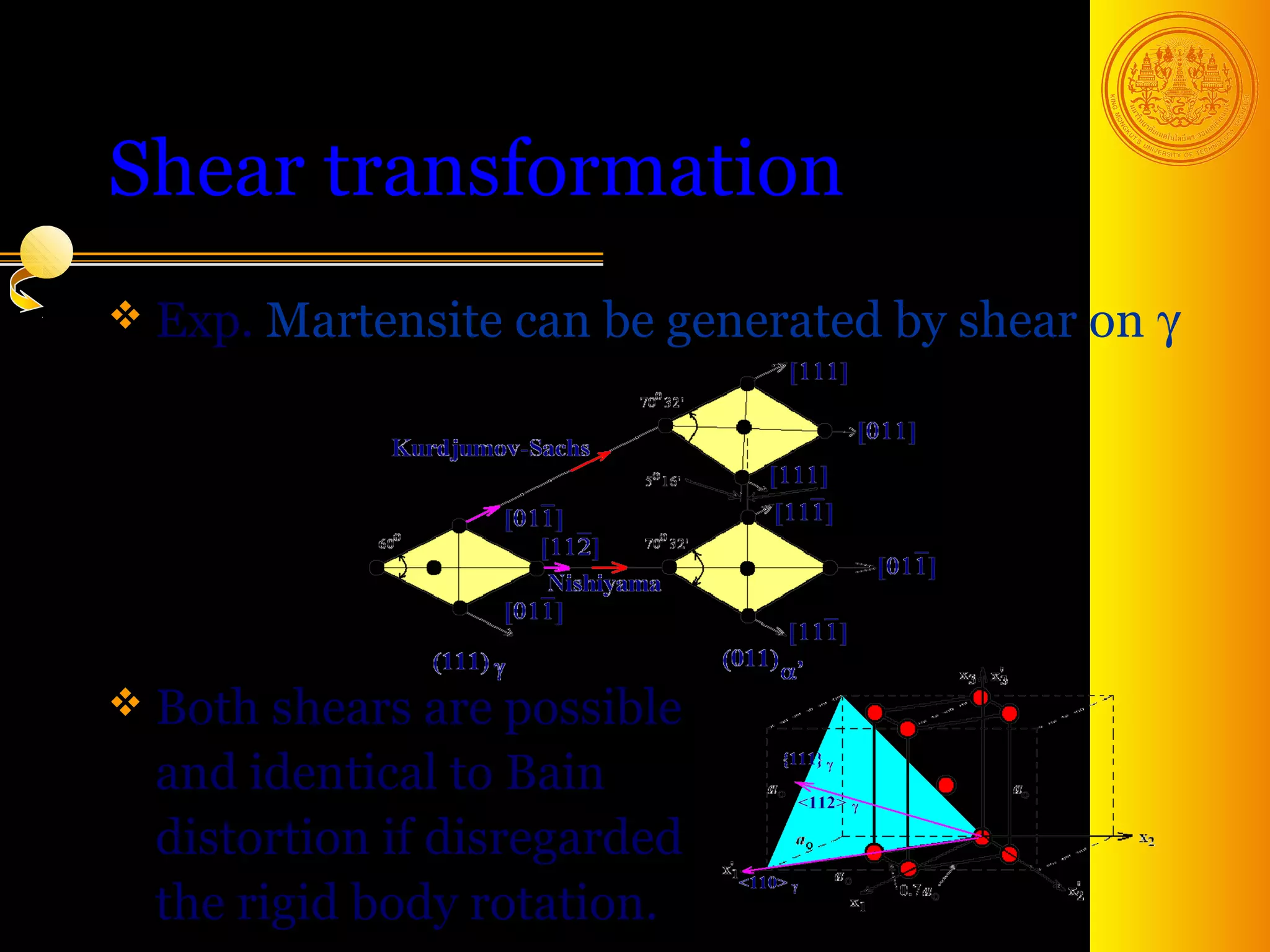
 Exp.   Martensite can be generated by shear on γ


 Both shears are possible
  and identical to Bain
  distortion if disregarded
  the rigid body rotation.               3
Shear transformation
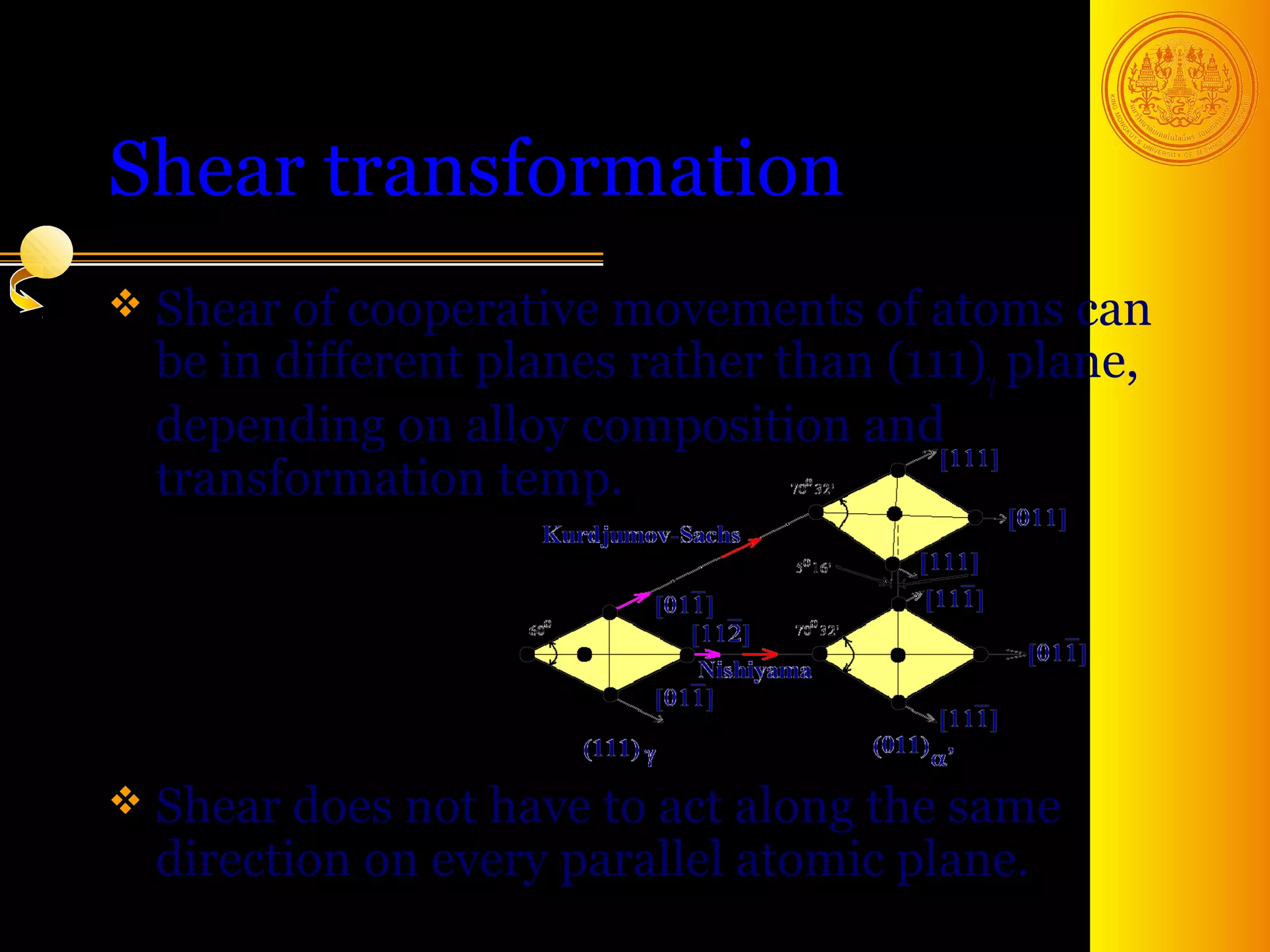
 Shear of cooperative  movements of atoms can
  be in different planes rather than (111)γ plane,
  depending on alloy composition and
  transformation temp.


 Shear does not have  to act along the same
  direction on every parallel atomic plane.
                                          4
Shear transformation
 Greninger and Troiano (1949) found   that
   Observed shear plane in Fe-22% Ni-0.8% C
    was not the {111}γ plane and the shear angle
    was 10.45°, not 19.5° as predicted by shear
    mechanism.

 Theysuggested that another shear had to be
  added in order to complete the mechanism.

                                        5
Double shear transformation
 The first shear isa macroscopic shear
  that contributes the shape change and
  change in crystal structure.

 The second    shear is a microscopic shear.
   Invariant plane
   Bain distortion has no invariant plane

   Lattice-invariant shear with Bain distortion

                                        6
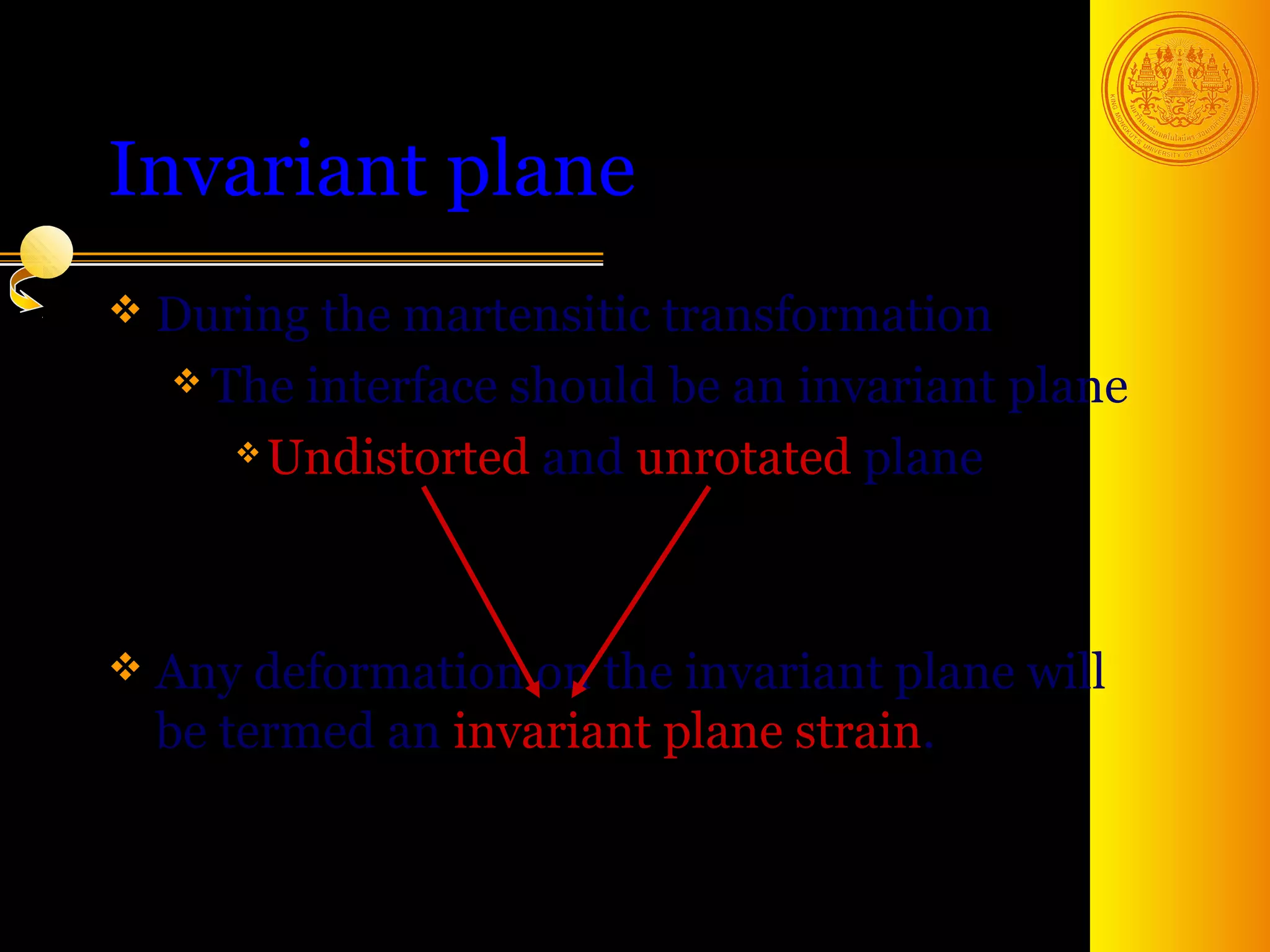
Invariant plane
 During the martensitic transformation
   The interface should be an invariant plane

      Undistorted and unrotated plane


 Any deformation  on the invariant plane will
  be termed an invariant plane strain.


                                        7
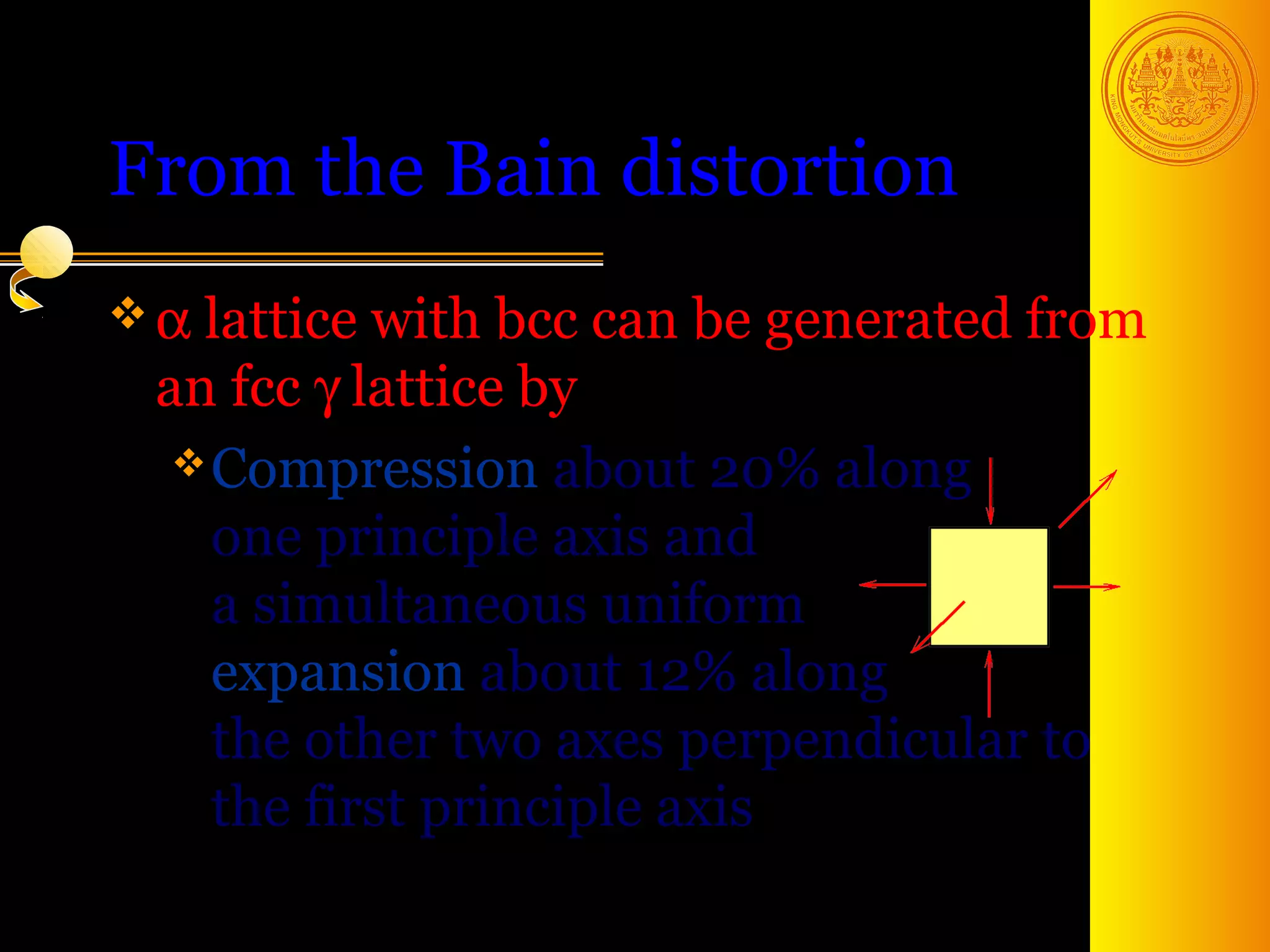
From the Bain distortion
 α lattice with bcc can be generated from
  an fcc γ lattice by
    Compression about 20% along
     one principle axis and
     a simultaneous uniform
     expansion about 12% along
     the other two axes perpendicular to
     the first principle axis
                                   8
Bain distortion of a sphere
 Due to the Bain distortion
   A unit sphere of the parent crystal
    transforms into an oblate spheroid of the
    product crystal
      Contraction about 20% along the one

       principle axis
      Expansion about 12% along the other

       two axes perpendicular to the first
       principle axis
                                       9
Bain distortion of a sphere
 Initial   sphere equation of the parent crystal
                     x12 + x2 + x3 = 1
                            2    2


            12% expansion                         20% contraction
 Ellipsoid equation           of the transformed crystal

                 (x )
                    ' 2
                    1
                               +
                                    (x )
                                       ' 2
                                       2
                                                  +
                                                       (x )
                                                          ' 2
                                                          3
                                                                     =1
                ( 1.12 )           ( 1.12 )           ( 0.80 )
                           2                  2                  2


                                                                          10
Bain distortion of a sphere
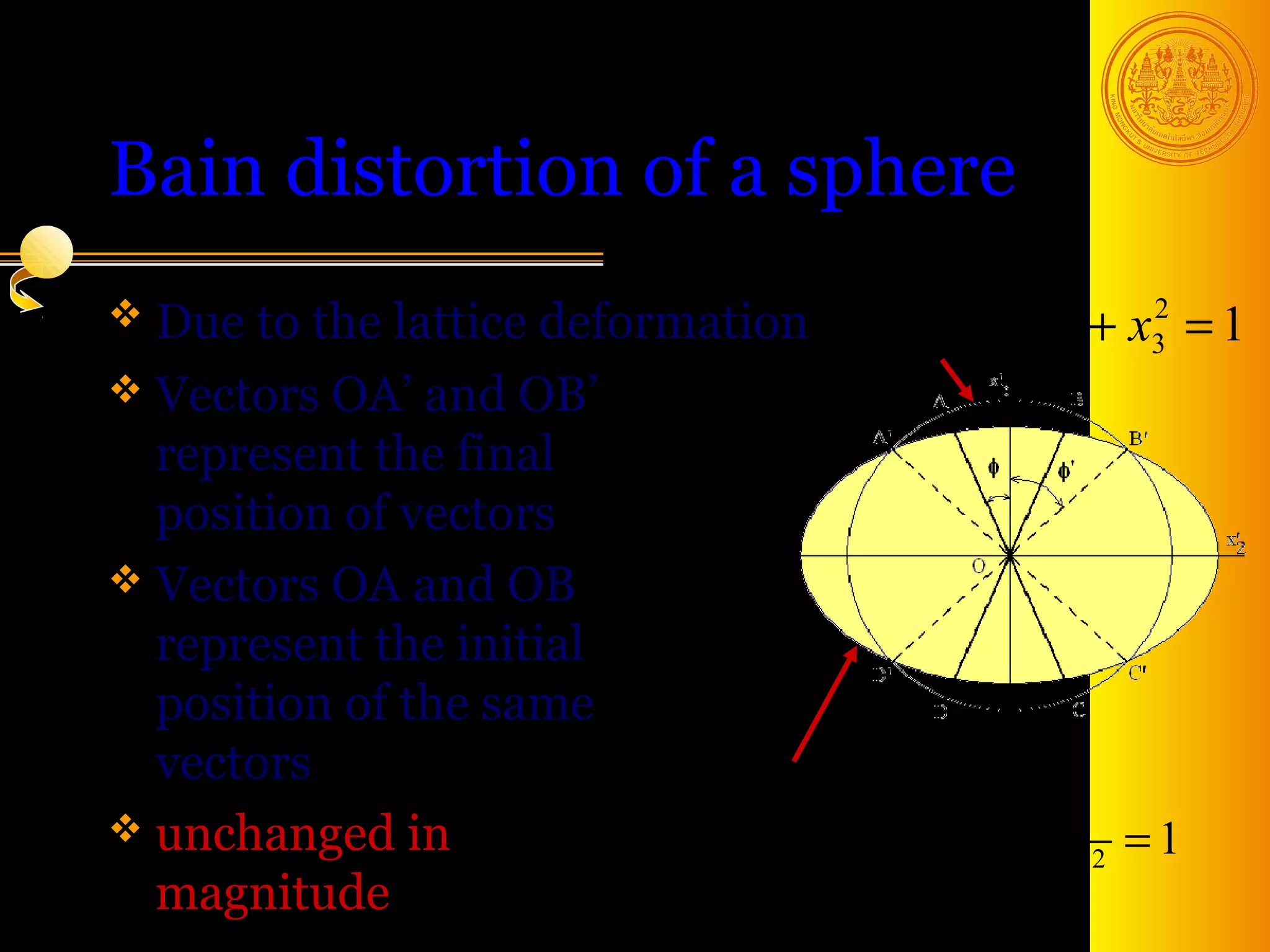
 Due  to the lattice deformation            x12 + x2 + x3 = 1
                                                      2   2

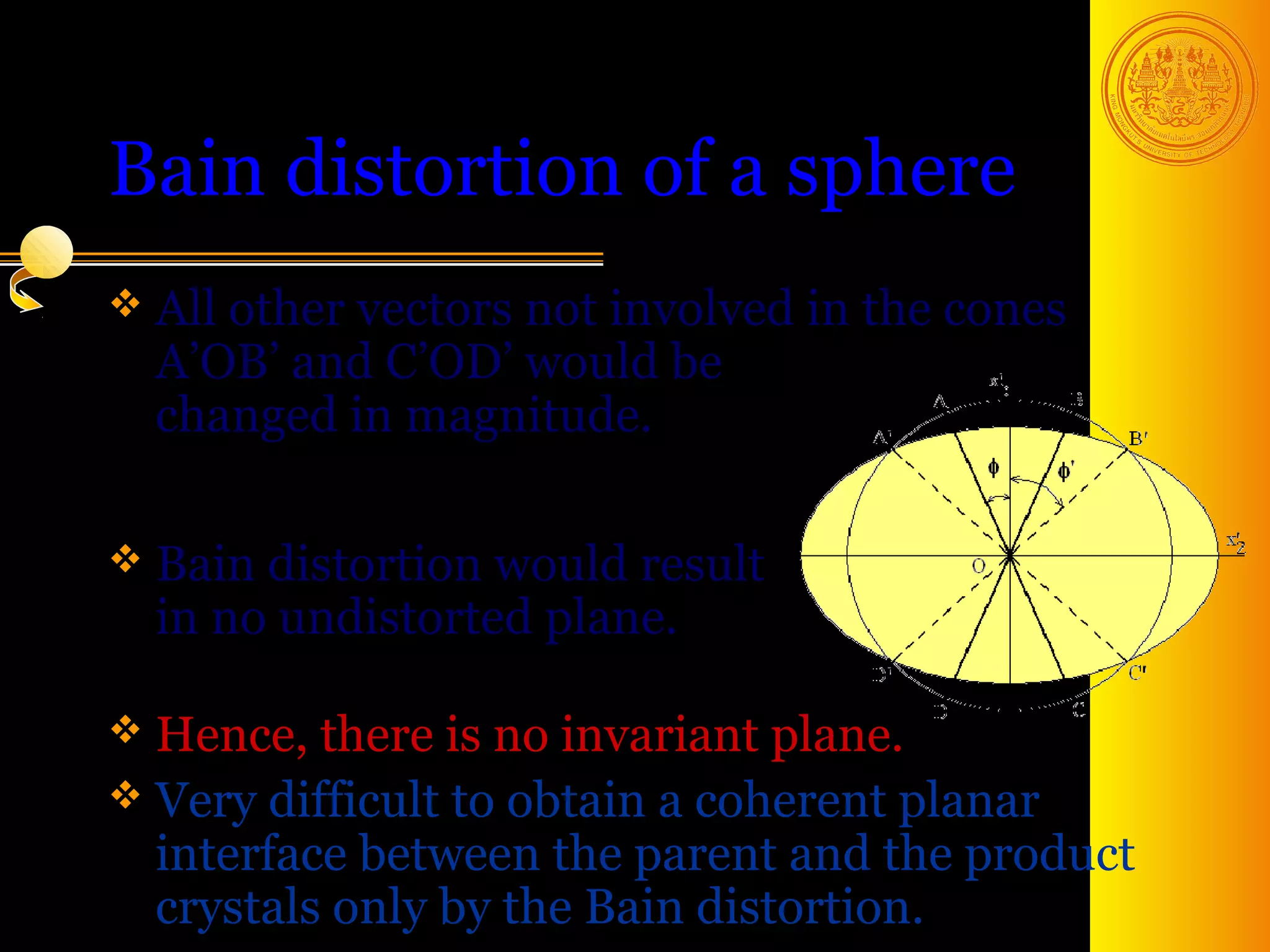
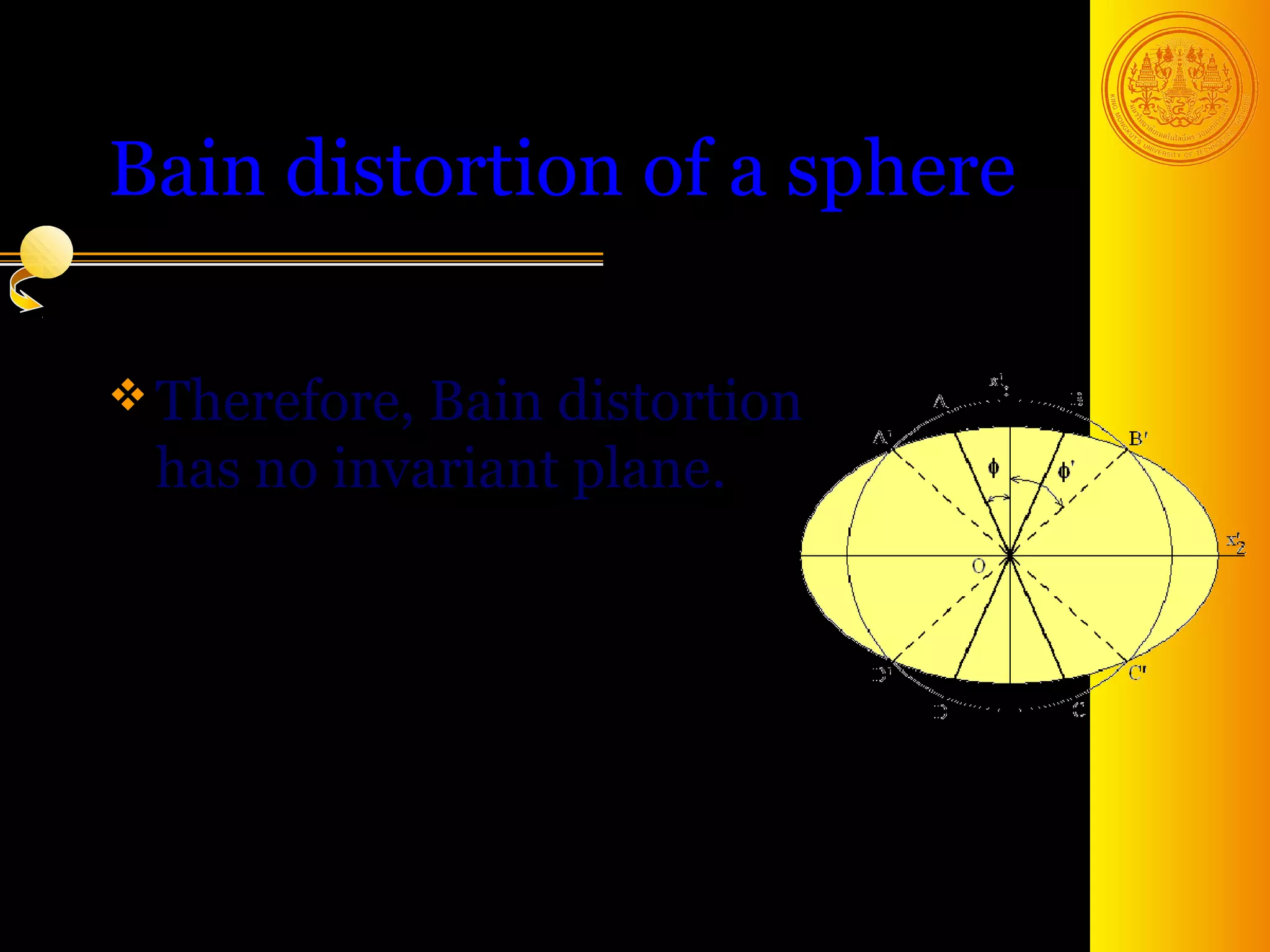
 Vectors OA’ and OB’
  represent the final
  position of vectors
 Vectors OA and OB
  represent the initial
  position of the same
  vectors
 unchanged in
                           ( x1 ) + ( x2 ) + ( x3 ) = 1
                              ' 2      ' 2          ' 2


                         ( 1.12 ) ( 1.12 ) ( 11 )
                                  2        2            2
  magnitude                                      0.80
Bain distortion of a sphere
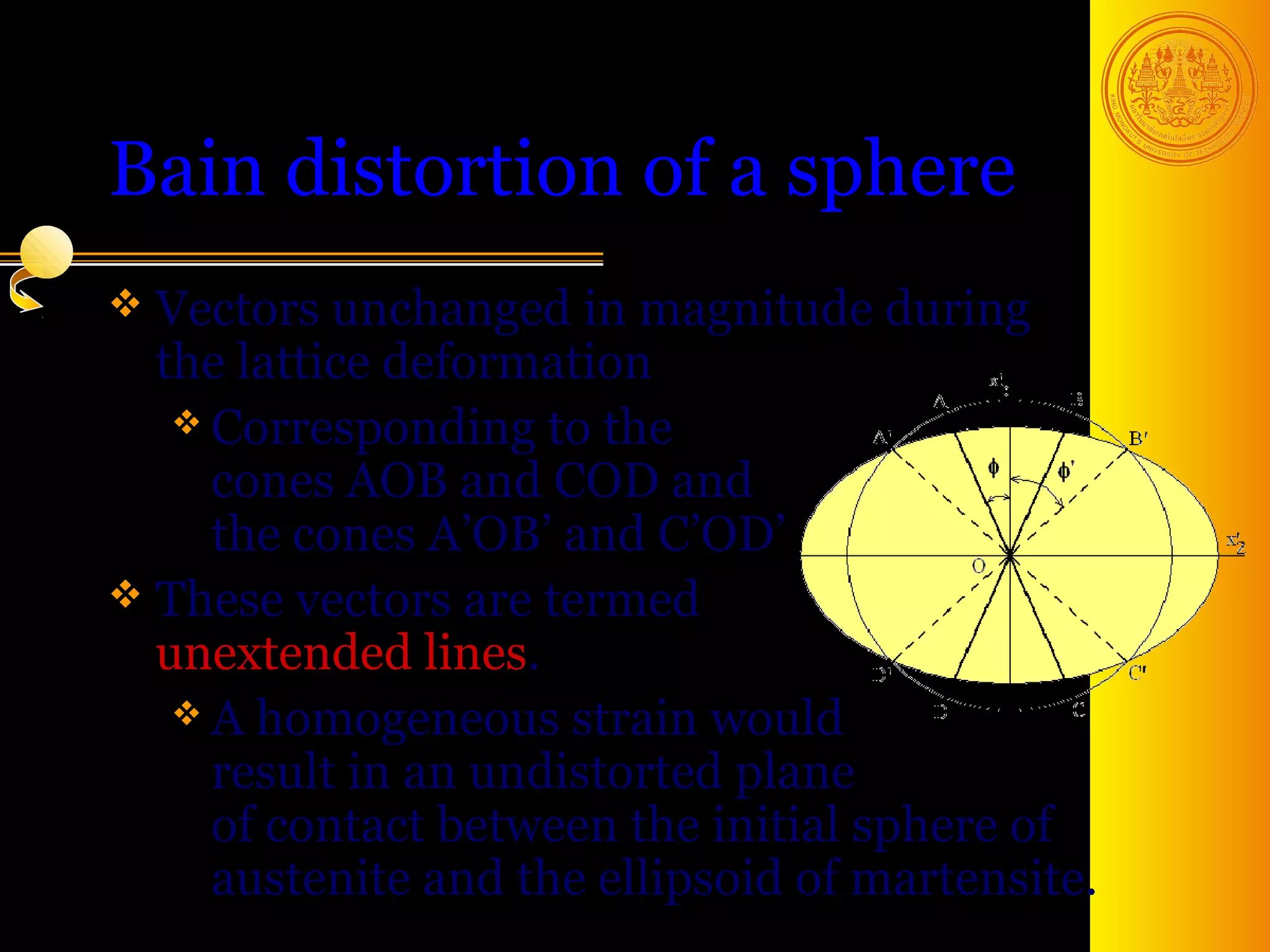
 Vectors unchanged in   magnitude during
  the lattice deformation
    Corresponding to the
     cones AOB and COD and
     the cones A’OB’ and C’OD’
 These vectors are termed
  unextended lines.
    A homogeneous strain would
     result in an undistorted plane
     of contact between the initial sphere of
     austenite and the ellipsoid of martensite.
                                          12
Bain distortion of a sphere
 Allother vectors not involved in the cones
  A’OB’ and C’OD’ would be
  changed in magnitude.

 Bain distortion would result
  in no undistorted plane.

 Hence,  there is no invariant plane.
 Very difficult to obtain a coherent planar
  interface between the parent and the product
  crystals only by the Bain distortion. 13
Bain distortion of a sphere

 Therefore,Bain distortion
 has no invariant plane.


                              14
Lattice-invariant shear
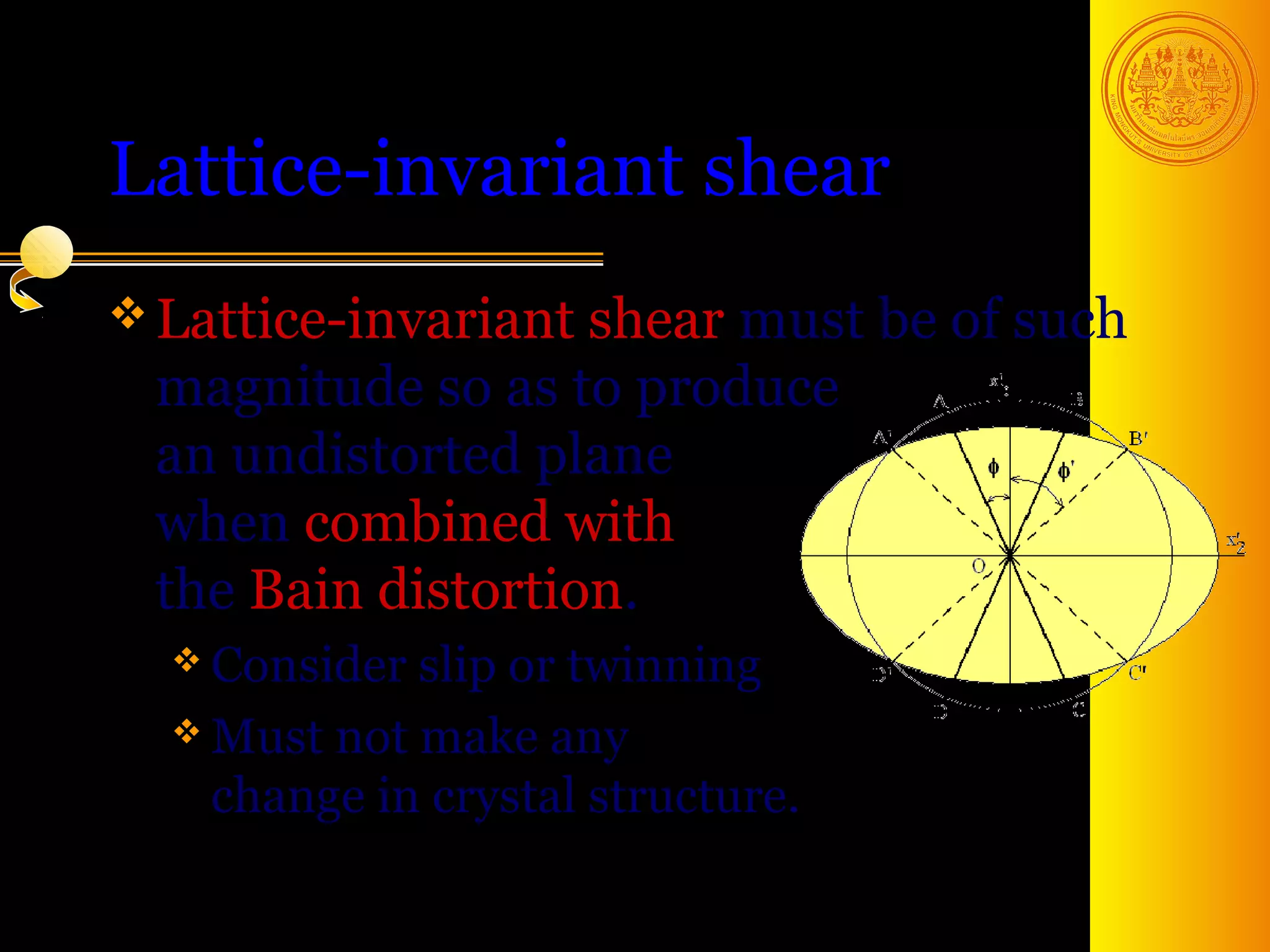
 Lattice-invariant shear
                        must be of such
 magnitude so as to produce
 an undistorted plane
 when combined with
 the Bain distortion.
   Consider slip or twinning
   Must not make any
    change in crystal structure.

                                   15
Lattice-invariant shear
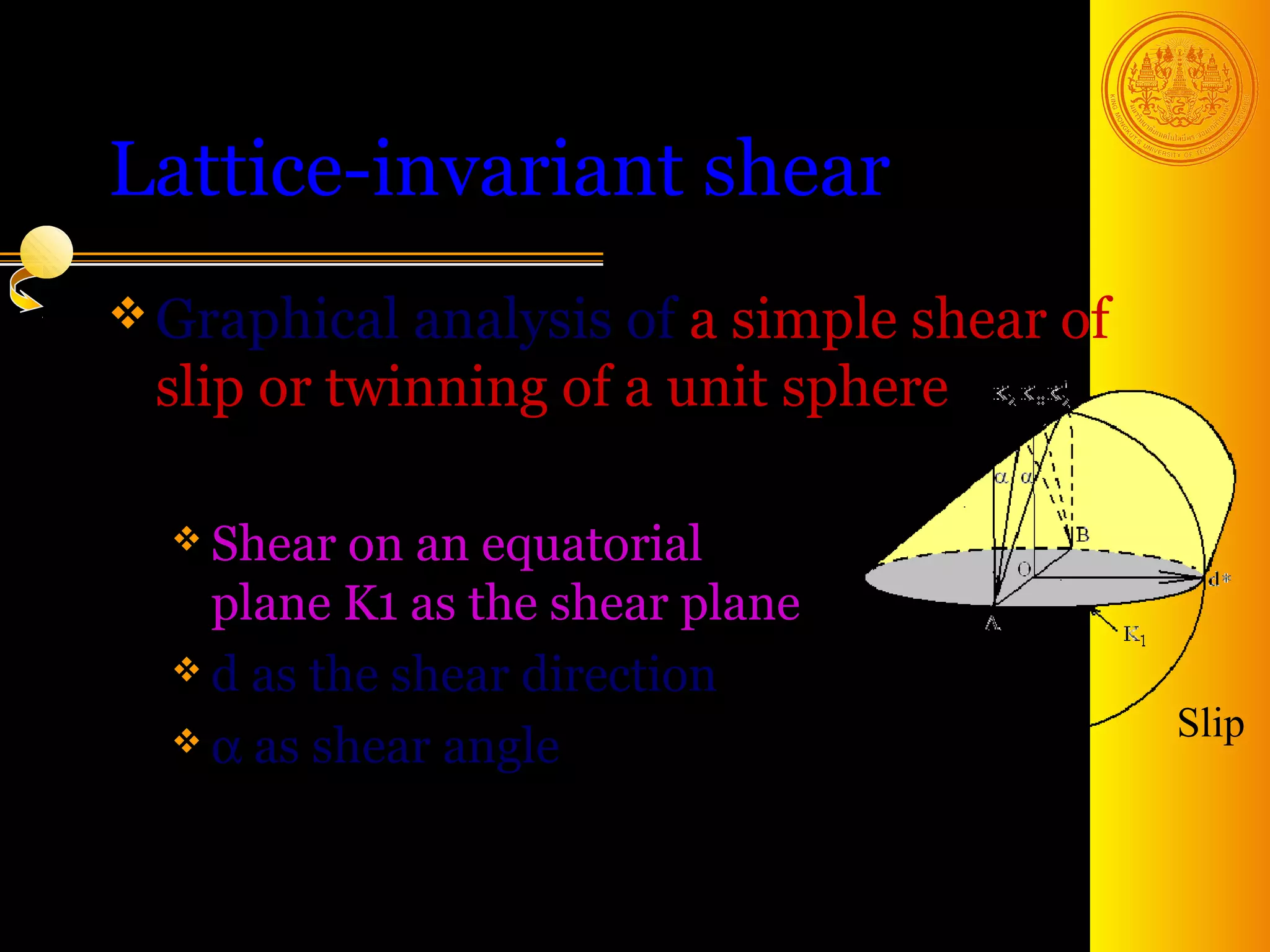
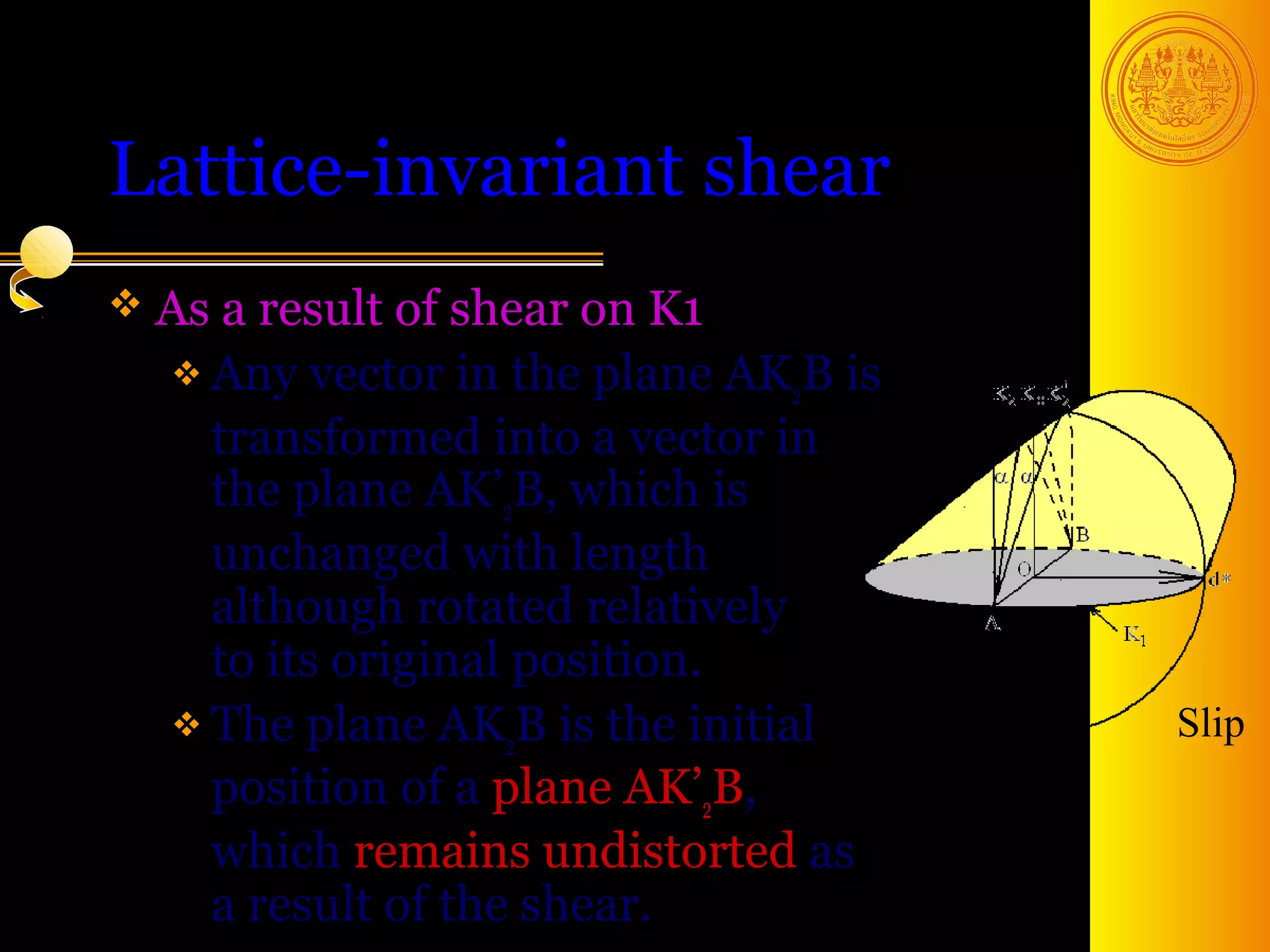
 Graphical analysis of a simple shear of
 slip or twinning of a unit sphere

   Shear  on an equatorial
    plane K1 as the shear plane
   d as the shear direction

   α as shear angle                        Slip


                                   16
Lattice-invariant shear
 As a result of  shear on K1
    Any vector in the plane AK B is
                                 2
     transformed into a vector in
     the plane AK’2B, which is
     unchanged with length
     although rotated relatively
     to its original position.
    The plane AK B is the initial          Slip
                    2
     position of a plane AK’2B,
     which remains undistorted as
     a result of the shear.            17
Lattice-invariant shear
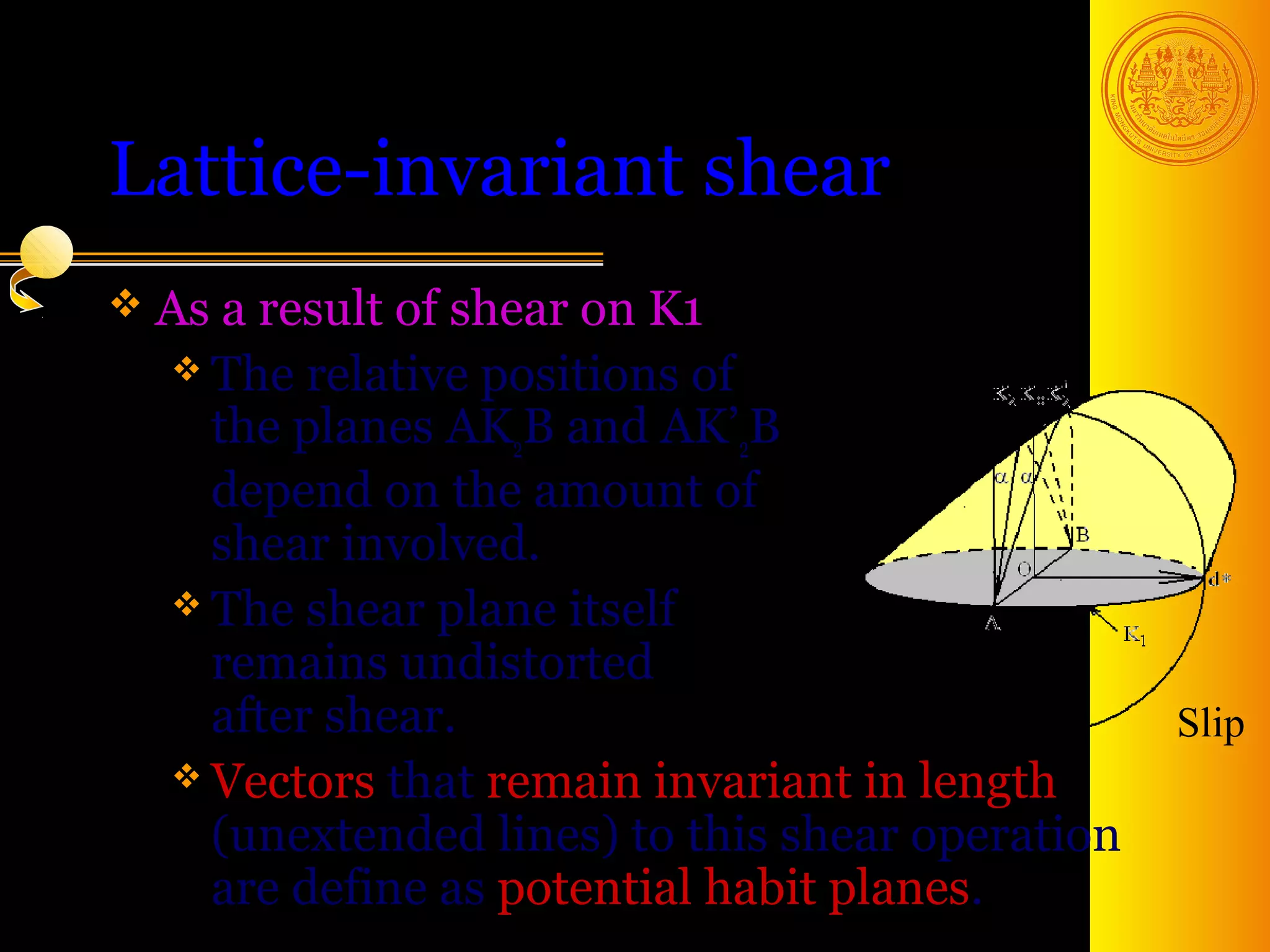
 As a result ofshear on K1
    The relative positions of
     the planes AK2B and AK’2B
     depend on the amount of
     shear involved.
    The shear plane itself
     remains undistorted
     after shear.                                 Slip
    Vectors that remain invariant in length
     (unextended lines) to this shear operation
     are define as potential habit planes. 18
Lattice-invariant shear
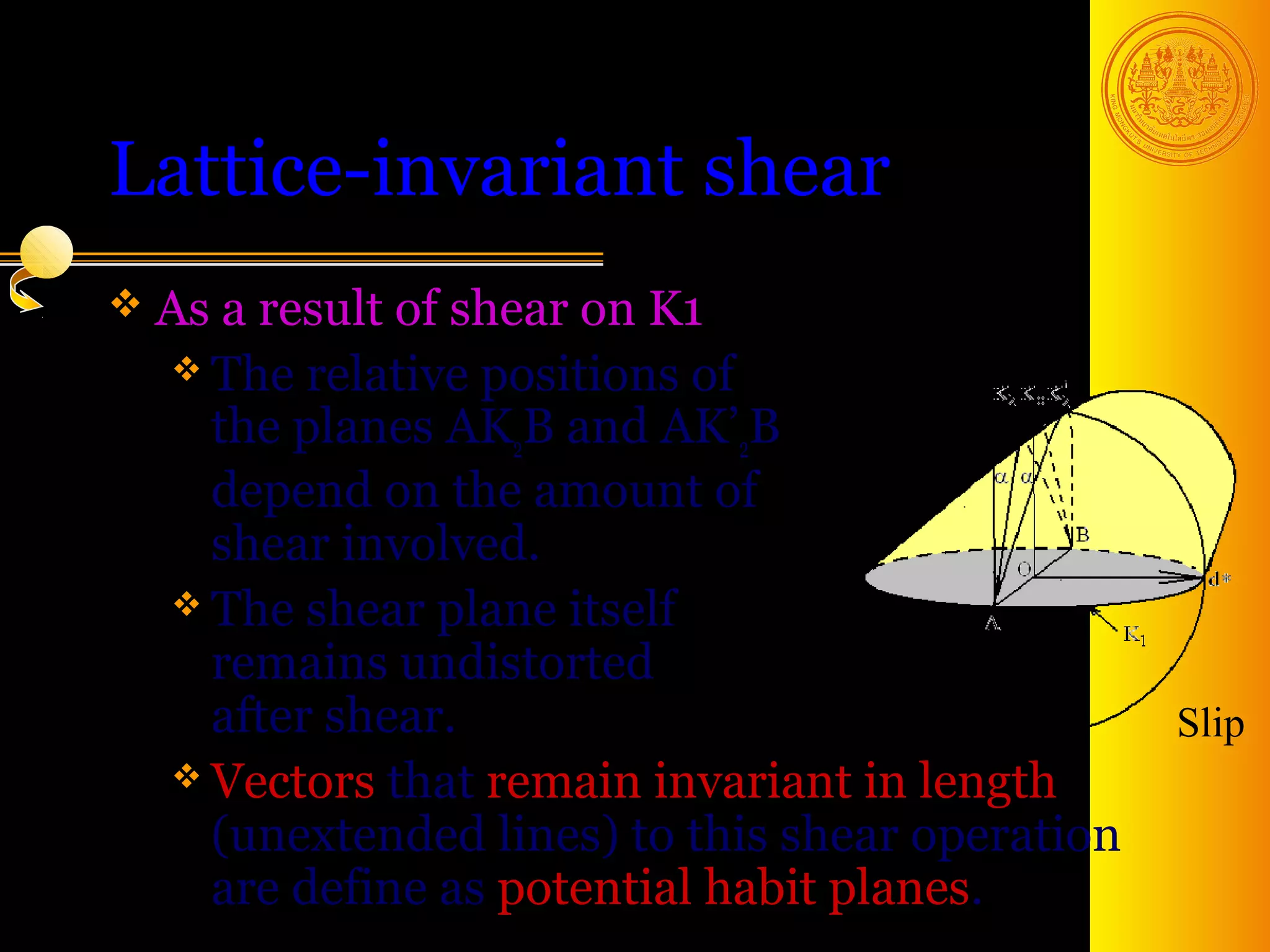
 As a result ofshear on K1
    The relative positions of
     the planes AK2B and AK’2B
     depend on the amount of
     shear involved.
    The shear plane itself
     remains undistorted
     after shear.                                 Slip
    Vectors that remain invariant in length
     (unextended lines) to this shear operation
     are define as potential habit planes. 19
Lattice-invariant shear
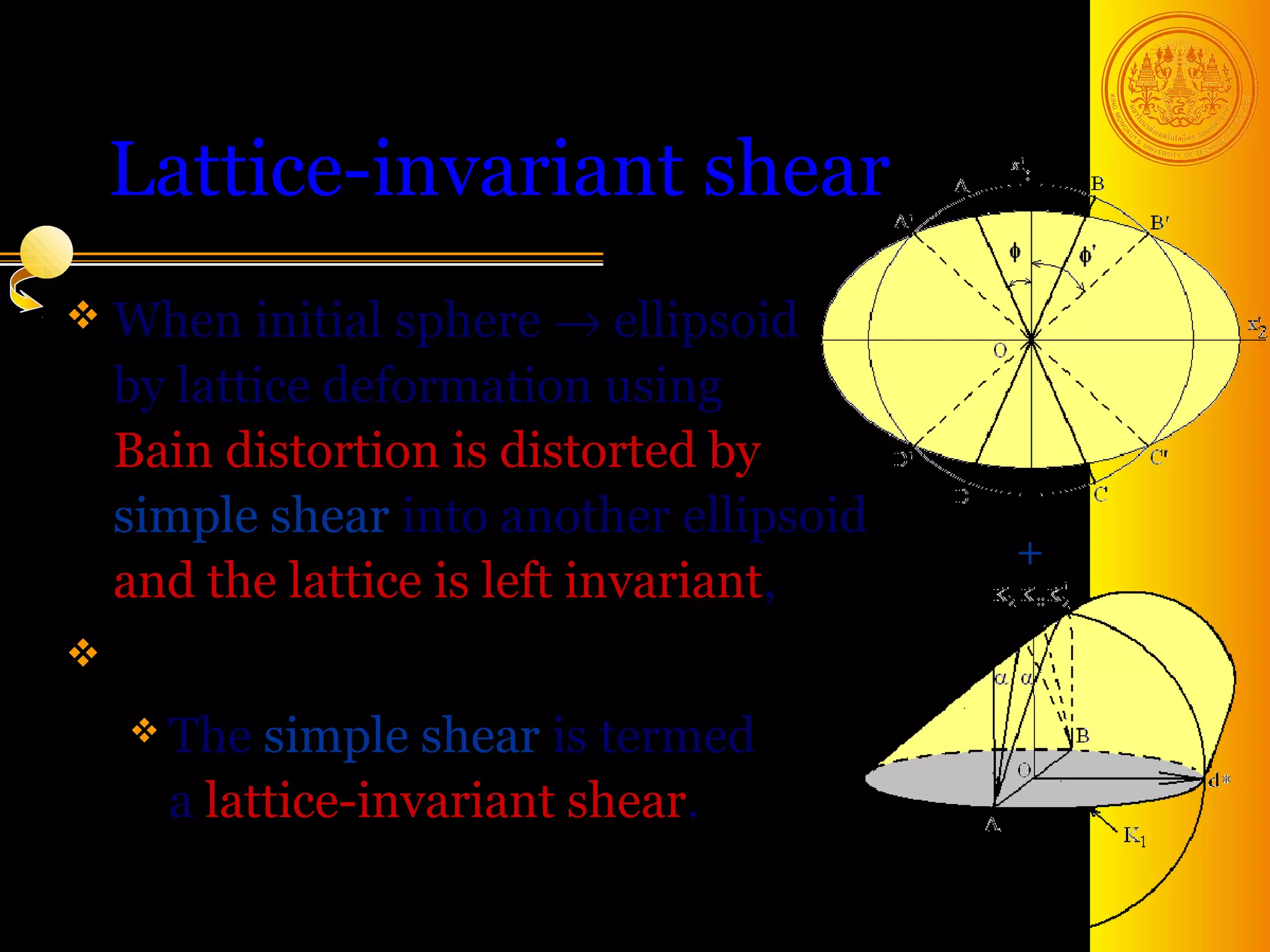
 When     initial sphere → ellipsoid
    by lattice deformation using
    Bain distortion is distorted by
    simple shear into another ellipsoid
                                           +
    and the lattice is left invariant,

     The  simple shear is termed
      a lattice-invariant shear.
                          shear
                                          20
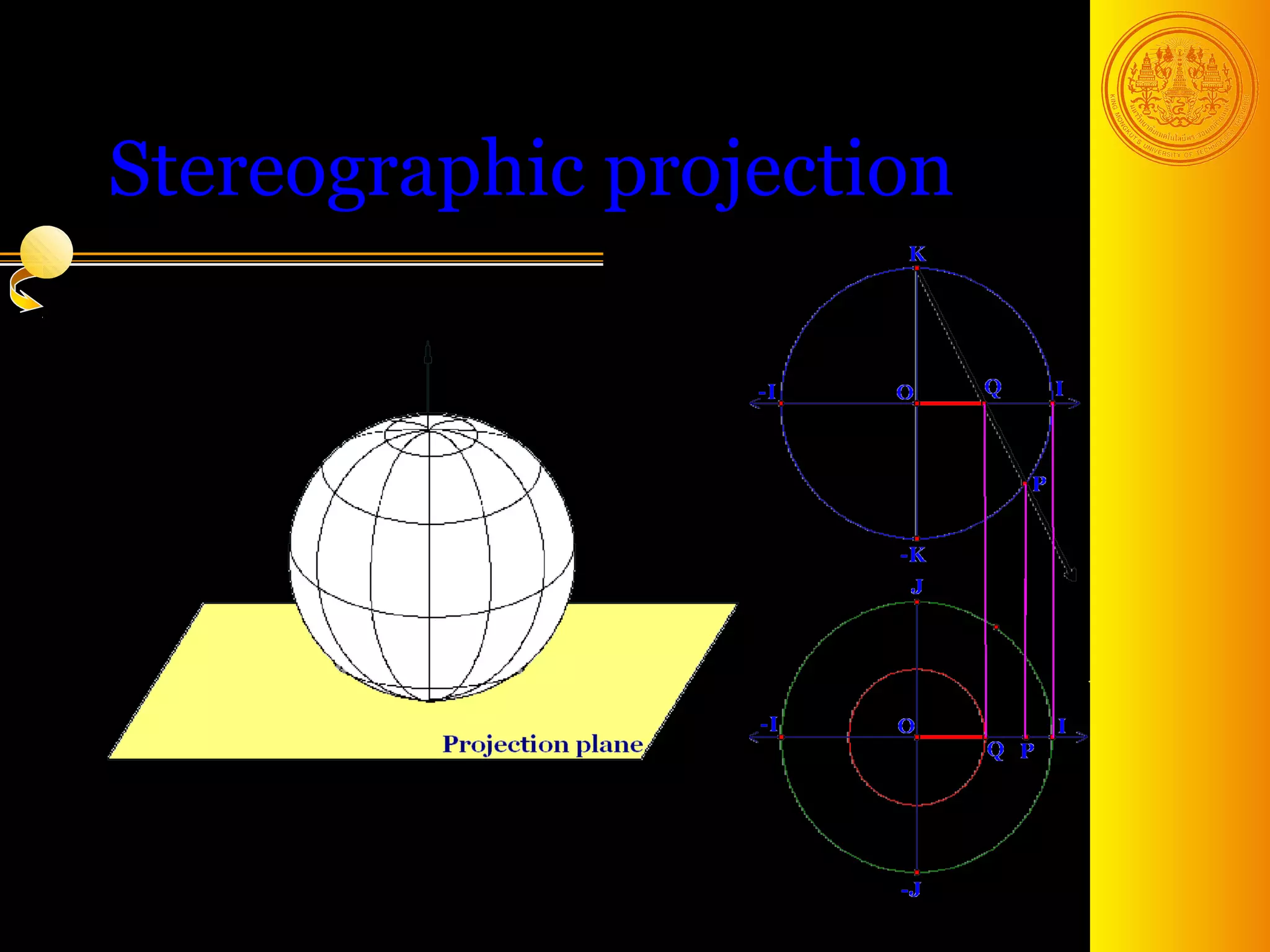
Stereographic projection


                           21
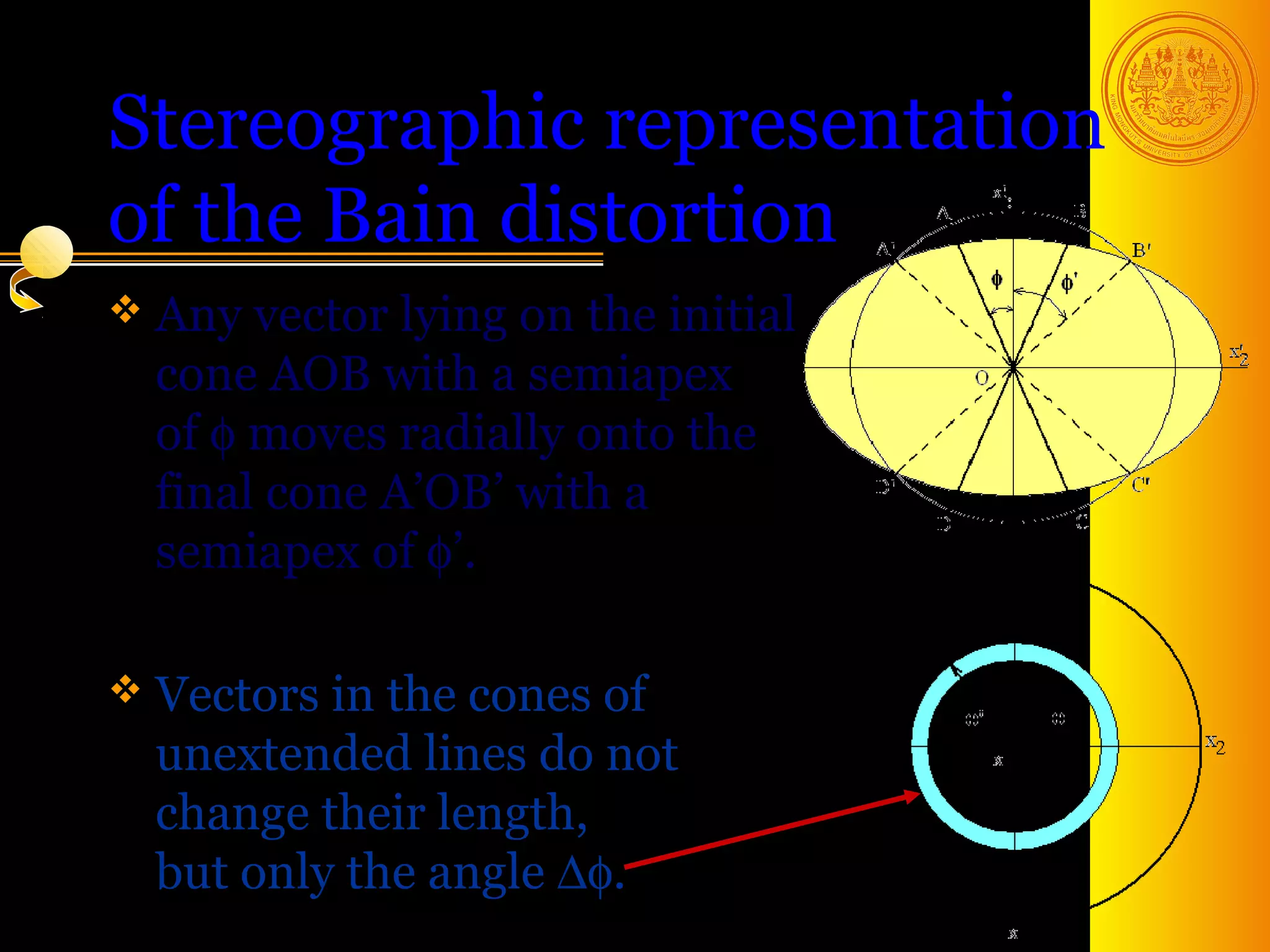
Stereographic representation
of the Bain distortion
 Any vector lying on the initial
  cone AOB with a semiapex
  of φ moves radially onto the
  final cone A’OB’ with a
  semiapex of φ’.

 Vectors in the cones of
  unextended lines do not
  change their length,
  but only the angle ∆φ.
                                    22
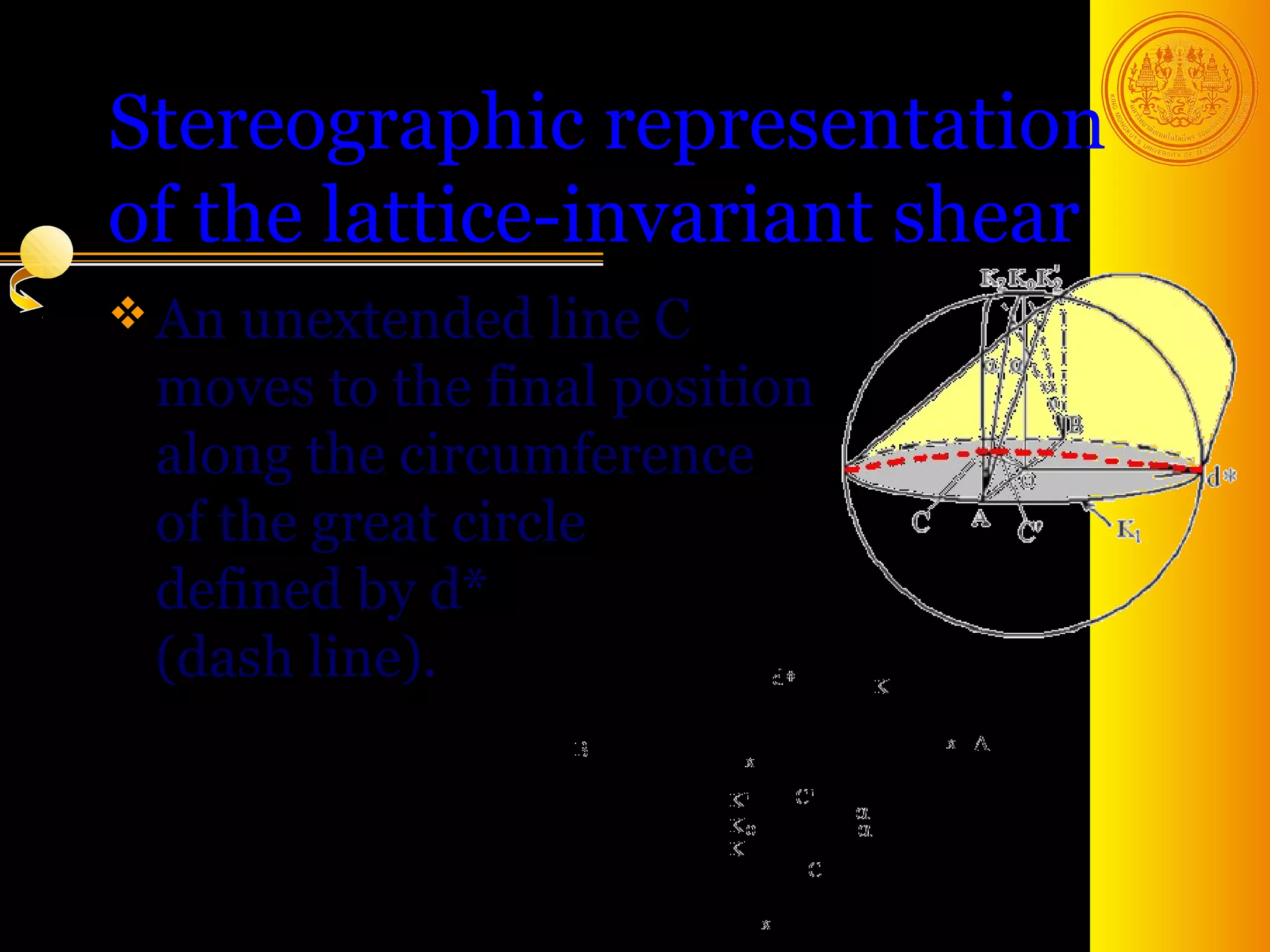
Stereographic representation
of the lattice-invariant shear
 An unextended line C
 moves to the final position
 along the circumference
 of the great circle
 defined by d*
 (dash line).


                               23
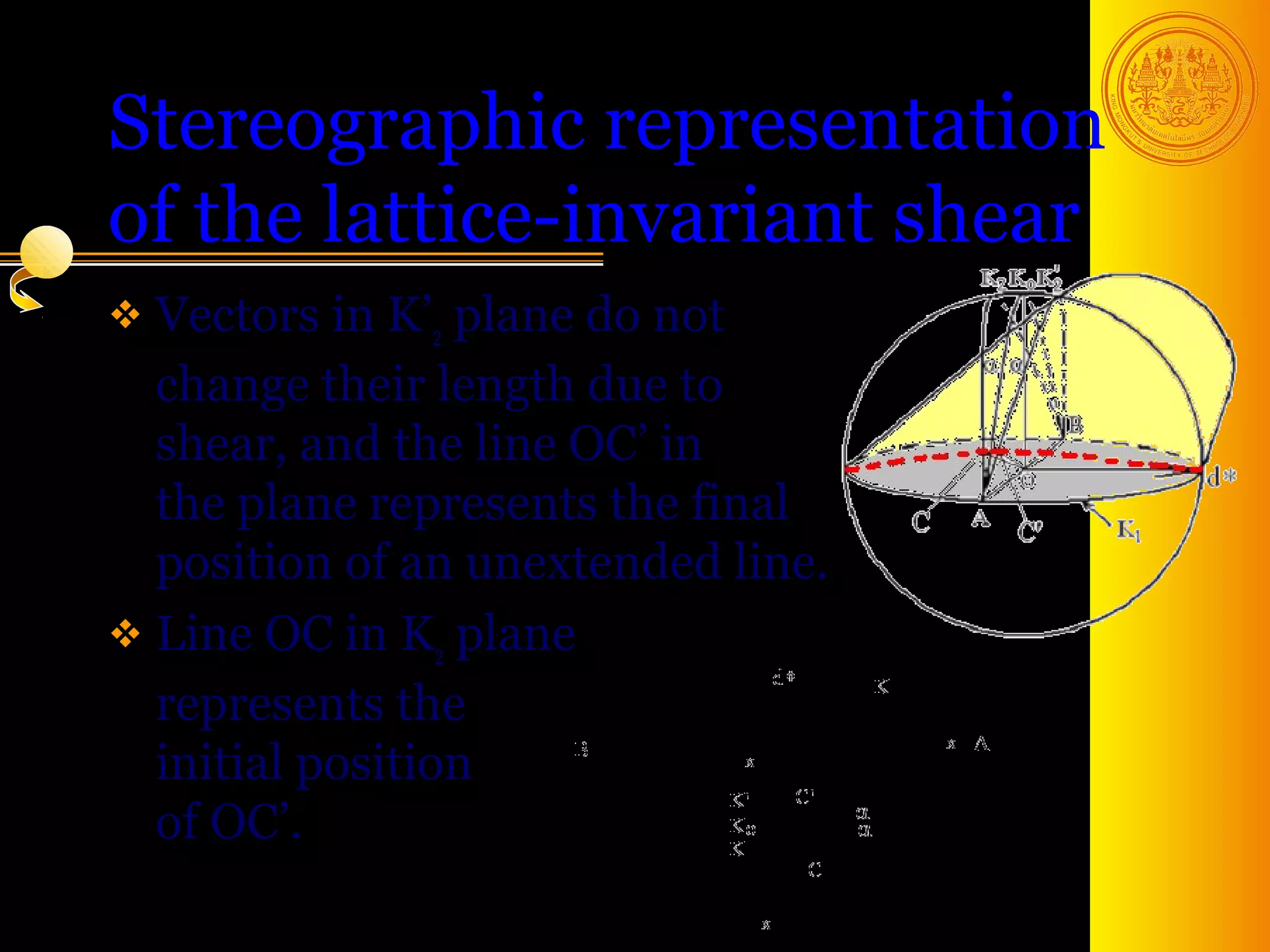
Stereographic representation
of the lattice-invariant shear
 Vectors in K’2 plane do not
  change their length due to
  shear, and the line OC’ in
  the plane represents the final
  position of an unextended line.
 Line OC in K2 plane
  represents the
  initial position
  of OC’.
                                    24
Requirement for habit plane
 Both Bain   distortion and lattice
  invariant shear provide an undistorted
  plane for the habit plane.
 Additional requirement is that the habit
  plane be unrotated.
    A rigid body rotation must be able to
     return the undistorted plane to its
     original position before
     transformation.
                                   25
3 important components
 Bain distortion
 Lattice invariant shear
 Rigid body rotation


                            26
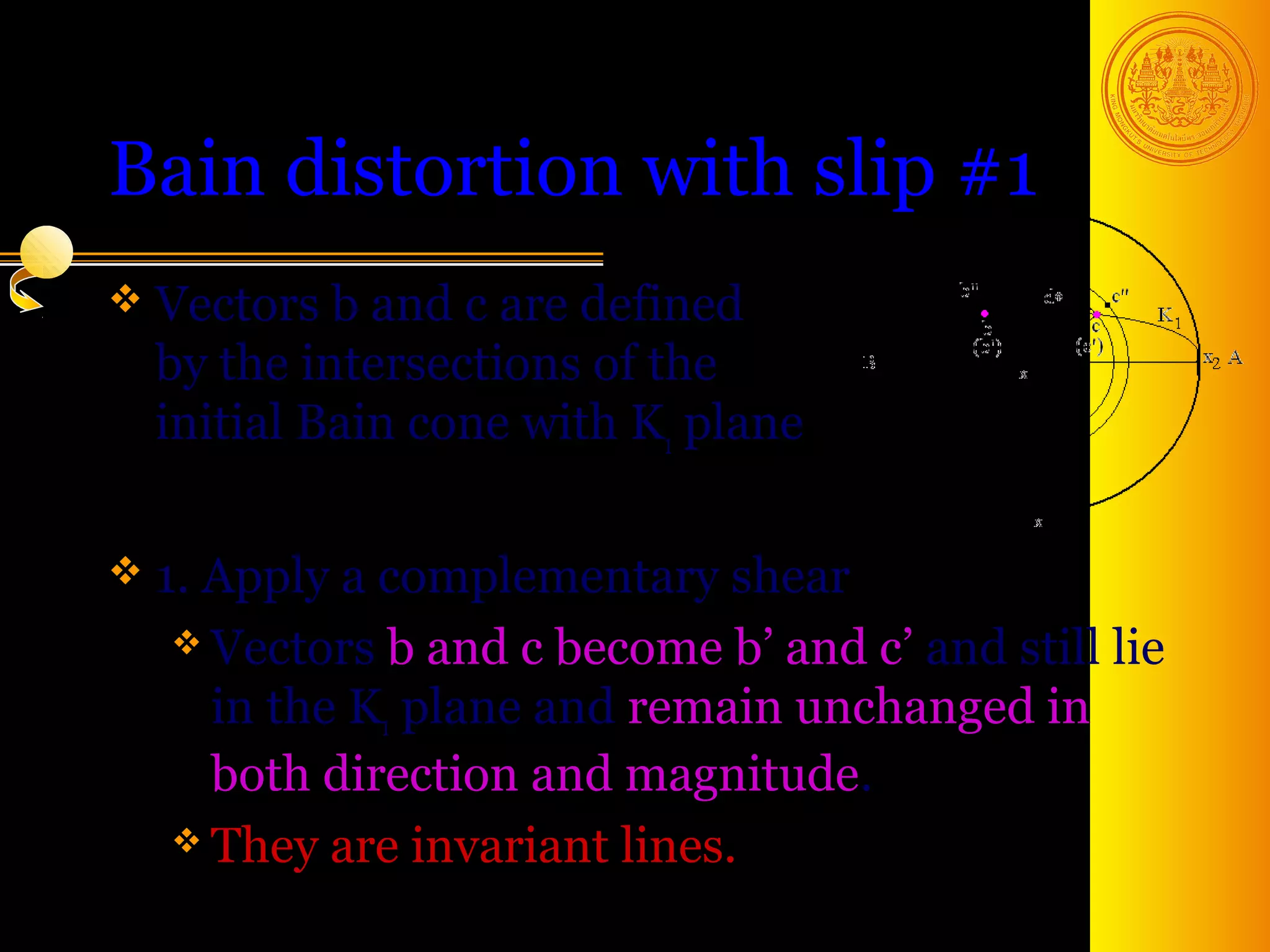
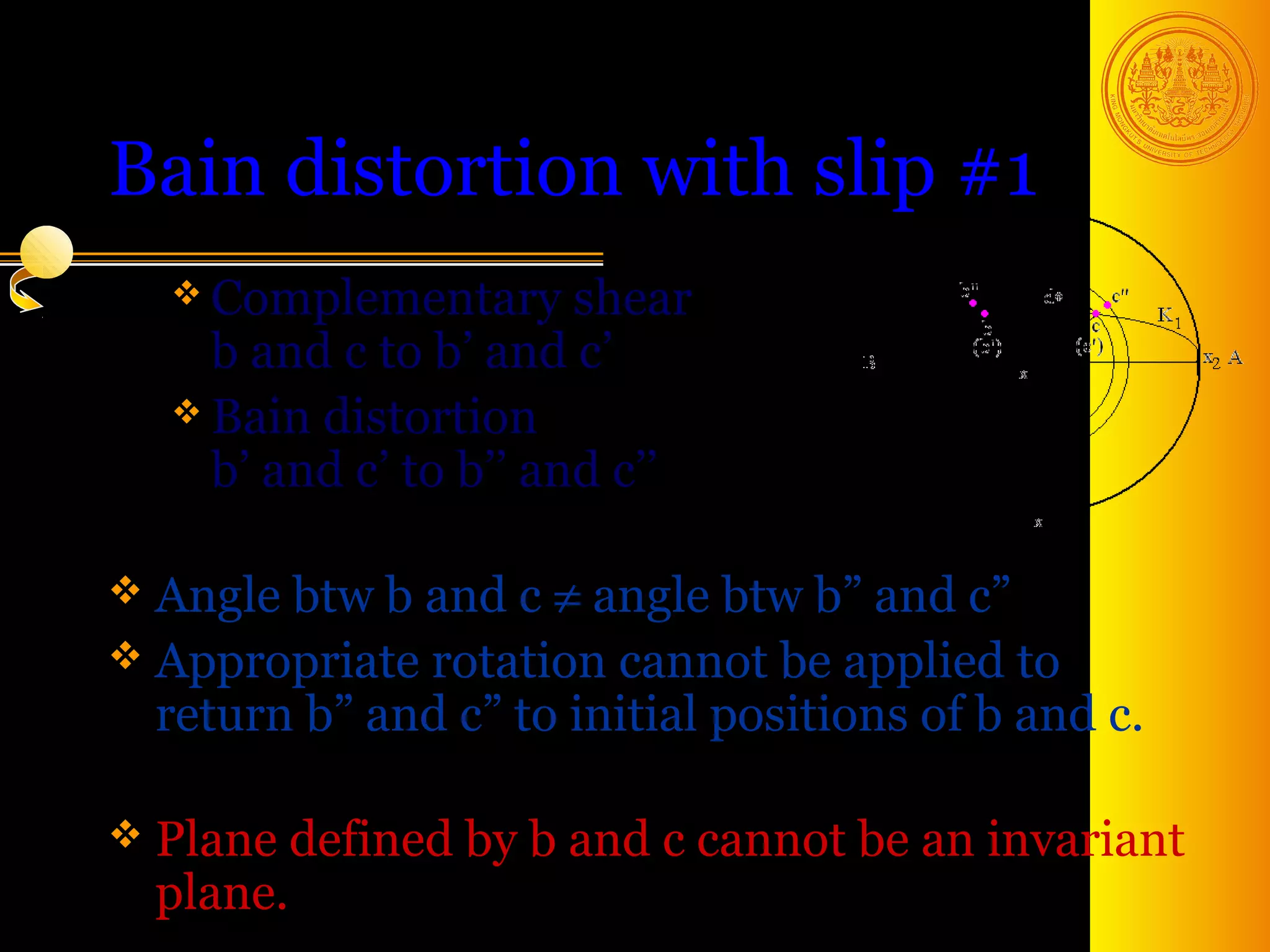
Bain distortion with slip #1
 Vectors b and c  are defined
  by the intersections of the
  initial Bain cone with K1 plane

 1.Apply a complementary shear
    Vectors b and c become b’ and c’ and still lie
     in the K1 plane and remain unchanged in
     both direction and magnitude.
    They are invariant lines.
                                          27
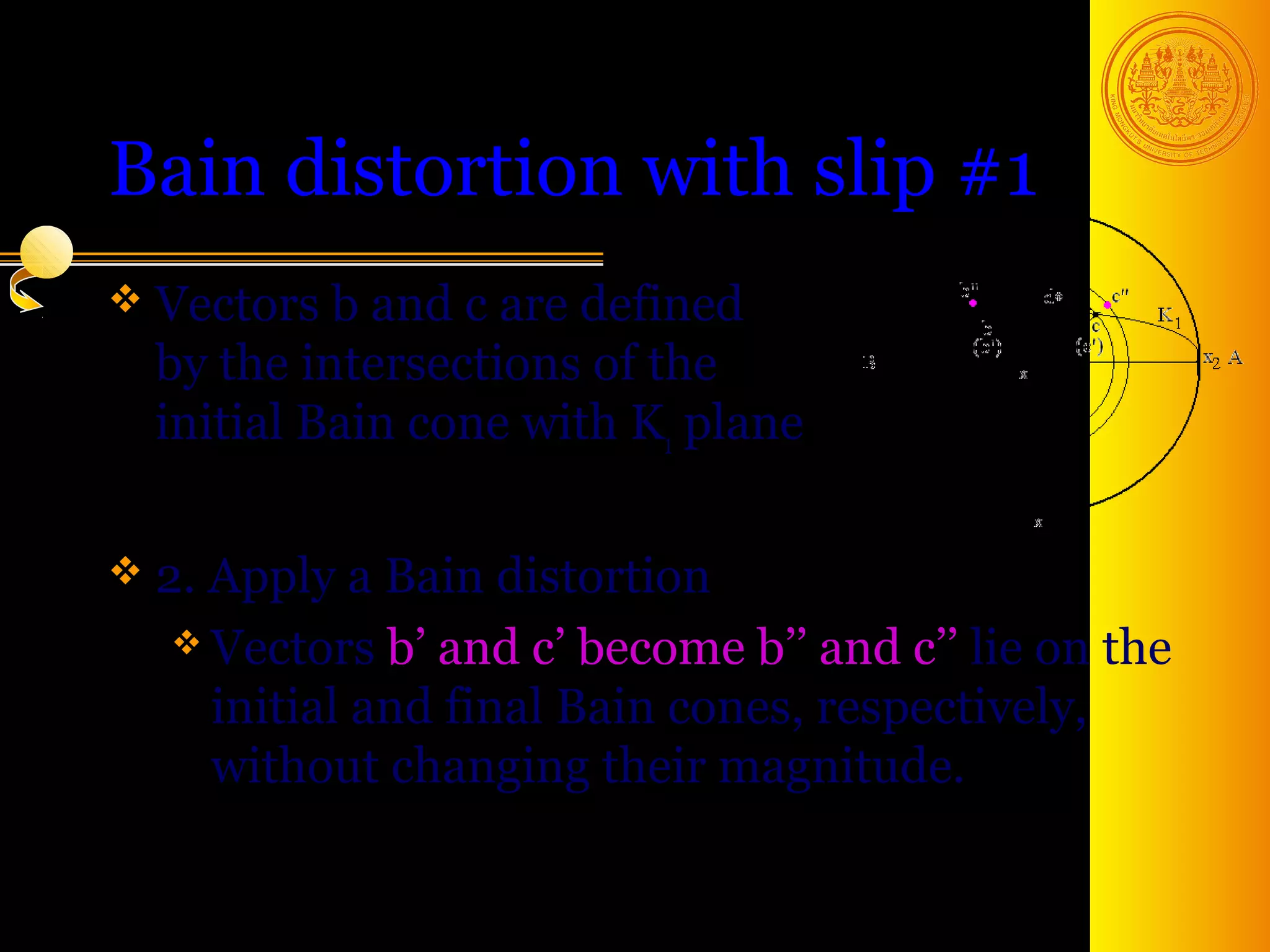
Bain distortion with slip #1
 Vectors b and c  are defined
  by the intersections of the
  initial Bain cone with K1 plane

 2.Apply a Bain distortion
   Vectors b’ and c’ become b’’ and c’’ lie on the
    initial and final Bain cones, respectively,
    without changing their magnitude.

                                         28
Bain distortion with slip #1
    Complementary      shear
     b and c to b’ and c’
    Bain distortion
     b’ and c’ to b’’ and c’’

 Angle btw b and c ≠ angle btw b” and c”
 Appropriate rotation cannot be applied to
  return b” and c” to initial positions of b and c.

 Plane    defined by b and c cannot be an invariant
  plane.                                   29
Bain distortion with slip #2
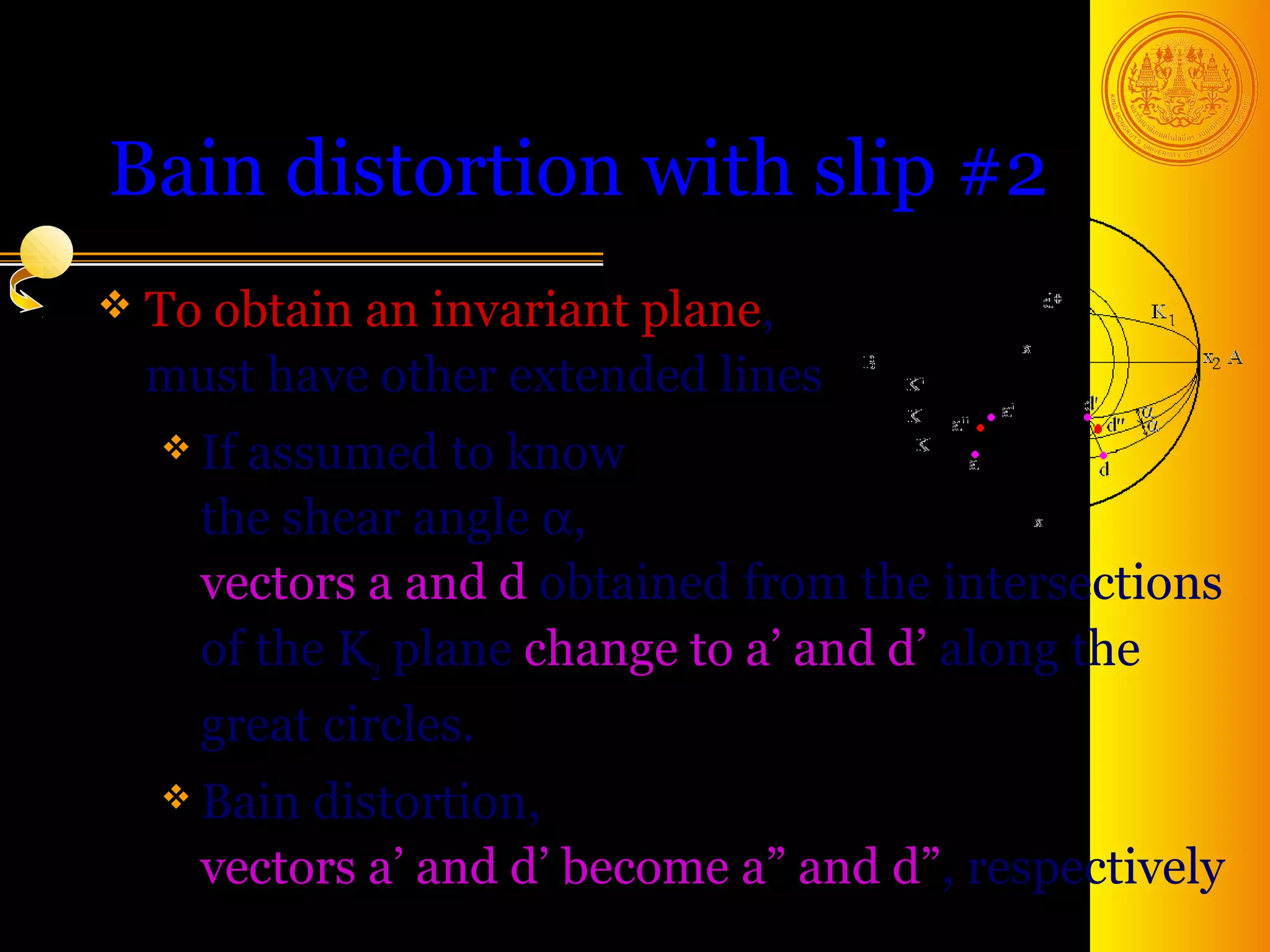
 To obtainan invariant plane,
  must have other extended lines
   Ifassumed to know
    the shear angle α,
    vectors a and d obtained from the intersections
    of the K2 plane change to a’ and d’ along the
    great circles.
   Bain distortion,
    vectors a’ and d’ become a” and d”, respectively
                                        30
Bain distortion with slip #2
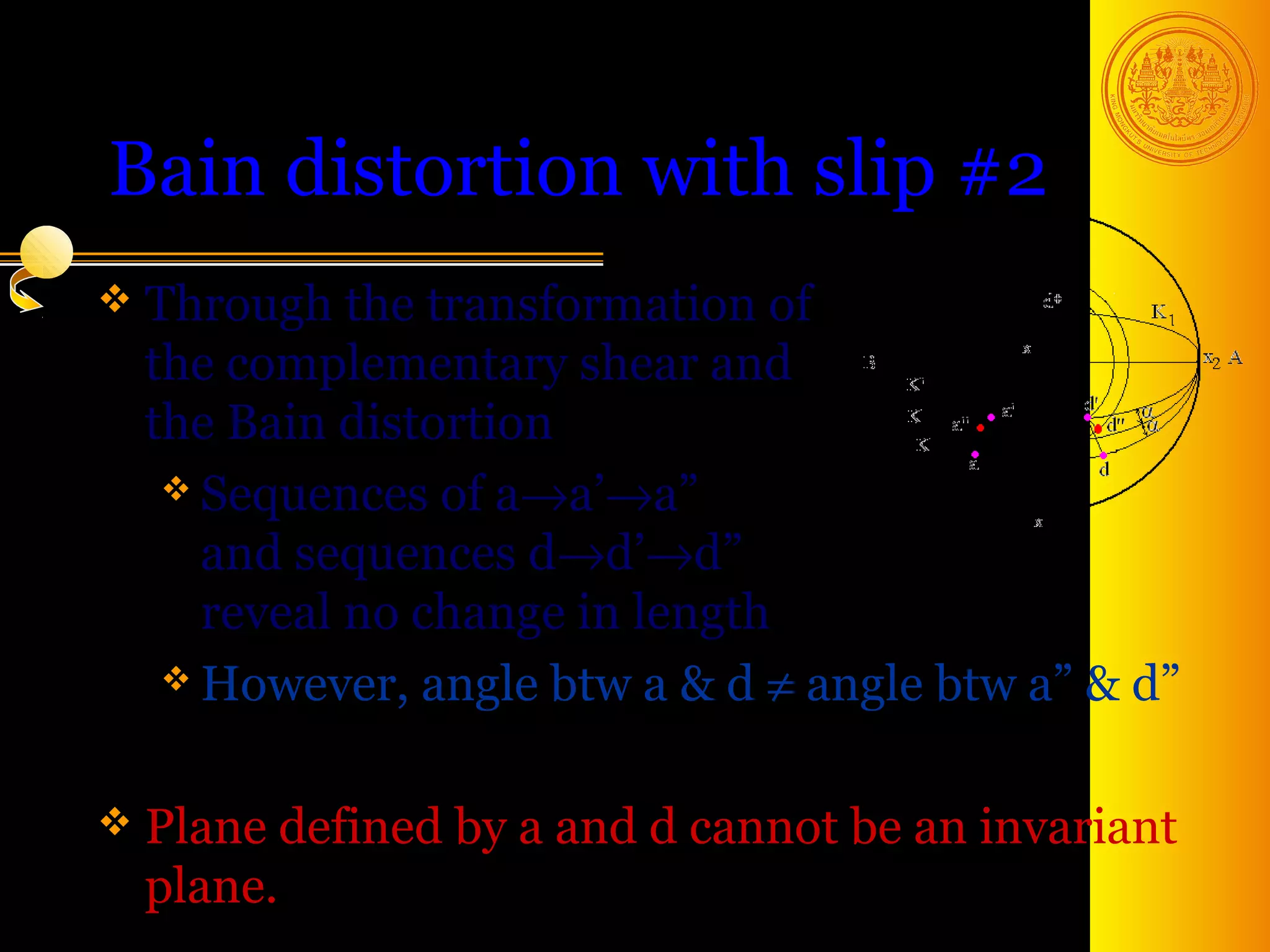
 Through  the transformation of
 the complementary shear and
 the Bain distortion
   Sequences of a→a’→a”
    and sequences d→d’→d”
    reveal no change in length
   However, angle btw a & d ≠ angle btw a” & d”


 Plane   defined by a and d cannot be an invariant
 plane.                                   31
Complete transformation
process
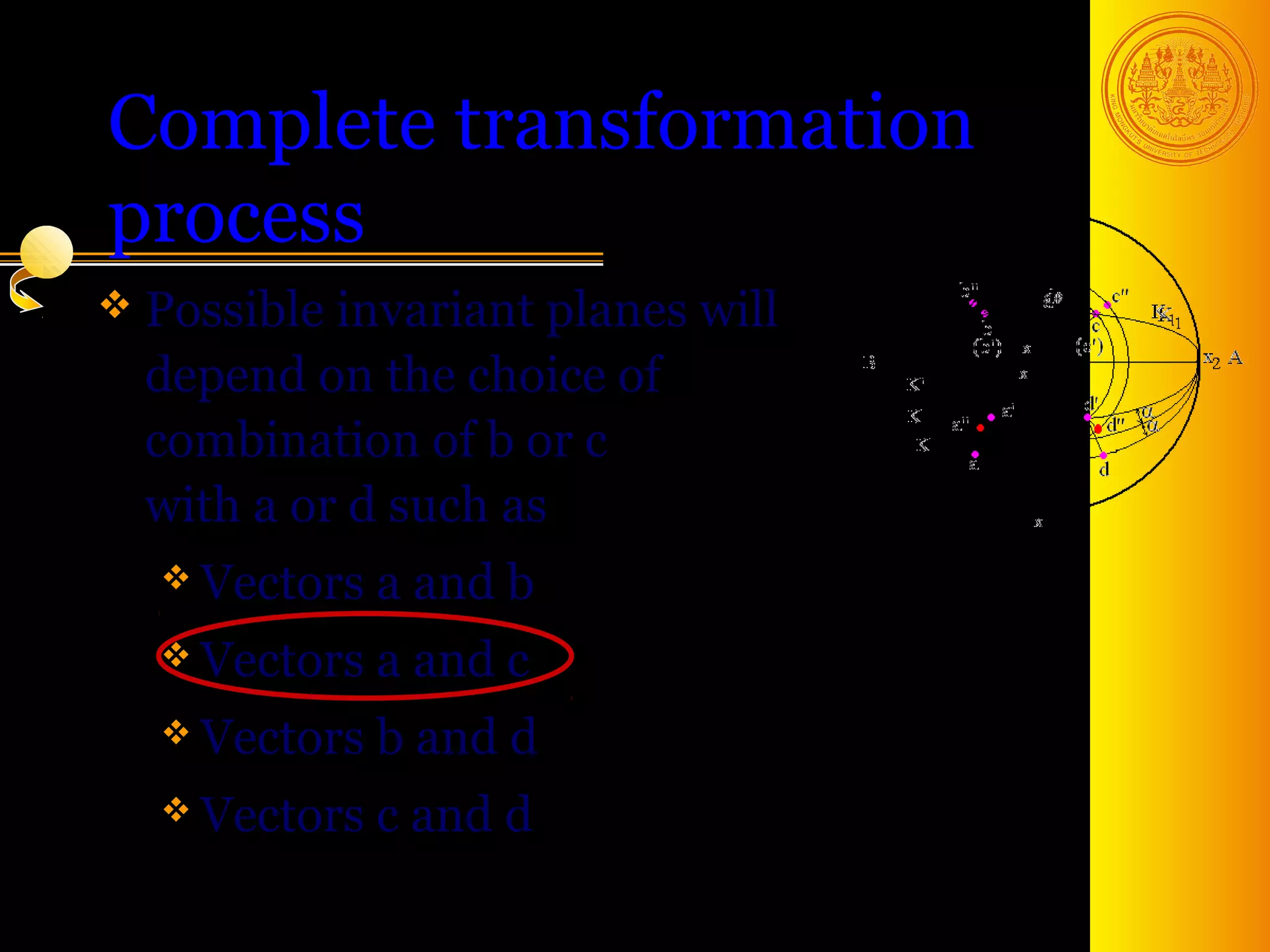
 Possible invariant planes will
  depend on the choice of
  combination of b or c
  with a or d such as
   Vectors   a and b
   Vectors   a and c
   Vectors   b and d
   Vectors   c and d
                                   32
Complete transformation
 process
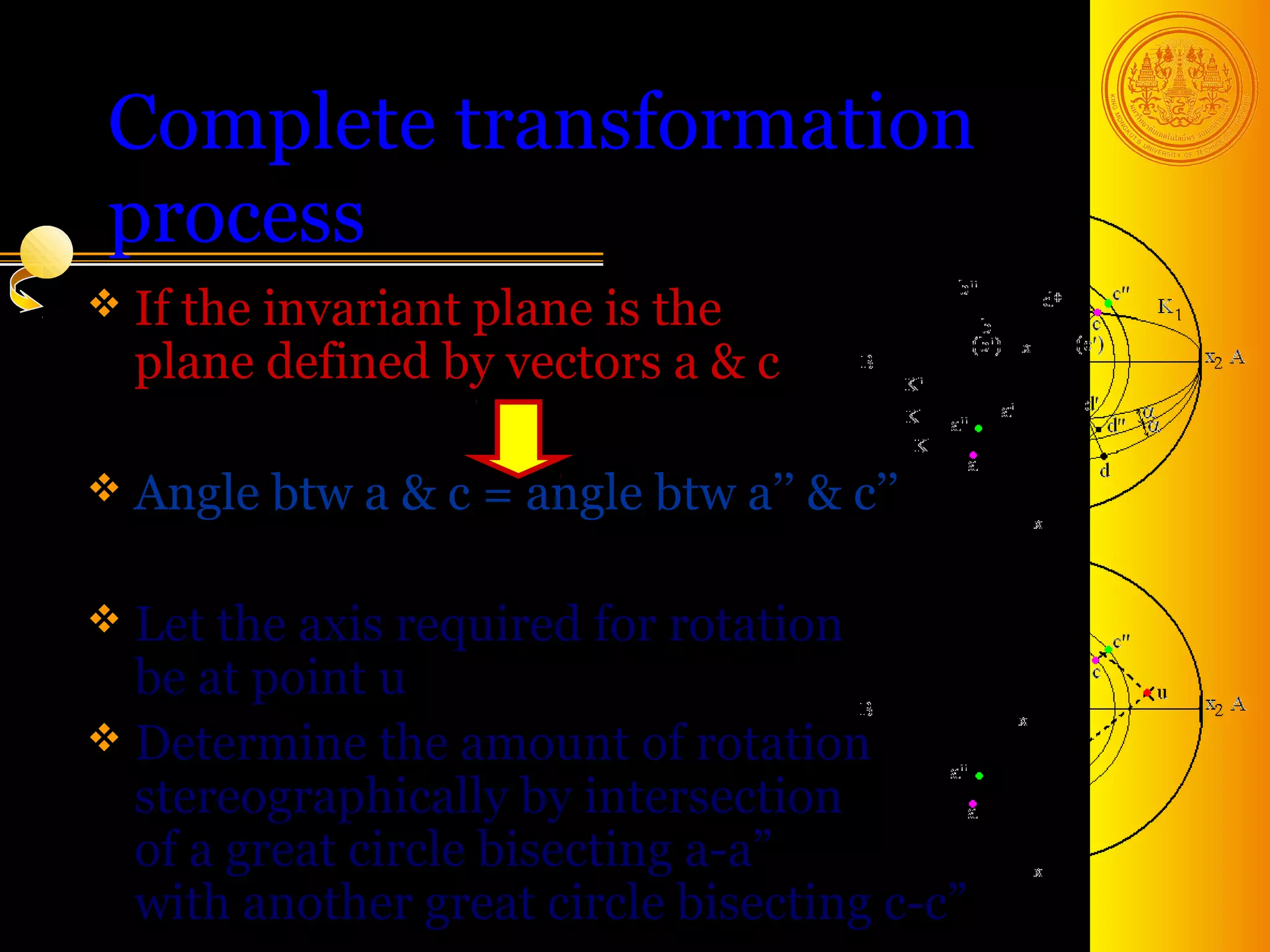
 If theinvariant plane is the
  plane defined by vectors a & c

 Angle btw a & c   = angle btw a’’ & c’’

 Let the axis required for rotation
  be at point u
 Determine the amount of rotation
  stereographically by intersection
  of a great circle bisecting a-a”
  with another great circle bisecting c-c” 33
Complete transformation
process
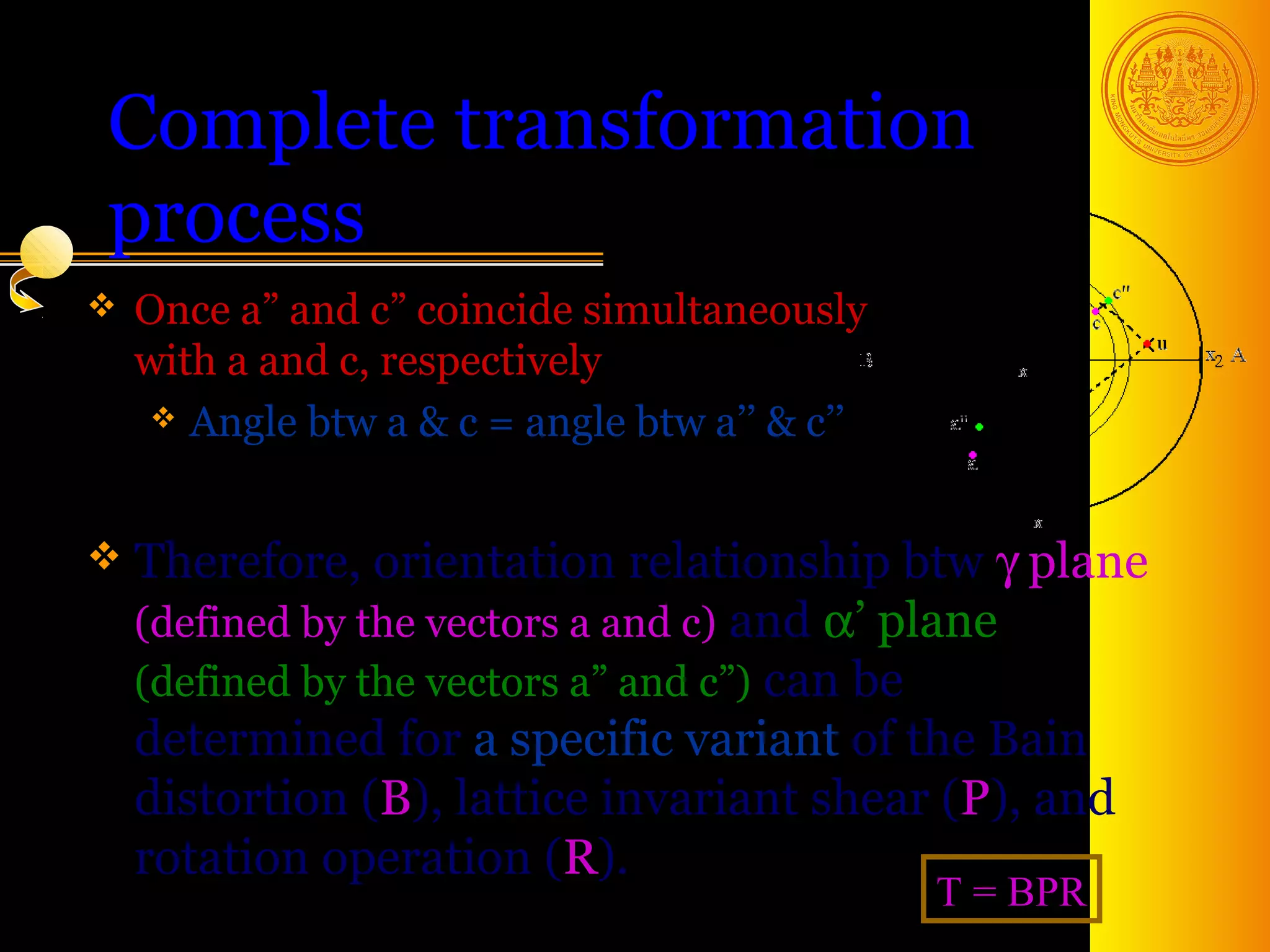
   Once a” and c” coincide simultaneously
    with a and c, respectively
      Angle btw a & c = angle btw a’’ & c’’


 Therefore,     orientation relationship btw γ plane
    (defined by the vectors a and c) and α’ plane
    (defined by the vectors a” and c”) can be
    determined for a specific variant of the Bain
    distortion (B), lattice invariant shear (P), and
    rotation operation (R).
                                               T = BPR
                                                  34
Complete transformation
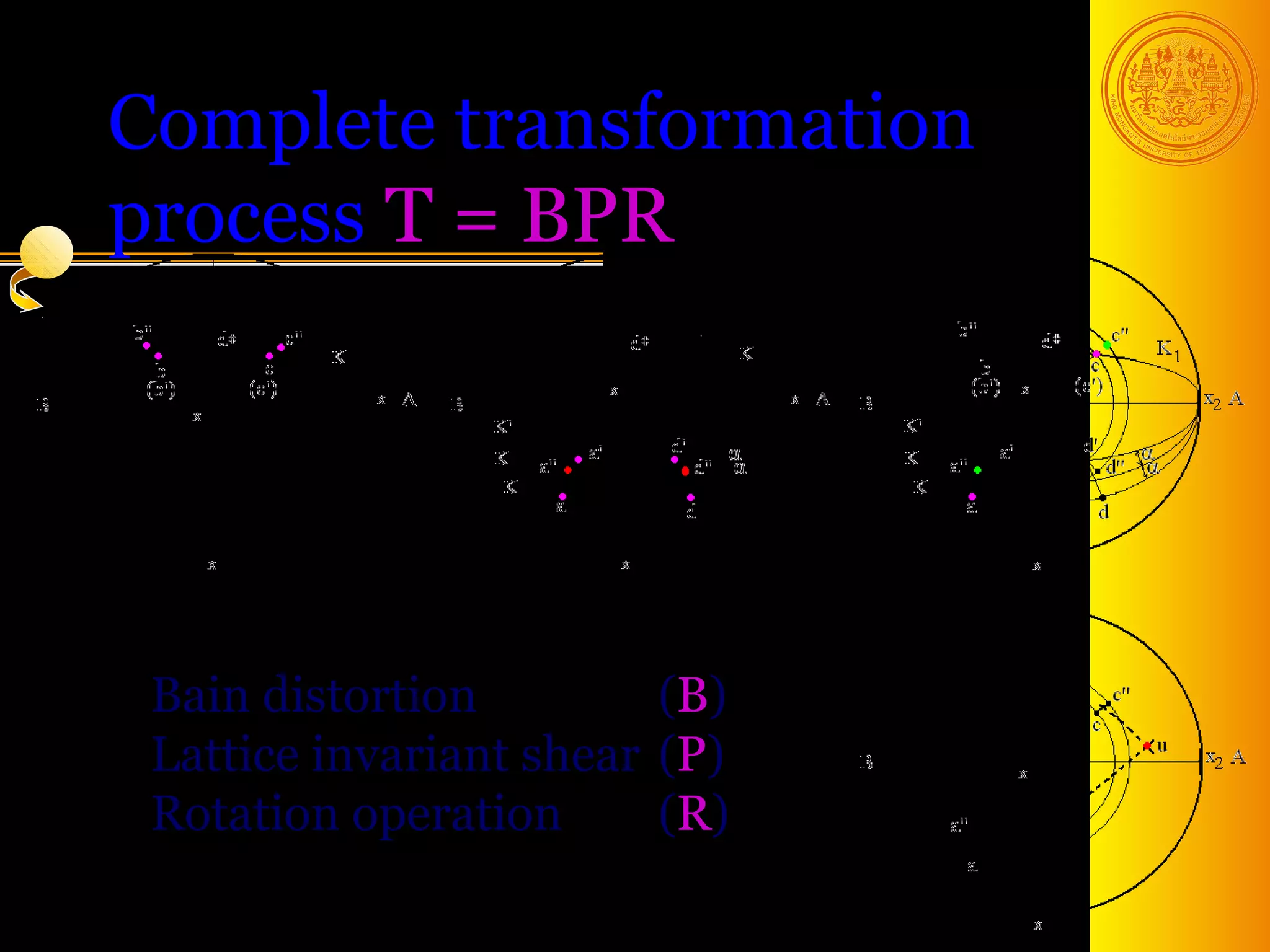
process T = BPR


 Bain distortion         (B)
 Lattice invariant shear (P)
 Rotation operation      (R)
                               35
Bain distortion with twinning
 Twinned martensite       can take place by having
  alternate regions in the parent phase undergo
  the lattice deformation along different
  contraction axes, which are initially at right
  angles to each other.
    In the first region, contraction occurs along
     the x3 [ 001] f axis.
    In the adjacent region, contraction direction
     can be either x1 [100] f or x2 [ 010] f axis.
 Two rigid body rotations   are also involved in
  the twinning analysis.                  36
Nucleation and growth
 It only takes  about 10-5 to 10-7 seconds for a plate
  of martensite to grow to its full size.
 The nucleation during the martensitic
  transformation is extremely difficult to study
  experimentally.
 Average number of martensite is as large as 104
  nuclei/mm3
    Number of martensite nuclei can be
     increased by increasing ∆T prior to Ms.
    It is too small in term of number of
     nucleation sites for homogeneous nucleation.
                                             37
Nucleation and growth
 Less likely to occur by  homogeneous nucleation
  process, but heterogeneous.
    Surfaces and grain boundaries are not
     significantly contributing to nucleation.
    Most likely types of defect that could produce
     the observed density of martensite nuclei are
     dislocations (> 105 dislocation/mm2).
 C. Zener (1948): movement of partial dislocations
  during twinning could generate a thin bcc region
  of lattice from an fcc region.
                                        38
Nucleation and growth
 Dissociation  of a dislocation
  into 2 partials is favorable
  → lower strain energy.
                                       r r r
 To generate                          b1 = b2 + b3
                bcc structure,     a         a        a
                                     [ 110] = [ 211] + 121
  the requirements are that all    2         6        6 

  green atoms move (shear)
               a
  forward by 12 [ 211] and an
  additional dilatation
  to correct lattice spacings.                  39
Nucleation and growth
 Growth of  lath martensite with dimension
  a > b >> c growing on a {111}γ planes
   Thickening    mechanism would involve the
     nucleation and glide of transformation
     dislocations moving on discrete ledges
     behind the growing front.
 Due to large misfit between
  bct and fcc lattice,
  dislocations could be
  self-nucleated at the
  lath interface as the lath moves forward.
                                         40
Nucleation and growth
 In medium and high carbon steels,
   Morphology of martensite turns to change
    from a lath to a plate-like shape.
 As carbon concentration decreases,
   Decrease lath structure
   Decrease martensitic temperature
   Increase twinning
   Increase retained austenite
   Depending on compositions, the habit plane
    changes from {111}γ → {225}γ → {259}γ
                                     41
Effect of pressure to martensite
 As pressure increases
   In Fe unary system, the equilibrium
    temperature decreases
   In Fe-C binary system, the phase region
    around γ phase shifts to the left and
    downward.
      Similar to adding austenite stabilizer


                                        42
Effect of alloying element to
martensite
 Each alloying element will   effect the martensitic
  transformation differently.
 If initially Hγ = Hα
    When adding C

        The ē of C will decrease Hα and cause α to

         be less stable.
        ∆H = Hγ – Hα > 0, stabilize the γ

    When adding X

        Increase Hα and ∆H < 0, stabilize the α
                                          43
Effect of external stress to
martensite
 As martensite prefers to nucleate   and grow
  along the dislocation
    Expected that an externally applied shear
     stress will assist and accelerate the
     generation of dislocations and hence the
     growth of martensite.
 An external shear stress can aid martensite
  nucleation if the external elastic strain
  components play as a part of the Bain strain.
    This can also help by raising the M
                                           s
     temperature.                            44
Effect of external stress to
martensite
 Once  the plastic deformation occurs
   There is an upper limit value of M that the
                                       s
    stress can be applied.
   The limit temp. of M is called M (highest
                          s          d
    temperature that stress helps to form
    martensite)
      Too much plastic deformation will

       suppress the transformation.

                                        45
Effect of external stress to
martensite
 If a tensile
             stress is applied
    M temperature can be suppressed to lower
       s
     temperature
    Transformation may be reversed from α’ →
     γ
 Presence of large magnetic field may favor the
  formation of the ferromagnetic phase and
  therefore raise Ms temp.

                                        46
Effect of external stress to
martensite
 Plastic  deformation of γ before transformation
  will assist on increasing number of nucleation
  sites.
    Once the transformation occurs
       Result in very fine plate size of martensite

         (Called the ausforming process)

 Combined effect of   very fine martensite plates,
                       1
  2
    solution hardening of carbon, and 3dislocation
  hardening
     Very high strength ausformed steel 47
Shape-memory alloys (SMA)
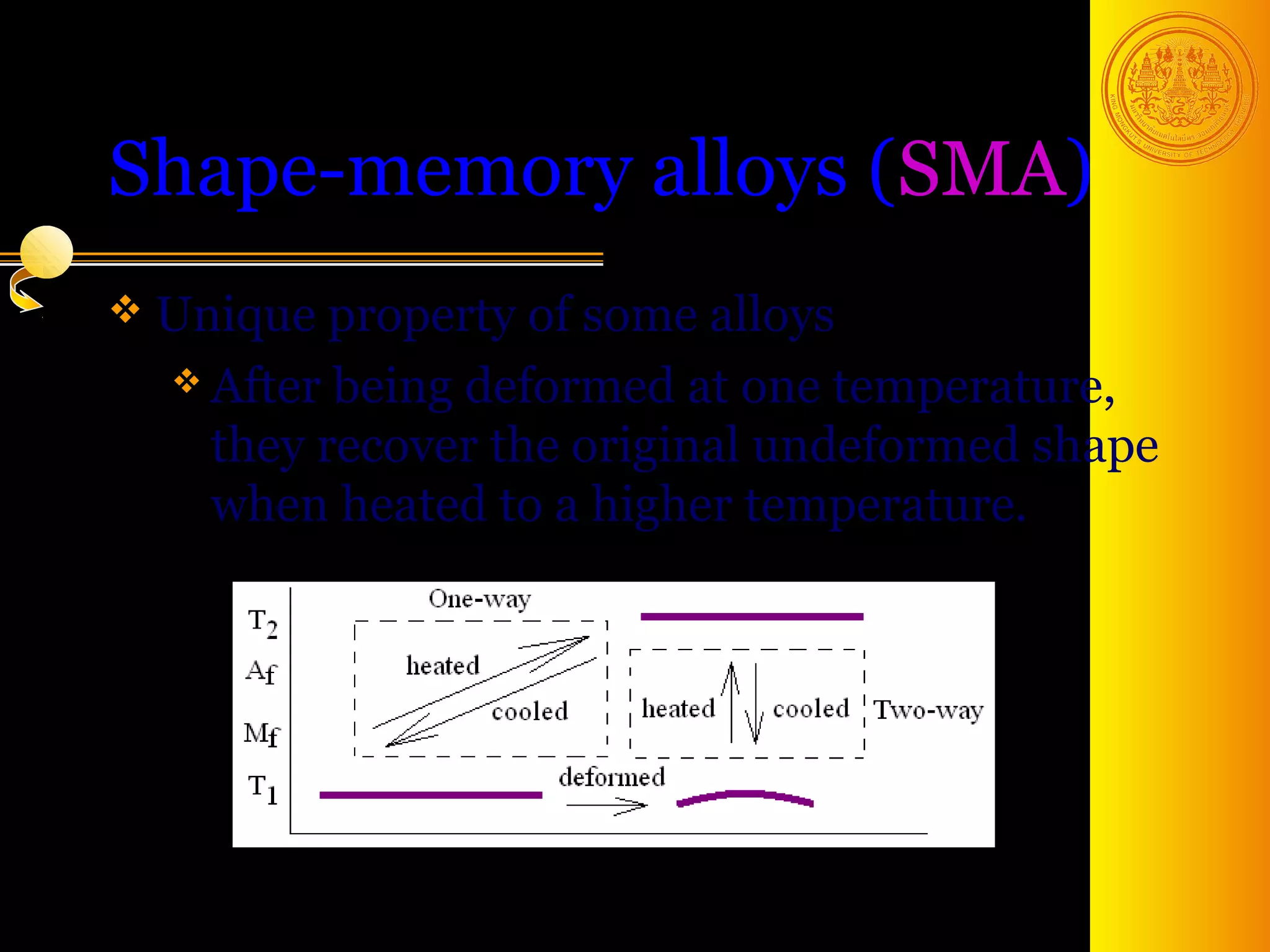
 Unique property  of some alloys
   After being deformed at one temperature,
    they recover the original undeformed shape
    when heated to a higher temperature.


                                      48
Shape-memory alloys (SMA)
 Unique property   of some alloys
    After being deformed at one temperature,
     they recover the original undeformed shape
     when heated to a higher temperature.
 Fundamental to the shape-memory effect
  (SME) is the occurrence of a martensitic phase
  transformation and its subsequent reversal.
 Alloys: Ni-Ti (called NiTiNOL), Ni-Al, Fe-Pt,
  Cu-Al-Ni, Cu-Au-Zn, Cu-Zn-(Al,Ga,Sn,Si),
  Ni-Mn-Ga                               49
SMA
 Common     characteristics
   Atomicordering transformation from
   ordered parent phase to ordered martensite
   phase
   Thermoelastic   martensitic transformation
   that is crystallographic reversible
   Martensite
           phase that forms in a self-
   accommodating manner (slip or twinning)
                                       50
SMA
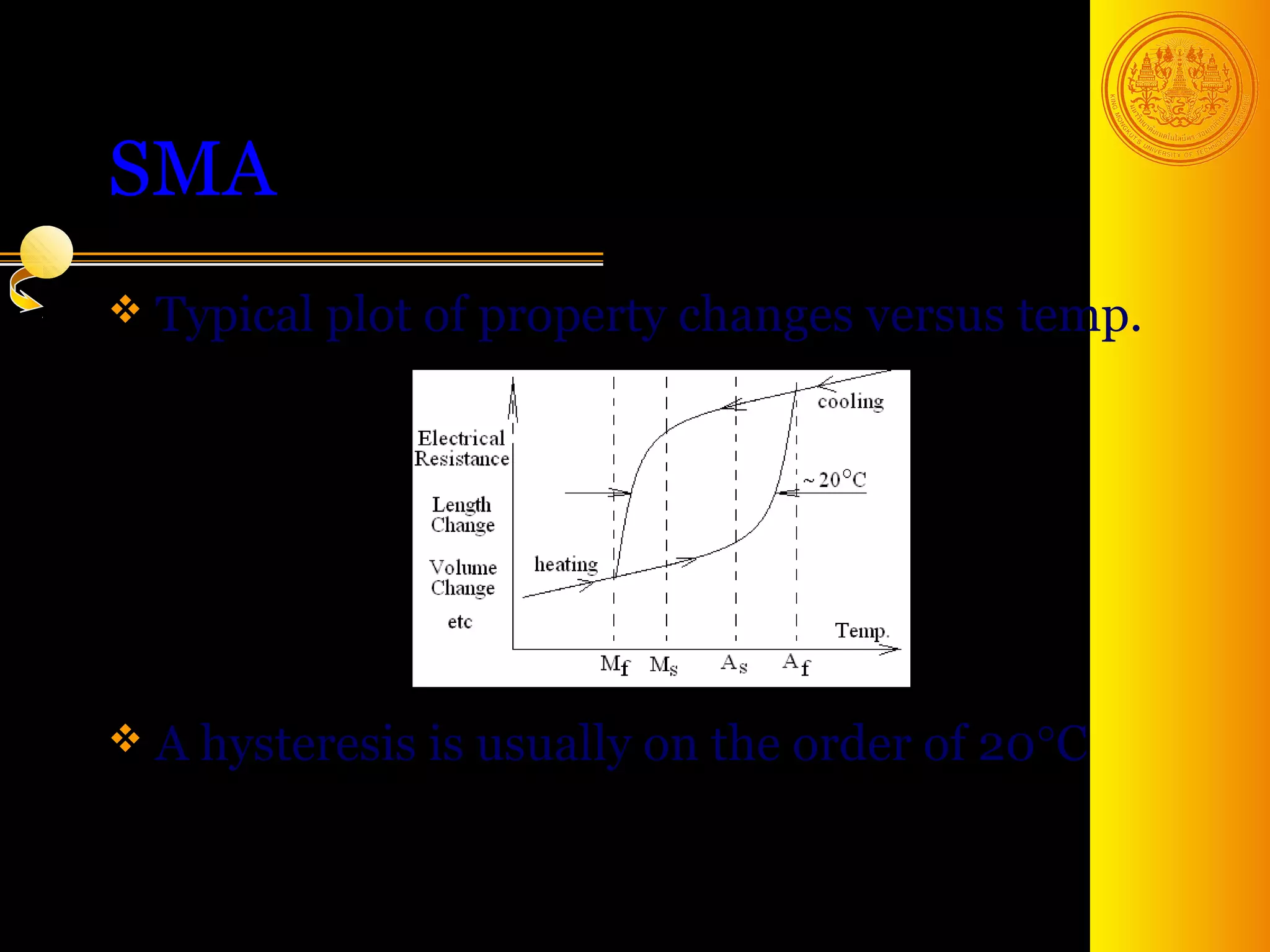
 Typical   plot of property changes versus temp.


 A hysteresis is   usually on the order of 20°C


                                           51
One-way SMA
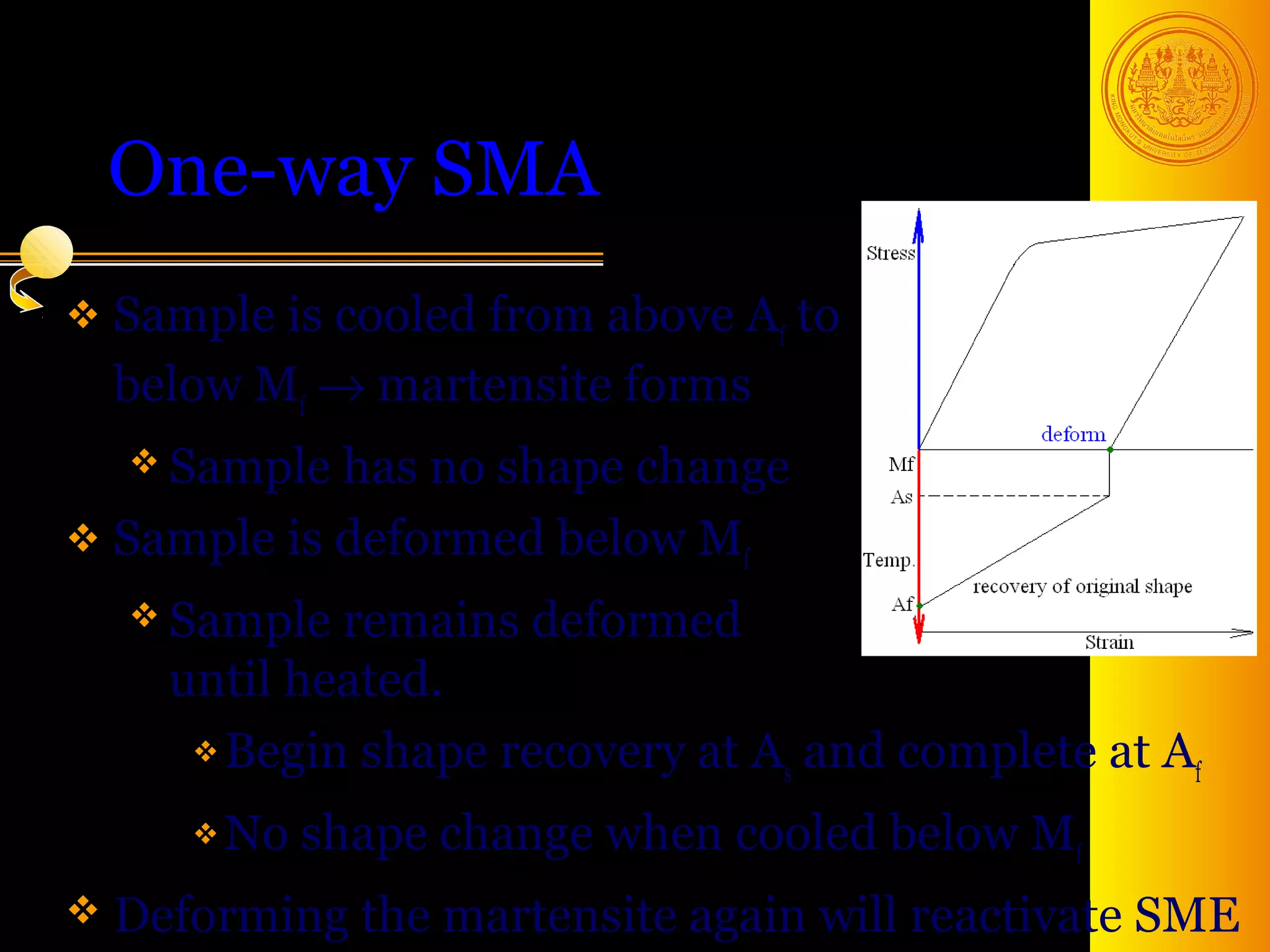
 Sample is cooled from above Af to
  below Mf → martensite forms
   Sample  has no shape change
 Sample is deformed below Mf
   Sample  remains deformed
    until heated.
      Begin shape recovery at A and complete at A
                                s                  f

        No shape change when cooled below Mf
 Deforming the                            52
                  martensite again will reactivate SME
Two-way SMA
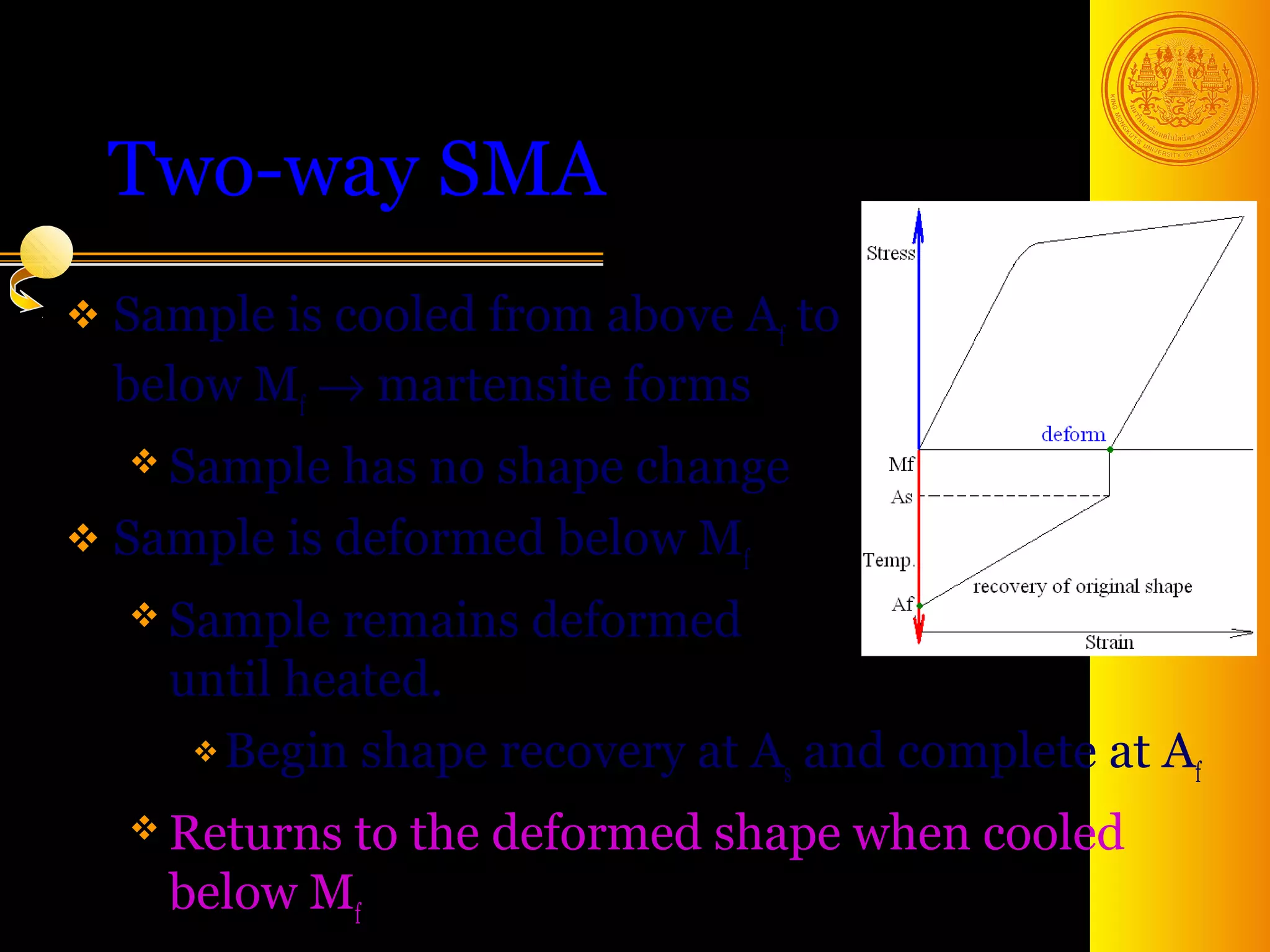
 Sample is cooled from above Af to
  below Mf → martensite forms
   Sample  has no shape change
 Sample is deformed below Mf
   Sample  remains deformed
    until heated.
      Begin shape recovery at A and complete at A
                                s                  f

   Returnsto the deformed shape when cooled
    below Mf                          53

Mt 610 phasetransformationsinsolids_iv

  • 1.
    MT 610 Advanced PhysicalMetallurgy Session : Phase Transformations in Solids IV Materials Technology School of Energy and Materials
  • 2.
    Contents  Diffusional transformations  Long-range diffusion  Short-range diffusion  Diffusionless transformations  Martensitictransformation  Geometric observation  Mechanism 2
  • 3.
    Shear transformation  Exp. Martensite can be generated by shear on γ  Both shears are possible and identical to Bain distortion if disregarded the rigid body rotation. 3
  • 4.
    Shear transformation  Shearof cooperative movements of atoms can be in different planes rather than (111)γ plane, depending on alloy composition and transformation temp.  Shear does not have to act along the same direction on every parallel atomic plane. 4
  • 5.
    Shear transformation  Greningerand Troiano (1949) found that  Observed shear plane in Fe-22% Ni-0.8% C was not the {111}γ plane and the shear angle was 10.45°, not 19.5° as predicted by shear mechanism.  Theysuggested that another shear had to be added in order to complete the mechanism. 5
  • 6.
    Double shear transformation The first shear isa macroscopic shear that contributes the shape change and change in crystal structure.  The second shear is a microscopic shear.  Invariant plane  Bain distortion has no invariant plane  Lattice-invariant shear with Bain distortion 6
  • 7.
    Invariant plane  Duringthe martensitic transformation  The interface should be an invariant plane  Undistorted and unrotated plane  Any deformation on the invariant plane will be termed an invariant plane strain. 7
  • 8.
    From the Baindistortion  α lattice with bcc can be generated from an fcc γ lattice by  Compression about 20% along one principle axis and a simultaneous uniform expansion about 12% along the other two axes perpendicular to the first principle axis 8
  • 9.
    Bain distortion ofa sphere  Due to the Bain distortion  A unit sphere of the parent crystal transforms into an oblate spheroid of the product crystal  Contraction about 20% along the one principle axis  Expansion about 12% along the other two axes perpendicular to the first principle axis 9
  • 10.
    Bain distortion ofa sphere  Initial sphere equation of the parent crystal x12 + x2 + x3 = 1 2 2 12% expansion 20% contraction  Ellipsoid equation of the transformed crystal (x ) ' 2 1 + (x ) ' 2 2 + (x ) ' 2 3 =1 ( 1.12 ) ( 1.12 ) ( 0.80 ) 2 2 2 10
  • 11.
    Bain distortion ofa sphere  Due to the lattice deformation x12 + x2 + x3 = 1 2 2  Vectors OA’ and OB’ represent the final position of vectors  Vectors OA and OB represent the initial position of the same vectors  unchanged in ( x1 ) + ( x2 ) + ( x3 ) = 1 ' 2 ' 2 ' 2 ( 1.12 ) ( 1.12 ) ( 11 ) 2 2 2 magnitude 0.80
  • 12.
    Bain distortion ofa sphere  Vectors unchanged in magnitude during the lattice deformation  Corresponding to the cones AOB and COD and the cones A’OB’ and C’OD’  These vectors are termed unextended lines.  A homogeneous strain would result in an undistorted plane of contact between the initial sphere of austenite and the ellipsoid of martensite. 12
  • 13.
    Bain distortion ofa sphere  Allother vectors not involved in the cones A’OB’ and C’OD’ would be changed in magnitude.  Bain distortion would result in no undistorted plane.  Hence, there is no invariant plane.  Very difficult to obtain a coherent planar interface between the parent and the product crystals only by the Bain distortion. 13
  • 14.
    Bain distortion ofa sphere  Therefore,Bain distortion has no invariant plane. 14
  • 15.
    Lattice-invariant shear  Lattice-invariantshear must be of such magnitude so as to produce an undistorted plane when combined with the Bain distortion.  Consider slip or twinning  Must not make any change in crystal structure. 15
  • 16.
    Lattice-invariant shear  Graphicalanalysis of a simple shear of slip or twinning of a unit sphere  Shear on an equatorial plane K1 as the shear plane  d as the shear direction  α as shear angle Slip 16
  • 17.
    Lattice-invariant shear  Asa result of shear on K1  Any vector in the plane AK B is 2 transformed into a vector in the plane AK’2B, which is unchanged with length although rotated relatively to its original position.  The plane AK B is the initial Slip 2 position of a plane AK’2B, which remains undistorted as a result of the shear. 17
  • 18.
    Lattice-invariant shear  Asa result ofshear on K1  The relative positions of the planes AK2B and AK’2B depend on the amount of shear involved.  The shear plane itself remains undistorted after shear. Slip  Vectors that remain invariant in length (unextended lines) to this shear operation are define as potential habit planes. 18
  • 19.
    Lattice-invariant shear  Asa result ofshear on K1  The relative positions of the planes AK2B and AK’2B depend on the amount of shear involved.  The shear plane itself remains undistorted after shear. Slip  Vectors that remain invariant in length (unextended lines) to this shear operation are define as potential habit planes. 19
  • 20.
    Lattice-invariant shear  When initial sphere → ellipsoid by lattice deformation using Bain distortion is distorted by simple shear into another ellipsoid + and the lattice is left invariant,   The simple shear is termed a lattice-invariant shear. shear 20
  • 21.
  • 22.
    Stereographic representation of theBain distortion  Any vector lying on the initial cone AOB with a semiapex of φ moves radially onto the final cone A’OB’ with a semiapex of φ’.  Vectors in the cones of unextended lines do not change their length, but only the angle ∆φ. 22
  • 23.
    Stereographic representation of thelattice-invariant shear  An unextended line C moves to the final position along the circumference of the great circle defined by d* (dash line). 23
  • 24.
    Stereographic representation of thelattice-invariant shear  Vectors in K’2 plane do not change their length due to shear, and the line OC’ in the plane represents the final position of an unextended line.  Line OC in K2 plane represents the initial position of OC’. 24
  • 25.
    Requirement for habitplane  Both Bain distortion and lattice invariant shear provide an undistorted plane for the habit plane.  Additional requirement is that the habit plane be unrotated.  A rigid body rotation must be able to return the undistorted plane to its original position before transformation. 25
  • 26.
    3 important components Bain distortion  Lattice invariant shear  Rigid body rotation 26
  • 27.
    Bain distortion withslip #1  Vectors b and c are defined by the intersections of the initial Bain cone with K1 plane  1.Apply a complementary shear  Vectors b and c become b’ and c’ and still lie in the K1 plane and remain unchanged in both direction and magnitude.  They are invariant lines. 27
  • 28.
    Bain distortion withslip #1  Vectors b and c are defined by the intersections of the initial Bain cone with K1 plane  2.Apply a Bain distortion  Vectors b’ and c’ become b’’ and c’’ lie on the initial and final Bain cones, respectively, without changing their magnitude. 28
  • 29.
    Bain distortion withslip #1  Complementary shear b and c to b’ and c’  Bain distortion b’ and c’ to b’’ and c’’  Angle btw b and c ≠ angle btw b” and c”  Appropriate rotation cannot be applied to return b” and c” to initial positions of b and c.  Plane defined by b and c cannot be an invariant plane. 29
  • 30.
    Bain distortion withslip #2  To obtainan invariant plane, must have other extended lines  Ifassumed to know the shear angle α, vectors a and d obtained from the intersections of the K2 plane change to a’ and d’ along the great circles.  Bain distortion, vectors a’ and d’ become a” and d”, respectively 30
  • 31.
    Bain distortion withslip #2  Through the transformation of the complementary shear and the Bain distortion  Sequences of a→a’→a” and sequences d→d’→d” reveal no change in length  However, angle btw a & d ≠ angle btw a” & d”  Plane defined by a and d cannot be an invariant plane. 31
  • 32.
    Complete transformation process  Possibleinvariant planes will depend on the choice of combination of b or c with a or d such as  Vectors a and b  Vectors a and c  Vectors b and d  Vectors c and d 32
  • 33.
    Complete transformation process If theinvariant plane is the plane defined by vectors a & c  Angle btw a & c = angle btw a’’ & c’’  Let the axis required for rotation be at point u  Determine the amount of rotation stereographically by intersection of a great circle bisecting a-a” with another great circle bisecting c-c” 33
  • 34.
    Complete transformation process  Once a” and c” coincide simultaneously with a and c, respectively  Angle btw a & c = angle btw a’’ & c’’  Therefore, orientation relationship btw γ plane (defined by the vectors a and c) and α’ plane (defined by the vectors a” and c”) can be determined for a specific variant of the Bain distortion (B), lattice invariant shear (P), and rotation operation (R). T = BPR 34
  • 35.
    Complete transformation process T= BPR Bain distortion (B) Lattice invariant shear (P) Rotation operation (R) 35
  • 36.
    Bain distortion withtwinning  Twinned martensite can take place by having alternate regions in the parent phase undergo the lattice deformation along different contraction axes, which are initially at right angles to each other.  In the first region, contraction occurs along the x3 [ 001] f axis.  In the adjacent region, contraction direction can be either x1 [100] f or x2 [ 010] f axis.  Two rigid body rotations are also involved in the twinning analysis. 36
  • 37.
    Nucleation and growth It only takes about 10-5 to 10-7 seconds for a plate of martensite to grow to its full size.  The nucleation during the martensitic transformation is extremely difficult to study experimentally.  Average number of martensite is as large as 104 nuclei/mm3  Number of martensite nuclei can be increased by increasing ∆T prior to Ms.  It is too small in term of number of nucleation sites for homogeneous nucleation. 37
  • 38.
    Nucleation and growth Less likely to occur by homogeneous nucleation process, but heterogeneous.  Surfaces and grain boundaries are not significantly contributing to nucleation.  Most likely types of defect that could produce the observed density of martensite nuclei are dislocations (> 105 dislocation/mm2).  C. Zener (1948): movement of partial dislocations during twinning could generate a thin bcc region of lattice from an fcc region. 38
  • 39.
    Nucleation and growth Dissociation of a dislocation into 2 partials is favorable → lower strain energy. r r r  To generate b1 = b2 + b3 bcc structure, a a a [ 110] = [ 211] + 121 the requirements are that all 2 6 6  green atoms move (shear) a forward by 12 [ 211] and an additional dilatation to correct lattice spacings. 39
  • 40.
    Nucleation and growth Growth of lath martensite with dimension a > b >> c growing on a {111}γ planes  Thickening mechanism would involve the nucleation and glide of transformation dislocations moving on discrete ledges behind the growing front.  Due to large misfit between bct and fcc lattice, dislocations could be self-nucleated at the lath interface as the lath moves forward. 40
  • 41.
    Nucleation and growth In medium and high carbon steels,  Morphology of martensite turns to change from a lath to a plate-like shape.  As carbon concentration decreases,  Decrease lath structure  Decrease martensitic temperature  Increase twinning  Increase retained austenite  Depending on compositions, the habit plane changes from {111}γ → {225}γ → {259}γ 41
  • 42.
    Effect of pressureto martensite  As pressure increases  In Fe unary system, the equilibrium temperature decreases  In Fe-C binary system, the phase region around γ phase shifts to the left and downward.  Similar to adding austenite stabilizer 42
  • 43.
    Effect of alloyingelement to martensite  Each alloying element will effect the martensitic transformation differently.  If initially Hγ = Hα  When adding C  The ē of C will decrease Hα and cause α to be less stable.  ∆H = Hγ – Hα > 0, stabilize the γ  When adding X  Increase Hα and ∆H < 0, stabilize the α 43
  • 44.
    Effect of externalstress to martensite  As martensite prefers to nucleate and grow along the dislocation  Expected that an externally applied shear stress will assist and accelerate the generation of dislocations and hence the growth of martensite.  An external shear stress can aid martensite nucleation if the external elastic strain components play as a part of the Bain strain.  This can also help by raising the M s temperature. 44
  • 45.
    Effect of externalstress to martensite  Once the plastic deformation occurs  There is an upper limit value of M that the s stress can be applied.  The limit temp. of M is called M (highest s d temperature that stress helps to form martensite)  Too much plastic deformation will suppress the transformation. 45
  • 46.
    Effect of externalstress to martensite  If a tensile stress is applied  M temperature can be suppressed to lower s temperature  Transformation may be reversed from α’ → γ  Presence of large magnetic field may favor the formation of the ferromagnetic phase and therefore raise Ms temp. 46
  • 47.
    Effect of externalstress to martensite  Plastic deformation of γ before transformation will assist on increasing number of nucleation sites.  Once the transformation occurs  Result in very fine plate size of martensite (Called the ausforming process)  Combined effect of very fine martensite plates, 1 2 solution hardening of carbon, and 3dislocation hardening  Very high strength ausformed steel 47
  • 48.
    Shape-memory alloys (SMA) Unique property of some alloys  After being deformed at one temperature, they recover the original undeformed shape when heated to a higher temperature. 48
  • 49.
    Shape-memory alloys (SMA) Unique property of some alloys  After being deformed at one temperature, they recover the original undeformed shape when heated to a higher temperature.  Fundamental to the shape-memory effect (SME) is the occurrence of a martensitic phase transformation and its subsequent reversal.  Alloys: Ni-Ti (called NiTiNOL), Ni-Al, Fe-Pt, Cu-Al-Ni, Cu-Au-Zn, Cu-Zn-(Al,Ga,Sn,Si), Ni-Mn-Ga 49
  • 50.
    SMA  Common characteristics  Atomicordering transformation from ordered parent phase to ordered martensite phase  Thermoelastic martensitic transformation that is crystallographic reversible  Martensite phase that forms in a self- accommodating manner (slip or twinning) 50
  • 51.
    SMA  Typical plot of property changes versus temp.  A hysteresis is usually on the order of 20°C 51
  • 52.
    One-way SMA  Sampleis cooled from above Af to below Mf → martensite forms  Sample has no shape change  Sample is deformed below Mf  Sample remains deformed until heated.  Begin shape recovery at A and complete at A s f  No shape change when cooled below Mf  Deforming the 52 martensite again will reactivate SME
  • 53.
    Two-way SMA  Sampleis cooled from above Af to below Mf → martensite forms  Sample has no shape change  Sample is deformed below Mf  Sample remains deformed until heated.  Begin shape recovery at A and complete at A s f  Returnsto the deformed shape when cooled below Mf 53