Aims, Goals, and Objectives
Hina Jalal
PhD Scholar, GCUF
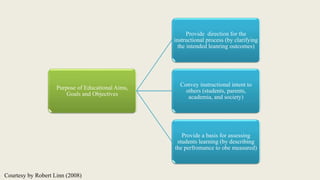
Purpose of Educational Aims,
Goals and Objectives
Provide direction for the
instructional process (by clarifying
the intended leanring outcomes)
Convey instructional intent to
others (students, parents,
academia, and society)
Provide a basis for assessing
students learning (by describing
the perfromance to obe measured)
Courtesy by Robert Linn (2008)
Aims
Aims include:
• General statements that provide a sense of direction and serve as guiding principles for educational policy;
• Aims are the translations of the general philosophy and needs of the country;
• Aims are designed at the national/state level by policy making groups;
• Aims can be based on the constitution of the country;
Examples of aims
• To prepare students for democratic citizenship;
• To develop a moral character and personal discipline;
• To strengthen ethical and spiritual values;
• To teach the rights and duties of citizenship;
• To encourage creative and critical thinking.
Goals
Goals include:
• Derived from aims;
• Aims become goals when they become more specific and refer to a education system and to a specific
subject area of the curriculum;
• Goals translate aims into statements that will describe what schools are expected to accomplish;
• Goals are more specific and definite than aims, but they are still nonbehavioral and therefore non-
observable and non-measurable.
Examples of Goals
• The development of reading skills;
• The appreciation of arts;
• The understanding of scientific and mathematical concepts.
Objectives
Objectives include:
• • Objectives are stated in observable and measurable terms (outcomes,
proficiencies, or competences);
• • Objectives are behavioral in nature and more precise than goals;
• • Objectives state what students should know at the end of the course and what is
expected from them;
Examples of Objectives
• • To identify the main idea of the author;
• • To be able to express advice, apology, complaint, etc.;
• • To be able to locate the topic sentence and the supporting details;
• • To be aware of the differences between the present simple and present perfect.
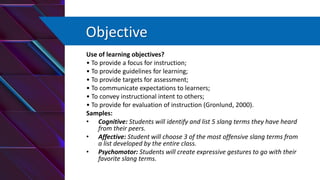
Objective
Use of learning objectives?
• To provide a focus for instruction;
• To provide guidelines for learning;
• To provide targets for assessment;
• To communicate expectations to learners;
• To convey instructional intent to others;
• To provide for evaluation of instruction (Gronlund, 2000).
Samples:
• Cognitive: Students will identify and list 5 slang terms they have heard
from their peers.
• Affective: Student will choose 3 of the most offensive slang terms from
a list developed by the entire class.
• Psychomotor: Students will create expressive gestures to go with their
favorite slang terms.

Aims, goals, and objectives

  • 1.
    Aims, Goals, andObjectives Hina Jalal PhD Scholar, GCUF
  • 2.
    Purpose of EducationalAims, Goals and Objectives Provide direction for the instructional process (by clarifying the intended leanring outcomes) Convey instructional intent to others (students, parents, academia, and society) Provide a basis for assessing students learning (by describing the perfromance to obe measured) Courtesy by Robert Linn (2008)
  • 3.
    Aims Aims include: • Generalstatements that provide a sense of direction and serve as guiding principles for educational policy; • Aims are the translations of the general philosophy and needs of the country; • Aims are designed at the national/state level by policy making groups; • Aims can be based on the constitution of the country; Examples of aims • To prepare students for democratic citizenship; • To develop a moral character and personal discipline; • To strengthen ethical and spiritual values; • To teach the rights and duties of citizenship; • To encourage creative and critical thinking.
  • 4.
    Goals Goals include: • Derivedfrom aims; • Aims become goals when they become more specific and refer to a education system and to a specific subject area of the curriculum; • Goals translate aims into statements that will describe what schools are expected to accomplish; • Goals are more specific and definite than aims, but they are still nonbehavioral and therefore non- observable and non-measurable. Examples of Goals • The development of reading skills; • The appreciation of arts; • The understanding of scientific and mathematical concepts.
  • 5.
    Objectives Objectives include: • •Objectives are stated in observable and measurable terms (outcomes, proficiencies, or competences); • • Objectives are behavioral in nature and more precise than goals; • • Objectives state what students should know at the end of the course and what is expected from them; Examples of Objectives • • To identify the main idea of the author; • • To be able to express advice, apology, complaint, etc.; • • To be able to locate the topic sentence and the supporting details; • • To be aware of the differences between the present simple and present perfect.
  • 6.
    Objective Use of learningobjectives? • To provide a focus for instruction; • To provide guidelines for learning; • To provide targets for assessment; • To communicate expectations to learners; • To convey instructional intent to others; • To provide for evaluation of instruction (Gronlund, 2000). Samples: • Cognitive: Students will identify and list 5 slang terms they have heard from their peers. • Affective: Student will choose 3 of the most offensive slang terms from a list developed by the entire class. • Psychomotor: Students will create expressive gestures to go with their favorite slang terms.