Presented by
Asif Shaikh
Roll No. 2K20-B.Ed-(1.5)-08
Submit to Sir Naeem Baloch
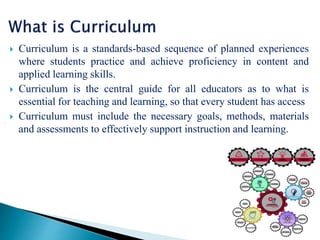
 Curriculum is a standards-based sequence of planned experiences
where students practice and achieve proficiency in content and
applied learning skills.
 Curriculum is the central guide for all educators as to what is
essential for teaching and learning, so that every student has access
 Curriculum must include the necessary goals, methods, materials
and assessments to effectively support instruction and learning.
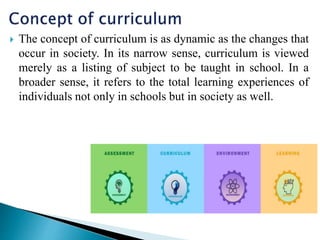
 The concept of curriculum is as dynamic as the changes that
occur in society. In its narrow sense, curriculum is viewed
merely as a listing of subject to be taught in school. In a
broader sense, it refers to the total learning experiences of
individuals not only in schools but in society as well.
 Sequence relates to when different parts of the curriculum
should be learned with respect to the other parts of the
curriculum.
 Integration relates to how different strands of a piece of
curriculum relate to other things.
 Continuity relates to how previous learning and future learning
relate in terms of cumulative effects of learning.
 Scope refers to the breadth of the curriculum- the content,
learning experiences and activities to be included in the
curriculum.
 The scope can be arrived at by answering the following
questions: What do young people need in order to succeed in the
society? What are the needs of the locality, society, nation and
world? What are the essentials of the discipline?
 The content must occupationally be relevant for teaching.
 The content should be professionally relevant for
teaching.
 The scope must determine the appropriate skills, attitudes
and beliefs, which the students need to be aware of The
scope should determine the appropriate intellectual and
practical level of difficulty in the content.
 The scope needs to be taken into account whether
additional external expertise is needed from outside the
field of teaching.
 The scope of the content should reflect the necessary
educational technology to be included and the curriculum
materials.
 The scope ought to include consideration of the basic
form of assessment and examinations to be used.
 Subject-matter
 Instructional plan
 Aim
 Rationale
 Goals and objectives
 Audience and pre-requisites
 Materials
 Instructional plan
 Plans for assessment and evaluation
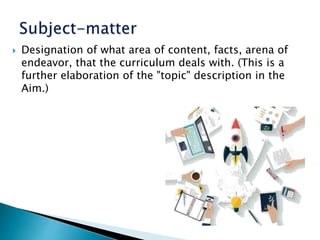
 Designation of what area of content, facts, arena of
endeavor, that the curriculum deals with. (This is a
further elaboration of the "topic" description in the
Aim.)
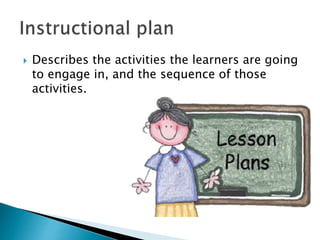
 Describes the activities the learners are going
to engage in, and the sequence of those
activities.
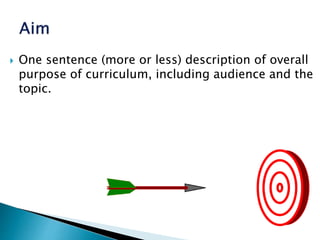
 One sentence (more or less) description of overall
purpose of curriculum, including audience and the
topic.
 Paragraph describing why aim is worth achieving.
This section would include assessment of needs.
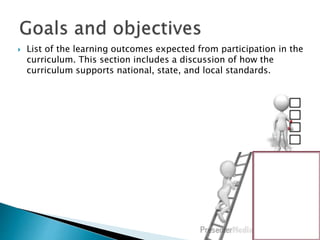
 List of the learning outcomes expected from participation in the
curriculum. This section includes a discussion of how the
curriculum supports national, state, and local standards.
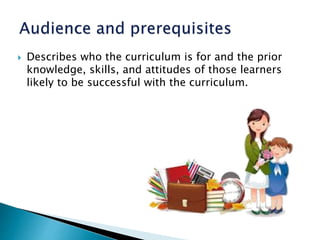
 Describes who the curriculum is for and the prior
knowledge, skills, and attitudes of those learners
likely to be successful with the curriculum.
 Lists materials necessary for successful teaching of the curriculum.
Includes a list of web pages. Often, the web site will NOT be the
only materials needed by the students. They may need books,
tables, paper, chalkboards, calculators, and other tools. You
should spell these additional materials out in your teaching guide.
 Describes the activities the learners are going to engage in, and
the sequence of those activities.
 Includes plan for assessing learning and evaluating
the curriculum as a whole. May include description
of a model project, sample exam questions, or
other elements of assessment.
Curriculum development scope, elements and importance

Curriculum development scope, elements and importance

  • 2.
    Presented by Asif Shaikh RollNo. 2K20-B.Ed-(1.5)-08 Submit to Sir Naeem Baloch
  • 3.
     Curriculum isa standards-based sequence of planned experiences where students practice and achieve proficiency in content and applied learning skills.  Curriculum is the central guide for all educators as to what is essential for teaching and learning, so that every student has access  Curriculum must include the necessary goals, methods, materials and assessments to effectively support instruction and learning.
  • 4.
     The conceptof curriculum is as dynamic as the changes that occur in society. In its narrow sense, curriculum is viewed merely as a listing of subject to be taught in school. In a broader sense, it refers to the total learning experiences of individuals not only in schools but in society as well.
  • 5.
     Sequence relatesto when different parts of the curriculum should be learned with respect to the other parts of the curriculum.  Integration relates to how different strands of a piece of curriculum relate to other things.  Continuity relates to how previous learning and future learning relate in terms of cumulative effects of learning.  Scope refers to the breadth of the curriculum- the content, learning experiences and activities to be included in the curriculum.  The scope can be arrived at by answering the following questions: What do young people need in order to succeed in the society? What are the needs of the locality, society, nation and world? What are the essentials of the discipline?
  • 6.
     The contentmust occupationally be relevant for teaching.  The content should be professionally relevant for teaching.  The scope must determine the appropriate skills, attitudes and beliefs, which the students need to be aware of The scope should determine the appropriate intellectual and practical level of difficulty in the content.  The scope needs to be taken into account whether additional external expertise is needed from outside the field of teaching.  The scope of the content should reflect the necessary educational technology to be included and the curriculum materials.  The scope ought to include consideration of the basic form of assessment and examinations to be used.
  • 7.
     Subject-matter  Instructionalplan  Aim  Rationale  Goals and objectives  Audience and pre-requisites  Materials  Instructional plan  Plans for assessment and evaluation
  • 8.
     Designation ofwhat area of content, facts, arena of endeavor, that the curriculum deals with. (This is a further elaboration of the "topic" description in the Aim.)
  • 9.
     Describes theactivities the learners are going to engage in, and the sequence of those activities.
  • 10.
     One sentence(more or less) description of overall purpose of curriculum, including audience and the topic.
  • 11.
     Paragraph describingwhy aim is worth achieving. This section would include assessment of needs.
  • 12.
     List ofthe learning outcomes expected from participation in the curriculum. This section includes a discussion of how the curriculum supports national, state, and local standards.
  • 13.
     Describes whothe curriculum is for and the prior knowledge, skills, and attitudes of those learners likely to be successful with the curriculum.
  • 14.
     Lists materialsnecessary for successful teaching of the curriculum. Includes a list of web pages. Often, the web site will NOT be the only materials needed by the students. They may need books, tables, paper, chalkboards, calculators, and other tools. You should spell these additional materials out in your teaching guide.
  • 15.
     Describes theactivities the learners are going to engage in, and the sequence of those activities.
  • 16.
     Includes planfor assessing learning and evaluating the curriculum as a whole. May include description of a model project, sample exam questions, or other elements of assessment.