Cognition: Thinking, 
Intelligence & 
CognitiLona: Tnhginukiangg, e 
Cognition: Thinking, 
Intelligence & Language
Section 1: Thinking and Problem Solving 
Learning Goals 
•Students should be able to answer the following: 
1. What are the functions of concepts? 
2. What strategies assist our problem solving? 
What is creativity and what fosters it? 
3. What are the obstacles to problem solving? 
Intelligence Gardner 
Cognition Concepts Problems A.I. Creativity 
I.Q. Wechsler Bias Delay Terman Heredity 
Animal 
2
TThhiinnkkiinngg
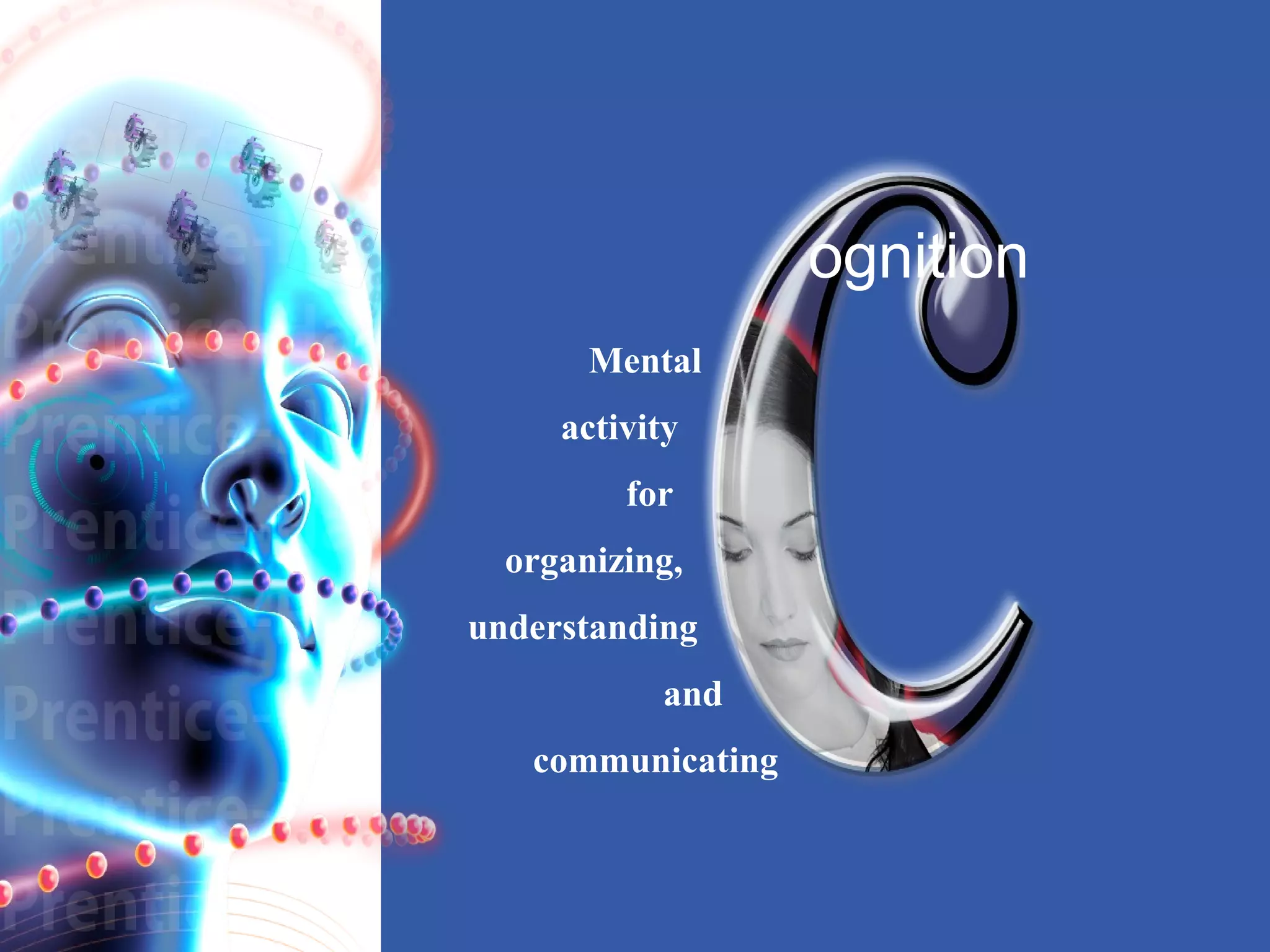
Mental 
activity 
for 
organizing, 
understanding 
and 
communicating 
ognition
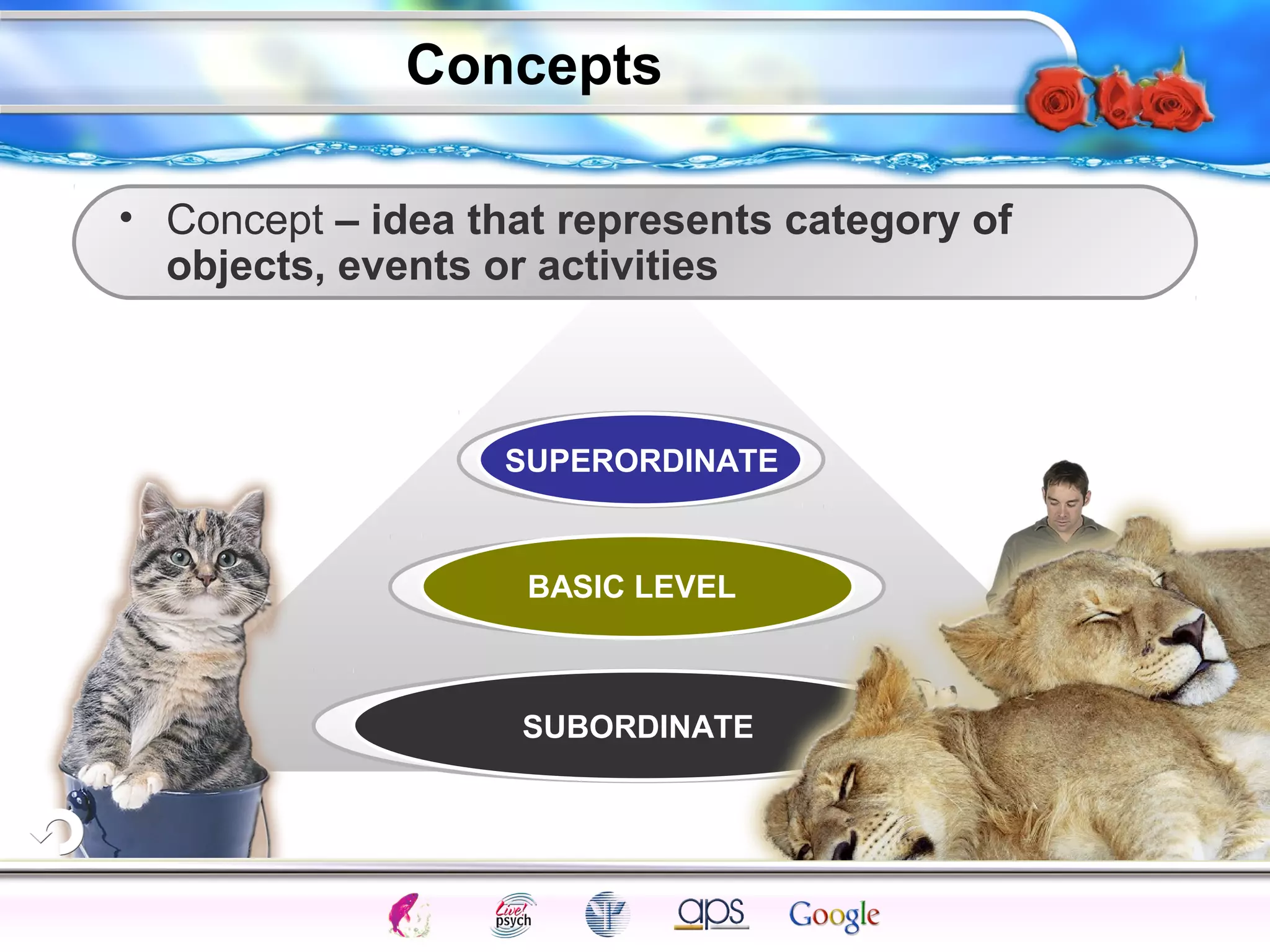
• Concept – idea that represents category of 
objects, events or activities 
Intelligence Gardner 
Concepts 
SUPERORDINATE 
BASIC LEVEL 
SUBORDINATE 
Cognition Concepts Problems A.I. Creativity 
I.Q. Wechsler Bias Delay Terman Heredity 
Animal
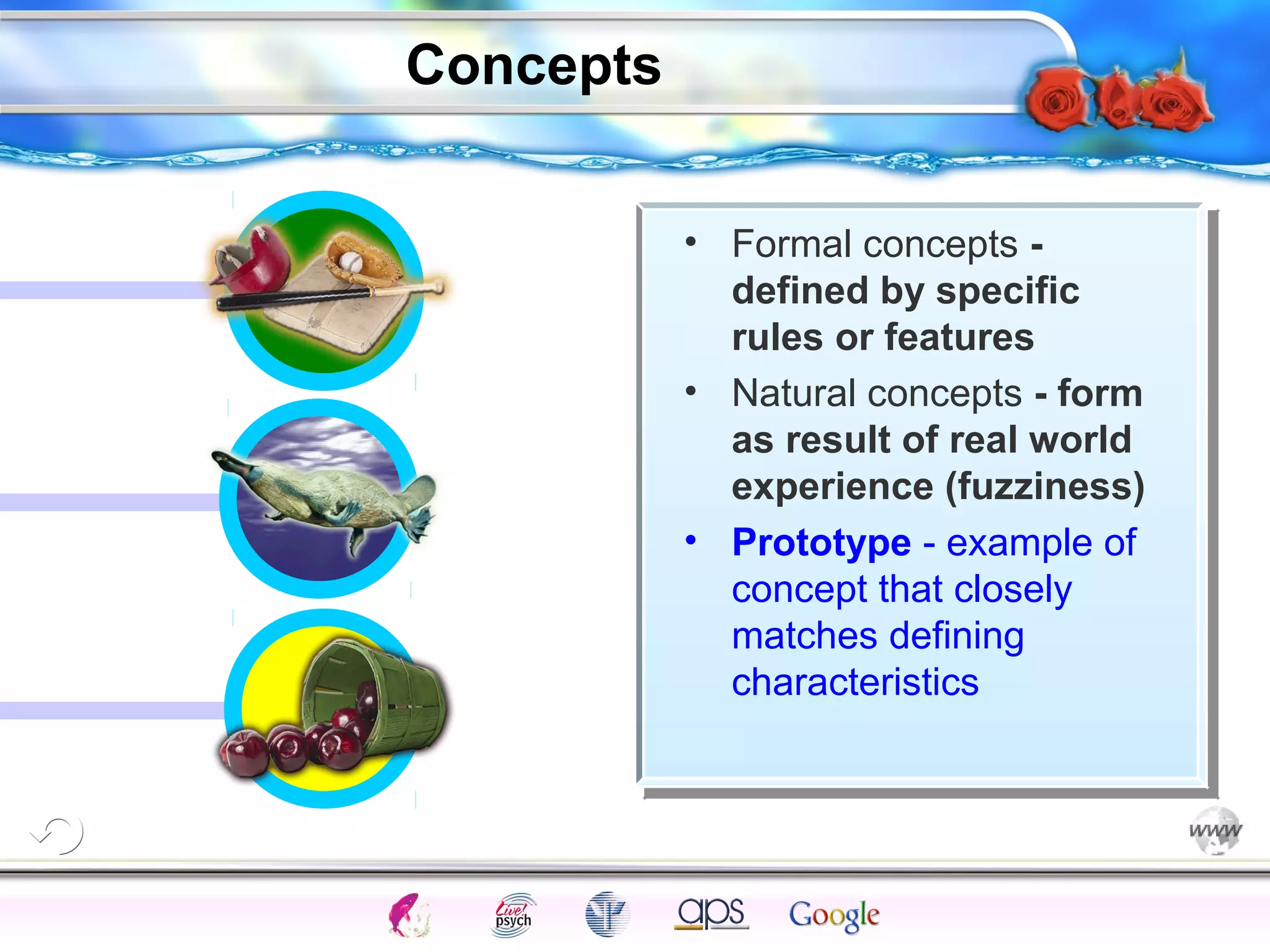
• Formal concepts - 
defined by specific 
rules or features 
• Natural concepts - form 
as result of real world 
experience (fuzziness) 
• Prototype - example of 
concept that closely 
matches defining 
characteristics 
Intelligence Gardner 
Concepts 
Cognition Concepts Problems A.I. Creativity 
I.Q. Wechsler Bias Delay Terman Heredity 
Animal
Concepts v. Prototypes 
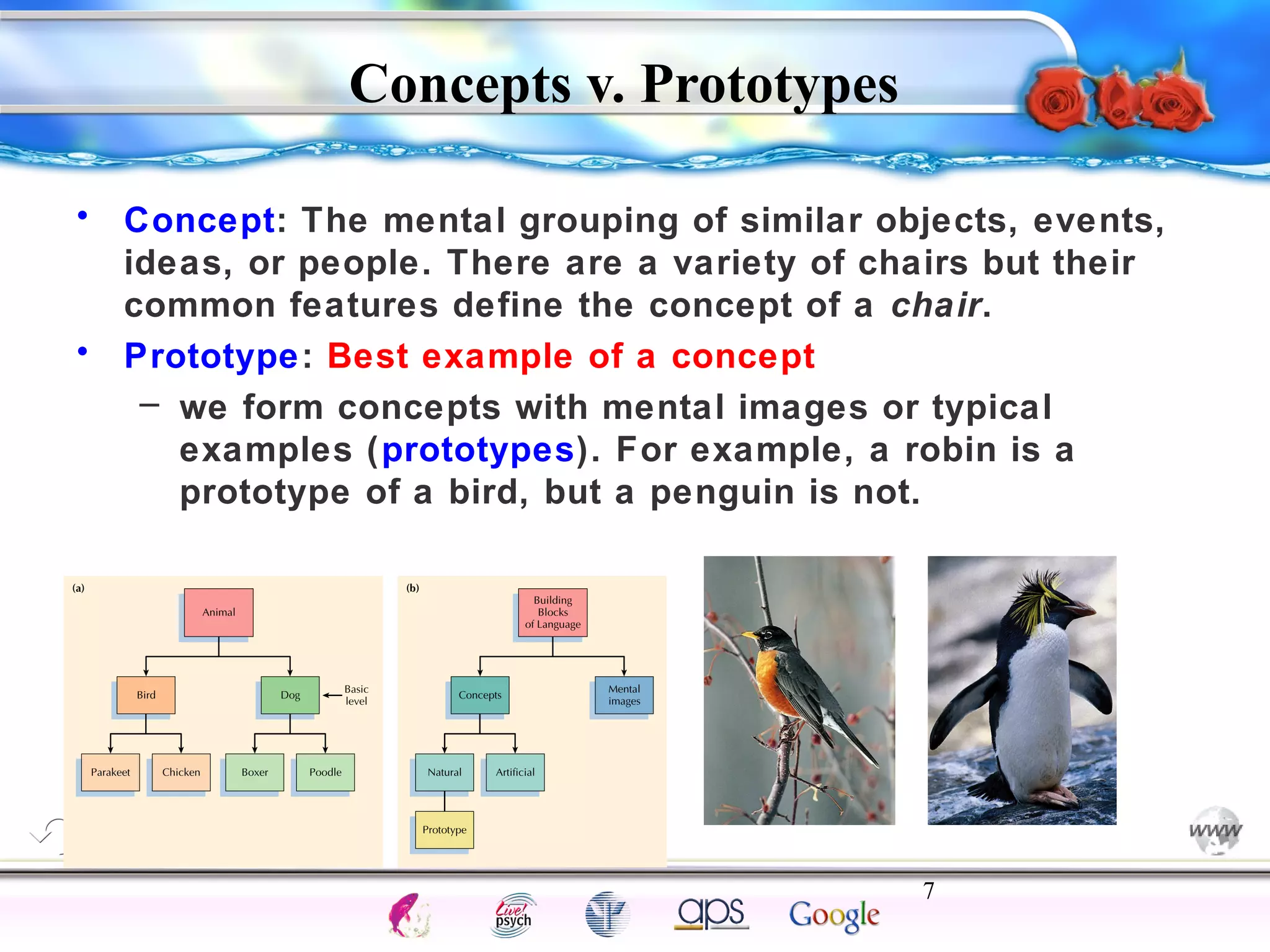
• Concept: The mental grouping of similar objects, events, 
ideas, or people. There are a variety of chairs but their 
common features define the concept of a chair. 
– we form concepts with mental images or typical 
examples (prototypes). For example, a robin is a 
prototype of a bird, but a penguin is not. 
7 
Intelligence Gardner 
• Prototype: Best example of a concept 
Cognition Concepts Problems A.I. Creativity 
I.Q. Wechsler Bias Delay Terman Heredity 
Animal
Intelligence Gardner 
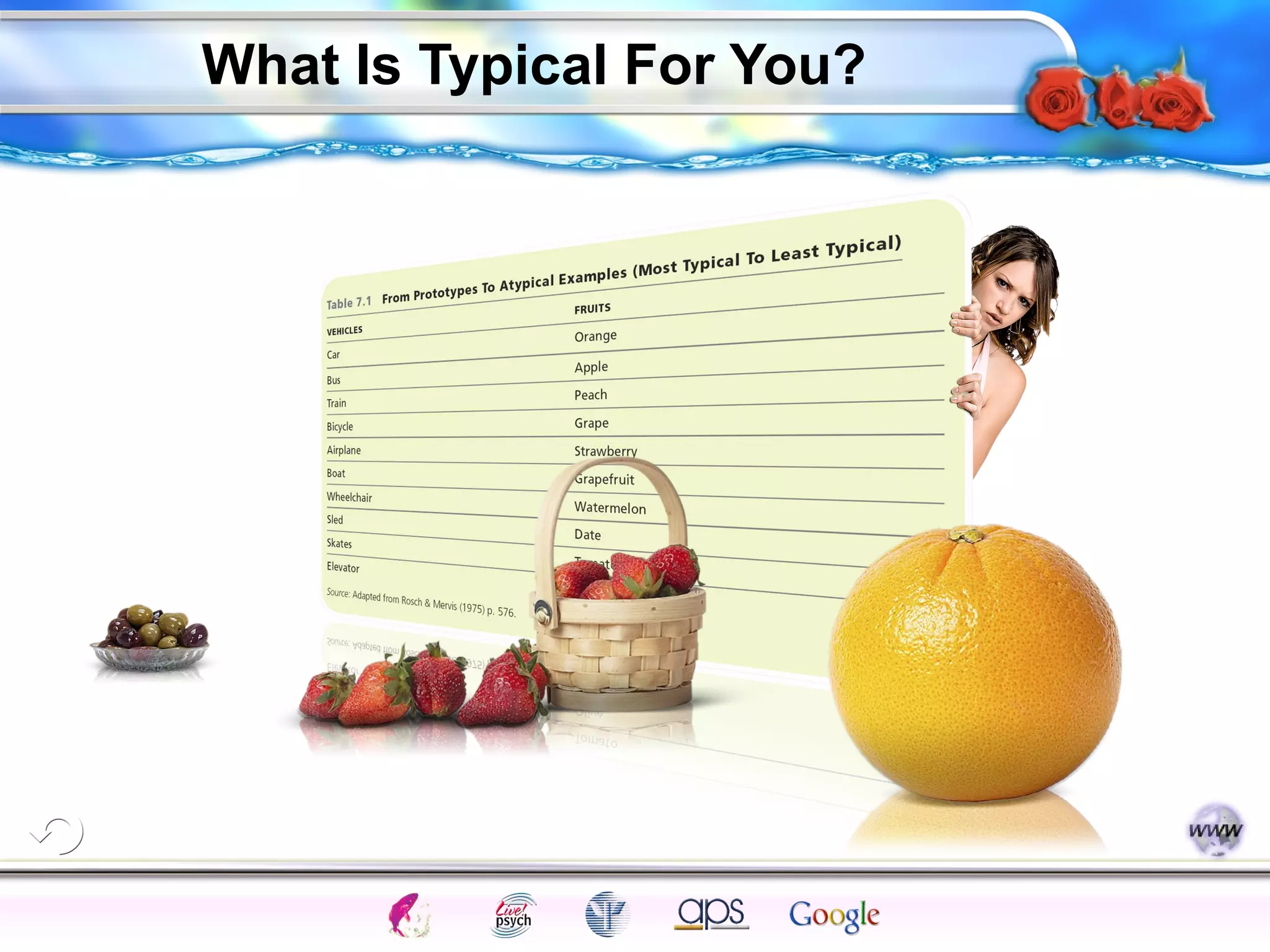
What Is Typical For You? 
Cognition Concepts Problems A.I. Creativity 
I.Q. Wechsler Bias Delay Terman Heredity 
Animal
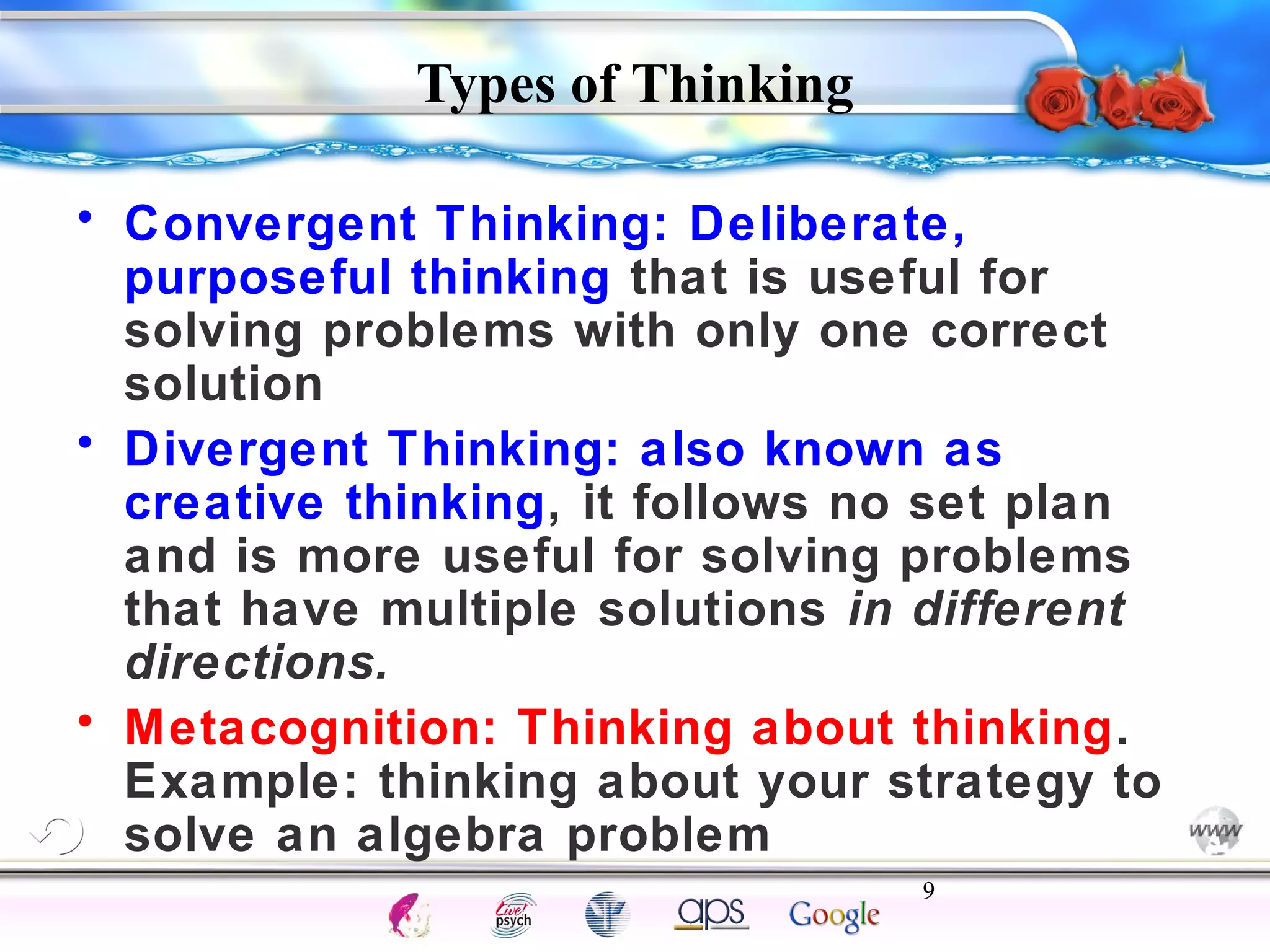
• Convergent Thinking: Deliberate, 
purposeful thinking that is useful for 
solving problems with only one correct 
solution 
• Divergent Thinking: also known as 
creative thinking, it follows no set plan 
and is more useful for solving problems 
that have multiple solutions in different 
directions. 
• Metacognition: Thinking about thinking. 
Example: thinking about your strategy to 
solve an algebra problem 
9 
Intelligence Gardner 
Types of Thinking 
Cognition Concepts Problems A.I. Creativity 
I.Q. Wechsler Bias Delay Terman Heredity 
Animal
7.2 What are the methods people use to solve problems and make decisions? 
Intelligence Gardner 
Problem-Solving 
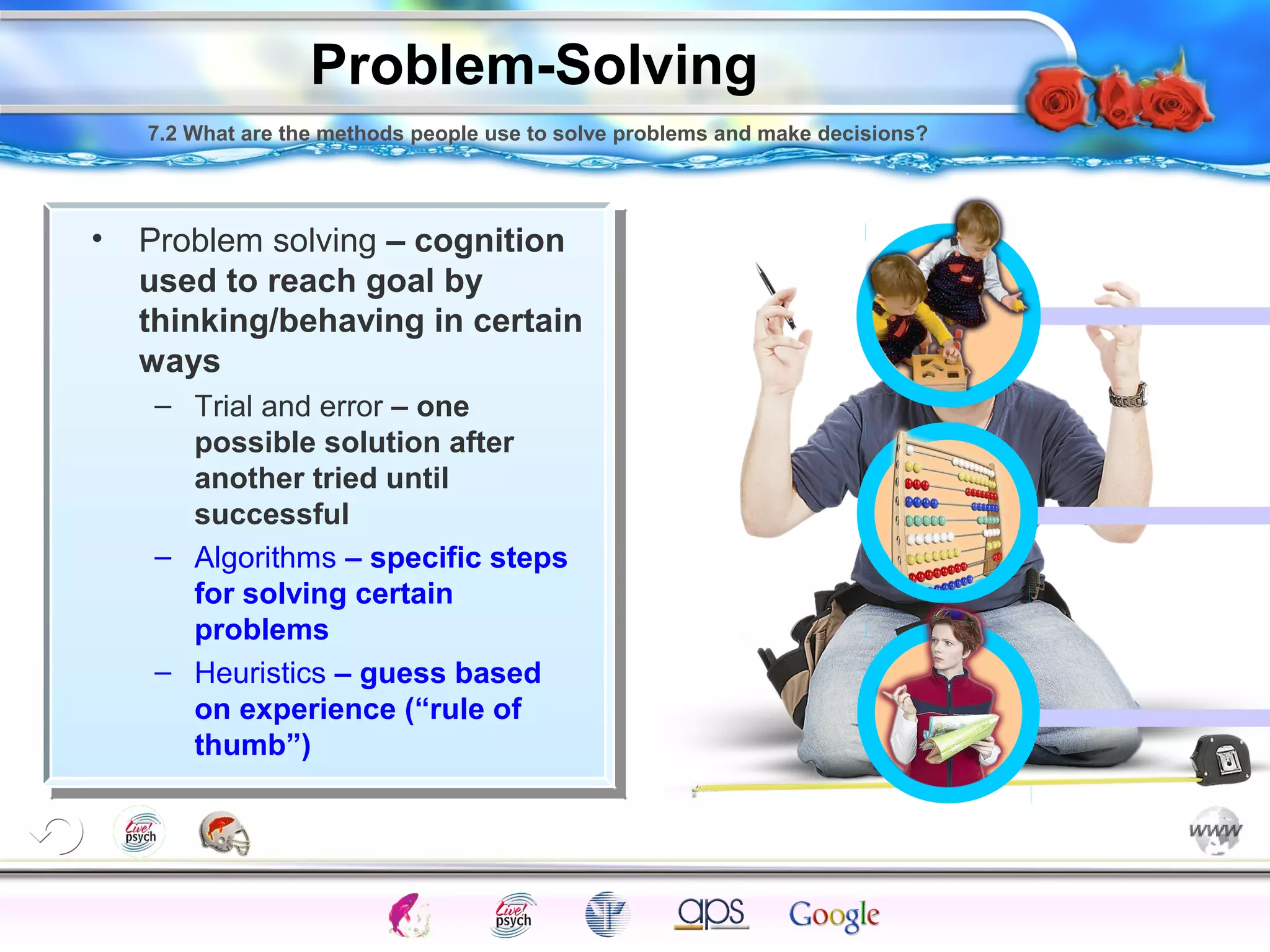
• Problem solving – cognition 
used to reach goal by 
thinking/behaving in certain 
ways 
– Trial and error – one 
possible solution after 
another tried until 
successful 
– Algorithms – specific steps 
for solving certain 
problems 
– Heuristics – guess based 
on experience (“rule of 
thumb”) 
Cognition Concepts Problems A.I. Creativity 
I.Q. Wechsler Bias Delay Terman Heredity 
Animal
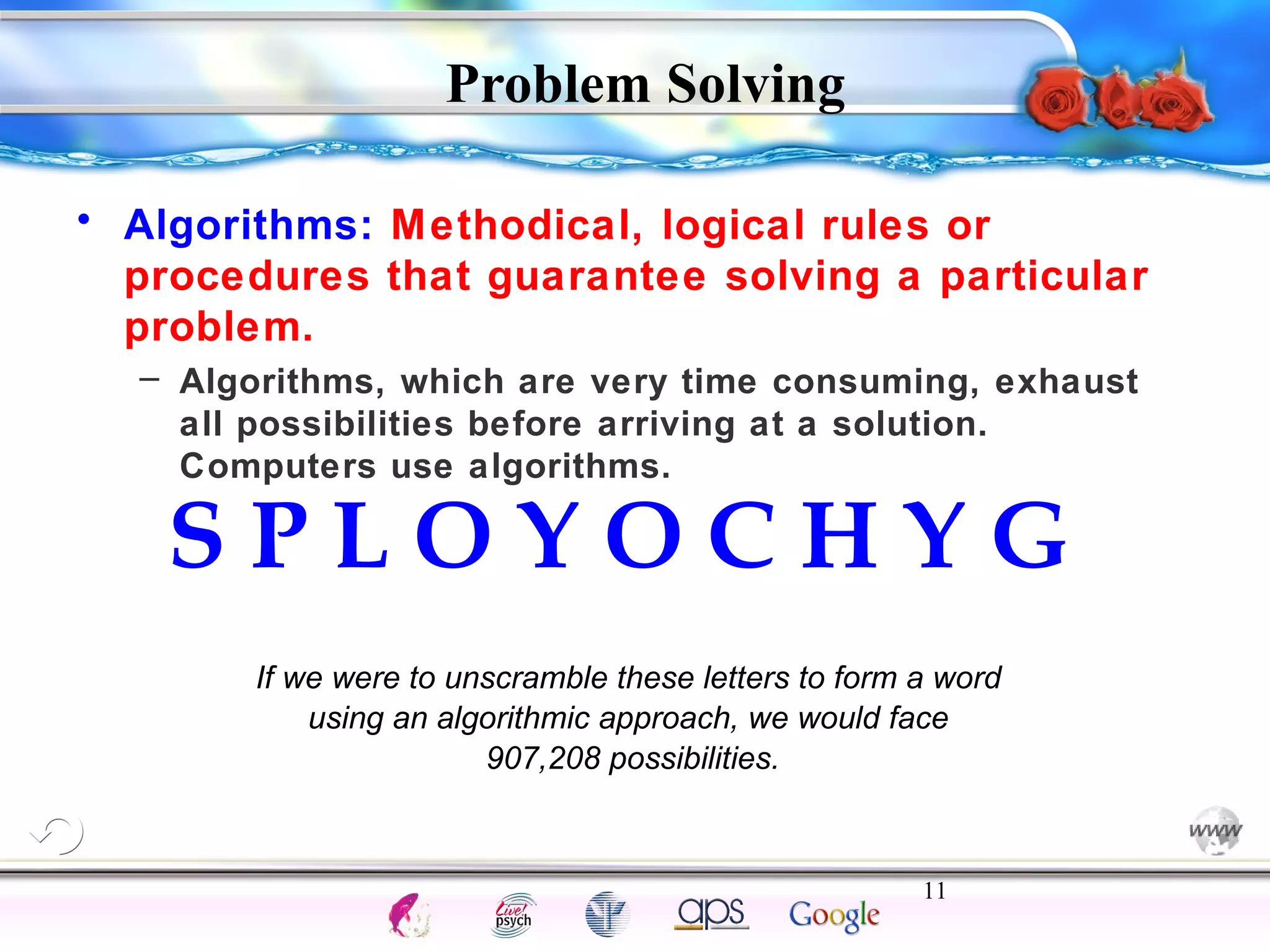
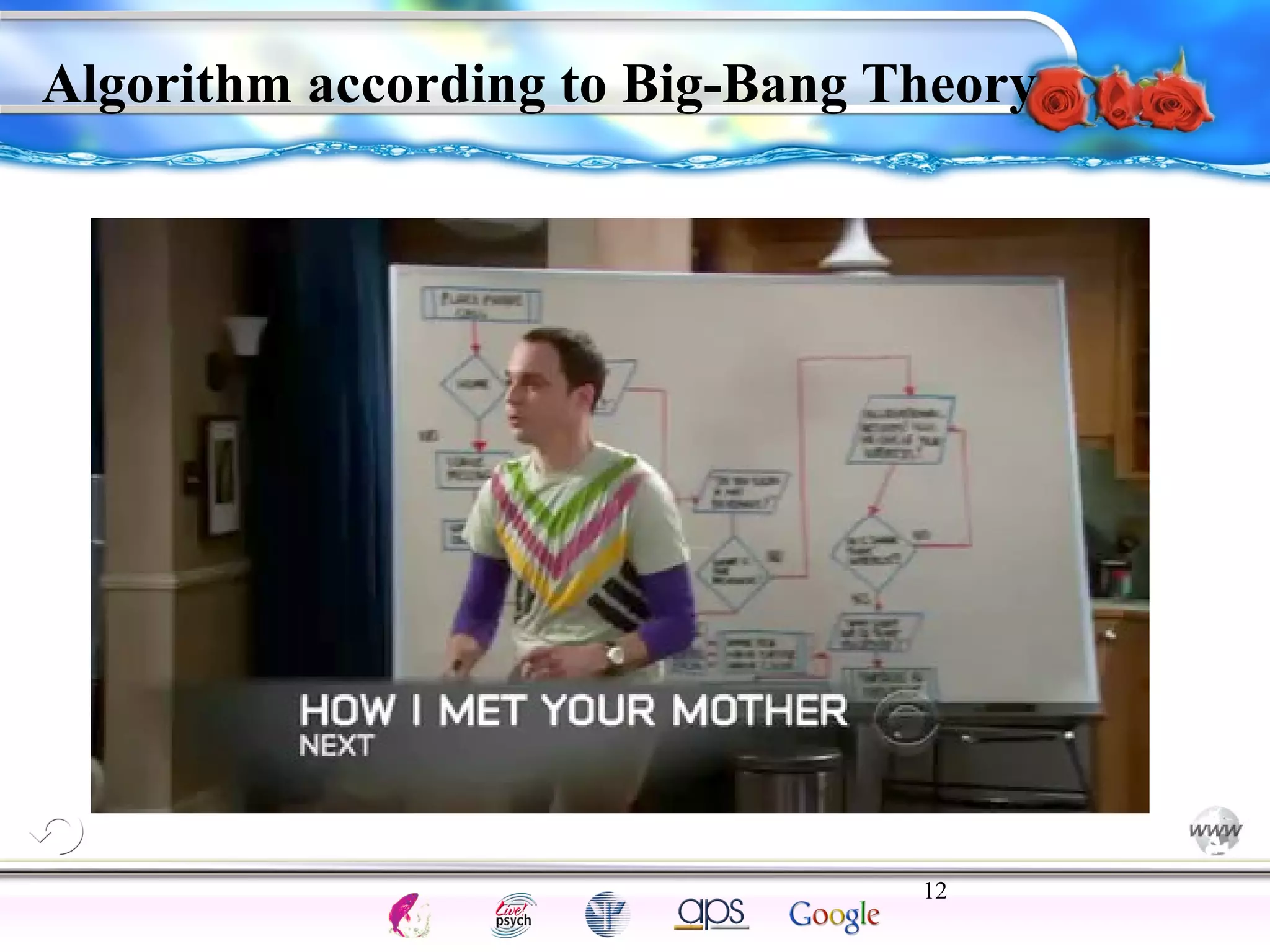
• Algorithms: Methodical, logical rules or 
procedures that guarantee solving a particular 
problem. 
– Algorithms, which are very time consuming, exhaust 
all possibilities before arriving at a solution. 
Computers use algorithms. 
S P L O Y O C H Y G 
If we were to unscramble these letters to form a word 
using an algorithmic approach, we would face 
11 
Intelligence Gardner 
Problem Solving 
907,208 possibilities. 
Cognition Concepts Problems A.I. Creativity 
I.Q. Wechsler Bias Delay Terman Heredity 
Animal
Algorithm according to Big-Bang Theory 
12 
Intelligence Gardner 
Cognition Concepts Problems A.I. Creativity 
I.Q. Wechsler Bias Delay Terman Heredity 
Animal
1. How can you physically stand behind your father while 
2. What occurred on the 6th of May, 1978 at 12:34PM? 
3. Can you translate this: Y Y U R Y Y U B I C U R Y Y 4 M E 
4. A man bought a horse for $60 and sold it for $70. Then 
he bought the same horse back for $80 and sold it again 
for $90. How much money did he make in the horse 
business? 
13 
Intelligence Gardner 
Problem Solving Examples 
he is standing behind you? 
Cognition Concepts Problems A.I. Creativity 
I.Q. Wechsler Bias Delay Terman Heredity 
Animal
Insight & Incubation 
14 
Intelligence Gardner 
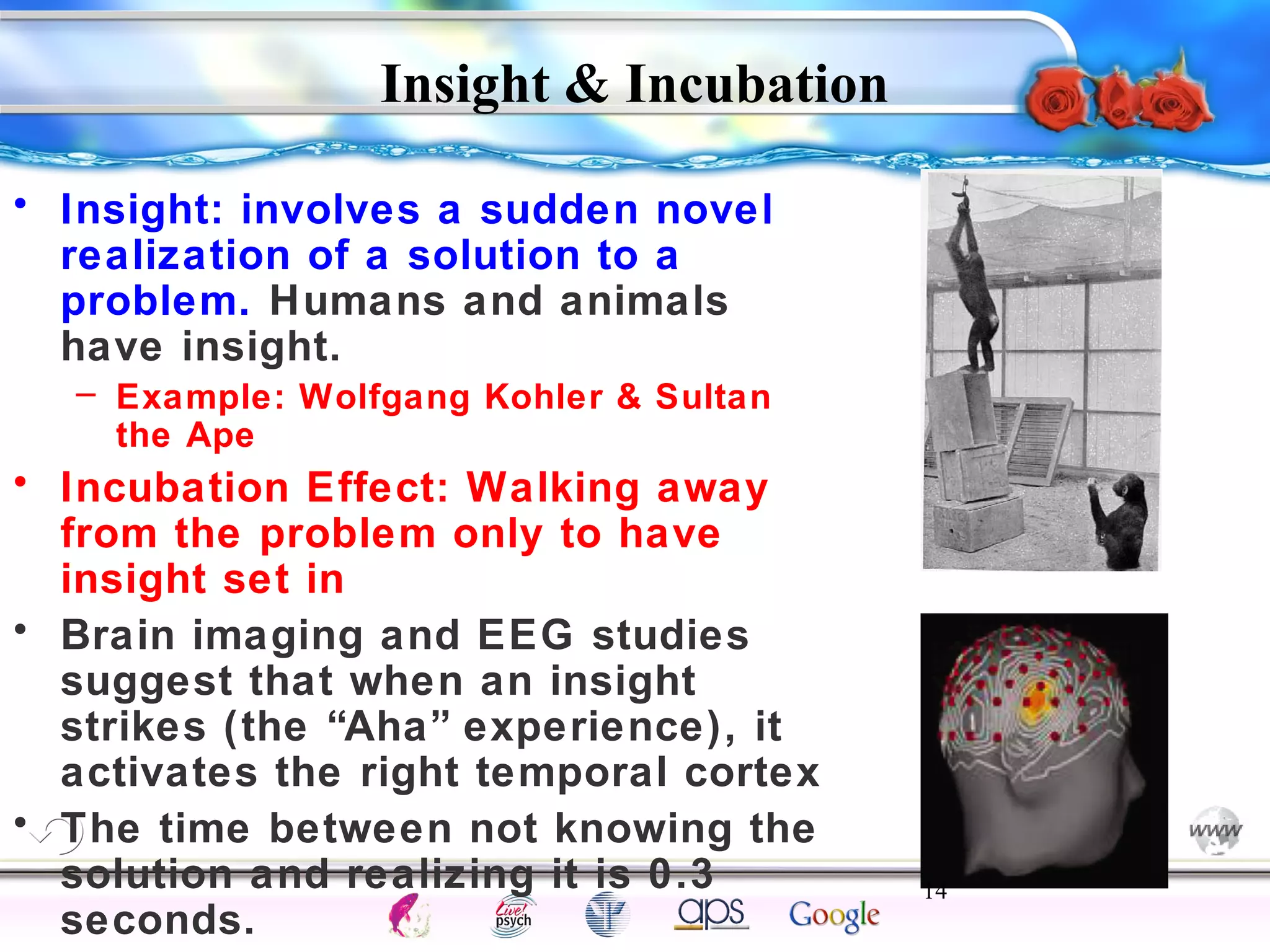
• Insight: involves a sudden novel 
realization of a solution to a 
problem. Humans and animals 
have insight. 
– Example: Wolfgang Kohler & Sultan 
the Ape 
• Incubation Effect: Walking away 
from the problem only to have 
insight set in 
• Brain imaging and EEG studies 
suggest that when an insight 
strikes (the “Aha” experience), it 
activates the right temporal cortex 
• The time between not knowing the 
solution and realizing it is 0.3 
seconds. 
Cognition Concepts Problems A.I. Creativity 
I.Q. Wechsler Bias Delay Terman Heredity 
Animal
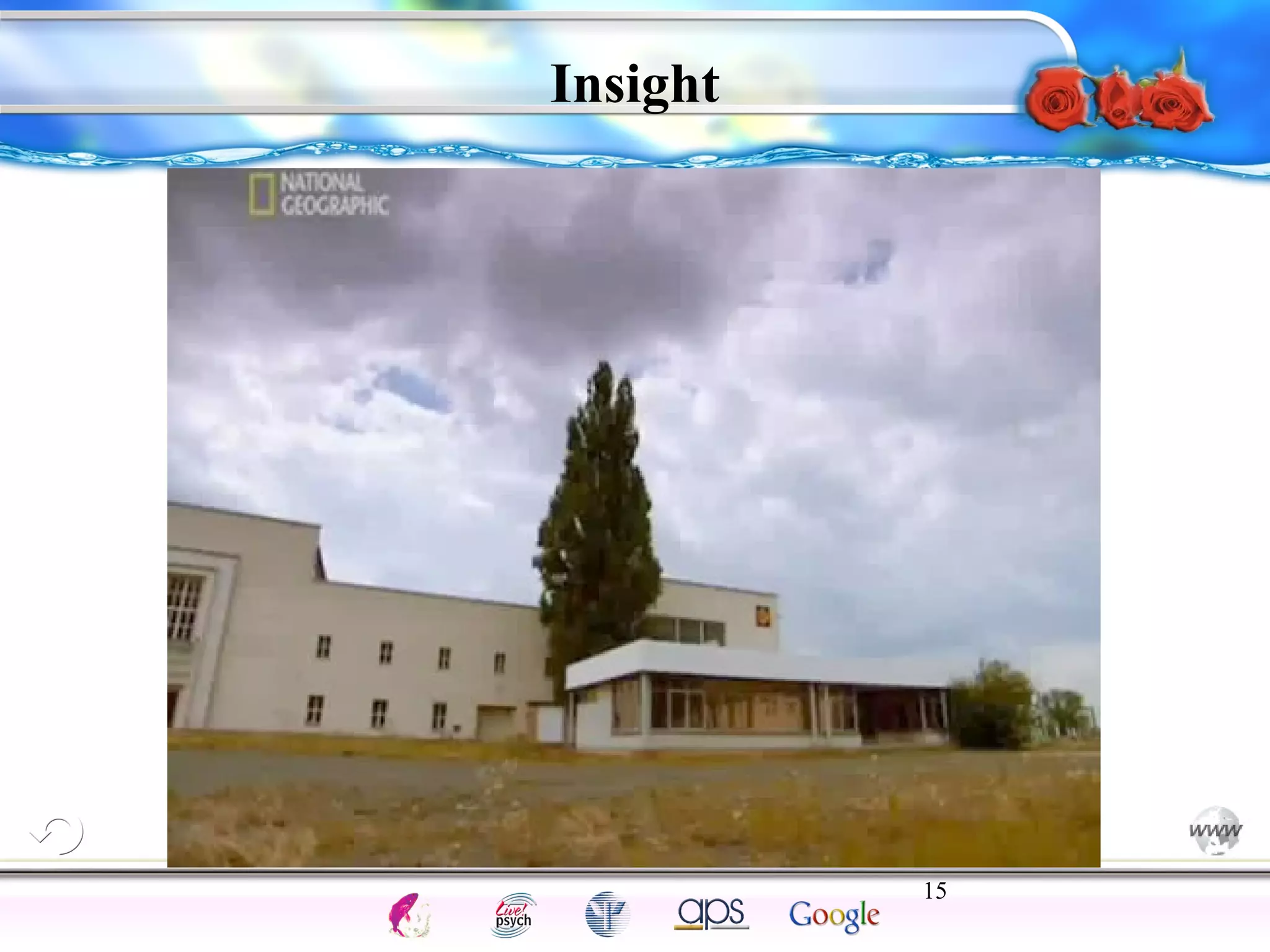
15 
Intelligence Gardner 
Insight 
Cognition Concepts Problems A.I. Creativity 
I.Q. Wechsler Bias Delay Terman Heredity 
Animal
7.3 Why does problem solving sometimes fail and what is creative thinking? 
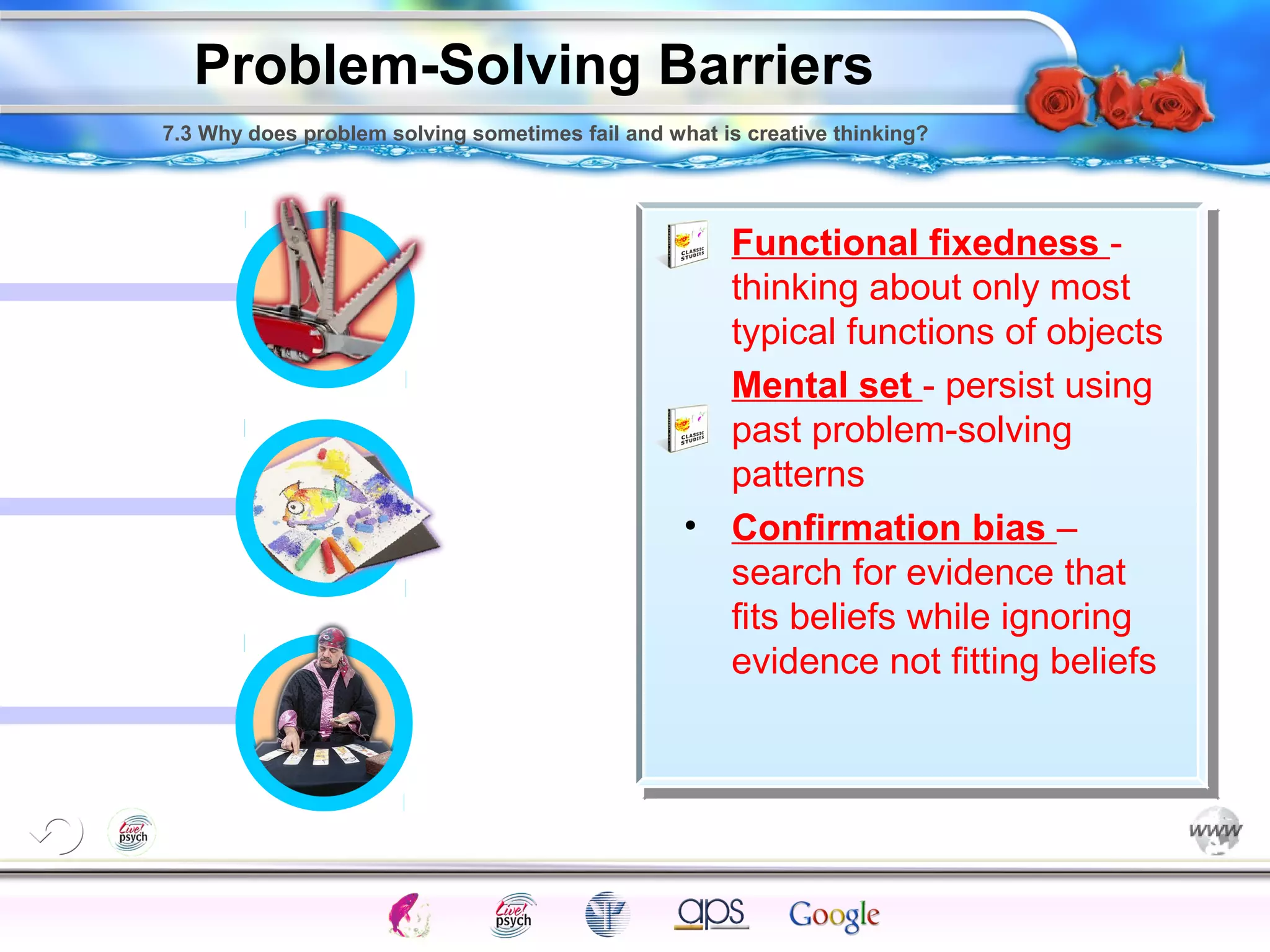
Functional fixedness - 
thinking about only most 
typical functions of objects 
Mental set - persist using 
past problem-solving 
patterns 
• Confirmation bias – 
search for evidence that 
fits beliefs while ignoring 
evidence not fitting beliefs 
Intelligence Gardner 
Problem-Solving Barriers 
Cognition Concepts Problems A.I. Creativity 
I.Q. Wechsler Bias Delay Terman Heredity 
Animal
Intelligence Gardner 
Functional Fixedness 
Cognition Concepts Problems A.I. Creativity 
I.Q. Wechsler Bias Delay Terman Heredity 
Animal
• Working Backwards is another way to 
solve problems like this one: 
The water lilies on the surface of a small 
pond double in area every 24 hours. 
From the time the first water lily 
appears until the pond is completely 
covered takes 60 days. On what day is 
half the pond covered in water lilies? 
18 
Intelligence Gardner 
Working Backwards 
Cognition Concepts Problems A.I. Creativity 
I.Q. Wechsler Bias Delay Terman Heredity 
Animal
Section Thinking and Problem Solving 
Reflect on Learning Goals 
•Students should be able to answer the following: 
1. What are the functions of concepts? 
2. What strategies assist our problem solving? What is 
I can… 
•Identify and describe the terms associated with the learning goal 
questions. 
•Explain the answer to the learning goal questions with specific details. 
•Apply the main concepts of the learning goal to myself or other topics 
related to the course. 
I can… 
•Identify and describe the terms associated with the learning goal 
questions. 
•Explain the answer to the learning goal questions with specific details. 
I can… 
•Identify and describe the terms associated with the learning goal 
questions. 
Intelligence Gardner 
creativity and what fosters it? 
3. What are the obstacles to problem solving? 
Self-Rating Level of Understanding 
4.0 
★ 3.0 ★ 
2.0 
Cognition Concepts Problems A.I. Creativity 
1.0 •I need help in understanding the learning goals! 
I.Q. Wechsler Bias Delay Terman Heredity 
Animal
• Using the handouts and games provided by the 
instructor, students will work in groups to solve 
various brain teasers and puzzles. 
• Students should be able to discuss with the 
instructor how the problem-solving terms 
relate to solving the brain teasers and puzzles. 
• Complete the problem-solving analysis 
worksheet on your own paper. 
20 
Intelligence Gardner 
Section Assessment 
Cognition Concepts Problems A.I. Creativity 
I.Q. Wechsler Bias Delay Terman Heredity 
Animal
Section 2:Heuristics and Framing 
Learning Goals 
•Students should be able to answer the following: 
1. How do heuristics, overconfidence, and belief 
perseverance influence our decisions and 
judgments? 
Intelligence Gardner 
2. What is framing? 
Cognition Concepts Problems A.I. Creativity 
I.Q. Wechsler Bias Delay Terman Heredity 
Animal 
21
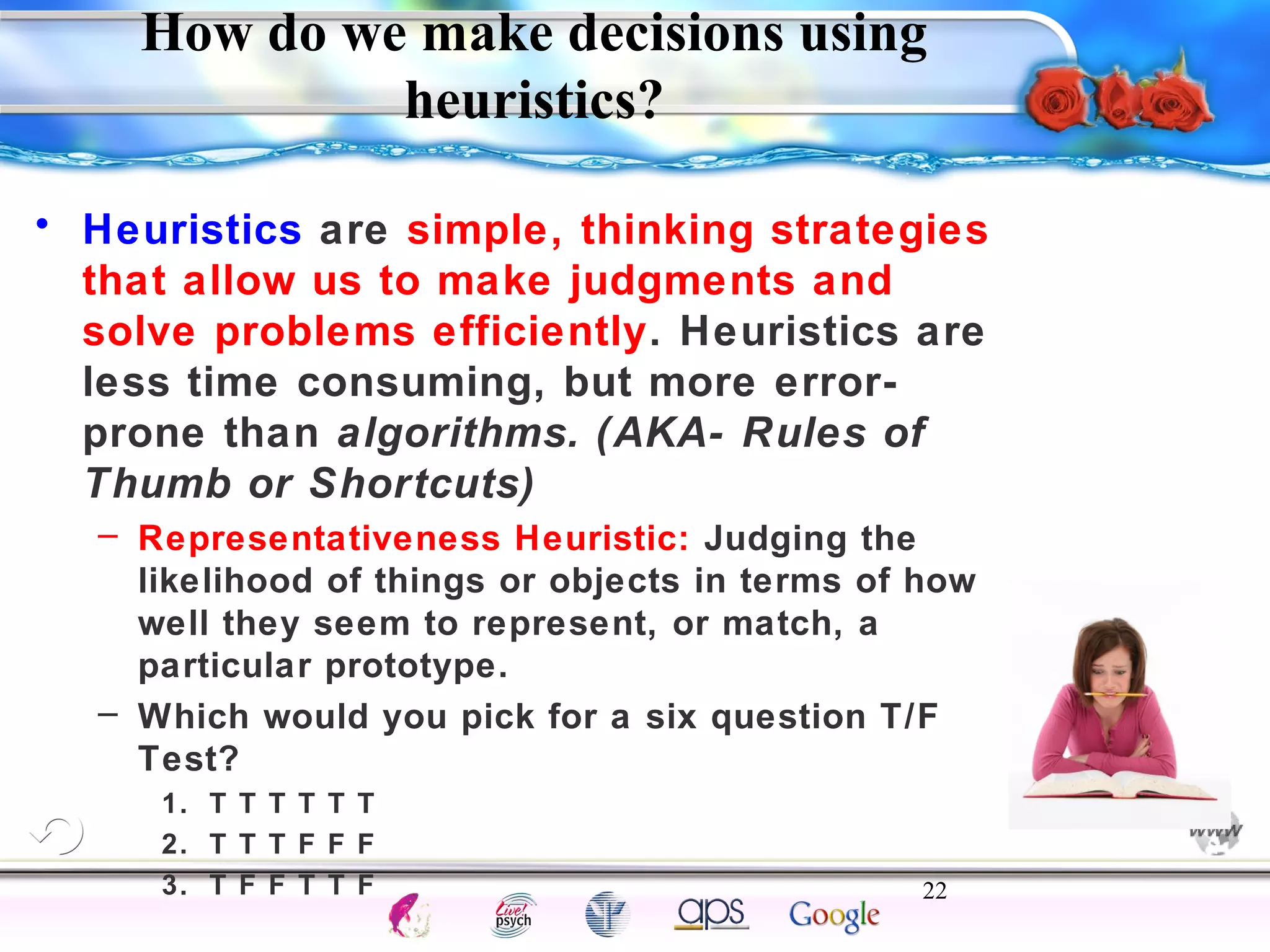
How do we make decisions using 
• Heuristics are simple, thinking strategies 
that allow us to make judgments and 
solve problems efficiently. Heuristics are 
less time consuming, but more error-prone 
than algorithms. (AKA- Rules of 
Thumb or Shortcuts) 
– Representativeness Heuristic: Judging the 
likelihood of things or objects in terms of how 
well they seem to represent, or match, a 
particular prototype. 
– Which would you pick for a six question T/F 
Test? 
1. T T T T T T 
2. T T T F F F 
3. T F F T T F 22 
Intelligence Gardner 
heuristics? 
Cognition Concepts Problems A.I. Creativity 
I.Q. Wechsler Bias Delay Terman Heredity 
Animal
How do we make decisions using 
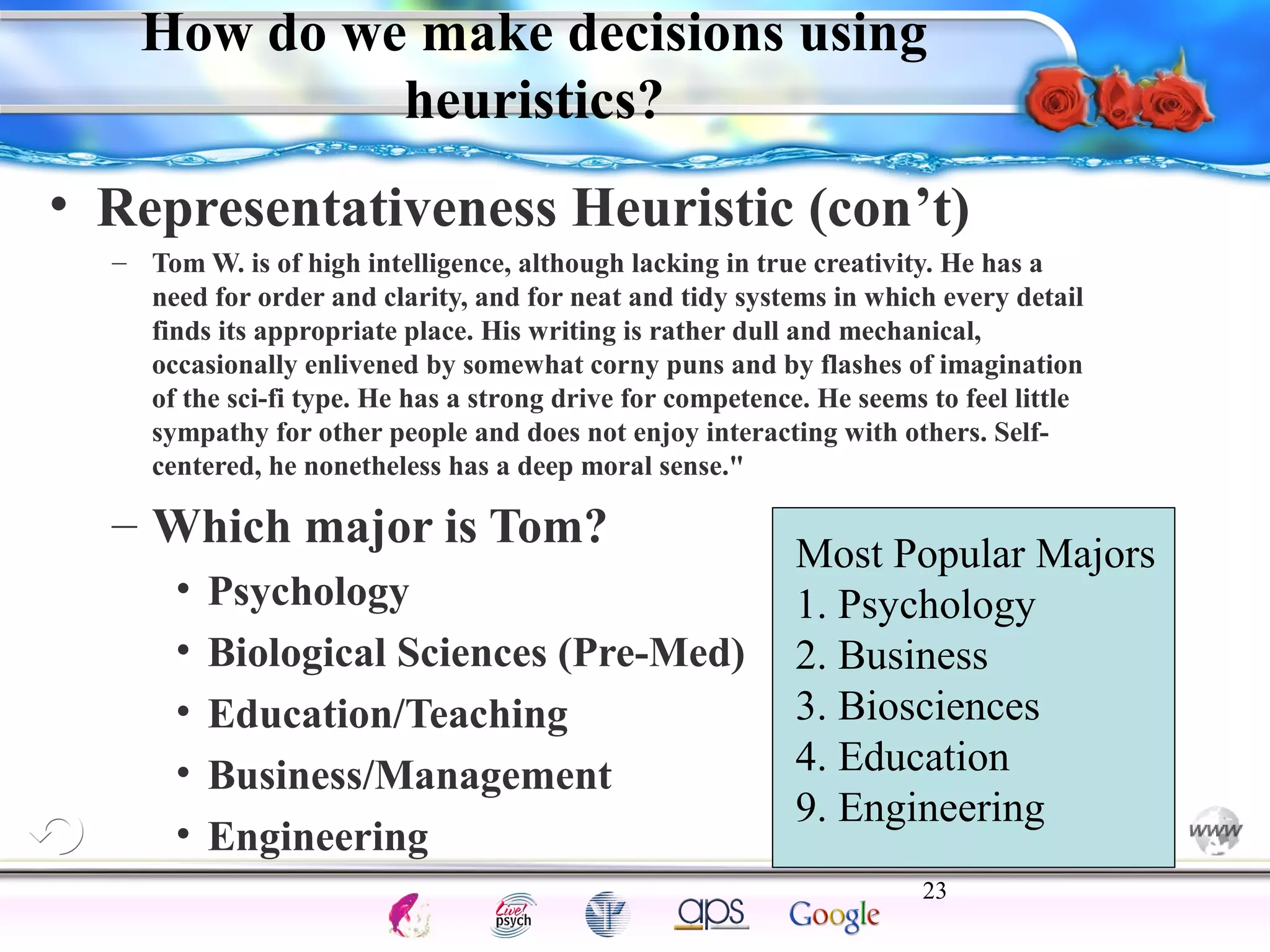
• Representativeness Heuristic (con’t) 
– Tom W. is of high intelligence, although lacking in true creativity. He has a 
need for order and clarity, and for neat and tidy systems in which every detail 
finds its appropriate place. His writing is rather dull and mechanical, 
occasionally enlivened by somewhat corny puns and by flashes of imagination 
of the sci-fi type. He has a strong drive for competence. He seems to feel little 
sympathy for other people and does not enjoy interacting with others. Self-centered, 
Most Popular Majors 
1. Psychology 
2. Business 
3. Biosciences 
4. Education 
9. Engineering 
23 
Intelligence Gardner 
heuristics? 
he nonetheless has a deep moral sense." 
– Which major is Tom? 
• Psychology 
• Biological Sciences (Pre-Med) 
• Education/Teaching 
• Business/Management 
• Engineering 
Cognition Concepts Problems A.I. Creativity 
I.Q. Wechsler Bias Delay Terman Heredity 
Animal
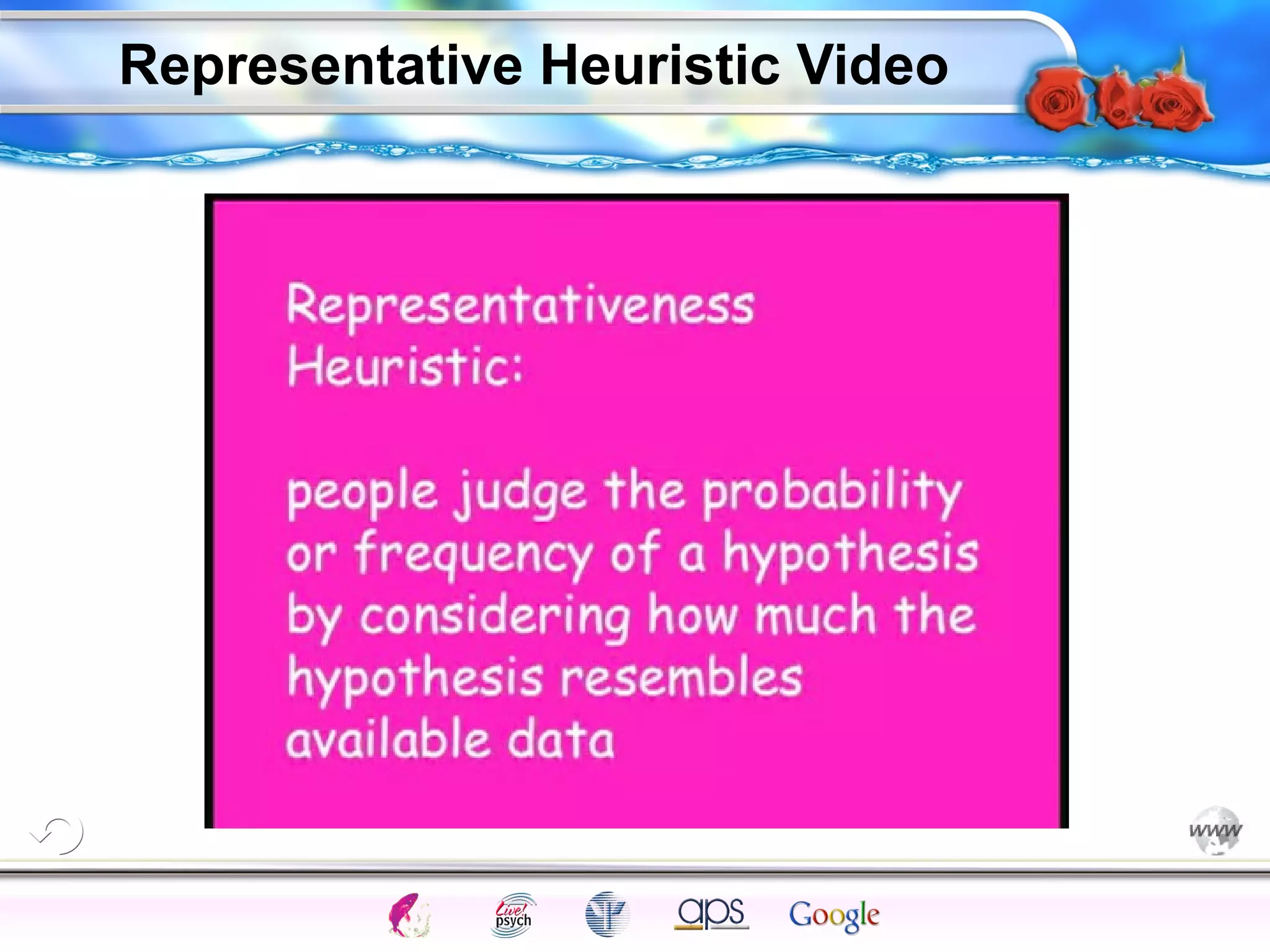
Representative Heuristic Video 
Intelligence Gardner 
Cognition Concepts Problems A.I. Creativity 
I.Q. Wechsler Bias Delay Terman Heredity 
Animal
How do we make decisions using 
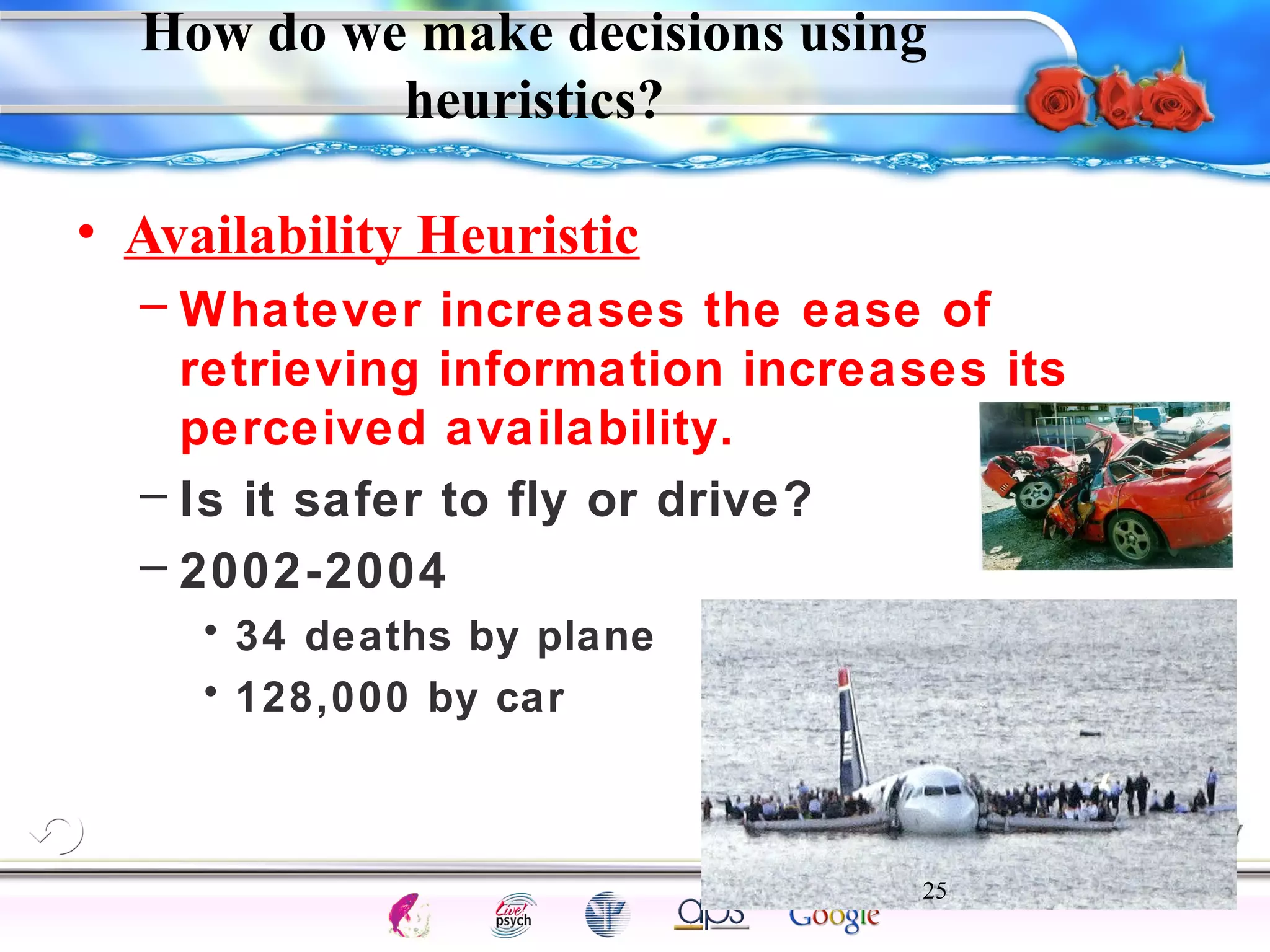
– Whatever increases the ease of 
retrieving information increases its 
perceived availability. 
– Is it safer to fly or drive? 
– 2002-2004 
25 
Intelligence Gardner 
heuristics? 
• Availability Heuristic 
• 34 deaths by plane 
• 128,000 by car 
Cognition Concepts Problems A.I. Creativity 
I.Q. Wechsler Bias Delay Terman Heredity 
Animal
26 
Intelligence Gardner 
Availability Heuristic 
Cognition Concepts Problems A.I. Creativity 
I.Q. Wechsler Bias Delay Terman Heredity 
Animal
How do we make decisions using 
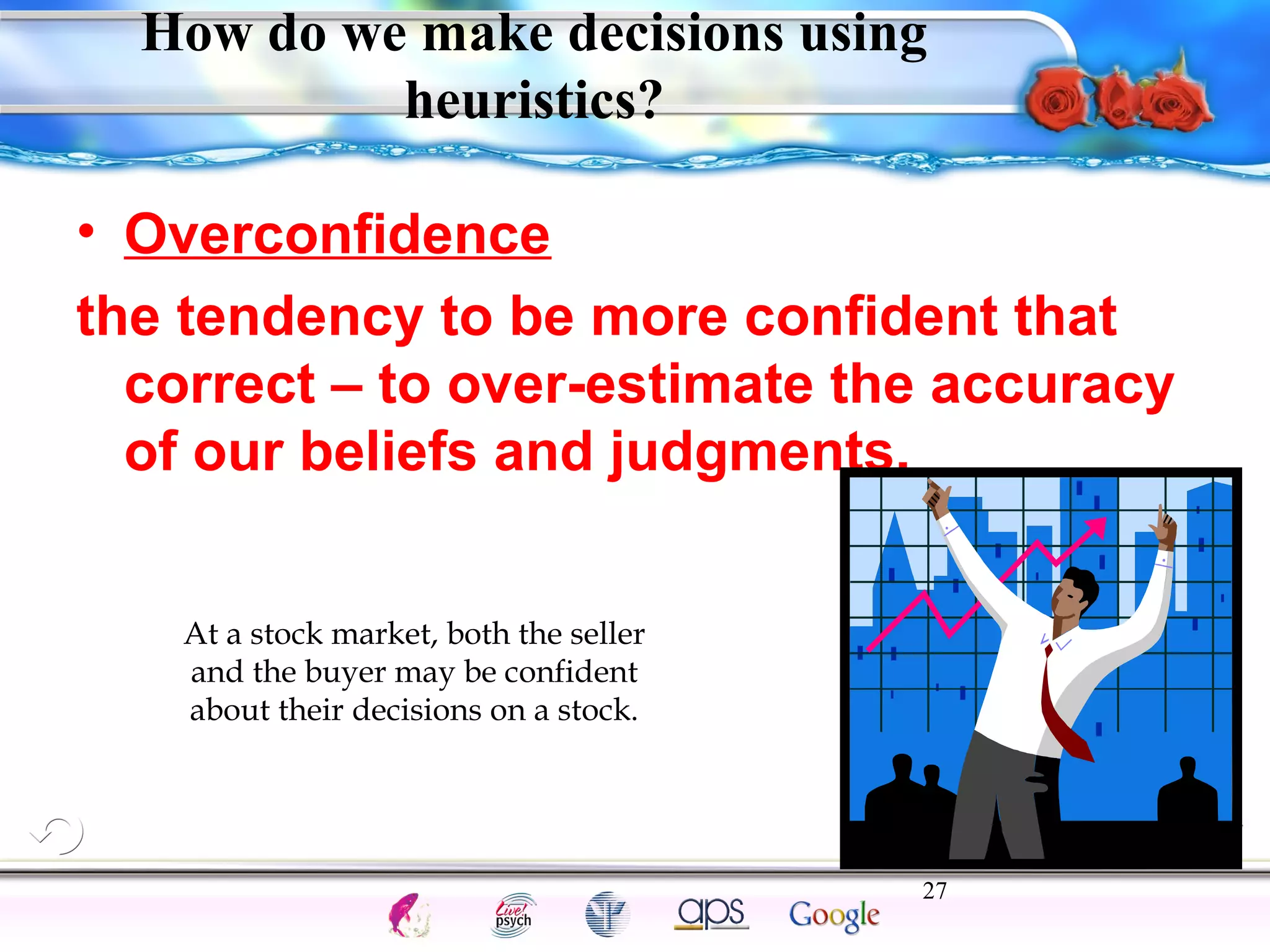
• Overconfidence 
the tendency to be more confident that 
correct – to over-estimate the accuracy 
of our beliefs and judgments. 
27 
Intelligence Gardner 
heuristics? 
At a stock market, both the seller 
and the buyer may be confident 
about their decisions on a stock. 
Cognition Concepts Problems A.I. Creativity 
I.Q. Wechsler Bias Delay Terman Heredity 
Animal
Belief Bias 
The tendency of one’s preexisting beliefs to 
distort logical reasoning by making invalid 
conclusions. 
God is love. 
Love is blind 
Ray Charles is blind. 
Ray Charles is God. 
Anonymous graffiti 
Cognition Concepts Problems A.I. Creativity 28 
Intelligence Gardner 
I.Q. Wechsler Bias Delay Terman Heredity 
Animal
How do we make decisions using 
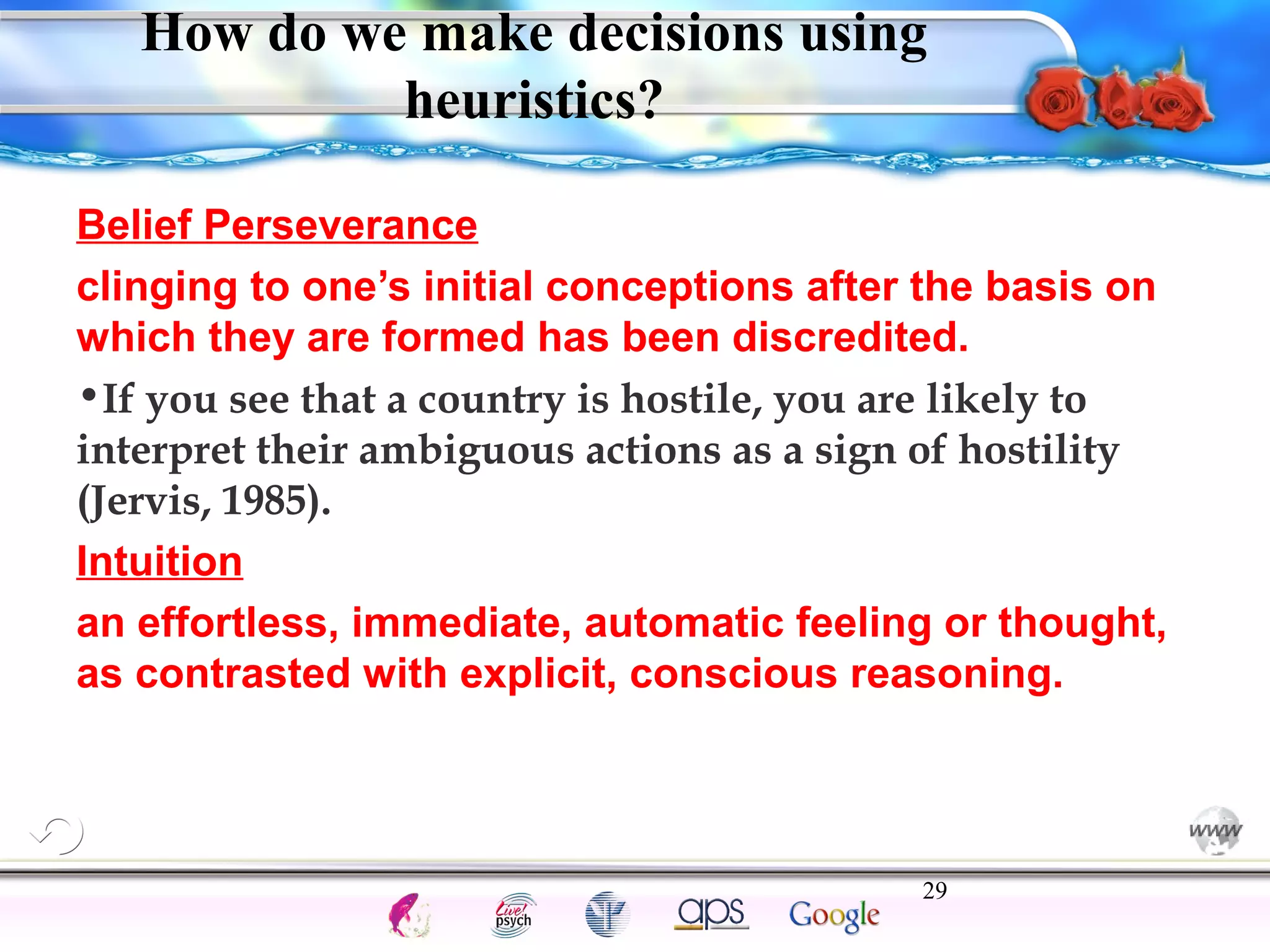
Belief Perseverance 
clinging to one’s initial conceptions after the basis on 
which they are formed has been discredited. 
•If you see that a country is hostile, you are likely to 
interpret their ambiguous actions as a sign of hostility 
(Jervis, 1985). 
Intuition 
an effortless, immediate, automatic feeling or thought, 
as contrasted with explicit, conscious reasoning. 
29 
Intelligence Gardner 
heuristics? 
Cognition Concepts Problems A.I. Creativity 
I.Q. Wechsler Bias Delay Terman Heredity 
Animal
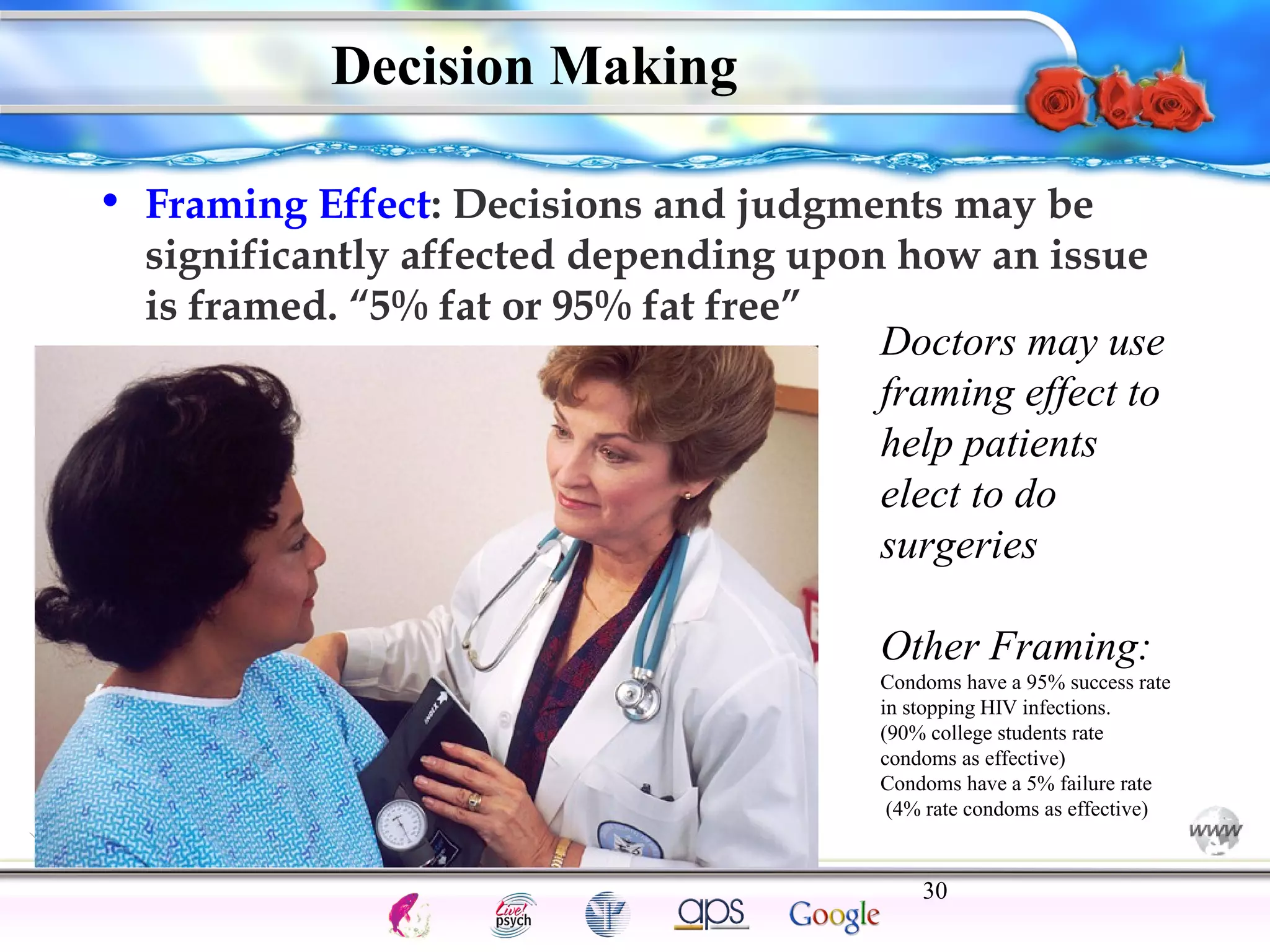
• Framing Effect: Decisions and judgments may be 
significantly affected depending upon how an issue 
is framed. “5% fat or 95% fat free” 
Doctors may use 
framing effect to 
help patients 
elect to do 
surgeries 
Other Framing: 
Condoms have a 95% success rate 
in stopping HIV infections. 
(90% college students rate 
condoms as effective) 
Condoms have a 5% failure rate 
(4% rate condoms as effective) 
30 
Intelligence Gardner 
Decision Making 
Cognition Concepts Problems A.I. Creativity 
I.Q. Wechsler Bias Delay Terman Heredity 
Animal
1. Breast cancer has recently received a great deal of attention in the news. 
This may lead us to believe that breast cancer is a much bigger risk of 
death than is heart disease, which would not be the case. This 
overestimation of risk effect is an example of: 
(A) Representativeness heuristic 
(B) Availability heuristic 
(C) Stereotyping 
(D) Confirmation bias 
2. A math student consistently tries to answer a problem using the same 
solution, but is unable to generate any new approaches to the problem. 
This is best illustrated by: 
(A) A Mental Set 
(B) Overgeneralization 
(C) The Framing Effect 
(D) Metacognition 
31 
Intelligence Gardner 
Section Assessment 
Cognition Concepts Problems A.I. Creativity 
I.Q. Wechsler Bias Delay Terman Heredity 
Animal
Section 2 Heuristics and Framing 
Reflect on Learning Goals 
•Students should be able to answer the following: 
1. How do heuristics, overconfidence, and belief perseverance 
I can… 
•Identify and describe the terms associated with the learning goal 
questions. 
•Explain the answer to the learning goal questions with specific details. 
•Apply the main concepts of the learning goal to myself or other topics 
related to the course. 
I can… 
•Identify and describe the terms associated with the learning goal 
questions. 
•Explain the answer to the learning goal questions with specific details. 
I can… 
•Identify and describe the terms associated with the learning goal 
questions. 
Intelligence Gardner 
influence our decisions and judgments? 
2. What is framing? 
Self-Rating Level of Understanding 
4.0 
★ 3.0 ★ 
2.0 
1.0 •I need help in understanding the learning goals! 
Cognition Concepts Problems A.I. Creativity 
I.Q. Wechsler Bias Delay Terman Heredity 
Animal
Learning Goals 
•Students should be able to answer the following: 
1. What are the structural components of a 
2. What are the milestones of language 
3. How do we learn language? 
4. What is the relationship between language 
Intelligence Gardner 
Section 3: Language 
language? 
development? 
and thinking? 
Cognition Concepts Problems A.I. Creativity 
I.Q. Wechsler Bias Delay Terman Heredity 
Animal 
33
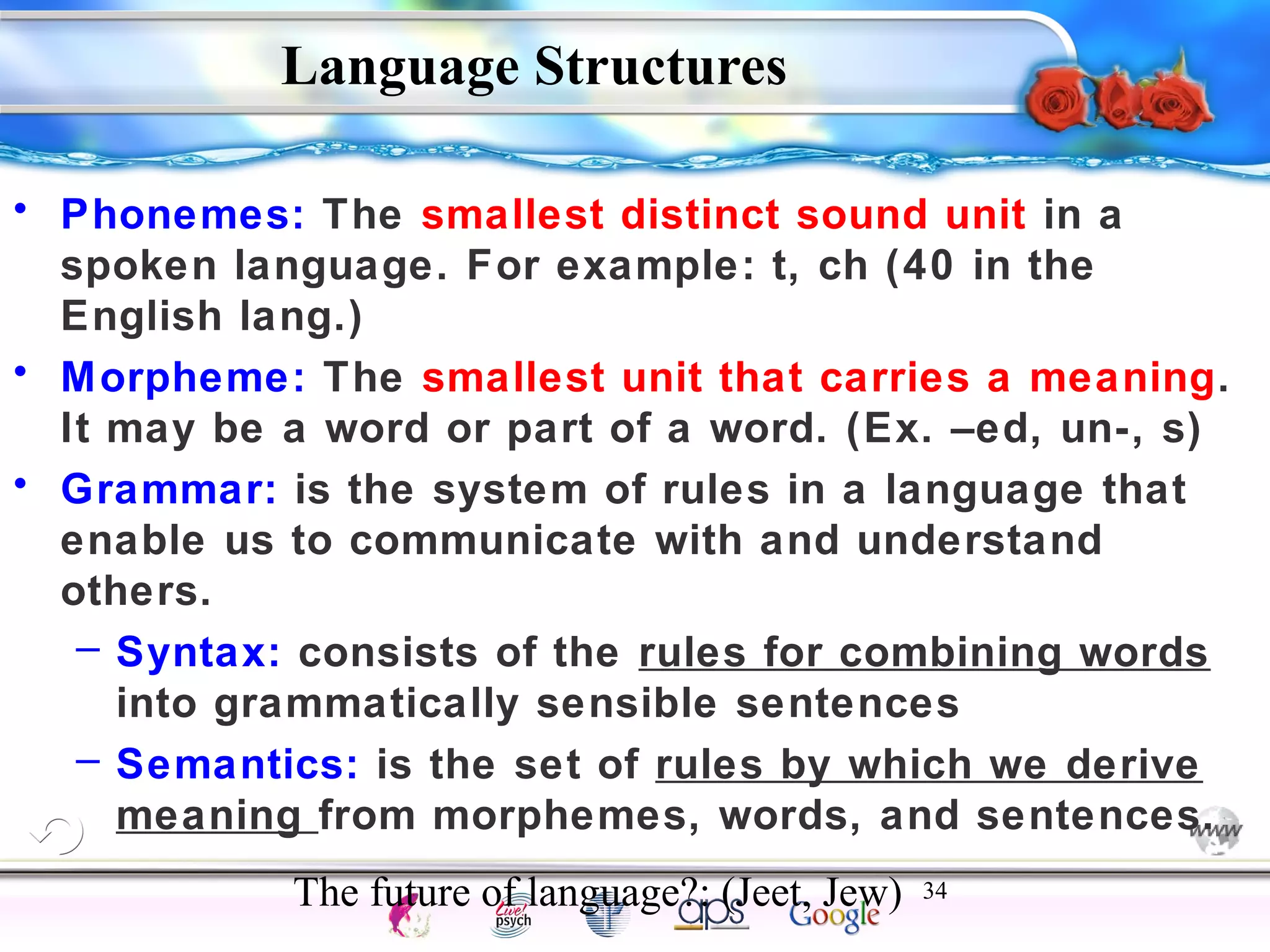
• Phonemes: The smallest distinct sound unit in a 
spoken language. For example: t, ch (40 in the 
English lang.) 
• Morpheme: The smallest unit that carries a meaning. 
It may be a word or part of a word. (Ex. –ed, un-, s) 
• Grammar: is the system of rules in a language that 
enable us to communicate with and understand 
others. 
– Syntax: consists of the rules for combining words 
into grammatically sensible sentences 
– Semantics: is the set of rules by which we derive 
meaning from morphemes, words, and sentences. 
The future of language?: (Jeet, Jew) 34 
Intelligence Gardner 
Language Structures 
Cognition Concepts Problems A.I. Creativity 
I.Q. Wechsler Bias Delay Terman Heredity 
Animal
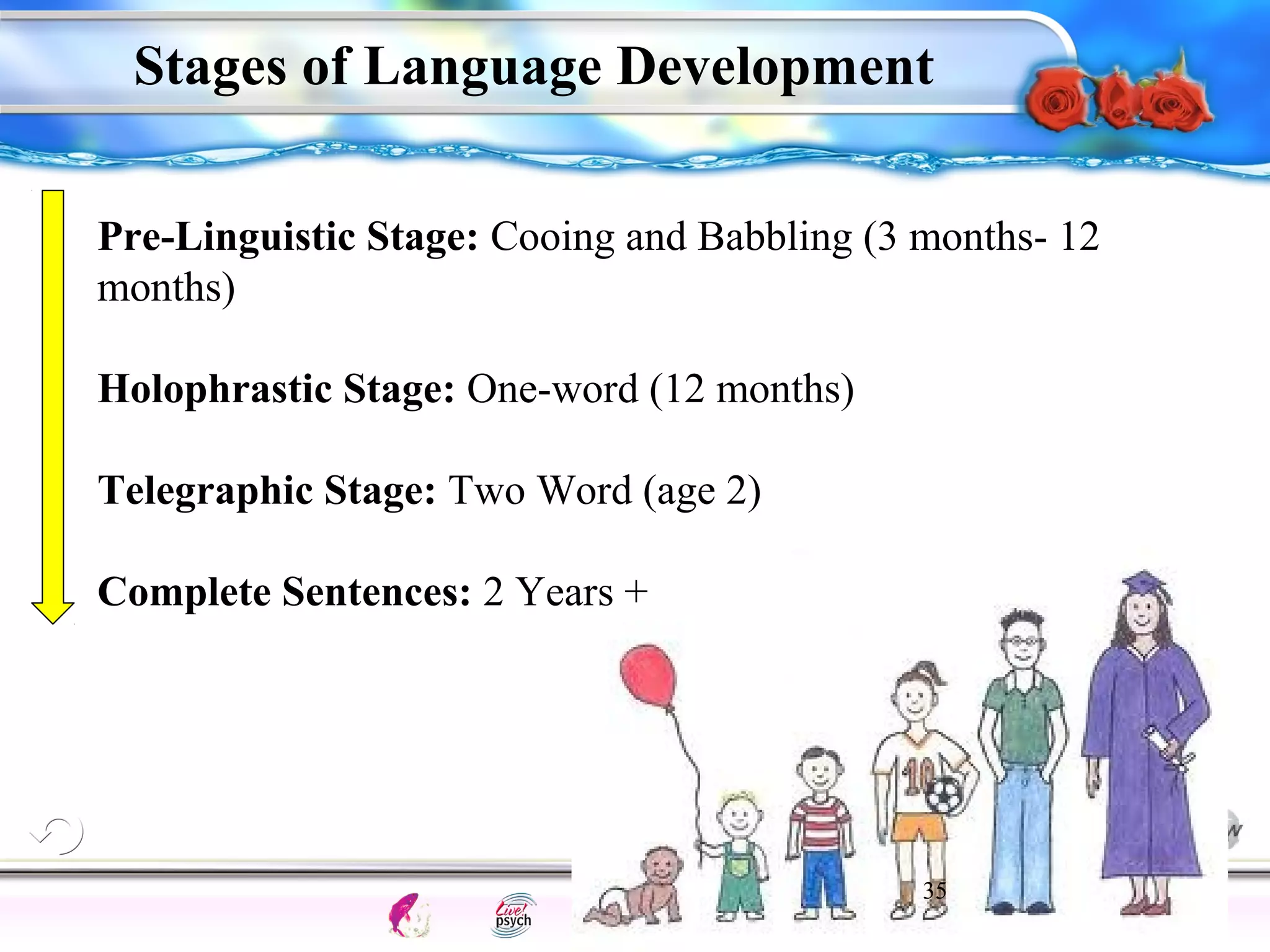
Stages of Language Development 
Pre-Linguistic Stage: Cooing and Babbling (3 months- 12 
months) 
35 
Intelligence Gardner 
Holophrastic Stage: One-word (12 months) 
Telegraphic Stage: Two Word (age 2) 
Complete Sentences: 2 Years + 
Cognition Concepts Problems A.I. Creativity 
I.Q. Wechsler Bias Delay Terman Heredity 
Animal
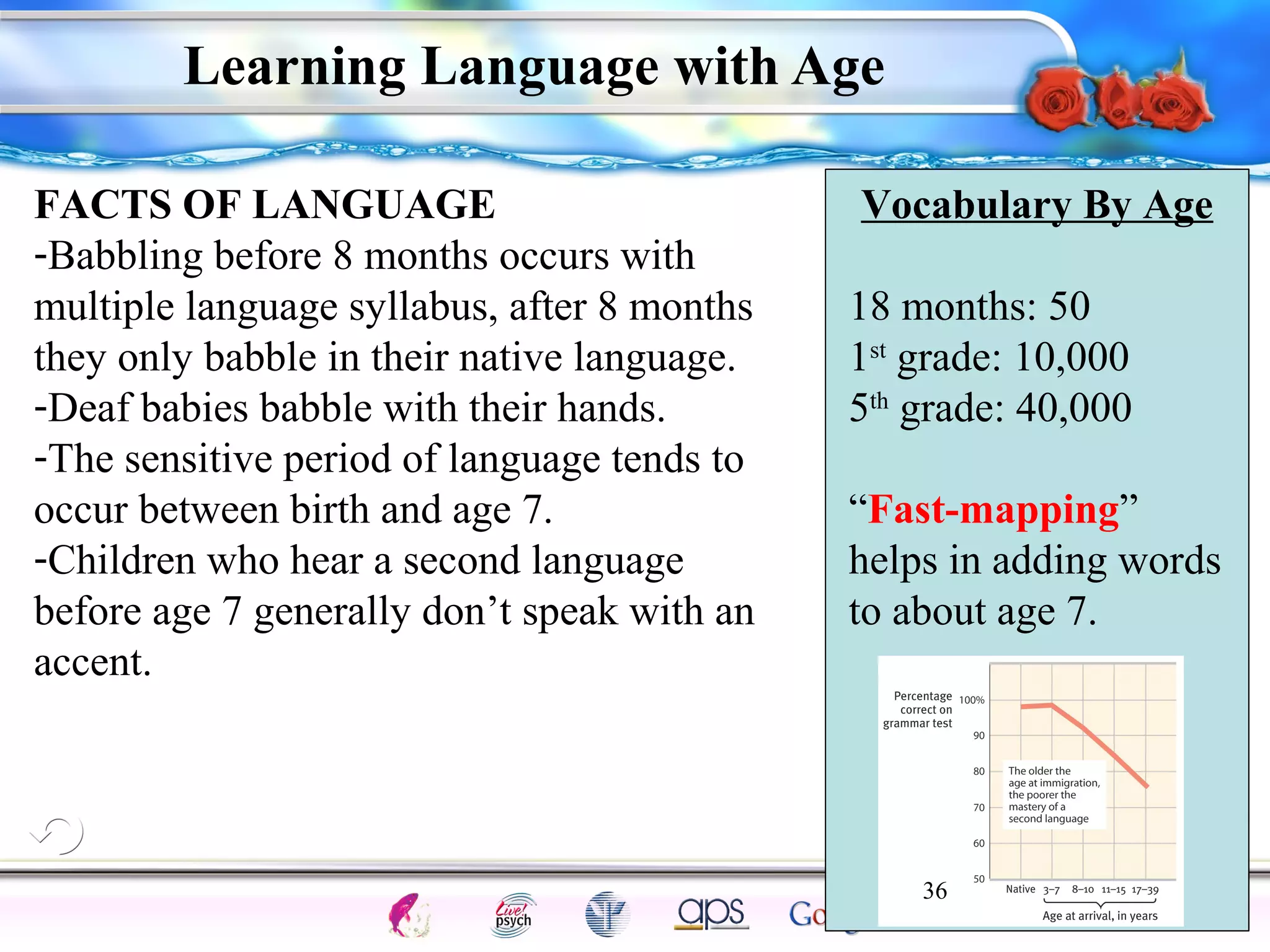
Vocabulary By Age 
18 months: 50 
1st grade: 10,000 
5th grade: 40,000 
“Fast-mapping” 
helps in adding words 
to about age 7. 
36 
Intelligence Gardner 
Learning Language with Age 
FACTS OF LANGUAGE 
-Babbling before 8 months occurs with 
multiple language syllabus, after 8 months 
they only babble in their native language. 
-Deaf babies babble with their hands. 
-The sensitive period of language tends to 
occur between birth and age 7. 
-Children who hear a second language 
before age 7 generally don’t speak with an 
accent. 
Cognition Concepts Problems A.I. Creativity 
I.Q. Wechsler Bias Delay Terman Heredity 
Animal
Language Development Theories 
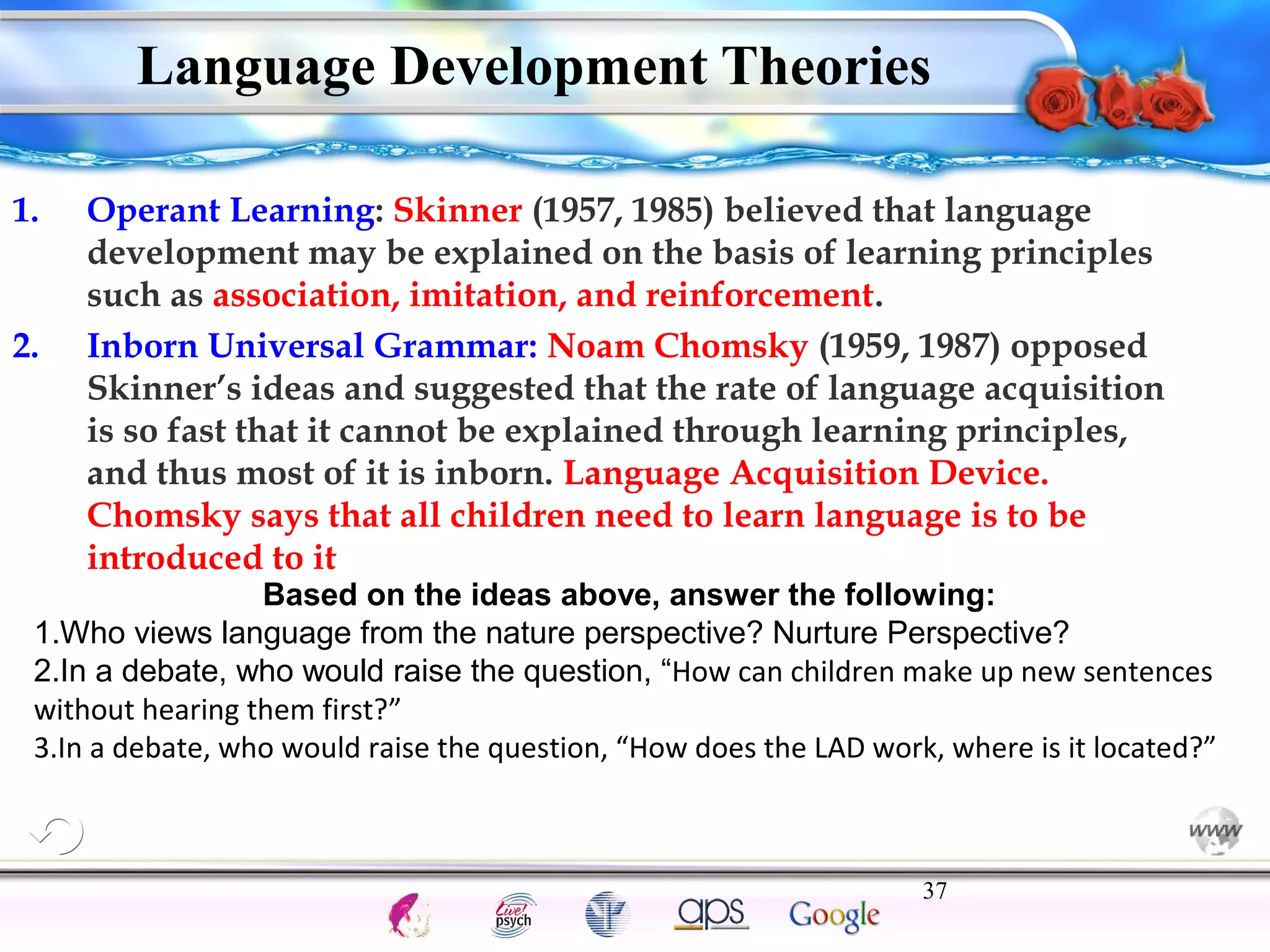
1. Operant Learning: Skinner (1957, 1985) believed that language 
development may be explained on the basis of learning principles 
such as association, imitation, and reinforcement. 
2. Inborn Universal Grammar: Noam Chomsky (1959, 1987) opposed 
Skinner’s ideas and suggested that the rate of language acquisition 
is so fast that it cannot be explained through learning principles, 
and thus most of it is inborn. Language Acquisition Device. 
Chomsky says that all children need to learn language is to be 
introduced to it 
Based on the ideas above, answer the following: 
1.Who views language from the nature perspective? Nurture Perspective? 
2.In a debate, who would raise the question, “How can children make up new sentences 
without hearing them first?” 
3.In a debate, who would raise the question, “How does the LAD work, where is it located?” 
37 
Intelligence Gardner 
Cognition Concepts Problems A.I. Creativity 
I.Q. Wechsler Bias Delay Terman Heredity 
Animal
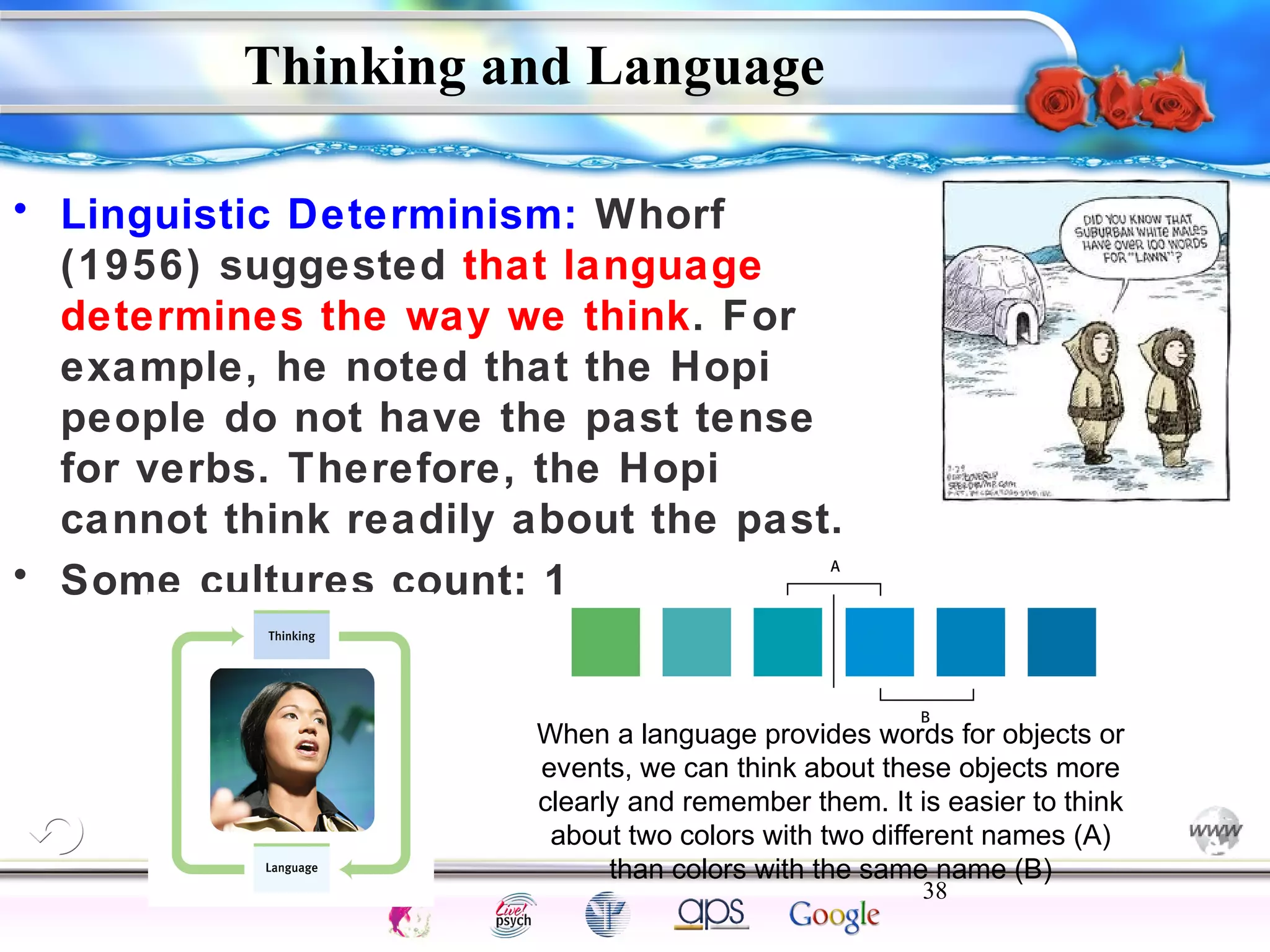
When a language provides words for objects or 
events, we can think about these objects more 
clearly and remember them. It is easier to think 
about two colors with two different names (A) 
than colors with the same name (B) 
38 
Intelligence Gardner 
Thinking and Language 
• Linguistic Determinism: Whorf 
(1956) suggested that language 
determines the way we think. For 
example, he noted that the Hopi 
people do not have the past tense 
for verbs. Therefore, the Hopi 
cannot think readily about the past. 
• Some cultures count: 1, 2, many… 
Cognition Concepts Problems A.I. Creativity 
I.Q. Wechsler Bias Delay Terman Heredity 
Animal
Explaining Language Development 
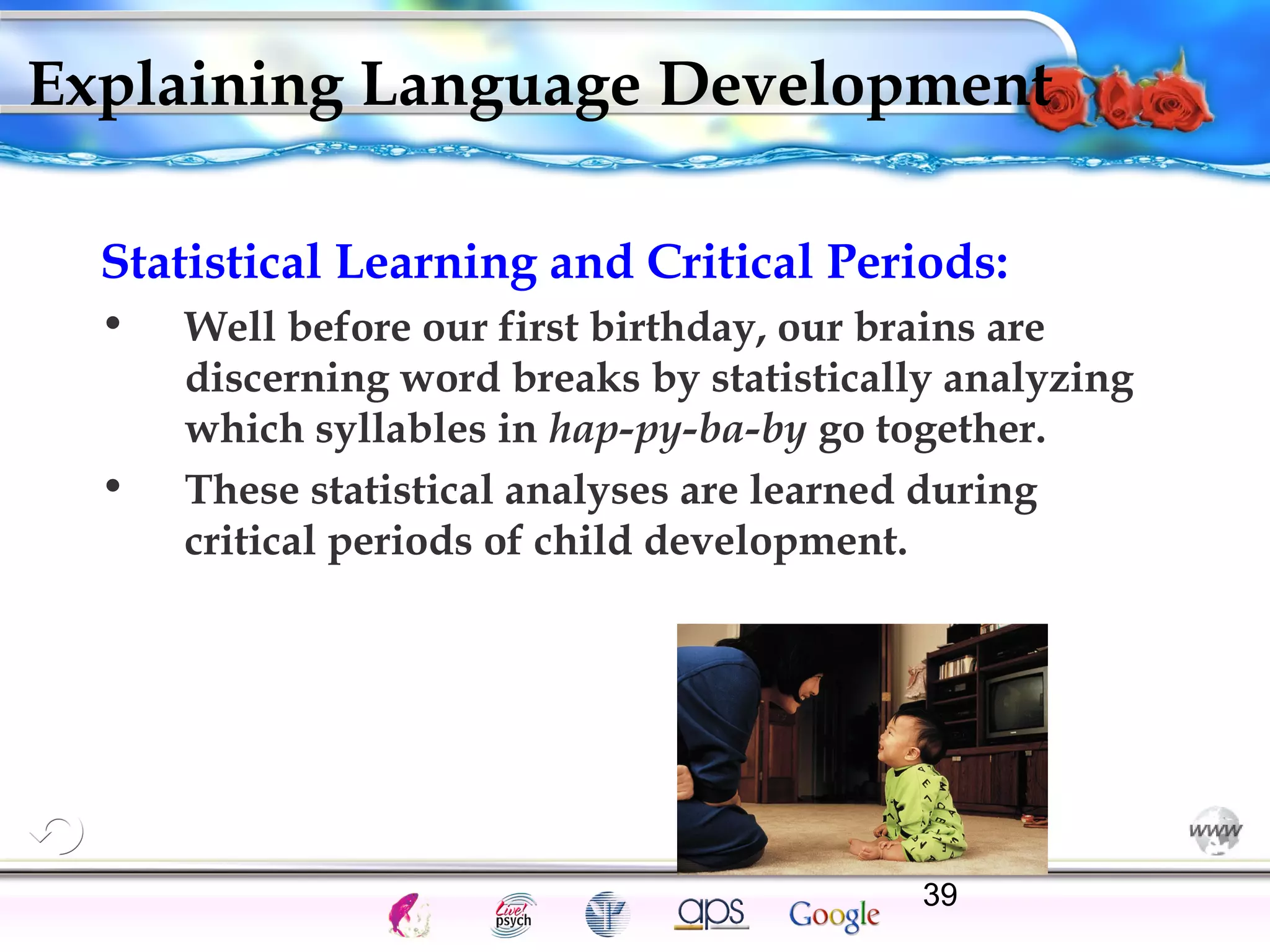
Statistical Learning and Critical Periods: 
• Well before our first birthday, our brains are 
discerning word breaks by statistically analyzing 
which syllables in hap-py-ba-by go together. 
• These statistical analyses are learned during 
critical periods of child development. 
Cognition Concepts Problems A.I. Creativity 39 
Intelligence Gardner 
I.Q. Wechsler Bias Delay Terman Heredity 
Animal
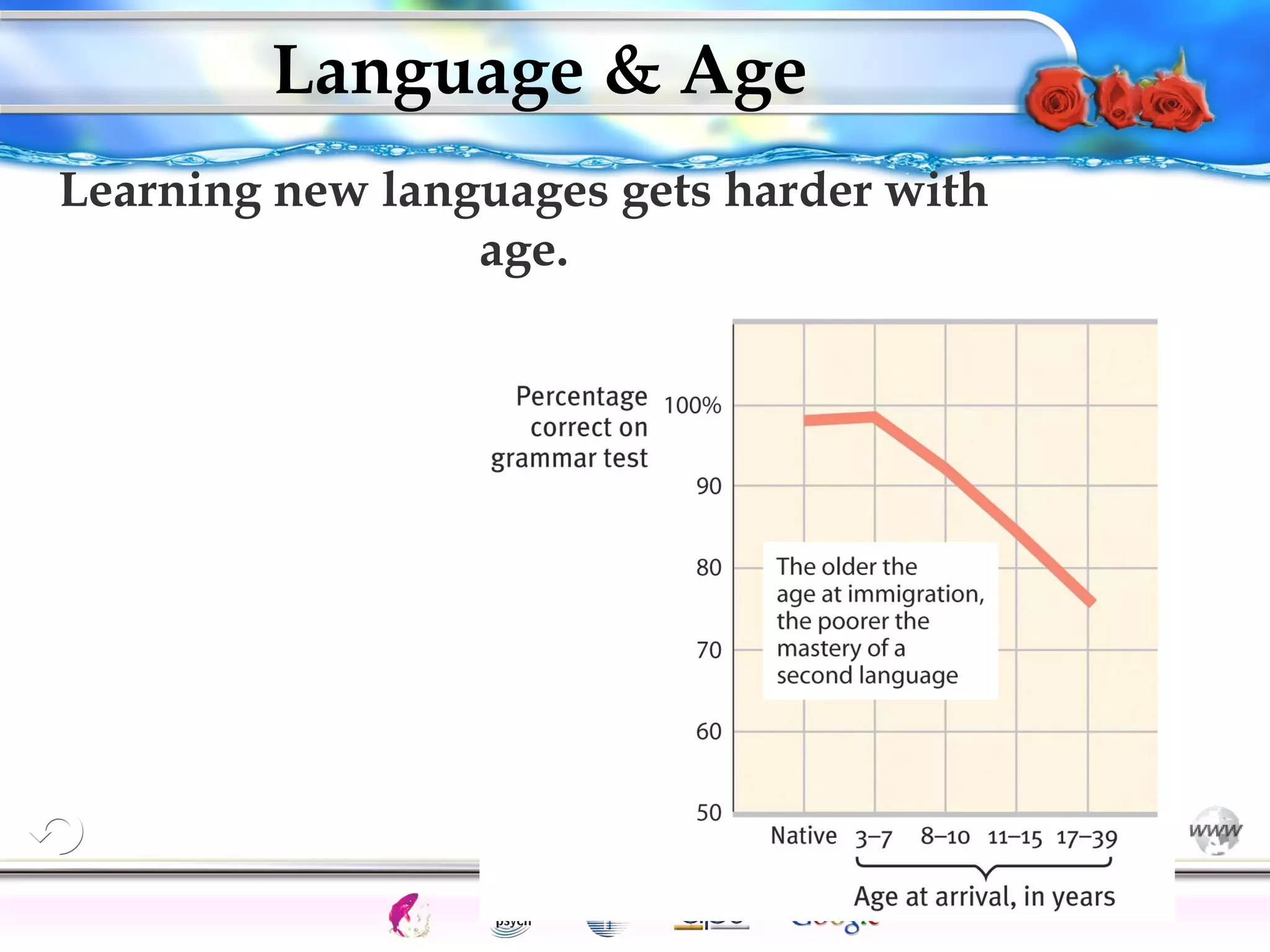
Language & Age 
Learning new languages gets harder with 
age. 
Cognition Concepts Problems A.I. Creativity 40 
Intelligence Gardner 
I.Q. Wechsler Bias Delay Terman Heredity 
Animal
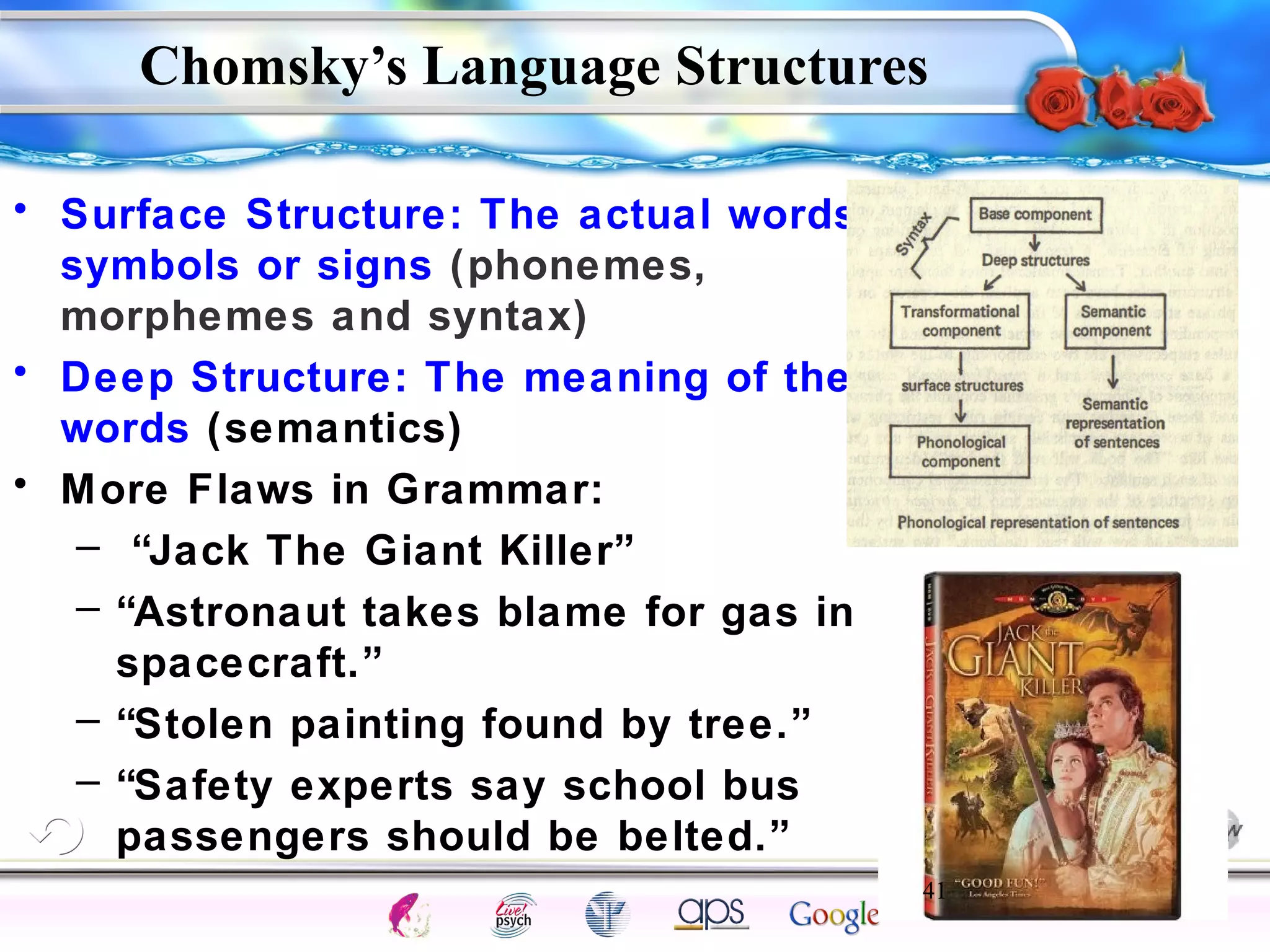
Chomsky’s Language Structures 
41 
Intelligence Gardner 
• Surface Structure: The actual words, 
symbols or signs (phonemes, 
morphemes and syntax) 
• Deep Structure: The meaning of the 
words (semantics) 
• More Flaws in Grammar: 
– “Jack The Giant Killer” 
– “Astronaut takes blame for gas in 
spacecraft.” 
– “Stolen painting found by tree.” 
– “Safety experts say school bus 
passengers should be belted.” 
Cognition Concepts Problems A.I. Creativity 
I.Q. Wechsler Bias Delay Terman Heredity 
Animal
Flaws in Semantics and Syntax 
42 
Intelligence Gardner 
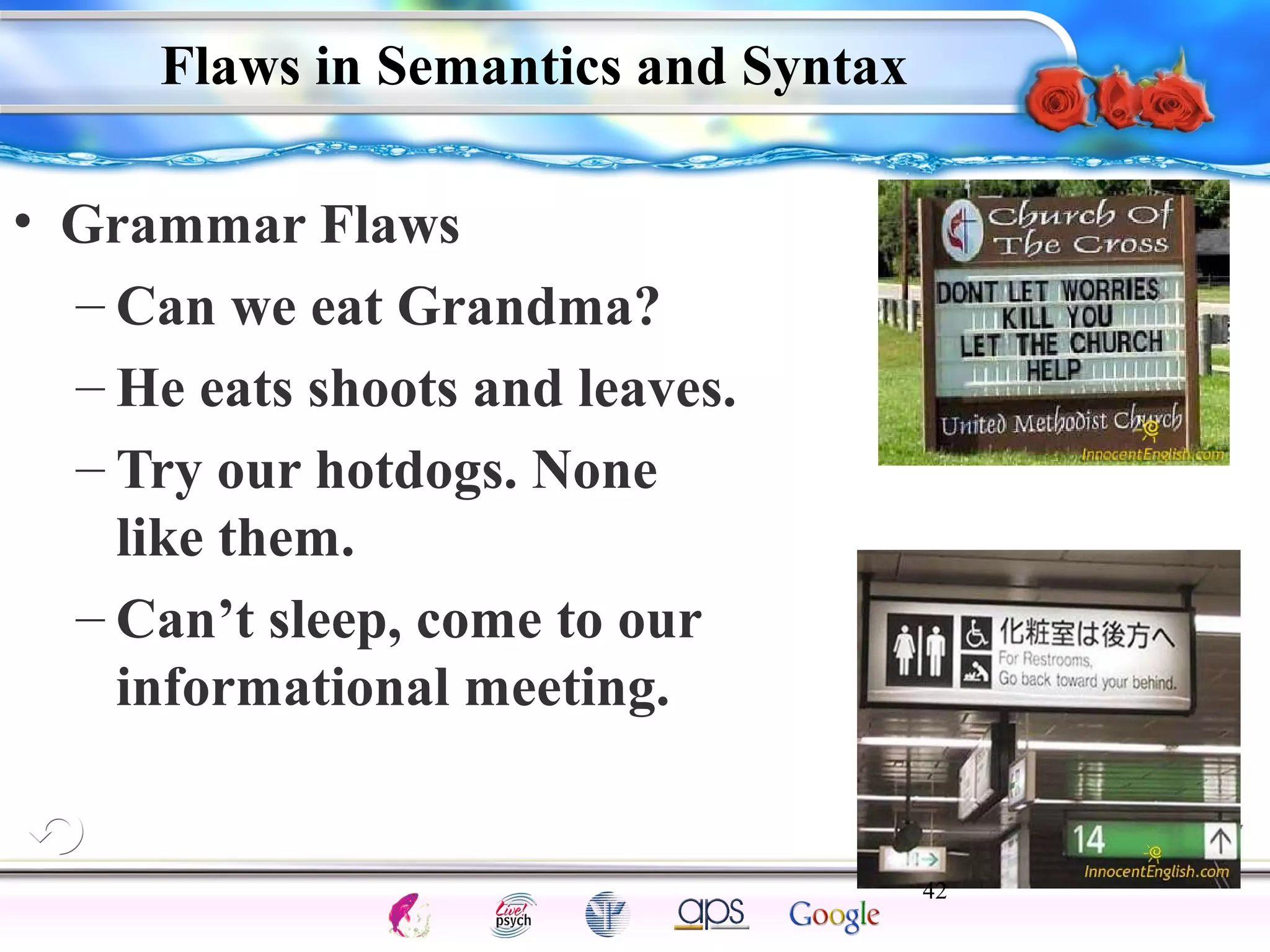
• Grammar Flaws 
– Can we eat Grandma? 
– He eats shoots and leaves. 
– Try our hotdogs. None 
like them. 
– Can’t sleep, come to our 
informational meeting. 
Cognition Concepts Problems A.I. Creativity 
I.Q. Wechsler Bias Delay Terman Heredity 
Animal
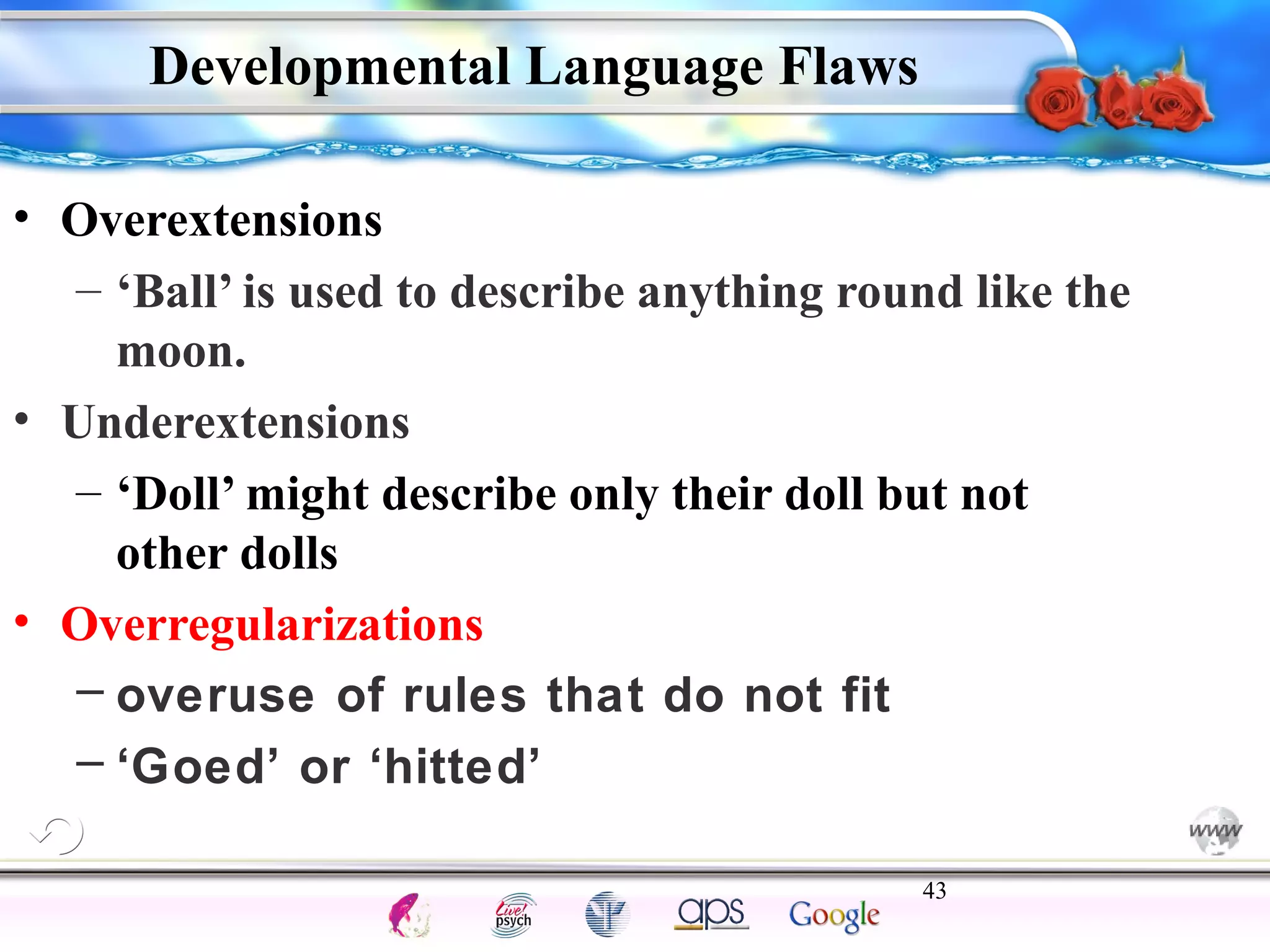
Developmental Language Flaws 
– ‘Ball’ is used to describe anything round like the 
moon. 
– ‘Doll’ might describe only their doll but not 
other dolls 
– overuse of rules that do not fit 
– ‘Goed’ or ‘hitted’ 
43 
Intelligence Gardner 
• Overextensions 
• Underextensions 
• Overregularizations 
Cognition Concepts Problems A.I. Creativity 
I.Q. Wechsler Bias Delay Terman Heredity 
Animal
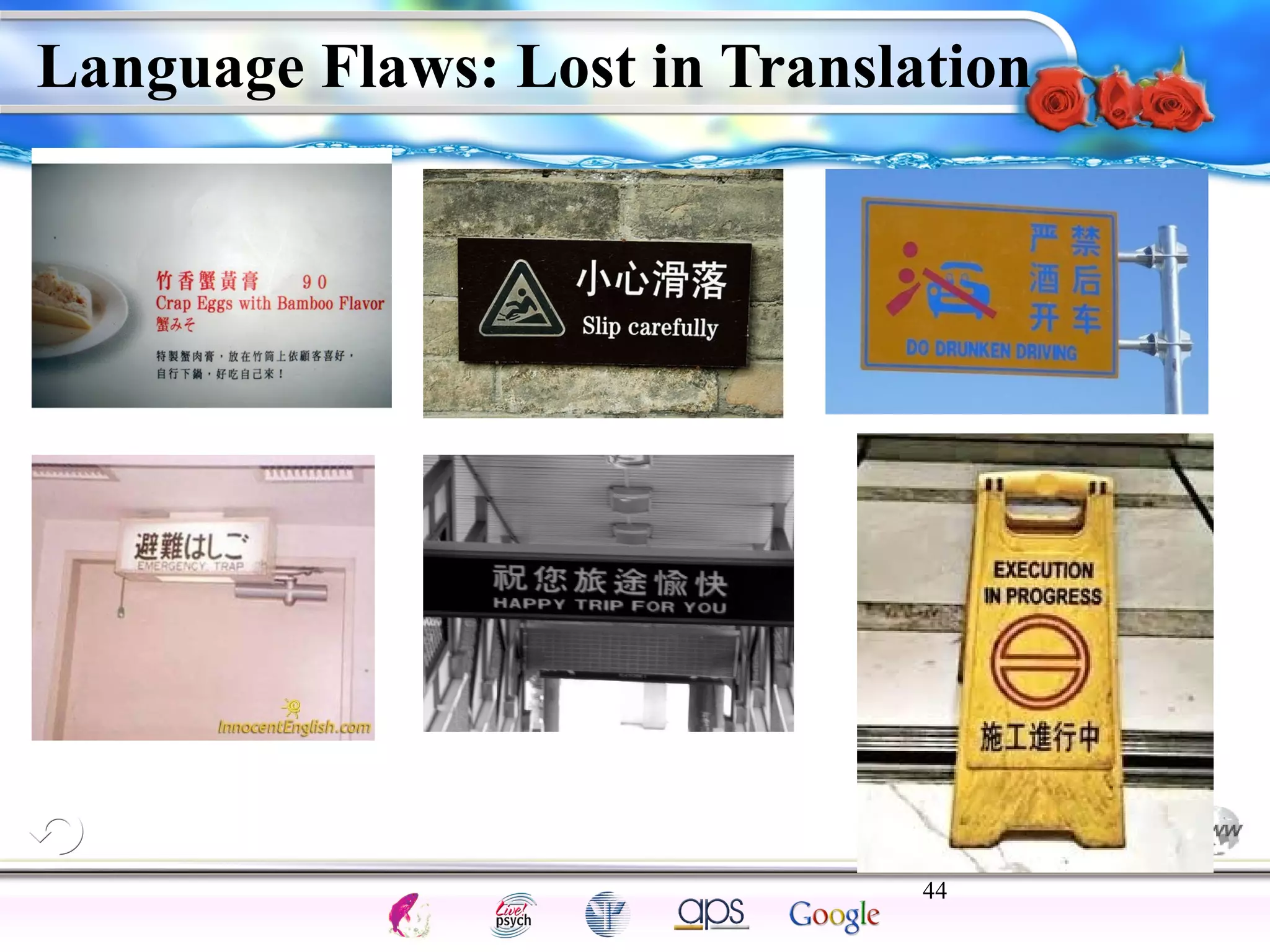
Language Flaws: Lost in Translation 
44 
Intelligence Gardner 
Cognition Concepts Problems A.I. Creativity 
I.Q. Wechsler Bias Delay Terman Heredity 
Animal
Darren, a junior in high school, is taking 
French I. For part of his midterm exam, he is 
required to translate a dialogue in French 
and recite it in front of the class. Describe 
how the following may affect his 
performance. 
•Phonemes 
•His Age 
•Syntax 
•Proactive Interference 
45 
Intelligence Gardner 
Language Review: Mini FRQ 
Cognition Concepts Problems A.I. Creativity 
I.Q. Wechsler Bias Delay Terman Heredity 
Animal
Language Review: Mini FRQ Grading 
• POINT 1: Darren needs to know the French phonemes so he 
can pronounce the words correctly. 
• POINT 2: As he is older, he will have difficulty (1) pronouncing 
or (2) understanding the word order because he is past his 
critical period of language development, hence learning 
another language is harder 
• POINT 3: He needs to know the proper syntax in French, so 
that he can say the words in proper order so the dialogue 
makes sense. (an example may be needed to clarify this point) 
• POINT 4: Darren’s learning of English first, may interfere 
with his recall of French terms. (student may use another 
example as long as they indicate that old information is 
interfering with him learning French). 
46 
Intelligence Gardner 
Cognition Concepts Problems A.I. Creativity 
I.Q. Wechsler Bias Delay Terman Heredity 
Animal
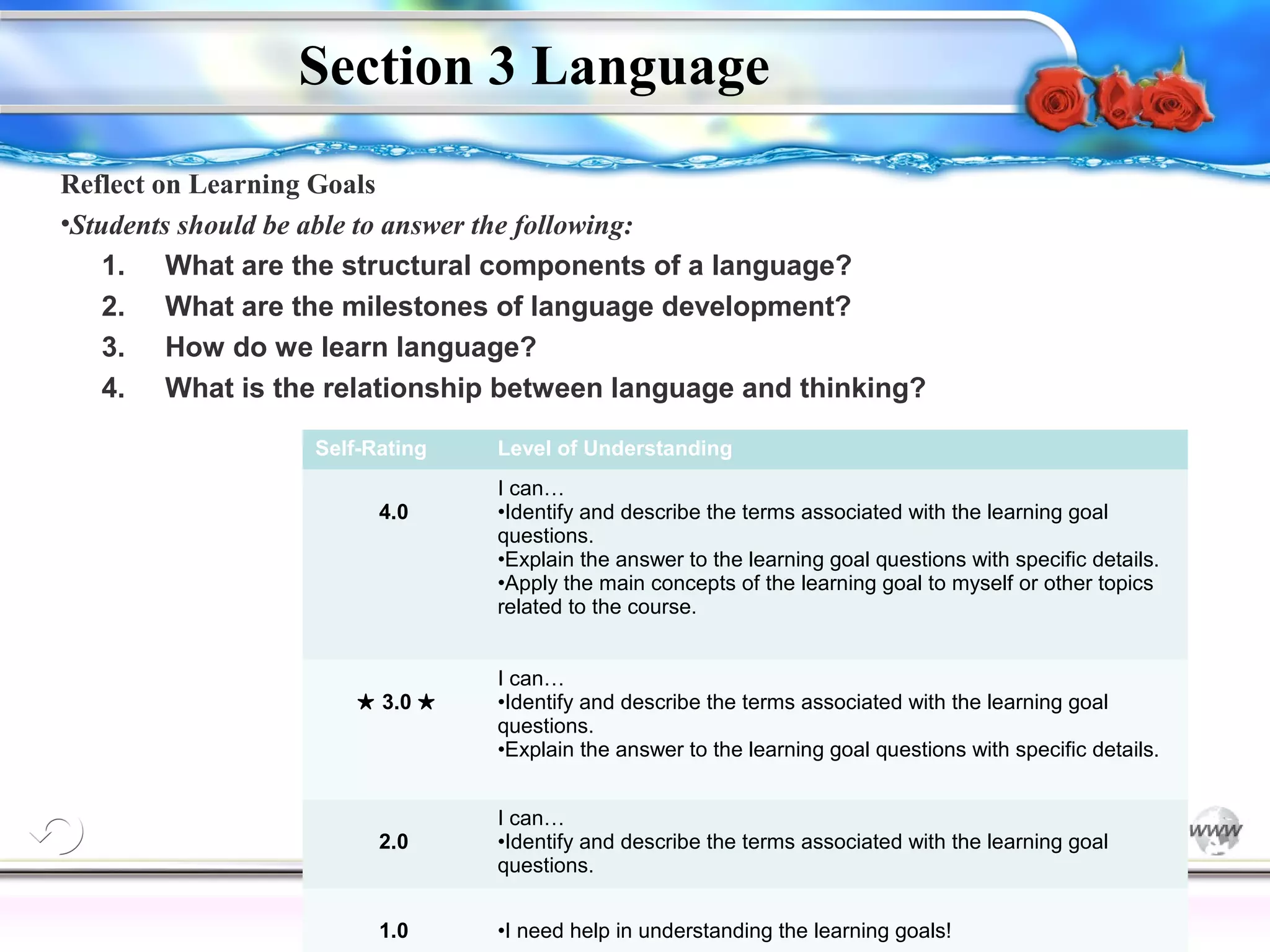
1. What are the structural components of a language? 
2. What are the milestones of language development? 
3. How do we learn language? 
4. What is the relationship between language and thinking? 
I can… 
•Identify and describe the terms associated with the learning goal 
questions. 
•Explain the answer to the learning goal questions with specific details. 
•Apply the main concepts of the learning goal to myself or other topics 
related to the course. 
I can… 
•Identify and describe the terms associated with the learning goal 
questions. 
•Explain the answer to the learning goal questions with specific details. 
I can… 
•Identify and describe the terms associated with the learning goal 
questions. 
Intelligence Gardner 
Section 3 Language 
Reflect on Learning Goals 
•Students should be able to answer the following: 
Self-Rating Level of Understanding 
4.0 
★ 3.0 ★ 
2.0 
Cognition Concepts Problems A.I. Creativity 
1.0 •I need help in understanding the learning goals! 
I.Q. Wechsler Bias Delay Terman Heredity 
Animal
Lecture Activities
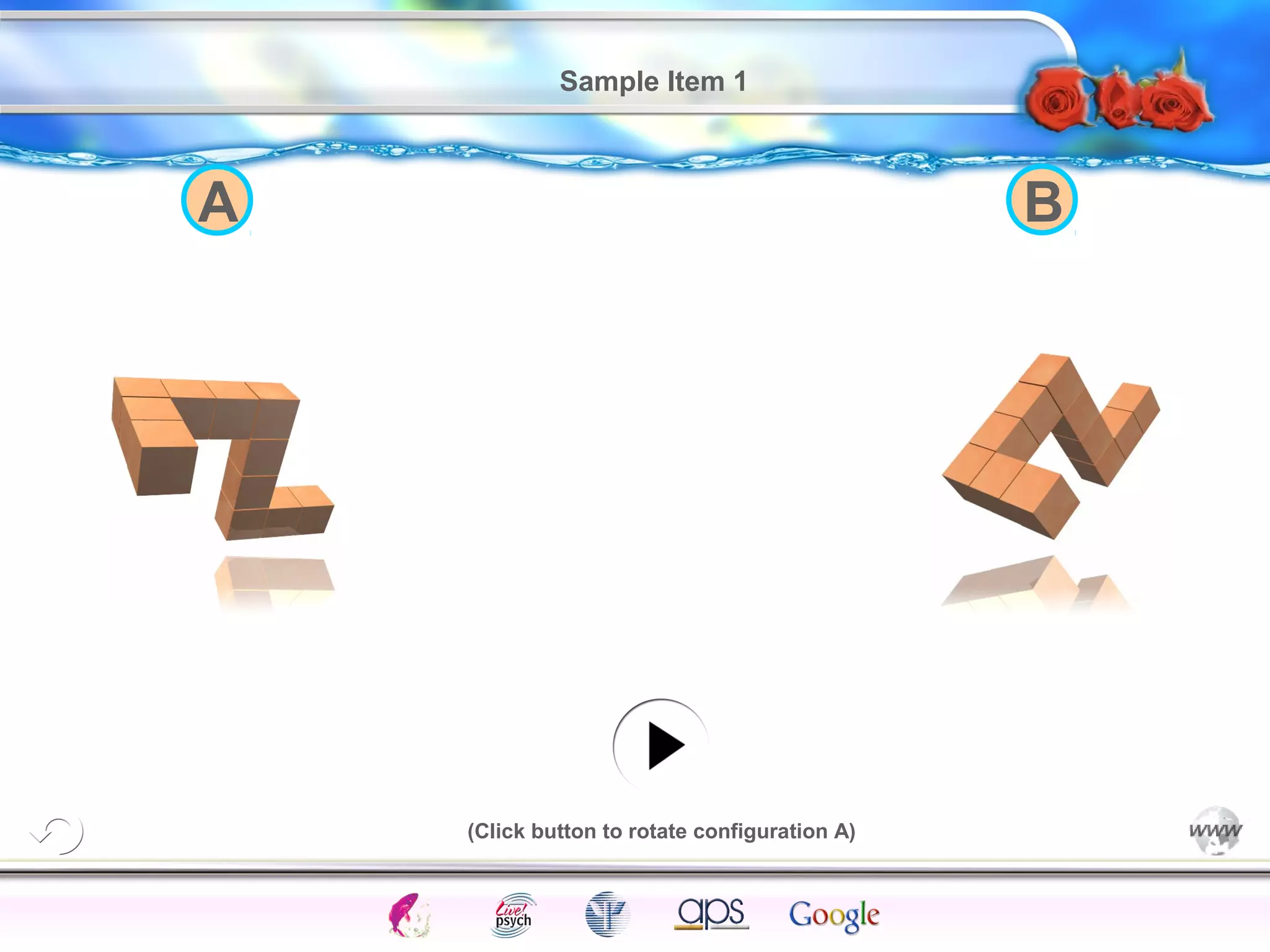
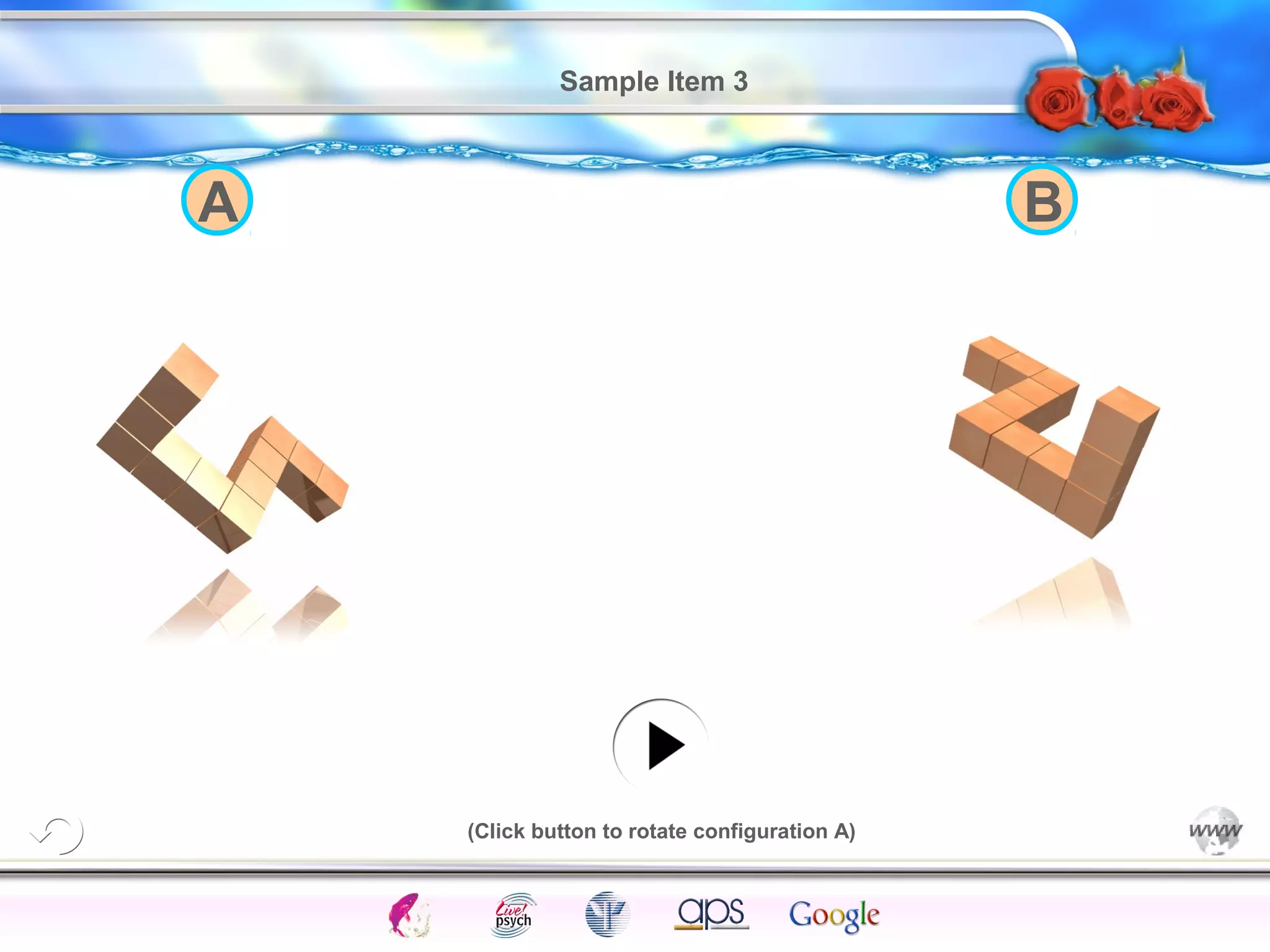
• Mental Rotation of Objects 
• Some creative studies have been conducted on 
our ability to mentally rotate “three-dimensional” 
objects. On each of the next three slides, you will 
see two groups of blocks (A and B). Your task will be 
to decide, as quickly as possible, whether: 
• 1. Groups A and B ARE identical 
structures rotated to different 
orientations or… 
• 2. Groups A and B ARE NOT identical 
structures. 
Intelligence Gardner 
Cognition Concepts Problems A.I. Creativity 
I.Q. Wechsler Bias Delay Terman Heredity 
Animal
Sample Item 1 
A B 
Intelligence Gardner 
(Click button to rotate configuration A) 
Cognition Concepts Problems A.I. Creativity 
I.Q. Wechsler Bias Delay Terman Heredity 
Animal
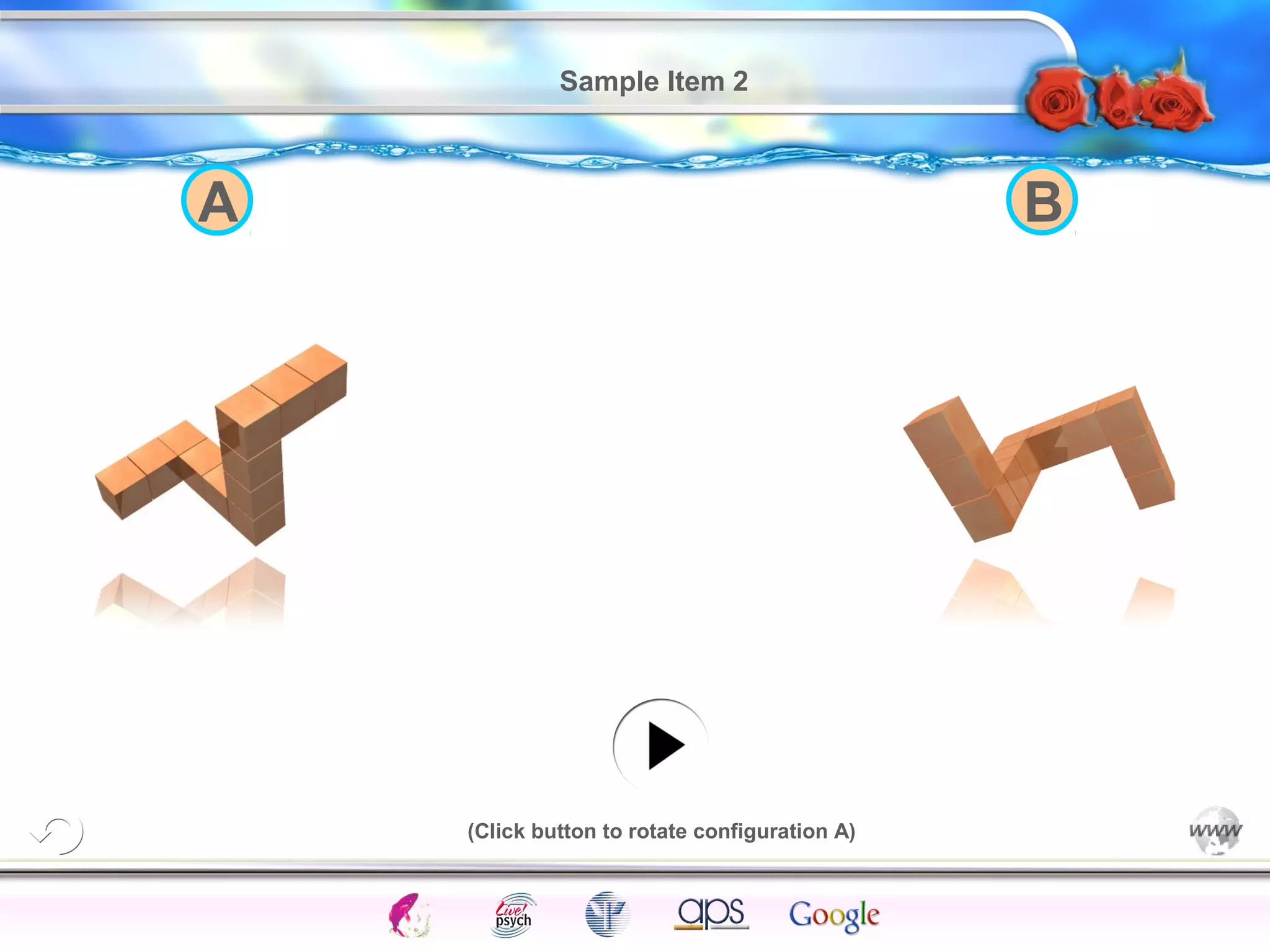
Sample Item 2 
A B 
Intelligence Gardner 
(Click button to rotate configuration A) 
Cognition Concepts Problems A.I. Creativity 
I.Q. Wechsler Bias Delay Terman Heredity 
Animal
Sample Item 3 
A B 
Intelligence Gardner 
(Click button to rotate configuration A) 
Cognition Concepts Problems A.I. Creativity 
I.Q. Wechsler Bias Delay Terman Heredity 
Animal
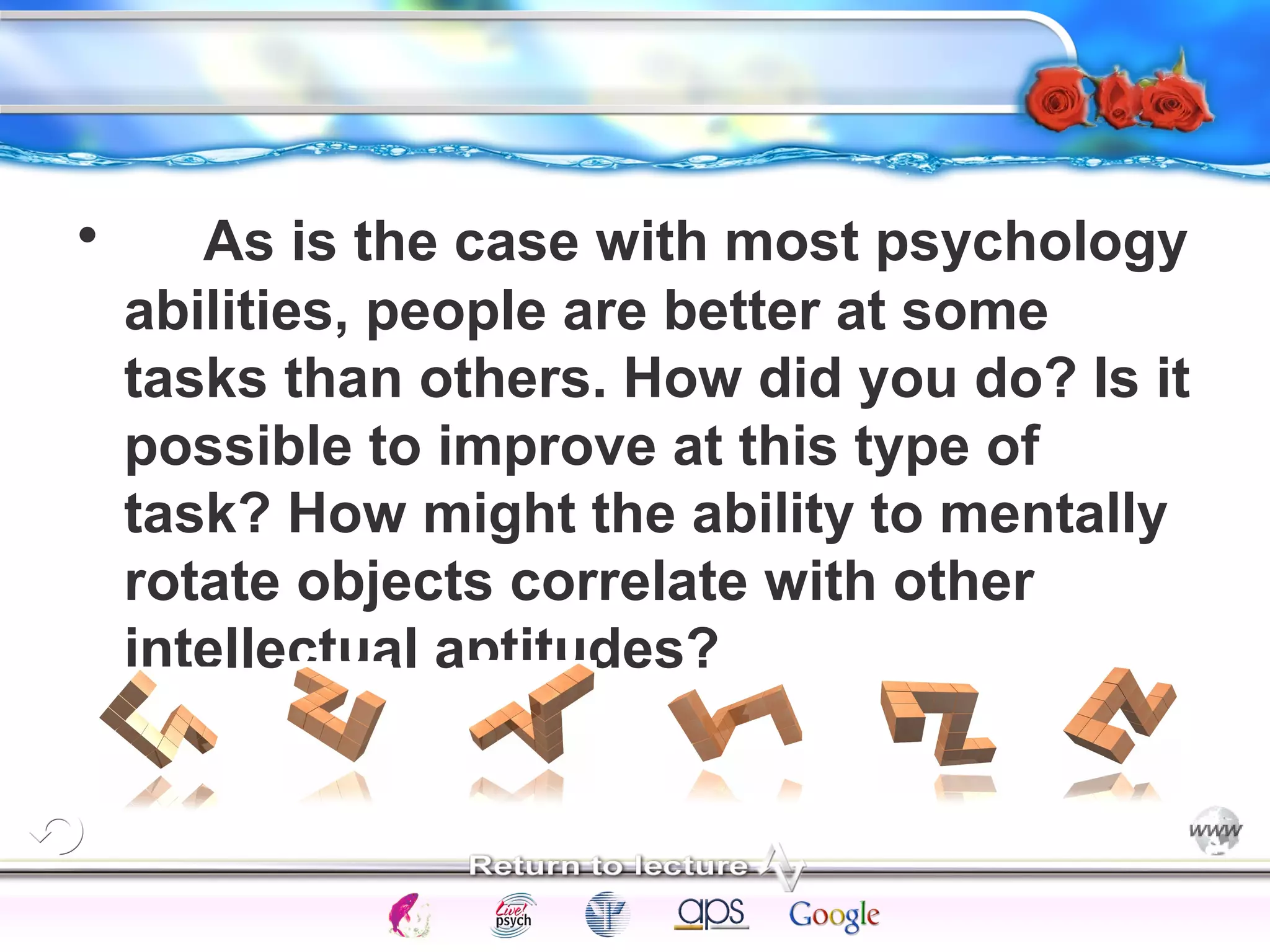
• As is the case with most psychology 
abilities, people are better at some 
tasks than others. How did you do? Is it 
possible to improve at this type of 
task? How might the ability to mentally 
rotate objects correlate with other 
intellectual aptitudes? 
Intelligence Gardner 
Cognition Concepts Problems A.I. Creativity 
I.Q. Wechsler Bias Delay Terman Heredity 
Animal
Breaking Through Functional Fixedness 
Intelligence Gardner 
• On the next slide you will 
see various items on a desk and 
be presented with a problem to 
be solved. Let’s see who is able 
to break through their functional 
fixedness. 
Cognition Concepts Problems A.I. Creativity 
I.Q. Wechsler Bias Delay Terman Heredity 
Animal
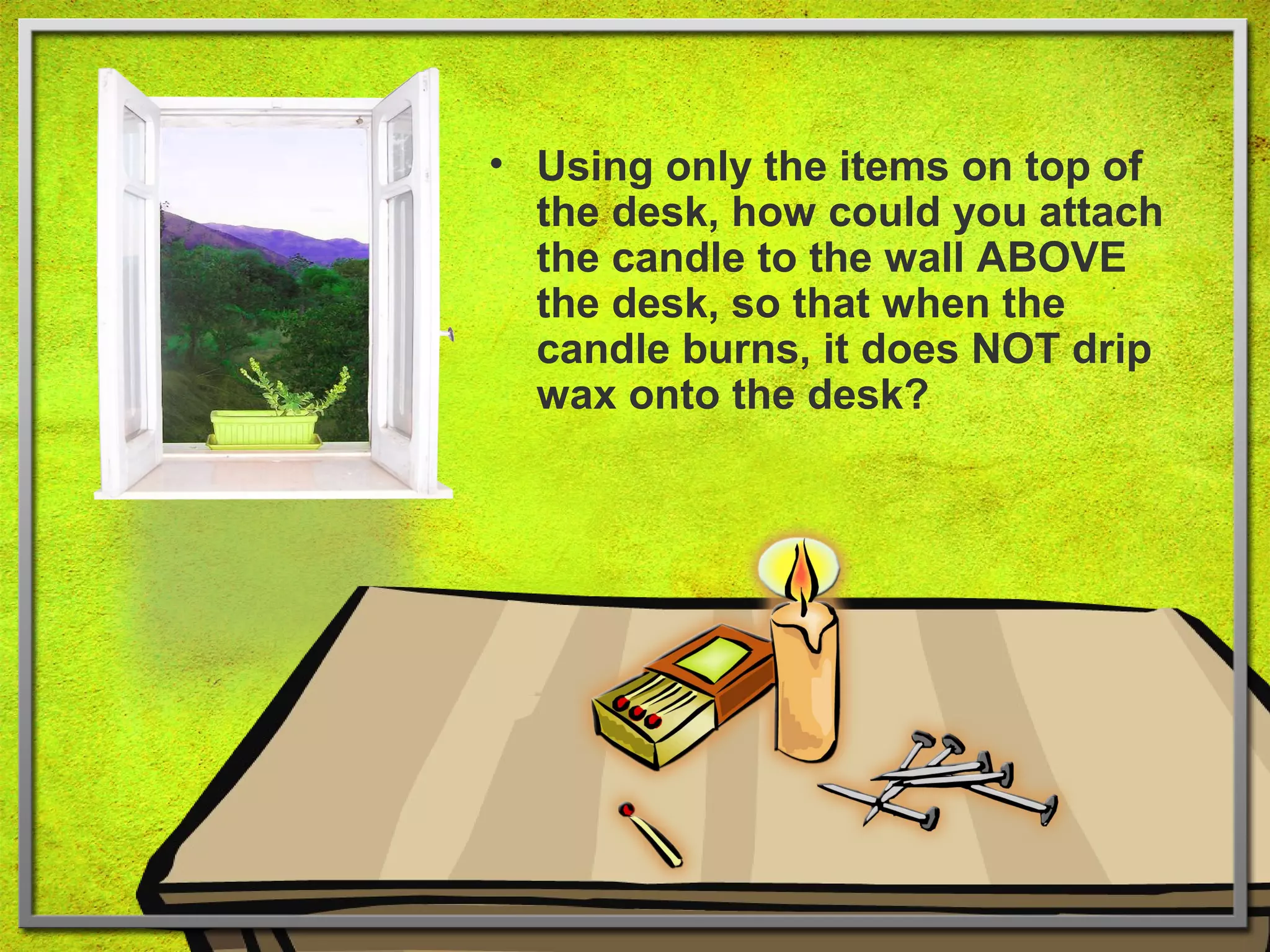
• Using only the items on top of 
the desk, how could you attach 
the candle to the wall ABOVE 
the desk, so that when the 
candle burns, it does NOT drip 
wax onto the desk? 
Intelligence Gardner 
Cognition Concepts Problems A.I. Creativity 
I.Q. Wechsler Bias Delay Terman Heredity 
Animal
Intelligence Gardner 
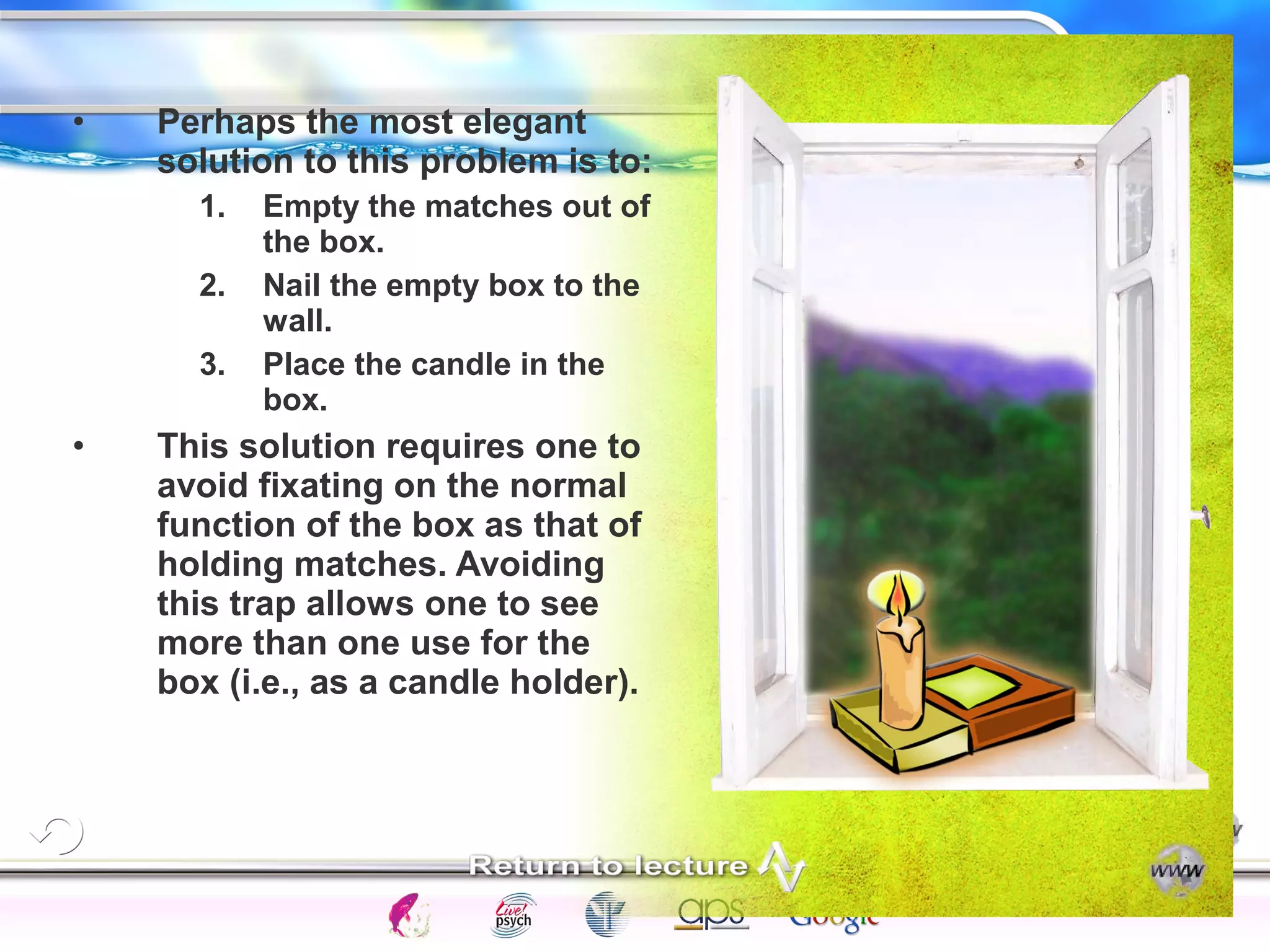
• Perhaps the most elegant 
solution to this problem is to: 
1. Empty the matches out of 
the box. 
2. Nail the empty box to the 
wall. 
3. Place the candle in the 
box. 
• This solution requires one to 
avoid fixating on the normal 
function of the box as that of 
holding matches. Avoiding 
this trap allows one to see 
more than one use for the 
box (i.e., as a candle holder). 
Cognition Concepts Problems A.I. Creativity 
I.Q. Wechsler Bias Delay Terman Heredity 
Animal
• A Mental Set 
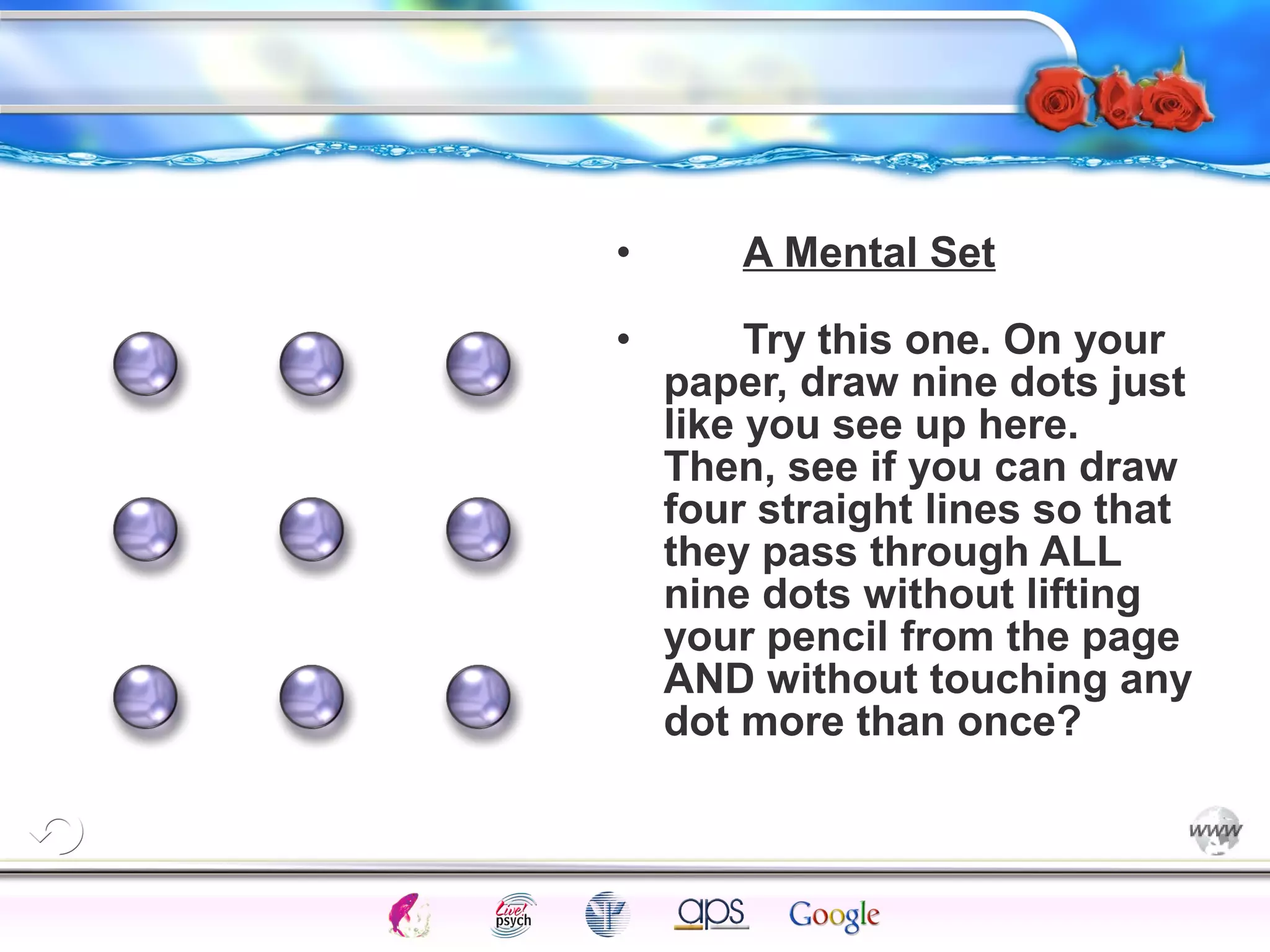
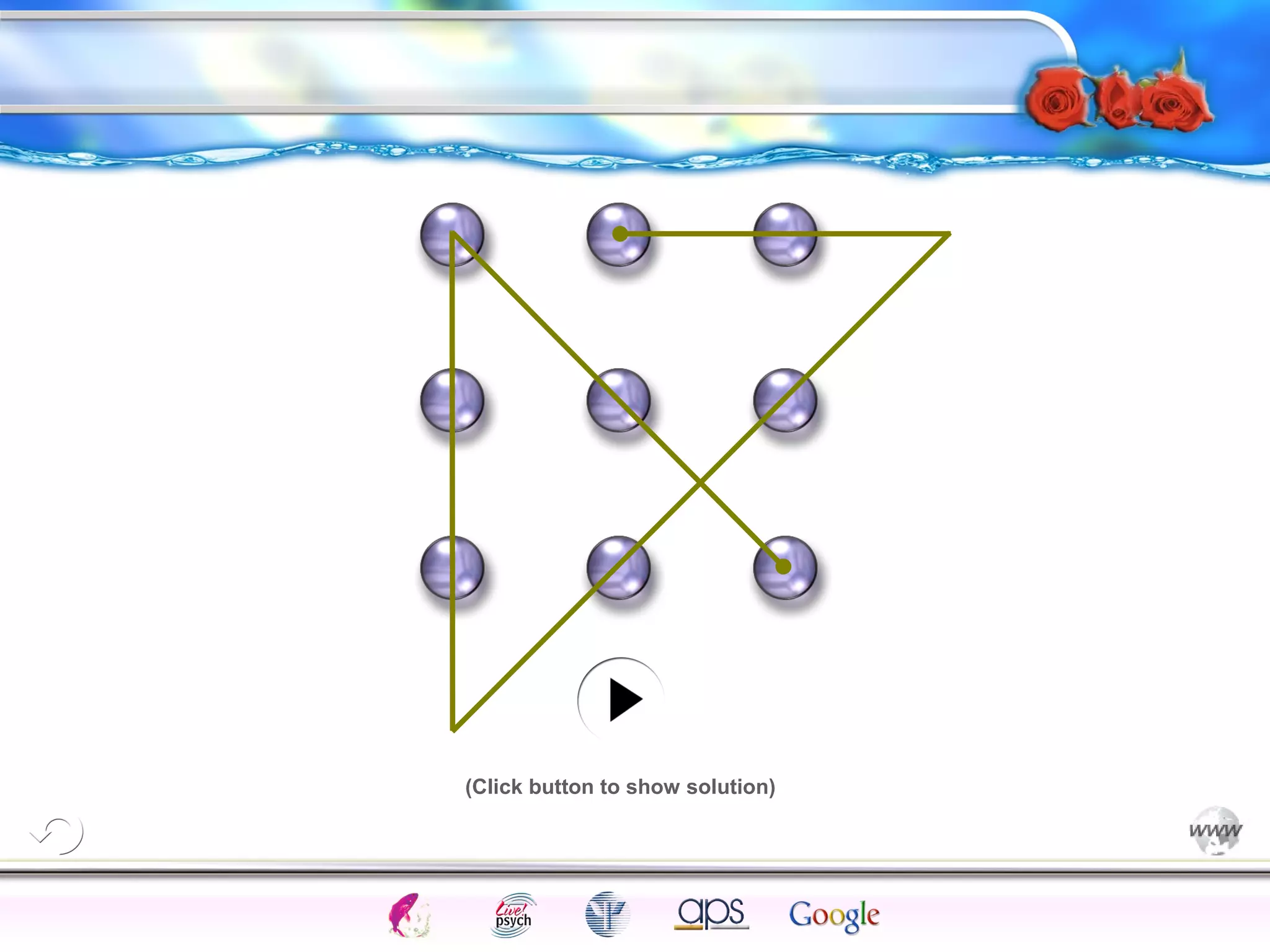
• Try this one. On your 
paper, draw nine dots just 
like you see up here. 
Then, see if you can draw 
four straight lines so that 
they pass through ALL 
nine dots without lifting 
your pencil from the page 
AND without touching any 
dot more than once? 
Intelligence Gardner 
Cognition Concepts Problems A.I. Creativity 
I.Q. Wechsler Bias Delay Terman Heredity 
Animal
Intelligence Gardner 
(Click button to show solution) 
Cognition Concepts Problems A.I. Creativity 
I.Q. Wechsler Bias Delay Terman Heredity 
Animal
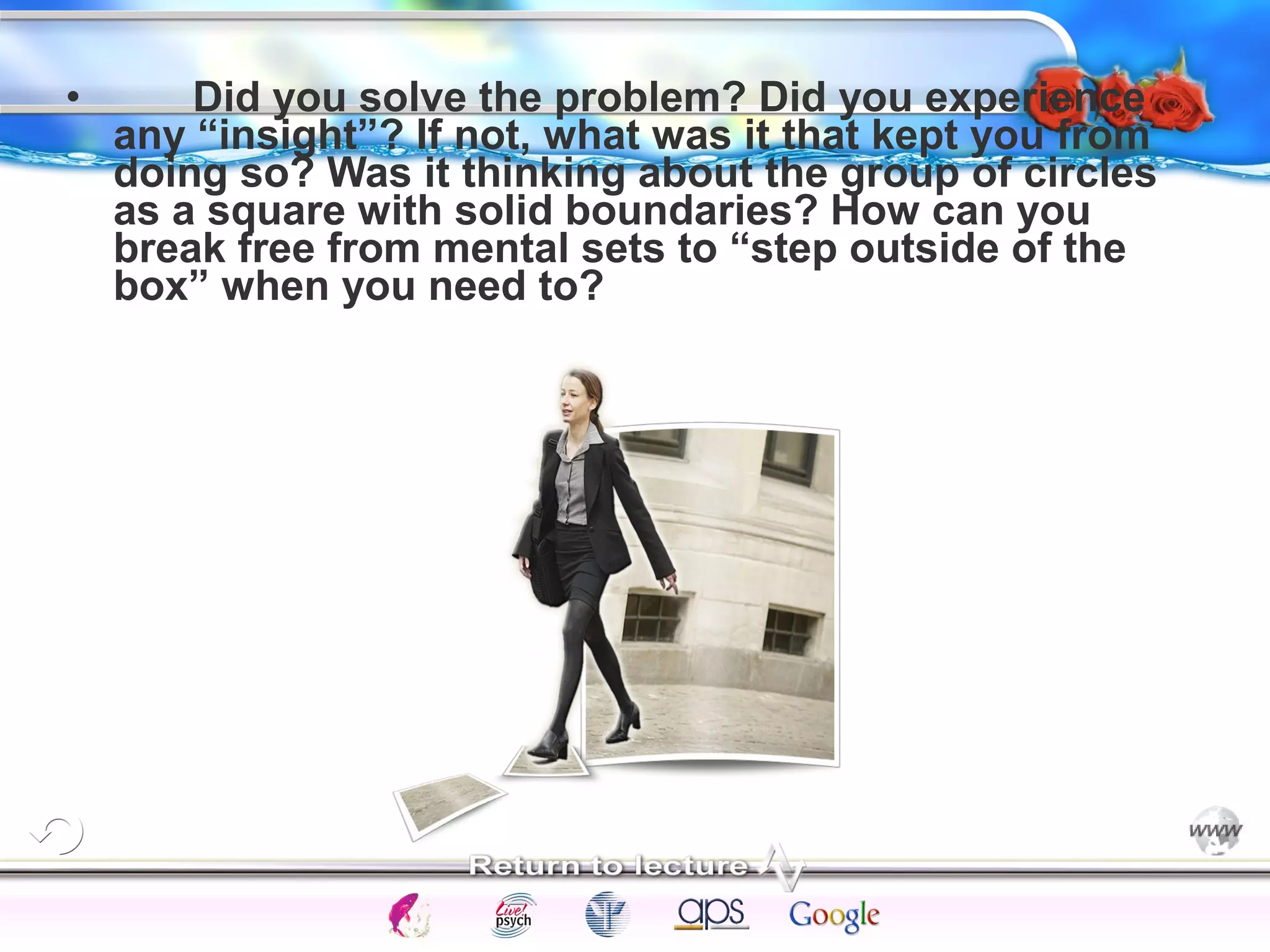
• Did you solve the problem? Did you experience 
any “insight”? If not, what was it that kept you from 
doing so? Was it thinking about the group of circles 
as a square with solid boundaries? How can you 
break free from mental sets to “step outside of the 
box” when you need to? 
Intelligence Gardner 
Cognition Concepts Problems A.I. Creativity 
I.Q. Wechsler Bias Delay Terman Heredity 
Animal
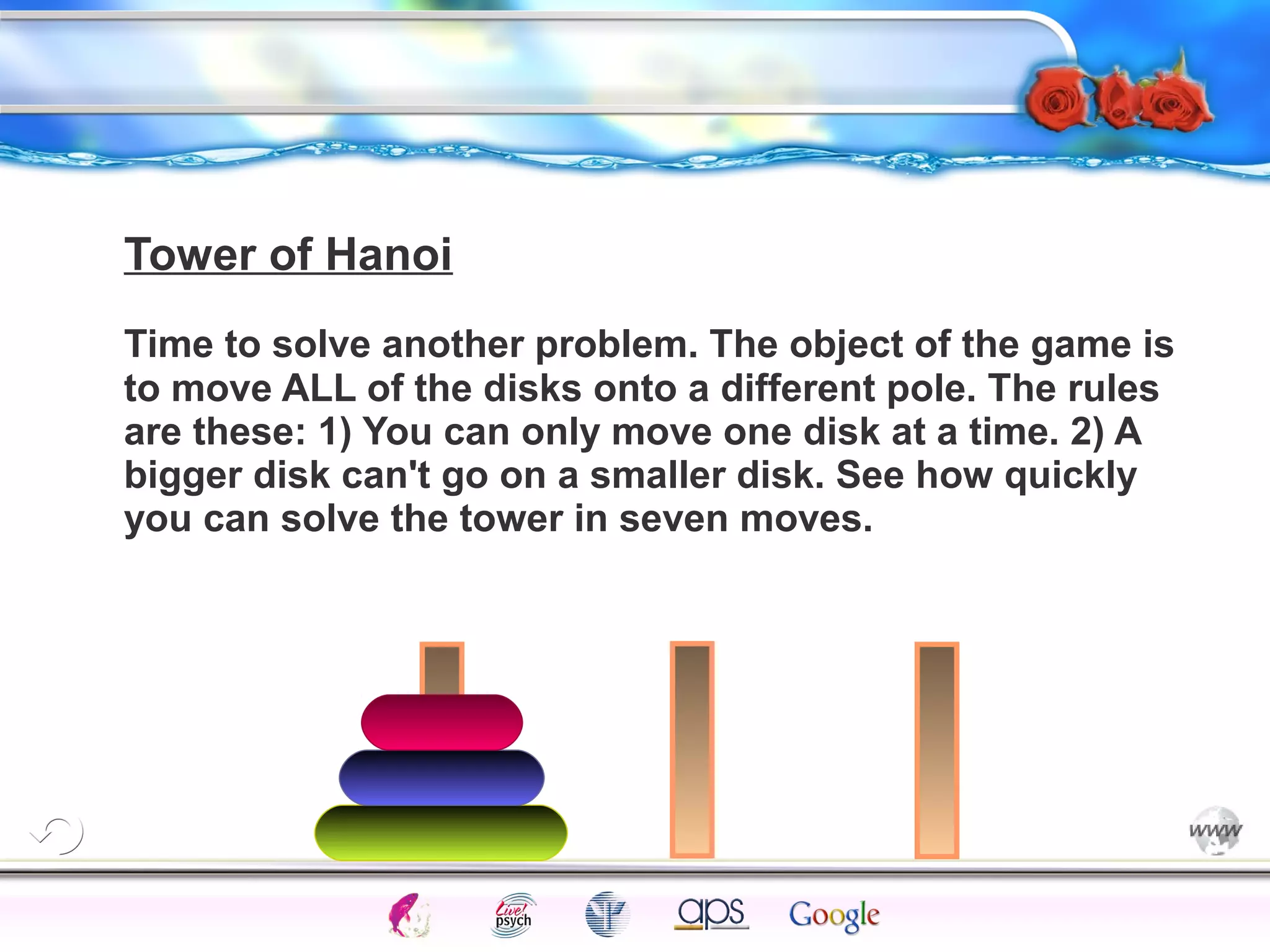
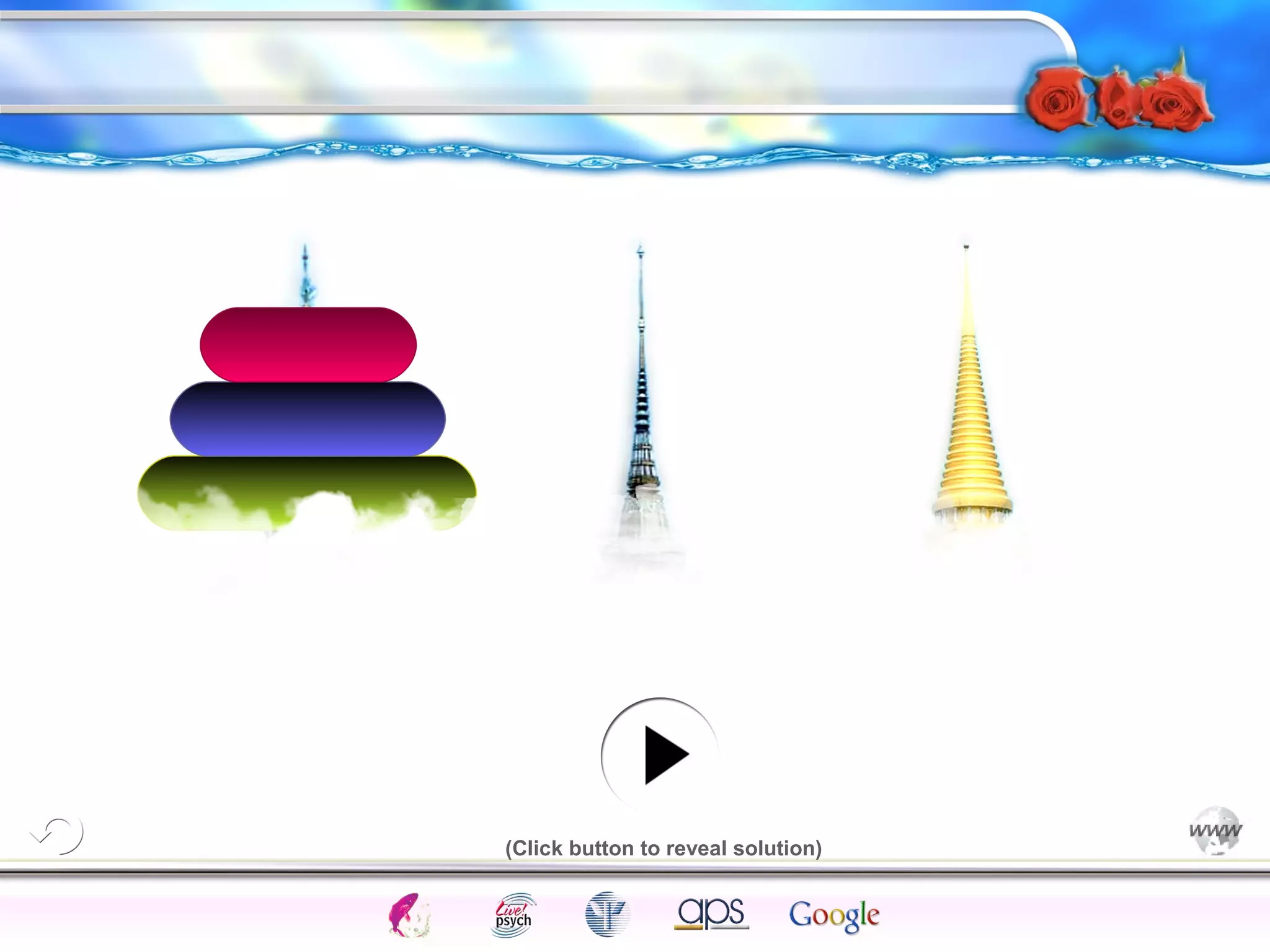
Tower of Hanoi 
Time to solve another problem. The object of the game is 
to move ALL of the disks onto a different pole. The rules 
are these: 1) You can only move one disk at a time. 2) A 
bigger disk can't go on a smaller disk. See how quickly 
you can solve the tower in seven moves. 
Intelligence Gardner 
Cognition Concepts Problems A.I. Creativity 
I.Q. Wechsler Bias Delay Terman Heredity 
Animal
Intelligence Gardner 
(Click button to reveal solution) 
Cognition Concepts Problems A.I. Creativity 
I.Q. Wechsler Bias Delay Terman Heredity 
Animal
• Did you use an algorithm or a heuristic to 
solve that problem? What types of day-to-day 
problems might require algorithmic 
solutions? What types of daily problems 
could be handled more heuristically? What 
do your conclusions suggest about the 
nature of problem solving? 
Intelligence Gardner 
Cognition Concepts Problems A.I. Creativity 
I.Q. Wechsler Bias Delay Terman Heredity 
Animal
• Certainly, one definition 
of “creativity” won’t 
satisfy everyone in 
class. Get together in 
small groups and 
develop your own 
definition. Write down 
your group’s definition. 
Be prepared to share. 
Intelligence Gardner 
Cognition Concepts Problems A.I. Creativity 
I.Q. Wechsler Bias Delay Terman Heredity 
Animal
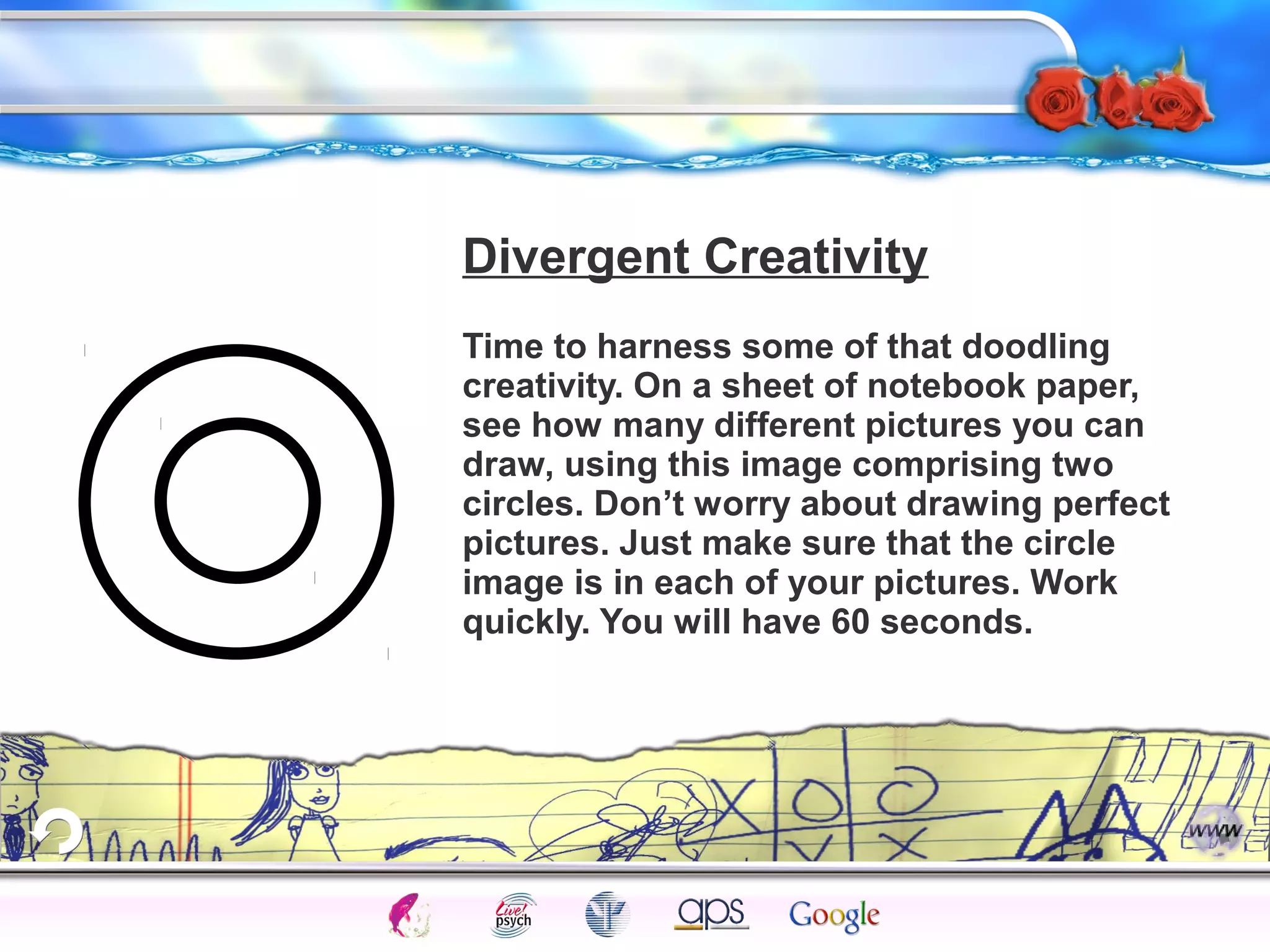
Divergent Creativity 
Time to harness some of that doodling 
creativity. On a sheet of notebook paper, 
see how many different pictures you can 
draw, using this image comprising two 
circles. Don’t worry about drawing perfect 
pictures. Just make sure that the circle 
image is in each of your pictures. Work 
quickly. You will have 60 seconds. 
Intelligence Gardner 
Cognition Concepts Problems A.I. Creativity 
I.Q. Wechsler Bias Delay Terman Heredity 
Animal
• Times up! After such a task, a 
psychologist studying creativity 
might be interested in answers to the 
following types of questions: 
1. How many pictures did you draw? 
2. Were the pictures from different semantic 
categories (e.g., fruits, sports, cars, etc.)? 
3. Were your pictures unique? In other words, 
did you draw pictures that others probably 
did not? 
Intelligence Gardner 
Cognition Concepts Problems A.I. Creativity 
I.Q. Wechsler Bias Delay Terman Heredity 
Animal
Intelligence Gardner 
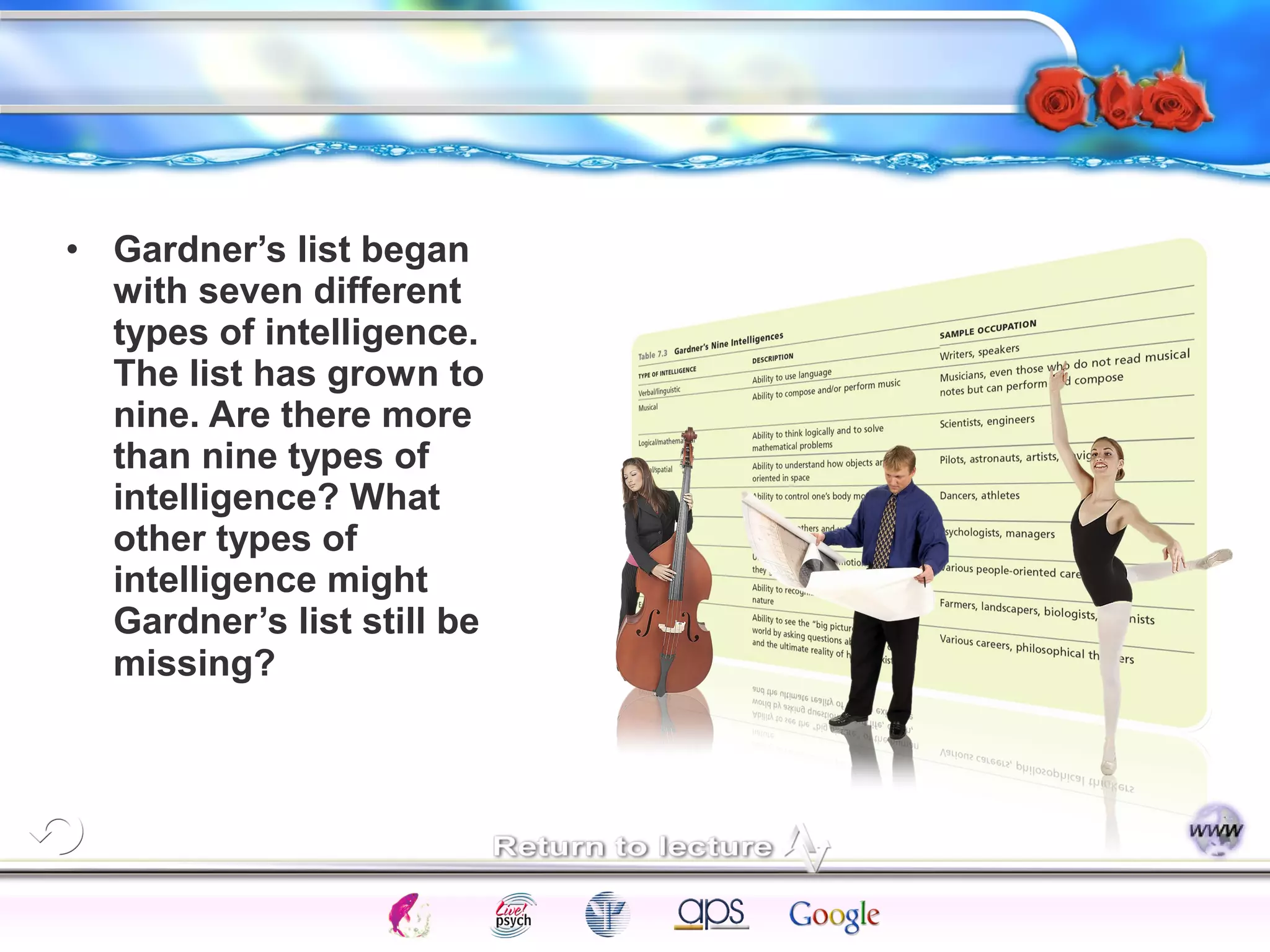
• Gardner’s list began 
with seven different 
types of intelligence. 
The list has grown to 
nine. Are there more 
than nine types of 
intelligence? What 
other types of 
intelligence might 
Gardner’s list still be 
missing? 
Cognition Concepts Problems A.I. Creativity 
I.Q. Wechsler Bias Delay Terman Heredity 
Animal

Aguiar ap cognition thinking problem_solving_creativity_language

  • 1.
    Cognition: Thinking, Intelligence& CognitiLona: Tnhginukiangg, e Cognition: Thinking, Intelligence & Language
  • 2.
    Section 1: Thinkingand Problem Solving Learning Goals •Students should be able to answer the following: 1. What are the functions of concepts? 2. What strategies assist our problem solving? What is creativity and what fosters it? 3. What are the obstacles to problem solving? Intelligence Gardner Cognition Concepts Problems A.I. Creativity I.Q. Wechsler Bias Delay Terman Heredity Animal 2
  • 3.
  • 4.
    Mental activity for organizing, understanding and communicating ognition
  • 5.
    • Concept –idea that represents category of objects, events or activities Intelligence Gardner Concepts SUPERORDINATE BASIC LEVEL SUBORDINATE Cognition Concepts Problems A.I. Creativity I.Q. Wechsler Bias Delay Terman Heredity Animal
  • 6.
    • Formal concepts- defined by specific rules or features • Natural concepts - form as result of real world experience (fuzziness) • Prototype - example of concept that closely matches defining characteristics Intelligence Gardner Concepts Cognition Concepts Problems A.I. Creativity I.Q. Wechsler Bias Delay Terman Heredity Animal
  • 7.
    Concepts v. Prototypes • Concept: The mental grouping of similar objects, events, ideas, or people. There are a variety of chairs but their common features define the concept of a chair. – we form concepts with mental images or typical examples (prototypes). For example, a robin is a prototype of a bird, but a penguin is not. 7 Intelligence Gardner • Prototype: Best example of a concept Cognition Concepts Problems A.I. Creativity I.Q. Wechsler Bias Delay Terman Heredity Animal
  • 8.
    Intelligence Gardner WhatIs Typical For You? Cognition Concepts Problems A.I. Creativity I.Q. Wechsler Bias Delay Terman Heredity Animal
  • 9.
    • Convergent Thinking:Deliberate, purposeful thinking that is useful for solving problems with only one correct solution • Divergent Thinking: also known as creative thinking, it follows no set plan and is more useful for solving problems that have multiple solutions in different directions. • Metacognition: Thinking about thinking. Example: thinking about your strategy to solve an algebra problem 9 Intelligence Gardner Types of Thinking Cognition Concepts Problems A.I. Creativity I.Q. Wechsler Bias Delay Terman Heredity Animal
  • 10.
    7.2 What arethe methods people use to solve problems and make decisions? Intelligence Gardner Problem-Solving • Problem solving – cognition used to reach goal by thinking/behaving in certain ways – Trial and error – one possible solution after another tried until successful – Algorithms – specific steps for solving certain problems – Heuristics – guess based on experience (“rule of thumb”) Cognition Concepts Problems A.I. Creativity I.Q. Wechsler Bias Delay Terman Heredity Animal
  • 11.
    • Algorithms: Methodical,logical rules or procedures that guarantee solving a particular problem. – Algorithms, which are very time consuming, exhaust all possibilities before arriving at a solution. Computers use algorithms. S P L O Y O C H Y G If we were to unscramble these letters to form a word using an algorithmic approach, we would face 11 Intelligence Gardner Problem Solving 907,208 possibilities. Cognition Concepts Problems A.I. Creativity I.Q. Wechsler Bias Delay Terman Heredity Animal
  • 12.
    Algorithm according toBig-Bang Theory 12 Intelligence Gardner Cognition Concepts Problems A.I. Creativity I.Q. Wechsler Bias Delay Terman Heredity Animal
  • 13.
    1. How canyou physically stand behind your father while 2. What occurred on the 6th of May, 1978 at 12:34PM? 3. Can you translate this: Y Y U R Y Y U B I C U R Y Y 4 M E 4. A man bought a horse for $60 and sold it for $70. Then he bought the same horse back for $80 and sold it again for $90. How much money did he make in the horse business? 13 Intelligence Gardner Problem Solving Examples he is standing behind you? Cognition Concepts Problems A.I. Creativity I.Q. Wechsler Bias Delay Terman Heredity Animal
  • 14.
    Insight & Incubation 14 Intelligence Gardner • Insight: involves a sudden novel realization of a solution to a problem. Humans and animals have insight. – Example: Wolfgang Kohler & Sultan the Ape • Incubation Effect: Walking away from the problem only to have insight set in • Brain imaging and EEG studies suggest that when an insight strikes (the “Aha” experience), it activates the right temporal cortex • The time between not knowing the solution and realizing it is 0.3 seconds. Cognition Concepts Problems A.I. Creativity I.Q. Wechsler Bias Delay Terman Heredity Animal
  • 15.
    15 Intelligence Gardner Insight Cognition Concepts Problems A.I. Creativity I.Q. Wechsler Bias Delay Terman Heredity Animal
  • 16.
    7.3 Why doesproblem solving sometimes fail and what is creative thinking? Functional fixedness - thinking about only most typical functions of objects Mental set - persist using past problem-solving patterns • Confirmation bias – search for evidence that fits beliefs while ignoring evidence not fitting beliefs Intelligence Gardner Problem-Solving Barriers Cognition Concepts Problems A.I. Creativity I.Q. Wechsler Bias Delay Terman Heredity Animal
  • 17.
    Intelligence Gardner FunctionalFixedness Cognition Concepts Problems A.I. Creativity I.Q. Wechsler Bias Delay Terman Heredity Animal
  • 18.
    • Working Backwardsis another way to solve problems like this one: The water lilies on the surface of a small pond double in area every 24 hours. From the time the first water lily appears until the pond is completely covered takes 60 days. On what day is half the pond covered in water lilies? 18 Intelligence Gardner Working Backwards Cognition Concepts Problems A.I. Creativity I.Q. Wechsler Bias Delay Terman Heredity Animal
  • 19.
    Section Thinking andProblem Solving Reflect on Learning Goals •Students should be able to answer the following: 1. What are the functions of concepts? 2. What strategies assist our problem solving? What is I can… •Identify and describe the terms associated with the learning goal questions. •Explain the answer to the learning goal questions with specific details. •Apply the main concepts of the learning goal to myself or other topics related to the course. I can… •Identify and describe the terms associated with the learning goal questions. •Explain the answer to the learning goal questions with specific details. I can… •Identify and describe the terms associated with the learning goal questions. Intelligence Gardner creativity and what fosters it? 3. What are the obstacles to problem solving? Self-Rating Level of Understanding 4.0 ★ 3.0 ★ 2.0 Cognition Concepts Problems A.I. Creativity 1.0 •I need help in understanding the learning goals! I.Q. Wechsler Bias Delay Terman Heredity Animal
  • 20.
    • Using thehandouts and games provided by the instructor, students will work in groups to solve various brain teasers and puzzles. • Students should be able to discuss with the instructor how the problem-solving terms relate to solving the brain teasers and puzzles. • Complete the problem-solving analysis worksheet on your own paper. 20 Intelligence Gardner Section Assessment Cognition Concepts Problems A.I. Creativity I.Q. Wechsler Bias Delay Terman Heredity Animal
  • 21.
    Section 2:Heuristics andFraming Learning Goals •Students should be able to answer the following: 1. How do heuristics, overconfidence, and belief perseverance influence our decisions and judgments? Intelligence Gardner 2. What is framing? Cognition Concepts Problems A.I. Creativity I.Q. Wechsler Bias Delay Terman Heredity Animal 21
  • 22.
    How do wemake decisions using • Heuristics are simple, thinking strategies that allow us to make judgments and solve problems efficiently. Heuristics are less time consuming, but more error-prone than algorithms. (AKA- Rules of Thumb or Shortcuts) – Representativeness Heuristic: Judging the likelihood of things or objects in terms of how well they seem to represent, or match, a particular prototype. – Which would you pick for a six question T/F Test? 1. T T T T T T 2. T T T F F F 3. T F F T T F 22 Intelligence Gardner heuristics? Cognition Concepts Problems A.I. Creativity I.Q. Wechsler Bias Delay Terman Heredity Animal
  • 23.
    How do wemake decisions using • Representativeness Heuristic (con’t) – Tom W. is of high intelligence, although lacking in true creativity. He has a need for order and clarity, and for neat and tidy systems in which every detail finds its appropriate place. His writing is rather dull and mechanical, occasionally enlivened by somewhat corny puns and by flashes of imagination of the sci-fi type. He has a strong drive for competence. He seems to feel little sympathy for other people and does not enjoy interacting with others. Self-centered, Most Popular Majors 1. Psychology 2. Business 3. Biosciences 4. Education 9. Engineering 23 Intelligence Gardner heuristics? he nonetheless has a deep moral sense." – Which major is Tom? • Psychology • Biological Sciences (Pre-Med) • Education/Teaching • Business/Management • Engineering Cognition Concepts Problems A.I. Creativity I.Q. Wechsler Bias Delay Terman Heredity Animal
  • 24.
    Representative Heuristic Video Intelligence Gardner Cognition Concepts Problems A.I. Creativity I.Q. Wechsler Bias Delay Terman Heredity Animal
  • 25.
    How do wemake decisions using – Whatever increases the ease of retrieving information increases its perceived availability. – Is it safer to fly or drive? – 2002-2004 25 Intelligence Gardner heuristics? • Availability Heuristic • 34 deaths by plane • 128,000 by car Cognition Concepts Problems A.I. Creativity I.Q. Wechsler Bias Delay Terman Heredity Animal
  • 26.
    26 Intelligence Gardner Availability Heuristic Cognition Concepts Problems A.I. Creativity I.Q. Wechsler Bias Delay Terman Heredity Animal
  • 27.
    How do wemake decisions using • Overconfidence the tendency to be more confident that correct – to over-estimate the accuracy of our beliefs and judgments. 27 Intelligence Gardner heuristics? At a stock market, both the seller and the buyer may be confident about their decisions on a stock. Cognition Concepts Problems A.I. Creativity I.Q. Wechsler Bias Delay Terman Heredity Animal
  • 28.
    Belief Bias Thetendency of one’s preexisting beliefs to distort logical reasoning by making invalid conclusions. God is love. Love is blind Ray Charles is blind. Ray Charles is God. Anonymous graffiti Cognition Concepts Problems A.I. Creativity 28 Intelligence Gardner I.Q. Wechsler Bias Delay Terman Heredity Animal
  • 29.
    How do wemake decisions using Belief Perseverance clinging to one’s initial conceptions after the basis on which they are formed has been discredited. •If you see that a country is hostile, you are likely to interpret their ambiguous actions as a sign of hostility (Jervis, 1985). Intuition an effortless, immediate, automatic feeling or thought, as contrasted with explicit, conscious reasoning. 29 Intelligence Gardner heuristics? Cognition Concepts Problems A.I. Creativity I.Q. Wechsler Bias Delay Terman Heredity Animal
  • 30.
    • Framing Effect:Decisions and judgments may be significantly affected depending upon how an issue is framed. “5% fat or 95% fat free” Doctors may use framing effect to help patients elect to do surgeries Other Framing: Condoms have a 95% success rate in stopping HIV infections. (90% college students rate condoms as effective) Condoms have a 5% failure rate (4% rate condoms as effective) 30 Intelligence Gardner Decision Making Cognition Concepts Problems A.I. Creativity I.Q. Wechsler Bias Delay Terman Heredity Animal
  • 31.
    1. Breast cancerhas recently received a great deal of attention in the news. This may lead us to believe that breast cancer is a much bigger risk of death than is heart disease, which would not be the case. This overestimation of risk effect is an example of: (A) Representativeness heuristic (B) Availability heuristic (C) Stereotyping (D) Confirmation bias 2. A math student consistently tries to answer a problem using the same solution, but is unable to generate any new approaches to the problem. This is best illustrated by: (A) A Mental Set (B) Overgeneralization (C) The Framing Effect (D) Metacognition 31 Intelligence Gardner Section Assessment Cognition Concepts Problems A.I. Creativity I.Q. Wechsler Bias Delay Terman Heredity Animal
  • 32.
    Section 2 Heuristicsand Framing Reflect on Learning Goals •Students should be able to answer the following: 1. How do heuristics, overconfidence, and belief perseverance I can… •Identify and describe the terms associated with the learning goal questions. •Explain the answer to the learning goal questions with specific details. •Apply the main concepts of the learning goal to myself or other topics related to the course. I can… •Identify and describe the terms associated with the learning goal questions. •Explain the answer to the learning goal questions with specific details. I can… •Identify and describe the terms associated with the learning goal questions. Intelligence Gardner influence our decisions and judgments? 2. What is framing? Self-Rating Level of Understanding 4.0 ★ 3.0 ★ 2.0 1.0 •I need help in understanding the learning goals! Cognition Concepts Problems A.I. Creativity I.Q. Wechsler Bias Delay Terman Heredity Animal
  • 33.
    Learning Goals •Studentsshould be able to answer the following: 1. What are the structural components of a 2. What are the milestones of language 3. How do we learn language? 4. What is the relationship between language Intelligence Gardner Section 3: Language language? development? and thinking? Cognition Concepts Problems A.I. Creativity I.Q. Wechsler Bias Delay Terman Heredity Animal 33
  • 34.
    • Phonemes: Thesmallest distinct sound unit in a spoken language. For example: t, ch (40 in the English lang.) • Morpheme: The smallest unit that carries a meaning. It may be a word or part of a word. (Ex. –ed, un-, s) • Grammar: is the system of rules in a language that enable us to communicate with and understand others. – Syntax: consists of the rules for combining words into grammatically sensible sentences – Semantics: is the set of rules by which we derive meaning from morphemes, words, and sentences. The future of language?: (Jeet, Jew) 34 Intelligence Gardner Language Structures Cognition Concepts Problems A.I. Creativity I.Q. Wechsler Bias Delay Terman Heredity Animal
  • 35.
    Stages of LanguageDevelopment Pre-Linguistic Stage: Cooing and Babbling (3 months- 12 months) 35 Intelligence Gardner Holophrastic Stage: One-word (12 months) Telegraphic Stage: Two Word (age 2) Complete Sentences: 2 Years + Cognition Concepts Problems A.I. Creativity I.Q. Wechsler Bias Delay Terman Heredity Animal
  • 36.
    Vocabulary By Age 18 months: 50 1st grade: 10,000 5th grade: 40,000 “Fast-mapping” helps in adding words to about age 7. 36 Intelligence Gardner Learning Language with Age FACTS OF LANGUAGE -Babbling before 8 months occurs with multiple language syllabus, after 8 months they only babble in their native language. -Deaf babies babble with their hands. -The sensitive period of language tends to occur between birth and age 7. -Children who hear a second language before age 7 generally don’t speak with an accent. Cognition Concepts Problems A.I. Creativity I.Q. Wechsler Bias Delay Terman Heredity Animal
  • 37.
    Language Development Theories 1. Operant Learning: Skinner (1957, 1985) believed that language development may be explained on the basis of learning principles such as association, imitation, and reinforcement. 2. Inborn Universal Grammar: Noam Chomsky (1959, 1987) opposed Skinner’s ideas and suggested that the rate of language acquisition is so fast that it cannot be explained through learning principles, and thus most of it is inborn. Language Acquisition Device. Chomsky says that all children need to learn language is to be introduced to it Based on the ideas above, answer the following: 1.Who views language from the nature perspective? Nurture Perspective? 2.In a debate, who would raise the question, “How can children make up new sentences without hearing them first?” 3.In a debate, who would raise the question, “How does the LAD work, where is it located?” 37 Intelligence Gardner Cognition Concepts Problems A.I. Creativity I.Q. Wechsler Bias Delay Terman Heredity Animal
  • 38.
    When a languageprovides words for objects or events, we can think about these objects more clearly and remember them. It is easier to think about two colors with two different names (A) than colors with the same name (B) 38 Intelligence Gardner Thinking and Language • Linguistic Determinism: Whorf (1956) suggested that language determines the way we think. For example, he noted that the Hopi people do not have the past tense for verbs. Therefore, the Hopi cannot think readily about the past. • Some cultures count: 1, 2, many… Cognition Concepts Problems A.I. Creativity I.Q. Wechsler Bias Delay Terman Heredity Animal
  • 39.
    Explaining Language Development Statistical Learning and Critical Periods: • Well before our first birthday, our brains are discerning word breaks by statistically analyzing which syllables in hap-py-ba-by go together. • These statistical analyses are learned during critical periods of child development. Cognition Concepts Problems A.I. Creativity 39 Intelligence Gardner I.Q. Wechsler Bias Delay Terman Heredity Animal
  • 40.
    Language & Age Learning new languages gets harder with age. Cognition Concepts Problems A.I. Creativity 40 Intelligence Gardner I.Q. Wechsler Bias Delay Terman Heredity Animal
  • 41.
    Chomsky’s Language Structures 41 Intelligence Gardner • Surface Structure: The actual words, symbols or signs (phonemes, morphemes and syntax) • Deep Structure: The meaning of the words (semantics) • More Flaws in Grammar: – “Jack The Giant Killer” – “Astronaut takes blame for gas in spacecraft.” – “Stolen painting found by tree.” – “Safety experts say school bus passengers should be belted.” Cognition Concepts Problems A.I. Creativity I.Q. Wechsler Bias Delay Terman Heredity Animal
  • 42.
    Flaws in Semanticsand Syntax 42 Intelligence Gardner • Grammar Flaws – Can we eat Grandma? – He eats shoots and leaves. – Try our hotdogs. None like them. – Can’t sleep, come to our informational meeting. Cognition Concepts Problems A.I. Creativity I.Q. Wechsler Bias Delay Terman Heredity Animal
  • 43.
    Developmental Language Flaws – ‘Ball’ is used to describe anything round like the moon. – ‘Doll’ might describe only their doll but not other dolls – overuse of rules that do not fit – ‘Goed’ or ‘hitted’ 43 Intelligence Gardner • Overextensions • Underextensions • Overregularizations Cognition Concepts Problems A.I. Creativity I.Q. Wechsler Bias Delay Terman Heredity Animal
  • 44.
    Language Flaws: Lostin Translation 44 Intelligence Gardner Cognition Concepts Problems A.I. Creativity I.Q. Wechsler Bias Delay Terman Heredity Animal
  • 45.
    Darren, a juniorin high school, is taking French I. For part of his midterm exam, he is required to translate a dialogue in French and recite it in front of the class. Describe how the following may affect his performance. •Phonemes •His Age •Syntax •Proactive Interference 45 Intelligence Gardner Language Review: Mini FRQ Cognition Concepts Problems A.I. Creativity I.Q. Wechsler Bias Delay Terman Heredity Animal
  • 46.
    Language Review: MiniFRQ Grading • POINT 1: Darren needs to know the French phonemes so he can pronounce the words correctly. • POINT 2: As he is older, he will have difficulty (1) pronouncing or (2) understanding the word order because he is past his critical period of language development, hence learning another language is harder • POINT 3: He needs to know the proper syntax in French, so that he can say the words in proper order so the dialogue makes sense. (an example may be needed to clarify this point) • POINT 4: Darren’s learning of English first, may interfere with his recall of French terms. (student may use another example as long as they indicate that old information is interfering with him learning French). 46 Intelligence Gardner Cognition Concepts Problems A.I. Creativity I.Q. Wechsler Bias Delay Terman Heredity Animal
  • 47.
    1. What arethe structural components of a language? 2. What are the milestones of language development? 3. How do we learn language? 4. What is the relationship between language and thinking? I can… •Identify and describe the terms associated with the learning goal questions. •Explain the answer to the learning goal questions with specific details. •Apply the main concepts of the learning goal to myself or other topics related to the course. I can… •Identify and describe the terms associated with the learning goal questions. •Explain the answer to the learning goal questions with specific details. I can… •Identify and describe the terms associated with the learning goal questions. Intelligence Gardner Section 3 Language Reflect on Learning Goals •Students should be able to answer the following: Self-Rating Level of Understanding 4.0 ★ 3.0 ★ 2.0 Cognition Concepts Problems A.I. Creativity 1.0 •I need help in understanding the learning goals! I.Q. Wechsler Bias Delay Terman Heredity Animal
  • 48.
  • 49.
    • Mental Rotationof Objects • Some creative studies have been conducted on our ability to mentally rotate “three-dimensional” objects. On each of the next three slides, you will see two groups of blocks (A and B). Your task will be to decide, as quickly as possible, whether: • 1. Groups A and B ARE identical structures rotated to different orientations or… • 2. Groups A and B ARE NOT identical structures. Intelligence Gardner Cognition Concepts Problems A.I. Creativity I.Q. Wechsler Bias Delay Terman Heredity Animal
  • 50.
    Sample Item 1 A B Intelligence Gardner (Click button to rotate configuration A) Cognition Concepts Problems A.I. Creativity I.Q. Wechsler Bias Delay Terman Heredity Animal
  • 51.
    Sample Item 2 A B Intelligence Gardner (Click button to rotate configuration A) Cognition Concepts Problems A.I. Creativity I.Q. Wechsler Bias Delay Terman Heredity Animal
  • 52.
    Sample Item 3 A B Intelligence Gardner (Click button to rotate configuration A) Cognition Concepts Problems A.I. Creativity I.Q. Wechsler Bias Delay Terman Heredity Animal
  • 53.
    • As isthe case with most psychology abilities, people are better at some tasks than others. How did you do? Is it possible to improve at this type of task? How might the ability to mentally rotate objects correlate with other intellectual aptitudes? Intelligence Gardner Cognition Concepts Problems A.I. Creativity I.Q. Wechsler Bias Delay Terman Heredity Animal
  • 54.
    Breaking Through FunctionalFixedness Intelligence Gardner • On the next slide you will see various items on a desk and be presented with a problem to be solved. Let’s see who is able to break through their functional fixedness. Cognition Concepts Problems A.I. Creativity I.Q. Wechsler Bias Delay Terman Heredity Animal
  • 55.
    • Using onlythe items on top of the desk, how could you attach the candle to the wall ABOVE the desk, so that when the candle burns, it does NOT drip wax onto the desk? Intelligence Gardner Cognition Concepts Problems A.I. Creativity I.Q. Wechsler Bias Delay Terman Heredity Animal
  • 56.
    Intelligence Gardner •Perhaps the most elegant solution to this problem is to: 1. Empty the matches out of the box. 2. Nail the empty box to the wall. 3. Place the candle in the box. • This solution requires one to avoid fixating on the normal function of the box as that of holding matches. Avoiding this trap allows one to see more than one use for the box (i.e., as a candle holder). Cognition Concepts Problems A.I. Creativity I.Q. Wechsler Bias Delay Terman Heredity Animal
  • 57.
    • A MentalSet • Try this one. On your paper, draw nine dots just like you see up here. Then, see if you can draw four straight lines so that they pass through ALL nine dots without lifting your pencil from the page AND without touching any dot more than once? Intelligence Gardner Cognition Concepts Problems A.I. Creativity I.Q. Wechsler Bias Delay Terman Heredity Animal
  • 58.
    Intelligence Gardner (Clickbutton to show solution) Cognition Concepts Problems A.I. Creativity I.Q. Wechsler Bias Delay Terman Heredity Animal
  • 59.
    • Did yousolve the problem? Did you experience any “insight”? If not, what was it that kept you from doing so? Was it thinking about the group of circles as a square with solid boundaries? How can you break free from mental sets to “step outside of the box” when you need to? Intelligence Gardner Cognition Concepts Problems A.I. Creativity I.Q. Wechsler Bias Delay Terman Heredity Animal
  • 60.
    Tower of Hanoi Time to solve another problem. The object of the game is to move ALL of the disks onto a different pole. The rules are these: 1) You can only move one disk at a time. 2) A bigger disk can't go on a smaller disk. See how quickly you can solve the tower in seven moves. Intelligence Gardner Cognition Concepts Problems A.I. Creativity I.Q. Wechsler Bias Delay Terman Heredity Animal
  • 61.
    Intelligence Gardner (Clickbutton to reveal solution) Cognition Concepts Problems A.I. Creativity I.Q. Wechsler Bias Delay Terman Heredity Animal
  • 62.
    • Did youuse an algorithm or a heuristic to solve that problem? What types of day-to-day problems might require algorithmic solutions? What types of daily problems could be handled more heuristically? What do your conclusions suggest about the nature of problem solving? Intelligence Gardner Cognition Concepts Problems A.I. Creativity I.Q. Wechsler Bias Delay Terman Heredity Animal
  • 63.
    • Certainly, onedefinition of “creativity” won’t satisfy everyone in class. Get together in small groups and develop your own definition. Write down your group’s definition. Be prepared to share. Intelligence Gardner Cognition Concepts Problems A.I. Creativity I.Q. Wechsler Bias Delay Terman Heredity Animal
  • 64.
    Divergent Creativity Timeto harness some of that doodling creativity. On a sheet of notebook paper, see how many different pictures you can draw, using this image comprising two circles. Don’t worry about drawing perfect pictures. Just make sure that the circle image is in each of your pictures. Work quickly. You will have 60 seconds. Intelligence Gardner Cognition Concepts Problems A.I. Creativity I.Q. Wechsler Bias Delay Terman Heredity Animal
  • 65.
    • Times up!After such a task, a psychologist studying creativity might be interested in answers to the following types of questions: 1. How many pictures did you draw? 2. Were the pictures from different semantic categories (e.g., fruits, sports, cars, etc.)? 3. Were your pictures unique? In other words, did you draw pictures that others probably did not? Intelligence Gardner Cognition Concepts Problems A.I. Creativity I.Q. Wechsler Bias Delay Terman Heredity Animal
  • 66.
    Intelligence Gardner •Gardner’s list began with seven different types of intelligence. The list has grown to nine. Are there more than nine types of intelligence? What other types of intelligence might Gardner’s list still be missing? Cognition Concepts Problems A.I. Creativity I.Q. Wechsler Bias Delay Terman Heredity Animal

Editor's Notes

  • #5 Thinking (cognition) - mental activity that goes on in the brain when a person is organizing and attempting to understand information and communicating information to others. Cognition refers to the mental activities associated with thinking, knowing, remembering, and communicating. Cognitive psychologists study these activities including the logical and illogical ways we create concepts, solve problems, make decisions, and form judgments.
  • #6 To think about the countless events, objects, and people in our world, we organize them into mental groupings called concepts. To simplify things further, we organize concepts into category hierarchies. Concepts - ideas that represent a class or category of objects, events, or activities. Superordinate concept - the most general form of a type of concept, such as “animal” or “fruit.” Basic level type - an example of a type of concept around which other similar concepts are organized, such as “dog,” “cat,” or “pear.” Subordinate concept – the most specific category of a concept, such as one’s pet dog or a pear in one’s hand.
  • #7 Formal concepts - concepts that are defined by specific rules or features. Natural concepts - concepts people form as a result of their experiences in the real world. Prototype - an example of a concept that closely matches the defining characteristics of a concept.
  • #8 developing a prototype, a mental image or best example of a particular category. For example, a robin more closely resembles our “bird” category than does a penguin. The more closely objects match our prototype of a concept, the more readily we recog- nize them as examples of a concept. Once we place an item in a category, our memory of it later moves in the direction of the category prototype.
  • #10 Divergent thinking: Thinking in different directions- What is half of 13?; How many uses can you think of for a brick Convergent thinking: Creating Multiple solutions trying to find the right one
  • #11 We approach some problems through trial and error, attempting various solutions until stumbling upon one that works. For other problems, we may follow a methodical rule or step-by-step proce- dure called an algorithm. Because algorithms can be laborious, we often rely instead on simple thinking strategies called heuristics. Speedier than algorithms, heuristics are also more error- prone. Problem solving - process of cognition that occurs when a goal must be reached by thinking and behaving in certain ways. Trial and error (mechanical solution) – problem-solving method in which one possible solution after another is tried until a successful one is found. Algorithms - very specific, step-by-step procedures for solving certain types of problems. Heuristic - an educated guess based on prior experiences that helps narrow down the possible solutions for a problem. Also known as a “rule of thumb.” Means–end analysis - heuristic in which the difference between the starting situation and the goal is determined and then steps are taken to reduce that difference. Insight - sudden perception of a solution to a problem.
  • #14 1. Back to back, 2. all in a row, 3. yy = two wise, 4. $20
  • #15 Sometimes, however, we are unaware of using any problem-solving strategy; the answer just comes to us as a sudden flash of insight. Researchers have identified brain activity associated with insight.
  • #16 Sometimes, however, we are unaware of using any problem-solving strategy; the answer just comes to us as a sudden flash of insight. Researchers have identified brain activity associated with insight.
  • #17 Functional fixedness - a block to problem solving that comes from thinking about objects in terms of only their typical functions. Mental set - the tendency for people to persist in using problem-solving patterns that have worked for them in the past. Confirmation bias – the tendency to search for evidence that fits one’s beliefs while ignoring any evidence that does not fit those beliefs. A major obstacle to problem solving is our eagerness to search for information that confirms our ideas, a phenomenon known as confirmation bias. This can mean that once people form a wrong idea, they will not budge from their illogic. Another obstacle to problem solving is fixation—the inability to see a problem from a fresh perspective. The tendency to repeat solutions that have worked in the past is a type of fixation called mental set. It may interfere with our taking a fresh approach when faced with problems that demand an entirely new solution. Our tendency to perceive the functions of objects as fixed and unchanging is called functional fixedness. Perceiving and relating familiar things in new ways is an important aspect of creativity. Mental set: Assume that you are the engineer of a passenger train. (bolt resources p.12)
  • #18 A major obstacle to problem solving is our eagerness to search for information that confirms our ideas, a phenomenon known as confirmation bias. This can mean that once people form a wrong idea, they will not budge from their illogic. Another obstacle to problem solving is fixation—the inability to see a problem from a fresh perspective. The tendency to repeat solutions that have worked in the past is a type of fixation called mental set. It may interfere with our taking a fresh approach when faced with problems that demand an entirely new solution. Our tendency to perceive the functions of objects as fixed and unchanging is called functional fixedness. Perceiving and relating familiar things in new ways is an important aspect of creativity. Mental set: Assume that you are the engineer of a passenger train. (bolt resources p.12)
  • #19 Answer: 59th day
  • #23 The representativeness heuristic involves judging the likelihood of things in terms of how well they seem to represent, or match, particular prototypes. If something matches our mental representation of a category, that fact usually overrides other considerations of statistics or logic.
  • #26 Heuristics worksheet: more The availability heuristic operates when we base our judgments on the availability of information in our memories. If instances of an event come to mind readily, perhaps because of their vividness, we presume such events are common. Both heuristics enable us to make snap judgments. However, these quick decisions sometimes lead us to ignore important information or to underestimate the chances of something happening. to die from.
  • #27 Heuristics worksheet: more The availability heuristic operates when we base our judgments on the availability of information in our memories. If instances of an event come to mind readily, perhaps because of their vividness, we presume such events are common. Both heuristics enable us to make snap judgments. However, these quick decisions sometimes lead us to ignore important information or to underestimate the chances of something happening. to die from.
  • #28 Overconfidence, the tendency to overestimate the accuracy of our knowledge and judgments, can have adaptive value. People who err on the side of overconfidence live more happily, find it easier to make tough decisions, and seem more credible than those who lack self-confidence. At the same time, failing to appreciate one’s potential for error when making military, economic, or political judgments can have devastating consequences.
  • #29 OBJECTIVE 8| Explain how our preexisting beliefs can distort our logic.
  • #30 We exhibit belief perseverance, clinging to our ideas in the face of contrary evidence, because the explanation we accepted as valid lingers in our minds. Once beliefs are formed and justified, it takes more compelling evidence to change them than it did to create them. The best remedy for this form of bias is to make a deliberate effort to consider evidence supporting the opposite position. Although human intuition is sometimes perilous, it can be, whether conscious or unconscious, remarkably efficient and adaptive. Moreover, it feeds our expertise, our creativity, our love, and our spirituality. Smart intuition is born of experience. As we gain expertise in a field, we become better at making quick, adept judgments. Experienced nurses, firefighters, art critics, hockey play- ers, and anyone who develops a deep and special knowledge learn to size up a situation in an eye- blink. Intuition is powerful, but sometimes perilous, and especially so when we overfeel and underthink, as we do when judging risks. So, we need to check our intuitions against reality.
  • #31 The same issue presented in two different but logically equivalent ways can elicit quite different answers. This framing effect suggests that our judgments and decisions may not be well reasoned and that those who understand the power of framing can use it to influence important decisions— for example, by wording survey questions to support or reject a particular viewpoint.
  • #32 1) B 2) A
  • #35 10 months – about 18 months lose all phonemes Language is our way of combining words to communicate meaning. Spoken language is built from basic speech sounds, called phonemes; elementary units of meaning, called morphemes; and words. Finally, language must have a grammar, a system of rules that enables us to communicate 10 months – about 18 months lose all phonemes with and understand others. Semantics refers to the rules we use to derive meaning from the mor- phemes, words, and sentences; syntax refers to the rules we use to order words into grammatically sensible sentences. In all 6000 human languages, the grammar is intricately complex.
  • #36 Children’s language development moves from simplicity to complexity. Their receptive language abilities mature before their productive language. Beginning at about 4 months, infants enter a babbling stage in which they spontaneously utter various sounds at first unrelated to the household language. By about age 10 months, a trained ear can identify the language of the household by listening to an infant’s babbling. Around the first birthday, most children enter the one-word stage, and by their second birthday, they are uttering two-word sentences. This two-word stage is characterized by telegraphic speech. This soon leads to their uttering longer phrases (there seems to be no “three-word stage”), and by early elementary school, they understand complex sentences.
  • #38 Representing the nurture side of the argument, behaviorist B. F. Skinner argued that we learn language by the familiar principles of association (of sights of things with sounds of words), imitation (of words and syntax modeled by others), and reinforcement (with success, smiles, and hugs after saying something right). Challenging this claim, and representing the nature side of the debate, Noam Chomsky notes that children are biologically prepared to learn words and use grammar (they are born with what Chomsky called a language acquisition device already in place). He argues that children acquire untaught words and grammar at too fast a rate to be explained solely by learning principles. Moreover, there is a universal grammar that underlies all human language. Cognitive neuroscientists suggest that the statistical analysis that children perform during life’s first years is critical for the mastery of grammar. Skinner’s emphasis on learning helps explain how infants acquire their language as they interact with others. Chomsky’s emphasis on our built- in readiness to learn grammar helps explain why preschoolers acquire language so readily and use grammar so well. Nature and nurture work together. Childhood does seem to represent a critical (or “sensitive”) period for certain aspects of learning. Research indicates that children who have not been exposed to either a spoken or signed language by about age 7 gradually lose their ability to master any language. Learning a second language also becomes more difficult after the window of opportunity closes. For example, adults who attempt to master a second language typically speak it with the accent of their first. Con against Skinner: How can children make up new sentences without hearing them first? Con against Chomsky: How does the LAD work, where is it located?
  • #39 Although Benjamin Whorf’s linguistic determinism hypothesis suggests that language determines thought, it is more accurate to say that language influences thought. Language expresses our thoughts, and different languages can embody different ways of thinking. Many bilinguals report that they have a different sense of self, depending on which language they use. We use language in forming categories, and words can influence our thinking about colors. Perceived differences grow when we assign different names to colors. Given the subtle influence of words on thinking, we ought to choose our words carefully. Studies of the effects of the generic pronoun he and the abili- ty of vocabulary enrichment to enhance thinking reveal the influence of words. We might say that our thinking influences our language, which then affects our thoughts.
  • #45 The shooting of the psychologist was terrible.
  • #46 IDEA K.I.S.S. B.S.
  • #51 A & B are identical structures.
  • #52 A & B are not identical structures.
  • #53 A & B are not identical structures.
  • #59 Mental set causes people to think of the dots as representing a box, and they try to draw the line while staying in the box. Additionally, people are taught from the earliest grades to stay within the lines, right? That tried-and-true method will not help in solving the dot problem. The only way to connect all nine dots without lifting the pencil from the paper is to draw the lines so they extend out of the box of dots—literally “thinking outside the box.”