Consciousness & Sleep
Day 1 Notes
Awareness
of
everything
going
on
within
ourselves
and our
surroundings
onsciousness
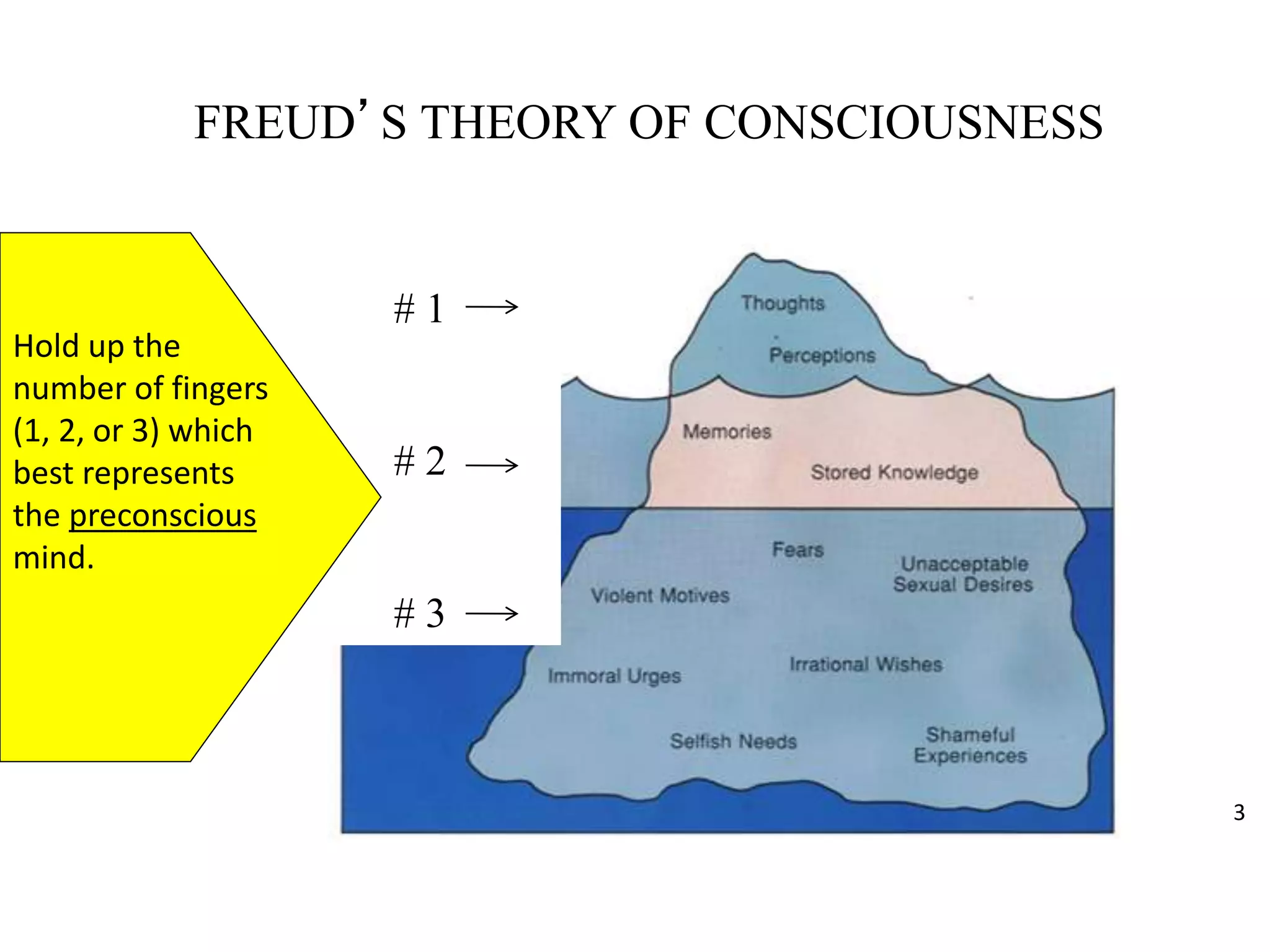
FREUD’S THEORY OF CONSCIOUSNESS
3
# 1
# 2
# 3
Hold up the
number of fingers
(1, 2, or 3) which
best represents
the preconscious
mind.
BODILY RHYTHMS
Circadian Rhythm
– A biological rhythm of Sleep, Alertness, and Body
Temperature changes
– 24 Hour sleep/wake cycle
– Alertness slowly increases until around noon and then decreases until a dip around 3pm,
rises and peaks again around 6pm, then decreases slowly until around 3am and then
gradually increases throughout the morning.
Rhythms:
– Jet lag can mess with rhythms
– Bright light can reset our natural
“clock”
4
Did you know?
If all light cues and clocks are hidden,
we will adapt to a 25-hour day
Necessity of Sleep
• Circadian rhythm
– 24 hour bodily
rhythm
• Hypothalamus –
tiny section of
brain influences
glandular system
• Suprachiasmatic
nucleus –internal
clock tells people
wake up/fall
asleep
• tells pineal gland
secrete melatonin
for sleepiness
4.2 Why do people need to sleep and how does it work?
Theories of WHY We Sleep
• Animals evolved sleep patterns to avoid predators by
sleeping when predators are most active
Adaptive theory - theory of sleep proposing that animals
and humans evolved sleep patterns to avoid predators by
sleeping when predators are most active.
Restorative theory - theory of sleep proposing that sleep is
necessary to the physical health of the body and serves to
replenish chemicals and repair cellular damage.

Psych ch4-day1 notes

  • 1.
  • 2.
  • 3.
    FREUD’S THEORY OFCONSCIOUSNESS 3 # 1 # 2 # 3 Hold up the number of fingers (1, 2, or 3) which best represents the preconscious mind.
  • 4.
    BODILY RHYTHMS Circadian Rhythm –A biological rhythm of Sleep, Alertness, and Body Temperature changes – 24 Hour sleep/wake cycle – Alertness slowly increases until around noon and then decreases until a dip around 3pm, rises and peaks again around 6pm, then decreases slowly until around 3am and then gradually increases throughout the morning. Rhythms: – Jet lag can mess with rhythms – Bright light can reset our natural “clock” 4 Did you know? If all light cues and clocks are hidden, we will adapt to a 25-hour day
  • 5.
    Necessity of Sleep •Circadian rhythm – 24 hour bodily rhythm • Hypothalamus – tiny section of brain influences glandular system • Suprachiasmatic nucleus –internal clock tells people wake up/fall asleep • tells pineal gland secrete melatonin for sleepiness 4.2 Why do people need to sleep and how does it work?
  • 6.
    Theories of WHYWe Sleep • Animals evolved sleep patterns to avoid predators by sleeping when predators are most active Adaptive theory - theory of sleep proposing that animals and humans evolved sleep patterns to avoid predators by sleeping when predators are most active. Restorative theory - theory of sleep proposing that sleep is necessary to the physical health of the body and serves to replenish chemicals and repair cellular damage.