Visit https://testbankfan.com to download the full version and
explore more testbank or solution manual
PSYCH 5th Edition Rathus Solutions Manual
_____ Click the link below to download _____
https://testbankfan.com/product/psych-5th-edition-
rathus-solutions-manual/
Explore and download more testbank at testbankfan.com
Here are some suggested products you might be interested in.
Click the link to download
PSYCH 5th Edition Rathus Test Bank
https://testbankfan.com/product/psych-5th-edition-rathus-test-bank/
PSYCH 3rd Edition Rathus Test Bank
https://testbankfan.com/product/psych-3rd-edition-rathus-test-bank/
Childhood Voyages in Development 5th Edition Rathus
Solutions Manual
https://testbankfan.com/product/childhood-voyages-in-development-5th-
edition-rathus-solutions-manual/
Financial Accounting 6th Edition Weygandt Test Bank
https://testbankfan.com/product/financial-accounting-6th-edition-
weygandt-test-bank/
Introduction to Brain and Behavior 5th Edition Kolb Test
Bank
https://testbankfan.com/product/introduction-to-brain-and-
behavior-5th-edition-kolb-test-bank/
Essentials of Human Development A Life Span View 2nd
Edition Kail Test Bank
https://testbankfan.com/product/essentials-of-human-development-a-
life-span-view-2nd-edition-kail-test-bank/
Concepts Of Genetics 10th Edition Klug Test Bank
https://testbankfan.com/product/concepts-of-genetics-10th-edition-
klug-test-bank/
Microeconomics 1st Edition Karlan Test Bank
https://testbankfan.com/product/microeconomics-1st-edition-karlan-
test-bank/
Molecular Biology of the Cell 6th Edition Bruce Alberts
Test Bank
https://testbankfan.com/product/molecular-biology-of-the-cell-6th-
edition-bruce-alberts-test-bank/
CB 8th Edition Babin Test Bank
https://testbankfan.com/product/cb-8th-edition-babin-test-bank/
1
Chapter 7: Thinking, Language, and Intelligence
© 2018 Cengage Learning. All Rights Reserved. May not be scanned, copied or duplicated, or posted to a publicly accessible website, in whole or in part.
Chapter 7
Thinking, Language, and Intelligence
Lecture Outline
Cognition is defined as the mental activity involved in understanding, processing, and
communicating information.
I. Thinking
Thinking means paying attention to information, representing it mentally, reasoning about it,
and making judgments and decisions about it. Thinking refers to conscious, planned attempts to
make sense of and change the world.
A. Concepts
Concepts are mental categories used to group together objects, relations, events, abstractions,
or qualities that have common properties. Thinking has to do with categorizing new concepts
and manipulating relationships among concepts, as in problems in geometry. People tend to
organize concepts in hierarchies. Prototypes are good examples. Simple prototypes, such as
dog and red, are taught by means of examples, or exemplars. Dogs are positive instances of
the dog concept. Negative instances—things that are not dogs—are then shown to the child
while one says, “This is not a dog.”
In language development, such over inclusion of instances in a category (reference to horses
as dogs) is labeled overextension.
B. Problem Solving
Problem solving is an important aspect of thinking.
C. Methods of Problem Solving
Understanding the Problem
Successful understanding of a problem generally requires three features:
• The parts of one’s mental representation of the problem relate to one another in a
meaningful way.
2
Chapter 7: Thinking, Language, and Intelligence
© 2018 Cengage Learning. All Rights Reserved. May not be scanned, copied or duplicated, or posted to a publicly accessible website, in whole or in part.
• The elements of one’s mental representation of the problem correspond to the
elements of the problem in the outer world.
• People have a storehouse of background knowledge that they can apply to the
problem.
The Use of Algorithms
An algorithm is a specific procedure for solving a type of problem. An algorithm
invariably leads to the solution. If one was to use the systematic random search
algorithm, one would list every possible letter combination, using from one to all five
letters.
The Use of Heuristic Devices
The shortcuts are called heuristics, or heuristic devices—rules of thumb that help
individuals simplify and solve problems. In contrast to algorithms, heuristics do not
guarantee a correct solution. When they work, they permit more rapid solutions. One type
of heuristic device is the means–end analysis, a heuristic device in which one tries to
solve a problem by evaluating the difference between the current situation and the goal.
The Use of Analogies
An analogy is a partial similarity among things that are different in other ways. The
analogy heuristic applies the solution of an earlier problem to the solution of a new one.
D. Factors That Affect Problem Solving
Expertise
Experts solve problems more efficiently and rapidly than novices do. People who are
experts at solving a certain kind of problem share the following characteristics (Bassok &
Novick, 2012; Bunt et al., 2013):
• They know the particular area well.
• They have a good memory for the elements in the problems.
• They form mental images or representations that facilitate problem solving.
• They relate the problem to similar problems.
• They are more goal-directed and have efficient methods for problem solving.
Experts seemed to use parallel processing. That is, they dealt simultaneously with two or
more elements of the problems. Novices were more likely to engage in serial processing—
3
Chapter 7: Thinking, Language, and Intelligence
© 2018 Cengage Learning. All Rights Reserved. May not be scanned, copied or duplicated, or posted to a publicly accessible website, in whole or in part.
that is, to handle one element of the problem at a time.
Mental Sets
The tendency to respond to a new problem with the same approach that helped solve
similar problems is termed a mental set. Mental sets usually make an individual’s work
easier, but they can mislead him or her when the similarity between problems is illusory.
Insight
Insight, in Gestalt psychology, is a sudden perception of relationships among elements of
the mentally represented elements of a problem that permits its solution.
Incubation
Incubation in problem solving refers to standing back from the problem for a while as
some process within may continue to work on it. Later, the answer may come to one in a
flash of insight. Standing back from the problem may help by distancing one from
unprofitable but persistent mental sets (Gilhooly et al., 2013; Koppel & Storm, 2013).
Functional Fixedness
Functional fixedness is the tendency to think of an object in terms of its name or its
familiar function. It can be similar to a mental set in that it makes it difficult to use familiar
objects to solve problems in novel ways.
E. Judgment and Decision Making
People make most of their decisions on the basis of limited information. They take shortcuts.
They use heuristic devices—rules of thumb—in judgments and decision making just as they
do in problem solving (Mousavi & Gigerenzer, 2014).
Heuristics in Decision Making
• Representativeness heuristic—a decision-making heuristic in which people make
judgments about samples according to the populations they appear to represent.
• Availability heuristic—a decision-making heuristic in which the estimates of
frequency or probability of events are based on how easy it is to find examples.
• Anchoring and adjustment heuristic—a decision-making heuristic in which a
presumption or first estimate serves as a cognitive anchor; as people receive
4
Chapter 7: Thinking, Language, and Intelligence
© 2018 Cengage Learning. All Rights Reserved. May not be scanned, copied or duplicated, or posted to a publicly accessible website, in whole or in part.
additional information, they make adjustments but tend to remain in the proximity of
the anchor.
The Framing Effect
The framing effect refers to the way in which wording, or the context in which
information is presented, affects decision making (Takemura, 2014). Political groups, like
advertisers, are aware of the framing effect and choose their words accordingly.
Overconfidence
Whether one’s decisions are correct or incorrect, most people tend to be overconfident
about them. People tend to view their situations with 20/20 hindsight. There are several
reasons for overconfidence, even when people’s judgments are wrong.
• People tend to be unaware of how flimsy their assumptions may be.
• People tend to focus on examples that confirm their judgments and ignore those that
do not.
• Because people’s working memories have limited space, they tend to forget
information that runs counter to their judgments.
• People work to bring about the events they believe in, so they sometimes become
self-fulfilling prophecies.
Handout
Concept Chart
5
Chapter 7: Thinking, Language, and Intelligence
© 2018 Cengage Learning. All Rights Reserved. May not be scanned, copied or duplicated, or posted to a publicly accessible website, in whole or in part.
II. Language
A. Communication by Nonhumans
The exclusive human claim to language has been brought into question by studies of
communication with various animal species. A language is a system of symbols along with
rules that are used to manipulate the symbols. Symbols such as words stand for or represent
other objects, events, or ideas.
Do Apes Really Use Language?
A chimpanzee named Washoe, who was a pioneer in the effort to teach apes to use
language, was using 181 signs by the age of 32 (King, 2008). One chimp, Kanzi, picked up
language from observing another chimp being trained and has the grammatical abilities of
a two-and-a-half-year-old child. Critics of the view that apes can learn to produce
language, such as Herbert Terrace (Terrace & Metcalfe, 2005) and Steven Pinker (1994a,
2011), note that:
• Apes can string together signs in a given sequence to earn rewards, but animals lower
on the evolutionary ladder, such as pigeons, can also peck buttons in a certain
sequence to obtain a reward.
• It takes apes longer to learn new signs than it takes children to learn new words.
• Apes are unreliable in their sequencing of signs, suggesting that by and large they do
not comprehend rules of grammar.
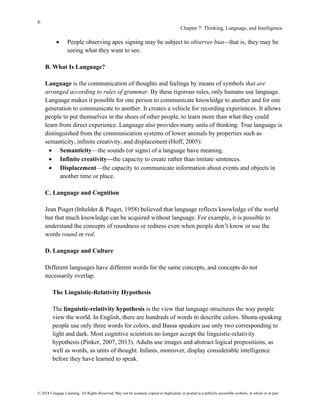
Thinking
Problem
Solving Concepts
Judgment
Decision
Making
6
Chapter 7: Thinking, Language, and Intelligence
© 2018 Cengage Learning. All Rights Reserved. May not be scanned, copied or duplicated, or posted to a publicly accessible website, in whole or in part.
• People observing apes signing may be subject to observer bias—that is, they may be
seeing what they want to see.
B. What Is Language?
Language is the communication of thoughts and feelings by means of symbols that are
arranged according to rules of grammar. By these rigorous rules, only humans use language.
Language makes it possible for one person to communicate knowledge to another and for one
generation to communicate to another. It creates a vehicle for recording experiences. It allows
people to put themselves in the shoes of other people, to learn more than what they could
learn from direct experience. Language also provides many units of thinking. True language is
distinguished from the communication systems of lower animals by properties such as
semanticity, infinite creativity, and displacement (Hoff, 2005):
• Semanticity—the sounds (or signs) of a language have meaning.
• Infinite creativity—the capacity to create rather than imitate sentences.
• Displacement—the capacity to communicate information about events and objects in
another time or place.
C. Language and Cognition
Jean Piaget (Inhelder & Piaget, 1958) believed that language reflects knowledge of the world
but that much knowledge can be acquired without language. For example, it is possible to
understand the concepts of roundness or redness even when people don’t know or use the
words round or red.
D. Language and Culture
Different languages have different words for the same concepts, and concepts do not
necessarily overlap.
The Linguistic-Relativity Hypothesis
The linguistic-relativity hypothesis is the view that language structures the way people
view the world. In English, there are hundreds of words to describe colors. Shona-speaking
people use only three words for colors, and Bassa speakers use only two corresponding to
light and dark. Most cognitive scientists no longer accept the linguistic-relativity
hypothesis (Pinker, 2007, 2013). Adults use images and abstract logical propositions, as
well as words, as units of thought. Infants, moreover, display considerable intelligence
before they have learned to speak.
7
Chapter 7: Thinking, Language, and Intelligence
© 2018 Cengage Learning. All Rights Reserved. May not be scanned, copied or duplicated, or posted to a publicly accessible website, in whole or in part.
III. Language Development: The Two-Year Explosion
Languages around the world develop in a specific sequence of steps, beginning with the
prelinguistic vocalizations of crying, cooing, and babbling. These sounds are not symbols. That
is, they do not represent objects or events.
A. Prelinguistic Vocalizations
As parents are well aware, newborn children have one inborn, highly effective form of verbal
expression: crying—and more crying. Babbling, like crying and cooing, is inborn and
prelinguistic. Children tend to utter their first word at 11 to 13 months, but a range of 8 to 18
months is normal (McCardle et al., 2009; Tamis-LeMonda et al., 2014). By about 18 months,
children are producing a couple of dozen words.
B. Development of Grammar
Holophrase refers to a single word used to express complex meanings. Most children show
their parents what they intend by augmenting their holophrases with gestures and intonations.
Toward the end of the second year, children begin to speak two-word sentences. These
sentences are termed telegraphic speech because they resemble telegrams. There are different
kinds of two-word utterances. Some contain nouns or pronouns and verbs (“Daddy sit”).
Others contain verbs and objects (“Hit ball”).
Overregularization
Overregularization is an important development for understanding the roles of nature and
nurture in language development (Ambridge et al., 2013; Pinker, 2013). They become
aware of the grammatical rules for forming the past tense and plurals. The tendency to
regularize the irregular is what is meant by overregularization.
Other Developments
By the age of six, children’s vocabularies have expanded to 10,000 words, give or take a
few thousand. By seven to nine, most children realize that words can have more than one
meaning, and they are entertained by riddles and jokes that require some sophistication
with language.
C. Nature and Nurture in Language Development
Language development, like many other areas of development, apparently reflects the
8
Chapter 7: Thinking, Language, and Intelligence
© 2018 Cengage Learning. All Rights Reserved. May not be scanned, copied or duplicated, or posted to a publicly accessible website, in whole or in part.
interactions between nature and nurture.
Learning Theory and Language Development
Learning theorists see language as developing according to laws of learning (Hoff, 2005).
They usually refer to the concepts of imitation and reinforcement. From a social–cognitive
perspective, parents serve as models. Children learn language, at least in part, through
observation and imitation. Learning theory cannot account for the unchanging sequence of
language development and the spurts in children’s language acquisition.
The Nativist Approach to Language Development
The nativist theory of language development holds that the innate factors—which make up
children’s nature—cause children to attend to and acquire language in certain ways.
According to psycholinguistic theory, language acquisition involves the interaction of
environmental influences—such as exposure to parental speech and reinforcement—and
the inborn tendency to acquire language. Noam Chomsky (see Cherniak, 2009) refers to the
inborn tendency as a language acquisition device (LAD). Evidence for an LAD is found
in the universality of human language abilities and in the specific sequence of language
development (Cherniak, 2009; A. Clark & Lappin, 2013).
IV. Theories of Intelligence
The concept of intelligence is closely related to thinking. Intelligence is the underlying ability to
understand the world and cope with its challenges (Strenze, 2015). Although intelligence, like
thinking, cannot be directly seen or touched, psychologists tie the concept to achievements such
as school performance and occupational status (Nisbett, 2013).
A. Factor Theories
Factor theories argue that intelligence is made up of a number of mental abilities, ranging
from one kind of ability to hundreds. In 1904, British psychologist Charles Spearman
suggested that the behaviors people consider intelligent have a common underlying factor that
he labeled g, for “general intelligence” or broad reasoning and problem-solving abilities. He
also noted that even the most capable people are relatively superior in some areas. For this
reason, he suggested that specific, or s factors account for specific abilities.
American psychologist Louis Thurstone (1938) analyzed tests of specific abilities and
concluded that Spearman had oversimplified intelligence. Thurstone’s data suggested the
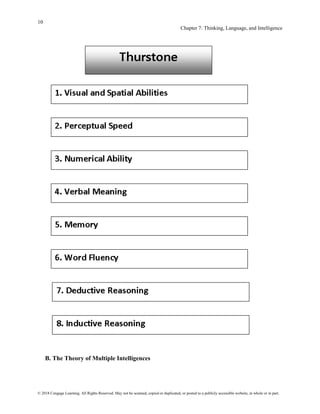
presence of eight specific factors, which he labeled primary mental abilities:
9
Chapter 7: Thinking, Language, and Intelligence
© 2018 Cengage Learning. All Rights Reserved. May not be scanned, copied or duplicated, or posted to a publicly accessible website, in whole or in part.
• Visual and spatial abilities
• Perceptual speed
• Numerical ability
• Verbal meaning
• Memory
• Word fluency
• Deductive reasoning
• Inductive reasoning
Handout
10
Chapter 7: Thinking, Language, and Intelligence
© 2018 Cengage Learning. All Rights Reserved. May not be scanned, copied or duplicated, or posted to a publicly accessible website, in whole or in part.
B. The Theory of Multiple Intelligences
11
Chapter 7: Thinking, Language, and Intelligence
© 2018 Cengage Learning. All Rights Reserved. May not be scanned, copied or duplicated, or posted to a publicly accessible website, in whole or in part.
Thurstone wrote about various factors or components of intelligence. Howard Gardner’s
(1983/1993, 2009) theory of multiple intelligences proposes, instead, that there are a number
of intelligences, not just one. Gardner refers to each kind of intelligence in his theory as “an
intelligence” because they can differ so much. Two of these “intelligences” are familiar ones:
language ability and logical–mathematical ability. Gardner also refers, however, to bodily–
kinesthetic talents (of the sort shown by dancers and athletes), musical talent, spatial–relations
skills, and two kinds of personal intelligence: awareness of one’s own inner feelings and
sensitivity to other people’s feelings. Gardner (2001) more recently added “naturalist
intelligence” and “existential intelligence.”
Critics of Gardner’s view agree that people function more intelligently in some aspects of life
than in others. But these critics question whether such talents are best thought of as
“intelligences” or special talents (Neisser et al., 1996). Language skills, reasoning ability, and
ability to solve math problems seem to be more closely related than musical or gymnastic
talent to what most people mean by intelligence.
C. The Triarchic Theory of Intelligence
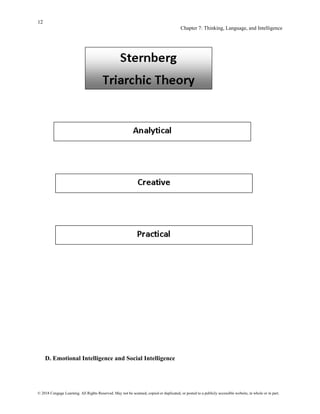
Psychologist Robert Sternberg (2000; 2006) has constructed a three-pronged or triarchic
theory of intelligence that includes analytical, creative, and practical intelligence.
• Analytical intelligence can be defined as academic ability.
• Creative intelligence is defined by the ability to cope with novel situations and generate
many possible solutions to problems.
• Practical intelligence (“street smarts”) enables people to deal with other people,
including difficult people, and to meet the demands of their environment.
Handout
12
Chapter 7: Thinking, Language, and Intelligence
© 2018 Cengage Learning. All Rights Reserved. May not be scanned, copied or duplicated, or posted to a publicly accessible website, in whole or in part.
D. Emotional Intelligence and Social Intelligence
13
Chapter 7: Thinking, Language, and Intelligence
© 2018 Cengage Learning. All Rights Reserved. May not be scanned, copied or duplicated, or posted to a publicly accessible website, in whole or in part.
Psychologists Peter Salovey and John Mayer developed the theory of emotional intelligence,
which holds that social and emotional skills are a form of intelligence, just as academic skills
are (Boyatzis et al., 2015; Stein & Deonarine, 2015). Emotional intelligence resembles two of
Gardner’s “intelligences”—intrapersonal skills and interpersonal skills. Failure to develop
emotional intelligence is connected with poor ability to cope with stress, depression, and
aggressive behavior (Brackett et al., 2011).
E. Creativity and Intelligence
Creativity is the ability to generate novel and useful solutions to problems. Creative people
share a number of qualities (Plucker et al., 2015): they take chances. They refuse to accept
limitations. They appreciate art and music. They use common materials to make unique
things. They challenge social norms and take unpopular stands. They challenge ideas that
other people accept at face value.
• In convergent thinking, thought is limited to present facts; the problem solver narrows
his or her thinking to find the best solution.
• In divergent thinking, the problem solver associates freely to the elements of the
problem, allowing “leads” to run a nearly limitless course.
Problem solving can involve both kinds of thinking. At first, divergent thinking helps generate
many possible solutions. Convergent thinking is then used to select likely solutions and reject
others.
V. The Measurement of Intelligence
A. The Stanford–Binet Intelligence Scale
Early in the 20th
century, the French public school system was looking for a test that could
identify children who were unlikely to benefit from regular classroom instruction. The first
version of that test, the Binet–Simon scale, came into use in 1905. The Binet–Simon scale
yielded a score called a mental age (MA). The MA shows the intellectual level at which a
child is functioning.
Louis Terman adapted the Binet–Simon scale for use with American children at Stanford
University. The first version of the resultant Stanford–Binet Intelligence Scale was published
in 1916. The SBIS included more items than the original test and was used with children aged
2 to 16. The SBIS also yielded an intelligence quotient (IQ) rather than an MA. The IQ
reflects the relationship between a child’s mental age and his or her actual chronological age
(CA).
14
Chapter 7: Thinking, Language, and Intelligence
© 2018 Cengage Learning. All Rights Reserved. May not be scanned, copied or duplicated, or posted to a publicly accessible website, in whole or in part.
IQ = mental age (MA)/chronological age (CA) X 100. IQ scores on the SBIS today are
derived by comparing results to those of other people of the same age.
B. The Wechsler Scales
In contrast to the SBIS, David Wechsler developed a series of scales for use with children and
adults. The Wechsler scales group test questions into a number of separate subtests. Each
subtest measures a different intellectual task. Wechsler described some of his scales as
measuring verbal tasks and others as assessing performance tasks. Verbal subtests require
knowledge of verbal concepts, whereas performance subtests require familiarity with spatial-
relations concepts.
Wechsler also introduced the concept of the deviation IQ. He based IQ scores on how a
person’s answers compared with those attained by people in the same age group. The average
test result at any age level is defined as an IQ score of 100. Wechsler distributed IQ scores so
that the middle 50% were defined as the “broad average range” of 90 to 110. Only 4% of the
population have IQ scores of above 130 or below 70.
C. Group Tests
Group tests for children were first developed during World War I. At first these tests were
hailed as remarkable instruments because they helped school administrators place children.
As the years passed, however, group tests came under attack because many administrators
relied on them exclusively and did not seek other sources of information about children’s
abilities. Numbers alone, and especially IQ scores, cannot adequately define children’s special
abilities and talents.
D. The Reliability and Validity of Intelligence Tests
Over the years, the SBIS and the Wechsler scales have been shown to be reliable and valid. In
terms of reliability, the scores are rather consistent from testing to testing. This kind of
reliability is called test–retest reliability.
E. Differences in Intellectual Functioning
The average IQ score in the United States is very close to 100.
Socioeconomic and Ethnic Differences
Lower-class U.S. children obtain IQ scores some 10 to 15 points lower than those obtained
15
Chapter 7: Thinking, Language, and Intelligence
© 2018 Cengage Learning. All Rights Reserved. May not be scanned, copied or duplicated, or posted to a publicly accessible website, in whole or in part.
by middle- or upper-class children. African American children tend to obtain IQ scores
some 15 points lower than those obtained by their European American age-mates (Nisbett
et al., 2012; Saklofske et al., 2015). Latin American and Native American children also
tend to score below the norms for European Americans. There may also be intellectual
differences between Asians and Caucasians. Asian Americans, for example, frequently
outscore European Americans on the math portion of the Scholastic Aptitude Test. Most
psychologists believe that such ethnic differences reflect cultural attitudes toward
education rather than inborn racial differences (Nisbett at al., 2012).
Gender Differences
Girls are somewhat superior to boys in verbal abilities, such as vocabulary, ability to
generate sentences and words that are similar in meaning to other words, spelling,
knowledge of foreign languages, and pronunciation (Andreano & Cahill, 2009; Lohman &
Lakin, 2009). Males seem to do somewhat better at manipulating visual images in working
memory. For half a century or more, it has been believed that male adolescents generally
outperform females in mathematics, and research has tended to support that belief (Else-
Quest et al., 2013; Miller & Halpern, 2014). The reported gender differences are group
differences. There is greater variation in these skills between individuals within the groups
than between males and females (Miller & Halpern, 2014).
VI. Nature and Nurture in Intelligence
A. Genetic Influences on Intelligence
Research on genetic influences has employed kinship studies, twin studies, and adoptee
studies. The IQ scores of identical (monozygotic, or MZ) twins are more alike than scores for
any other pairs, even when the twins have been reared apart. In sum, studies generally suggest
that the heritability of intelligence is between 40% and 60% (Neisser et al., 1996; Plomin et
al., 2013). Several studies with one- and two-year-old children in Colorado (Baker et al.,
1983), Texas (Horn, 1983), and Minnesota (Scarr & Weinberg, 1983) have found a stronger
relationship between the IQ scores of adopted children and those of their biological parents
than between the children’s scores and those of their adoptive parents.
B. Environmental Influences on Intelligence
The Home Environment
Children of parents who are emotionally and verbally responsive, furnish appropriate play
materials, are involved with their children, encourage independence, and provide varied
16
Chapter 7: Thinking, Language, and Intelligence
© 2018 Cengage Learning. All Rights Reserved. May not be scanned, copied or duplicated, or posted to a publicly accessible website, in whole or in part.
daily experiences obtain higher IQ scores later on (Bradley, 2006). Organization and safety
in the home have also been linked to higher IQs and achievement test scores (Bradley et
al., 1989; Petrill et al., 2010).
Education
Although intelligence is viewed as permitting people to profit from education, education
also apparently contributes to intelligence. Head Start programs, for example, enhance IQ
scores, achievement test scores, and academic skills of disadvantaged children (Bierman et
al., 2008) by exposing them to materials and activities that middle-class children take for
granted. Children who have been in school longer obtain higher IQ scores (Neisser et al.,
1996). Test scores tend to decrease during the summer vacation (Neisser et al., 1996).
The Flynn Effect
Philosopher and researcher John Flynn (2003) found that IQ scores in the Western world
increased substantially between 1947 and 2002, some 18 points in the United States.
Psychologist Richard Nisbett (2009) argues that people’s genetic codes could not possibly
have changed enough in half a century to account for this enormous difference and
concludes that social and cultural factors such as the effects of improved educational
systems and the penetration of the mass media must be among the reasons for the change.
Lecture Topics
I. Thinking
Lecture Topic 1: Heuristic Judgment Theory
The use of heuristics is common among people. This problem-solving strategy works well but
can lead to errors in judgment. The topic of heuristics can be a fun discussion as students begin
to relate to the errors that are made in daily judgments. To help students understand a new theory
of heuristic judgment, access the article titled “Heuristic Judgment Theory” written by Harvey
(1998). The article discusses the importance of heuristics in human decision making, proposes a
decision-making process, and discusses the psychology of decision making.
Lecture Topic 2: Decision Making
An interesting article titled “Problems for Judgment and Decision Making” written by Hastie
(2001) can be discussed. It explores the area of judgment and decision making in cognitive
psychology. The author attempts to review recent developments in the field of judgment and
17
Chapter 7: Thinking, Language, and Intelligence
© 2018 Cengage Learning. All Rights Reserved. May not be scanned, copied or duplicated, or posted to a publicly accessible website, in whole or in part.
decision making and also discusses what makes a good research problem in this area. Finally, the
author suggests 16 problems that could be considered for judgment and decision-making
research. This information can help students see the contemporary thought in this area.
Lecture Topic 3: ‘Like Me’: A Foundation for Social Cognition
Infants try to understand their own perception (of actions) by comparing it with others. In other
words, they begin to recognize that their own self is a lot like others with relation to perceptions
and emotions. This “like me” perception of others is an infant’s first steps toward social
cognition. To help students understand this area of research, access the article titled “‘Like Me’:
A Foundation for Social Cognition” written by Andrew N. Meltzoff (2007). This article will
provide information for students by illustrating an expanded view of cognition.
II. Language
Lecture Topic 1: Language and Nature
To help students understand the argument made by Chomsky and others about language being
more natural, access the article titled “Language and Nature” written by Chomsky (1995). In this
article, Chomsky suggests that the mind and brain need be thought of as natural processes and
should be studied that way. As language is a part of the brain, language should also be studied
and understood through naturalistic principles.
Lecture Topic 2: Culture, Language, and Color
For an interesting discussion that instructors can have with students about how language
development can actually alter perceptions, access the article titled “A Study of Colour Grouping
in Three Languages: A Test of the Linguistic Relativity Hypothesis” written by Davies (1998).
This article discusses a research project where individuals who speak different languages were
asked to group color tiles. The results indicate that grouping differences were seen between those
who speak different languages. A possible explanation presented by the authors is that language
development may impact perceptions.
Lecture Topic 3: Childcare and Language Development
This lecture topic will give instructors an opportunity to discuss various environmental factors
that contribute to language and cognitive development. A study was conducted with children
from ten sites in the United States to determine the factors that contribute to language and
cognitive development. The main independent variables explored in the study were daycare and
family environments. Instructors can access this article titled “The Relation of Child Care to
18
Chapter 7: Thinking, Language, and Intelligence
© 2018 Cengage Learning. All Rights Reserved. May not be scanned, copied or duplicated, or posted to a publicly accessible website, in whole or in part.
Cognitive and Language Development” written for Child Development (2000). This article
discusses such topics as quality, type, and amount of care and how these variables relate to
development. One result from the article is that at age three, children in daycare centers
performed better than children in other types of care.
Lecture Topic 4: Translating between Languages: English and Japanese
The process of how bilinguals maintain two languages has intrigued cognitive psychologists
attempting to determine the processes of translation. Two hypotheses are at the forefront: (1)
“word association,” where the word is directly translated with the corresponding word in the
second language; and (2) concept mediation hypothesis, which suggests that semantic memory
plays a role. To help students understand these two hypotheses, access the article titled “The
Process of Translation between English Words and Japanese Words” written by Ikeda (1998).
This article describes a research study exploring which hypothesis might be correct and suggests
that word association has more support.
III. Intelligence
Lecture Topic 1: Race and Intelligence
An interesting topic to share with students is that of race and intelligence. It is perhaps this area
that is more controversial than any other in the field of psychology. An article titled “Race and
Intelligence: Separating Science from Myth” written by Reeve (2002) is a book review that
focuses on this issue. Topics covered in the book (which would also make excellent topics for
discussion in class) include the following: (a) race exists only as a socially defined category, (b)
racial categories are developed for the purpose of justifying and perpetuating social inequalities,
(c) the merits of intelligence testing, (d) the misuse of statistical concepts, and (e) alternative
interpretations of the bell curve.
Lecture Topic 2: Sex Differences in Intelligence
A topic that can lead to an interesting class discussion is that of sex differences and intelligence.
The correlation between brain size and intelligence has been established, and, just over a decade
ago, it was determined that males have larger brains compared to females, even when making
adjustments for body size. Thus, it could be concluded that males should be more intelligent.
Yet, research utilizing large samples does not support males being more intelligent in the
traditional categories of fluid and crystallized intelligence. In an article titled “Sex Differences in
Intelligence and Brain Size: A Developmental Theory” written by Lynn (1999), this topic is
discussed. The author presents his own explanations, and he reviews the explanations of others.
19
Chapter 7: Thinking, Language, and Intelligence
© 2018 Cengage Learning. All Rights Reserved. May not be scanned, copied or duplicated, or posted to a publicly accessible website, in whole or in part.
Lecture Topic 3: Music and Intelligence
For an interesting study regarding the relationship between music and intelligence, access the
article titled “Music for Your Brain” written by Knox (1994). This article describes what the
authors call the Mozart Effect, which suggests that listening to classical music (specifically
Mozart) can increase ability in spatial reasoning tasks. Though the effect may be short-lived, the
conclusion of the research is interesting.
IV. Nature and Nurture in Intelligence
Lecture Topic 1: The Evolution of Human Intelligence
To help students better understand the evolutionary nature of intelligence, access the article titled
“The Evolution of Human Intelligence” written by Clamp (2001). This article discusses how
intelligence has evolved over time and allowed humans to adapt. The costs that are seen in this
process are discussed, as well as two specific theoretical perspectives explaining why it makes
sense to take this perspective (ecological theory and social theory). This information can help
students see the value in such a perspective.
Lecture Topic 2: Giftedness: Infancy to Adolescence
To help students better understand the developmental nature of giftedness, access the article
titled “Giftedness: Infancy to Adolescence—A Developmental Perspective” written by Dalzell
(1998). This in-depth article discusses historical perspectives of giftedness and then transitions
into modern approaches. The authors suggest that gifted children differ from their peers of the
same age in such ways as motivation, independence, and introversion. This article contains
interesting information that will assist students in their understanding of giftedness.
Lecture Topic 3: What Is Intelligence?
In a slightly different approach to understanding where intelligence comes from, access the
article titled “Human Abilities” written by Sternberg and Kaufman (1998). This article explores
definitions of intelligence, which include cognitive, biological, psychometric, and traditional
approaches. Presenting these approaches to students can help them see that the concept of
intelligence may just come from the theory rather than the theory attempting to explain the
construct of intelligence.
20
Chapter 7: Thinking, Language, and Intelligence
© 2018 Cengage Learning. All Rights Reserved. May not be scanned, copied or duplicated, or posted to a publicly accessible website, in whole or in part.
Classroom Demonstrations
I. Thinking
Classroom Demonstration 1: Framing Effect
To help students understand the power of framing, access the article titled “Influence of
Elaboration on the Framing of Decision” written by Takemura (1994). This article provides an
example of the framing effect, which can be used in class to describe an unusual disease
expected to kill 600 people. Instructors may want to create an overhead of the framing example.
Two alternatives are presented between which students need to choose. One option is positively
framed, and one is negatively framed. After presenting the scenario to the students, have them
write down which option they would choose. This demonstration will help students understand
framing.
Classroom Demonstration 2: Why Overconfidence Occurs and How to Overcome it
For this demonstration, instructors would have to create a survey on a similar topic where
students are sure to make overtly confident guesses about a particular outcome (e.g., a sports
event, a court verdict, or the winner of local elections etc.).
The article titled “Why Overconfidence Occurs and How to Overcome It” written by Winston
Sieck (2016) offers an interesting example of overconfidence. This article discusses a research
study that college students used to demonstrate overconfidence about financial knowledge. They
chose finance as a topic because major decisions in life are made using financial management. A
replication of this study can help students understand this phenomenon. To demonstrate how
overconfidence truly works, have students complete a similar survey that tests their
overconfidence. The collected data will help demonstrate the concept of overconfidence.
Classroom Demonstration 3: Research on Cognition
John Krantz of Hanover College provides a number of cognitive experiments on his website,
http://psych.hanover.edu/JavaTest/CLE/Cognition/Cognition.html. Studies include research on
automaticity, attention, and decision making. Choose one or more of the experiments, and then
simply demonstrate to the class how a person would participate in the study, or (if the instructor
has the time) have some students participate in the study and investigate the results as a class.
Classroom Demonstration 4: Cognitive Demonstrations
Visit the website http://www.gocognitive.net/demos, which offers a number of free
21
Chapter 7: Thinking, Language, and Intelligence
© 2018 Cengage Learning. All Rights Reserved. May not be scanned, copied or duplicated, or posted to a publicly accessible website, in whole or in part.
demonstrations on cognitive psychology and cognitive neuroscience. Instructors can choose from
these demonstrations and share them with their class.
II. Language
Classroom Demonstration 1: That’s Not What He Meant
One way to get students engaged in the study of language is to present them with a variety of
(humorous) ambiguous sentences. Reisberg (2010) offers a number of them, drawn from actual
newspaper headlines. Reading these aloud to the class can be a good icebreaker to begin the
discussion of language and also underscores how important language rules are for correct
comprehension.
Classroom Demonstration 2: Research on Language
Langston (1998) suggests a number of demonstrations of how research is conducted in the field
of psycholinguistics. Instructors can read the article and choose demonstrations that they think
would be the most informative and interesting for their class.
Classroom Demonstration 3: Bilingualism
For this demonstration, have a student (or more than one, if there are more bilingual students)
demonstrate his or her ability in the languages he or she has learned. Ask this person to talk
about when the languages were learned and how this education has been a benefit. Then present
an article titled “Banishing Bilingualism” written by Katz and Kohl (2002). This article discusses
attempts to remove bilingualism from education and how some states have advanced with this.
This topic can lead to a lively debate with students for bilingualism or English only.
III. Intelligence
Classroom Demonstration 1: Prodigies Grow Up
For this demonstration, share with the class the three case studies listed in an article titled
“Prodigies Grow Up: College at Age 11, Chess at 6. Now Adults, Five Former Superkids Look
Back” written by Jerome, Cheakalos, and Horsburgh (2003). This article describes five child
prodigies who are now adults. They look back and describe their lives and the special talents that
they have. This demonstration will provide an illustration of highly intelligent individuals.
Classroom Demonstration 2: One-Minute Intelligence Test
22
Chapter 7: Thinking, Language, and Intelligence
© 2018 Cengage Learning. All Rights Reserved. May not be scanned, copied or duplicated, or posted to a publicly accessible website, in whole or in part.
Instructors will need to recreate Figures 1 and 2 from the article mentioned below. Copying and
enlarging the figures should work. Then, instructors shall create overheads from the
enlargements.
For this project, instructors will introduce a type of intelligence test to their students. Though not
technically an intelligence test, it can be used to introduce the topic of intelligence testing and
lead to a discussion on reliability and validity. The tests are actually brainteasers often called
rebus puzzles. These “intelligence tests” can be found in an article titled “A One-Minute
‘Intelligence’ Test” written by Griggs (2000). This article found in the Teaching of Psychology
journal presents the two tests, directions on how to administer the tests, and the answers. An
example of one of the items is DEATH/LIFE with the keyed response “life after death.”
Classroom Demonstration 3: Artificial Intelligence
Is intelligence a characteristically human feature or could nonhuman—and even inanimate—
entities one day possess intelligence too? To get students talking about the possibility of artificial
intelligence, introduce them to the ELIZA website, an example of artificial intelligence:
http://www-ai.ijs.si/eliza/eliza.html. Have students volunteer to ask ELIZA questions. In what
cases does ELIZA work well, and where does she fall short? Why is it difficult to replicate
human intelligence in a machine? Do students think true artificial intelligence will ever be
possible? Why, or why not?
Classroom Demonstration 4: The Flynn Effect
The “Flynn Effect” takes its name after John Flynn, who proposed that there is a noticeable
increase in standardized test scores of individuals from the 1930s to the year 2000. To engage
students in a debate, have them access the article titled “The Flynn Effect: A Meta-analysis”
written by Fletcher, Hiscock, Stuebing, and Trahan (2014). Have students think about concepts
such as intellectual disability and special education and how the Flynn effect factors in these
criteria. Have students consider environmental factors, technological advances, and other factors
that might have played a role in the increase of IQ tests over the years. Ask students to read this
article and then write a two-page response paper summarizing what they learned.
IV. Nature and Nurture in Intelligence
Classroom Demonstration 1: Intelligence Video
Show students a video from the Discovering Psychology series titled #16: Testing and
Intelligence. The video includes interviews with Robert Sternberg and Howard Gardner. It is
available streaming for free from the Annenberg Foundation at
23
Chapter 7: Thinking, Language, and Intelligence
© 2018 Cengage Learning. All Rights Reserved. May not be scanned, copied or duplicated, or posted to a publicly accessible website, in whole or in part.
http://www.learner.org/resources/series138.html.
Classroom Demonstration 2: Intelligence Meter
In class, explain that a fictional intelligence meter has been developed that will measure an
infant’s intellectual potential. This meter is so modern that testing is no longer necessary;
instead, the child is passed through what appears to be an airport metal detector, and a
measurement is taken.
In this fictional scenario, two children have been measured: “Child A” and “Child B.” On the
day of their birth, both children are measured for intelligence, and both are shown to have a
potential IQ score of exactly 100, which is at the 50th
percentile in the normal bell curve and
considered to be average. Child A and Child B are from different families and different
environments. The parents of Child A want the best for all of their children, but neither parent is
well educated. They lack parenting skills, and both have to work extremely long hours in order to
make ends meet.
The parents of Child B are just the opposite. Child B is able to attend museums and visit zoos,
and he or she has a strong vocabulary because of books and reading. Each child, due to
circumstances, experiences his or her world differently.
Years later, both children sit next to each other in a classroom and take an intelligence test. Ask
the class if it seems reasonable that the enriched environment that has been provided for Child B
would be worth 15 more points on an IQ test. Next, ask if it also seems reasonable that there
could be a loss of 15 points in Child A’s score due to the less nurturing environment. After the
response from students, illustrate for them the normal bell curve, and place Child B at the first
standard deviation (84th
percentile) and Child A at the standard deviation below the mean (16th
percentile). Child A is headed toward remedial education, and Child B is close to being gifted.
Solicit from students their reaction to this scenario.
Classroom Demonstration 3: Intelligence Live!
The Society of the Teaching of Psychology offers a free e-book with ideas for classroom
activities at http://teachpsych.org/ebooks/pse2011/vol2/index.php. Scroll down to find the
chapter on intelligence by Amber Esping and Jonathan Plucker. They offer a number of ideas for
classroom demonstrations that instructors may want to share with their class.
24
Chapter 7: Thinking, Language, and Intelligence
© 2018 Cengage Learning. All Rights Reserved. May not be scanned, copied or duplicated, or posted to a publicly accessible website, in whole or in part.
Student Projects and Activities
I. Thinking
Student Project 1: Individual Differences in Problem Solving
Insight refers to the solution to a problem that seems to be non-obvious and functional. For this
project, students will explore the phenomenon of insight. Students can access the article titled
“Cognitive Abilities Involved in Insight Problem Solving: An Individual Differences Model”
written by DeYoung, Flanders, and Peterson (2008). After reading this article, students will write
a one-page response paper defining insight.
Student Project 2: Neural Basis of Cognition
For the project, students will explore a website created to report findings from research in the
area of the neural basis of cognition: http://www.cnbc.cmu.edu. This website is the research page
for the Center for the Neural Basis of Cognition. Students shall explore it and write a one-page
summary of what they learned.
Student Project 3: Genes to Cognition
Explore the website for Genes to Cognition: http://www.g2conline.org/. This organization
focuses on cognitive disorders, cognitive processes, and research approaches. Have students
write a two-page paper discussing the areas of the site that they found to be more informative
and interesting, and why they found them to be so. Students should also answer these two
questions. Is there further information that they’d like to see Genes to Cognition add to its site? If
so, what?
Journal Prompt 1: Divergent Thinking
For this journal entry, ask students to think back over their life experience and find a time when
they used divergent thinking by overcoming functional fixedness. Divergent thinking is
illustrated when one uses some object for a purpose other than what it was intended. Were they
creative when they overcame functional fixedness?
Journal Prompt 2: Faulty Thinking?
Ask students to consider the following questions: Have they ever had experiences where their
thinking seemed to be slightly off? Perhaps when they were trying to solve a problem they just
couldn’t solve? Often, when individuals have trouble thinking clearly, their thinking may be
25
Chapter 7: Thinking, Language, and Intelligence
© 2018 Cengage Learning. All Rights Reserved. May not be scanned, copied or duplicated, or posted to a publicly accessible website, in whole or in part.
influenced by other experiences such as stress, depression, elation, various emotional responses,
etc. For this journal entry, ask students to discuss a time when their thinking wasn’t quite as good
as it should have been, giving reasons.
Journal Prompt 3: Lack of Common Sense
Have students ponder the following question: Have they ever known someone who seemed to
possess intelligence but lacked in the area of common sense? For this journal entry, ask students
to discuss why this might happen. For example, how could a person be so “school smart” and
lack in daily living areas of thinking?
II. Language
Student Project 1: Enhancing Children’s Language Skills
One highlight in parents’ lives is when their child says their first word. Soon after this
celebratory event, language acquisition will accelerate faster than at any other time in life. For
some hints on things parents can do to enhance their children’s language skills, access the article
titled “More Than Baby Talk: 10 Ways to Promote the Language and Communication Skills of
Infants and Toddlers” written by Gardner-Neblett, N. and Gallagher, K. C. (2013). After reading
this article, have students summarize the suggestions provided in the article and discuss if they
think the suggestions would work or not.
Student Project 2: Everybody’s Talking
Everybody’s talking, but how is it that a person comes to acquire language? For this project,
students will explore two semi-opposing theories of how individuals acquire language. One view
suggests that language is learned, and the other says that language ability is innate. An article
titled “Everybody’s Talkin’: Language’s Great Innate Debate Continues to Make Noise” written
by Bower (1997) focuses on this topic. After reading the article, have students write a one-page
paper proposing what they think: innate or learned?
Student Project 3: Love of Languages
For this project, students will explore this website: http://www.ilovelanguages.com/. The website
is the homepage for I Love Languages, which has over 2,000 links to help students learn about
the topic of language as well as various languages spoken around the world. Have students
access this site and explore it until they find something of interest to them. Then have students
write a one-page response paper summarizing what they learned.
26
Chapter 7: Thinking, Language, and Intelligence
© 2018 Cengage Learning. All Rights Reserved. May not be scanned, copied or duplicated, or posted to a publicly accessible website, in whole or in part.
Student Project 4: Language Development in Bilingual Children
This project will provide an opportunity for students to get to know more about children who are
brought up in bilingual homes. This trend is growing increasingly common, and parents and
teachers want to know about regular bilingual language development. For this project, have
students access the article titled “Bilingualism and Raising Bilingual Children” written by Dr.
Susana Eisenchlas and Dr. Andrea Schalley (2014). After students have read this article, ask
them to summarize the benefits of bilingualism and provide information about the possible
challenges of being bilingual. Also, have them sum up the proposed advice for parents from the
article.
Student Project 5: Flashcards
The website http://anthro.palomar.edu /language/Default.htm provides a rich overview of
language and its relation to culture. Have students spend time reading the primers and then work
through some of the flashcards that are provided. After they’re done, have students write a two-
page paper summarizing the information and terms they learned that build upon what the
textbook covers and why they may find this information/these terms useful.
Journal Prompt 1: Teaching Second Languages
Should a larger variety of languages be taught to students at a young age in American schools?
As cultural diversity increases, is it important for American children to be multilingual? Should
various languages be mandated in grade school and junior high schools? At what age should they
begin? What languages would be required to graduate from school? Is English the only language
needed? As students contemplate these questions, have them write a journal entry discussing
what they would want their children to experience as they develop.
Journal Prompt 2: Which Language?
For this journal entry, students will write about their experience with other languages. If they
learned a language other than their primary language, which language did they pick, and why?
For those who haven’t learned a second language, if they could learn one, which one would they
choose, and why?
Journal Prompt 3: The Nonverbal Languages
When considering languages, students often overlook communication that is not verbal. Sign
language, Braille, and body language would fit in this category. For this journal entry, discuss
the importance of body language in communicating information. Ask them to ponder the
27
Chapter 7: Thinking, Language, and Intelligence
© 2018 Cengage Learning. All Rights Reserved. May not be scanned, copied or duplicated, or posted to a publicly accessible website, in whole or in part.
following questions: Do they use body language themselves? Do they pick up on other people’s
body language?
Journal Prompt 4: Bilingual Schools
There are some who advocate that bilingualism should be found in schools. As part of this
proposal, the suggestion is made that courses should be taught in at least two languages. Not long
ago, the United States Secretary of Education proposed an initiative that would create 1,000
dual-language schools. To learn more about this issue, have students access the article titled
“English Is the Goal” written for Knight Ridder/Tribune News Service (2000). Then ask students
to write a journal entry describing their views on this issue. Are they in favor or against such an
initiative?
III. Intelligence
Student Project 1: IQ and the Supreme Court
Intelligence testing is one of the most controversial areas in the field of psychology. IQ tests
were once used to determine placements in schools, and the origins of IQ testing focused on this
purpose. The Supreme Court actually banned the use of such tests with the mentally retarded,
and IQ testing in schools is relatively rare. For this project, have students access the article titled
“Despite Supreme Court Ruling, IQ Tests Likely to Remain Extinct in Schools” written by Usher
(2002). This article discusses a Supreme Court ruling focusing on the use of IQ testing with
inmates scheduled for execution. Ask students to read this article and then write a one-page
response paper summarizing what they learned.
Student Project 2: Emotional Intelligence
For this project, students will explore a topic that many find interesting in the field of
psychology—emotional intelligence. Some have suggested that this is what should be measured
in individuals rather than traditional intelligence. To learn what emotional intelligence is, have
students access the article titled “Emotional Intelligence: Implications for Personal, Social,
Academic, and Workplace Success” by Brackett, Rivers, Salovey, and Caruso (2011). After
reading this article, have students discuss the ability model of emotional intelligence and the four
emotional abilities and summarize what they learned from the article.
Student Project 3: Multiple Intelligences
One of the most widely accepted theories of intelligence is the one proposed by Howard
Gardner, who proposed a theory of multiple intelligence that expanded traditional theories of
28
Chapter 7: Thinking, Language, and Intelligence
© 2018 Cengage Learning. All Rights Reserved. May not be scanned, copied or duplicated, or posted to a publicly accessible website, in whole or in part.
intelligence. To learn more about Gardner’s approach to intelligence, have students access the
article titled “Gardner’s Theory” written by Brualdi (1998). After reading this article, have
students list and summarize the seven intelligences found in the article. Gardner has since
accepted one more “type” of intelligence. Ask students to access the Internet and see if they can
find the eighth type of intelligence that is now part of Gardner’s theory.
Journal Prompt 1: Nutrition and Intelligence
Researchers have found that babies who are breastfed during the first year of life can have
significantly higher IQ scores when tested at age eight. To learn more about this research study,
access the article titled “Nutrition Is Key to Intelligence” written for USA Today (1994). Have
students read this article and write a journal prompt discussing their reaction to this article.
Journal Prompt 2: The Ultimate IQ Test
For this journal entry, ask students to take an IQ test found at http://www.iqtest.com. After
taking the test, have them write a journal entry and discuss whether they think the score they
received is accurate of their intelligence level. Why, or why not? Note: some intelligence tests
found on the Internet require a payment to receive the results of the test. Paying for the results is
NOT a requirement for the assignment.
IV. Nature and Nurture in Intelligence
Student Project 1: Family Size and Intelligence
This student project will give students an opportunity to explore the influence that family size
can have on a person’s intelligence. Before reading the assigned article, have students write their
hypothesis. Ask them to ponder about the influence that family size has on intelligence. The
assigned article is titled “Small Family, Smart Family? Family Size and the IQ Scores of Young
Men” and is written by Black, Devereux, and Salvanes (2010). After reading this article, ask
students to write a two-page summary of what they learned. Ask them whether their initial
hypothesis was supported by this article.
Student Project 2: Smart Beginnings
This student project will provide an opportunity for students to have a better understanding of
some early contributors to intelligence. Have students access the article titled “Smart
Beginnings: Probing the Roots of Superior Intelligence” written by Nichols (1994). After reading
this short article, ask students to summarize what they learned in a one-page response paper.
29
Chapter 7: Thinking, Language, and Intelligence
© 2018 Cengage Learning. All Rights Reserved. May not be scanned, copied or duplicated, or posted to a publicly accessible website, in whole or in part.
Student Project 3: Do You Have Genius Hair?
Many have heard of the Biblical character Samson and how his physical strength was directly
related to the length of his hair. Could something like this also be true with intelligence? To
explore this possibility, access the article titled “Geniuses with Black Hair” written by Alias
(1997). After reading this article, ask students to write a one-page response paper summarizing
the information in the article. Students should keep in mind the information on correlational data
that they learned. They may also want to include any anecdotal evidence from their personal
experiences.
Student Project 4: Genes Determine How Well You Do in School
A new study states that students’ high IQ scores have to do with genetic influence. To get a
better picture of this phenomenon, have students access the article titled “Genes Don’t Just
Influence Your IQ—They Determine How Well You Do in School” by Sarah Williams (2014).
After reading this article, ask students to write a one-page response paper summarizing the
information in the article. In their paper, ask students to analyze how traits play a crucial role in
increasing intelligence.
Journal Prompt 1: Smart Pills
For this journal entry, ask students to read a short article titled “Smart Pills That Make You
Smarter” written for Chemistry and Industry (2002). This article suggests the possibility of
creating a pill that could aid in memory and spatial awareness. For this journal entry, have
students discuss their view on the possibility of creating a smart pill. Do they think that this is
something that should be pursued?
Journal Prompt 2: Higher Education
For this journal entry, have students write a few thoughts about their college experience. Do they
think that college is going to help them become better thinkers? After writing these thoughts, ask
them to access the article titled “Relationship between Higher-Order Thinking Skills and L2
Performance” written by Etsuko Toyoda (2015). This short article discusses the relationship
between higher education and thinking skills. Did the article support the students’ expectation of
higher education?
30
Chapter 7: Thinking, Language, and Intelligence
© 2018 Cengage Learning. All Rights Reserved. May not be scanned, copied or duplicated, or posted to a publicly accessible website, in whole or in part.
Videos and Websites
Cognition:
1. http://www.cnbc.cmu.edu
This website is the research page for the Center for the Neural Basis of Cognition.
2. http://www.g2conline.org/
This is the homepage of Genes to Cognition, which focuses on cognitive disorders,
cognitive processes, and research approaches.
3. http://psych.hanover.edu/JavaTest/CLE/Cognition/Cognition.html
This site provides a plethora of cognition laboratory experiments.
4. http://www.gocognitive.net/
This site provides free educational tools related to cognitive psychology and cognitive
neuroscience.
Language:
5. http://www.ilovelanguages.com/
This website is the home page for I Love Languages, which has over 2,000 links to help
you learn about the topic of language as well as various languages spoken around the
world.
6. http://anthro.palomar.edu/language/Default.htm
This site provides a strong overview on language, including how culture affects language.
It also offers flashcards to aid in studying.
7. http://cowgill.ling.yale.edu/sra/animals_cell.htm
This website tries to understand how animal communications can be studied to better
appreciate how human language evolved throughout the ages.
Intelligence:
7. http://www.iqtest.com
This website presents an online IQ test.
8. http://www-ai.ijs.si/eliza/eliza.html
This site presents ELIZA, an example of artificial intelligence.
9. http://www.6seconds.org/2014/10/16/emotional-intelligence-overrated
This website presents a debate on whether emotional intelligence is as important as IQ.
Discovering Diverse Content Through
Random Scribd Documents
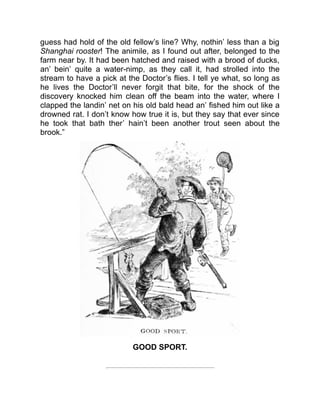
guess had hold of the old fellow’s line? Why, nothin’ less than a big
Shanghai rooster! The animile, as I found out after, belonged to the
farm near by. It had been hatched and raised with a brood of ducks,
an’ bein’ quite a water-nimp, as they call it, had strolled into the
stream to have a pick at the Doctor’s flies. I tell ye what, so long as
he lives the Doctor’ll never forgit that bite, for the shock of the
discovery knocked him clean off the beam into the water, where I
clapped the landin’ net on his old bald head an’ fished him out like a
drowned rat. I don’t know how true it is, but they say that ever since
he took that bath ther’ hain’t been another trout seen about the
brook.”
GOOD SPORT.
“Which puts me in mind of another fish story, in which I and an old
schoolmaster friend of mine are concerned,” said the Colonel, as
Hiram concluded. “Out trouting once we suddenly met on our way to
the brook a dog, which sneaked out from a patch of woods and
began to follow in a close trot at our heels. We were taken somewhat
by surprise at his appearance, because of the loneliness of the
country, for there was no house within miles of us, and we were
puzzled to think where he had come from. He looked the picture of
starvation. His skin was literally hanging on him, and the body was
so thin and sunken that we almost heard his ribs playing a bone
chorus as he jogged behind us. We fed him with a portion of our
lunch, which he devoured greedily. Finding himself favored, he
followed us to the trouting ground. Spying out a beautiful quiet brook
we sat down on the bank and cast our flies. The sport was
instantaneous, and for a while continued and exciting, during which
time the Professor had the good fortune to capture some half-dozen
trout, which equalled in weight and beauty anything I had ever seen.
When the luck was on the wane we reeled in our lines, and turned
about to gather together our ‘catch,’ which during the sport we had
thrown behind us on the grass. Suddenly the Professor gave a gasp.
‘Great heavens!’ he cried; ‘My half-dozen beauties! Where are they?’
We searched the bank, but they could not be found. ‘Is it possible
that any one is prowling about these parts and has crept behind us
and stolen them?’ he said. ‘I don’t think that likely,’ I replied. At the
same time my attention was attracted to an object lying at the base
of a tree. It was our dog—thin, starved and miserable-looking no
longer, but swelled out as fat as a potato-bag, and wagging his tail,
and smacking his jaws in heavenly transport. ‘Professor,’ said I;
‘look!’ ‘What! Another dog!’ gasped the Professor. ‘No, the same dog
with variations,’ I said, ‘thanks to the expansive properties of trout, a
little rosier in health.’ The Professor guessed the truth and gave a
groan. He danced about like a lunatic and kicked the dog until it
began to snap at his legs. Then with a heavy heart he packed his
traps and we left the animal at the tree enjoying its siesta. ‘Fate
could not harm him—he had dined that day.’”
Rare treats, these fish feasts. Rare tack, these fish stories. But,
reader, beware of bones.
CHAPTER III.
“But who can paint
Like Nature? Can imagination boast,
Amid it’s gay creation, hues like hers?”—Thomson.
IN ROUGH WATER.—NORTH TWIN STREAM.—AN
INDIAN PADDLE FOR FUTURE USE.—BREEZES,
BLANKETS, COLD AND ICE.—SPIDER LAKE.—
MANIFOLD CHARMS OF CAMP LIFE.—AT WORK WITH
THE TRAPS.—CONCERNING BEAVER.—WE
PROCLAIM OUR INTENTIONS.
Early on the morning of September 23d we
continued down Eagle Lake and through the
“Thoroughfare” to Churchill Lake. Then a change
came o’er the spirit of the weather. It grew suddenly
colder, and as our three canoes prowed into the
lake a sharp breeze sprang up which ruffled its
usually calm surface into a restless quiver. As the
breeze increased to a “blow” the waves were lashed into white caps,
and then into billows, until our fragile birch-barks were tossed about
like corks.
Each breaker seemed ready to engulf us; but we shipped little water,
for the inventive genius of the Colonel had devised a novel covering
for the bows of our canoes.
It consisted of a strip of white canvas extending aft about two feet,
which was stretched and secured to a brass hoop arched across the
canoe, and fastened with brass pins or pegs.
This made the bow of the canoe resemble the fore-part of an
immense Chinese shoe. All articles liable to damage by exposure
were thus secured from the spray of the waves and passing rain
showers. It proved a capital nook for the storage of the camera,
guns, ammunition, etc., and was quite a suggestion to Nichols, who
was an old canoe maker.
Our course lay through the Eastern arm of Churchill Lake, a distance
of only six miles, the larger body of these waters lying to the north,
and having for their outlet the Allaguash River.
At one o’clock we beached our canoes and erected our tents at the
mouth of North Twin Stream.
As we supped that night on broiled partridge and stewed duck, we
little dreamed of the hardships which lay to the eastward, between
us and the waters of the great Aroostook River.
Since leaving our camp on Mud Pond Stream, Nichols had been
hard at work at odd moments on a long paddle. From a rough maple
log-split, it had gradually been shaped into a thing of beauty, and
now with pride was being curiously ornamented with all the artistic
execution of which the Indian’s deft hand was capable.
“Me beat you, boys, when I get to the ‘Roostook,’” said Nichols, with
a sly twinkle of his eye, as from under his black felt hat he cast a
triumphant look at the other guides.
“But perhaps we shall never get there unless it rains,” said John.
“Me think so, too,” chimed in Hiram, trying to imitate in tone of voice
the Indian’s favorite expression.
“When the ‘Pioneers of the Aroostook’ pushed through this country
last season,” said the Colonel, glancing at me with an air of
superiority, “we experienced no difficulty in continuing our voyage
one mile above to Marsh Pond. On examination, since landing, I find
we shall be obliged to ‘carry’ around the obstructions, and it will
detain us a day.”
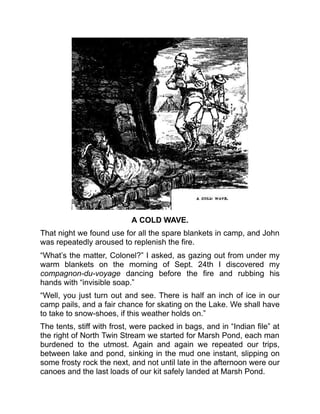
A COLD WAVE.
That night we found use for all the spare blankets in camp, and John
was repeatedly aroused to replenish the fire.
“What’s the matter, Colonel?” I asked, as gazing out from under my
warm blankets on the morning of Sept. 24th I discovered my
compagnon-du-voyage dancing before the fire and rubbing his
hands with “invisible soap.”
“Well, you just turn out and see. There is half an inch of ice in our
camp pails, and a fair chance for skating on the Lake. We shall have
to take to snow-shoes, if this weather holds on.”
The tents, stiff with frost, were packed in bags, and in “Indian file” at
the right of North Twin Stream we started for Marsh Pond, each man
burdened to the utmost. Again and again we repeated our trips,
between lake and pond, sinking in the mud one instant, slipping on
some frosty rock the next, and not until late in the afternoon were our
canoes and the last loads of our kit safely landed at Marsh Pond.
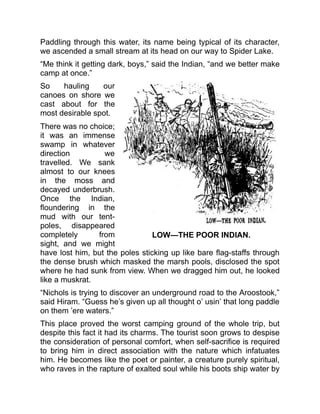
LOW—THE POOR INDIAN.
Paddling through this water, its name being typical of its character,
we ascended a small stream at its head on our way to Spider Lake.
“Me think it getting dark, boys,” said the Indian, “and we better make
camp at once.”
So hauling our
canoes on shore we
cast about for the
most desirable spot.
There was no choice;
it was an immense
swamp in whatever
direction we
travelled. We sank
almost to our knees
in the moss and
decayed underbrush.
Once the Indian,
floundering in the
mud with our tent-
poles, disappeared
completely from
sight, and we might
have lost him, but the poles sticking up like bare flag-staffs through
the dense brush which masked the marsh pools, disclosed the spot
where he had sunk from view. When we dragged him out, he looked
like a muskrat.
“Nichols is trying to discover an underground road to the Aroostook,”
said Hiram. “Guess he’s given up all thought o’ usin’ that long paddle
on them ’ere waters.”
This place proved the worst camping ground of the whole trip, but
despite this fact it had its charms. The tourist soon grows to despise
the consideration of personal comfort, when self-sacrifice is required
to bring him in direct association with the nature which infatuates
him. He becomes like the poet or painter, a creature purely spiritual,
who raves in the rapture of exalted soul while his boots ship water by
DEVELOPING A PLATE.
TREES PILED ON TREES.
the gallon, while scarcely a rag hangs
to his back, and low-dwindling
provisions place him on rations
intimate with starvation.
Thus it was with us. Our surroundings
were unpleasant, but apart from this,
as we saw them, interestingly
picturesque.
Here we were in the presence of a
great dead forest. Across the pools,
the rocks, and the brush growth lay
the trunks of monster trees prostrated
by the winds, storms, and decaying
processes of nature. Trees were piled
on trees in huge, insurmountable
barriers, each
one bearing on
the other with a
crushing force
that tore
through the
limbs and logs,
and pressed
the massive
pile down deep
into the soft
vegetation of
the marsh.
All was grey
and lifeless. It
seemed as if
nature had lain unresurrected since the Deluge, and that the trees
had twisted about and embraced each other in their dying agonies.
All was dead! dead! dead! The only sign of life upon them was the
deep moss that flourished on the decayed and weather-beaten
trunks; but this was like the grass above the grave.
The next day for lack of water we dragged our canoes through the
remainder of the river to Spider Lake, and camped on a high ledge of
rocks on the Southern shore, its dry and picturesque position being
in delightful contrast to our last quarters. This lake, three miles long
and half a mile wide, set among these forest depths like a jewel in a
ring, reflects ten mountain peaks on its surface.
On our way to camp we examined a point of rocks jutting far out into
the lake, whose curious construction attracted our attention. It was a
perpendicular pile of corrugated stone crowned with a tall growth of
spruce trees, which swept like Indian head-plumes to a hill-top
beyond.
The rocks at this time arose fifteen feet from the water, but their well-
worn sides indicated their covering in any but a dry season. At their
base we discovered deep, subterranean cavities, made by the action
of the water, and into these with curiosity we pushed our canoes
bent on a full investigation. Some were only slight excavations,
suggesting the dwelling-places of large trout, or the coverts of the fur
animals abounding in the vicinity, but there were others of
considerable space, into which we passed without difficulty. Within all
was gloomy and damp, and the motion of the water against the cold,
slimy walls made a strange phase of music which echoed mournfully
through the caverns. They seemed like the abodes of spirits; we
could scarcely repress a shudder at the weird effect of the scene.
Many times afterward did we recall with pleasure the delightful
experiences of our sojourn at Spider Lake. The charming comforts of
a dry and well-pitched camp, the exhilarating sport by the trout pools
among the rocks not twenty feet from the tent door, the partridge-
shooting in the woods, the ducking on the lake, the adventures of
exploration, and the grand scenic surroundings which we still admire
in the souvenirs afforded by photography, have made those too
fleeting hours “red-letter days” in our memory.
“You are not proposing to desert this lovely camp so soon?” I said to
the Colonel, as we stood in the tent door gazing out on the lake
TWILIGHT IN THE WILDS.
EVACUATION.
some
days
later. “It
seems a
pity after
spending
so much
labor
about the
camp to
leave at
once.”
“Well, we
cannot
tarry long;
we little
know
what is
before us if the water courses remain dry;
our birch canoes will not endure the strain
much longer,” was the Colonel’s reply. And
so we bade farewell to this charming spot.
At night we reached Logan Pond. Before our
tents were in position we were overtaken by
a drenching rain storm, which we fought
through with philosophical patience, hoping
it would increase the water along the route.
It takes true grit to endure without complaint
a rain-storm in the woods, and one must
have an abundance of cheerfulness to keep
from murmuring.
“You had better set those beaver traps to-
night,” said the Colonel to the Indian, as he
stood drying himself before the fire, and
turning about from one side to the other like a roasting turkey.
“Yes, me think so, too,” replied Nichols; and suiting the action to the
word, he soon started off down the hill with the iron traps over his
shoulder, I following him, bent upon investigating all the mysteries of
wood-craft.
“You see beaver house over there?” whispered the guide, as we
reached a mud dam at the outlet of the lake, at the same time
pointing out to me a cone-shaped knob of mud and sticks about ten
feet high and six feet in diameter. “One, two, three beaver live there,
and me set traps to catch one to-night. Beaver build house with door;
then build dam and raise water to cover door to house.”
Slipping into the woods the Indian soon returned with a cedar pole
ten feet in length and four inches in diameter at the butt. With his axe
he split this, and slipping over it the chain ring of the trap, secured it
in position by a wedge. The trap was then opened and lowered
carefully into the water, and after driving the pole into the mud, the
upper end was made fast with twisted grasses to a neighboring tree.
What was our joy on arising the next morning to see Nichols
returning from the pond lugging a fine beaver of over forty pounds’
weight, held in position on his shoulders by a withe of cedar bark
encircling his forehead.
“Me lost another beaver,” said the Indian, as he dropped the heavy
animal before the tent door for our examination, and wiped the
perspiration from his dusky forehead. “Beaver cut pole in pieces and
run with trap. Me hunt pond all over, but no find him;” and he
displayed as much sorrow over the loss as if it had been a small
fortune.
The fur of the animal was in excellent condition. He was three feet in
length, with tail 5 × 12 inches, half an inch in thickness, and covered
with black, shining scales of leather-like toughness.
“Is there any truth in the story, Nichols, that the beaver uses his tail
to build his dam?”
“No! no!” replied the guide, as laying the animal across his lap he
commenced to rob him of his “jacket.” “No beaver do that. He use tail
to make noise to other beavers. It slap on water, make sound like
pistol, and give alarm. Beaver push mud and stones from bed of
river with front feet to make dam, and when build house walk up
straight on hind feet, and hold to breast sticks and stones with front
feet. No one hunt beaver who tell such stories.”
The animal was soon dressed and stewed for our breakfast. Its taste
was similar to that of corn beef, but of a much more delicate flavor,
the liver being reserved as a choice dish for the next meal. The tail
was one mass of solid fat, which only the Indian, after toasting it
before the fire, could digest. The skin was stretched on a hoop four
feet in diameter laced with strips of cedar bark, a shingle of wood
being used in spreading the skin of the tail.
“Me no like this,” said the Indian, arising after the completion of his
work. “In my tribe, brave trap beaver; squaw dress him.”
“Which is a much superior way,” observed the Colonel. “Thus all the
world over the gallant brave saddles upon the poor woman the
undaintiful share of the work. A great pity, Nichols, that
circumstances in your life have abolished the custom, as far as you
are concerned.”
“Me think so; yes,” replied the Indian, with just the faintest idea of
what the Colonel meant; and as he turned to wash the grease and
blood from his warrior hands he looked the picture of dignity
dethroned.
After a few days tarry we pushed on across Logan Pond, made half
a mile carry to Beaver Pond, and camped on Osgood Carry at the
head of the last water.
“What do you find so interesting?” I inquired of the Colonel, as I saw
him examining minutely the side of an old tree not far from the tents.
“Oh! nothing special, except a record I made last year regarding the
‘Pioneers of the Aroostook,’ which the winter storms have failed to
obliterate.”
“Then, before we go, we had better leave some relic of this tour,” I
said.
Accordingly a photographic plate which had been spoiled by sudden
contact with the light was drawn from my Tourograph, and scratching
the names of the party on its surface, we nailed it to the tree for the
benefit of the next comer, adding as a suggestion of our destination
“On to the Aroostook!”
CHAPTER IV.
“The wise and active conquer difficulties
By daring to attempt them: sloth and folly
Shiver and shrink at sight of toil and hazard,
And make the impossibility they fear.”
OSGOOD CARRY.—THE PACK HORSE LEAGUE.—
NOVEL TRICK IN PEDESTRIANISM.—CAMP ON ECHO
LAKE.—HIRAM TELLS A STORY.—SLUICING A DAM.—
MORE CONCERNING BEAVER.—CAMP AT THE
MANSUNGUN LAKES.
Imagine the difficulties we surmounted in our passage
across Osgood Carry to Echo Lake.
With the exception of an occasional beaver, duck,
partridge, or string of trout captured on the way, we
were obliged to carry provisions sufficient for five men,
who never failed in their attendance at meals three
times a day, and with appetites which only wood life can stimulate.
Add to these provisions the weight of three tents, three blankets for
each man, rubber beds, personal baggage, cooking utensils, guns,
ammunition, rods, a Tourograph with seventy five glass plates, and
three canoes weighing from eighty-five to one hundred pounds each
and you have an idea of the toil and hardships of a tramp through
this wilderness.
This “Carry” is the water-shed of the St. John’s and Aroostook
Rivers, and passes over a succession of hills, through swamps, and
wind falls.
Although one trip across is but two miles, a return for a second load
makes four, and four trips carrying during half the time all one can
bear on his shoulders makes sixteen miles, a fair day’s tramp in a
country where not even a “spotted line” guides the traveler to his
destination.
At the time of our appearance there, the ground after the recent rain
was in a soft, soggy condition, which made the way slippery and
tedious.
As we pushed forward loaded down with our traps, frequently did a
misstep send one of our number “to grass,” and smother him among
the articles which constituted his burden. Our progress, as Hiram
observed, “was slower than cold molasses.”
For every step taken forward we slipped two backward, until the idea
was suggested to us of turning about and walking in the opposite
direction, that we might travel faster.
“Me fix your load for the ‘Carry,’” said Nichols to me, as I started off
with what I supposed I should be able to transport without halting; “I
show you how to fix pack.”
Stepping aside into the woods he cut from a cedar broad strips of
bark, and passing them about my chest outside of my arms,
fastened them to a roll of blankets on my back. On top of this he
mounted my Tourograph, and held it in place by another strap across
my forehead.
Like a horse being harnessed, I stood motionless, while he placed
my rifle on one shoulder, my shot gun on the other, and hung to them
an iron tea kettle, cups, and various other cooking utensils.
Everything ready, and having burdened himself with a much heavier
load arranged in like manner, we started off up the side of the
mountain in search of Echo Lake.
THE PACK HORSE LEAGUE.
It was hard work. Soon I was boiling with perspiration, and the Indian
puffing like a grampus. It seemed like a veritable “first of May” in the
wilderness.
Occasionally as a fallen log crossed our path we could relieve our
aching shoulders by resting the load thereon, but never for a
moment did we change its position.
Then on we would tramp, over rocks and through the mire, the
stillness of the woods unbroken save by the crackle of twigs beneath
our footsteps, or the occasional grunt of the Indian guide.
From early dawn until late at night, dividing our party at times into
sections, we labored with our baggage, transporting it but half the
distance, from whence it was forwarded by a second relay of guides
the remainder of the way, and landed in safety at our camp on Echo
Lake.
In this vicinity we discovered in the crotch of an aged tree an old
folding canvas canoe. This the Colonel, with a burst of delight,
AT NIGHT BY THE CAMP-FIRE.
recognized as one deserted by
the “Pioneers of the Aroostook”
in their excursion of the previous
year. Running short of provisions
they had been forced to abandon
it, and make for the settlements
as quickly as possible in their
other two.
That night about the camp-fire
the Colonel told us the story of
their privations, and how their
final meal consisted of nothing
but the boiled bone of a salt ham
seasoned with the last crumbs of
hard-tack.
This story suggested others of
the same kind, and many and
interesting were those retailing
the experiences of our guides. I
give the following, told by Hiram,
of the man who was the first to
make maps of Moosehead Lake and its vicinity. It gives an idea of
the rigors and danger incident to a journey through the woods of
Maine in the dead of winter, and may not be uninteresting:
“Ye never heerd me tell about the man who fust tried to make maps
o’ these ’ere woods, did ye?” said Hiram, as he tossed an extra log
upon the fire. “Wall, it’s a long story; but I’ll try an’ load the cart’idge
so the bullet won’t go far, as I see Nichols a-blinkin’ over there like
an’ owl at high meridian. It was ’long about the Autumn of 1870, if I
remember right, that a feller by the name o’ Way cum up from down
below an’ took board in Greenville, foot o’ Moosehead Lake. He was
quite a spruce lookin’ chap for these ’ere regions, an’ though still
under twenty-one years of age, had seen a deal o’ the world in his
little day. Wall, Johnny (that was his name,) had come to rough it, an’
take his chances for life with the rest of us, though it was said he’d
heaps o’ money, an’ mighty fine fixins’ at home; but he was one of
them advent’rous splinters as are allers flyin’ round a-wantin’ to see
more an’ more, an’ git into wuss an’ wuss every step they go. Us
boys was mighty busy that year a-loggin’, an he enj’yed the fust
winter so rattlin’ well among us that he cum back the next season.
When the snow got good an’ deep in Jan’wary, an’ snow-shoein’ was
just fine, we two arranged a huntin’ trip an’ started out with our rifles
an’ all the provishuns we could truss on our backs toward
Chamberlin Farm. We hunted about there some days, but finally
made a hand-sled, strapped our kit on to it, and by dint o’ pushin’
and haulin’ made our way over the fruz surface o’ Chamberlin and
Eagle Lakes to Smith Brook. Next day we pushed on to Haymoak
Brook an’ as it cum on to rain we built a hut of bark and camped.
“BY DINT O’ PUSHIN’ AN’ HAULIN’—”
“Johnny was a restless feller, an’ fur all tired out with the pull through
to camp, thought if we were goin’ to stay long and hunt we’d better
lay in more provishuns. He was a plucky little feller, too, an’ ’though
not much used to the woods, could foller a ‘spotted line’ with the best
o’ ye. So he made up his mind to switch back to Chamberlin Farm
an’ git enough provishuns to last out the trip. I thought this a rather
crazy freak, for I felt pretty sartin we could manage to pan out with
what we had. But Johnny wanted to be sure. Like all city fellers he
had a peevish bread-basket, an’ fur all he’d spirit enough to rough it
in other ways, he couldn’t weather the trial of goin’ without his
straight meal no-how. I did all I could do to hold him back, but it was
no use; then I offered to go back with him, but he was bent on doin’
the trip alone, an’ leavin’ me to rest in camp. So, after buryin’ his part
o’ the kit in the snow, he stood ready to start.
“He did’nt want to go back the same way we had come, but had
planned to skirt round back o’ the lakes, you know—a mighty
unsartin kind of bizness, boys, for a feller raised in a hot-house.
“But he plead so hard I finally give in to him, an’ with the point o’ my
ramrod I marked out his course in the wet snow. Says I, ‘You see
here, Johnny, that mark I jist made goes across Haymoak Lake to
Stink Pond. Now don’t you forgit it,’ says I, ‘to keep right on your
course to Fourth Lake, for that there line leads into Little Leadbetter
Pond, an’ by a foot-track, will take ye to Chamberlin Lake, an’ then
yer all hunk. There’s an old log camp on the Leadbetter, right there,’
says I, diggin’ the rod into the snow. ‘Don’t go further than that to-
night. Camp there, no matter how early ye reach it; lie over till
mornin’ an then push on.’
“It was the wuss snow shoein’ I ever did see, and I ought not to’ve let
the boy go, but I’d said yes, an’ I’m not one of them fellers who goes
back on his word.
“I buckled on Way’s haversack, filled it with graham bread, stuck his
hatchet in his belt, slung his rifle over his shoulder, and with many
misgivin’s saw him disappear in the woods. After he’d left I
commenced to get kind o’ nervus like, an’ wish I hadn’t let him go.
Afore night I begun to feel terrible skittish about him. I lit my pipe,
cleaned my gun, cut boughs and bark from the trees to make our
camp more snug, an’ tried by fussin’ round to git the lad out o’ my
mind; but ’twant no use—it didn’t work wuth a cent. So buryin’ the
balance of our kit in the snow I started back to Chamberlin Farm by
the old path and camped that night on Haymoak Lake, reaching the
farm the next night.
“You will bet boys I was scared to find that Way had not got in, but I
thought p’raps he was restin’ at the old log camp I had pinted out for
him on the Leadbetter. John the “toter” came along the next morning
“FOLLERIN HIS SLOAT—HALLOO!”
from the logging camp—don’t you think, he had’nt seen a hair of him
either. Wall, the way I got into them snow-shoes was a caution—the
deer’s hide was gathered over my toes and heels quicker than a
trout takes a fly, and I was a-slidin’ off into the woods like mad. I kept
goin’ and goin’ hour arter hour, as if the devil hisself was arter me; it
was the best time I ever made on snow-shoes, even on a moose
track.
“At 2 o’clock I reached Way’s camp of the night before, and follerin’
his ‘sloat’ (track) I kept on arter him and in two hours saw him
stumblin’ along through the snow in front o’ me like a lost sheep. I
give a shout of joy, and then a wild halloo, as I dashed on arter him.
But he plunged on without turnin’ a head—he did’nt seem to hear
me. I hailed him agin with no better effect, ‘Somethin’s up. He’s not
hisself by a long sight,’ I said to myself; an’ the way I put forrard
through that snow would have done honor to a pair o’ the seven
leagued boots. Jist as I come up with him, an’ was about plankin’ my
paw down on his shoulder, I heerd him give a gasp, an’ then he
stumbled an’ fell in a parfect heap at my feet.
“‘Johnny! Johnny!’ says I,
‘Brace up. Hiram’s here,
and yer all safe.’ But he
was so far gone, he skarce
knew me. To his belt was
tied a partridge; but this
was all the provishuns he
had left, an’ with his half
froze hands he could but
jist hang on to his rifle. I
took his gun an’
haversack, an’ goin’ before
broke down the big drifts
with my snow-shoes, an’
cleared a track for him to
foller. But he was so weak
an’ benumbed with cold,
Welcome to our website – the ideal destination for book lovers and
knowledge seekers. With a mission to inspire endlessly, we offer a
vast collection of books, ranging from classic literary works to
specialized publications, self-development books, and children's
literature. Each book is a new journey of discovery, expanding
knowledge and enriching the soul of the reade
Our website is not just a platform for buying books, but a bridge
connecting readers to the timeless values of culture and wisdom. With
an elegant, user-friendly interface and an intelligent search system,
we are committed to providing a quick and convenient shopping
experience. Additionally, our special promotions and home delivery
services ensure that you save time and fully enjoy the joy of reading.
Let us accompany you on the journey of exploring knowledge and
personal growth!
testbankfan.com


PSYCH 5th Edition Rathus Solutions Manual

  • 1.
    Visit https://testbankfan.com todownload the full version and explore more testbank or solution manual PSYCH 5th Edition Rathus Solutions Manual _____ Click the link below to download _____ https://testbankfan.com/product/psych-5th-edition- rathus-solutions-manual/ Explore and download more testbank at testbankfan.com
  • 2.
    Here are somesuggested products you might be interested in. Click the link to download PSYCH 5th Edition Rathus Test Bank https://testbankfan.com/product/psych-5th-edition-rathus-test-bank/ PSYCH 3rd Edition Rathus Test Bank https://testbankfan.com/product/psych-3rd-edition-rathus-test-bank/ Childhood Voyages in Development 5th Edition Rathus Solutions Manual https://testbankfan.com/product/childhood-voyages-in-development-5th- edition-rathus-solutions-manual/ Financial Accounting 6th Edition Weygandt Test Bank https://testbankfan.com/product/financial-accounting-6th-edition- weygandt-test-bank/
  • 3.
    Introduction to Brainand Behavior 5th Edition Kolb Test Bank https://testbankfan.com/product/introduction-to-brain-and- behavior-5th-edition-kolb-test-bank/ Essentials of Human Development A Life Span View 2nd Edition Kail Test Bank https://testbankfan.com/product/essentials-of-human-development-a- life-span-view-2nd-edition-kail-test-bank/ Concepts Of Genetics 10th Edition Klug Test Bank https://testbankfan.com/product/concepts-of-genetics-10th-edition- klug-test-bank/ Microeconomics 1st Edition Karlan Test Bank https://testbankfan.com/product/microeconomics-1st-edition-karlan- test-bank/ Molecular Biology of the Cell 6th Edition Bruce Alberts Test Bank https://testbankfan.com/product/molecular-biology-of-the-cell-6th- edition-bruce-alberts-test-bank/
  • 4.
    CB 8th EditionBabin Test Bank https://testbankfan.com/product/cb-8th-edition-babin-test-bank/
  • 5.
    1 Chapter 7: Thinking,Language, and Intelligence © 2018 Cengage Learning. All Rights Reserved. May not be scanned, copied or duplicated, or posted to a publicly accessible website, in whole or in part. Chapter 7 Thinking, Language, and Intelligence Lecture Outline Cognition is defined as the mental activity involved in understanding, processing, and communicating information. I. Thinking Thinking means paying attention to information, representing it mentally, reasoning about it, and making judgments and decisions about it. Thinking refers to conscious, planned attempts to make sense of and change the world. A. Concepts Concepts are mental categories used to group together objects, relations, events, abstractions, or qualities that have common properties. Thinking has to do with categorizing new concepts and manipulating relationships among concepts, as in problems in geometry. People tend to organize concepts in hierarchies. Prototypes are good examples. Simple prototypes, such as dog and red, are taught by means of examples, or exemplars. Dogs are positive instances of the dog concept. Negative instances—things that are not dogs—are then shown to the child while one says, “This is not a dog.” In language development, such over inclusion of instances in a category (reference to horses as dogs) is labeled overextension. B. Problem Solving Problem solving is an important aspect of thinking. C. Methods of Problem Solving Understanding the Problem Successful understanding of a problem generally requires three features: • The parts of one’s mental representation of the problem relate to one another in a meaningful way.
  • 6.
    2 Chapter 7: Thinking,Language, and Intelligence © 2018 Cengage Learning. All Rights Reserved. May not be scanned, copied or duplicated, or posted to a publicly accessible website, in whole or in part. • The elements of one’s mental representation of the problem correspond to the elements of the problem in the outer world. • People have a storehouse of background knowledge that they can apply to the problem. The Use of Algorithms An algorithm is a specific procedure for solving a type of problem. An algorithm invariably leads to the solution. If one was to use the systematic random search algorithm, one would list every possible letter combination, using from one to all five letters. The Use of Heuristic Devices The shortcuts are called heuristics, or heuristic devices—rules of thumb that help individuals simplify and solve problems. In contrast to algorithms, heuristics do not guarantee a correct solution. When they work, they permit more rapid solutions. One type of heuristic device is the means–end analysis, a heuristic device in which one tries to solve a problem by evaluating the difference between the current situation and the goal. The Use of Analogies An analogy is a partial similarity among things that are different in other ways. The analogy heuristic applies the solution of an earlier problem to the solution of a new one. D. Factors That Affect Problem Solving Expertise Experts solve problems more efficiently and rapidly than novices do. People who are experts at solving a certain kind of problem share the following characteristics (Bassok & Novick, 2012; Bunt et al., 2013): • They know the particular area well. • They have a good memory for the elements in the problems. • They form mental images or representations that facilitate problem solving. • They relate the problem to similar problems. • They are more goal-directed and have efficient methods for problem solving. Experts seemed to use parallel processing. That is, they dealt simultaneously with two or more elements of the problems. Novices were more likely to engage in serial processing—
  • 7.
    3 Chapter 7: Thinking,Language, and Intelligence © 2018 Cengage Learning. All Rights Reserved. May not be scanned, copied or duplicated, or posted to a publicly accessible website, in whole or in part. that is, to handle one element of the problem at a time. Mental Sets The tendency to respond to a new problem with the same approach that helped solve similar problems is termed a mental set. Mental sets usually make an individual’s work easier, but they can mislead him or her when the similarity between problems is illusory. Insight Insight, in Gestalt psychology, is a sudden perception of relationships among elements of the mentally represented elements of a problem that permits its solution. Incubation Incubation in problem solving refers to standing back from the problem for a while as some process within may continue to work on it. Later, the answer may come to one in a flash of insight. Standing back from the problem may help by distancing one from unprofitable but persistent mental sets (Gilhooly et al., 2013; Koppel & Storm, 2013). Functional Fixedness Functional fixedness is the tendency to think of an object in terms of its name or its familiar function. It can be similar to a mental set in that it makes it difficult to use familiar objects to solve problems in novel ways. E. Judgment and Decision Making People make most of their decisions on the basis of limited information. They take shortcuts. They use heuristic devices—rules of thumb—in judgments and decision making just as they do in problem solving (Mousavi & Gigerenzer, 2014). Heuristics in Decision Making • Representativeness heuristic—a decision-making heuristic in which people make judgments about samples according to the populations they appear to represent. • Availability heuristic—a decision-making heuristic in which the estimates of frequency or probability of events are based on how easy it is to find examples. • Anchoring and adjustment heuristic—a decision-making heuristic in which a presumption or first estimate serves as a cognitive anchor; as people receive
  • 8.
    4 Chapter 7: Thinking,Language, and Intelligence © 2018 Cengage Learning. All Rights Reserved. May not be scanned, copied or duplicated, or posted to a publicly accessible website, in whole or in part. additional information, they make adjustments but tend to remain in the proximity of the anchor. The Framing Effect The framing effect refers to the way in which wording, or the context in which information is presented, affects decision making (Takemura, 2014). Political groups, like advertisers, are aware of the framing effect and choose their words accordingly. Overconfidence Whether one’s decisions are correct or incorrect, most people tend to be overconfident about them. People tend to view their situations with 20/20 hindsight. There are several reasons for overconfidence, even when people’s judgments are wrong. • People tend to be unaware of how flimsy their assumptions may be. • People tend to focus on examples that confirm their judgments and ignore those that do not. • Because people’s working memories have limited space, they tend to forget information that runs counter to their judgments. • People work to bring about the events they believe in, so they sometimes become self-fulfilling prophecies. Handout Concept Chart
  • 9.
    5 Chapter 7: Thinking,Language, and Intelligence © 2018 Cengage Learning. All Rights Reserved. May not be scanned, copied or duplicated, or posted to a publicly accessible website, in whole or in part. II. Language A. Communication by Nonhumans The exclusive human claim to language has been brought into question by studies of communication with various animal species. A language is a system of symbols along with rules that are used to manipulate the symbols. Symbols such as words stand for or represent other objects, events, or ideas. Do Apes Really Use Language? A chimpanzee named Washoe, who was a pioneer in the effort to teach apes to use language, was using 181 signs by the age of 32 (King, 2008). One chimp, Kanzi, picked up language from observing another chimp being trained and has the grammatical abilities of a two-and-a-half-year-old child. Critics of the view that apes can learn to produce language, such as Herbert Terrace (Terrace & Metcalfe, 2005) and Steven Pinker (1994a, 2011), note that: • Apes can string together signs in a given sequence to earn rewards, but animals lower on the evolutionary ladder, such as pigeons, can also peck buttons in a certain sequence to obtain a reward. • It takes apes longer to learn new signs than it takes children to learn new words. • Apes are unreliable in their sequencing of signs, suggesting that by and large they do not comprehend rules of grammar. Thinking Problem Solving Concepts Judgment Decision Making
  • 10.
    6 Chapter 7: Thinking,Language, and Intelligence © 2018 Cengage Learning. All Rights Reserved. May not be scanned, copied or duplicated, or posted to a publicly accessible website, in whole or in part. • People observing apes signing may be subject to observer bias—that is, they may be seeing what they want to see. B. What Is Language? Language is the communication of thoughts and feelings by means of symbols that are arranged according to rules of grammar. By these rigorous rules, only humans use language. Language makes it possible for one person to communicate knowledge to another and for one generation to communicate to another. It creates a vehicle for recording experiences. It allows people to put themselves in the shoes of other people, to learn more than what they could learn from direct experience. Language also provides many units of thinking. True language is distinguished from the communication systems of lower animals by properties such as semanticity, infinite creativity, and displacement (Hoff, 2005): • Semanticity—the sounds (or signs) of a language have meaning. • Infinite creativity—the capacity to create rather than imitate sentences. • Displacement—the capacity to communicate information about events and objects in another time or place. C. Language and Cognition Jean Piaget (Inhelder & Piaget, 1958) believed that language reflects knowledge of the world but that much knowledge can be acquired without language. For example, it is possible to understand the concepts of roundness or redness even when people don’t know or use the words round or red. D. Language and Culture Different languages have different words for the same concepts, and concepts do not necessarily overlap. The Linguistic-Relativity Hypothesis The linguistic-relativity hypothesis is the view that language structures the way people view the world. In English, there are hundreds of words to describe colors. Shona-speaking people use only three words for colors, and Bassa speakers use only two corresponding to light and dark. Most cognitive scientists no longer accept the linguistic-relativity hypothesis (Pinker, 2007, 2013). Adults use images and abstract logical propositions, as well as words, as units of thought. Infants, moreover, display considerable intelligence before they have learned to speak.
  • 11.
    7 Chapter 7: Thinking,Language, and Intelligence © 2018 Cengage Learning. All Rights Reserved. May not be scanned, copied or duplicated, or posted to a publicly accessible website, in whole or in part. III. Language Development: The Two-Year Explosion Languages around the world develop in a specific sequence of steps, beginning with the prelinguistic vocalizations of crying, cooing, and babbling. These sounds are not symbols. That is, they do not represent objects or events. A. Prelinguistic Vocalizations As parents are well aware, newborn children have one inborn, highly effective form of verbal expression: crying—and more crying. Babbling, like crying and cooing, is inborn and prelinguistic. Children tend to utter their first word at 11 to 13 months, but a range of 8 to 18 months is normal (McCardle et al., 2009; Tamis-LeMonda et al., 2014). By about 18 months, children are producing a couple of dozen words. B. Development of Grammar Holophrase refers to a single word used to express complex meanings. Most children show their parents what they intend by augmenting their holophrases with gestures and intonations. Toward the end of the second year, children begin to speak two-word sentences. These sentences are termed telegraphic speech because they resemble telegrams. There are different kinds of two-word utterances. Some contain nouns or pronouns and verbs (“Daddy sit”). Others contain verbs and objects (“Hit ball”). Overregularization Overregularization is an important development for understanding the roles of nature and nurture in language development (Ambridge et al., 2013; Pinker, 2013). They become aware of the grammatical rules for forming the past tense and plurals. The tendency to regularize the irregular is what is meant by overregularization. Other Developments By the age of six, children’s vocabularies have expanded to 10,000 words, give or take a few thousand. By seven to nine, most children realize that words can have more than one meaning, and they are entertained by riddles and jokes that require some sophistication with language. C. Nature and Nurture in Language Development Language development, like many other areas of development, apparently reflects the
  • 12.
    8 Chapter 7: Thinking,Language, and Intelligence © 2018 Cengage Learning. All Rights Reserved. May not be scanned, copied or duplicated, or posted to a publicly accessible website, in whole or in part. interactions between nature and nurture. Learning Theory and Language Development Learning theorists see language as developing according to laws of learning (Hoff, 2005). They usually refer to the concepts of imitation and reinforcement. From a social–cognitive perspective, parents serve as models. Children learn language, at least in part, through observation and imitation. Learning theory cannot account for the unchanging sequence of language development and the spurts in children’s language acquisition. The Nativist Approach to Language Development The nativist theory of language development holds that the innate factors—which make up children’s nature—cause children to attend to and acquire language in certain ways. According to psycholinguistic theory, language acquisition involves the interaction of environmental influences—such as exposure to parental speech and reinforcement—and the inborn tendency to acquire language. Noam Chomsky (see Cherniak, 2009) refers to the inborn tendency as a language acquisition device (LAD). Evidence for an LAD is found in the universality of human language abilities and in the specific sequence of language development (Cherniak, 2009; A. Clark & Lappin, 2013). IV. Theories of Intelligence The concept of intelligence is closely related to thinking. Intelligence is the underlying ability to understand the world and cope with its challenges (Strenze, 2015). Although intelligence, like thinking, cannot be directly seen or touched, psychologists tie the concept to achievements such as school performance and occupational status (Nisbett, 2013). A. Factor Theories Factor theories argue that intelligence is made up of a number of mental abilities, ranging from one kind of ability to hundreds. In 1904, British psychologist Charles Spearman suggested that the behaviors people consider intelligent have a common underlying factor that he labeled g, for “general intelligence” or broad reasoning and problem-solving abilities. He also noted that even the most capable people are relatively superior in some areas. For this reason, he suggested that specific, or s factors account for specific abilities. American psychologist Louis Thurstone (1938) analyzed tests of specific abilities and concluded that Spearman had oversimplified intelligence. Thurstone’s data suggested the presence of eight specific factors, which he labeled primary mental abilities:
  • 13.
    9 Chapter 7: Thinking,Language, and Intelligence © 2018 Cengage Learning. All Rights Reserved. May not be scanned, copied or duplicated, or posted to a publicly accessible website, in whole or in part. • Visual and spatial abilities • Perceptual speed • Numerical ability • Verbal meaning • Memory • Word fluency • Deductive reasoning • Inductive reasoning Handout
  • 14.
    10 Chapter 7: Thinking,Language, and Intelligence © 2018 Cengage Learning. All Rights Reserved. May not be scanned, copied or duplicated, or posted to a publicly accessible website, in whole or in part. B. The Theory of Multiple Intelligences
  • 15.
    11 Chapter 7: Thinking,Language, and Intelligence © 2018 Cengage Learning. All Rights Reserved. May not be scanned, copied or duplicated, or posted to a publicly accessible website, in whole or in part. Thurstone wrote about various factors or components of intelligence. Howard Gardner’s (1983/1993, 2009) theory of multiple intelligences proposes, instead, that there are a number of intelligences, not just one. Gardner refers to each kind of intelligence in his theory as “an intelligence” because they can differ so much. Two of these “intelligences” are familiar ones: language ability and logical–mathematical ability. Gardner also refers, however, to bodily– kinesthetic talents (of the sort shown by dancers and athletes), musical talent, spatial–relations skills, and two kinds of personal intelligence: awareness of one’s own inner feelings and sensitivity to other people’s feelings. Gardner (2001) more recently added “naturalist intelligence” and “existential intelligence.” Critics of Gardner’s view agree that people function more intelligently in some aspects of life than in others. But these critics question whether such talents are best thought of as “intelligences” or special talents (Neisser et al., 1996). Language skills, reasoning ability, and ability to solve math problems seem to be more closely related than musical or gymnastic talent to what most people mean by intelligence. C. The Triarchic Theory of Intelligence Psychologist Robert Sternberg (2000; 2006) has constructed a three-pronged or triarchic theory of intelligence that includes analytical, creative, and practical intelligence. • Analytical intelligence can be defined as academic ability. • Creative intelligence is defined by the ability to cope with novel situations and generate many possible solutions to problems. • Practical intelligence (“street smarts”) enables people to deal with other people, including difficult people, and to meet the demands of their environment. Handout
  • 16.
    12 Chapter 7: Thinking,Language, and Intelligence © 2018 Cengage Learning. All Rights Reserved. May not be scanned, copied or duplicated, or posted to a publicly accessible website, in whole or in part. D. Emotional Intelligence and Social Intelligence
  • 17.
    13 Chapter 7: Thinking,Language, and Intelligence © 2018 Cengage Learning. All Rights Reserved. May not be scanned, copied or duplicated, or posted to a publicly accessible website, in whole or in part. Psychologists Peter Salovey and John Mayer developed the theory of emotional intelligence, which holds that social and emotional skills are a form of intelligence, just as academic skills are (Boyatzis et al., 2015; Stein & Deonarine, 2015). Emotional intelligence resembles two of Gardner’s “intelligences”—intrapersonal skills and interpersonal skills. Failure to develop emotional intelligence is connected with poor ability to cope with stress, depression, and aggressive behavior (Brackett et al., 2011). E. Creativity and Intelligence Creativity is the ability to generate novel and useful solutions to problems. Creative people share a number of qualities (Plucker et al., 2015): they take chances. They refuse to accept limitations. They appreciate art and music. They use common materials to make unique things. They challenge social norms and take unpopular stands. They challenge ideas that other people accept at face value. • In convergent thinking, thought is limited to present facts; the problem solver narrows his or her thinking to find the best solution. • In divergent thinking, the problem solver associates freely to the elements of the problem, allowing “leads” to run a nearly limitless course. Problem solving can involve both kinds of thinking. At first, divergent thinking helps generate many possible solutions. Convergent thinking is then used to select likely solutions and reject others. V. The Measurement of Intelligence A. The Stanford–Binet Intelligence Scale Early in the 20th century, the French public school system was looking for a test that could identify children who were unlikely to benefit from regular classroom instruction. The first version of that test, the Binet–Simon scale, came into use in 1905. The Binet–Simon scale yielded a score called a mental age (MA). The MA shows the intellectual level at which a child is functioning. Louis Terman adapted the Binet–Simon scale for use with American children at Stanford University. The first version of the resultant Stanford–Binet Intelligence Scale was published in 1916. The SBIS included more items than the original test and was used with children aged 2 to 16. The SBIS also yielded an intelligence quotient (IQ) rather than an MA. The IQ reflects the relationship between a child’s mental age and his or her actual chronological age (CA).
  • 18.
    14 Chapter 7: Thinking,Language, and Intelligence © 2018 Cengage Learning. All Rights Reserved. May not be scanned, copied or duplicated, or posted to a publicly accessible website, in whole or in part. IQ = mental age (MA)/chronological age (CA) X 100. IQ scores on the SBIS today are derived by comparing results to those of other people of the same age. B. The Wechsler Scales In contrast to the SBIS, David Wechsler developed a series of scales for use with children and adults. The Wechsler scales group test questions into a number of separate subtests. Each subtest measures a different intellectual task. Wechsler described some of his scales as measuring verbal tasks and others as assessing performance tasks. Verbal subtests require knowledge of verbal concepts, whereas performance subtests require familiarity with spatial- relations concepts. Wechsler also introduced the concept of the deviation IQ. He based IQ scores on how a person’s answers compared with those attained by people in the same age group. The average test result at any age level is defined as an IQ score of 100. Wechsler distributed IQ scores so that the middle 50% were defined as the “broad average range” of 90 to 110. Only 4% of the population have IQ scores of above 130 or below 70. C. Group Tests Group tests for children were first developed during World War I. At first these tests were hailed as remarkable instruments because they helped school administrators place children. As the years passed, however, group tests came under attack because many administrators relied on them exclusively and did not seek other sources of information about children’s abilities. Numbers alone, and especially IQ scores, cannot adequately define children’s special abilities and talents. D. The Reliability and Validity of Intelligence Tests Over the years, the SBIS and the Wechsler scales have been shown to be reliable and valid. In terms of reliability, the scores are rather consistent from testing to testing. This kind of reliability is called test–retest reliability. E. Differences in Intellectual Functioning The average IQ score in the United States is very close to 100. Socioeconomic and Ethnic Differences Lower-class U.S. children obtain IQ scores some 10 to 15 points lower than those obtained
  • 19.
    15 Chapter 7: Thinking,Language, and Intelligence © 2018 Cengage Learning. All Rights Reserved. May not be scanned, copied or duplicated, or posted to a publicly accessible website, in whole or in part. by middle- or upper-class children. African American children tend to obtain IQ scores some 15 points lower than those obtained by their European American age-mates (Nisbett et al., 2012; Saklofske et al., 2015). Latin American and Native American children also tend to score below the norms for European Americans. There may also be intellectual differences between Asians and Caucasians. Asian Americans, for example, frequently outscore European Americans on the math portion of the Scholastic Aptitude Test. Most psychologists believe that such ethnic differences reflect cultural attitudes toward education rather than inborn racial differences (Nisbett at al., 2012). Gender Differences Girls are somewhat superior to boys in verbal abilities, such as vocabulary, ability to generate sentences and words that are similar in meaning to other words, spelling, knowledge of foreign languages, and pronunciation (Andreano & Cahill, 2009; Lohman & Lakin, 2009). Males seem to do somewhat better at manipulating visual images in working memory. For half a century or more, it has been believed that male adolescents generally outperform females in mathematics, and research has tended to support that belief (Else- Quest et al., 2013; Miller & Halpern, 2014). The reported gender differences are group differences. There is greater variation in these skills between individuals within the groups than between males and females (Miller & Halpern, 2014). VI. Nature and Nurture in Intelligence A. Genetic Influences on Intelligence Research on genetic influences has employed kinship studies, twin studies, and adoptee studies. The IQ scores of identical (monozygotic, or MZ) twins are more alike than scores for any other pairs, even when the twins have been reared apart. In sum, studies generally suggest that the heritability of intelligence is between 40% and 60% (Neisser et al., 1996; Plomin et al., 2013). Several studies with one- and two-year-old children in Colorado (Baker et al., 1983), Texas (Horn, 1983), and Minnesota (Scarr & Weinberg, 1983) have found a stronger relationship between the IQ scores of adopted children and those of their biological parents than between the children’s scores and those of their adoptive parents. B. Environmental Influences on Intelligence The Home Environment Children of parents who are emotionally and verbally responsive, furnish appropriate play materials, are involved with their children, encourage independence, and provide varied
  • 20.
    16 Chapter 7: Thinking,Language, and Intelligence © 2018 Cengage Learning. All Rights Reserved. May not be scanned, copied or duplicated, or posted to a publicly accessible website, in whole or in part. daily experiences obtain higher IQ scores later on (Bradley, 2006). Organization and safety in the home have also been linked to higher IQs and achievement test scores (Bradley et al., 1989; Petrill et al., 2010). Education Although intelligence is viewed as permitting people to profit from education, education also apparently contributes to intelligence. Head Start programs, for example, enhance IQ scores, achievement test scores, and academic skills of disadvantaged children (Bierman et al., 2008) by exposing them to materials and activities that middle-class children take for granted. Children who have been in school longer obtain higher IQ scores (Neisser et al., 1996). Test scores tend to decrease during the summer vacation (Neisser et al., 1996). The Flynn Effect Philosopher and researcher John Flynn (2003) found that IQ scores in the Western world increased substantially between 1947 and 2002, some 18 points in the United States. Psychologist Richard Nisbett (2009) argues that people’s genetic codes could not possibly have changed enough in half a century to account for this enormous difference and concludes that social and cultural factors such as the effects of improved educational systems and the penetration of the mass media must be among the reasons for the change. Lecture Topics I. Thinking Lecture Topic 1: Heuristic Judgment Theory The use of heuristics is common among people. This problem-solving strategy works well but can lead to errors in judgment. The topic of heuristics can be a fun discussion as students begin to relate to the errors that are made in daily judgments. To help students understand a new theory of heuristic judgment, access the article titled “Heuristic Judgment Theory” written by Harvey (1998). The article discusses the importance of heuristics in human decision making, proposes a decision-making process, and discusses the psychology of decision making. Lecture Topic 2: Decision Making An interesting article titled “Problems for Judgment and Decision Making” written by Hastie (2001) can be discussed. It explores the area of judgment and decision making in cognitive psychology. The author attempts to review recent developments in the field of judgment and
  • 21.
    17 Chapter 7: Thinking,Language, and Intelligence © 2018 Cengage Learning. All Rights Reserved. May not be scanned, copied or duplicated, or posted to a publicly accessible website, in whole or in part. decision making and also discusses what makes a good research problem in this area. Finally, the author suggests 16 problems that could be considered for judgment and decision-making research. This information can help students see the contemporary thought in this area. Lecture Topic 3: ‘Like Me’: A Foundation for Social Cognition Infants try to understand their own perception (of actions) by comparing it with others. In other words, they begin to recognize that their own self is a lot like others with relation to perceptions and emotions. This “like me” perception of others is an infant’s first steps toward social cognition. To help students understand this area of research, access the article titled “‘Like Me’: A Foundation for Social Cognition” written by Andrew N. Meltzoff (2007). This article will provide information for students by illustrating an expanded view of cognition. II. Language Lecture Topic 1: Language and Nature To help students understand the argument made by Chomsky and others about language being more natural, access the article titled “Language and Nature” written by Chomsky (1995). In this article, Chomsky suggests that the mind and brain need be thought of as natural processes and should be studied that way. As language is a part of the brain, language should also be studied and understood through naturalistic principles. Lecture Topic 2: Culture, Language, and Color For an interesting discussion that instructors can have with students about how language development can actually alter perceptions, access the article titled “A Study of Colour Grouping in Three Languages: A Test of the Linguistic Relativity Hypothesis” written by Davies (1998). This article discusses a research project where individuals who speak different languages were asked to group color tiles. The results indicate that grouping differences were seen between those who speak different languages. A possible explanation presented by the authors is that language development may impact perceptions. Lecture Topic 3: Childcare and Language Development This lecture topic will give instructors an opportunity to discuss various environmental factors that contribute to language and cognitive development. A study was conducted with children from ten sites in the United States to determine the factors that contribute to language and cognitive development. The main independent variables explored in the study were daycare and family environments. Instructors can access this article titled “The Relation of Child Care to
  • 22.
    18 Chapter 7: Thinking,Language, and Intelligence © 2018 Cengage Learning. All Rights Reserved. May not be scanned, copied or duplicated, or posted to a publicly accessible website, in whole or in part. Cognitive and Language Development” written for Child Development (2000). This article discusses such topics as quality, type, and amount of care and how these variables relate to development. One result from the article is that at age three, children in daycare centers performed better than children in other types of care. Lecture Topic 4: Translating between Languages: English and Japanese The process of how bilinguals maintain two languages has intrigued cognitive psychologists attempting to determine the processes of translation. Two hypotheses are at the forefront: (1) “word association,” where the word is directly translated with the corresponding word in the second language; and (2) concept mediation hypothesis, which suggests that semantic memory plays a role. To help students understand these two hypotheses, access the article titled “The Process of Translation between English Words and Japanese Words” written by Ikeda (1998). This article describes a research study exploring which hypothesis might be correct and suggests that word association has more support. III. Intelligence Lecture Topic 1: Race and Intelligence An interesting topic to share with students is that of race and intelligence. It is perhaps this area that is more controversial than any other in the field of psychology. An article titled “Race and Intelligence: Separating Science from Myth” written by Reeve (2002) is a book review that focuses on this issue. Topics covered in the book (which would also make excellent topics for discussion in class) include the following: (a) race exists only as a socially defined category, (b) racial categories are developed for the purpose of justifying and perpetuating social inequalities, (c) the merits of intelligence testing, (d) the misuse of statistical concepts, and (e) alternative interpretations of the bell curve. Lecture Topic 2: Sex Differences in Intelligence A topic that can lead to an interesting class discussion is that of sex differences and intelligence. The correlation between brain size and intelligence has been established, and, just over a decade ago, it was determined that males have larger brains compared to females, even when making adjustments for body size. Thus, it could be concluded that males should be more intelligent. Yet, research utilizing large samples does not support males being more intelligent in the traditional categories of fluid and crystallized intelligence. In an article titled “Sex Differences in Intelligence and Brain Size: A Developmental Theory” written by Lynn (1999), this topic is discussed. The author presents his own explanations, and he reviews the explanations of others.
  • 23.
    19 Chapter 7: Thinking,Language, and Intelligence © 2018 Cengage Learning. All Rights Reserved. May not be scanned, copied or duplicated, or posted to a publicly accessible website, in whole or in part. Lecture Topic 3: Music and Intelligence For an interesting study regarding the relationship between music and intelligence, access the article titled “Music for Your Brain” written by Knox (1994). This article describes what the authors call the Mozart Effect, which suggests that listening to classical music (specifically Mozart) can increase ability in spatial reasoning tasks. Though the effect may be short-lived, the conclusion of the research is interesting. IV. Nature and Nurture in Intelligence Lecture Topic 1: The Evolution of Human Intelligence To help students better understand the evolutionary nature of intelligence, access the article titled “The Evolution of Human Intelligence” written by Clamp (2001). This article discusses how intelligence has evolved over time and allowed humans to adapt. The costs that are seen in this process are discussed, as well as two specific theoretical perspectives explaining why it makes sense to take this perspective (ecological theory and social theory). This information can help students see the value in such a perspective. Lecture Topic 2: Giftedness: Infancy to Adolescence To help students better understand the developmental nature of giftedness, access the article titled “Giftedness: Infancy to Adolescence—A Developmental Perspective” written by Dalzell (1998). This in-depth article discusses historical perspectives of giftedness and then transitions into modern approaches. The authors suggest that gifted children differ from their peers of the same age in such ways as motivation, independence, and introversion. This article contains interesting information that will assist students in their understanding of giftedness. Lecture Topic 3: What Is Intelligence? In a slightly different approach to understanding where intelligence comes from, access the article titled “Human Abilities” written by Sternberg and Kaufman (1998). This article explores definitions of intelligence, which include cognitive, biological, psychometric, and traditional approaches. Presenting these approaches to students can help them see that the concept of intelligence may just come from the theory rather than the theory attempting to explain the construct of intelligence.
  • 24.
    20 Chapter 7: Thinking,Language, and Intelligence © 2018 Cengage Learning. All Rights Reserved. May not be scanned, copied or duplicated, or posted to a publicly accessible website, in whole or in part. Classroom Demonstrations I. Thinking Classroom Demonstration 1: Framing Effect To help students understand the power of framing, access the article titled “Influence of Elaboration on the Framing of Decision” written by Takemura (1994). This article provides an example of the framing effect, which can be used in class to describe an unusual disease expected to kill 600 people. Instructors may want to create an overhead of the framing example. Two alternatives are presented between which students need to choose. One option is positively framed, and one is negatively framed. After presenting the scenario to the students, have them write down which option they would choose. This demonstration will help students understand framing. Classroom Demonstration 2: Why Overconfidence Occurs and How to Overcome it For this demonstration, instructors would have to create a survey on a similar topic where students are sure to make overtly confident guesses about a particular outcome (e.g., a sports event, a court verdict, or the winner of local elections etc.). The article titled “Why Overconfidence Occurs and How to Overcome It” written by Winston Sieck (2016) offers an interesting example of overconfidence. This article discusses a research study that college students used to demonstrate overconfidence about financial knowledge. They chose finance as a topic because major decisions in life are made using financial management. A replication of this study can help students understand this phenomenon. To demonstrate how overconfidence truly works, have students complete a similar survey that tests their overconfidence. The collected data will help demonstrate the concept of overconfidence. Classroom Demonstration 3: Research on Cognition John Krantz of Hanover College provides a number of cognitive experiments on his website, http://psych.hanover.edu/JavaTest/CLE/Cognition/Cognition.html. Studies include research on automaticity, attention, and decision making. Choose one or more of the experiments, and then simply demonstrate to the class how a person would participate in the study, or (if the instructor has the time) have some students participate in the study and investigate the results as a class. Classroom Demonstration 4: Cognitive Demonstrations Visit the website http://www.gocognitive.net/demos, which offers a number of free
  • 25.
    21 Chapter 7: Thinking,Language, and Intelligence © 2018 Cengage Learning. All Rights Reserved. May not be scanned, copied or duplicated, or posted to a publicly accessible website, in whole or in part. demonstrations on cognitive psychology and cognitive neuroscience. Instructors can choose from these demonstrations and share them with their class. II. Language Classroom Demonstration 1: That’s Not What He Meant One way to get students engaged in the study of language is to present them with a variety of (humorous) ambiguous sentences. Reisberg (2010) offers a number of them, drawn from actual newspaper headlines. Reading these aloud to the class can be a good icebreaker to begin the discussion of language and also underscores how important language rules are for correct comprehension. Classroom Demonstration 2: Research on Language Langston (1998) suggests a number of demonstrations of how research is conducted in the field of psycholinguistics. Instructors can read the article and choose demonstrations that they think would be the most informative and interesting for their class. Classroom Demonstration 3: Bilingualism For this demonstration, have a student (or more than one, if there are more bilingual students) demonstrate his or her ability in the languages he or she has learned. Ask this person to talk about when the languages were learned and how this education has been a benefit. Then present an article titled “Banishing Bilingualism” written by Katz and Kohl (2002). This article discusses attempts to remove bilingualism from education and how some states have advanced with this. This topic can lead to a lively debate with students for bilingualism or English only. III. Intelligence Classroom Demonstration 1: Prodigies Grow Up For this demonstration, share with the class the three case studies listed in an article titled “Prodigies Grow Up: College at Age 11, Chess at 6. Now Adults, Five Former Superkids Look Back” written by Jerome, Cheakalos, and Horsburgh (2003). This article describes five child prodigies who are now adults. They look back and describe their lives and the special talents that they have. This demonstration will provide an illustration of highly intelligent individuals. Classroom Demonstration 2: One-Minute Intelligence Test
  • 26.
    22 Chapter 7: Thinking,Language, and Intelligence © 2018 Cengage Learning. All Rights Reserved. May not be scanned, copied or duplicated, or posted to a publicly accessible website, in whole or in part. Instructors will need to recreate Figures 1 and 2 from the article mentioned below. Copying and enlarging the figures should work. Then, instructors shall create overheads from the enlargements. For this project, instructors will introduce a type of intelligence test to their students. Though not technically an intelligence test, it can be used to introduce the topic of intelligence testing and lead to a discussion on reliability and validity. The tests are actually brainteasers often called rebus puzzles. These “intelligence tests” can be found in an article titled “A One-Minute ‘Intelligence’ Test” written by Griggs (2000). This article found in the Teaching of Psychology journal presents the two tests, directions on how to administer the tests, and the answers. An example of one of the items is DEATH/LIFE with the keyed response “life after death.” Classroom Demonstration 3: Artificial Intelligence Is intelligence a characteristically human feature or could nonhuman—and even inanimate— entities one day possess intelligence too? To get students talking about the possibility of artificial intelligence, introduce them to the ELIZA website, an example of artificial intelligence: http://www-ai.ijs.si/eliza/eliza.html. Have students volunteer to ask ELIZA questions. In what cases does ELIZA work well, and where does she fall short? Why is it difficult to replicate human intelligence in a machine? Do students think true artificial intelligence will ever be possible? Why, or why not? Classroom Demonstration 4: The Flynn Effect The “Flynn Effect” takes its name after John Flynn, who proposed that there is a noticeable increase in standardized test scores of individuals from the 1930s to the year 2000. To engage students in a debate, have them access the article titled “The Flynn Effect: A Meta-analysis” written by Fletcher, Hiscock, Stuebing, and Trahan (2014). Have students think about concepts such as intellectual disability and special education and how the Flynn effect factors in these criteria. Have students consider environmental factors, technological advances, and other factors that might have played a role in the increase of IQ tests over the years. Ask students to read this article and then write a two-page response paper summarizing what they learned. IV. Nature and Nurture in Intelligence Classroom Demonstration 1: Intelligence Video Show students a video from the Discovering Psychology series titled #16: Testing and Intelligence. The video includes interviews with Robert Sternberg and Howard Gardner. It is available streaming for free from the Annenberg Foundation at
  • 27.
    23 Chapter 7: Thinking,Language, and Intelligence © 2018 Cengage Learning. All Rights Reserved. May not be scanned, copied or duplicated, or posted to a publicly accessible website, in whole or in part. http://www.learner.org/resources/series138.html. Classroom Demonstration 2: Intelligence Meter In class, explain that a fictional intelligence meter has been developed that will measure an infant’s intellectual potential. This meter is so modern that testing is no longer necessary; instead, the child is passed through what appears to be an airport metal detector, and a measurement is taken. In this fictional scenario, two children have been measured: “Child A” and “Child B.” On the day of their birth, both children are measured for intelligence, and both are shown to have a potential IQ score of exactly 100, which is at the 50th percentile in the normal bell curve and considered to be average. Child A and Child B are from different families and different environments. The parents of Child A want the best for all of their children, but neither parent is well educated. They lack parenting skills, and both have to work extremely long hours in order to make ends meet. The parents of Child B are just the opposite. Child B is able to attend museums and visit zoos, and he or she has a strong vocabulary because of books and reading. Each child, due to circumstances, experiences his or her world differently. Years later, both children sit next to each other in a classroom and take an intelligence test. Ask the class if it seems reasonable that the enriched environment that has been provided for Child B would be worth 15 more points on an IQ test. Next, ask if it also seems reasonable that there could be a loss of 15 points in Child A’s score due to the less nurturing environment. After the response from students, illustrate for them the normal bell curve, and place Child B at the first standard deviation (84th percentile) and Child A at the standard deviation below the mean (16th percentile). Child A is headed toward remedial education, and Child B is close to being gifted. Solicit from students their reaction to this scenario. Classroom Demonstration 3: Intelligence Live! The Society of the Teaching of Psychology offers a free e-book with ideas for classroom activities at http://teachpsych.org/ebooks/pse2011/vol2/index.php. Scroll down to find the chapter on intelligence by Amber Esping and Jonathan Plucker. They offer a number of ideas for classroom demonstrations that instructors may want to share with their class.
  • 28.
    24 Chapter 7: Thinking,Language, and Intelligence © 2018 Cengage Learning. All Rights Reserved. May not be scanned, copied or duplicated, or posted to a publicly accessible website, in whole or in part. Student Projects and Activities I. Thinking Student Project 1: Individual Differences in Problem Solving Insight refers to the solution to a problem that seems to be non-obvious and functional. For this project, students will explore the phenomenon of insight. Students can access the article titled “Cognitive Abilities Involved in Insight Problem Solving: An Individual Differences Model” written by DeYoung, Flanders, and Peterson (2008). After reading this article, students will write a one-page response paper defining insight. Student Project 2: Neural Basis of Cognition For the project, students will explore a website created to report findings from research in the area of the neural basis of cognition: http://www.cnbc.cmu.edu. This website is the research page for the Center for the Neural Basis of Cognition. Students shall explore it and write a one-page summary of what they learned. Student Project 3: Genes to Cognition Explore the website for Genes to Cognition: http://www.g2conline.org/. This organization focuses on cognitive disorders, cognitive processes, and research approaches. Have students write a two-page paper discussing the areas of the site that they found to be more informative and interesting, and why they found them to be so. Students should also answer these two questions. Is there further information that they’d like to see Genes to Cognition add to its site? If so, what? Journal Prompt 1: Divergent Thinking For this journal entry, ask students to think back over their life experience and find a time when they used divergent thinking by overcoming functional fixedness. Divergent thinking is illustrated when one uses some object for a purpose other than what it was intended. Were they creative when they overcame functional fixedness? Journal Prompt 2: Faulty Thinking? Ask students to consider the following questions: Have they ever had experiences where their thinking seemed to be slightly off? Perhaps when they were trying to solve a problem they just couldn’t solve? Often, when individuals have trouble thinking clearly, their thinking may be
  • 29.
    25 Chapter 7: Thinking,Language, and Intelligence © 2018 Cengage Learning. All Rights Reserved. May not be scanned, copied or duplicated, or posted to a publicly accessible website, in whole or in part. influenced by other experiences such as stress, depression, elation, various emotional responses, etc. For this journal entry, ask students to discuss a time when their thinking wasn’t quite as good as it should have been, giving reasons. Journal Prompt 3: Lack of Common Sense Have students ponder the following question: Have they ever known someone who seemed to possess intelligence but lacked in the area of common sense? For this journal entry, ask students to discuss why this might happen. For example, how could a person be so “school smart” and lack in daily living areas of thinking? II. Language Student Project 1: Enhancing Children’s Language Skills One highlight in parents’ lives is when their child says their first word. Soon after this celebratory event, language acquisition will accelerate faster than at any other time in life. For some hints on things parents can do to enhance their children’s language skills, access the article titled “More Than Baby Talk: 10 Ways to Promote the Language and Communication Skills of Infants and Toddlers” written by Gardner-Neblett, N. and Gallagher, K. C. (2013). After reading this article, have students summarize the suggestions provided in the article and discuss if they think the suggestions would work or not. Student Project 2: Everybody’s Talking Everybody’s talking, but how is it that a person comes to acquire language? For this project, students will explore two semi-opposing theories of how individuals acquire language. One view suggests that language is learned, and the other says that language ability is innate. An article titled “Everybody’s Talkin’: Language’s Great Innate Debate Continues to Make Noise” written by Bower (1997) focuses on this topic. After reading the article, have students write a one-page paper proposing what they think: innate or learned? Student Project 3: Love of Languages For this project, students will explore this website: http://www.ilovelanguages.com/. The website is the homepage for I Love Languages, which has over 2,000 links to help students learn about the topic of language as well as various languages spoken around the world. Have students access this site and explore it until they find something of interest to them. Then have students write a one-page response paper summarizing what they learned.
  • 30.
    26 Chapter 7: Thinking,Language, and Intelligence © 2018 Cengage Learning. All Rights Reserved. May not be scanned, copied or duplicated, or posted to a publicly accessible website, in whole or in part. Student Project 4: Language Development in Bilingual Children This project will provide an opportunity for students to get to know more about children who are brought up in bilingual homes. This trend is growing increasingly common, and parents and teachers want to know about regular bilingual language development. For this project, have students access the article titled “Bilingualism and Raising Bilingual Children” written by Dr. Susana Eisenchlas and Dr. Andrea Schalley (2014). After students have read this article, ask them to summarize the benefits of bilingualism and provide information about the possible challenges of being bilingual. Also, have them sum up the proposed advice for parents from the article. Student Project 5: Flashcards The website http://anthro.palomar.edu /language/Default.htm provides a rich overview of language and its relation to culture. Have students spend time reading the primers and then work through some of the flashcards that are provided. After they’re done, have students write a two- page paper summarizing the information and terms they learned that build upon what the textbook covers and why they may find this information/these terms useful. Journal Prompt 1: Teaching Second Languages Should a larger variety of languages be taught to students at a young age in American schools? As cultural diversity increases, is it important for American children to be multilingual? Should various languages be mandated in grade school and junior high schools? At what age should they begin? What languages would be required to graduate from school? Is English the only language needed? As students contemplate these questions, have them write a journal entry discussing what they would want their children to experience as they develop. Journal Prompt 2: Which Language? For this journal entry, students will write about their experience with other languages. If they learned a language other than their primary language, which language did they pick, and why? For those who haven’t learned a second language, if they could learn one, which one would they choose, and why? Journal Prompt 3: The Nonverbal Languages When considering languages, students often overlook communication that is not verbal. Sign language, Braille, and body language would fit in this category. For this journal entry, discuss the importance of body language in communicating information. Ask them to ponder the
  • 31.
    27 Chapter 7: Thinking,Language, and Intelligence © 2018 Cengage Learning. All Rights Reserved. May not be scanned, copied or duplicated, or posted to a publicly accessible website, in whole or in part. following questions: Do they use body language themselves? Do they pick up on other people’s body language? Journal Prompt 4: Bilingual Schools There are some who advocate that bilingualism should be found in schools. As part of this proposal, the suggestion is made that courses should be taught in at least two languages. Not long ago, the United States Secretary of Education proposed an initiative that would create 1,000 dual-language schools. To learn more about this issue, have students access the article titled “English Is the Goal” written for Knight Ridder/Tribune News Service (2000). Then ask students to write a journal entry describing their views on this issue. Are they in favor or against such an initiative? III. Intelligence Student Project 1: IQ and the Supreme Court Intelligence testing is one of the most controversial areas in the field of psychology. IQ tests were once used to determine placements in schools, and the origins of IQ testing focused on this purpose. The Supreme Court actually banned the use of such tests with the mentally retarded, and IQ testing in schools is relatively rare. For this project, have students access the article titled “Despite Supreme Court Ruling, IQ Tests Likely to Remain Extinct in Schools” written by Usher (2002). This article discusses a Supreme Court ruling focusing on the use of IQ testing with inmates scheduled for execution. Ask students to read this article and then write a one-page response paper summarizing what they learned. Student Project 2: Emotional Intelligence For this project, students will explore a topic that many find interesting in the field of psychology—emotional intelligence. Some have suggested that this is what should be measured in individuals rather than traditional intelligence. To learn what emotional intelligence is, have students access the article titled “Emotional Intelligence: Implications for Personal, Social, Academic, and Workplace Success” by Brackett, Rivers, Salovey, and Caruso (2011). After reading this article, have students discuss the ability model of emotional intelligence and the four emotional abilities and summarize what they learned from the article. Student Project 3: Multiple Intelligences One of the most widely accepted theories of intelligence is the one proposed by Howard Gardner, who proposed a theory of multiple intelligence that expanded traditional theories of
  • 32.
    28 Chapter 7: Thinking,Language, and Intelligence © 2018 Cengage Learning. All Rights Reserved. May not be scanned, copied or duplicated, or posted to a publicly accessible website, in whole or in part. intelligence. To learn more about Gardner’s approach to intelligence, have students access the article titled “Gardner’s Theory” written by Brualdi (1998). After reading this article, have students list and summarize the seven intelligences found in the article. Gardner has since accepted one more “type” of intelligence. Ask students to access the Internet and see if they can find the eighth type of intelligence that is now part of Gardner’s theory. Journal Prompt 1: Nutrition and Intelligence Researchers have found that babies who are breastfed during the first year of life can have significantly higher IQ scores when tested at age eight. To learn more about this research study, access the article titled “Nutrition Is Key to Intelligence” written for USA Today (1994). Have students read this article and write a journal prompt discussing their reaction to this article. Journal Prompt 2: The Ultimate IQ Test For this journal entry, ask students to take an IQ test found at http://www.iqtest.com. After taking the test, have them write a journal entry and discuss whether they think the score they received is accurate of their intelligence level. Why, or why not? Note: some intelligence tests found on the Internet require a payment to receive the results of the test. Paying for the results is NOT a requirement for the assignment. IV. Nature and Nurture in Intelligence Student Project 1: Family Size and Intelligence This student project will give students an opportunity to explore the influence that family size can have on a person’s intelligence. Before reading the assigned article, have students write their hypothesis. Ask them to ponder about the influence that family size has on intelligence. The assigned article is titled “Small Family, Smart Family? Family Size and the IQ Scores of Young Men” and is written by Black, Devereux, and Salvanes (2010). After reading this article, ask students to write a two-page summary of what they learned. Ask them whether their initial hypothesis was supported by this article. Student Project 2: Smart Beginnings This student project will provide an opportunity for students to have a better understanding of some early contributors to intelligence. Have students access the article titled “Smart Beginnings: Probing the Roots of Superior Intelligence” written by Nichols (1994). After reading this short article, ask students to summarize what they learned in a one-page response paper.
  • 33.
    29 Chapter 7: Thinking,Language, and Intelligence © 2018 Cengage Learning. All Rights Reserved. May not be scanned, copied or duplicated, or posted to a publicly accessible website, in whole or in part. Student Project 3: Do You Have Genius Hair? Many have heard of the Biblical character Samson and how his physical strength was directly related to the length of his hair. Could something like this also be true with intelligence? To explore this possibility, access the article titled “Geniuses with Black Hair” written by Alias (1997). After reading this article, ask students to write a one-page response paper summarizing the information in the article. Students should keep in mind the information on correlational data that they learned. They may also want to include any anecdotal evidence from their personal experiences. Student Project 4: Genes Determine How Well You Do in School A new study states that students’ high IQ scores have to do with genetic influence. To get a better picture of this phenomenon, have students access the article titled “Genes Don’t Just Influence Your IQ—They Determine How Well You Do in School” by Sarah Williams (2014). After reading this article, ask students to write a one-page response paper summarizing the information in the article. In their paper, ask students to analyze how traits play a crucial role in increasing intelligence. Journal Prompt 1: Smart Pills For this journal entry, ask students to read a short article titled “Smart Pills That Make You Smarter” written for Chemistry and Industry (2002). This article suggests the possibility of creating a pill that could aid in memory and spatial awareness. For this journal entry, have students discuss their view on the possibility of creating a smart pill. Do they think that this is something that should be pursued? Journal Prompt 2: Higher Education For this journal entry, have students write a few thoughts about their college experience. Do they think that college is going to help them become better thinkers? After writing these thoughts, ask them to access the article titled “Relationship between Higher-Order Thinking Skills and L2 Performance” written by Etsuko Toyoda (2015). This short article discusses the relationship between higher education and thinking skills. Did the article support the students’ expectation of higher education?
  • 34.
    30 Chapter 7: Thinking,Language, and Intelligence © 2018 Cengage Learning. All Rights Reserved. May not be scanned, copied or duplicated, or posted to a publicly accessible website, in whole or in part. Videos and Websites Cognition: 1. http://www.cnbc.cmu.edu This website is the research page for the Center for the Neural Basis of Cognition. 2. http://www.g2conline.org/ This is the homepage of Genes to Cognition, which focuses on cognitive disorders, cognitive processes, and research approaches. 3. http://psych.hanover.edu/JavaTest/CLE/Cognition/Cognition.html This site provides a plethora of cognition laboratory experiments. 4. http://www.gocognitive.net/ This site provides free educational tools related to cognitive psychology and cognitive neuroscience. Language: 5. http://www.ilovelanguages.com/ This website is the home page for I Love Languages, which has over 2,000 links to help you learn about the topic of language as well as various languages spoken around the world. 6. http://anthro.palomar.edu/language/Default.htm This site provides a strong overview on language, including how culture affects language. It also offers flashcards to aid in studying. 7. http://cowgill.ling.yale.edu/sra/animals_cell.htm This website tries to understand how animal communications can be studied to better appreciate how human language evolved throughout the ages. Intelligence: 7. http://www.iqtest.com This website presents an online IQ test. 8. http://www-ai.ijs.si/eliza/eliza.html This site presents ELIZA, an example of artificial intelligence. 9. http://www.6seconds.org/2014/10/16/emotional-intelligence-overrated This website presents a debate on whether emotional intelligence is as important as IQ.

  • 35.
    Discovering Diverse ContentThrough Random Scribd Documents
  • 36.
    guess had holdof the old fellow’s line? Why, nothin’ less than a big Shanghai rooster! The animile, as I found out after, belonged to the farm near by. It had been hatched and raised with a brood of ducks, an’ bein’ quite a water-nimp, as they call it, had strolled into the stream to have a pick at the Doctor’s flies. I tell ye what, so long as he lives the Doctor’ll never forgit that bite, for the shock of the discovery knocked him clean off the beam into the water, where I clapped the landin’ net on his old bald head an’ fished him out like a drowned rat. I don’t know how true it is, but they say that ever since he took that bath ther’ hain’t been another trout seen about the brook.” GOOD SPORT.
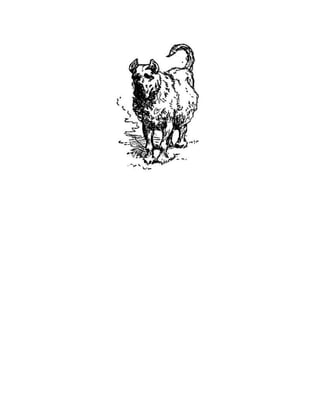
  • 37.
    “Which puts mein mind of another fish story, in which I and an old schoolmaster friend of mine are concerned,” said the Colonel, as Hiram concluded. “Out trouting once we suddenly met on our way to the brook a dog, which sneaked out from a patch of woods and began to follow in a close trot at our heels. We were taken somewhat by surprise at his appearance, because of the loneliness of the country, for there was no house within miles of us, and we were puzzled to think where he had come from. He looked the picture of starvation. His skin was literally hanging on him, and the body was so thin and sunken that we almost heard his ribs playing a bone chorus as he jogged behind us. We fed him with a portion of our lunch, which he devoured greedily. Finding himself favored, he followed us to the trouting ground. Spying out a beautiful quiet brook we sat down on the bank and cast our flies. The sport was instantaneous, and for a while continued and exciting, during which time the Professor had the good fortune to capture some half-dozen trout, which equalled in weight and beauty anything I had ever seen. When the luck was on the wane we reeled in our lines, and turned about to gather together our ‘catch,’ which during the sport we had thrown behind us on the grass. Suddenly the Professor gave a gasp. ‘Great heavens!’ he cried; ‘My half-dozen beauties! Where are they?’ We searched the bank, but they could not be found. ‘Is it possible that any one is prowling about these parts and has crept behind us and stolen them?’ he said. ‘I don’t think that likely,’ I replied. At the same time my attention was attracted to an object lying at the base of a tree. It was our dog—thin, starved and miserable-looking no longer, but swelled out as fat as a potato-bag, and wagging his tail, and smacking his jaws in heavenly transport. ‘Professor,’ said I; ‘look!’ ‘What! Another dog!’ gasped the Professor. ‘No, the same dog with variations,’ I said, ‘thanks to the expansive properties of trout, a little rosier in health.’ The Professor guessed the truth and gave a groan. He danced about like a lunatic and kicked the dog until it began to snap at his legs. Then with a heavy heart he packed his traps and we left the animal at the tree enjoying its siesta. ‘Fate could not harm him—he had dined that day.’” Rare treats, these fish feasts. Rare tack, these fish stories. But, reader, beware of bones.
  • 39.
    CHAPTER III. “But whocan paint Like Nature? Can imagination boast, Amid it’s gay creation, hues like hers?”—Thomson. IN ROUGH WATER.—NORTH TWIN STREAM.—AN INDIAN PADDLE FOR FUTURE USE.—BREEZES, BLANKETS, COLD AND ICE.—SPIDER LAKE.— MANIFOLD CHARMS OF CAMP LIFE.—AT WORK WITH THE TRAPS.—CONCERNING BEAVER.—WE PROCLAIM OUR INTENTIONS. Early on the morning of September 23d we continued down Eagle Lake and through the “Thoroughfare” to Churchill Lake. Then a change came o’er the spirit of the weather. It grew suddenly colder, and as our three canoes prowed into the lake a sharp breeze sprang up which ruffled its usually calm surface into a restless quiver. As the breeze increased to a “blow” the waves were lashed into white caps, and then into billows, until our fragile birch-barks were tossed about like corks. Each breaker seemed ready to engulf us; but we shipped little water, for the inventive genius of the Colonel had devised a novel covering for the bows of our canoes. It consisted of a strip of white canvas extending aft about two feet, which was stretched and secured to a brass hoop arched across the canoe, and fastened with brass pins or pegs. This made the bow of the canoe resemble the fore-part of an immense Chinese shoe. All articles liable to damage by exposure were thus secured from the spray of the waves and passing rain showers. It proved a capital nook for the storage of the camera,
  • 40.
    guns, ammunition, etc.,and was quite a suggestion to Nichols, who was an old canoe maker. Our course lay through the Eastern arm of Churchill Lake, a distance of only six miles, the larger body of these waters lying to the north, and having for their outlet the Allaguash River. At one o’clock we beached our canoes and erected our tents at the mouth of North Twin Stream. As we supped that night on broiled partridge and stewed duck, we little dreamed of the hardships which lay to the eastward, between us and the waters of the great Aroostook River. Since leaving our camp on Mud Pond Stream, Nichols had been hard at work at odd moments on a long paddle. From a rough maple log-split, it had gradually been shaped into a thing of beauty, and now with pride was being curiously ornamented with all the artistic execution of which the Indian’s deft hand was capable. “Me beat you, boys, when I get to the ‘Roostook,’” said Nichols, with a sly twinkle of his eye, as from under his black felt hat he cast a triumphant look at the other guides. “But perhaps we shall never get there unless it rains,” said John. “Me think so, too,” chimed in Hiram, trying to imitate in tone of voice the Indian’s favorite expression. “When the ‘Pioneers of the Aroostook’ pushed through this country last season,” said the Colonel, glancing at me with an air of superiority, “we experienced no difficulty in continuing our voyage one mile above to Marsh Pond. On examination, since landing, I find we shall be obliged to ‘carry’ around the obstructions, and it will detain us a day.”
  • 41.
    A COLD WAVE. Thatnight we found use for all the spare blankets in camp, and John was repeatedly aroused to replenish the fire. “What’s the matter, Colonel?” I asked, as gazing out from under my warm blankets on the morning of Sept. 24th I discovered my compagnon-du-voyage dancing before the fire and rubbing his hands with “invisible soap.” “Well, you just turn out and see. There is half an inch of ice in our camp pails, and a fair chance for skating on the Lake. We shall have to take to snow-shoes, if this weather holds on.” The tents, stiff with frost, were packed in bags, and in “Indian file” at the right of North Twin Stream we started for Marsh Pond, each man burdened to the utmost. Again and again we repeated our trips, between lake and pond, sinking in the mud one instant, slipping on some frosty rock the next, and not until late in the afternoon were our canoes and the last loads of our kit safely landed at Marsh Pond.
  • 42.
    LOW—THE POOR INDIAN. Paddlingthrough this water, its name being typical of its character, we ascended a small stream at its head on our way to Spider Lake. “Me think it getting dark, boys,” said the Indian, “and we better make camp at once.” So hauling our canoes on shore we cast about for the most desirable spot. There was no choice; it was an immense swamp in whatever direction we travelled. We sank almost to our knees in the moss and decayed underbrush. Once the Indian, floundering in the mud with our tent- poles, disappeared completely from sight, and we might have lost him, but the poles sticking up like bare flag-staffs through the dense brush which masked the marsh pools, disclosed the spot where he had sunk from view. When we dragged him out, he looked like a muskrat. “Nichols is trying to discover an underground road to the Aroostook,” said Hiram. “Guess he’s given up all thought o’ usin’ that long paddle on them ’ere waters.” This place proved the worst camping ground of the whole trip, but despite this fact it had its charms. The tourist soon grows to despise the consideration of personal comfort, when self-sacrifice is required to bring him in direct association with the nature which infatuates him. He becomes like the poet or painter, a creature purely spiritual, who raves in the rapture of exalted soul while his boots ship water by
  • 43.
    DEVELOPING A PLATE. TREESPILED ON TREES. the gallon, while scarcely a rag hangs to his back, and low-dwindling provisions place him on rations intimate with starvation. Thus it was with us. Our surroundings were unpleasant, but apart from this, as we saw them, interestingly picturesque. Here we were in the presence of a great dead forest. Across the pools, the rocks, and the brush growth lay the trunks of monster trees prostrated by the winds, storms, and decaying processes of nature. Trees were piled on trees in huge, insurmountable barriers, each one bearing on the other with a crushing force that tore through the limbs and logs, and pressed the massive pile down deep into the soft vegetation of the marsh. All was grey and lifeless. It seemed as if nature had lain unresurrected since the Deluge, and that the trees had twisted about and embraced each other in their dying agonies. All was dead! dead! dead! The only sign of life upon them was the
  • 44.
    deep moss thatflourished on the decayed and weather-beaten trunks; but this was like the grass above the grave. The next day for lack of water we dragged our canoes through the remainder of the river to Spider Lake, and camped on a high ledge of rocks on the Southern shore, its dry and picturesque position being in delightful contrast to our last quarters. This lake, three miles long and half a mile wide, set among these forest depths like a jewel in a ring, reflects ten mountain peaks on its surface. On our way to camp we examined a point of rocks jutting far out into the lake, whose curious construction attracted our attention. It was a perpendicular pile of corrugated stone crowned with a tall growth of spruce trees, which swept like Indian head-plumes to a hill-top beyond. The rocks at this time arose fifteen feet from the water, but their well- worn sides indicated their covering in any but a dry season. At their base we discovered deep, subterranean cavities, made by the action of the water, and into these with curiosity we pushed our canoes bent on a full investigation. Some were only slight excavations, suggesting the dwelling-places of large trout, or the coverts of the fur animals abounding in the vicinity, but there were others of considerable space, into which we passed without difficulty. Within all was gloomy and damp, and the motion of the water against the cold, slimy walls made a strange phase of music which echoed mournfully through the caverns. They seemed like the abodes of spirits; we could scarcely repress a shudder at the weird effect of the scene. Many times afterward did we recall with pleasure the delightful experiences of our sojourn at Spider Lake. The charming comforts of a dry and well-pitched camp, the exhilarating sport by the trout pools among the rocks not twenty feet from the tent door, the partridge- shooting in the woods, the ducking on the lake, the adventures of exploration, and the grand scenic surroundings which we still admire in the souvenirs afforded by photography, have made those too fleeting hours “red-letter days” in our memory. “You are not proposing to desert this lovely camp so soon?” I said to the Colonel, as we stood in the tent door gazing out on the lake
  • 45.
    TWILIGHT IN THEWILDS. EVACUATION. some days later. “It seems a pity after spending so much labor about the camp to leave at once.” “Well, we cannot tarry long; we little know what is before us if the water courses remain dry; our birch canoes will not endure the strain much longer,” was the Colonel’s reply. And so we bade farewell to this charming spot. At night we reached Logan Pond. Before our tents were in position we were overtaken by a drenching rain storm, which we fought through with philosophical patience, hoping it would increase the water along the route. It takes true grit to endure without complaint a rain-storm in the woods, and one must have an abundance of cheerfulness to keep from murmuring. “You had better set those beaver traps to- night,” said the Colonel to the Indian, as he stood drying himself before the fire, and
  • 46.
    turning about fromone side to the other like a roasting turkey. “Yes, me think so, too,” replied Nichols; and suiting the action to the word, he soon started off down the hill with the iron traps over his shoulder, I following him, bent upon investigating all the mysteries of wood-craft. “You see beaver house over there?” whispered the guide, as we reached a mud dam at the outlet of the lake, at the same time pointing out to me a cone-shaped knob of mud and sticks about ten feet high and six feet in diameter. “One, two, three beaver live there, and me set traps to catch one to-night. Beaver build house with door; then build dam and raise water to cover door to house.” Slipping into the woods the Indian soon returned with a cedar pole ten feet in length and four inches in diameter at the butt. With his axe he split this, and slipping over it the chain ring of the trap, secured it in position by a wedge. The trap was then opened and lowered carefully into the water, and after driving the pole into the mud, the upper end was made fast with twisted grasses to a neighboring tree. What was our joy on arising the next morning to see Nichols returning from the pond lugging a fine beaver of over forty pounds’ weight, held in position on his shoulders by a withe of cedar bark encircling his forehead. “Me lost another beaver,” said the Indian, as he dropped the heavy animal before the tent door for our examination, and wiped the perspiration from his dusky forehead. “Beaver cut pole in pieces and run with trap. Me hunt pond all over, but no find him;” and he displayed as much sorrow over the loss as if it had been a small fortune. The fur of the animal was in excellent condition. He was three feet in length, with tail 5 × 12 inches, half an inch in thickness, and covered with black, shining scales of leather-like toughness. “Is there any truth in the story, Nichols, that the beaver uses his tail to build his dam?” “No! no!” replied the guide, as laying the animal across his lap he commenced to rob him of his “jacket.” “No beaver do that. He use tail
  • 47.
    to make noiseto other beavers. It slap on water, make sound like pistol, and give alarm. Beaver push mud and stones from bed of river with front feet to make dam, and when build house walk up straight on hind feet, and hold to breast sticks and stones with front feet. No one hunt beaver who tell such stories.” The animal was soon dressed and stewed for our breakfast. Its taste was similar to that of corn beef, but of a much more delicate flavor, the liver being reserved as a choice dish for the next meal. The tail was one mass of solid fat, which only the Indian, after toasting it before the fire, could digest. The skin was stretched on a hoop four feet in diameter laced with strips of cedar bark, a shingle of wood being used in spreading the skin of the tail. “Me no like this,” said the Indian, arising after the completion of his work. “In my tribe, brave trap beaver; squaw dress him.” “Which is a much superior way,” observed the Colonel. “Thus all the world over the gallant brave saddles upon the poor woman the undaintiful share of the work. A great pity, Nichols, that circumstances in your life have abolished the custom, as far as you are concerned.” “Me think so; yes,” replied the Indian, with just the faintest idea of what the Colonel meant; and as he turned to wash the grease and blood from his warrior hands he looked the picture of dignity dethroned. After a few days tarry we pushed on across Logan Pond, made half a mile carry to Beaver Pond, and camped on Osgood Carry at the head of the last water. “What do you find so interesting?” I inquired of the Colonel, as I saw him examining minutely the side of an old tree not far from the tents. “Oh! nothing special, except a record I made last year regarding the ‘Pioneers of the Aroostook,’ which the winter storms have failed to obliterate.” “Then, before we go, we had better leave some relic of this tour,” I said.
  • 48.
    Accordingly a photographicplate which had been spoiled by sudden contact with the light was drawn from my Tourograph, and scratching the names of the party on its surface, we nailed it to the tree for the benefit of the next comer, adding as a suggestion of our destination “On to the Aroostook!”
  • 49.
    CHAPTER IV. “The wiseand active conquer difficulties By daring to attempt them: sloth and folly Shiver and shrink at sight of toil and hazard, And make the impossibility they fear.” OSGOOD CARRY.—THE PACK HORSE LEAGUE.— NOVEL TRICK IN PEDESTRIANISM.—CAMP ON ECHO LAKE.—HIRAM TELLS A STORY.—SLUICING A DAM.— MORE CONCERNING BEAVER.—CAMP AT THE MANSUNGUN LAKES. Imagine the difficulties we surmounted in our passage across Osgood Carry to Echo Lake. With the exception of an occasional beaver, duck, partridge, or string of trout captured on the way, we were obliged to carry provisions sufficient for five men, who never failed in their attendance at meals three times a day, and with appetites which only wood life can stimulate. Add to these provisions the weight of three tents, three blankets for each man, rubber beds, personal baggage, cooking utensils, guns, ammunition, rods, a Tourograph with seventy five glass plates, and three canoes weighing from eighty-five to one hundred pounds each and you have an idea of the toil and hardships of a tramp through this wilderness. This “Carry” is the water-shed of the St. John’s and Aroostook Rivers, and passes over a succession of hills, through swamps, and wind falls. Although one trip across is but two miles, a return for a second load makes four, and four trips carrying during half the time all one can bear on his shoulders makes sixteen miles, a fair day’s tramp in a
  • 50.
    country where noteven a “spotted line” guides the traveler to his destination. At the time of our appearance there, the ground after the recent rain was in a soft, soggy condition, which made the way slippery and tedious. As we pushed forward loaded down with our traps, frequently did a misstep send one of our number “to grass,” and smother him among the articles which constituted his burden. Our progress, as Hiram observed, “was slower than cold molasses.” For every step taken forward we slipped two backward, until the idea was suggested to us of turning about and walking in the opposite direction, that we might travel faster. “Me fix your load for the ‘Carry,’” said Nichols to me, as I started off with what I supposed I should be able to transport without halting; “I show you how to fix pack.” Stepping aside into the woods he cut from a cedar broad strips of bark, and passing them about my chest outside of my arms, fastened them to a roll of blankets on my back. On top of this he mounted my Tourograph, and held it in place by another strap across my forehead. Like a horse being harnessed, I stood motionless, while he placed my rifle on one shoulder, my shot gun on the other, and hung to them an iron tea kettle, cups, and various other cooking utensils. Everything ready, and having burdened himself with a much heavier load arranged in like manner, we started off up the side of the mountain in search of Echo Lake.
  • 51.
    THE PACK HORSELEAGUE. It was hard work. Soon I was boiling with perspiration, and the Indian puffing like a grampus. It seemed like a veritable “first of May” in the wilderness. Occasionally as a fallen log crossed our path we could relieve our aching shoulders by resting the load thereon, but never for a moment did we change its position. Then on we would tramp, over rocks and through the mire, the stillness of the woods unbroken save by the crackle of twigs beneath our footsteps, or the occasional grunt of the Indian guide. From early dawn until late at night, dividing our party at times into sections, we labored with our baggage, transporting it but half the distance, from whence it was forwarded by a second relay of guides the remainder of the way, and landed in safety at our camp on Echo Lake. In this vicinity we discovered in the crotch of an aged tree an old folding canvas canoe. This the Colonel, with a burst of delight,
  • 52.
    AT NIGHT BYTHE CAMP-FIRE. recognized as one deserted by the “Pioneers of the Aroostook” in their excursion of the previous year. Running short of provisions they had been forced to abandon it, and make for the settlements as quickly as possible in their other two. That night about the camp-fire the Colonel told us the story of their privations, and how their final meal consisted of nothing but the boiled bone of a salt ham seasoned with the last crumbs of hard-tack. This story suggested others of the same kind, and many and interesting were those retailing the experiences of our guides. I give the following, told by Hiram, of the man who was the first to make maps of Moosehead Lake and its vicinity. It gives an idea of the rigors and danger incident to a journey through the woods of Maine in the dead of winter, and may not be uninteresting: “Ye never heerd me tell about the man who fust tried to make maps o’ these ’ere woods, did ye?” said Hiram, as he tossed an extra log upon the fire. “Wall, it’s a long story; but I’ll try an’ load the cart’idge so the bullet won’t go far, as I see Nichols a-blinkin’ over there like an’ owl at high meridian. It was ’long about the Autumn of 1870, if I remember right, that a feller by the name o’ Way cum up from down below an’ took board in Greenville, foot o’ Moosehead Lake. He was quite a spruce lookin’ chap for these ’ere regions, an’ though still under twenty-one years of age, had seen a deal o’ the world in his
  • 53.
    little day. Wall,Johnny (that was his name,) had come to rough it, an’ take his chances for life with the rest of us, though it was said he’d heaps o’ money, an’ mighty fine fixins’ at home; but he was one of them advent’rous splinters as are allers flyin’ round a-wantin’ to see more an’ more, an’ git into wuss an’ wuss every step they go. Us boys was mighty busy that year a-loggin’, an he enj’yed the fust winter so rattlin’ well among us that he cum back the next season. When the snow got good an’ deep in Jan’wary, an’ snow-shoein’ was just fine, we two arranged a huntin’ trip an’ started out with our rifles an’ all the provishuns we could truss on our backs toward Chamberlin Farm. We hunted about there some days, but finally made a hand-sled, strapped our kit on to it, and by dint o’ pushin’ and haulin’ made our way over the fruz surface o’ Chamberlin and Eagle Lakes to Smith Brook. Next day we pushed on to Haymoak Brook an’ as it cum on to rain we built a hut of bark and camped. “BY DINT O’ PUSHIN’ AN’ HAULIN’—” “Johnny was a restless feller, an’ fur all tired out with the pull through to camp, thought if we were goin’ to stay long and hunt we’d better lay in more provishuns. He was a plucky little feller, too, an’ ’though not much used to the woods, could foller a ‘spotted line’ with the best o’ ye. So he made up his mind to switch back to Chamberlin Farm an’ git enough provishuns to last out the trip. I thought this a rather crazy freak, for I felt pretty sartin we could manage to pan out with what we had. But Johnny wanted to be sure. Like all city fellers he had a peevish bread-basket, an’ fur all he’d spirit enough to rough it
  • 54.
    in other ways,he couldn’t weather the trial of goin’ without his straight meal no-how. I did all I could do to hold him back, but it was no use; then I offered to go back with him, but he was bent on doin’ the trip alone, an’ leavin’ me to rest in camp. So, after buryin’ his part o’ the kit in the snow, he stood ready to start. “He did’nt want to go back the same way we had come, but had planned to skirt round back o’ the lakes, you know—a mighty unsartin kind of bizness, boys, for a feller raised in a hot-house. “But he plead so hard I finally give in to him, an’ with the point o’ my ramrod I marked out his course in the wet snow. Says I, ‘You see here, Johnny, that mark I jist made goes across Haymoak Lake to Stink Pond. Now don’t you forgit it,’ says I, ‘to keep right on your course to Fourth Lake, for that there line leads into Little Leadbetter Pond, an’ by a foot-track, will take ye to Chamberlin Lake, an’ then yer all hunk. There’s an old log camp on the Leadbetter, right there,’ says I, diggin’ the rod into the snow. ‘Don’t go further than that to- night. Camp there, no matter how early ye reach it; lie over till mornin’ an then push on.’ “It was the wuss snow shoein’ I ever did see, and I ought not to’ve let the boy go, but I’d said yes, an’ I’m not one of them fellers who goes back on his word. “I buckled on Way’s haversack, filled it with graham bread, stuck his hatchet in his belt, slung his rifle over his shoulder, and with many misgivin’s saw him disappear in the woods. After he’d left I commenced to get kind o’ nervus like, an’ wish I hadn’t let him go. Afore night I begun to feel terrible skittish about him. I lit my pipe, cleaned my gun, cut boughs and bark from the trees to make our camp more snug, an’ tried by fussin’ round to git the lad out o’ my mind; but ’twant no use—it didn’t work wuth a cent. So buryin’ the balance of our kit in the snow I started back to Chamberlin Farm by the old path and camped that night on Haymoak Lake, reaching the farm the next night. “You will bet boys I was scared to find that Way had not got in, but I thought p’raps he was restin’ at the old log camp I had pinted out for him on the Leadbetter. John the “toter” came along the next morning
  • 55.
    “FOLLERIN HIS SLOAT—HALLOO!” fromthe logging camp—don’t you think, he had’nt seen a hair of him either. Wall, the way I got into them snow-shoes was a caution—the deer’s hide was gathered over my toes and heels quicker than a trout takes a fly, and I was a-slidin’ off into the woods like mad. I kept goin’ and goin’ hour arter hour, as if the devil hisself was arter me; it was the best time I ever made on snow-shoes, even on a moose track. “At 2 o’clock I reached Way’s camp of the night before, and follerin’ his ‘sloat’ (track) I kept on arter him and in two hours saw him stumblin’ along through the snow in front o’ me like a lost sheep. I give a shout of joy, and then a wild halloo, as I dashed on arter him. But he plunged on without turnin’ a head—he did’nt seem to hear me. I hailed him agin with no better effect, ‘Somethin’s up. He’s not hisself by a long sight,’ I said to myself; an’ the way I put forrard through that snow would have done honor to a pair o’ the seven leagued boots. Jist as I come up with him, an’ was about plankin’ my paw down on his shoulder, I heerd him give a gasp, an’ then he stumbled an’ fell in a parfect heap at my feet. “‘Johnny! Johnny!’ says I, ‘Brace up. Hiram’s here, and yer all safe.’ But he was so far gone, he skarce knew me. To his belt was tied a partridge; but this was all the provishuns he had left, an’ with his half froze hands he could but jist hang on to his rifle. I took his gun an’ haversack, an’ goin’ before broke down the big drifts with my snow-shoes, an’ cleared a track for him to foller. But he was so weak an’ benumbed with cold,
  • 56.
    Welcome to ourwebsite – the ideal destination for book lovers and knowledge seekers. With a mission to inspire endlessly, we offer a vast collection of books, ranging from classic literary works to specialized publications, self-development books, and children's literature. Each book is a new journey of discovery, expanding knowledge and enriching the soul of the reade Our website is not just a platform for buying books, but a bridge connecting readers to the timeless values of culture and wisdom. With an elegant, user-friendly interface and an intelligent search system, we are committed to providing a quick and convenient shopping experience. Additionally, our special promotions and home delivery services ensure that you save time and fully enjoy the joy of reading. Let us accompany you on the journey of exploring knowledge and personal growth! testbankfan.com