PSYCHOLOGY
Katherine P. Minter • William J. Elmhorst
• • • • • • • • • • • • • • • • • • • • • • • • • • • • • • • • •
Copyright © Pearson Education 2012
Copyright ©
Pearson Education 2012
Links to Learning Objectives
29.1 What is the psychodynamic theory of
personality?
29.2 How do behaviorists and social cognitive
theorists explain personality?
29.3 How do humanistic psychologists explain
personality?
29.4 What are historical and current views of the trait
perspective?
30.1 What techniques do researchers use to measure
personality? Are these techniques reliable and
valid?
Theories of
Personality
Copyright ©
Pearson Education 2012
Unique
and
stable
ways
people
think,
feel,
and
behave ersonality
29.1 What is the psychodynamic theory of personality?
Copyright ©
Pearson Education 2012
Theories of Personality
TemperamentCharacter
Value judgments of
morality and ethics
Enduring
characteristics each
person is born with
Copyright ©
Pearson Education 2012
Psychodynamic
Behavioral
Humanistic
Trait
Four Main Perspectives
The Man and the
Couch: Sigmund
Freud and the
Psychodynamic
Perspective
Copyright ©
Pearson Education 2012
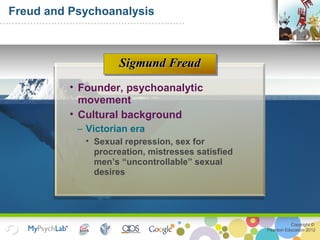
Freud and Psychoanalysis
• Founder, psychoanalytic
movement
• Cultural background
– Victorian era
• Sexual repression, sex for
procreation, mistresses satisfied
men’s “uncontrollable” sexual
desires
Sigmund FreudSigmund Freud
Copyright ©
Pearson Education 2012
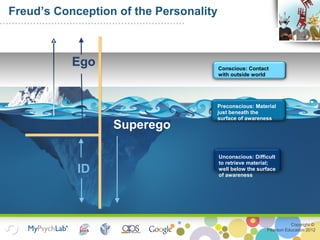
Freud’s Conception of the Personality
ID
Superego
Ego Conscious: Contact
with outside world
Preconscious: Material
just beneath the
surface of awareness
Unconscious: Difficult
to retrieve material;
well below the surface
of awareness
Copyright ©
Pearson Education 2012
The three parts of the personality are the id,
ego, and superego:
The id works on the pleasure principle
The ego works on the reality principle.
The superego is the moral center of personality,
containing the conscience, and is the source of
moral anxiety.
Copyright ©
Pearson Education 2012
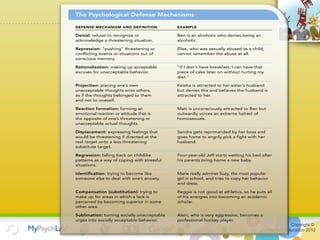
Psychological defense
mechanisms:
Unconscious distortions of a
person’s perception of
reality that reduce stress
and anxiety
The Psychological Defense Mechanisms
Copyright ©
Pearson Education 2012
Copyright ©
Pearson Education 2012
Defense Mechanisms in Movie Clips
Copyright ©
Pearson Education 2012
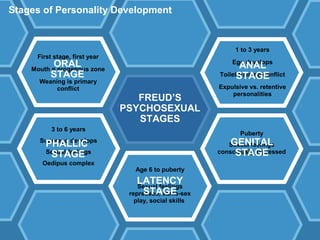
Stages of Personality Development
• Fixation: Unresolved
psychosexual stage conflict
–“Stuck” in stage of
development
• Psychosexual stages:
–Five stages of personality
–Tied to sexual development
Copyright ©
Pearson Education 2012
Stages of Personality Development
First stage, first year
Mouth = erogenous zone
Weaning is primary
conflict
Age 6 to puberty
Sexual feelings
repressed, same-sex
play, social skills
3 to 6 years
Superego develops
Sexual feelings
Oedipus complex
1 to 3 years
Ego develops
Toilet training conflict
Expulsive vs. retentive
personalities
Puberty
Sexual feelings
consciously expressed
LATENCY
STAGE
ANAL
STAGE
GENITAL
STAGE
ORAL
STAGE
PHALLIC
STAGE
FREUD’S
PSYCHOSEXUAL
STAGES
Copyright ©
Pearson Education 2012
Freud’s Psychosexual Stages
Copyright ©
Pearson Education 2012
Summary of Freud’s Psychoanalytic Theory of
Personal Development
Copyright ©
Pearson Education 2012
Neo-FreudiansNeo-Freudians
The Neo-Freudians
Developed competing psychoanalysis
theories
• Jung: Personal and collective unconscious,
archetypes
• Adler: Inferiority and compensation,
birth-order theory
• Horney: Basic anxiety and neurotic
personalities
• Erikson: Social relationships across the
lifespan
Copyright ©
Pearson Education 2012
Modern Psychoanalytic Theory
Current research has found support for:
• Defense mechanisms
• Concept of an unconscious mind that can
influence conscious behavior
Other concepts cannot be scientifically
researched.
Copyright ©
Pearson Education 2012
Healthy and Unhealthy Defense Mechanisms
The Behaviorist
and Social
Cognitive View
of Personality
Copyright ©
Pearson Education 2011
The Behaviorist and Social Cognitive
View of Personality
Behaviorists define personality
as a set of learned responses
or habits.
Social cognitive theorists
emphasize the importance
of others’ behaviors and
one’s own expectations.
29.2 How do behaviorists and social cognitive theories explain personality?
Copyright ©
Pearson Education 2011
Bandura’s Reciprocal Determinism
and Self-Efficacy
Reciprocal Determinism:
Environment, characteristics
of the person, and behavior
itself all interact
Self-efficacy:
Perception of one’s
competence in a certain
circumstance
Copyright ©
Pearson Education 2012
Rotter’s Social Learning Theory: Expectancies
Personality is set
of potential
responses to
various situations,
including:
• Locus of control
• Sense of
expectancy
The Third Force:
Humanism and
Personality
Copyright ©
Pearson Education 2012
Humanistic view:
Focuses on traits that
make people uniquely
human
•Reaction against
negativity of
psychoanalysis and
behavioral determinism
29.3 How do humanistic psychologists explain personality?
The Third Force: Humanism and Personality
Copyright ©
Pearson Education 2012
Carl Rogers and Self-Concept
Self-actualizing
tendency
Self-actualizing
tendency Self-concept
Self-concept
Striving to fulfill
innate capabilities
Image of oneself that
develops from
interactions with
significant people in
one’s life
Copyright ©
Pearson Education 2012
Carl Rogers and Self-Concept
Real self: One’s perception of actual
characteristics, traits, and abilities
Ideal self: What one should or would like to be
IDEAL
SELF
REAL
SELF
Match = Harmony
IDEAL
SELF
REAL
SELF
Mismatch = Anxiety
Copyright ©
Pearson Education 2012
Unconditional
positive regard:
Positive
regard that is
given without
conditions or
strings
attached
Carl Rogers and Self-Concept
Conditional
positive regard:
Positive regard
that is given only
when the person
is doing what the
providers of
positive regard
wish
Copyright ©
Pearson Education 2012
Personality Theories
Trait Theories:
Who Are You?
Copyright ©
Pearson Education 2012
rait
Consistent,
enduring way of
thinking, feeling,
or behaving
Copyright ©
Pearson Education 2012
Trait Theories of Personality
29.4 What are historical and current views of the trait perspective?
Allport: Listed 200 traits and
believed traits were part of
nervous system
Cattell: Reduced number of
traits to between 16 and 23
with computer method called
factor analysis
Copyright ©
Pearson Education 2012
Click here to watch classic
footage of Gordon Allport
discussing personality traits
on mypsychlab.com.
Copyright ©
Pearson Education 2012
Trait Theories of Personality
Source traits:
More basic traits
forming core of
personality
• Example:
Introversion is
source trait in which
people withdraw
Surface traits:
Can be seen by other
people in the outward
actions of a person
Copyright ©
Pearson Education 2012
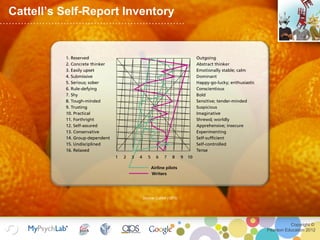
Cattell’s Self-Report Inventory
Source: Cattell (1973)
Copyright ©
Pearson Education 2012
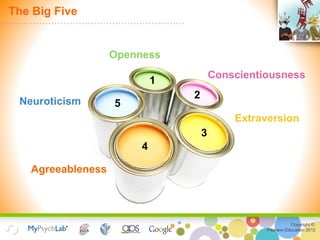
The Big Five
Conscientiousness
Extraversion
Agreeableness
Neuroticism
Openness
1
2
3
4
5
Copyright ©
Pearson Education 2012
The Big 5 Personality Traits
Copyright ©
Pearson Education 2012
The Big Five
Assessment
of Personality
Copyright ©
Pearson Education 2012
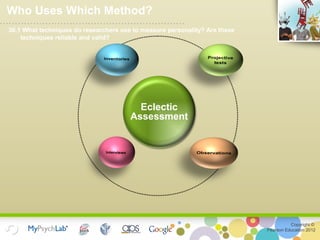
Eclectic
Assessment
Who Uses Which Method?
30.1 What techniques do researchers use to measure personality? Are these
techniques reliable and valid?
Copyright ©
Pearson Education 2012
Who Uses Which Method?
Copyright ©
Pearson Education 2012
Interviews
Interview:
Professional
asks questions
of client,
structured or
unstructured
Halo effect:
Allowing client’s
positive traits to
influence assessment
of client
Copyright ©
Pearson Education 2012
Projective Tests
• Projection: Projecting one’s
unacceptable thoughts or
impulses onto others
• Projective tests: Ambiguous
visual stimuli presented to
client who responds with
whatever comes to mind
–Rorschach inkblot test: 10
inkblots as ambiguous stimuli
–Thematic Apperception
Test (TAT): 20 pictures of people
in ambiguous situations
• Subjectivity problems with
projective tests
Copyright ©
Pearson Education 2012
Behavioral Assessments
Direct observation:
Professional observes
client; clinical or
natural settings
• Rating scale:
Numeric value
assigned to specific
behavior
• Frequency count:
Frequency of
behaviors is counted
Problems:
• Observer
effects/bias
• Lack of control
Copyright ©
Pearson Education 2012
Personality Inventories
NEO-PI:
Based on the five-
factor model
Myers-Briggs
Type Indicator:
Based on Jung’s
theory of
personality types
MMPI-2:
Designed to detect
abnormal
personality
Personality inventory: Questionnaire with
standard list of questions
• Response format: Yes, no, can’t decide, etc.
• Include validity scales to prevent cheating, but
such measures are not perfect
Applying
Psychology to
Everyday Life:
The Biological
Basis of the
Big Five
Copyright ©
Pearson Education 2011
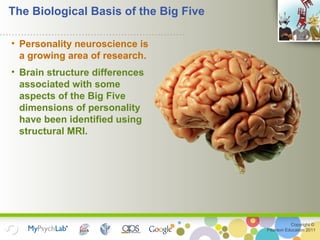
The Biological Basis of the Big Five
• Personality neuroscience is
a growing area of research.
• Brain structure differences
associated with some
aspects of the Big Five
dimensions of personality
have been identified using
structural MRI.
Acknowledgements
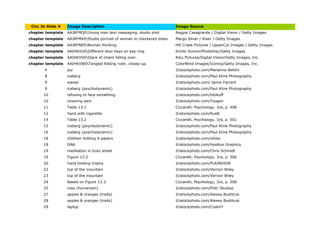
Cicc 3e Slide # Image Description Image Source
chapter template AAJRFMQ0Young man text messaging, studio shot Reggie Casagrande / Digital Vision / Getty Images
chapter template AAJRFMX0Studio portrait of woman in checkered dress Margo Silver / Riser / Getty Images
chapter template AAJRFNE0Woman thinking Hill Creek Pictures / UpperCut Images / Getty Images
chapter template AAIHKVU0Different door keys on key ring. Emilio Simion/PhotoDisc/Getty Images
chapter template AAIHKVV0Stack of chairs falling over. Riko Pictures/Digital Vision/Getty Images, Inc.
chapter template AAIHKVW0Tangled folding ruler, closep-up. ColorBlind Images/Iconica/Getty Images, Inc.
4 joy ©istockphoto.com/Marianna Bettini
8 iceberg ©istockphoto.com/Paul Kline Photography
9 waves ©istockphoto.com/ Jamie Farrant
9 iceberg (psychodynamic) ©istockphoto.com/Paul Kline Photography
10 refusing to face something ©istockphoto.com/bibikoff
10 covering ears ©istockphoto.com/Yougen
11 Table 13.1 Ciccarelli, Psychology, 3/e, p. 498
12 hand with cigarette ©istockphoto.com/RusN
14 Table 13.2 Ciccarelli, Psychology, 3/e, p. 501
15 iceberg (psychodynamic) ©istockphoto.com/Paul Kline Photography
16 iceberg (psychodynamic) ©istockphoto.com/Paul Kline Photography
18 children holding A papers ©istockphoto.com/iofoto
18 DNA ©istockphoto.com/HooRoo Graphics
19 meditation in busy street ©istockphoto.com/Chris Schmidt
19 Figure 13.2 Ciccarelli, Psychology, 3/e, p. 506
20 hand holding trophy ©istockphoto.com/PLAINVIEW
22 top of the mountain ©istockphoto.com/Vernon Wiley
23 top of the mountain ©istockphoto.com/Vernon Wiley
24 Based on Figure 13.3 Ciccarelli, Psychology, 3/e, p. 508
25 rose (humanism) ©istockphoto.com/Piotr Skubisz
27 apples & oranges (traits) ©istockphoto.com/Alexey Bushtruk
28 apples & oranges (traits) ©istockphoto.com/Alexey Bushtruk
29 laptop ©istockphoto.com/CostinT
29 spring for multimedia template istockphoto©Pei Ling Hoo
31 apples & oranges (traits) ©istockphoto.com/Alexey Bushtruk
31 Figure 13.4 Ciccarelli, Psychology, 3/e, p. 511
32 5 paint cans ©istockphoto.com/Amanda Rohde
33 apples & oranges (traits) ©istockphoto.com/Alexey Bushtruk
33 Table 13.3 Ciccarelli, Psychology, 3/e, p. 511
37 interview ©istockphoto.com/peepo
28 Rorschach test ©istockphoto.com/Erik van Hannen
39 woman observing & taking notes ©istockphoto.com/Claudio Arnese
42s brain ©istockphoto.com/Stephen Kirklys
Copyright ©
Pearson Education 2012
What FB says About You

Psych ch12-personalityslideshare

  • 1.
    PSYCHOLOGY Katherine P. Minter• William J. Elmhorst • • • • • • • • • • • • • • • • • • • • • • • • • • • • • • • • • Copyright © Pearson Education 2012
  • 2.
    Copyright © Pearson Education2012 Links to Learning Objectives 29.1 What is the psychodynamic theory of personality? 29.2 How do behaviorists and social cognitive theorists explain personality? 29.3 How do humanistic psychologists explain personality? 29.4 What are historical and current views of the trait perspective? 30.1 What techniques do researchers use to measure personality? Are these techniques reliable and valid?
  • 3.
  • 4.
    Copyright © Pearson Education2012 Unique and stable ways people think, feel, and behave ersonality 29.1 What is the psychodynamic theory of personality?
  • 5.
    Copyright © Pearson Education2012 Theories of Personality TemperamentCharacter Value judgments of morality and ethics Enduring characteristics each person is born with
  • 6.
    Copyright © Pearson Education2012 Psychodynamic Behavioral Humanistic Trait Four Main Perspectives
  • 7.
    The Man andthe Couch: Sigmund Freud and the Psychodynamic Perspective
  • 8.
    Copyright © Pearson Education2012 Freud and Psychoanalysis • Founder, psychoanalytic movement • Cultural background – Victorian era • Sexual repression, sex for procreation, mistresses satisfied men’s “uncontrollable” sexual desires Sigmund FreudSigmund Freud
  • 9.
    Copyright © Pearson Education2012 Freud’s Conception of the Personality ID Superego Ego Conscious: Contact with outside world Preconscious: Material just beneath the surface of awareness Unconscious: Difficult to retrieve material; well below the surface of awareness
  • 10.
    Copyright © Pearson Education2012 The three parts of the personality are the id, ego, and superego: The id works on the pleasure principle The ego works on the reality principle. The superego is the moral center of personality, containing the conscience, and is the source of moral anxiety.
  • 11.
    Copyright © Pearson Education2012 Psychological defense mechanisms: Unconscious distortions of a person’s perception of reality that reduce stress and anxiety The Psychological Defense Mechanisms
  • 12.
  • 13.
    Copyright © Pearson Education2012 Defense Mechanisms in Movie Clips
  • 14.
    Copyright © Pearson Education2012 Stages of Personality Development • Fixation: Unresolved psychosexual stage conflict –“Stuck” in stage of development • Psychosexual stages: –Five stages of personality –Tied to sexual development
  • 15.
    Copyright © Pearson Education2012 Stages of Personality Development First stage, first year Mouth = erogenous zone Weaning is primary conflict Age 6 to puberty Sexual feelings repressed, same-sex play, social skills 3 to 6 years Superego develops Sexual feelings Oedipus complex 1 to 3 years Ego develops Toilet training conflict Expulsive vs. retentive personalities Puberty Sexual feelings consciously expressed LATENCY STAGE ANAL STAGE GENITAL STAGE ORAL STAGE PHALLIC STAGE FREUD’S PSYCHOSEXUAL STAGES
  • 16.
    Copyright © Pearson Education2012 Freud’s Psychosexual Stages
  • 17.
    Copyright © Pearson Education2012 Summary of Freud’s Psychoanalytic Theory of Personal Development
  • 18.
    Copyright © Pearson Education2012 Neo-FreudiansNeo-Freudians The Neo-Freudians Developed competing psychoanalysis theories • Jung: Personal and collective unconscious, archetypes • Adler: Inferiority and compensation, birth-order theory • Horney: Basic anxiety and neurotic personalities • Erikson: Social relationships across the lifespan
  • 19.
    Copyright © Pearson Education2012 Modern Psychoanalytic Theory Current research has found support for: • Defense mechanisms • Concept of an unconscious mind that can influence conscious behavior Other concepts cannot be scientifically researched.
  • 20.
    Copyright © Pearson Education2012 Healthy and Unhealthy Defense Mechanisms
  • 21.
  • 22.
    Copyright © Pearson Education2011 The Behaviorist and Social Cognitive View of Personality Behaviorists define personality as a set of learned responses or habits. Social cognitive theorists emphasize the importance of others’ behaviors and one’s own expectations. 29.2 How do behaviorists and social cognitive theories explain personality?
  • 23.
    Copyright © Pearson Education2011 Bandura’s Reciprocal Determinism and Self-Efficacy Reciprocal Determinism: Environment, characteristics of the person, and behavior itself all interact Self-efficacy: Perception of one’s competence in a certain circumstance
  • 24.
    Copyright © Pearson Education2012 Rotter’s Social Learning Theory: Expectancies Personality is set of potential responses to various situations, including: • Locus of control • Sense of expectancy
  • 25.
  • 26.
    Copyright © Pearson Education2012 Humanistic view: Focuses on traits that make people uniquely human •Reaction against negativity of psychoanalysis and behavioral determinism 29.3 How do humanistic psychologists explain personality? The Third Force: Humanism and Personality
  • 27.
    Copyright © Pearson Education2012 Carl Rogers and Self-Concept Self-actualizing tendency Self-actualizing tendency Self-concept Self-concept Striving to fulfill innate capabilities Image of oneself that develops from interactions with significant people in one’s life
  • 28.
    Copyright © Pearson Education2012 Carl Rogers and Self-Concept Real self: One’s perception of actual characteristics, traits, and abilities Ideal self: What one should or would like to be IDEAL SELF REAL SELF Match = Harmony IDEAL SELF REAL SELF Mismatch = Anxiety
  • 29.
    Copyright © Pearson Education2012 Unconditional positive regard: Positive regard that is given without conditions or strings attached Carl Rogers and Self-Concept Conditional positive regard: Positive regard that is given only when the person is doing what the providers of positive regard wish
  • 30.
    Copyright © Pearson Education2012 Personality Theories
  • 31.
  • 32.
    Copyright © Pearson Education2012 rait Consistent, enduring way of thinking, feeling, or behaving
  • 33.
    Copyright © Pearson Education2012 Trait Theories of Personality 29.4 What are historical and current views of the trait perspective? Allport: Listed 200 traits and believed traits were part of nervous system Cattell: Reduced number of traits to between 16 and 23 with computer method called factor analysis
  • 34.
    Copyright © Pearson Education2012 Click here to watch classic footage of Gordon Allport discussing personality traits on mypsychlab.com.
  • 35.
    Copyright © Pearson Education2012 Trait Theories of Personality Source traits: More basic traits forming core of personality • Example: Introversion is source trait in which people withdraw Surface traits: Can be seen by other people in the outward actions of a person
  • 36.
    Copyright © Pearson Education2012 Cattell’s Self-Report Inventory Source: Cattell (1973)
  • 37.
    Copyright © Pearson Education2012 The Big Five Conscientiousness Extraversion Agreeableness Neuroticism Openness 1 2 3 4 5
  • 38.
    Copyright © Pearson Education2012 The Big 5 Personality Traits
  • 39.
  • 40.
  • 41.
    Copyright © Pearson Education2012 Eclectic Assessment Who Uses Which Method? 30.1 What techniques do researchers use to measure personality? Are these techniques reliable and valid?
  • 42.
    Copyright © Pearson Education2012 Who Uses Which Method?
  • 43.
    Copyright © Pearson Education2012 Interviews Interview: Professional asks questions of client, structured or unstructured Halo effect: Allowing client’s positive traits to influence assessment of client
  • 44.
    Copyright © Pearson Education2012 Projective Tests • Projection: Projecting one’s unacceptable thoughts or impulses onto others • Projective tests: Ambiguous visual stimuli presented to client who responds with whatever comes to mind –Rorschach inkblot test: 10 inkblots as ambiguous stimuli –Thematic Apperception Test (TAT): 20 pictures of people in ambiguous situations • Subjectivity problems with projective tests
  • 45.
    Copyright © Pearson Education2012 Behavioral Assessments Direct observation: Professional observes client; clinical or natural settings • Rating scale: Numeric value assigned to specific behavior • Frequency count: Frequency of behaviors is counted Problems: • Observer effects/bias • Lack of control
  • 46.
    Copyright © Pearson Education2012 Personality Inventories NEO-PI: Based on the five- factor model Myers-Briggs Type Indicator: Based on Jung’s theory of personality types MMPI-2: Designed to detect abnormal personality Personality inventory: Questionnaire with standard list of questions • Response format: Yes, no, can’t decide, etc. • Include validity scales to prevent cheating, but such measures are not perfect
  • 47.
    Applying Psychology to Everyday Life: TheBiological Basis of the Big Five
  • 48.
    Copyright © Pearson Education2011 The Biological Basis of the Big Five • Personality neuroscience is a growing area of research. • Brain structure differences associated with some aspects of the Big Five dimensions of personality have been identified using structural MRI.
  • 49.
  • 50.
    Cicc 3e Slide# Image Description Image Source chapter template AAJRFMQ0Young man text messaging, studio shot Reggie Casagrande / Digital Vision / Getty Images chapter template AAJRFMX0Studio portrait of woman in checkered dress Margo Silver / Riser / Getty Images chapter template AAJRFNE0Woman thinking Hill Creek Pictures / UpperCut Images / Getty Images chapter template AAIHKVU0Different door keys on key ring. Emilio Simion/PhotoDisc/Getty Images chapter template AAIHKVV0Stack of chairs falling over. Riko Pictures/Digital Vision/Getty Images, Inc. chapter template AAIHKVW0Tangled folding ruler, closep-up. ColorBlind Images/Iconica/Getty Images, Inc. 4 joy ©istockphoto.com/Marianna Bettini 8 iceberg ©istockphoto.com/Paul Kline Photography 9 waves ©istockphoto.com/ Jamie Farrant 9 iceberg (psychodynamic) ©istockphoto.com/Paul Kline Photography 10 refusing to face something ©istockphoto.com/bibikoff 10 covering ears ©istockphoto.com/Yougen 11 Table 13.1 Ciccarelli, Psychology, 3/e, p. 498 12 hand with cigarette ©istockphoto.com/RusN 14 Table 13.2 Ciccarelli, Psychology, 3/e, p. 501 15 iceberg (psychodynamic) ©istockphoto.com/Paul Kline Photography 16 iceberg (psychodynamic) ©istockphoto.com/Paul Kline Photography 18 children holding A papers ©istockphoto.com/iofoto 18 DNA ©istockphoto.com/HooRoo Graphics 19 meditation in busy street ©istockphoto.com/Chris Schmidt 19 Figure 13.2 Ciccarelli, Psychology, 3/e, p. 506 20 hand holding trophy ©istockphoto.com/PLAINVIEW 22 top of the mountain ©istockphoto.com/Vernon Wiley 23 top of the mountain ©istockphoto.com/Vernon Wiley 24 Based on Figure 13.3 Ciccarelli, Psychology, 3/e, p. 508 25 rose (humanism) ©istockphoto.com/Piotr Skubisz 27 apples & oranges (traits) ©istockphoto.com/Alexey Bushtruk 28 apples & oranges (traits) ©istockphoto.com/Alexey Bushtruk 29 laptop ©istockphoto.com/CostinT
  • 51.
    29 spring formultimedia template istockphoto©Pei Ling Hoo 31 apples & oranges (traits) ©istockphoto.com/Alexey Bushtruk 31 Figure 13.4 Ciccarelli, Psychology, 3/e, p. 511 32 5 paint cans ©istockphoto.com/Amanda Rohde 33 apples & oranges (traits) ©istockphoto.com/Alexey Bushtruk 33 Table 13.3 Ciccarelli, Psychology, 3/e, p. 511 37 interview ©istockphoto.com/peepo 28 Rorschach test ©istockphoto.com/Erik van Hannen 39 woman observing & taking notes ©istockphoto.com/Claudio Arnese 42s brain ©istockphoto.com/Stephen Kirklys
  • 52.
    Copyright © Pearson Education2012 What FB says About You

Editor's Notes

  • #6 Personality is different from character and temperament but includes those aspects. Temperament is based in one’s biology, either through genetic influences, prenatal influences, or a combination of those influences, and forms the basis upon which one’s larger personality is built. Every adult personality is a combination of temperaments and personal history of family, culture, and the time during which they grew up.
  • #7 The psychodynamic perspective had its beginnings in the work of Sigmund Freud and still exists today. It focuses on the role of the unconscious mind in the development of personality. This perspective is also heavily focused on biological causes of personality differences. The behaviorist perspective is based on the theories of learning as discussed in Chapter Six. This approach focuses on the effect of the environment on behavior. The humanistic perspective first arose as a reaction against the psychoanalytic and behaviorist perspectives and focuses on the role of each person’s conscious life experiences and choices in personality development. The trait perspective differs from the other three in its basic goals: The psychoanalytic, behaviorist, and humanistic perspectives all seek to explain the process that causes personality to form into its unique characteristics, whereas trait theorists are more concerned with the end result—the characteristics themselves. Although some trait theorists assume that traits are biologically determined, others make no such assumption.
  • #10 The three divisions of the mind are the conscious, preconscious, and unconscious. The unconscious can be revealed in dreams and Freudian slips of the tongue. The three parts of the personality are the id, ego, and superego. The id works on the pleasure principle and the ego works on the reality principle. The superego is the moral center of personality, containing the conscience, and is the source of moral anxiety. FIGURE: This iceberg represents the three levels of the mind. The part of the iceberg visible above the surface is the conscious mind. Just below the surface is the preconscious mind, everything that is not yet part of the conscious mind. Hidden deep below the surface is the unconscious mind, feelings, memories, thoughts, and urges that cannot be easily brought into consciousness. While two of the three parts of the personality (ego and superego) exist at all three levels of awareness, the id is completely in the unconscious mind.
  • #12 The conflicts between the demands of the id and the rules and restrictions of the superego lead to anxiety for the ego, which uses defense mechanisms to deal with that anxiety.
  • #15 Fixation occurs when conflicts are not fully resolved during a stage, resulting in adult personality characteristics reflecting childhood inadequacies.
  • #16 The personality develops in a series of psychosexual stages: oral (id dominates), anal (ego develops), phallic (superego develops), latency (period of sexual repression), and genital (sexual feelings reawaken with appropriate targets). The Oedipus and Electra complexes (sexual “crushes” on the opposite sex parent) create anxiety in the phallic stage, which is resolved through identification with the same-sex parent.
  • #19 A number of early psychoanalysts, objecting to Freud’s emphasis on biology and particularly on sexuality, broke away from a strict interpretation of psychoanalytic theory, instead altering the focus of psychoanalysis (the term Freud applied to both his explanation of the workings of the unconscious mind and the development of personality and the therapy he based on that theory) to the impact of the social environment. The neo-Freudians changed the focus of psychoanalysis to fit their own interpretation of the personality, leading to the more modern version known as the psychodynamic perspective. Jung developed a theory of a collective unconscious, which was his name for the memories shared by all members of the human species. Adler proposed feelings of inferiority as the driving force behind personality and developed birth order theory. Horney developed a theory based on basic anxiety and rejected the concept of penis envy. Erikson developed a theory based on social rather than sexual relationships, covering the entire life span.
  • #23 The social cognitive view of personality, unlike traditional behaviorism, includes social and mental processes and their influence on behavior. Unlike psychoanalysis, the concepts in this theory can and have been tested under scientific conditions. Some of this most recent research has investigated how people’s expectancies can influence their control of their own negative moods. Although some critics think that human personality and behavior are too complex to explain as the result of cognitions and external stimuli interacting, others point out that this viewpoint has enabled the development of therapies based on learning theory that have become effective in changing undesirable behavior.
  • #24 One of the more well-researched learning theories that includes the concept of cognitive processes as influences on behavior is the social cognitive theory of Albert Bandura. In the social cognitive view, behavior is governed not just by the influence of external stimuli and response patterns but also by cognitive processes such as anticipating, judging, and memory as well as learning through the imitation of models. FIGURE: In Bandura’s model of reciprocal determinism, three factors influence behavior: the environment, which consists of the physical surroundings and the potential for reinforcement; the person (personal/cognitive characteristics that have been rewarded in the past); and the behavior itself, which may or may not be reinforced at this particular time and place. Self-efficacy is a characteristic in which a person perceives a behavior as more or less effective based on previous experiences, the opinions of others, and perceived personal competencies.
  • #25 Julian Rotter devised a theory based on a basic principle of motivation derived from Thorndike’s law of effect: People are motivated to seek reinforcement and avoid punishment. Locus of control is a determinant of personality in which one either assumes that one’s actions directly affect events and reinforcement one experiences or that such events and reinforcements are the result of luck, fate, or powerful others. Personality, in the form of potential behavior patterns, is also determined by an interaction between one’s expectancies for success and the perceived value of the potential reinforcement.
  • #27 Humanistic theory is not scientifically researched but has been effective in therapy situations.
  • #28 Carl Rogers proposed that self-actualization depends on proper development of the self-concept. The self-concept is based on what people are told by others and how the sense of self is reflected in the words and actions of important people in one’s life, such as parents, siblings, coworkers, friends, and teachers.
  • #29 According to Rogers, the self-concept includes the real self and the ideal self. The real self is a person’s actual perception of traits and abilities, whereas the ideal self is the perception of what a person would like to be or thinks he or she should be. When the ideal self and the real self are very similar (matching), the person experiences harmony and contentment. When there is a mismatch between the two selves, the person experiences anxiety and may engage in neurotic behavior.
  • #30 Positive regard is warmth, affection, love, and respect that come from significant others in one’s life. Unconditional positive regard from important others in a person’s life helps the formation of the self-concept and the congruity of the real and ideal selves, leading to a fully functioning person.
  • #34 Trait theorists describe personality traits in order to predict behavior.   
  • #35 NOTE TO INSTRUCTORS: You must be logged in to your MyPsychLab account in order to view this video. Description of video: An explanation of cardinal and central traits
  • #36 Cattell defined two types of traits as surface traits and source traits. Surface traits are like those found by Allport, representing the personality characteristics easily seen by other people. Source traits are those more basic traits that underlie the surface traits.
  • #37 Cattell developed his assessment questionnaire, The Sixteen Personality Factor (16PF) Questionnaire based on just 16 source traits. These 16 source traits are seen as trait dimensions, or continuums, in which there are two opposite traits at each end with a range of possible degrees for each trait measurable along the dimension. FIGURE: This is an example of personality profiles based on Cattell’s 16PF self-report inventory. The two groups represented are airline pilots and writers. Notice that airline pilots, when compared to writers, tend to be more conscientious, relaxed, self-assured, and far less sensitive. Writers, on the other hand, are more imaginative and better able to are think abstractly.
  • #38 Several researchers have arrived at five trait dimensions that have research support across cultures, called the Big Five or five-factor model. Openness can best be described as a person’s willingness to try new things and be open to new experiences. Conscientiousness refers to a person’s organization and motivation. Extraversion is a term first used by Carl Jung (1933), who believed that all people could be divided into two personality types: extraverts and introverts. Extraverts are outgoing and sociable, whereas introverts are more solitary and dislike being the center of attention. Agreeableness refers to the basic emotional style of a person. Neuroticism refers to emotional instability or stability. Some theorists have cautioned that personality traits will not always be expressed in the same way across different situations. Walter Mischel, a social cognitive theorist, has emphasized that there is a trait–situation interaction in which the particular circumstances of any given situation are assumed to influence the way in which a trait is expressed. Future research will explore the degree to which child-rearing practices and heredity may influence the five personality factors.
  • #42 Most psychological professionals doing a personality assessment on a client do not necessarily tie themselves down to one theoretical viewpoint only, preferring to take a more eclectic view of personality. The eclectic view is a way of choosing the parts of different theories that seem to best fit a particular situation, rather than using only one theory to explain a phenomenon.  
  • #44 Interviews are used primarily by psychoanalysts and humanists and can include structured or unstructured interviews. Disadvantages of interviews can include the halo effect and bias of the interpretation on the part of the interviewer.
  • #45 Projective tests are based on the defense mechanism of projection and are used by psychoanalysts. Projective tests can be useful in finding starting points to open a dialogue between therapist and client but have been criticized for being low in reliability and validity.
  • #46 Behavioral assessments are primarily used by behaviorists and include direct observation of behavior, rating scales of specific behavior, and frequency counts of behavior. Behavioral assessments have the disadvantage of the observer effect, which causes an observed person’s behavior to change, and observer bias on the part of the person doing the assessment.
  • #47 Personality inventories are typically developed by trait theorists and provide a detailed description of certain personality traits. They are objective tests rather than subjective. Validity scales are built into any well-designed psychological inventory and are intended to indicate whether or not a person taking the inventory is responding honestly. Responses to certain items on the test will indicate if people are trying to make themselves look better or worse than they are, for example, and certain items are repeated throughout the test in a slightly different form, so that anyone trying to “fake” the test will have difficultly responding to those items consistently.