The Beginnings of Civilization      Section 2

            The Beginning of Agriculture

  Preview
  • Main Idea / Reading Focus
  • The New Stone Age
  • Development of Agriculture
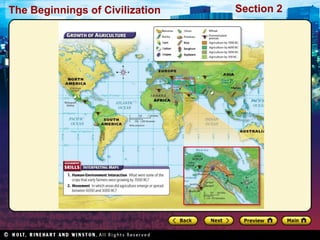
  • Map: Growth of Agriculture
  • Agriculture Changes Society
The Beginnings of Civilization                      Section 2

              The Beginning of Agriculture
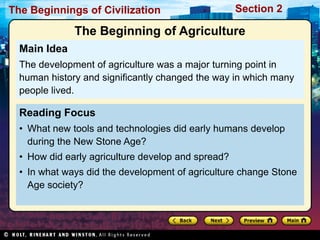
  Main Idea
  The development of agriculture was a major turning point in
  human history and significantly changed the way in which many
  people lived.

  Reading Focus
  • What new tools and technologies did early humans develop
    during the New Stone Age?
  • How did early agriculture develop and spread?
  • In what ways did the development of agriculture change Stone
    Age society?
The Beginnings of Civilization                 Section 2

                   The New Stone Age
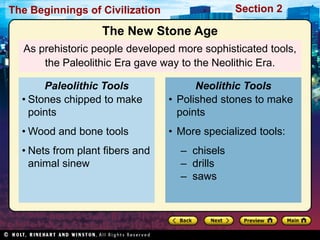
  As prehistoric people developed more sophisticated tools,
      the Paleolithic Era gave way to the Neolithic Era.

       Paleolithic Tools               Neolithic Tools
  • Stones chipped to make       • Polished stones to make
    points                         points
  • Wood and bone tools          • More specialized tools:
  • Nets from plant fibers and     – chisels
    animal sinew                   – drills
                                   – saws
The Beginnings of Civilization      Section 2


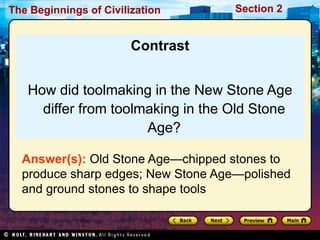
                        Contrast


   How did toolmaking in the New Stone Age
     differ from toolmaking in the Old Stone
                      Age?

  Answer(s): Old Stone Age—chipped stones to
  produce sharp edges; New Stone Age—polished
  and ground stones to shape tools
The Beginnings of Civilization                           Section 2

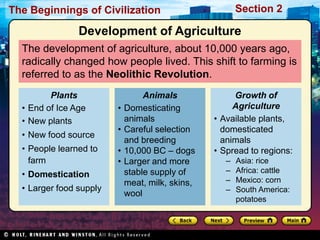
                Development of Agriculture
  The development of agriculture, about 10,000 years ago,
  radically changed how people lived. This shift to farming is
  referred to as the Neolithic Revolution.
         Plants                   Animals              Growth of
  • End of Ice Age       •   Domesticating             Agriculture
  • New plants               animals              • Available plants,
                         •   Careful selection      domesticated
  • New food source
                             and breeding           animals
  • People learned to    •   10,000 BC – dogs     • Spread to regions:
    farm                 •   Larger and more         –   Asia: rice
                             stable supply of        –   Africa: cattle
  • Domestication
                             meat, milk, skins,      –   Mexico: corn
  • Larger food supply                               –   South America:
                             wool
                                                         potatoes
The Beginnings of Civilization   Section 2
The Beginnings of Civilization         Section 2


             Identify Cause and Effect


  How did people benefit from farming and the
     domestication of plants and animals?

  Answer(s): more reliable food supply; people
  could pool labor and resources
The Beginnings of Civilization                                          Section 2

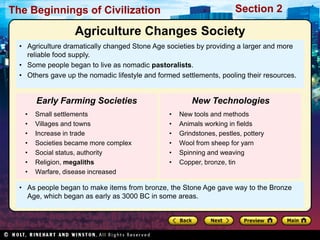
                   Agriculture Changes Society
  • Agriculture dramatically changed Stone Age societies by providing a larger and more
    reliable food supply.
  • Some people began to live as nomadic pastoralists.
  • Others gave up the nomadic lifestyle and formed settlements, pooling their resources.


       Early Farming Societies                           New Technologies
   •   Small settlements                         •   New tools and methods
   •   Villages and towns                        •   Animals working in fields
   •   Increase in trade                         •   Grindstones, pestles, pottery
   •   Societies became more complex             •   Wool from sheep for yarn
   •   Social status, authority                  •   Spinning and weaving
   •   Religion, megaliths                       •   Copper, bronze, tin
   •   Warfare, disease increased

  • As people began to make items from bronze, the Stone Age gave way to the Bronze
    Age, which began as early as 3000 BC in some areas.
The Beginnings of Civilization                Section 2

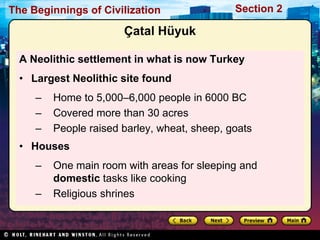
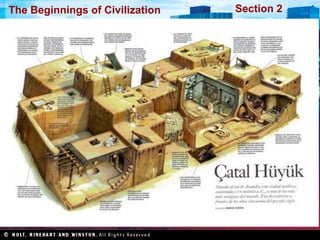
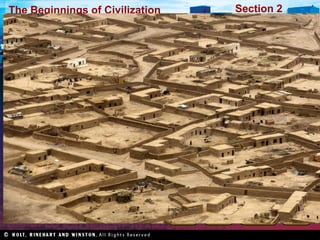
                       Çatal Hüyuk

  A Neolithic settlement in what is now Turkey
  • Largest Neolithic site found
     –   Home to 5,000–6,000 people in 6000 BC
     –   Covered more than 30 acres
     –   People raised barley, wheat, sheep, goats
  • Houses
     –   One main room with areas for sleeping and
         domestic tasks like cooking
     –   Religious shrines
The Beginnings of Civilization   Section 2
The Beginnings of Civilization                               Section 2

                             Ötzi the Iceman
  Discoveries added to our knowledge of Neolithic societies
  • 1991- hikers discover frozen male body
  • Scientific tests performed
  • 5,300 years old, from Neolithic Era

  Ötzi and belongings well preserved
  • Clothes: three types of animal skins stitched together
  • Leather shoes, woven grass cape, fur hat, backpack
  • Quiver with arrows, dagger, ax with copper blade

  Scientists’ theories
  • Diet included coarse grains
  • Did not live in location where found
  • Might have been murdered
The Beginnings of Civilization         Section 2


                      Summarize


     How did the development of agriculture
           affect Neolithic societies?

  Answer(s): revolutionary changes; men and
  women assumed different roles; led to towns,
  government, religion, trade

Agriculture origin

  • 1.
    The Beginnings ofCivilization Section 2 The Beginning of Agriculture Preview • Main Idea / Reading Focus • The New Stone Age • Development of Agriculture • Map: Growth of Agriculture • Agriculture Changes Society
  • 2.
    The Beginnings ofCivilization Section 2 The Beginning of Agriculture Main Idea The development of agriculture was a major turning point in human history and significantly changed the way in which many people lived. Reading Focus • What new tools and technologies did early humans develop during the New Stone Age? • How did early agriculture develop and spread? • In what ways did the development of agriculture change Stone Age society?
  • 3.
    The Beginnings ofCivilization Section 2 The New Stone Age As prehistoric people developed more sophisticated tools, the Paleolithic Era gave way to the Neolithic Era. Paleolithic Tools Neolithic Tools • Stones chipped to make • Polished stones to make points points • Wood and bone tools • More specialized tools: • Nets from plant fibers and – chisels animal sinew – drills – saws
  • 4.
    The Beginnings ofCivilization Section 2 Contrast How did toolmaking in the New Stone Age differ from toolmaking in the Old Stone Age? Answer(s): Old Stone Age—chipped stones to produce sharp edges; New Stone Age—polished and ground stones to shape tools
  • 5.
    The Beginnings ofCivilization Section 2 Development of Agriculture The development of agriculture, about 10,000 years ago, radically changed how people lived. This shift to farming is referred to as the Neolithic Revolution. Plants Animals Growth of • End of Ice Age • Domesticating Agriculture • New plants animals • Available plants, • Careful selection domesticated • New food source and breeding animals • People learned to • 10,000 BC – dogs • Spread to regions: farm • Larger and more – Asia: rice stable supply of – Africa: cattle • Domestication meat, milk, skins, – Mexico: corn • Larger food supply – South America: wool potatoes
  • 6.
    The Beginnings ofCivilization Section 2
  • 7.
    The Beginnings ofCivilization Section 2 Identify Cause and Effect How did people benefit from farming and the domestication of plants and animals? Answer(s): more reliable food supply; people could pool labor and resources
  • 8.
    The Beginnings ofCivilization Section 2 Agriculture Changes Society • Agriculture dramatically changed Stone Age societies by providing a larger and more reliable food supply. • Some people began to live as nomadic pastoralists. • Others gave up the nomadic lifestyle and formed settlements, pooling their resources. Early Farming Societies New Technologies • Small settlements • New tools and methods • Villages and towns • Animals working in fields • Increase in trade • Grindstones, pestles, pottery • Societies became more complex • Wool from sheep for yarn • Social status, authority • Spinning and weaving • Religion, megaliths • Copper, bronze, tin • Warfare, disease increased • As people began to make items from bronze, the Stone Age gave way to the Bronze Age, which began as early as 3000 BC in some areas.
  • 9.
    The Beginnings ofCivilization Section 2 Çatal Hüyuk A Neolithic settlement in what is now Turkey • Largest Neolithic site found – Home to 5,000–6,000 people in 6000 BC – Covered more than 30 acres – People raised barley, wheat, sheep, goats • Houses – One main room with areas for sleeping and domestic tasks like cooking – Religious shrines
  • 10.
    The Beginnings ofCivilization Section 2
  • 11.
    The Beginnings ofCivilization Section 2
  • 12.
    The Beginnings ofCivilization Section 2 Ötzi the Iceman Discoveries added to our knowledge of Neolithic societies • 1991- hikers discover frozen male body • Scientific tests performed • 5,300 years old, from Neolithic Era Ötzi and belongings well preserved • Clothes: three types of animal skins stitched together • Leather shoes, woven grass cape, fur hat, backpack • Quiver with arrows, dagger, ax with copper blade Scientists’ theories • Diet included coarse grains • Did not live in location where found • Might have been murdered
  • 13.
    The Beginnings ofCivilization Section 2 Summarize How did the development of agriculture affect Neolithic societies? Answer(s): revolutionary changes; men and women assumed different roles; led to towns, government, religion, trade